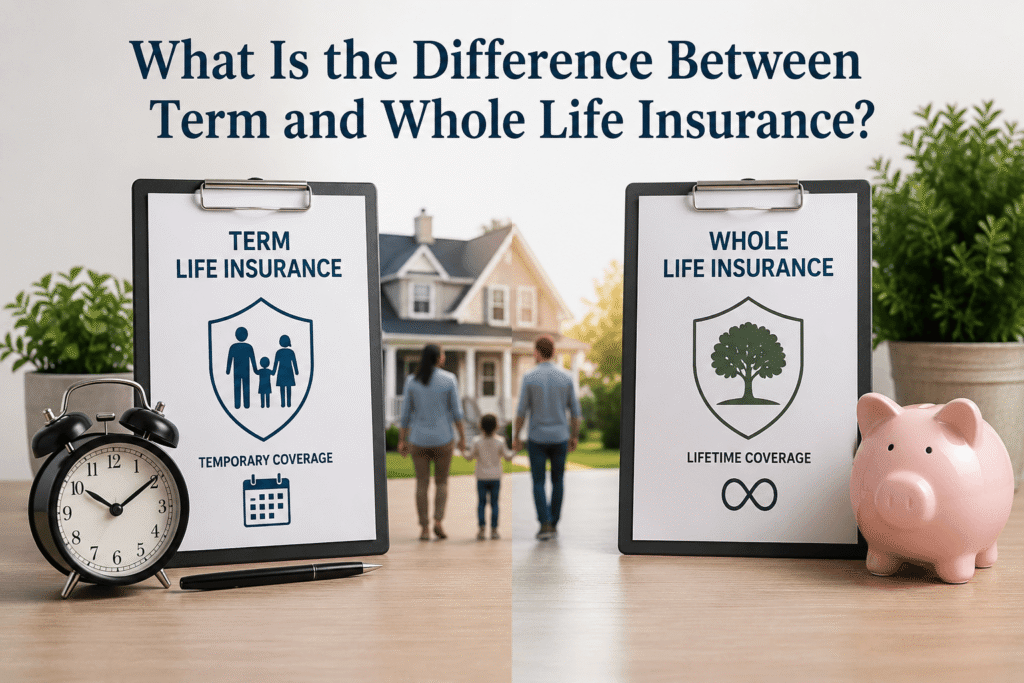
Breakdown of how these two policies actually work, what they cost, and how to figure out which one fits your life.
Marcus is 32. He just had his second kid, refinanced a mortgage he can barely pronounce the terms of, and decided it’s finally time to buy life insurance. So he gets two quotes.
The first one is $28 a month for $500,000 of coverage. The second is $420 a month for the same $500,000. Same age. Same health. Same amount of coverage. Fifteen times the price.
Marcus isn’t being scammed. He’s looking at the two basic flavors of life insurance in the U.S. market: term life insurance and whole life insurance. They protect your family in the same basic way — by paying out a death benefit if you die — but everything else about them is different: how long they last, what they cost, whether they build savings, and who they’re actually built for.
This guide walks through both types in plain language, shows realistic 2026 pricing, and gives you a clear way to decide which one (or which combination) makes sense for your situation. No sales pitch. Just the tradeoffs, laid out honestly.
⚡ Quick Answer
Term life insurance covers you for a set period — usually 10 to 30 years — and pays a death benefit only if you die during that window. It’s pure protection, no savings component, and it’s the cheapest way to get a large amount of coverage.
Whole life insurance covers you for your entire life as long as premiums are paid, and part of every payment builds tax-deferred cash value you can borrow against. It costs far more — often 10 to 15 times more — for the same death benefit.
Bottom line: most families with temporary needs (a mortgage, young kids, an income to replace) are better served by term. Whole life tends to fit people with permanent needs — estate planning, a special-needs dependent, or a desire for forced, guaranteed savings on top of a death benefit.
TL;DR: The Short Version
- Term life is temporary, affordable, and built for income replacement during your working and child-raising years.
- Whole life is permanent, expensive, and combines a death benefit with a savings-like cash value account.
- Cost gap: whole life premiums typically run 10–15x higher than term for the same death benefit.
- Cash value in whole life grows slowly at first and can take 10+ years to outpace what you’ve paid in.
- Term insurance can usually be converted to permanent coverage later without a new medical exam, if you buy a convertible term policy.
- Most financial planners recommend term for the majority of working families, reserving whole life for specific estate-planning or business needs.
- Neither is universally “better” — the right choice depends on how long you need coverage and whether you want a savings component bundled in.
- You should always compare quotes from multiple insurers, since pricing varies significantly by health class and company.
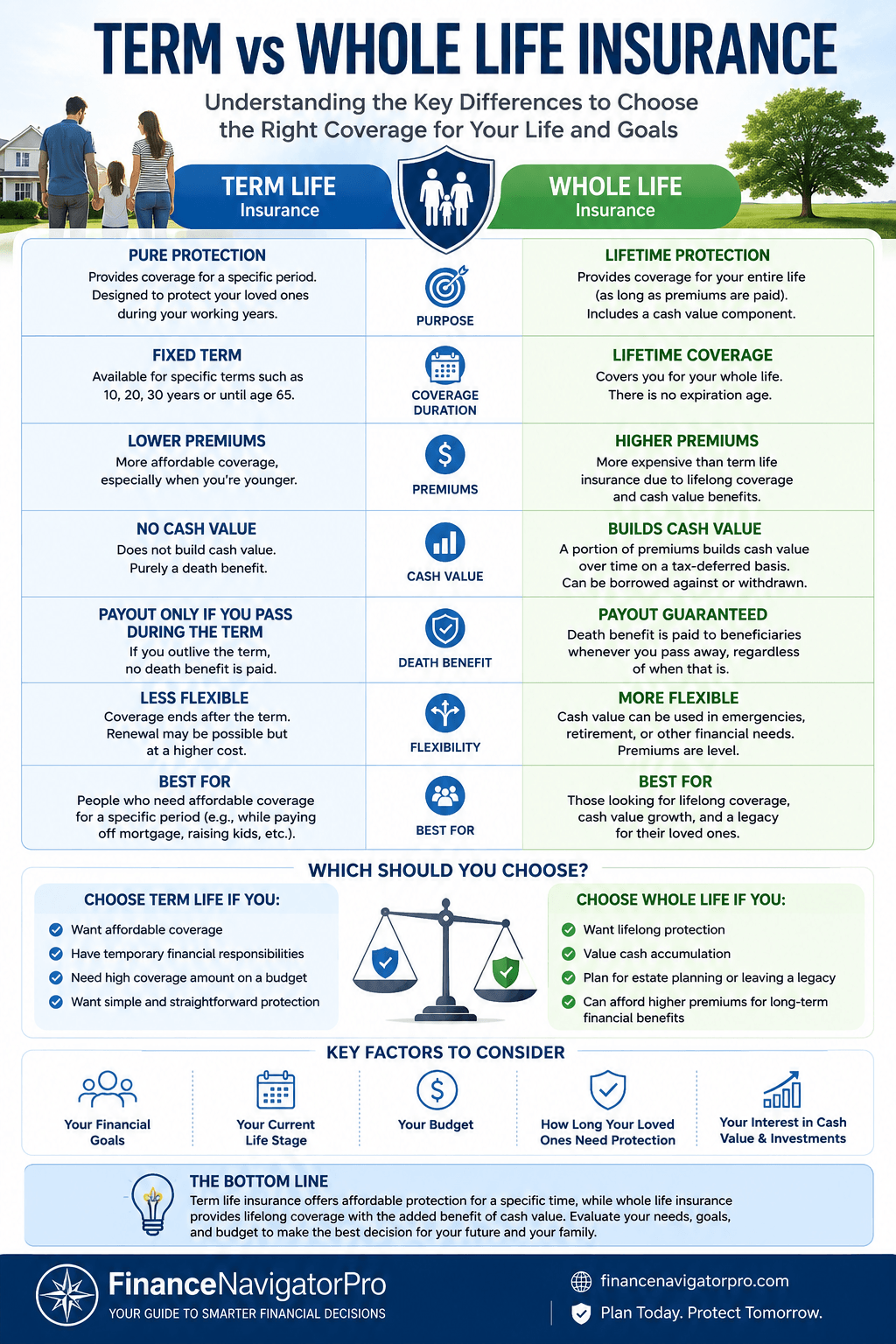
Term vs. Whole Life Insurance: Side-by-Side Comparison
Here’s the full picture in one table. We’ll unpack every row in detail below.
| Feature | Term Life | Whole Life |
|---|---|---|
| Coverage Length | 10, 15, 20, or 30 years | Entire lifetime, if premiums are paid |
| Monthly Cost (Age 35, $500K) | Roughly $20–$35 | Roughly $350–$550 |
| Cash Value | None | Yes — grows slowly, guaranteed minimum |
| Investment Component | None | Tax-deferred cash value; some dividend-paying |
| Guaranteed Premium | Yes, for the term length | Yes, for life |
| Death Benefit | Fixed, tax-free to beneficiaries | Fixed (or growing), tax-free to beneficiaries |
| Renewable After Term Ends | Yes, usually at a much higher rate | N/A — already permanent |
| Convertible to Permanent | Often, if policy includes conversion rider | N/A |
| Best For | Temporary needs: income replacement, mortgage, child-raising years | Permanent needs: estate planning, lifelong dependents, forced savings |
| Pros | Affordable, simple, high coverage per dollar | Lifelong coverage, cash value, predictable premiums |
| Cons | Coverage ends; renewing later is expensive | Expensive; cash value grows slowly early on |
| Typical Buyers | Parents, homeowners, working-age adults 25–55 | High-net-worth families, business owners, estate planners |
What Is Term Life Insurance?
How Term Life Insurance Works
Think of term life insurance like car insurance for your life. You pay a premium every month, and if something happens to you during the policy period, your family receives a payout. If nothing happens — which is the outcome everyone actually wants — you don’t get your premiums back, and the coverage simply ends when the term is up.
Here’s the catch that trips people up: term insurance isn’t designed to build wealth. It’s designed to replace your income or cover a specific financial obligation if you die unexpectedly. That’s it. No cash value, no loans against the policy, no dividend checks. Just a death benefit, available cheaply, for a defined window of time.
Premiums on most term policies are level for the entire term — meaning if you lock in a 20-year term at $32 a month, you’ll pay $32 a month every month for 20 years, regardless of how your health changes. That price stability is one of term insurance’s biggest selling points.
Common Term Lengths
- 10-year term: Cheapest option. Good for short-term debts or a narrow coverage gap.
- 15-year term: A middle-ground choice, often used to match a shorter mortgage or a specific financial goal.
- 20-year term: The most popular length in the U.S. It tends to line up with the years between having young kids and them becoming financially independent.
- 30-year term: Costs more than shorter terms but locks in a rate for three decades — popular with younger buyers who want long-term price certainty.
Pros of Term Life Insurance
- Low cost for a large amount of coverage — often the only way to affordably get $500,000+ in protection.
- Simple to understand — no investment jargon, no fine print about cash value growth.
- Flexible lengths that can be matched to a specific need, like the years left on a mortgage.
- Convertible options on many policies let you switch to permanent coverage later without new medical underwriting.
- Frees up cash for other financial goals like retirement accounts, since premiums are so much lower than whole life.
Cons of Term Life Insurance
- Coverage expires. If you outlive the term, the protection is gone unless you renew or buy a new policy.
- Renewal can be expensive. Premiums on renewed or new policies are based on your age and health at that later point — which usually means a much higher price.
- No cash value. Every dollar you pay goes toward the cost of insurance and the insurer’s overhead — nothing comes back if you don’t use it.
- Re-qualifying isn’t guaranteed. If your health declines, a new policy could be far more expensive or, in rare cases, unavailable — which is why many advisors recommend term lengths that run well past the years you expect to need coverage.
Who Should Buy Term Life Insurance
Term life tends to be the better fit for people with a defined window of financial risk: parents who need coverage until their kids are grown, homeowners who want their mortgage paid off if they die, and working adults who need to replace 10–20 years of income for the people who depend on it. If your need for coverage has a natural end date, term insurance is usually the more efficient tool.
What Is Whole Life Insurance?
How Whole Life Insurance Works
Whole life insurance is one type of permanent life insurance — the broader category that also includes universal life, variable life, and indexed universal life. What makes whole life specific is its structure: fixed premiums, a guaranteed death benefit, and a guaranteed minimum rate of cash value growth, all locked in from day one.
Every premium payment is split into three buckets: the actual cost of the insurance (which rises as you age, though you don’t see that increase directly), the insurer’s fees and overhead, and the cash value contribution. Early in the policy, a large share of your premium goes toward fees and the cost of insurance — which is exactly why cash value grows slowly in the first several years and sometimes takes a decade or more to exceed what you’ve paid in.
That’s where many people get confused: cash value is not the same as the death benefit. The death benefit is what your beneficiaries receive when you die. Cash value is a separate, internal savings-like component that you can access while you’re still alive — through withdrawals or policy loans — but borrowing against it reduces the death benefit until it’s repaid.
Lifetime Coverage
As long as you keep paying premiums, whole life insurance never expires and never requires you to re-qualify based on health. This is the core appeal: the death benefit is locked in for life, which makes whole life a common tool for final expenses, estate planning, and leaving an inheritance regardless of when you die.
Cash Value and Guaranteed Growth
The cash value account inside a whole life policy grows according to a rate guaranteed in the contract — often in the 2–4% range, though actual performance depends on the insurer. Growth is tax-deferred, meaning you don’t pay taxes on the gains as they accumulate inside the policy.
Policy Loans
Once a policy has built up sufficient cash value, you can borrow against it for almost any reason — a home repair, a business expense, an emergency. These loans aren’t run through a credit check, and you’re not obligated to repay them on a fixed schedule. However, any unpaid loan balance, plus interest, gets subtracted from the death benefit if you die before repaying it, and an unpaid loan that grows too large relative to the cash value can cause the policy to lapse.
Dividends (Where Applicable)
Some whole life policies, especially those from mutual insurance companies, are “participating” policies that pay annual dividends. These dividends aren’t guaranteed — they depend on the insurer’s financial performance — but policyholders can typically use them to buy additional coverage, reduce premiums, accumulate as cash, or take them as a check.
Pros of Whole Life Insurance
- Lifetime coverage that never expires as long as premiums are paid.
- Guaranteed cash value growth at a minimum contractual rate, regardless of market conditions.
- Predictable, level premiums that never increase due to age or health changes.
- Access to cash through policy loans or withdrawals during your lifetime.
- Useful estate-planning tool for passing on a guaranteed, tax-free inheritance.
Cons of Whole Life Insurance
- Significantly more expensive — often 10 to 15 times the cost of term insurance for the same death benefit.
- Slow early cash value growth, meaning the policy can underperform other savings vehicles in its first decade or more.
- Less flexibility than investing the cost difference yourself in a 401(k) or IRA.
- Complexity — riders, dividend options, and loan provisions can be hard to evaluate without help.
- Surrender charges may apply if you cancel the policy in its early years.
Who Should Buy Whole Life Insurance
Whole life insurance tends to make the most sense for people with a permanent need: high-net-worth households doing estate planning, parents of a dependent with lifelong special needs, business owners funding a buy-sell agreement, or anyone who specifically wants forced, guaranteed savings bundled with a death benefit and is comfortable paying a premium for that combination.
The Biggest Differences Between Term and Whole Life Insurance
The comparison table above gives you the overview. Here’s where each of those differences actually matters in real life.
Coverage
Term life insurance covers you for a defined window — 10, 15, 20, or 30 years. Whole life insurance covers you permanently, for as long as you live and keep paying premiums. This single difference drives almost everything else on this list: cost, complexity, and what each policy is actually good for.
Price
This is the difference most people notice first. A healthy 35-year-old might pay $25 a month for $500,000 of 20-year term coverage, and $450 a month for $500,000 of whole life coverage — roughly 18 times more. The gap exists because whole life premiums have to fund a permanent death benefit and a cash value account that’s guaranteed to grow, while term premiums only need to cover the statistical risk of death during a limited window.
Cash Value
Term life has zero cash value — there’s nothing to borrow against, nothing that accumulates, nothing left if you cancel the policy. Whole life builds cash value from the start, though growth is slow in the early years. This is the feature that turns whole life from “just insurance” into something closer to a hybrid savings-and-insurance product.
Investment Component
Term has none. Whole life’s cash value grows at a guaranteed minimum rate set in the contract, and some participating policies add non-guaranteed dividends on top. It’s worth being clear-eyed here: whole life’s cash value is not designed to compete with market-based investing. It’s designed to be slow, guaranteed, and predictable — the tradeoff for that safety is usually lower long-term returns than a diversified investment portfolio.
Flexibility
Term policies are straightforward — pick a length and a death benefit, and that’s largely it. Whole life policies offer more moving parts: dividend options, paid-up additions, the ability to adjust premium payments using accumulated cash value, and various riders. More flexibility also means more decisions, which is part of why whole life policies often need a conversation with an advisor to fully understand.
Estate Planning
Because whole life guarantees a payout no matter when you die, it’s a common tool in estate planning — funding estate taxes, equalizing inheritances among heirs, or guaranteeing a legacy gift. Term life can play a role too, but only if you’re confident you’ll die within the term; for open-ended estate planning, permanent coverage is the more reliable tool.
Taxes
Both term and whole life death benefits are generally received income-tax-free by beneficiaries. Where they differ is during your lifetime: whole life’s cash value grows tax-deferred, and policy loans are typically not taxed as income as long as the policy stays in force. Term life has no tax implications during the policy term since there’s no cash value to grow.
Borrowing
You cannot borrow against a term policy — there’s no cash value to draw from. Whole life policyholders can take a policy loan against accumulated cash value, usually without a credit check or fixed repayment schedule, though unpaid loans plus interest reduce the death benefit and can cause a policy to lapse if they grow too large.
Premiums
Term premiums are level for the length of the term, then typically jump dramatically if you renew afterward (since the new rate reflects your older age). Whole life premiums are level for life, from the day you buy the policy until you die — they never go up.
Returns
Term offers no return — if you don’t die during the term, you don’t get money back. Whole life offers a guaranteed minimum return on cash value, generally modest, plus possible dividends. Investors comparing whole life’s cash value growth to long-term stock market returns usually find the policy’s guaranteed rate is lower — which is the cost of guaranteed, non-market-correlated growth.
Death Benefit
Both policy types pay a tax-free death benefit to your named beneficiary. The difference is certainty of payout: term only pays if death occurs within the term, while whole life is structured to pay out eventually, since death is the one certainty it’s built around.
Complexity
Term life is about as simple as financial products get: a death benefit, a price, and a length of time. Whole life involves cash value schedules, surrender charges, dividend scales, loan provisions, and riders — all of which benefit from being reviewed with a licensed professional before you buy.
Affordability
For the vast majority of households, term life is the only realistic way to get an adequate death benefit — often $500,000 to $1 million or more — without straining the monthly budget. Whole life’s higher cost means many families end up underinsured if they put their full life insurance budget into a whole life policy instead of term.
Liquidity
Term life offers no liquidity — you can’t access funds from the policy itself while you’re alive. Whole life’s cash value provides a source of liquidity through loans or withdrawals, which is one reason some people use it as part of a broader financial plan, separate from its function as life insurance.
Long-Term Value
Over a multi-decade horizon, whole life’s combination of permanent coverage and accumulated cash value can represent meaningful value — particularly for estate planning or guaranteed legacy goals. But dollar-for-dollar, most financial planners note that buying term and investing the premium difference in a 401(k), IRA, or taxable brokerage account has historically outperformed whole life’s cash value growth over long periods, though that strategy requires the discipline to actually invest the difference rather than spend it.
Term vs. Whole Life Insurance Cost Comparison (2026)
Numbers help more than generalities, so here’s what term and whole life actually cost for healthy, non-smoking applicants at different ages and coverage amounts. These are illustrative monthly premium ranges based on typical 2026 market pricing for a 20-year level term policy compared with whole life coverage of the same death benefit.
Monthly Premiums by Age: Male, Healthy Non-Smoker
| Age | $250K Term | $250K Whole Life | $500K Term | $500K Whole Life | $1M Term | $1M Whole Life |
|---|---|---|---|---|---|---|
| 25 | $13 | $165 | $18 | $310 | $28 | $590 |
| 35 | $15 | $225 | $22 | $430 | $35 | $830 |
| 45 | $28 | $330 | $45 | $640 | $78 | $1,250 |
| 55 | $62 | $480 | $108 | $940 | $195 | $1,840 |
Monthly Premiums by Age: Female, Healthy Non-Smoker
Women generally pay somewhat less than men for the same coverage, reflecting longer average life expectancy.
| Age | $250K Term | $250K Whole Life | $500K Term | $500K Whole Life | $1M Term | $1M Whole Life |
|---|---|---|---|---|---|---|
| 25 | $11 | $145 | $15 | $275 | $24 | $520 |
| 35 | $13 | $195 | $19 | $370 | $30 | $715 |
| 45 | $23 | $280 | $38 | $540 | $66 | $1,050 |
| 55 | $51 | $405 | $89 | $790 | $162 | $1,540 |
Why Whole Life Costs So Much More
The price gap isn’t an accident or a markup — it comes down to what the insurer is guaranteeing. With term insurance, the company is only on the hook if you die during a limited window, and statistically, most people outlive their term. With whole life, the company is guaranteeing a payout eventually (since everyone dies at some point) and guaranteeing a minimum rate of cash value growth on top of that — both of which require the insurer to collect significantly more in premiums to stay solvent and meet those promises.
Here’s a simple way to think about it: term insurance prices in the chance you’ll need the payout. Whole life insurance prices in the certainty that you eventually will.
What Drives Your Individual Price
- Age: the single biggest factor — premiums rise steadily, and sharply after age 50.
- Health class: insurers sort applicants into tiers (preferred-plus, preferred, standard, substandard) based on the medical exam and health history.
- Tobacco use: smokers often pay 2–3x more than non-smokers for identical coverage.
- Gender: women typically pay less due to longer average life expectancy.
- Coverage amount: larger death benefits cost more, though the per-dollar cost often improves at higher amounts.
- Policy length (term only): longer terms cost more per month since the insurer is locking in a rate further into the future.
- Riders: optional add-ons like a waiver of premium or accidental death rider increase the premium.
- Location: state regulations and regional mortality data can shift pricing slightly.
Which Life Insurance Is Better for You?
There’s no universal answer — the right policy depends entirely on what you’re protecting against and for how long. Here’s how the decision tends to break down across common life situations.
Young Adults (20s–Early 30s)
Term life is almost always the better starting point. Coverage needs are typically tied to future obligations — a future mortgage, future kids — and budgets are tighter early in a career. A 20- or 30-year term locks in a low rate while you’re young and healthy.
Parents
Term life that covers the years until your kids are financially independent is the standard recommendation. A 20-year term often lines up well with a child’s path from birth through college.
Married Couples
Most couples benefit from term policies on both spouses, sized to replace each person’s income or contribution to the household (including a stay-at-home parent’s unpaid labor, which has real replacement cost). Some couples add a smaller whole life policy for guaranteed final expense coverage.
Single Adults
If no one depends on your income, your life insurance need may be minimal — often limited to covering final expenses or paying off co-signed debt. A small term policy or no policy at all may be appropriate, depending on your debts and dependents.
Business Owners
Often need both: term insurance for personal income replacement and a permanent policy (frequently whole life) to fund a buy-sell agreement, ensuring a smooth ownership transition if a partner dies.
High-Income Earners
May use whole life as part of estate planning, especially once net worth exceeds estate tax thresholds, while still using term insurance for the bulk of income-replacement needs.
Retirees
Term insurance becomes less useful once income replacement is no longer the goal. Retirees with a permanent need — leaving an inheritance, covering final expenses, or supporting a dependent — may consider a smaller, paid-up whole life policy.
Stay-at-Home Parents
Often overlooked, but the unpaid labor of childcare, household management, and logistics has real economic value that would cost real money to replace. A term policy on a stay-at-home parent is frequently underrated but worthwhile.
People With Mortgages
A term policy matched to the remaining mortgage length and balance ensures the home doesn’t become a financial burden for survivors. Some choose decreasing term insurance that mirrors a shrinking mortgage balance.
People With Debt
Term life sized to cover co-signed or jointly held debt — private student loans, car loans, business debt — protects family members who could otherwise inherit the obligation.
People Wanting Lifelong Coverage
If the goal is a guaranteed payout no matter when death occurs — for final expenses, a guaranteed inheritance, or a dependent who will need lifelong care — whole life or another form of permanent insurance is the more appropriate tool.
People Wanting an Investment Component
Those who specifically want forced savings bundled with insurance, and who have already maxed out tax-advantaged accounts like a 401(k) or IRA, sometimes add whole life as a low-risk, guaranteed-growth piece of a broader portfolio.
Real-Life Examples: Term and Whole Life in Action
Generic advice only goes so far. Here’s how these decisions actually play out for different households.
The Young Family
Jake and Priya, both 29, just bought their first home and had their first child. Their main financial risk is straightforward: if either of them dies, the other needs to cover the mortgage, childcare, and lost income for years. They each buy a 20-year, $600,000 term policy — roughly $20 a month combined — timed to expire around when their daughter finishes college and their mortgage is mostly paid down. They skip whole life entirely for now, reasoning that their need is temporary and their budget is better spent maxing out retirement contributions while they’re young.
The Business Owner
Renee, 41, co-owns a marketing agency with one business partner. They have a buy-sell agreement that requires whichever partner survives to buy out the deceased partner’s share — but that only works if there’s money available to do it. Renee and her partner each take out a $1 million whole life policy specifically to fund that buyout, since the need is permanent (the agreement doesn’t expire) and the cash value adds a modest reserve asset to the business in the meantime. Separately, Renee carries a personal $750,000 term policy to protect her own family’s income.
The High-Net-Worth Couple
Tom and Linda, both 58, have a net worth well above the federal estate tax exemption threshold and want to make sure their heirs don’t have to sell property to cover estate taxes when they pass. They purchase a $2 million whole life policy, structured to pay out tax-free to an irrevocable life insurance trust, specifically to cover anticipated estate taxes without forcing a fire sale of real estate or business interests. For them, the high premium is simply the cost of guaranteed liquidity at the right moment.
The Single Professional
Devon, 27, is single, rents an apartment, and has no dependents — but he co-signed $40,000 in private student loans with his mother. He buys a small 15-year, $50,000 term policy specifically to make sure that debt doesn’t fall on her if something happens to him. At roughly $6 a month, it’s an easy decision that solves one specific, defined risk without overcomplicating his finances.
The New Parent
Aisha, 31, just had her first baby and works as a freelance graphic designer with no employer benefits. She buys a 25-year, $500,000 term policy to replace her income through her child’s college years, paying about $24 a month. She specifically chooses a convertible term policy, reasoning that her needs might shift as her career and family grow, and she wants the option to convert part of the coverage to permanent insurance later without a new medical exam.
The Retiree
Walter, 67, retired three years ago. His mortgage is paid off, his kids are grown, and his retirement income comes from Social Security and a modest IRA. His income-replacement need is gone, but he wants to guarantee his final expenses — funeral costs, medical bills, small debts — don’t become a burden on his children. He buys a small, $35,000 whole life policy specifically designed for final expenses, paying a fixed premium for guaranteed, lifelong coverage that will never lapse due to age or new health issues.
The Small Business Partnership
Three partners co-own a regional HVAC company. Their buy-sell agreement is funded by whole life policies on each partner, with the company as beneficiary, ensuring that if one partner dies, the company has guaranteed funds to buy out that partner’s shares from their family rather than forcing a sale of the business or an awkward ownership dispute. The premium cost is treated as a predictable business expense, justified by the certainty it buys for ownership continuity.
The Estate Planning Example
Harold and Margaret, both 62, want to leave an equal inheritance to their three children, but their largest asset is a family farm that only one child wants to take over. They use a $1.5 million whole life policy, payable to the two children who won’t inherit the farm, to equalize the inheritance without forcing a sale of the land. Because whole life guarantees a payout regardless of when they die, it solves a problem term insurance couldn’t reliably address.
Pros and Cons at a Glance
Pros of Term Life Insurance
- Lowest cost per dollar of coverage
- Simple, easy to understand
- Flexible term lengths matched to specific needs
- Often convertible to permanent coverage
- Frees up money for other savings and investment goals
Pros of Whole Life Insurance
- Coverage that never expires
- Guaranteed cash value growth
- Premiums that never increase
- Access to cash through policy loans
- Useful for estate planning and guaranteed legacies
Cons of Term Life Insurance
- Coverage ends when the term expires
- Renewing later is significantly more expensive
- No cash value or savings component
- Re-qualifying for new coverage isn’t guaranteed if health changes
Cons of Whole Life Insurance
- Much higher premiums for the same death benefit
- Slow cash value growth in the early years
- Less flexible than investing the cost difference elsewhere
- More complex, with riders and provisions that need careful review
Common Myths About Term and Whole Life Insurance
A lot of bad financial decisions start with a half-true rule of thumb. Here are the most common ones.
Myth 1: Whole life is always better because it lasts forever.
Truth: Lasting forever only matters if you have a permanent need. For temporary needs — like income replacement during child-raising years — paying for lifelong coverage is often paying for something you don’t need.
Myth 2: Term life is a waste of money if you don’t die.
Truth: Term life isn’t designed to pay you back — it’s designed to transfer risk, the same way car or home insurance does. “Wasting” money on a term policy you didn’t need is the same as “wasting” money on home insurance for a house that never burned down.
Myth 3: Whole life is a good investment.
Truth: Whole life’s cash value is designed for safety and guarantees, not growth. Most financial planners note that, dollar-for-dollar, it underperforms diversified market investments over long time horizons.
Myth 4: You don’t need life insurance if you’re single with no kids.
Truth: If you have co-signed debt, aging parents who depend on you, or want to cover funeral costs, a small policy can still make sense even without a spouse or children.
Myth 5: Term insurance is only for young people.
Truth: Term insurance is available well into your 60s and 70s, though premiums rise sharply with age. It can still make sense for older adults with a defined, time-limited need.
Myth 6: You can’t get life insurance if you have a health condition.
Truth: Many health conditions don’t disqualify you — they may place you in a higher-priced health class, or you may qualify for guaranteed issue policies, which skip the medical exam in exchange for higher costs and lower coverage limits.
Myth 7: Stay-at-home parents don’t need life insurance.
Truth: A stay-at-home parent’s unpaid labor — childcare, household management, transportation — has real replacement cost that a surviving spouse would otherwise have to pay for out of pocket.
Myth 8: Employer life insurance is enough.
Truth: Employer-provided coverage is often just one to two times your salary — far below what most families need — and it typically doesn’t transfer with you if you change jobs.
Myth 9: Whole life premiums go up over time like term renewals do.
Truth: Whole life premiums are level for life from the day you buy the policy — they’re specifically designed never to increase, which is one of its genuine advantages.
Myth 10: You should buy life insurance based only on price.
Truth: The cheapest policy isn’t useful if it doesn’t provide enough coverage, comes from a financially unstable insurer, or lacks riders you actually need — price is one factor among several.
Myth 11: You can’t change your policy once you buy it.
Truth: Many term policies include conversion options, and whole life policies often allow adjustments to premium payments or dividend use — reviewing your policy periodically is part of using it well.
Myth 12: Term insurance always becomes unaffordable as you age.
Truth: It’s true that renewing or buying new term coverage gets more expensive with age — but locking in a 20- or 30-year term while you’re young avoids this entirely for the length of that term.
Common Mistakes People Make When Buying Life Insurance
Buying too little coverage
A common rule of thumb is 10–12 times your annual income, but the right number depends on debts, dependents, and future obligations like college costs. Underinsuring defeats the purpose of buying a policy at all.
Buying too much coverage
Overbuying — especially expensive permanent coverage — can strain a budget unnecessarily. Coverage should match an actual calculated need, not a round number that sounds impressive.
Ignoring inflation
A death benefit that looks generous today may not stretch as far in 15 or 20 years. Some people slightly overbuy term coverage specifically to offset inflation over a long term length.
Choosing based only on price
The cheapest quote may come from an insurer with weaker financial ratings or fewer rider options. Financial strength and policy terms matter alongside price.
Not naming beneficiaries correctly
Failing to name a beneficiary, naming an outdated one after a divorce or remarriage, or naming a minor without a trust structure can all delay or complicate a payout.
Not reviewing policies periodically
Major life events — marriage, a new child, a new mortgage, a divorce — change how much and what type of coverage actually makes sense. A policy bought a decade ago may no longer fit.
Waiting too long to buy
Premiums rise with age, and health changes can affect eligibility. Buying coverage while young and healthy generally locks in the lowest lifetime cost.
Skipping useful riders
Riders like a waiver of premium (which keeps your policy active if you become disabled) or a child term rider can add meaningful protection for a small additional cost.
Relying only on employer coverage limits
Group life insurance through an employer is often capped at one to two times salary and typically doesn’t follow you if you leave the job — a gap many people don’t realize until it’s too late.
Replacing an existing policy without understanding consequences
Canceling an older policy to buy a new one can mean losing accumulated cash value, restarting surrender charge periods, or requalifying medically at an older age. Always compare carefully before replacing a policy.
Decision Framework: Term or Whole Life?
Use this simple flow to narrow down your starting point. It won’t replace a conversation with a licensed advisor for complex situations, but it covers the most common decision points.
🧭 Quick Decision Flow
Step 1: Do you only need coverage for a certain number of years (until kids are grown, mortgage is paid off, debt is retired)?
→ Yes: Term life is very likely your answer. Move to Step 4 to size your coverage.
→ No / Not sure: Continue to Step 2.
Step 2: Do you need coverage that lasts your entire life — for estate planning, a lifelong dependent, or a guaranteed legacy?
→ Yes: Whole life (or another permanent policy) is likely the better fit.
→ No: Continue to Step 3.
Step 3: Is your top priority the lowest possible premium for the largest death benefit?
→ Yes: Term life. It will almost always deliver more coverage per dollar.
→ No, I specifically want guaranteed cash value accumulation alongside coverage: Whole life may suit you, ideally after maxing out tax-advantaged retirement accounts first.
Step 4: Size your coverage — a common starting point is 10–12x your annual income, adjusted for debts, mortgage balance, and future obligations like college costs.
Visual Flowchart
Do you only need coverage for a certain number of years?
→ Choose Term Life
Need permanent, lifelong protection?
→ Choose Whole Life
Is this primarily for estate planning?
→ Choose Whole Life
Is the lowest possible premium the top priority?
→ Choose Term Life
Want guaranteed cash value accumulation?
→ Choose Whole Life
20 Expert Tips for Buying Life Insurance
- Buy life insurance while you’re young and healthy — age and health are the two biggest price drivers, and both only get more expensive to wait on.
- Compare quotes from at least three to five insurers before deciding — pricing for the same coverage can vary substantially between companies.
- Choose a term length that runs past your actual need, not just up to it, in case your timeline shifts.
- If you’re considering whole life, ask specifically about the guaranteed minimum cash value growth rate, not just illustrated projections.
- Look for convertible term policies if there’s any chance you’ll want permanent coverage later — it can save you a future medical exam.
- Don’t cancel an old policy before a new one is fully approved — you don’t want a coverage gap if the new application is delayed or denied.
- Check the insurer’s financial strength rating (from agencies like A.M. Best) before committing to a long-term policy.
- Name both primary and contingent (backup) beneficiaries on every policy.
- Revisit your coverage after every major life event: marriage, divorce, a new child, a new mortgage, or a significant income change.
- Don’t assume your employer’s group life insurance is enough — calculate your real need independently.
- If you’re self-employed, factor in the cost of replacing benefits, not just salary, when sizing your coverage.
- Consider laddering term policies (buying multiple terms of different lengths) to match different financial obligations as they expire.
- Ask about a waiver of premium rider if you’re concerned about a disability interrupting your ability to pay.
- Be honest on medical exams and applications — misrepresentation can void a claim later, at the worst possible time for your family.
- If cost is the main obstacle, consider a smaller amount of permanent coverage paired with a larger term policy, rather than skipping permanent coverage — or term — entirely.
- Understand surrender charges before buying whole life — canceling early can mean losing much of what you’ve paid in.
- If you’re a small business owner, talk to a professional about buy-sell agreement funding before assuming personal coverage is enough.
- Don’t let a policy lapse over a missed payment without checking your grace period — most policies allow 30 days or more before coverage ends.
- Review whether your state has specific protections or free-look periods that let you cancel a new policy within a set window without penalty.
- When in doubt, talk to a licensed, fee-transparent insurance professional rather than relying solely on online calculators — your situation may have details a general guide can’t account for.
Frequently Asked Questions
What is term life insurance?
Term life insurance is a policy that covers you for a set period of time, usually 10 to 30 years. If you die during that period, your beneficiaries receive a tax-free death benefit. If you outlive the term, the coverage simply ends, with no payout and no cash value returned.
What is whole life insurance?
Whole life insurance is a type of permanent life insurance that covers you for your entire life, as long as premiums are paid. It includes a cash value component that grows on a tax-deferred basis at a guaranteed minimum rate, which you can borrow against while you’re alive.
Which is better, term or whole life insurance?
Neither is universally better — it depends on your need. Term life is generally better for temporary needs like income replacement or mortgage protection, while whole life suits permanent needs like estate planning or lifelong dependents. Most financial planners recommend term for the majority of households.
Which is cheaper, term or whole life insurance?
Term life insurance is significantly cheaper — typically 10 to 15 times less expensive than whole life insurance for the same death benefit, since it only covers a limited period rather than your entire life.
Can you switch from term to whole life insurance later?
Often, yes. Many term policies include a conversion option that lets you switch some or all of the coverage to a permanent policy without a new medical exam, usually within a specified window. Not all term policies include this feature, so it’s worth checking before you buy.
Does whole life insurance build cash value?
Yes. A portion of every premium payment goes into a cash value account that grows at a guaranteed minimum rate, tax-deferred. Growth is typically slow in the first several years before accelerating.
Is term life insurance enough?
For most working-age people with dependents, a sufficiently large term policy can fully cover income replacement and major debts, which is often the primary goal of life insurance. Whether it’s “enough” depends on whether you also have a permanent need, like estate planning.
Can you outlive a term life insurance policy?
Yes — in fact, most people do. If you’re still alive when the term ends, the policy expires without a payout, and you’d need to renew, convert, or buy a new policy if you still want coverage.
Can you borrow against whole life insurance?
Yes. Once a whole life policy has built sufficient cash value, you can take a policy loan against it for any reason. The loan isn’t taxed as income, but unpaid balances plus interest reduce the death benefit and can cause the policy to lapse if left unpaid.
Should young families buy whole life insurance?
Usually not as a primary strategy. Most young families have temporary, large coverage needs — a mortgage, young children, years of income to replace — that term life addresses far more affordably. Whole life can be added later for specific permanent goals if needed.
How much life insurance do I need?
A common starting estimate is 10 to 12 times your annual income, adjusted for outstanding debts, your mortgage balance, future obligations like college costs, and any existing savings or coverage. A licensed advisor can help refine this for your specific situation.
Is whole life insurance worth it?
It depends on your goals. If you specifically need permanent coverage, guaranteed cash value, or estate-planning tools, it can be worth the higher cost. If you mainly need affordable, temporary protection, term insurance usually delivers more value for the same budget.
What happens to term life insurance if I don’t die?
Nothing is paid out, and you don’t get your premiums back. The coverage simply ends when the term expires, similar to how auto or home insurance works if you never file a claim.
What happens to whole life insurance if I cancel it early?
You may receive a surrender value, which is your accumulated cash value minus any surrender charges, especially in the policy’s early years. Canceling early often means losing a significant portion of what you’ve paid in fees and cost of insurance.
Can I have both term and whole life insurance?
Yes. Many people combine a larger term policy for temporary, high-coverage needs with a smaller whole life policy for permanent goals like final expenses or guaranteed legacy planning.
Does term life insurance expire?
Yes. Term life insurance is only active for the length of the term you select — commonly 10, 15, 20, or 30 years. Once that period ends, coverage stops unless you renew, convert, or buy a new policy.
Is whole life insurance a good investment?
It’s better thought of as a guaranteed, low-risk savings feature attached to insurance rather than an investment in the traditional sense. Its growth rate is typically lower than long-term market investments, but it’s also more predictable and tax-deferred.
What is convertible term insurance?
Convertible term insurance is a term policy that includes the option to convert some or all of the coverage into a permanent policy, usually without a new medical exam, within a specified period of the original term.
Do I need a medical exam for life insurance?
Many traditional term and whole life policies require a medical exam as part of underwriting. Some insurers now offer no-exam or accelerated underwriting options, often with higher premiums or lower coverage limits in exchange for skipping the exam.
What is guaranteed issue life insurance?
Guaranteed issue life insurance approves applicants without any medical questions or exams, usually with lower coverage limits and higher premiums. It’s typically marketed to older adults or those with significant health conditions who can’t qualify for traditional underwriting.
Is life insurance death benefit taxable?
Generally, no. Life insurance death benefits are typically received income-tax-free by beneficiaries, whether from a term or whole life policy. There are exceptions in certain estate-tax situations, which is why high-net-worth households often work with an estate planning professional.
What’s the difference between whole life and universal life insurance?
Both are types of permanent life insurance, but whole life has fixed premiums and a guaranteed cash value growth rate, while universal life offers more flexibility in premium payments and death benefit amounts, with cash value tied to current interest rates rather than a fixed guarantee.
What is indexed universal life insurance?
Indexed universal life insurance is a type of permanent life insurance where cash value growth is linked to the performance of a market index, like the S&P 500, typically with a cap on gains and a floor that limits losses.
Can I cash out a whole life insurance policy?
Yes, you can surrender a whole life policy for its cash surrender value, which ends the coverage. You can also withdraw a portion of the cash value without fully canceling the policy, depending on the policy’s terms.
What is a death benefit?
A death benefit is the amount of money a life insurance policy pays to your named beneficiaries when you die, assuming the policy is active and in force at the time of death.
What is the difference between a beneficiary and an estate?
A beneficiary is the specific person or entity you name to receive your life insurance payout directly. Without a named beneficiary, the payout may go through your estate instead, which can mean delays and probate involvement that a direct beneficiary designation avoids.
Does life insurance avoid probate?
When a valid beneficiary is named, life insurance proceeds typically pass directly to that person, bypassing probate. If no beneficiary is named, or if the estate itself is named beneficiary, the payout can become part of the probate process.
What riders are commonly available on life insurance policies?
Common riders include a waiver of premium (which keeps coverage active if you become disabled), an accelerated death benefit (allowing early payout for terminal illness), a child term rider, and an accidental death rider, among others.
How does my health affect my life insurance premium?
Insurers place applicants into health classes based on the medical exam, health history, and lifestyle factors. Better health classes — like preferred-plus — receive significantly lower premiums than standard or substandard classes.
What happens if I miss a life insurance payment?
Most policies include a grace period, often 30 days, during which coverage stays active even after a missed payment. If the payment still isn’t made after the grace period, the policy can lapse, ending coverage.
Can my life insurance premium increase over time?
On a level term policy, no — the premium stays the same for the entire term. On whole life, premiums are also level for life. Premiums can change on certain other policy types, like some universal life policies, or if you renew term coverage after the original term ends.
What is final expense insurance?
Final expense insurance is a small whole life policy, typically $5,000 to $50,000, designed specifically to cover funeral costs, medical bills, and other end-of-life expenses, often with simplified underwriting for older applicants.
Should I buy life insurance through my employer or on my own?
Employer coverage is convenient and often free or low-cost, but it’s usually limited in amount and doesn’t transfer if you change jobs. Most financial advisors recommend supplementing employer coverage with an individual policy sized to your actual need.
How long does it take to get approved for life insurance?
Traditional underwriting with a medical exam can take two to eight weeks. Accelerated or no-exam underwriting can sometimes approve coverage within days, though often at a higher premium or with lower coverage limits.
Can I have life insurance on my children?
Yes, some policies include child term riders, or parents can buy small standalone whole life policies for children, often to lock in low rates and guarantee future insurability regardless of health changes later in life.
Quick, direct answers to the questions people ask most often about term and whole life insurance.
Coverage Comparisons by Situation and Amount
A few more side-by-side breakdowns for specific situations people frequently search for.
Term vs. Whole Life for Young Families
Young families usually have the largest coverage need relative to their budget — a new mortgage, young kids, and decades of income still to replace. Term life insurance lets a young family secure $500,000 to $1 million or more in coverage for a fraction of what the same amount would cost in whole life, freeing up money for retirement savings, an emergency fund, and other near-term financial goals. Whole life is rarely the first recommendation here unless there’s a specific permanent need, like a child with special needs.
Term vs. Whole Life for Seniors
By retirement, the income-replacement rationale for life insurance has usually faded, while a permanent need — final expenses, a guaranteed inheritance, or estate liquidity — often remains. This is one of the few life stages where whole life, particularly smaller final-expense policies, tends to outshine term, since new term coverage becomes very expensive at older ages and may not be worth buying for a need that’s already largely passed.
Term vs. Whole Life for Parents
Parents are the textbook case for term life insurance: a clear, time-limited need (raising kids to financial independence) that lines up almost perfectly with standard term lengths like 20 or 25 years. Whole life can supplement this for parents who also want guaranteed final-expense coverage or are doing broader estate planning, but it’s rarely the primary tool for the core need of protecting young children’s financial future.
Term vs. Whole Life for High-Income Earners
High-income earners often have larger coverage needs in absolute dollar terms, which makes term life’s affordability even more valuable for the core income-replacement need. Where whole life enters the picture is usually estate planning — once net worth approaches or exceeds estate tax thresholds, permanent coverage becomes a tool for covering taxes or equalizing inheritances rather than a primary protection strategy.
Term vs. Whole Life for Business Owners
Business owners frequently need both types working together: term insurance to protect personal income and family obligations, and permanent insurance (often whole life) to fund buy-sell agreements, key-person coverage, or business loan guarantees that don’t have a natural expiration date the way a personal income-replacement need does.
$250K vs. $500K vs. $1 Million Coverage
Coverage amount should be driven by a calculation, not a round number. A $250,000 policy might suit someone with modest debt and no dependents, while $500,000 to $1 million is more typical for parents covering a mortgage, years of income, and future costs like college. The cost difference between these tiers is much smaller in percentage terms for term insurance than for whole life, which is part of why financial planners often suggest erring toward more term coverage rather than less.
10-Year vs. 20-Year vs. 30-Year Term Policies
A 10-year term suits a short, well-defined need — like covering the final years of a loan. A 20-year term is the most commonly purchased length, generally aligning with raising children to adulthood. A 30-year term costs more per month but locks in a rate for the longest stretch, appealing to younger buyers who want long-term price certainty even if it means paying somewhat more than a shorter term would cost today.
The Bottom Line
Term and whole life insurance solve different problems. Term life insurance is built for temporary, large-scale protection — replacing income, covering a mortgage, protecting young kids — at the lowest possible cost. Whole life insurance is built for permanent needs — estate planning, lifelong dependents, guaranteed legacies — at a meaningfully higher cost that reflects the certainty it guarantees.
Neither one is the “right” answer for everyone. Going back to Marcus from the opening of this guide: for a 32-year-old father with a mortgage and young kids, the $28-a-month term policy is very likely the better fit for his core need, even though the $420-a-month whole life policy offers things term doesn’t — permanence and cash value. The decision comes down to matching the tool to the actual problem, not picking whichever option sounds more comprehensive.
Before you buy, take the time to calculate your real coverage need, compare quotes from multiple insurers, and revisit your policy after major life changes like marriage, a new child, or a new mortgage. If your situation involves business ownership, estate planning, or other complex financial goals, a conversation with a licensed insurance professional or financial advisor can help you apply these general principles to your specific numbers.
📋 Next Steps
- ✓ Compare multiple life insurance quotes before choosing a policy.
- ✓ Estimate how much coverage your family actually needs using your income, debts, and future obligations.
- ✓ Review your coverage after major life events such as marriage, having children, or buying a home.
- ✓ Speak with a licensed insurance professional if your situation involves business ownership, estate planning, or other complex financial goals.