

Quick Answer: What Is Group Life Insurance?
| Feature | Details |
|---|---|
| Definition | A life insurance policy purchased by an employer or organization and extended to eligible employees as a workplace benefit. |
| Who Offers It | Most medium and large employers; also unions, professional associations, and membership organizations. |
| Who Pays | Typically the employer pays for basic coverage; employees may pay for supplemental or dependent coverage via payroll deduction. |
| Average Coverage | 1x to 2x annual salary for employer-paid basic coverage; up to 8x salary with voluntary supplemental coverage. |
| Key Pros | Affordable or free, no medical exam for basic coverage, easy automatic enrollment, payroll deduction convenience. |
| Key Cons | Coverage ends when employment ends, limited coverage amounts, employer controls the policy, no cash value, not portable by default. |
| Best For | Supplementing individual life insurance; ideal starting point for employees who can’t qualify for individual coverage. |
| Average Cost | $0.20–$0.80 per $1,000 of coverage per month for group rates; voluntary coverage adds $2–$10 per month per $50,000 of coverage. |
| Medical Exam | Not required for basic employer-paid coverage. May be required for large supplemental coverage amounts. |
You start a new job, complete your benefits paperwork, and check the box for “Employer-Paid Life Insurance.” You feel responsible—covered—and move on with your day. Months later, maybe even years later, you realize you never looked at how much coverage you actually have. Or whether it’s enough to protect your family if something unexpected happens.
You’re not alone. Millions of Americans rely on employer-provided group life insurance as their primary—sometimes only—life insurance. According to LIMRA, nearly 57% of working Americans have life insurance through their employer, making it the most common way U.S. workers access coverage. Yet surveys consistently show that most employees significantly overestimate how much protection their employer policy actually provides.
Group life insurance is a valuable benefit. It’s affordable, easy to enroll in, and requires no medical exam for basic coverage. But it also comes with important limitations that employees rarely read about until a crisis forces the question: What exactly do I have, and what happens if I lose this job?
This guide answers every question you should be asking—before you need the answers. Whether you’re a new hire reviewing your first benefits package, a parent worried about leaving your family financially exposed, or someone approaching a job change and wondering what happens to your coverage, this is the resource you need.
You’ll learn exactly how group life insurance works, how much employers typically provide, when it’s enough and when it falls dangerously short, how taxes work, what conversion and portability options exist, and how to build a complete life insurance strategy that protects your family regardless of your employment status.
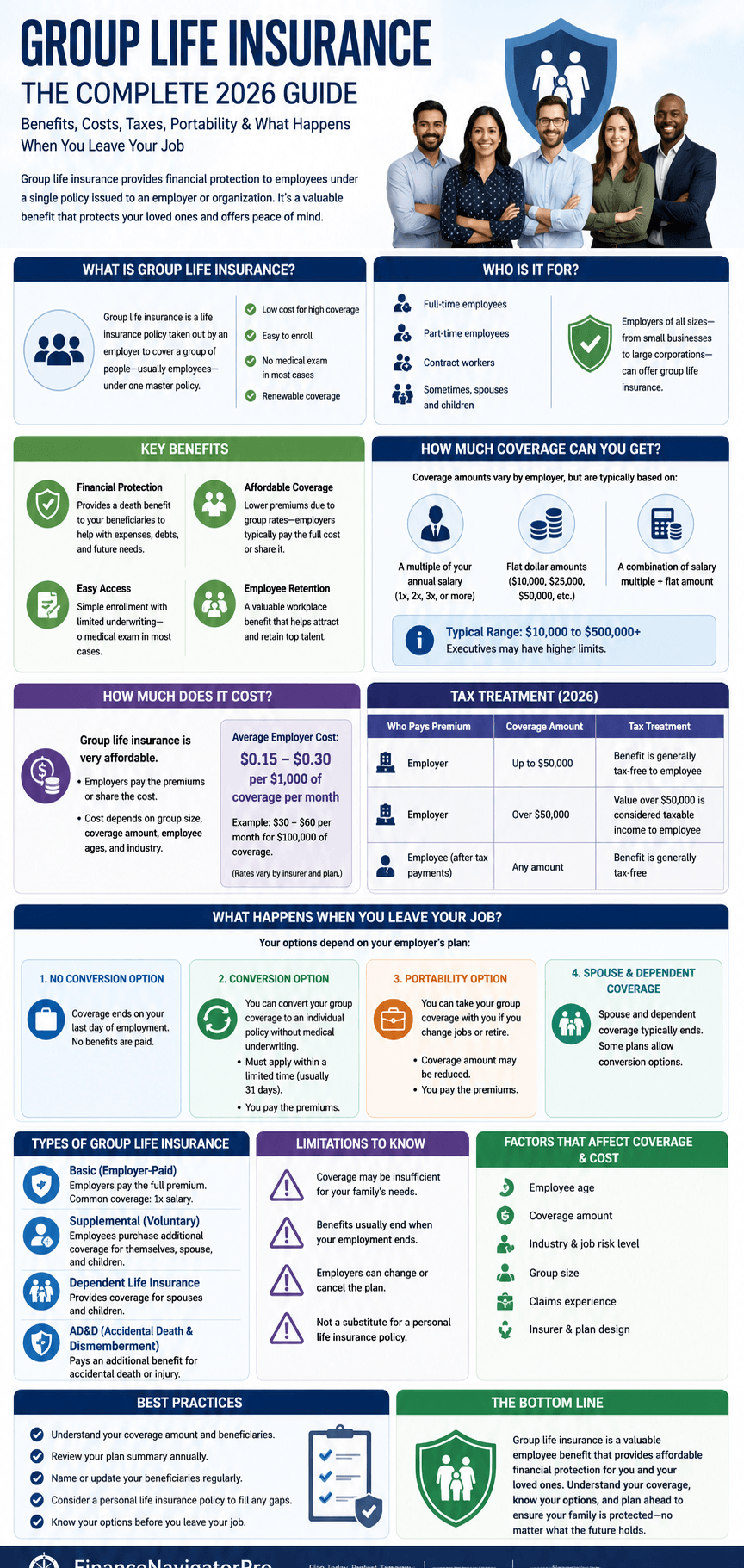
Section 1: What Is Group Life Insurance?
Group life insurance is a single policy issued to an employer or organization that provides life insurance coverage to a defined group of people—typically employees and sometimes their dependents. The employer is the policyholder; individual employees are the certificate holders, meaning each covered employee receives a certificate of coverage rather than an individual policy.
When a covered employee dies, the insurer pays a tax-free death benefit—called a death benefit or face amount—directly to the beneficiary or beneficiaries the employee named. The death benefit is typically a lump sum payment, though some plans offer payment in installments.
How It Works: The Core Mechanics
An employer negotiates a group policy with an insurance carrier. The carrier determines premiums based on the group’s size, age distribution, occupation, and industry risk profile. Because coverage is spread across a large pool of people, the insurer takes on less individual risk, which is why group rates are almost always lower than individual rates.
Employees don’t own their own policies. The employer owns the master contract. Employees receive coverage certificates and have the right to name beneficiaries, but they do not control the policy terms. The employer can switch carriers, reduce coverage, or discontinue the benefit—decisions that can affect you without your direct input.
How Claims Work
- The employee’s beneficiary contacts the employer’s HR department to report the death.
- HR provides the required claim forms and contacts the insurance carrier.
- The beneficiary submits a certified death certificate plus the completed claim forms.
- The insurance carrier reviews the claim and verifies coverage was active at the time of death.
- The death benefit is paid—usually within 30 to 60 days of receiving complete documentation.
⭐ Key Takeaway
Group life insurance is a workplace benefit—not a personal policy. The employer owns it, sets the terms, and can change it. Employees should understand that this coverage is tied to their job, not their personal insurance portfolio.
Section 2: How Does Employer Group Life Insurance Work?
The process from employer purchase to employee benefit is straightforward, but each step has important details employees often overlook. Here’s how group life insurance actually moves from an employer decision to your benefits card.
Step-by-Step: From Policy to Paycheck
- Employer Purchases the Policy: The employer selects an insurance carrier and negotiates coverage terms—typically 1x to 2x annual salary for basic employer-paid life insurance. The employer pays the premium for this base coverage.
- Employees Become Eligible: Full-time employees typically become eligible after a waiting period—commonly 30 to 90 days after their start date. Some employers offer immediate coverage on day one.
- Enrollment Occurs: During initial enrollment or open enrollment, employees select their coverage level, name beneficiaries, and—if adding voluntary coverage—authorize payroll deductions.
- Coverage Begins: Once enrolled, the employee’s life insurance becomes active. Coverage amounts are usually confirmed in an annual benefits statement.
- Payroll Deductions (If Applicable): For voluntary or supplemental coverage, premiums are deducted directly from the employee’s paycheck before taxes, reducing the employee’s taxable income.
- Beneficiary Designation: Employees name primary and contingent beneficiaries through HR or the insurance carrier’s online portal. This designation controls who receives the death benefit.
- Death Claim Process: If the employee dies while covered, the beneficiary files a claim with HR and the carrier. The carrier reviews and pays the benefit, typically within 30 to 60 days.
💡 Important
Coverage is tied to active employment. If you leave your job, retire, or are laid off, employer-paid group life insurance typically ends within 30 days of your last day unless you elect conversion or portability options.
⭐ Key Takeaway
Group life insurance is seamless—until you leave your employer. Understanding the mechanics helps you plan for the gaps before they become a crisis.
Section 3: Types of Group Life Insurance
1. Basic Employer-Paid Life Insurance
This is the most common form. The employer purchases and pays the premium for a flat coverage amount—often $25,000, $50,000, or 1x the employee’s annual salary. Enrollment is typically automatic. No medical questions are required.
2. Voluntary Life Insurance
Also called optional or elective life insurance, this allows employees to purchase additional coverage beyond the employer-paid amount. Employees pay premiums via payroll deduction, usually at group rates that are still lower than individual policy rates. Coverage amounts often go up to 5x to 8x annual salary.
3. Supplemental Life Insurance
Closely related to voluntary life insurance, supplemental coverage adds a layer on top of the basic employer-paid benefit. Some plans offer supplemental coverage for employees, spouses, and children as separate elections.
4. Dependent Life Insurance
Employees can often elect coverage for their spouse and/or children. Spouse coverage typically ranges from $10,000 to $250,000. Child coverage is often a flat amount—$5,000 to $25,000 per child—and covers all eligible children under one premium.
5. Accidental Death & Dismemberment (AD&D)
AD&D insurance pays an additional benefit if the employee dies as a result of a covered accident, or a partial benefit if the employee suffers a serious injury—such as loss of a limb or eyesight. AD&D is often bundled with group life policies but is a distinct benefit.
6. Union-Sponsored and Association-Sponsored Coverage
Labor unions, professional associations, and membership organizations sometimes offer group life insurance to members. These policies follow the same basic structure as employer-sponsored plans but are tied to membership rather than employment.
7. Retiree Group Life Insurance
Some large employers—particularly government agencies, universities, and legacy corporations—continue group life coverage into retirement, though at reduced amounts. This is less common among private sector employers than it was a generation ago.
| Type | Who Pays | Amount | Medical Exam | Portable |
|---|---|---|---|---|
| Basic Employer-Paid | Employer | 1x–2x salary | None | No |
| Voluntary/Supplemental | Employee | Up to 8x salary | Sometimes | Sometimes |
| Dependent | Employee | $10K–$250K | Sometimes | No |
| AD&D | Employer/Employee | Matches life benefit | None | No |
| Union/Association | Member dues | Varies | Sometimes | Yes (if member) |
| Retiree | Employer/Retiree | Reduced | None | Varies |
Section 4: Who Is Eligible for Group Life Insurance?
Eligibility rules vary by employer and plan, but some general patterns apply across most group life insurance programs in the United States.
Typical Eligibility Categories
- Full-time employees: Eligible in almost all employer group plans. The standard threshold is working 30 or more hours per week.
- Part-time employees: Sometimes eligible at larger employers, particularly in healthcare, retail, and government. Coverage amounts may be reduced.
- Temporary and seasonal workers: Rarely eligible for group life insurance. If included, there may be a longer waiting period or reduced benefit.
- Government employees: Federal employees are covered by Federal Employees’ Group Life Insurance (FEGLI), one of the largest group life programs in the country. State and local government employees have similar state-administered programs.
- Teachers and educators: Public school teachers are typically covered through state group plans. Private school teachers follow their employer’s plan.
- Military personnel: Active duty service members are covered by Servicemembers’ Group Life Insurance (SGLI), with optional coverage up to $500,000.
- Union workers: Covered through employer plans and/or union-negotiated group policies.
- Nonprofit employees: Generally eligible for group life through their employer, similar to private sector employees.
Waiting Periods
Most employers require a waiting period before group life insurance takes effect. The most common waiting periods are 30 days, 60 days, and 90 days. Some plans use the first of the month following 30 days of employment as the eligibility date. A minority of employers—particularly those competing aggressively for talent—offer coverage starting on day one.
⚠️ New Hire Tip
If you’re in a waiting period and your employer doesn’t offer day-one coverage, you may want to maintain individual coverage during that gap window. Even a few weeks without life insurance can be a significant risk if you have dependents.
⭐ Key Takeaway
Full-time employees at most U.S. employers qualify for group life insurance, but part-time, temporary, and contract workers often fall through the cracks. Always verify your eligibility during onboarding.
Section 5: How Much Coverage Do Employers Offer?
Employer-provided life insurance almost always falls short of what financial planners recommend for income replacement. Understanding exactly what you have is the starting point for building an adequate protection plan. If you’re thinking about how this fits into your broader financial picture, see our guide on saving vs. investing for context on building long-term security.
Common Coverage Structures
- Flat amount: A set dollar figure—often $25,000, $50,000, or $100,000—regardless of the employee’s salary. Common at smaller employers.
- Salary multiple: The most common structure. Employer pays for 1x annual salary; employee can purchase up to 5x to 8x additional through voluntary plans.
- Benefit class structure: Executives and senior employees sometimes receive higher multiples (2x to 3x salary) while front-line workers receive 1x.
Real-World Examples
| Annual Salary | Employer Pays (1x) | Max Voluntary (8x) | Total Max Coverage |
|---|---|---|---|
| $45,000 | $45,000 | $360,000 | $405,000 |
| $70,000 | $70,000 | $560,000 | $630,000 |
| $100,000 | $100,000 | $800,000 | $900,000 |
| $150,000 | $150,000 | $1,200,000 | $1,350,000 |
According to the Bureau of Labor Statistics (BLS), 57% of civilian workers had access to life insurance through their employer as of 2024. Among those with access, the median employer-paid benefit was approximately 1x annual salary.
⭐ Key Takeaway
Employer-paid coverage of 1x salary covers roughly 1 year of income replacement. Financial planners typically recommend 10x to 12x annual income. The gap between employer coverage and recommended coverage is where individual life insurance becomes essential.
Section 6: What Does Group Life Insurance Cover?
What Is Covered
- Natural death from illness or disease (heart attack, cancer, stroke, etc.)
- Accidental death (car accidents, workplace accidents, falls, etc.)
- Death from mental health conditions (policies vary; most cover suicide after a contestability period)
- Death occurring outside of the United States
- Death of covered dependents, if dependent coverage is elected
Common Exclusions
- Suicide within the first one to two years of coverage (the “contestability period”)
- Deaths resulting from illegal activities
- Deaths from acts of war in some older policies
- Deaths occurring during a waiting period before coverage takes effect
- Misrepresentation on enrollment forms (rare but applicable if evidence of insurability was required)
Contestability Period
Like individual life insurance, most group policies include a contestability clause—typically one or two years. During this period, the insurer can investigate and potentially deny a claim if it discovers the employee misrepresented their health status or other material information during enrollment.
AD&D Coverage (When Bundled)
If your employer bundles Accidental Death & Dismemberment coverage with your life insurance, you may receive an additional payout—often equal to the life benefit—if your death is accidental. AD&D also pays a partial benefit (typically 25% to 100% of the coverage amount) for qualifying injuries such as the loss of a hand, foot, or eyesight.
ℹ️ What AD&D Does NOT Cover
AD&D does not cover deaths from illness, disease, or natural causes. It’s a supplement to life insurance—not a replacement. Relying only on AD&D for death benefits is a dangerous mistake.
Section 7: Group Life Insurance Costs
One of the biggest advantages of group life insurance is cost. Because the insurer pools risk across many employees, group rates are substantially lower than what an individual would pay for the same coverage on the open market. For broader context on managing insurance costs, see how to lower your insurance premium.
Employer-Paid Coverage
Basic employer-paid coverage costs the employee nothing. The employer pays the entire premium. Typical group rates run from $0.20 to $0.80 per $1,000 of coverage per month, depending on the group’s age profile and the carrier’s risk assessment. On a $50,000 policy, this is $10 to $40 per month—paid entirely by the employer.
Voluntary/Supplemental Coverage Costs by Age Band
| Age Band | Rate per $1,000/mo | $100K/Month | $250K/Month |
|---|---|---|---|
| Under 25 | $0.05 | $5.00 | $12.50 |
| 25–29 | $0.06 | $6.00 | $15.00 |
| 30–34 | $0.08 | $8.00 | $20.00 |
| 35–39 | $0.09 | $9.00 | $22.50 |
| 40–44 | $0.10 | $10.00 | $25.00 |
| 45–49 | $0.15 | $15.00 | $37.50 |
| 50–54 | $0.23 | $23.00 | $57.50 |
| 55–59 | $0.43 | $43.00 | $107.50 |
| 60–64 | $0.73 | $73.00 | $182.50 |
| 65–69 | $1.13 | $113.00 | $282.50 |
Note: Rates are illustrative averages and vary by insurer and employer group. Your HR department or benefits portal shows your plan’s actual rates.
⭐ Key Takeaway
Group life insurance is significantly cheaper than individual policies, especially for older workers. A 55-year-old might pay $43/month for $100,000 of group coverage, vs. $100–$250/month or more for an equivalent individual term policy.
Section 8: Pros and Cons of Group Life Insurance
| ✅ Pros | ❌ Cons |
|---|---|
| Employer-paid basic coverage (free to employee) | Coverage ends when employment ends |
| No medical exam required for basic coverage | Employer controls the policy—not you |
| Guaranteed issue for basic coverage amounts | Coverage amounts are often insufficient (1x salary) |
| Lower group rates for supplemental coverage | No cash value or investment component |
| Payroll deduction is convenient and pre-tax | Not portable by default; conversion is expensive |
| Fast, easy enrollment during benefits period | Employer can change or eliminate benefit |
| Can cover dependents at group rates | Coverage maxes out (usually 8x salary cap) |
| Available to employees who can’t qualify individually | Limited customization—no riders typically |
Section 9: Is Employer Life Insurance Enough?
This is the question most employees avoid asking—until a crisis forces it. The short answer for most American families is: no, employer life insurance alone is not enough. Here’s how to think through your actual needs.
The Standard Income Replacement Formula
Financial planners widely recommend coverage equal to 10x to 12x your annual income. This estimate accounts for income replacement, mortgage payoff, children’s education costs, outstanding debts, and final expenses. If you earn $75,000 per year, a complete coverage plan should provide $750,000 to $900,000 in death benefits.
An employer-paid benefit of 1x salary ($75,000) covers roughly one year of income replacement—a significant shortfall.
Case Studies
Case Study 1 — Young Parent (Age 32, $65,000 salary)
Employer provides $65,000 in coverage (1x salary). Has a spouse, two young children, and a $280,000 mortgage.
Needs: $650,000+ to cover income replacement, mortgage, and education costs.
Gap: $585,000+ uncovered by employer benefit alone.
Case Study 2 — Single Professional (Age 28, $55,000 salary, no dependents)
Employer provides $55,000 in coverage. Has $20,000 in student loans and no dependents.
Verdict: Employer coverage adequately covers final expenses and debt. Individual policy may not be urgent but remains wise for future family planning.
Case Study 3 — Near-Retirement Employee (Age 58, $90,000 salary)
Children are grown; mortgage nearly paid off. Employer provides $90,000. Spouse will need income bridge for 5–7 years.
Verdict: Employer coverage may be close to adequate depending on savings and spouse’s income.
Quick Coverage Needs Calculator
| Coverage Factor | Recommended Amount |
|---|---|
| Annual income × 10 | $______ |
| Outstanding mortgage balance | + $______ |
| Other debts (student loans, car, credit cards) | + $______ |
| Children’s education costs | + $______ |
| Final expenses & funeral costs (~$15,000) | + $15,000 |
| Spouse’s income gap (if applicable) | + $______ |
| Total Recommended Coverage | = $______ |
| Minus existing employer coverage | – $______ |
| Individual Life Insurance Gap | = $______ |
⭐ Key Takeaway
For most American families with children, a mortgage, and a spouse who depends on your income, employer life insurance covers a small fraction of actual needs. Supplementing with an individual term life policy is usually the right move. You might also want to review our guide on building an emergency fund as a complementary financial safety net.
Section 10: Group Life Insurance vs. Individual Life Insurance
| Feature | Group Life Insurance | Individual Life Insurance |
|---|---|---|
| Ownership | Employer (certificate holder) | You own the policy |
| Portability | Usually not portable | Fully portable—travels with you |
| Coverage Amount | Limited (1x–8x salary) | Flexible—any amount |
| Premium Control | Employer controls rates | Locked rate for policy term |
| Cash Value | None (term only) | Available with whole/universal life |
| Medical Exam | None for basic coverage | Required for larger amounts |
| Renewability | Ends with employment | Guaranteed for policy term |
| Customization | Minimal | Full—riders, terms, amounts |
| Best Use Case | Supplemental/immediate benefit | Primary long-term protection |
💡 Expert Recommendation
Think of group life insurance and individual life insurance as a team, not competitors. Use employer coverage as a free or low-cost foundation, and add an individual term life policy to fill the gap. This two-layer approach gives you both affordability and security.
Section 11: Supplemental Life Insurance Explained
Supplemental life insurance—also called voluntary life insurance—lets you buy additional coverage beyond what your employer pays for, using the same group rates and payroll deduction convenience.
Who Should Buy Supplemental Life Insurance?
- Parents with minor children who depend on your income
- Homeowners with a mortgage larger than the employer-paid death benefit
- Employees who want to avoid a medical exam (for amounts under the guaranteed issue limit)
- Workers whose spouses do not work or earn significantly less
- Employees approaching a major life event: new baby, home purchase, marriage
How Much Should You Buy?
Use the coverage calculator in Section 9 to determine your total need, subtract the employer-paid amount, and consider purchasing the remainder through supplemental group coverage—up to the plan’s maximum. Then compare the per-dollar cost to an individual term policy. For employees under 45, an individual term policy is often competitively priced. For employees over 50, group supplemental rates may be more advantageous, especially if you have health conditions.
Cost Example
A 40-year-old purchasing $250,000 in supplemental group life insurance at $0.10 per $1,000 per month would pay $25 per month. The same coverage on the individual market for a healthy 40-year-old might cost $20 to $35 per month—comparable, but with the important difference that individual coverage stays with you after you leave your job.
⭐ Key Takeaway
Supplemental life insurance through your employer is convenient and affordable, but the coverage ends when your job ends. Use it as a bridge—especially when your health or age makes individual coverage expensive—but prioritize building individual coverage you own permanently.
Section 12: What Happens If You Leave Your Job?
This is the moment most employees haven’t planned for. You resign, get laid off, or retire—and the life insurance you’ve been counting on is about to disappear. Understanding what’s at stake is especially important if you’re also weighing severance pay and your broader financial picture during a job transition.
When Coverage Ends
Employer-paid group life insurance typically terminates on your last day of employment—or, if the plan allows, at the end of the month in which your employment ends. A 30-day grace period is common but not universal. Do not assume your coverage continues after you leave without confirming with HR.
Your Options After Leaving
- Do nothing: Accept the coverage gap. This works only if you have individual coverage in place or no dependents who rely on your income.
- COBRA for life insurance: Group life insurance is not subject to COBRA continuation the same way health insurance is. Most group life plans do NOT offer COBRA extension. Confirm with your employer.
- Port the coverage: If your employer’s plan offers portability, you can continue the group coverage—usually at group rates—for a defined period. You pay the premium directly. Portability must be elected within 30 to 31 days of leaving.
- Convert to an individual policy: Conversion allows you to switch your group life coverage to an individual permanent life policy (usually whole life) without a medical exam. The premium will be significantly higher—based on your current age—but it guarantees coverage regardless of health status.
- Purchase new individual coverage: If you are in good health, purchasing a new individual term life policy may be more affordable than conversion. This is often the best option for healthy employees under 55.
⚠️ Key Deadline
Both portability and conversion elections must typically be made within 30 to 31 days of losing group coverage. Missing this window may permanently close these options.
Decision Checklist: What to Do When Leaving a Job
- ☐ Request your group life insurance certificate from HR before your last day
- ☐ Confirm your coverage termination date
- ☐ Ask HR about portability and conversion options and deadlines
- ☐ Compare conversion premium vs. individual term life policy quotes
- ☐ If healthy: apply for individual coverage immediately
- ☐ If health issues exist: seriously consider portability or conversion
- ☐ Update your beneficiaries on any new or converted policies
⭐ Key Takeaway
Job transitions create life insurance gaps that kill financial plans. Know your options—portability, conversion, or new individual coverage—before you hand in your resignation letter.
Section 13: Can You Convert Group Life Insurance?
Yes—almost all group life insurance plans include a conversion privilege, which gives you the right to convert your group coverage to an individual permanent life insurance policy without taking a medical exam.
How Conversion Works
- Eligibility: Any employee who loses group coverage due to leaving the job, reduction in hours, or policy termination generally qualifies for conversion.
- Deadline: You must elect conversion within 30 to 31 days of losing group coverage. Some plans extend this to 60 days.
- Product: Conversion results in an individual permanent policy—most commonly whole life insurance. You cannot typically convert to term insurance.
- Premium: The premium is based on your current age and the insurance company’s standard rates for the permanent product. This is significantly more expensive than the group rate you paid as an employee.
- Medical Exam: No medical exam required. This is the key advantage—it guarantees coverage regardless of health status.
- Coverage Amount: Generally limited to the amount you had under the group plan.
When Conversion Makes Sense
- You have a significant health condition that would prevent you from qualifying for new individual coverage
- You are between jobs and need guaranteed coverage during the transition
- You’re approaching retirement and want to lock in permanent coverage
When Conversion Doesn’t Make Sense
- You are in good health and can qualify for lower-cost individual term coverage
- The conversion premium is significantly higher than equivalent individual coverage
- You don’t need permanent life insurance (most financial situations don’t require it)
💡 Real Example
Maria, age 52, leaves her employer after 15 years. She has high blood pressure and would likely face higher premiums or denial on the individual market. Conversion gives her guaranteed permanent coverage—at a higher premium—but ensures her family is protected.
Section 14: Group Life Insurance Tax Rules
The IRS treats employer-provided life insurance differently depending on the coverage amount. Understanding these rules prevents tax surprises at filing time. Related reading: federal income tax brackets explained.
The $50,000 Rule
The IRS allows employers to provide up to $50,000 of group term life insurance coverage tax-free to employees. This means if your employer pays for $50,000 or less of life insurance, the premium cost is not included in your taxable income.
Coverage Over $50,000: Imputed Income
If your employer provides more than $50,000 in group term life insurance, the cost of the excess coverage—calculated using IRS-published tables—is treated as imputed income. This amount is added to your gross wages and subject to income tax, Social Security, and Medicare taxes. You’ll see this on your W-2 form.
| Age | IRS Rate per $1,000/mo | Imputed Income per $100K Over Limit |
|---|---|---|
| Under 25 | $0.05 | $2.50/mo |
| 25–29 | $0.06 | $3.00/mo |
| 30–34 | $0.08 | $4.00/mo |
| 35–39 | $0.09 | $4.50/mo |
| 40–44 | $0.10 | $5.00/mo |
| 45–49 | $0.15 | $7.50/mo |
| 50–54 | $0.23 | $11.50/mo |
| 55–59 | $0.43 | $21.50/mo |
| 60–64 | $0.73 | $36.50/mo |
| 65–69 | $1.13 | $56.50/mo |
Are Death Benefits Taxable?
Generally no. Life insurance death benefits paid to a named beneficiary are income-tax-free under IRC Section 101(a). The beneficiary receives the full payout without owing federal income tax on it. However, if the death benefit is paid to the employee’s estate rather than a named individual, it may become subject to estate taxes for large estates.
Voluntary Premiums and Taxes
Premiums you pay for voluntary or supplemental life insurance through payroll deduction are paid with pre-tax dollars in most plans, reducing your taxable income. However, the same $50,000 rule applies—if your total coverage (employer-paid plus voluntary) exceeds $50,000, imputed income rules kick in on the excess.
⚖️ Tax Disclaimer
Tax rules are complex and change. This section reflects general IRS guidance as of 2026. Consult a licensed tax professional or CPA for advice specific to your situation.
⭐ Key Takeaway
Keep employer-paid coverage at or below $50,000 if tax simplicity is a priority. For coverage above that threshold, be aware that imputed income will appear on your W-2—it’s not a penalty, just taxable income to account for. See also our guide on capital gains tax rates for more on how investment income intersects with your overall tax picture.
Section 15: Choosing and Updating Beneficiaries
Your life insurance beneficiary designation is one of the most important financial decisions you’ll make—and one of the most frequently neglected. The beneficiary receives the death benefit directly, regardless of what your will says.
How to Name Beneficiaries
- Name a primary beneficiary: The person or entity who receives the death benefit first. Most commonly a spouse or domestic partner.
- Name a contingent (secondary) beneficiary: Receives the benefit if the primary beneficiary predeceases you or dies simultaneously.
- Name multiple beneficiaries: You can split the benefit—for example, 50% to your spouse and 50% to your child. Percentages must total 100%.
- Keep beneficiary information current: Use full legal names, dates of birth, and Social Security numbers to avoid delays during the claims process.
Special Situations
Minor Children as Beneficiaries: Life insurance carriers generally cannot pay death benefits directly to minors. If you name a minor child as beneficiary, a court may need to appoint a guardian to manage the funds—causing delays and legal costs. Alternatives include naming a trusted adult custodian or setting up a trust.
Trusts as Beneficiaries: Naming a trust as beneficiary gives you more control over how funds are distributed. A trustee manages the assets according to your instructions, which is particularly valuable for minor children, special needs dependents, or situations where you want to spread payments over time.
Estate as Beneficiary: Naming your estate as beneficiary is generally inadvisable. The death benefit becomes part of the probate process, potentially delaying distribution by months or years and exposing the funds to creditors.
Common Beneficiary Mistakes
- Never updating after divorce: Your ex-spouse may receive the benefit if you don’t change the designation after divorce.
- Naming “my children” without specifying: Courts interpret this differently than you may intend.
- Forgetting contingent beneficiaries: If your primary beneficiary predeceases you with no contingent named, the benefit may go to your estate.
- Not updating after life events: Marriage, birth of a child, divorce, and death of a named beneficiary are all triggers to update your designation.
⭐ Key Takeaway
Review and update your beneficiary designations every year—and immediately after major life events. This five-minute task is one of the most impactful things you can do for your family’s financial security.
Section 16: The Claims Process
When the time comes to file a life insurance claim, the process doesn’t have to be complicated—but families who know what to expect navigate it faster and with less stress.
Step-by-Step Claims Process
- Notify the employer: The beneficiary contacts the deceased employee’s HR department or benefits administrator as soon as possible.
- Obtain claim forms: HR or the insurance carrier provides the beneficiary with claim forms. These are available online in most cases.
- Gather required documents: The key document is a certified copy of the death certificate. You’ll typically need 1 to 3 certified copies.
- Submit completed forms: Return claim forms, death certificate, and any other requested documentation to the insurance carrier directly. HR can help coordinate.
- Verification and review: The carrier verifies that coverage was active at the time of death, confirms the beneficiary designation, and reviews for any policy exclusions.
- Benefit payment: If approved, the death benefit is paid—typically within 30 to 60 days of receiving complete documentation. Payment may be by check or electronic transfer.
Required Documents Checklist
- ☑ Certified copy of death certificate (obtain from the county vital records office or funeral home)
- ☑ Completed claim form (provided by HR or insurance carrier)
- ☑ Proof of identity for the beneficiary
- ☑ Policy certificate number (available from HR or benefits statements)
- ☑ If applicable: marriage certificate, birth certificate, or trust documents
Tips for a Smooth Claims Process
- Request multiple certified copies of the death certificate—you’ll need them for multiple purposes including banks, Social Security, and other insurers.
- File the claim promptly. While there is no hard deadline for beneficiaries to file in most states, delays can complicate the process.
- Keep a record of all communications with the insurance carrier, including names, dates, and reference numbers.
- If the carrier requests additional information, respond quickly to avoid processing delays.
- If a claim is denied, request a written explanation and consider consulting an attorney who specializes in insurance claims.
⭐ Key Takeaway
The claims process is manageable when families are prepared. Store your life insurance information—carrier name, policy number, HR contact—where your family can find it without searching.
Section 17: Common Mistakes Employees Make
| Mistake | Why It Matters & What to Do Instead |
|---|---|
| Assuming 1x salary is enough | Most families need 10x–12x income. Calculate your actual need and supplement with individual coverage. |
| Never updating beneficiaries | Life changes—divorce, death, birth—can make old designations dangerously wrong. Review annually. |
| Ignoring supplemental insurance during enrollment | Voluntary coverage during enrollment is guaranteed issue. Waiting until you need it may require a medical exam. |
| Missing conversion deadlines | The window to convert (usually 30–31 days) closes fast after leaving a job. Know your dates before you leave. |
| Not reading policy exclusions | AD&D exclusions, suicide clauses, and contestability periods affect when and whether your family gets paid. |
| Not understanding imputed income tax | Coverage above $50,000 creates taxable imputed income on your W-2. It’s not a penalty—just plan for it. |
| No estate planning to accompany insurance | A death benefit paid to the wrong person—or to your estate—can end up in court. Pair insurance with a will and trust. |
| Forgetting to enroll during new hire window | Guaranteed issue enrollment doesn’t wait. Miss it and you may need a medical exam to get coverage later. |
Section 18: How Much Life Insurance Do You Really Need?
Every financial situation is different, but several widely used formulas can give you a working estimate. The goal is not a perfect number—it’s a number that protects your family from financial hardship if you die unexpectedly.
The DIME Formula
- D — Debt: Add up all outstanding debts except the mortgage (credit cards, car loans, student loans, personal loans).
- I — Income: Multiply your annual income by the number of years your family will need support (typically until your youngest child is 18 or 22).
- M — Mortgage: Include the remaining balance on your mortgage.
- E — Education: Estimate the cost of college for each child.
Example Calculation
| Factor | Amount |
|---|---|
| Annual income ($75,000) × 15 years | $1,125,000 |
| Mortgage balance | $250,000 |
| Other debts (student loans, credit cards) | $35,000 |
| College for 2 children ($30,000 each) | $60,000 |
| Funeral and final expenses | $15,000 |
| Total Recommended Coverage | $1,485,000 |
| Employer-provided life insurance | – $75,000 |
| Individual Life Insurance Needed | $1,410,000 |
In this example, a $75,000 employer-paid policy covers about 5% of the recommended coverage. An individual term life policy for the gap—$1,400,000 for a healthy 35-year-old—might cost $60 to $90 per month. That’s meaningful protection for a small premium.
⭐ Key Takeaway
Use the DIME formula or a professional needs analysis to calculate your coverage gap. Most people discover that employer-paid coverage fills a fraction of their actual need. Knowing the number makes the solution clear. Also consider how this intersects with your retirement strategy for a complete financial protection plan.
Section 19: Best Situations for Group Life Insurance
- Young professionals starting their first job: Free coverage with no medical exam is a strong starting point for building financial protection.
- Parents with young children: Supplemental group coverage is quick to obtain and provides immediate protection during the enrollment window.
- Married couples with one income: When one spouse’s death would devastate family finances, supplemental group life buys affordable protection.
- Homeowners with new mortgages: The employer benefit partially offsets a catastrophic loss. Supplement to cover the full mortgage. See our guide on refinancing a mortgage for related reading.
- Government employees: Federal and state group plans—FEGLI, state teacher plans—often provide exceptional value and portability.
- Healthcare workers: Often have access to strong group plans through hospital systems and healthcare networks.
- Employees approaching retirement who developed health conditions: Group supplemental coverage may be available via guaranteed issue at annual enrollment even when individual coverage is expensive or unavailable.
Section 20: When Individual Life Insurance Is the Better Choice
- Business owners and freelancers: Group coverage doesn’t exist without an employer. Individual ownership ensures continuous protection.
- High-income earners: Coverage maximums in group plans often cap at a fraction of needed income replacement for executives earning $150,000+.
- People changing jobs frequently: Constantly starting over with group coverage creates gaps and missed portability windows.
- Long-term and estate planning needs: Permanent individual policies (whole life, universal life) build cash value and support advanced estate strategies.
- People who want locked-in premiums: Individual term policies fix your premium for 10, 20, or 30 years. Group rates increase as you age.
- Surviving a job loss: Individual coverage continues regardless of your employment status.
Expert Tips: 20 Insights from Financial Professionals
| # | Expert Tip |
|---|---|
| 1 | Enroll immediately during your new hire window. Guaranteed issue coverage doesn’t require a medical exam—don’t wait. |
| 2 | Name beneficiaries on day one. Don’t leave HR without completing your beneficiary designation. |
| 3 | Name both a primary AND contingent beneficiary. A single beneficiary who dies before you leaves your benefit in limbo. |
| 4 | Review your coverage every open enrollment. Life changes; your coverage needs change too. |
| 5 | Don’t rely solely on employer insurance. It ends when your job ends. Individual coverage follows you. |
| 6 | Buy individual coverage while you’re young and healthy. Premiums locked in at 30 cost a fraction of what they cost at 50. |
| 7 | Understand your portability window. It’s typically 30 days after leaving—and most people miss it. |
| 8 | Compare conversion premium vs. new policy quotes. Conversion is guaranteed but expensive. Get quotes first. |
| 9 | Elect guaranteed issue supplemental coverage during enrollment. After the window closes, a medical exam may be required. |
| 10 | Calculate your coverage gap before open enrollment, not during. Knowing your number makes enrollment decisions easy. |
| 11 | Salary changes affect your coverage. Some plans automatically adjust; others require you to elect more. |
| 12 | Don’t ignore dependent coverage. Funeral expenses for a spouse or child can be $15,000–$30,000. Dependent life helps. |
| 13 | Update beneficiaries after divorce immediately. Courts are not always on your family’s side in beneficiary disputes. |
| 14 | Keep your coverage certificate in a secure, accessible location. Families often can’t find policy information after a death. |
| 15 | Understand the difference between life insurance and AD&D. AD&D doesn’t pay for illness or natural death. |
| 16 | Ask HR about your plan’s insurance carrier and group policy number. You’ll need this for claims. |
| 17 | Consider a term life policy for the gap, not whole life. Term is cheaper and most people’s needs are time-limited. |
| 18 | Group life insurance is not an investment. It has no cash value. Don’t factor it into retirement planning. |
| 19 | If you have a health condition, conversion protects you. It’s expensive, but it’s guaranteed issue. |
| 20 | Review beneficiaries after every major life event: marriage, birth, divorce, death of a named beneficiary. |
Key Statistics on Group Life Insurance in the United States
| Statistic | Figure | Source |
|---|---|---|
| Workers with access to employer life insurance | 57% | BLS, 2024 |
| Workers who participate when offered | ~87% | BLS, 2024 |
| Median employer-paid benefit | 1x salary | LIMRA, 2024 |
| Americans who say they need more life insurance | 48% | LIMRA, 2025 |
| Average life insurance coverage gap per household | $200,000+ | LIMRA, 2025 |
| Federal employees covered by FEGLI | 4+ million | OPM, 2024 |
| Active military members covered by SGLI | ~2 million | SGLI, 2024 |
| Employers offering voluntary supplemental life | 68% | SHRM, 2024 |
| Average time to pay group life insurance claim | 30–60 days | NAIC, 2024 |
| Americans with no life insurance (any type) | ~22% | LIMRA, 2025 |
Frequently Asked Questions (FAQs)
Glossary of Key Terms
| Term | Definition |
|---|---|
| AD&D Insurance | Accidental Death & Dismemberment insurance. Pays a benefit if death or qualifying injury results from a covered accident. |
| Age Band | A range of ages (e.g., 40–44) used to set premium rates for voluntary group life coverage. Rates increase as age increases. |
| Basic Life Insurance | Employer-paid life insurance provided to all eligible employees, typically at no cost to the employee. |
| Beneficiary | The individual, trust, or entity designated to receive the life insurance death benefit. |
| Certificate of Coverage | A document issued to an employee confirming their participation in the group life plan, coverage amounts, and carrier information. |
| Contingent Beneficiary | A secondary beneficiary who receives the death benefit if the primary beneficiary cannot. |
| Contestability Period | Usually 1–2 years during which the insurer may investigate and potentially deny claims based on misrepresentation. |
| Conversion Privilege | The right to convert group life coverage to an individual permanent policy without a medical exam after losing group coverage. |
| Death Benefit | The amount paid to the beneficiary upon the insured’s death. |
| Dependent Life Insurance | Optional coverage employees can elect for spouses and/or children, paid via payroll deduction. |
| Evidence of Insurability | Medical information required when applying for coverage above the guaranteed issue limit or outside enrollment windows. |
| FEGLI | Federal Employees’ Group Life Insurance. The group life program for U.S. federal civilian employees. |
| Guaranteed Issue | Coverage available without a medical exam or health questions, up to a maximum amount. |
| Imputed Income | The taxable value assigned to employer-paid life insurance coverage exceeding $50,000, as determined by IRS tables. |
| Master Contract | The policy owned by the employer that governs all group life coverage. Employees receive certificates, not individual policies. |
| Open Enrollment | A designated period (usually annual) during which employees can enroll, change, or drop benefit elections. |
| Payroll Deduction | The automatic deduction of insurance premiums from an employee’s paycheck, often on a pre-tax basis. |
| Portability | The ability to continue group life coverage after leaving an employer by paying premiums directly to the carrier. |
| SGLI | Servicemembers’ Group Life Insurance. The group life program for active U.S. military members. |
| Supplemental Life Insurance | Additional life insurance that employees can purchase beyond the employer-paid basic benefit, at group rates. |
| Term Life Insurance | Life insurance that provides a death benefit for a defined period with no cash value component. Group life is almost always term. |
| Underwriting | The process an insurance carrier uses to evaluate risk before issuing coverage. |
| Voluntary Life Insurance | Employee-elected, employee-paid life insurance purchased at group rates through payroll deduction. Also called supplemental life insurance. |
| Waiting Period | The time between an employee’s start date and the date group life insurance coverage takes effect. |
| W-2 | Annual wage and tax statement. Imputed income from group life coverage above $50,000 appears in Box 12, Code C. |
Related Articles on FinanceNavigatorPro
Build a complete financial protection strategy with these related guides:
⚖️ Disclaimer
This guide is for informational purposes only and does not constitute legal, tax, or financial advice. Insurance policies, IRS rules, and employer plan terms vary. Consult a licensed insurance professional, financial advisor, or tax professional before making insurance or coverage decisions. The statistics and sources cited reflect publicly available data as of 2026 and may change.
Written by Jaykishan Panchal · 15+ Years SEO & Finance Experience · Updated 2026 · FinanceNavigatorPro.com