
Quick Summary
Here’s the short version if you’re in a hurry — but stick around, because the details genuinely matter for your wallet:
Savings accounts are safe, FDIC-insured, and liquid — perfect for short-term goals and emergencies.
Investing carries risk but historically averages ~10% annually in the stock market — hard to ignore over 20+ years.
Inflation (~3%/year) silently erodes the purchasing power of money sitting in low-yield accounts.
The financial hierarchy: build an emergency fund first, then kill high-interest debt, then invest.
Tax-advantaged accounts (Roth IRA, 401(k)) blur the line between saving and investing — and they’re usually your best first investment step.
Best strategy: do both simultaneously once your financial foundation is solid.
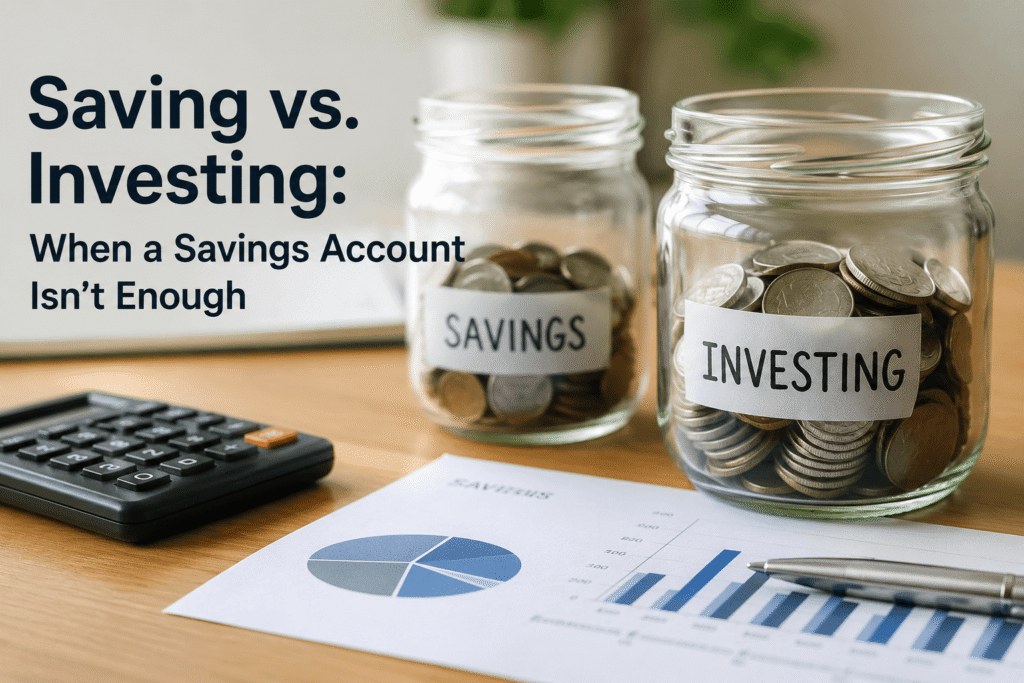
Saving vs. Investing: These Are Not the Same Thing
Let’s just get this out of the way: a lot of people use “saving” and “investing” interchangeably, like they’re basically the same deal with different vibes. They’re not. Not even close.
Saving is putting money somewhere safe — somewhere it doesn’t move, doesn’t disappear, and is right there waiting for you when you need it. A savings account, a high-yield savings account (HYSA), a money market account — these are savings vehicles.
Investing is putting money to work in assets that can grow over time — stocks, bonds, mutual funds, index funds, real estate. The upside is real. So is the risk.
Here’s an analogy: saving is like parking your car in the garage overnight. It’s safe, it stays put, it’s where you left it. Investing is like putting your car in a race — it might come back faster, upgraded, and more valuable. Or it might get a few dents. Either way, it’s not just sitting there.
Both strategies have a place in your financial life. The question isn’t which one is “better.” It’s which one is right for what you’re trying to accomplish — and when.
What Saving Means: Safety, Liquidity, and Guaranteed Returns
When you put money into a savings account, here’s what you’re getting:
The trade-off? The returns are modest. Traditional savings accounts often earn as little as 0.01% APY at big banks. Even the best high-yield savings accounts top out around 4–5% APY in a high-rate environment, though those rates fluctuate with the federal funds rate.
So for short-term goals — vacations, a new car, a house down payment in the next 2–3 years — savings accounts make total sense. You need the money to be there, untouched, ready to deploy.
Important distinction: Certificates of Deposit (CDs) and money market accounts are still savings tools, even though they sometimes feel more “advanced.” They’re not investments — they’re just savings with different terms and slightly different rules.
What Investing Means: Growth, Risk, and Time
Investing is a different beast. When you invest, you’re buying an asset that you believe will be worth more in the future than it is today. Sometimes you’re right. Sometimes you’re not.
The most common investment for regular Americans? The stock market — specifically, low-cost index funds that track the S&P 500. Over the last century, the S&P 500 has averaged roughly 10% annual returns before inflation. That’s not guaranteed every year — there will be bad years, brutal years even — but over long stretches, the trend has been up.
Here’s the thing about risk: it’s not just a four-letter word. Risk is also what makes growth possible. You don’t earn 10% by putting your money in a savings account. You earn 0.5% (on a good day at most banks). The risk is the price of the return.
The key variable: time. The longer your money stays invested, the more those annual returns compound. Missing out on 20 years of compounding in the market by staying in a savings account isn’t “playing it safe.” It’s a very expensive decision that just feels safe.
There’s also a wide range of investment risk levels. Bonds are less volatile than stocks. Dividend-paying stocks in blue-chip companies are less wild than speculative tech startups. You can calibrate your risk based on your timeline and comfort level.
The Return Gap: What the Numbers Actually Say
Okay, let’s talk real numbers. This is where it gets eye-opening. Imagine you put $10,000 away today. Here’s what happens over 30 years under different scenarios:
| Vehicle | Avg. Annual Return | $10,000 After 30 Years | Gain |
|---|---|---|---|
| Big-bank savings account | 0.5% | $11,614 | +$1,614 |
| High-yield savings account | 4.5% | $37,453 | +$27,453 |
| S&P 500 index fund | 10% | $174,494 | +$164,494 |
That’s not a typo. The difference between the big-bank savings account and an S&P 500 index fund over 30 years is more than $162,000 — on the same initial $10,000. That’s what time and compounding do.
Now, the HYSA does look pretty respectable — especially compared to the nearly useless big-bank rate. But here’s the catch: HYSA rates change constantly. When the Fed cuts rates, those 4–5% yields shrink fast. The stock market’s long-term average, while bumpy, has been more reliable over multi-decade periods.
The numbers above use historical averages. Past performance never guarantees future results — but 100 years of data is hard to ignore entirely.
The Inflation Problem: When Saving Feels Safe but Isn’t
Here’s a brutal truth nobody really wants to talk about: inflation is quietly pickpocketing your savings account every single day.
The U.S. has historically averaged about 3% inflation per year. That means the stuff you buy — groceries, gas, rent, healthcare — gets about 3% more expensive every year. If your savings account is earning 0.5%, you’re actually losing about 2.5% of your purchasing power annually. In real terms, your money is going backward.
Even at 4.5% HYSA rates, you’re barely keeping up with inflation — you’re not building real wealth, you’re running on a treadmill.
Over 10 years, a $50,000 account earning 0.5% while inflation runs at 3% loses roughly $13,000 in real purchasing power. The dollar amount in your account goes up slightly. But what that money can actually buy goes down. That’s the insidious part — it’s invisible until you go to buy something and realize your “savings” don’t stretch like they used to.
The bottom line: for anything more than a few years out, a savings account isn’t just underperforming — it’s actually costing you in real terms.
The Financial Hierarchy: What to Do Before You Invest
Before we talk about picking investments, let’s be real: not everyone is ready to invest yet. And that’s okay. There’s an order of operations here that actually matters. Skip a step and you can end up in a worse spot than when you started.
Build an Emergency Fund First
This is non-negotiable. Before you invest a single dollar, you need 3–6 months of living expenses parked in an accessible, liquid savings account. Why? Because if the market tanks 30% and you simultaneously lose your job, the last thing you want to do is sell your investments at a loss to cover rent.
Your emergency fund is not an investment. It’s insurance. Keep it in a high-yield savings account, access it only for genuine emergencies, and replenish it when you use it.
Shortcut: Can’t build the full 6 months quickly? Start with $1,000. Then build to one month. Then three. Progress beats perfection every time.
Pay Off High-Interest Debt
Credit card debt at 20–25% APR? Pay that off before you invest. It is impossible to reliably earn 20–25% in the market consistently. You’d have to be a once-in-a-generation investor. Dave Ramsey fans and Suze Orman fans can disagree on a lot of things, but they both agree on this one.
The math is simple: paying off a 22% credit card is the same as getting a guaranteed 22% return on that money. Nothing in the investment world offers that with certainty.
Note: not all debt is equal. Low-interest debt like federal student loans or a mortgage with a rate under 5–6%? You might reasonably invest while slowly paying those down — the expected market return may outpace the interest rate.
Max Out Tax-Advantaged Accounts
Here’s where things get exciting. Before you open a regular brokerage account and start buying random stocks, max out your tax-advantaged accounts. This is the single highest-leverage move most Americans can make:
401(k): Contribute at least up to your employer’s match — that’s free money with a 100% instant return. Then max it if you can ($23,500 in 2025 for under 50).
Roth IRA: Contribute up to $7,000/year (2025). Your investments grow tax-free, and withdrawals in retirement are tax-free. This is exceptional for younger earners. Read more about Roth IRA withdrawal rules.
Traditional IRA: Same $7,000 limit; contributions may be tax-deductible today, but you’ll owe taxes on withdrawals in retirement. Compare options with our rollover IRA vs traditional IRA guide.
HSA (if eligible): Triple tax advantage — pre-tax contributions, tax-free growth, tax-free withdrawals for medical expenses. Often called the best savings vehicle in America. See what is an HSA and how it compares in our HSA vs FSA breakdown.
Invest in Taxable Brokerage Accounts
Once you’ve done the above, open a taxable brokerage account and invest in low-cost index funds. At this stage, you’ve earned the flexibility to put money into the market without worrying that a bad year will destroy your financial stability.
Real-world example: Sarah, 29, has $800/month to work with. She puts $200 into her emergency fund until it’s full, pays the minimum on her low-interest student loans, contributes 6% to her 401(k) to get the full employer match, and puts $100/month into a Roth IRA. That’s not perfect — but it’s a solid financial foundation in motion.
Short-Term Goals: Why Savings Accounts Win Every Time
Let’s say you’re saving for a wedding in 18 months. Or a kitchen renovation next year. Or a new car in 2 years. Should you invest that money?
Nope. Hard no.
Here’s why: the stock market can drop 30–40% in a downturn — and those downturns don’t send you a calendar invite. The 2008 financial crisis knocked the market down about 50% from peak to trough. The COVID crash in March 2020 dropped the market 34% in about 33 days. The 2022 bear market wiped out about 25% of the S&P 500.
If your home renovation fund is sitting in the market when one of those events hits, and you need the money in 14 months, you either wait (and miss your timeline) or sell at a loss. Neither is good.
Rule of thumb: money you need in less than 3–5 years stays in savings. Period. A high-yield savings account or a CD ladder is your best friend for short-to-medium-term goals.
Long-Term Goals: Why Investing Usually Wins
Now flip it. Retirement at 65 (and you’re 30 now). Your kid’s college fund (your kid is 5). Building generational wealth. These are 15-, 20-, 30-year goals.
For these timelines, the calculus completely changes. Yes, there will be market downturns. Yes, some years will be brutal. But with 20+ years, you can ride out those crashes — and historically, the market has always recovered and gone on to new highs. Volatility is the price of admission for extraordinary long-term returns.
Consider the difference: $500/month invested in an S&P 500 index fund for 30 years at a 10% average annual return grows to roughly $1.13 million. The same $500/month in a high-yield savings account at 4% grows to about $347,000. The gap between those two numbers is life-changing.
The single biggest mistake long-term investors make? Staying on the sidelines because the market “seems too high” or “too risky right now.” Time in the market beats timing the market — almost every study ever done confirms this.
Dollar-cost averaging — investing a fixed amount at regular intervals regardless of what the market is doing — is the most straightforward way to get started. You buy more shares when prices are low, fewer when prices are high, and you don’t have to be a genius to make it work.
Tax-Advantaged Accounts: Where Saving and Investing Overlap
Here’s something that trips people up: a Roth IRA isn’t really a “savings account” or an “investment account” — it’s a tax wrapper. What you put inside it determines what it is.
You can open a Roth IRA and put the money in a money market fund — that’s more like saving. Or you can open a Roth IRA and put the money in a total stock market index fund — that’s investing. The account type is just the container. The contents are up to you.
Same with a 401(k). Your employer offers a menu of investment options. Choosing a target-date fund (highly recommended for most people) is a set-it-and-forget-it way to invest appropriately based on when you plan to retire.
Key point: tax-advantaged accounts are the most powerful way to invest for most Americans. The tax savings alone — especially in a Roth IRA over 30 years — can be worth tens of thousands of dollars. Always use these before opening a taxable brokerage account.
Saving vs. Investing: Full Comparison
Here’s the side-by-side breakdown — everything you need to compare both strategies at a glance:
| Factor | Saving | Investing |
|---|---|---|
| Purpose | Short-term goals, emergencies | Long-term wealth building |
| Risk Level | Very low (FDIC-insured) | Moderate to high (market risk) |
| Typical Return | 0.5%–5% APY | ~7–10% annually (historical avg.) |
| Liquidity | High — access anytime | Moderate — may take days to sell |
| Inflation Protection | Weak — often loses to inflation | Strong over long timeframes |
| Best Time Horizon | Under 3–5 years | 5+ years (ideally 10–30) |
| Tax Treatment | Interest taxed as ordinary income | Capital gains rates; tax-advantaged options available |
| Examples | HYSA, CD, money market account | S&P 500 index fund, Roth IRA, 401(k) |
| Minimum to Start | $0–$100 at most banks | $1 at many brokerages |
| Complexity | Simple — open account, deposit | Moderate — need to choose & manage investments |
Step-by-Step: How to Move From Saving to Investing (Without Losing Your Mind)
Ready to start investing but not sure where to actually begin? Here’s a practical, no-fluff roadmap:
Know Your Numbers
Before anything else, figure out your monthly cash flow. Income minus expenses. What’s left? That leftover is your working capital — what you can actually save and invest each month. Don’t skip this step. Investing while in the dark about your cash flow is like driving with a blindfold.
Lock In Your Emergency Fund
Open a high-yield savings account (Marcus by Goldman Sachs, Ally Bank, SoFi, and many credit unions offer competitive rates). Transfer money until you have 3–6 months of essential expenses covered. This is your financial foundation. Everything else sits on top of it.
Eliminate High-Interest Debt
Make a list of all your debts with interest rates. Anything above 7–8%? Prioritize paying that off aggressively before investing more. Use the avalanche method (highest rate first) to save the most money in interest, or the snowball method (smallest balance first) for psychological momentum. Either works — the best method is the one you’ll actually stick to.
Capture Your Employer 401(k) Match
If your employer offers a 401(k) match and you’re not contributing at least enough to get the full match — stop what you’re doing and fix this immediately. Log into your HR portal, increase your contribution to at least the match threshold, and set a reminder to do it today. A 50% or 100% match is an instant return that no investment can replicate.
Open a Roth IRA (If You’re Eligible)
Fidelity, Vanguard, and Charles Schwab all offer excellent Roth IRA accounts with no minimum and access to low-cost index funds. Open one, contribute what you can (up to $7,000/year in 2025), and invest in a target-date fund or a simple three-fund portfolio (total US stock market, total international, and bonds). Check out Roth IRA withdrawal rules before you get started.
Automate Everything
The secret to actually sticking with this? Remove yourself from the equation. Set up automatic transfers so money moves to your savings and investment accounts on payday — before you have a chance to spend it. Out of sight, out of mind, building your future.
Review and Adjust Once a Year
Set a calendar reminder every January or April to review your allocations. Did your income change? Did your goals shift? Adjust your savings rate and investment contributions accordingly. This doesn’t have to take more than 30–60 minutes a year. Consistency over time is what builds wealth — not obsessing over your portfolio daily.
The Balanced Approach: Doing Both at the Same Time
Here’s what most people get wrong: they think they have to choose between saving and investing. You don’t. You should be doing both — just allocating differently based on what each dollar is for.
Think of your money in three buckets:
3–6 months of expenses in HYSA. Earmarked for emergencies and goals under 3 years (vacation, car, etc.).
Goals 3–7 years out (house down payment, starting a business). Consider CDs, I-bonds, or conservative investment allocations.
Everything 7+ years out. Maximize tax-advantaged accounts, invest in diversified index funds, let it compound.
You don’t need to have a huge income to do this. Even if you’re only working with $400/month of extra cash, allocating $100 to your emergency fund and $300 to a Roth IRA is a perfectly valid financial strategy. Start where you are.
Frequently Asked Questions
Final Thoughts
Here’s the real talk: saving and investing aren’t rivals. They’re partners. A solid savings account gives you the stability and liquidity to take calculated risks in the market. A well-funded investment account means your savings account doesn’t have to be your entire retirement plan.
The biggest thing holding most people back isn’t the market being too complicated or the returns being too uncertain. It’s inertia. Starting feels overwhelming, so people put it off. Then a year goes by. Then five. And they wake up at 45 wishing they’d started at 30.
You don’t have to be an expert. You don’t need a lot of money. You need a basic plan, the right accounts, and the discipline to stick with it — even when the market gets scary (and it will, periodically, get scary).
The best investment strategy is the one you can actually stick to over decades. Simple, consistent, and boring beats clever, complicated, and inconsistent every single time.
The Simple Playbook
Start with the emergency fund. Get the employer match. Open the Roth IRA. Invest in index funds. Automate. Repeat.
That’s it. That’s the whole game. The people who win at personal finance aren’t usually the ones who found a secret — they’re the ones who started, stayed consistent, and didn’t panic.
Have a question about your specific situation? Drop it in the comments — we read every one.