Personal Finance · Savings
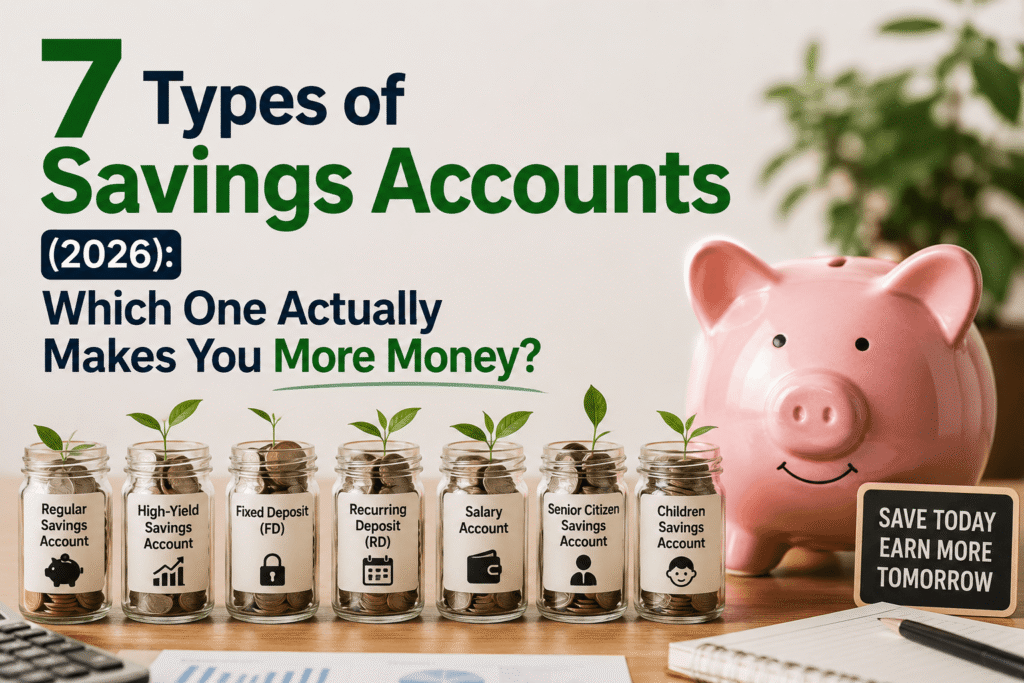
7 Types of Savings Accounts (2026):
Which One Actually Makes You More Money?
FN
Finance Navigator Pro
Editorial Team · 2026
🕑 18 min read
📄 7 Account Types
✅ FDIC Insured
⚡
Quick Answer
There are seven main types of savings accounts: traditional savings accounts, high-yield savings accounts (HYSAs), money market accounts, certificates of deposit (CDs), online savings accounts, kids/student savings accounts, and specialty goal-based accounts. The best one for you depends on your goal — if you want easy access and the highest return, a high-yield savings account or online savings account is hard to beat in 2026. If you’re saving for something specific on a fixed timeline, a CD could earn you more.
Quick Summary
| ✓ |
There are 7 major types of savings accounts, each built for a different purpose. |
| ✓ |
High-yield savings accounts (HYSAs) offer 4%–5%+ APY — 10x more than a traditional savings account at a big bank. |
| ✓ |
Money market accounts combine savings rates with checking-like features (debit cards, checks). |
| ✓ |
CDs lock your money for a set term in exchange for a guaranteed, often higher, interest rate. |
| ✓ |
Online savings accounts — offered by digital-only banks — typically have the best rates and lowest (or no) fees. |
| ✓ |
Kids’ and student savings accounts help minors build financial habits early, often with no minimums. |
| ✓ |
Specialty accounts let you save for a specific goal like a vacation, home, or wedding in a dedicated space. |
| ✓ |
All types covered here are FDIC-insured up to $250,000 per depositor — meaning your money is safe. |
What Is a Savings Account? (The Simple Version)
Let’s start with the basics before diving into the different types. A savings account is a deposit account held at a bank or credit union that earns interest on the money you store in it. Unlike a checking account — which you use for everyday spending — a savings account is designed to hold money you don’t need right away.
Think of it as a parking spot for your money where it actually earns something while it sits. You can typically make withdrawals whenever you need to, though some account types come with restrictions.
Here’s the thing a lot of people don’t realize: not all savings accounts are created equal. The difference between a traditional savings account at a big bank and a high-yield savings account at an online bank can be the difference between earning $5 a year and $250 a year on the same $5,000 balance. That’s not a typo — it really is that dramatic.
All the accounts we’ll cover in this guide are insured by the Federal Deposit Insurance Corporation (FDIC) — or by the NCUA if you’re banking through a credit union — up to $250,000 per depositor, per institution. That means your principal is protected, full stop.
The 7 Different Types of Savings Accounts (Explained)
1
Traditional Savings Account
A traditional savings account is what most people picture when they think about saving money. You open one at a local bank or credit union, deposit your money, and earn a modest interest rate. These accounts are offered by virtually every financial institution in the country — from big national banks like Chase and Bank of America to your local community bank.
What it is:
A basic, brick-and-mortar deposit account with easy access, minimal requirements, and a very low interest rate — typically between 0.01% and 0.50% APY as of 2026.
Who it’s best for:
People who value in-person banking relationships, beginners just starting their savings journey, or anyone who keeps emergency cash at the same bank where they have a checking account for easy transfers.
+ Pros
✓ Easy to open and manage — most major banks offer them
✓ Linked directly to your checking account for instant transfers
✓ No tech knowledge required
✓ Widely accessible — in-branch help available
− Cons
− Interest rates are very low — often just 0.01% APY at big banks
− Many have monthly maintenance fees or minimum balance requirements
− You’re leaving a lot of money on the table compared to better alternatives
👤 Real-life example:
Jennifer, 34, keeps $2,000 in her traditional savings account at her local bank because it’s linked to her checking account and she likes talking to the branch manager. It earned her about $0.20 in interest last year. She’s not maximizing returns, but she values the convenience.
2
High-Yield Savings Account (HYSA)
⭐ EDITOR’S TOP PICK 2026
If you’ve spent any time in personal finance circles, you’ve heard about high-yield savings accounts — and for good reason. These are the single best place to park your emergency fund or short-term savings in 2026, period.
What it is:
A federally insured savings account — typically offered by online banks or fintech companies — that pays a significantly higher interest rate than traditional accounts. In 2026, the top HYSAs are offering between 4.50% and 5.25% APY, compared to the national average of just 0.41% for regular savings accounts (according to the FDIC’s National Rates).
Who it’s best for:
Anyone building an emergency fund, saving for a short-term goal (vacation, car down payment), or simply wanting their idle cash to work harder. This is a great default account for most people.
+ Pros
✓ APY can be 10x–50x higher than traditional savings
✓ FDIC-insured — completely safe
✓ Easy to open online in minutes
✓ No or low fees at most providers
✓ Fully liquid — withdraw anytime
− Cons
− No physical branch access (usually)
− Rates are variable and can drop if the Federal Reserve cuts rates
− May have limits on monthly transfers (though federal rules eased in 2020)
👤 Real-life example:
Marcus, 28, moved his $10,000 emergency fund from his Chase savings account (earning 0.01% APY) to a high-yield savings account earning 5.00% APY. In one year, he earned $500 in interest instead of $1. He didn’t change his habits — he just changed where his money sat.
Where to look: Online banks like Ally Bank, Marcus by Goldman Sachs, and SoFi consistently offer competitive HYSA rates. Always compare current rates on the FDIC’s website before opening any account.
Pro tip: If you’re evaluating how much interest you could earn across different account types, our mortgage payment calculator can help you understand how interest math works across different financial products.
3
Money Market Account (MMA)
Money market accounts are the hybrid vehicles of the savings world. They combine the higher interest rates you’d expect from a savings account with the transactional features of a checking account.
What it is:
A deposit account that typically requires a higher minimum balance but offers checking-account features — like a debit card and the ability to write checks — alongside savings-account interest rates. These are FDIC-insured and offered by both traditional and online banks.
Who it’s best for:
People with a larger cash balance (typically $10,000+) who want flexibility to write checks or use a debit card without sacrificing interest earnings. Also great for business owners who need to keep operating cash accessible but working.
+ Pros
✓ Check-writing and debit card access
✓ Competitive interest rates, especially at online banks
✓ FDIC-insured — your money is safe
✓ Great for large, accessible cash reserves
− Cons
− Higher minimum balance requirements (often $1,000–$10,000)
− Some accounts still limit the number of withdrawals per month
− Not always worth it for smaller balances
👤 Real-life example:
Dana runs a small event planning business and keeps $25,000 in a money market account. She earns competitive interest on her balance and can write a check directly from the account when she needs to pay vendors — without moving money between accounts.
Important note: Don’t confuse a money market account (FDIC-insured, held at a bank) with a money market fund (an investment product, not FDIC-insured, held at a brokerage). They sound similar but are very different products.
4
Certificates of Deposit (CDs)
A CD is essentially a time-locked savings account. You agree to leave your money deposited for a fixed period — anywhere from 3 months to 5 years — and in exchange, the bank gives you a guaranteed, usually higher, interest rate.
What it is:
A time-deposit savings product where your money earns a fixed APY over a set term. In 2026, 1-year CDs from competitive banks are offering between 4.50% and 5.50% APY. At the end of the term (called “maturity”), you get back your principal plus all interest earned.
Who it’s best for:
People with a specific savings timeline — for example, saving for a house down payment in 18 months, or parking bonus money you don’t need until next year. CDs work best when you’re confident you won’t need the cash before the term ends.
+ Pros
✓ Guaranteed, fixed rate — not affected by Fed rate cuts
✓ Often the highest rates among savings products
✓ FDIC-insured up to $250,000
✓ Simple and predictable — you know exactly what you’ll earn
− Cons
− Your money is locked in — early withdrawal triggers a penalty
− No flexibility if you need the funds unexpectedly
− Rates don’t go up if market rates rise after you open
👤 Real-life example:
Priya, 42, received a $20,000 insurance payout and knows she wants to use it as a home down payment in exactly 12 months. Rather than leaving it in a savings account, she opens a 12-month CD at 5.10% APY. When it matures, she walks away with $21,020 — a clean, guaranteed $1,020 gain.
CD Laddering Strategy: Most people who use CDs strategically build a “CD ladder” — splitting money across multiple CDs with staggered maturity dates (e.g., 3-month, 6-month, 12-month, 24-month). This gives you regular access to some of your funds while still locking in higher rates. The Consumer Financial Protection Bureau (CFPB) has helpful tools for comparing deposit products.
Online savings accounts are technically a subcategory of savings accounts — but they deserve their own section because they’ve completely changed the landscape of personal savings. Online banks don’t have physical branches to maintain, which means their overhead is dramatically lower — and they pass those savings on to customers in the form of higher interest rates and lower fees.
What it is:
A savings account offered by a digital-only bank or fintech platform. These accounts are managed entirely through a website or mobile app. They’re FDIC-insured (either directly or through a partner bank), typically offer rates competitive with or higher than HYSAs, and usually come with zero monthly fees.
Who it’s best for:
Tech-comfortable savers who don’t need in-person banking, people who want the best rates with minimal fees, and anyone who manages their finances digitally anyway. In 2026, this describes most millennials and Gen Z adults.
+ Pros
✓ Best-in-class interest rates — typically 4.00% to 5.25% APY
✓ No monthly fees and no minimum balance at most providers
✓ User-friendly apps with savings buckets, auto-round-up, and goal tracking
✓ FDIC-insured through partner banks
✓ Easy to open — takes 5–10 minutes
− Cons
− No physical branch — all issues resolved online or by phone
− Cash deposits can be complicated or impossible
− Relies entirely on app/website functionality
👤 Real-life example:
Jordan, 26, opened an online savings account and set up an automatic transfer of $300 a month. The app shows her progress toward her 6-month emergency fund goal and breaks down her interest earned day by day. She’s never visited a bank branch and doesn’t feel like she needs to.
If you want to maximize your savings rate in 2026, pairing an online savings account with good budgeting habits is one of the most powerful combinations available to everyday Americans. Check out our guide on best investing apps to see how your savings can eventually grow into investments.
6
Kids’ and Student Savings Accounts
Teaching kids about money early is one of the most valuable financial gifts you can give. Kids’ and student savings accounts are specifically designed for minors (under 18) and young adults, with features that make saving accessible, low-pressure, and educational.
What it is:
A savings account designed for children or college students, usually opened jointly with a parent or guardian. These accounts typically have no minimum balance, no monthly fees, and sometimes offer small interest bonuses or educational tools. Many banks offer free accounts for minors that automatically transition to a standard account when the child turns 18.
Who it’s best for:
Parents who want to teach their kids financial literacy, minors with part-time job income, college students looking for a first savings account, or young adults who want a simple, low-stakes entry into banking.
+ Pros
✓ No fees and no minimums — perfect for small balances
✓ Teaches real money management habits from a young age
✓ Some accounts offer savings challenges and interest bonuses
✓ Great first step before introducing a checking account
− Cons
− Interest rates are typically low — this is a learning tool, not a wealth-building one
− Parental co-ownership means parents can access the account
− Limited features compared to adult accounts
👤 Real-life example:
Tom and Linda opened a kids’ savings account for their 10-year-old daughter, Maya, at their local credit union. Maya deposits her birthday money and a portion of her babysitting earnings. She checks her balance on the bank’s app and gets excited every time she sees her balance grow — a habit that’ll serve her for life.
Many credit unions and community banks offer excellent options for minors. Look for accounts with no minimum balance, no monthly fee, and strong financial education resources. The FDIC’s MoneySmart program is a free resource worth bookmarking if you’re raising financially aware kids.
7
Specialty and Goal-Based Savings Accounts
Sometimes the best way to save for something specific is to give that money its own home. Specialty and goal-based savings accounts — sometimes called “savings buckets” or “sub-accounts” — let you label and segment your money for a particular purpose.
What it is:
A savings account (or a feature within a savings account) that’s designated for a specific financial goal: a vacation, a wedding, a home down payment, a new car, or even holiday gifts. Some banks offer this as separate accounts; others build it as virtual “envelopes” within a single account. A few worth mentioning specifically:
Health Savings Accounts (HSAs): These are tax-advantaged accounts paired with a High-Deductible Health Plan. Contributions are tax-deductible, growth is tax-free, and withdrawals for qualified medical expenses are also tax-free. That’s a triple tax advantage — and unused funds can be invested.
529 College Savings Plans: Tax-advantaged accounts specifically for educational expenses. Funds grow tax-free when used for qualified education costs. If you have children, this is worth looking into early.
First-Home Savings / Down Payment Savings: Some states offer special programs or matching accounts for first-time homebuyers. These are worth researching through your state housing finance agency.
Who it’s best for:
Goal-oriented savers who struggle with “out of sight, out of mind” budgeting. When your vacation fund is named “Cancun 2026” and lives in its own account, you’re far less likely to raid it for impulse purchases.
+ Pros
✓ Psychological clarity — you know exactly what you’re saving for
✓ Prevents mixing goal money with emergency cash
✓ Tax advantages in some specialty account types (HSA, 529)
✓ Many modern banks offer this feature at no extra cost
− Cons
− Can get complicated if you have too many accounts
− Not all banks offer true sub-accounts
− Some specialty accounts (HSA, 529) come with restrictions on how funds are used
👤 Real-life example:
Carlos and his wife have three savings “buckets” inside their online bank: one for their emergency fund, one labeled “Europe Trip 2026,” and one for their eventual home down payment. Seeing each goal visually helps them stay motivated and resist unnecessary spending.
Savings Account Comparison Table (2026)
| Account Type |
Avg. Interest Rate |
Liquidity |
Risk Level |
Best For |
| Traditional Savings |
0.01%–0.50% |
High |
Very Low |
Basic emergency fund |
| High-Yield Savings ⭐ |
4.50%–5.25%* |
High |
Very Low |
Emergency fund, short-term goals |
| Money Market Account |
0.50%–5.00%* |
High (w/ limits) |
Very Low |
Large balances, bill payments |
| Certificate of Deposit |
4.50%–5.50%* |
Low (penalty) |
Very Low |
Fixed-term savings goals |
| Online Savings Account |
4.00%–5.25%* |
High |
Very Low |
Everyday savings, tech-savvy savers |
| Kids/Student Savings |
0.01%–3.00% |
High |
Very Low |
Teaching money habits, minors |
| Specialty/Goal-Based |
Varies |
Medium |
Very Low |
Vacation, wedding, home down payment |
*Rates shown are approximate and based on top competitive offerings in early 2026. Check FDIC.gov for current national average rates. Individual bank rates may vary.
Which Savings Account Is Best for You?
Here’s the honest answer: the “best” savings account is the one that matches your actual goal. Most people don’t need just one — they need a combination. Here’s how to think about it by scenario.
🏠 Building an Emergency Fund
Your emergency fund should be liquid — meaning you can access it immediately if needed — and earning as much interest as possible. The clear winner here is a high-yield savings account or online savings account. Keep 3–6 months of living expenses here. Don’t put your emergency fund in a CD — if your car breaks down, you don’t want to pay an early withdrawal penalty to access your own money.
🎯 Short-Term Goal (Under 2 Years)
A HYSA or short-term CD works well here. If you know the exact date you’ll need the money (like paying for a wedding next October), a 6–12 month CD with a locked-in rate is smart. If the timeline is fuzzy, stick with a HYSA for flexibility.
📈 Long-Term Goals (2–5 Years)
Consider a CD ladder or a combination of a HYSA and CDs. If you’re saving for a home down payment, you want your money to grow at a competitive rate while remaining accessible within your planned timeline. Check out our investing apps comparison when you’re ready to level up.
👤 Teaching Kids to Save
Open a kids’ or student savings account as soon as possible. The interest rate is almost irrelevant at this stage — what matters is building habits. Joint accounts at credit unions often have the best perks for young savers.
💵 Large Cash Reserves You Access Regularly
A money market account is your best bet if you regularly write large checks or need more transactional flexibility than a standard savings account offers. Businesses and freelancers with variable income especially benefit from MMAs.
How to Choose the Right Savings Account (Step-by-Step)
Not sure where to start? Walk through these steps and you’ll have a clear answer in under 10 minutes.
1
Define your savings goal.
Are you building an emergency fund? Saving for a specific purchase? Trying to grow a long-term nest egg? Write it down. Your goal determines everything else — the account type, the timeline, and how much flexibility you need.
2
Decide how long you can leave the money alone.
If you might need the money within the next few months, you need full liquidity (HYSA or online savings). If you won’t touch it for a year or more, a CD might earn you more.
3
Compare interest rates — seriously.
The national average for traditional savings accounts is around 0.41% APY. The top HYSAs are offering 4.50%–5.25% APY. On a $10,000 balance, that’s the difference between earning $41 and $500 in a year. Use the FDIC’s rate comparison tool as a reference point.
4
Check for fees and minimum balance requirements.
A 5.00% APY is worthless if you’re paying a $25 monthly maintenance fee. Look for accounts with no monthly fees and no (or low) minimum balance requirements. Online banks and credit unions are usually the best here.
5
Evaluate access and convenience.
Do you need a physical branch? Do you prefer a mobile app? Will you need a debit card or check-writing ability? Traditional banks win on access; online banks win on rates and fees. Be honest about what matters to you.
6
Confirm FDIC or NCUA insurance.
Every bank and credit union on this list should be federally insured. Always verify at FDIC BankFind before opening an account with any institution you’re not familiar with.
7
Set up automatic contributions.
Once you’ve opened your account, automate it. Set up a recurring transfer from your checking account on the day after your paycheck hits. Automating savings is the single most effective habit you can build — even $50 a week adds up to $2,600 in a year, plus interest.
Real-Life Savings Scenarios: What Would You Do?
Sometimes the best way to understand something is to see it in action. Here are five realistic scenarios — and the savings account strategy that makes the most sense for each.
Scenario 1 · Sarah, 31
Building Her First Emergency Fund
Sarah has $0 in savings and just landed a job paying $55,000/year. She wants to build a 3-month emergency fund (~$8,000) over the next 18 months.
Best approach: Open a high-yield savings account at an online bank with no fees. Set up an automatic transfer of $445/month from her checking account. In 18 months, she’ll hit her $8,000 goal and earn roughly $200–$300 in interest along the way.
Scenario 2 · Mike, 45
Parking His Year-End Bonus
Mike received a $15,000 performance bonus in January. He doesn’t need it for day-to-day expenses and wants it to grow — but he’s also planning to use it for a home renovation in about 14 months.
Best approach: A 12-month CD at 5.00% APY. He’ll earn $750 guaranteed by maturity, and the fixed rate protects him if the Fed cuts rates in the next year.
Scenario 3 · The Rodriguezes
Saving for Their Kids’ Future
David and Maria have two kids, ages 8 and 12. They want to start building savings for college and teach the kids about money.
Best approach: Open a 529 college savings plan for each child (tax-advantaged growth for education) and a kids’ savings account for each as their “spending money” account. The kids deposit birthday money and allowances — they can see the balance grow and learn how interest works.
Scenario 4 · Nia, 27
Saving for a Down Payment
Nia wants to buy a condo in 3 years. She has $8,000 saved and can add $700/month. She needs the money to grow but doesn’t want any risk.
Best approach: A combination strategy. Keep 3 months of emergency savings in an HYSA. Put her down payment savings in a CD ladder — $5,000 in a 12-month CD, $5,000 in an 18-month CD, $5,000 in a 24-month CD — so funds mature at staggered intervals while earning strong rates.
Scenario 5 · Derek, 38
Freelancer Needing Flexibility
Derek is a self-employed graphic designer with variable income. He brings in $6,000–$10,000/month but needs to pay business expenses and quarterly taxes. He wants his cash working for him between projects.
Best approach: A money market account with a high balance threshold. He can write checks for large vendor payments directly, earns competitive interest on his working capital, and keeps everything in one accessible account.
HYSA vs. CD vs. Money Market Account: Which Wins?
These three are the most commonly compared options — so let’s cut straight to it.
If you need flexibility and the highest possible liquid return: HYSA wins. You get rates nearly as good as CDs with no lock-in period.
If you have a fixed timeline and want a guaranteed rate: CD wins — especially if you’re worried rates might drop. Locking in 5.10% for 12 months while the Fed is cutting rates is a smart move.
If you have a large balance and need transactional features: Money market account wins. You get check-writing, a debit card, and competitive rates on a balance that’s meant to be used, not locked away.
The reality is that most financially healthy households use a combination: an HYSA for the emergency fund, CDs for fixed-timeline goals, and possibly a money market account if business or large-scale cash management is involved.
Common Savings Account Mistakes to Avoid
Even smart people make these errors. Knowing them upfront can save you hundreds — or thousands — of dollars.
⚠
Keeping too much at a big bank. Leaving $20,000 in a Chase or Wells Fargo savings account at 0.01% APY instead of a HYSA at 4.50% APY costs you roughly $900 per year in lost interest. That’s a very expensive habit.
⚠
Using your emergency fund as a CD. Locking your emergency savings in a CD is a trap. If something unexpected happens, you’ll pay an early withdrawal penalty on the money you needed most.
⚠
Ignoring fees. A $15 monthly maintenance fee wipes out $180 a year of interest earnings. Always look for no-fee accounts before opening anything.
⚠
Opening too many accounts. Having 7 different savings accounts at 4 different banks is a logistical nightmare. Pick one or two institutions and use their sub-account or bucket features for goal separation.
⚠
Not automating contributions. Waiting until the end of the month to “see what’s left” to save is the fastest way to save nothing. Automate on payday and save first, spend second.
⚠
Forgetting to shop for better rates annually. The best rate today might not be the best rate in 6 months. Set a calendar reminder to review your savings account rates once or twice a year.
A Note on Financial Safety: What You Need to Know
Every savings account type covered in this guide falls under either FDIC insurance (for banks) or NCUA insurance (for credit unions) — up to $250,000 per depositor, per institution, per account category. This is a federal government guarantee, meaning even if your bank fails, your money is protected.
If you have more than $250,000 to save, you can extend your coverage by spreading funds across multiple institutions or account categories (e.g., individual, joint, retirement). The FDIC’s Electronic Deposit Insurance Estimator (EDIE) is a free tool that shows you exactly how much of your deposits are covered.
One more thing: interest earned in savings accounts is taxable income. Your bank will send you a 1099-INT form if you earn $10 or more in interest during the year, and you’ll need to report it on your federal tax return. The only exceptions are certain tax-advantaged accounts (like HSAs and 529s). For more details, refer to the IRS guidance on interest income.
Frequently Asked Questions About Savings Accounts
What type of savings account earns the most interest?
In 2026, high-yield savings accounts (HYSAs) and online savings accounts offered by digital banks are earning the highest rates on liquid savings — between 4.50% and 5.25% APY at top institutions. Among time-deposit products, 1-year CDs can offer slightly higher rates but require you to lock your money in for the full term.
Is a CD better than a savings account?
It depends on your situation. A CD typically offers a slightly higher guaranteed rate, but your money is locked in for the full term. An HYSA offers nearly comparable rates with full liquidity. If you know you won’t need the money for a specific period, a CD can be better. If you value flexibility, an HYSA is usually the smarter choice. Many people use both.
Can I lose money in a savings account?
No — as long as your money is held at an FDIC-insured bank or NCUA-insured credit union. Your principal is federally guaranteed up to $250,000 per depositor, per institution. The only way you’d “lose” money is through fees (which is why no-fee accounts matter), or if you accidentally overdraft a linked checking account. Your savings account balance itself cannot go negative.
How many savings accounts should I have?
Most financial experts suggest one primary savings account for your emergency fund (a HYSA works well) and optionally one or two goal-specific accounts. Beyond three savings accounts, management gets complicated. Many online banks now offer savings “buckets” within a single account — a much simpler solution than opening separate accounts at multiple banks.
What’s the difference between an online savings account and a high-yield savings account?
These terms are often used interchangeably — and in most cases, they’re the same thing. Most high-yield savings accounts are offered by online banks. Technically, some traditional banks offer high-yield savings options too, but the best rates are almost exclusively found at online-only institutions that can operate with lower overhead costs.
Is a money market account the same as a money market fund?
Absolutely not — and this confusion trips people up constantly. A money market account is an FDIC-insured deposit account at a bank. A money market fund is an investment product held at a brokerage — it’s not FDIC-insured and carries (minimal but real) investment risk. They serve similar short-term cash management purposes but are completely different products with very different protections.
When should I move from a savings account to investing?
The general rule of thumb is: once your emergency fund is fully funded (3–6 months of expenses in a HYSA) and you have no high-interest debt, you can start directing additional savings toward investments. Our guide to the best investing apps is a great place to start that conversation with yourself.
Are savings account interest rates going up or down in 2026?
The Federal Reserve’s monetary policy decisions directly influence savings account rates. As of early 2026, rates remain elevated compared to pre-2022 levels, though the Fed has begun a gradual rate-cutting cycle. If rates continue to fall, HYSA and CD rates will likely decline — which is exactly why locking in a CD now (if you have the timeline for it) can be advantageous. Follow the Federal Reserve’s rate decisions to stay informed.
What is the minimum to open a savings account?
Many online banks and credit unions now offer savings accounts with no minimum deposit requirement — you can literally open an account with $1. Traditional banks often require $25–$100 to open, and some money market accounts require $1,000 or more to avoid fees or earn the advertised rate. Always check the minimum before applying.
Are my savings protected if a bank fails?
Yes — FDIC insurance protects you up to $250,000 per depositor, per institution, per account ownership category. This is a federal guarantee backed by the U.S. government. In the event a bank fails, the FDIC steps in and either transfers your account to another bank or sends you a check within a few business days. You can verify any bank’s insurance status at FDIC BankFind Suite.
Final Thoughts: Your Money Deserves a Better Home
Here’s the bottom line: the best savings account is the one that matches your goal — not the one with the flashiest marketing or the biggest bank name.
For most Americans, moving idle savings from a 0.01% big-bank account into a high-yield savings account is the single highest-impact, zero-risk financial move you can make in 2026. You’re not taking on any extra risk. You’re not locking anything up. You’re just choosing a better parking spot for your money — one that actually pays you while you wait.
If you’re building an emergency fund, an HYSA is your answer. If you’re saving for a specific goal on a fixed timeline, consider a CD. If you need flexibility and transactional features, a money market account has you covered. And if you’re starting to think beyond savings accounts — toward investing — make sure your emergency fund base is solid first.
Most importantly: don’t let perfect be the enemy of good. If you’ve been meaning to open a better savings account for months and keep putting it off, just pick one today. The difference between a perfect choice and a good choice is small. The difference between a good choice and no choice is enormous.
Your future self will thank you for the $200, $500, or $1,000 in extra interest you didn’t leave behind.
📚 Keep Reading on Finance Navigator Pro
Editorial Disclosure: This article is for informational purposes only and does not constitute financial advice. Interest rates cited are approximate and subject to change. Always verify current rates directly with financial institutions and confirm FDIC/NCUA insurance status before opening any account. Finance Navigator Pro may receive compensation through affiliate relationships with financial products mentioned herein, at no additional cost to readers.