

Guide to Costs, Coverage, Benefits & How to Choose the Right Policy
Quick Answer
What Is Final Expense Insurance?
Final expense insurance is a type of whole life insurance designed for adults aged 45–85 who want to cover funeral costs and end-of-life expenses. Policies typically range from $2,000 to $50,000, require no medical exam, and pay a guaranteed tax-free cash death benefit directly to your chosen beneficiary. Coverage is permanent — it never expires as long as premiums are paid.
Nobody likes thinking about funeral costs. But planning ahead can spare your loved ones from financial stress during one of life’s hardest moments. The average American funeral now runs between $8,000 and $12,000 — and that doesn’t count the unexpected medical bills, hospice care, or outstanding debts that often pile up at the end of life.
Final expense insurance exists to handle exactly those costs. It’s a straightforward, affordable life insurance policy designed to cover the bills that arrive after you’re gone — so your family can grieve without worrying about how to pay for it.
In this guide, you’ll learn everything you need to know: what final expense insurance covers, how much it costs, who qualifies, which companies offer the best policies, and how to decide whether it’s right for you. Whether you’re shopping for yourself or helping a parent plan ahead, you’ll have the answers you need to make a smart decision.
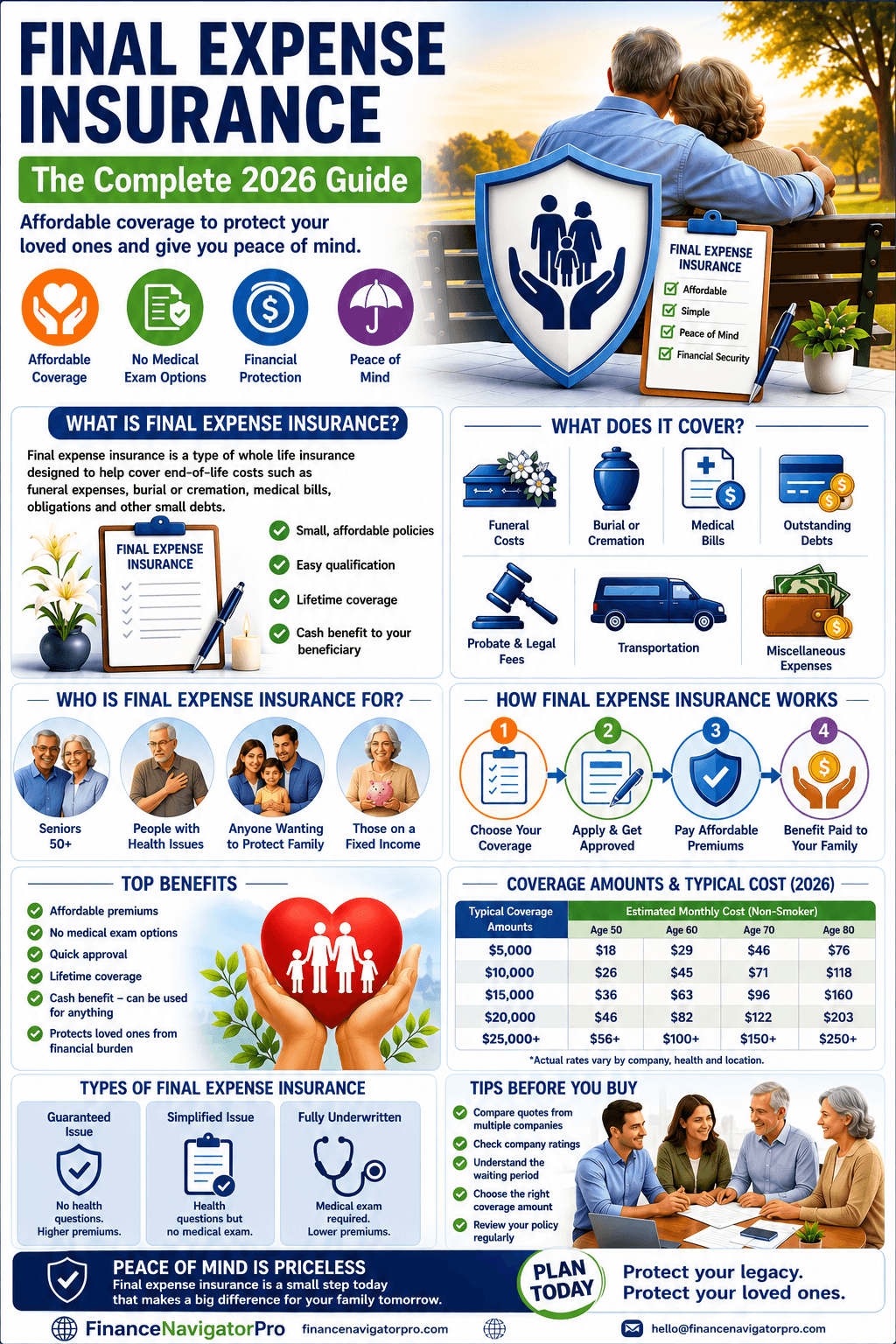
Final expense insurance at a glance: coverage, costs, and how it works
What Is Final Expense Insurance?
Final expense insurance — sometimes called burial insurance or funeral insurance — is a small whole life insurance policy designed to cover the costs associated with death. Unlike term life insurance, which expires after a set number of years, final expense policies are permanent. They stay in force for your entire life, as long as you keep paying the premiums.
The death benefit — the amount paid to your beneficiary when you die — is usually between $2,000 and $50,000. It’s not meant to replace your income or support a family for decades. It’s meant to cover one thing: the financial burden that comes with dying.
These policies are especially popular with seniors and retirees because they’re easy to qualify for (most require no medical exam), the premiums are fixed and won’t increase, and the benefit is guaranteed to be paid no matter when you die.
How Does Final Expense Insurance Work?
The process is simpler than most people expect. Here’s how it works from start to finish:
Apply online, over the phone, or through a licensed insurance agent. Most applications take 15–30 minutes.
Answer a few health questions (for simplified issue policies) or simply confirm your age (for guaranteed issue). No blood tests. No physicals.
Get approved — often the same day or within a few days.
Begin paying monthly or annual premiums. Rates are locked in and never increase.
Coverage begins immediately for most simplified issue policies. Guaranteed issue policies may have a waiting period of 2 years before full benefits apply.
When you pass away, your beneficiary files a claim with the insurance company.
The insurance company pays the death benefit — a tax-free lump sum — directly to your beneficiary, usually within a few days to a few weeks.
Your beneficiary uses the money however they choose: funeral costs, medical bills, debts, or anything else.
That’s it. There’s no complicated investment component, no stock market risk, and no confusion about how the benefit is paid.
What Does Final Expense Insurance Cover?
The death benefit is paid as cash — your beneficiary can use it for any purpose. Most families apply it toward the following expenses:
Funeral & Burial Costs
✓ Funeral home services & director fees
✓ Burial or cremation costs
✓ Casket or urn purchase
✓ Burial vault or grave liner
✓ Cemetery plot or niche
✓ Headstone or grave marker
✓ Flowers and memorial décor
✓ Obituary notices
✓ Transportation and hearse fees
✓ Memorial or graveside service
✓ Reception, catering, and gathering costs
Medical & End-of-Life Expenses
✓ Outstanding hospital or medical bills
✓ Hospice and palliative care costs
✓ Prescription drug balances
✓ Home health aide fees
Outstanding Debts & Legal Costs
✓ Credit card balances
✓ Personal loan balances
✓ Probate attorney fees
✓ Estate settlement costs
✓ Utility and housing bills left unpaid
Key Takeaway
Your beneficiary receives the money as a lump-sum cash payment — not a check made out to a funeral home. This gives your family full control over how the funds are used and which providers they work with.
What Doesn’t Final Expense Insurance Cover?
Final expense insurance is straightforward, but there are a few exclusions and limitations to know before you buy:
The Contestability Period
Most policies include a two-year contestability period. If you pass away within the first two years of the policy and the insurer discovers that you provided false information on the application, they can deny the claim or reduce the benefit. After two years, they generally cannot contest the claim.
The Suicide Clause
Most policies won’t pay the death benefit if the insured dies by suicide within the first one to two years of the policy. After that exclusion period, death by suicide is typically covered.
Missed Premium Payments
If you stop paying premiums and your policy lapses, coverage ends. Some policies include a grace period of 30 days. If you miss a payment, contact your insurer immediately — many policies can be reinstated if you catch up within a certain window.
Fraud or Misrepresentation
Providing false information on your application — about your age, health history, or lifestyle — can result in a denied claim at any time, including after the contestability period ends.
Who Should Buy Final Expense Insurance?
Final expense insurance is designed for a specific group of people. It’s not the right fit for everyone — but for many American families, it’s an affordable and practical solution.
Seniors and Retirees (Ages 50–85)
If you’re on a fixed income and don’t have substantial savings set aside for end-of-life costs, final expense insurance gives you peace of mind at an affordable monthly premium. It’s one of the few policies available without a medical exam to people in their 70s and 80s.
People with Pre-Existing Health Conditions
Diabetics, cancer survivors, people with heart disease, COPD, or other chronic conditions often can’t qualify for traditional life insurance — or face prohibitive premiums. Guaranteed issue final expense policies accept anyone aged 45–85 without health questions.
Smokers
Smokers pay higher premiums for most life insurance products. Final expense policies are available to smokers, often at rates that are still manageable, and guaranteed issue options don’t ask about tobacco use at all.
Veterans
Veterans may have access to burial benefits through the VA, including burial allowances and cemetery plots. However, VA benefits may not cover the full cost of a civilian funeral. A supplemental final expense policy can close that gap. If you’re a veteran exploring your financial options, see also our guide to personal loans for veterans.
Single Adults Without Dependents
Even if no one is depending on your income, someone will still face your end-of-life bills. Final expense insurance ensures your debts and funeral costs don’t become someone else’s problem.
Parents or Grandparents Buying for Elderly Relatives
Adult children can purchase final expense insurance on behalf of a parent or grandparent with the insured’s knowledge and consent. This is a common approach when a parent doesn’t have the ability or initiative to apply themselves.
People Without Life Insurance Savings
If you don’t have a life insurance policy and don’t have enough liquid savings to cover a $10,000–$15,000 funeral, final expense insurance fills that gap at a cost that fits almost any budget. Consider building an emergency fund alongside your policy for complete financial protection.
Who This Is For
Final expense insurance is best suited for adults between ages 50 and 85 who want permanent coverage without a medical exam, especially those on fixed incomes, with health challenges, or without savings earmarked for funeral costs.
Types of Final Expense Insurance
Not all final expense policies work the same way. There are three main types, and choosing the right one depends on your health and budget.
Simplified Issue Final Expense Insurance
This is the most common type. You’ll answer a short list of health questions — typically about serious conditions like cancer, HIV, organ transplants, or hospitalization within the past 12 months — but no medical exam is required.
Pros: Lower premiums, immediate coverage, higher benefit amounts available
Cons: Some health conditions may disqualify you or trigger a waiting period
Guaranteed Issue Final Expense Insurance
You cannot be turned down. No health questions, no medical exam — just confirm your age (typically 45–85). This is the option for people with serious health conditions who can’t qualify elsewhere.
Pros: Guaranteed acceptance, no health questions, permanent coverage
Cons: Higher premiums, lower coverage limits, and a 2-year graded death benefit period
Level Benefit Policies
From day one, your full death benefit is active. If you die on day two of the policy, your family receives 100% of the benefit. These are available through simplified issue policies to applicants who pass the health screening.
Graded Benefit Policies
During the first two years, the benefit is limited — often 110% of premiums paid, plus interest, rather than the full face value. After year two, the full benefit kicks in. Graded benefits are common in guaranteed issue policies.
Modified Benefit Policies
Similar to graded, but the benefit structure varies by insurer. Some pay a percentage of the face value in year one (e.g., 30%), a higher percentage in year two (e.g., 70%), and 100% from year three onward.
| Policy Type | Health Questions? | Waiting Period? | Best For |
|---|---|---|---|
| Simplified Issue | Yes (a few) | Usually none | Most applicants in good-to-fair health |
| Guaranteed Issue | None | 2 years (graded) | Serious health conditions |
| Level Benefit | Yes | None | Healthy applicants wanting immediate full coverage |
| Graded Benefit | Sometimes | 2 years | Moderate health issues |
| Modified Benefit | Sometimes | 1–3 years | Higher-risk applicants |
How Much Final Expense Insurance Do You Need?
The right coverage amount depends on your personal situation. Here’s a simple framework to estimate your needs:
| Factor | Low Estimate | High Estimate |
|---|---|---|
| Funeral & burial costs | $7,000 | $15,000 |
| Medical bills (final illness) | $2,000 | $8,000 |
| Hospice care not covered by Medicare | $1,000 | $5,000 |
| Outstanding credit card debt | $0 | $10,000 |
| Personal loans or other debts | $0 | $10,000 |
| Legal/probate costs | $500 | $3,000 |
| Small legacy for family | $0 | $5,000 |
| Total Estimated Need | $10,500 | $56,000 |
Most families find that a policy between $10,000 and $25,000 covers their needs comfortably. Here’s what different amounts cover in practice:
$10,000 – Covers a basic cremation, outstanding medical co-pays, and small debts
$15,000 – Covers a modest funeral with burial, plus minor outstanding bills
$20,000 – Covers a full traditional funeral and burial, plus medical bills
$25,000 – Covers all end-of-life expenses with a small remainder for family
$30,000–$40,000 – Adds a financial cushion for a surviving spouse or dependents
$50,000 – Provides for a full funeral, outstanding debts, and a meaningful legacy gift
Average Funeral Costs in America (2026)
According to the National Funeral Directors Association (NFDA), funeral costs have risen steadily over the past decade. Here’s what a typical American family can expect to spend:
| Service / Item | Cremation | Traditional Burial |
|---|---|---|
| Basic services fee | $2,300 | $2,300 |
| Embalming / body preparation | Not required | $750 |
| Casket | Not required | $2,500–$5,000 |
| Urn (cremation container) | $200–$500 | N/A |
| Burial vault or grave liner | N/A | $1,400 |
| Cemetery plot | N/A | $1,000–$4,000 |
| Niche (for ashes) | $1,000–$3,000 | N/A |
| Grave marker / headstone | $500–$3,000 | $500–$3,000 |
| Hearse / transportation | $350 | $350 |
| Funeral service / visitation | $500 | $500 |
| Memorial reception / catering | $500–$2,000 | $500–$2,000 |
| Flowers | $200–$700 | $200–$700 |
| Obituary notice | $200–$500 | $200–$500 |
| Estimated Total | $5,000–$10,000 | $10,000–$20,000 |
Expert Insight
Prices vary significantly by state and by funeral home. Urban areas and coastal states tend to run 20–40% higher than rural areas. Getting multiple quotes from funeral homes in advance is one of the best ways your family can save money when the time comes.
How Much Does Final Expense Insurance Cost?
Premiums vary based on your age, gender, health, coverage amount, and whether you smoke. The following table shows estimated monthly premiums for a $15,000 simplified issue final expense policy:
| Age | Female (Non-Smoker) | Male (Non-Smoker) | Female (Smoker) | Male (Smoker) |
|---|---|---|---|---|
| 50 | $28–$38 | $34–$46 | $38–$52 | $48–$64 |
| 55 | $33–$45 | $42–$58 | $46–$62 | $58–$78 |
| 60 | $42–$56 | $54–$72 | $58–$78 | $74–$98 |
| 65 | $55–$74 | $70–$94 | $76–$102 | $96–$128 |
| 70 | $75–$98 | $96–$126 | $104–$138 | $132–$174 |
| 75 | $102–$136 | $132–$176 | $142–$188 | $178–$238 |
| 80 | $148–$196 | $192–$256 | $204–$272 | $258–$342 |
Factors That Affect Your Premium
Understanding what drives your premium helps you make smart decisions — including when to buy.
Age
Age is the single biggest factor. Premiums increase with every year you wait. A 60-year-old pays roughly 40–60% less per month than a 70-year-old for the same coverage.
Gender
Women statistically live longer and therefore represent lower risk to insurers. Women typically pay 15–25% less than men for the same policy.
Health History
For simplified issue policies, your answers to health questions affect your eligibility and rate. Certain conditions (recent cancer, dialysis, dementia, confinement to a nursing home) may disqualify you from simplified issue and push you toward a guaranteed issue policy with higher premiums and a waiting period.
Smoking Status
Smokers typically pay 30–50% more than non-smokers for the same coverage. If you quit, some insurers will reclassify you as a non-smoker after 12–24 months without tobacco use.
Coverage Amount
Higher coverage means higher premiums. But the relationship isn’t always linear — getting a $20,000 policy isn’t always twice the cost of a $10,000 policy.
Policy Type
Guaranteed issue policies cost more than simplified issue policies for the same coverage amount, because the insurer is taking on more risk by not screening for health conditions. Understanding what insurance coverage you actually need is the first step to not overpaying.
State of Residence
Insurance is regulated at the state level. Premiums can vary by 10–20% depending on which state you live in, due to differences in regulation, cost of living, and insurer availability.
Best Age to Buy Final Expense Insurance
The honest answer is: the sooner you buy, the less you pay. Premiums are locked in at the age you purchase. Every year you wait means a higher monthly payment for the rest of your life.
Here’s an example using a $15,000 policy for a non-smoking woman:
| Age at Purchase | Monthly Premium | Total Paid Over 15 Years |
|---|---|---|
| 55 | $37/mo | $6,660 |
| 65 | $64/mo | $11,520 |
| 75 | $119/mo | $21,420 |
Buying at 55 instead of 75 saves over $14,000 in total premiums over 15 years, while delivering the same $15,000 death benefit. The sweet spot for most people is between ages 55 and 65, when premiums are still manageable and coverage is easy to obtain.
Pro Tip
Don’t wait until your health declines to buy. Applying while you’re in good health gives you access to simplified issue policies with lower rates and no waiting period. Once a serious health event occurs, you may be limited to more expensive guaranteed issue options.
Is Final Expense Insurance Worth It?
This is the question everyone should ask before buying. The honest answer depends on your personal situation.
✔ When It’s Worth It
You don’t have savings to cover a $10,000–$15,000 funeral
You want to spare your family from financial stress
Health conditions prevent qualifying for traditional life insurance
You’re on a fixed income needing predictable premiums
You’re over 65 and don’t want to leave a financial burden
✖ When It May Not Be Best
You have significant savings to cover funeral costs easily
You have an existing whole or term life policy with adequate coverage
You’re in excellent health and could qualify for a larger, cheaper policy
You’re under 50 — term life may be more economical
The Bottom Line
For most seniors and retirees without substantial savings, final expense insurance delivers real value: guaranteed coverage, fixed premiums, no medical exam, and the certainty that your family won’t be left scrambling. The peace of mind alone is worth it for millions of Americans.
Final Expense Insurance vs Other Life Insurance Options
Understanding how final expense insurance stacks up against other life insurance products helps you make the right choice for your situation.
| Product | Coverage | Medical Exam? | Premiums | Best For |
|---|---|---|---|---|
| Final Expense Insurance | $2K–$50K | No | Fixed, affordable | Seniors, end-of-life costs |
| Term Life Insurance | $100K–$1M+ | Usually yes | Low (temporary) | Younger adults with dependents |
| Whole Life Insurance | $50K–$1M+ | Usually yes | Higher, fixed | Long-term wealth transfer |
| Universal Life Insurance | $50K–$1M+ | Usually yes | Flexible | Flexible premium needs |
| Burial Insurance (same as final expense) | $2K–$25K | No | Fixed, affordable | Basic funeral coverage |
| Accidental Death Insurance | $25K–$500K | No | Very low | Accidental death only |
Variable Universal Life (VUL) is worth a special mention. A VUL policy combines permanent life insurance with investment sub-accounts — similar to mutual funds. Unlike final expense insurance, VUL requires a full underwriting process, larger premiums, and active management of the investment component. For a healthy 45-year-old who wants both permanent coverage and market-linked growth potential, a VUL might be worth exploring. For a 70-year-old on a fixed income looking to cover funeral costs, final expense insurance is the far simpler and more appropriate choice. Before deciding, compare the basics of saving vs. investing to understand where insurance fits in your overall financial plan.
Final Expense Insurance vs Burial Insurance
Many people use these terms interchangeably — and that’s completely fine, because they’re essentially the same thing. Both refer to small whole life policies designed to cover end-of-life costs without a medical exam.
If there’s any distinction, it’s in marketing: ‘burial insurance’ tends to be used by companies targeting consumers who think primarily about funeral and burial costs, while ‘final expense insurance’ is a broader term that signals coverage for all end-of-life expenses, including medical bills, debts, and probate fees. When shopping, don’t let the name confuse you. Focus on the policy terms, the coverage amount, the premium, the company’s financial strength rating, and whether there’s a waiting period.
Final Expense Insurance vs Prepaid Funeral Plans
A prepaid funeral plan (sometimes called a pre-need plan) lets you arrange and pay for your funeral in advance, locking in today’s prices with a specific funeral home. Here’s how the two compare:
| Feature | Final Expense Insurance | Prepaid Funeral Plan |
|---|---|---|
| Who controls the money? | Your beneficiary | The funeral home |
| Flexibility in how funds are used? | Yes — any purpose | No — specific funeral home only |
| Portability if you move? | Yes | Difficult — tied to one funeral home |
| Cash value growth? | Yes (modest) | No |
| Beneficiary receives cash? | Yes | No — services rendered |
| What if funeral home closes? | Unaffected — cash goes to beneficiary | Risk of loss (varies by state) |
Final expense insurance is generally more flexible and gives your family more control. Prepaid plans can make sense if you have very specific wishes about your funeral and you trust the funeral home — but they come with real risks if the home goes out of business or if your family’s circumstances change.
Best Final Expense Insurance Companies (2026)
Several reputable insurers specialize in final expense policies. Here’s a comparison of the top companies based on financial strength, product features, and customer satisfaction:
| Company | Best For | AM Best Rating | Medical Exam? | Coverage Range |
|---|---|---|---|---|
| Mutual of Omaha | Overall value | A+ (Superior) | No | $2K–$40K |
| Transamerica | Seniors with health conditions | A (Excellent) | No | $1K–$50K |
| AIG/American General | Guaranteed acceptance | A (Excellent) | No | $5K–$25K |
| AARP/New York Life | AARP members | A++ (Superior) | No | $2,500–$50K |
| Foresters Financial | Riders & benefits | A (Excellent) | No | $5K–$35K |
| Baltimore Life | No waiting period options | A- (Excellent) | No | $1K–$50K |
| Royal Neighbors | Female policyholders | A- (Excellent) | No | $5K–$30K |
| Gerber Life | Guaranteed acceptance | A (Excellent) | No | $5K–$25K |
Important Note
AM Best ratings reflect financial strength — a company’s ability to pay claims. Always choose a company rated A- or higher by AM Best. A low premium from a financially weak insurer is not a bargain if they can’t pay your family’s claim. Understanding how insurance quotes are calculated can help you compare offers more accurately.
How to Choose the Right Final Expense Policy
With so many options, here’s a practical checklist to guide your decision:
☐ Coverage Amount
Estimate your total end-of-life costs (funeral, debts, medical bills). Choose a coverage amount that covers your estimates with a small buffer.
☐ Premium Affordability
Make sure the monthly premium fits comfortably in your budget. Remember — this is a permanent commitment. Don’t buy more than you can sustain.
☐ Company Financial Strength
Only consider companies rated A- or better by AM Best. Check the insurer’s track record for claims payment and customer service.
☐ Waiting Period
If your health is good, look for simplified issue policies with immediate coverage. If you have serious health conditions, a guaranteed issue policy with a 2-year graded period may be your only option.
☐ Available Riders
Look for an accelerated death benefit rider (allows early access to benefits if terminally ill). Consider an accidental death rider for added protection.
☐ Application Process
Choose a policy with an application process you’re comfortable with (online, phone, or agent). Ask how long approval takes and when coverage begins.
☐ Claims Process
Research how quickly the company pays claims. Check customer reviews for claims satisfaction.
Common Riders on Final Expense Policies
Riders are optional add-ons that customize your policy. Here are the most valuable ones to know:
Accelerated Death Benefit Rider
This rider allows you to access a portion of your death benefit while you’re still alive if you’re diagnosed with a terminal illness (typically defined as a life expectancy of 12–24 months). Many insurers include this rider at no extra cost. It can be a lifeline if you need funds for end-of-life care.
Child or Grandchild Rider
Adds a small amount of life insurance for your children or grandchildren at a very low cost. Useful for covering any unexpected loss within the family.
Accidental Death Rider
Doubles the death benefit (or pays an additional fixed amount) if you die as the result of a covered accident. This adds meaningful extra protection at a low additional premium.
Waiver of Premium Rider
If you become totally disabled and can no longer work or pay premiums, this rider keeps your policy in force without requiring payments during the disability period. Less common on final expense policies but worth asking about.
How to Apply for Final Expense Insurance
Applying is straightforward. Here’s exactly what to expect:
STEP 1: Gather Your Information
Full legal name, date of birth, and Social Security number · Current address and contact information · Beneficiary’s name, relationship, and contact details · Answers to health questions (for simplified issue policies)
STEP 2: Compare Quotes
Get quotes from at least 3 insurers before committing. Use an independent insurance agent or broker — they can shop multiple companies at once and aren’t tied to one insurer.
STEP 3: Complete the Application
Applications are typically completed online, over the phone, or through a licensed agent. For simplified issue, you’ll answer 5–15 health questions. For guaranteed issue, you only confirm your age and payment information.
STEP 4: Review and Sign
Review the policy documents carefully, paying attention to the exclusion period, waiting period, and benefit structure. Sign and submit the application.
STEP 5: Approval and Coverage
Simplified issue: approval often occurs same-day or within 48 hours; coverage begins upon approval and first premium payment. Guaranteed issue: automatic approval; coverage begins immediately, but the graded death benefit period starts from your effective date.
STEP 6: Name Your Beneficiary
Designate your primary beneficiary and a contingent beneficiary (backup). Update your beneficiary designation whenever your life circumstances change (marriage, divorce, death of a beneficiary).
Common Mistakes to Avoid
These are the most frequent errors people make when buying final expense insurance — and how to avoid them:
1. Buying Too Little Coverage
Underestimating funeral costs is the most common mistake. Add up your realistic expenses — funeral, burial, medical bills, and debts — before choosing a coverage amount. Err on the side of slightly more coverage rather than slightly less.
2. Waiting Too Long to Buy
Every year you delay means higher premiums. And if your health declines, you may lose access to lower-cost simplified issue policies entirely. Don’t put it off.
3. Ignoring the Waiting Period
Not all policies pay immediately. If you have a guaranteed issue policy with a 2-year graded death benefit period and you pass away in year one, your family receives only premiums paid plus interest — not the full face value. Know the terms before you sign.
4. Naming the Wrong Beneficiary
Don’t name your estate as the beneficiary — it forces the payout through probate, which delays payment and reduces the amount your family receives. Name a specific person. And update your beneficiary if your circumstances change.
5. Not Comparing Quotes
Premiums for the same coverage can vary by 20–40% between insurers. Never accept the first quote you receive. Use an independent agent or broker to shop multiple companies.
6. Choosing an Insurer Based on Price Alone
A cheap premium from a company with a poor claims record or a low financial strength rating is a false economy. Always verify the AM Best rating before committing. See also: common mistakes that make insurance expensive.
7. Forgetting to Tell Your Beneficiary
Your policy does no good if your beneficiary doesn’t know it exists. Keep a copy of your policy documents somewhere accessible, and make sure your beneficiary knows the insurer’s name and your policy number.
Final Expense Insurance by Age and Situation
Final Expense Insurance for Seniors Over 50
Your 50s are actually the ideal time to buy. Premiums are still relatively low, most simplified issue policies are available without a medical exam, and you can lock in rates before any health changes occur. A $20,000 policy in your early 50s might cost less per month than a $10,000 policy purchased in your 70s.
Final Expense Insurance Over 60
Coverage is readily available for people in their 60s. Most carriers accept applicants up to age 80 or 85. Simplified issue policies are typically still accessible if you don’t have major health conditions. If you haven’t bought life insurance by now, this is the time to act.
Final Expense Insurance Over 70
Options narrow slightly, but plenty of quality policies are available. Premiums are higher, but guaranteed issue policies remain accessible regardless of health. Coverage amounts may be capped at $25,000 for some carriers at this age range.
Final Expense Insurance Over 80
Most insurers accept applicants up to age 85. Coverage options narrow and premiums are significantly higher, but guaranteed issue policies remain available. At this stage, a policy of $5,000–$15,000 is typically sufficient to cover cremation or a basic funeral.
Final Expense Insurance for Diabetics
Diabetes alone does not disqualify you from coverage. Many simplified issue policies accept applicants with Type 1 or Type 2 diabetes, especially if it’s well-controlled. Uncontrolled diabetes or related complications (such as dialysis or amputations) may push you toward guaranteed issue options. Always answer health questions honestly and compare multiple carriers.
Final Expense Insurance for Smokers
Tobacco use increases your premium by 30–50% with most carriers. However, coverage is always available. Guaranteed issue policies don’t ask about smoking, making them an option for smokers who prefer not to pay the tobacco surcharge — though higher base premiums on guaranteed issue policies may offset the savings.
Final Expense Insurance with No Waiting Period
Simplified issue policies typically offer immediate coverage with no waiting period. If you’re approved for a level benefit simplified issue policy, your full death benefit is active from day one. If you want immediate full coverage, answer the health questions honestly and apply for simplified issue — not guaranteed issue.
Final Expense Insurance with No Medical Exam
All final expense policies — both simplified issue and guaranteed issue — are no medical exam. You will never be asked to see a doctor, provide blood samples, or take a physical. This is one of the most accessible forms of life insurance available.
Cheap Final Expense Insurance
The most affordable final expense insurance is a simplified issue policy purchased as early as possible (ideally in your 50s) by a non-smoking woman in good health. Beyond that, the key to finding cheap final expense insurance is comparison shopping. Premiums for identical coverage can vary significantly between insurers. Use an independent agent to access quotes from multiple companies at once. For more money-saving strategies across your insurance portfolio, see our guide to how to lower your insurance premium.
Common Questions About Final Expense Insurance
Can I Buy Final Expense Insurance for My Parents?
Yes. An adult child can purchase a final expense policy on behalf of a parent or grandparent, provided the insured person gives their consent and is named as the insured on the policy. You can pay the premiums and be listed as the policy owner, while your parent is the insured and your family members are the beneficiaries.
Is Final Expense Insurance Taxable?
In most cases, no. Death benefits paid to an individual beneficiary are generally income-tax-free under IRS rules. There can be estate tax implications if the policy is payable to the insured’s estate, which is one more reason to name a specific person as your beneficiary rather than your estate.
Can Social Security Help Pay for Funeral Expenses?
The Social Security Administration provides a one-time lump-sum death payment of $255 to a surviving spouse (or eligible child) upon the death of a Social Security recipient. This amount hasn’t increased since 1954 and is nowhere near enough to cover a modern funeral. It should not be considered a meaningful source of funeral funding.
Do Veterans Get Burial Benefits?
Yes. The U.S. Department of Veterans Affairs (VA) offers burial allowances, burial in national cemeteries, headstones and markers, and burial flags to eligible veterans. The burial allowance varies based on the circumstances of death and can range from $300 to $2,000 or more. Check VA.gov for current eligibility and benefit amounts.
Does Medicare Cover Funeral Expenses?
No. Medicare does not pay for funeral or burial expenses. It covers medical care during your lifetime, not end-of-life arrangements. Medicaid may cover some burial costs for very low-income individuals through state-administered programs, but benefits are typically minimal.
Frequently Asked Questions (FAQ)
What is the maximum age to buy final expense insurance?
Most insurers accept applicants up to age 85. Some carriers set the cutoff at 80. A handful of guaranteed issue policies are available up to age 89. Check with individual carriers — age limits vary by company and product.
Is there a minimum age requirement?
Most final expense policies are available starting at age 45 or 50. Some carriers offer coverage starting at age 40. If you’re under 45 and want similar coverage, a small whole life or term life policy may be a better option.
Can I have more than one final expense policy?
Yes, you can hold multiple policies from different carriers. However, insurers may ask whether you have existing coverage, and some may limit total coverage across all policies. There’s generally no rule against multiple policies, but make sure the total coverage doesn’t exceed your actual needs.
Will my premium ever increase?
No. Final expense premiums are fixed for life. Once you lock in your rate, it will never increase — regardless of your age, health changes, or anything else. This is one of the key advantages over other types of coverage.
Does the policy build cash value?
Yes. As a whole life policy, a final expense policy gradually builds cash value over time. You can borrow against this cash value through a policy loan, though outstanding loans reduce the death benefit paid to your beneficiary. The cash value grows slowly and is not the primary purpose of these policies.
Can I take a loan against my policy?
Yes. Policy loans allow you to borrow against the accumulated cash value of your final expense policy. Unlike bank loans, there’s no credit check and no fixed repayment schedule. However, interest accrues on the loan balance, and unpaid loans reduce your death benefit.
What happens if I miss a premium payment?
Most policies include a 30-day grace period. If you pay within the grace period, your coverage continues uninterrupted. If you miss a payment and don’t catch up, your policy may lapse. Contact your insurer immediately if you’re having trouble keeping up with payments — reinstatement is often possible within a certain window.
Can I cancel my policy at any time?
Yes. You can cancel by notifying your insurer and stopping premium payments. After cancellation, you may receive a surrender value (the cash value minus any fees). Note that once cancelled, you may need to requalify for a new policy, potentially at a higher rate due to your age or health changes.
What is an accelerated death benefit?
An accelerated death benefit (ADB) rider allows you to access a portion of your death benefit while you’re still alive if you’re diagnosed with a terminal illness. This money can be used for medical care, hospice services, or anything else. The amount accessed is deducted from the death benefit your beneficiary eventually receives.
Are final expense insurance benefits paid quickly?
Most reputable insurers pay claims within 3–15 business days of receiving a completed claim with a death certificate. Some can pay within 24–48 hours. Choosing an insurer with a strong claims record is one of the most important criteria when shopping.
Do I need a beneficiary?
Technically, you could name your estate as the beneficiary, but this forces the payout through probate — a slow and costly legal process. Always name a specific individual as your primary beneficiary, and consider naming a contingent (backup) beneficiary in case your primary beneficiary predeceases you.
What if my beneficiary dies before me?
If your primary beneficiary passes away before you do and you haven’t updated your policy, the benefit may go to your contingent beneficiary (if named), or to your estate. Review and update your beneficiary designations regularly — especially after major life events.
Can final expense insurance be used for cremation costs?
Absolutely. There’s no restriction on how the death benefit is used. If your family chooses cremation, which typically costs $5,000–$10,000, the cash payout covers those costs — plus any remaining medical bills, debts, or other expenses.
Does final expense insurance pay if I die outside the U.S.?
Generally, yes — death benefits are typically paid regardless of where the death occurs, as long as the cause of death is not excluded by the policy. Check your specific policy terms for any geographic exclusions.
What’s the difference between the death benefit and the face value?
They’re usually the same thing. The face value is the coverage amount stated in the policy. The death benefit is what’s actually paid when you die. These amounts differ only if you have an outstanding policy loan, which reduces the benefit paid.
Can a final expense policy be used to pay estate taxes?
For most final expense policies ($50,000 or less), estate tax is unlikely to be a concern. Federal estate taxes only apply to estates over $13 million (2024). State-level estate taxes vary but also generally apply only to larger estates.
Will the insurance company verify my cause of death?
Yes. When your beneficiary files a claim, the insurer will request a death certificate and may investigate the circumstances of death, especially during the contestability period (first two years). After the contestability period ends, most claims are paid without investigation.
Can I buy final expense insurance if I have a criminal record?
A criminal record alone doesn’t automatically disqualify you. Factors like current incarceration, recent felony convictions, or pending charges may be a concern with some carriers. Guaranteed issue policies generally don’t ask about criminal history.
Is an independent insurance agent or a direct carrier better?
Working with an independent insurance agent gives you access to multiple carriers and objective advice on which policy best fits your situation. Going directly to a single carrier limits your options. For most shoppers, an independent agent or broker is the better choice.
Final Thoughts
Final expense insurance isn’t the most exciting financial product in the world. But for millions of American families, it’s one of the most important.
The reality is simple: funerals are expensive, medical bills pile up at the end of life, and very few families have the savings to absorb those costs without strain. Final expense insurance solves that problem at a price most people can afford — often for less than a cell phone bill per month.
If you’re between 50 and 75, don’t have significant savings earmarked for end-of-life costs, and want to make sure your family isn’t left holding the financial bag, a final expense policy deserves serious consideration. The key is to buy sooner rather than later, compare quotes from multiple carriers, work with a reputable insurer, and choose a coverage amount that realistically matches your needs.
Your family will thank you for thinking ahead.
Ready to Compare Policies?
The best way to find the right final expense insurance policy is to compare quotes from multiple carriers. Work with a licensed independent insurance agent who can access a range of products and help you find the best coverage for your budget and health situation. Get quotes, ask questions, and take your time — this is a decision worth making carefully.
Also see: Insurance discounts most people don’t know about | Average insurance costs in the US
Disclaimer: This guide is for informational purposes only and does not constitute professional financial or insurance advice. Premium estimates are illustrative and will vary based on individual factors and carrier offerings. Always consult a licensed insurance professional for advice specific to your situation. © 2026 | For Informational Purposes Only