

⚡ Quick Answer
What Is Whole Life Insurance?
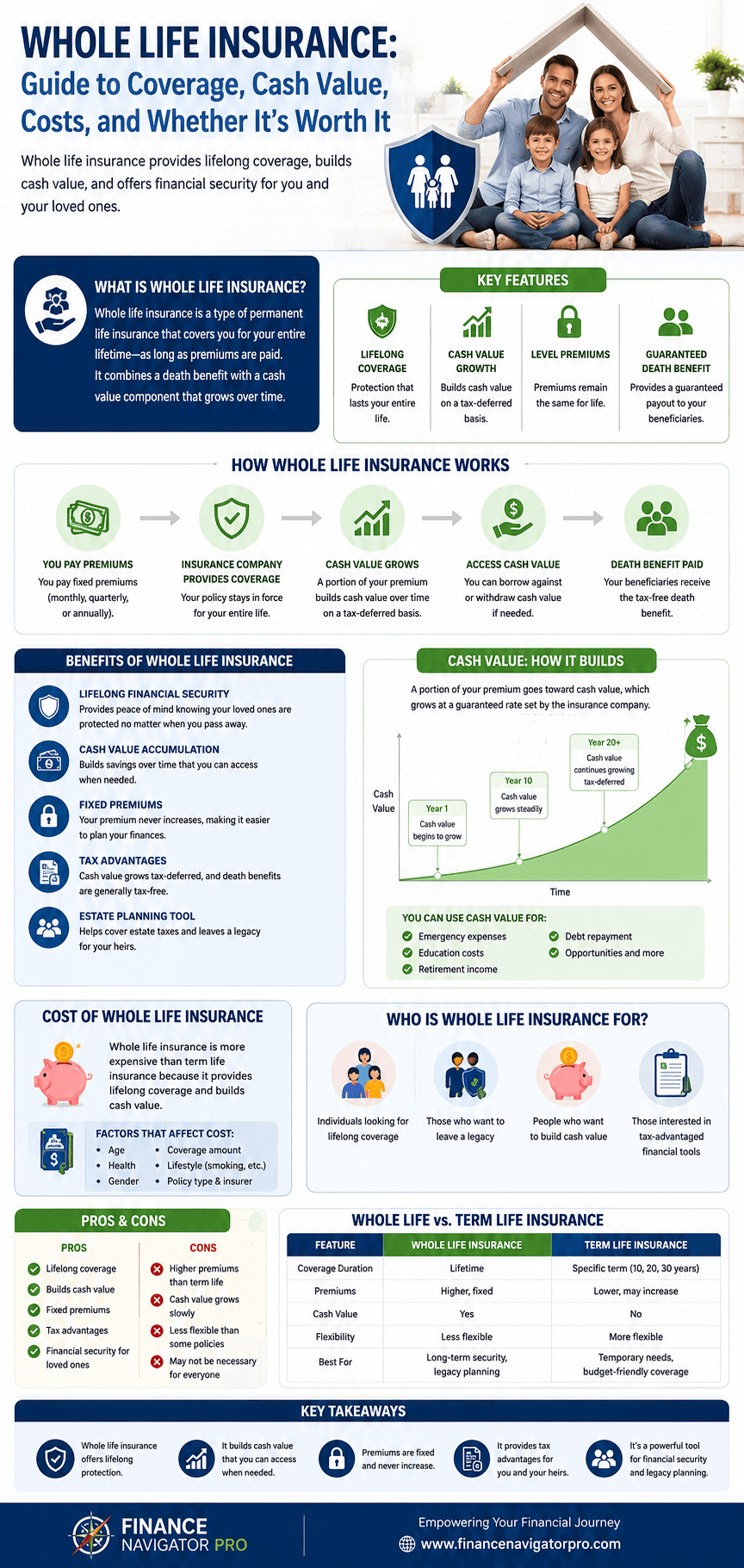
Whole life insurance is a type of permanent life insurance that provides coverage for your entire lifetime as long as you pay the premiums. Unlike term life insurance, it never expires. A portion of every premium you pay goes into a cash value account that grows over time on a tax-deferred basis. You can borrow against this cash value, and when you pass away, your beneficiaries receive a guaranteed death benefit.
If you’ve been shopping for life insurance, you’ve probably run into two terms pretty quickly: term life and whole life. Term life is straightforward — you pay a monthly premium, you’re covered for a set number of years, and the policy expires. Whole life is a different animal. It never expires, it builds savings over time, and it comes with a price tag that can make your eyebrows go up.
So is whole life insurance worth it? That depends entirely on who you are and what you need. This guide breaks down everything — how it works, what it costs, who benefits from it, and when you’re better off going a different route. No fluff. No pressure. Just the facts you need to make a smart decision.
✅ Key Takeaways
- ✓Provides lifetime coverage — no expiration date
- ✓Comes with a guaranteed death benefit for your beneficiaries
- ✓Builds cash value that grows tax-deferred over time
- ✓Premiums are fixed and never increase
- ✓Offers significant tax advantages for growth and loans
- ✓Significantly more expensive than term life insurance
- ✓Cash value can be borrowed against during your lifetime
- ✓Best suited for long-term financial and estate planning goals
SECTION 1
What Is Whole Life Insurance?
Whole life insurance is a form of permanent life insurance — meaning it’s designed to last your entire life, not just a fixed term. As long as you keep paying your premiums, your policy stays in force. When you die, your beneficiaries collect the death benefit, which is a lump-sum, tax-free payment.
But here’s what makes whole life different from every other type of life insurance: it’s also a financial savings vehicle. Every premium payment you make is split into two buckets. The first covers the cost of insurance and the insurer’s fees. The second goes into what’s called the cash value — a savings component that grows at a guaranteed rate over time.
How Is It Different from Other Life Insurance?
Think of it this way. Term life insurance is like renting an apartment — you pay monthly, you’re protected while you’re in, but at the end of the lease, you have nothing to show for it financially. Whole life insurance is more like buying a home. You pay more every month, but you’re building equity (cash value) and you own something of lasting worth.
Other forms of permanent life insurance — like universal life or variable life — also build cash value, but they come with variable premiums, market risk, or more complexity. Whole life is the most straightforward of the permanent policies. The premiums don’t change. The death benefit is guaranteed. The cash value grows predictably.
Why Do People Buy Whole Life Insurance?
People choose whole life for several reasons, and none of them are wrong — they just depend on your situation:
- They want lifetime coverage that never expires.
- They want to leave a guaranteed inheritance for their family.
- They’re looking for a tax-advantaged savings vehicle alongside their retirement accounts.
- They have a lifelong financial dependent, such as a child with special needs.
- They own a business and want to fund a buy-sell agreement.
- They’re doing estate planning and need liquidity to pay estate taxes.
🧩 Real-Life Example: The Martinez Family
Carlos Martinez is 34 years old, married with two kids, and owns a small landscaping business. He buys a $500,000 whole life policy. His premium is $450 a month — more than term life would cost, but here’s what he gets: his family is covered for the rest of his life, not just 20 years. His cash value will grow to a meaningful amount by the time he’s 60. He can borrow against it if his business hits a rough patch. And when he dies, his wife and kids receive $500,000 tax-free. For Carlos, the permanence and the built-in savings are worth the higher cost.
SECTION 2
How Does Whole Life Insurance Work?
Understanding the mechanics of whole life insurance makes it much easier to decide if it fits your life. Here’s how it works from start to finish.
1You Apply and Go Through Underwriting
When you apply for a whole life policy, the insurance company evaluates your risk through a process called underwriting. They look at your age, health history, lifestyle, family medical history, occupation, and sometimes require a medical exam. Based on this, they assign you a risk classification — Preferred Plus, Preferred, Standard, or Substandard — and that determines your premium.
2You Pay Premiums
Once your policy is issued, you start paying premiums. These payments are fixed for the life of the policy — they won’t go up as you age or if your health changes. You can typically choose to pay monthly, quarterly, semi-annually, or annually.
3The Insurance Company Splits Your Premium
Here’s something most people don’t realize: your whole life premium isn’t just paying for insurance. The insurer allocates it across three areas:
- Cost of Insurance (COI) — covers the actual risk of insuring your life.
- Company expenses and fees — covers administrative costs and agent commissions.
- Cash value contribution — the remainder goes into your policy’s savings component.
4Cash Value Grows Over Time
The cash value in your whole life policy grows at a guaranteed minimum interest rate, typically between 1% and 4%, set by the insurer. If you have a participating policy from a mutual insurance company, you may also receive annual dividends that can accelerate growth. The growth is tax-deferred, meaning you don’t pay taxes on earnings as they accumulate.
5You Can Access the Cash Value While Alive
At any point after the early years of the policy, you can:
- Take out a policy loan against your cash value at low interest rates.
- Make a partial withdrawal (though this may reduce your death benefit).
- Fully surrender the policy and receive the surrender value in cash.
6Your Beneficiaries Receive the Death Benefit
When you pass away, the insurer pays your named beneficiaries the full death benefit — typically the face amount of the policy, tax-free. If you’ve taken loans against the cash value that weren’t repaid, the outstanding balance is deducted from the death benefit.
7Policy Maturity
Most whole life policies mature at age 100 or 121. If you’re still alive at maturity, the insurer pays you the face value of the policy. This is sometimes called an endowment, and it’s a relatively rare but important feature to understand.
SECTION 3
Key Features of Whole Life Insurance
Lifetime Coverage
Unlike term life, which covers you for 10, 20, or 30 years, whole life insurance covers you for your entire life. There’s no renewal required, no risk of outliving your policy, and no need to reapply as you get older and potentially less insurable.
Guaranteed Level Premiums
Your premiums are locked in at the time you buy the policy. A 35-year-old who pays $400 a month today will still pay $400 a month at age 65. This predictability makes budgeting easier and protects you from rate increases that can happen with other insurance types.
Guaranteed Death Benefit
The face amount — the amount your beneficiaries receive — is guaranteed, as long as you pay your premiums. This is non-negotiable and doesn’t fluctuate with market conditions.
Cash Value Accumulation
A portion of every premium builds tax-deferred cash value. Over decades, this can grow into a substantial financial asset. You can access it during your lifetime through loans or withdrawals.
Policy Dividends (Participating Policies)
If you buy a whole life policy from a mutual insurance company — one owned by its policyholders — you may receive annual dividends. These aren’t guaranteed, but many mutual insurers have paid dividends consistently for more than 100 years. You can use dividends to reduce premiums, buy additional paid-up insurance, take them as cash, or let them accumulate at interest.
Living Benefits
Many whole life policies include or allow you to add riders that provide living benefits — meaning you can access part of your death benefit while still alive if you’re diagnosed with a terminal, chronic, or critical illness.
Loan Options
You can borrow against your cash value at typically favorable interest rates (often 5–8%). You’re not required to repay the loan on any schedule — but unpaid interest and principal reduce your death benefit over time.
Estate Planning Benefits
Whole life insurance proceeds pass directly to your beneficiaries outside of probate — meaning faster transfer and no public record. This makes it a powerful estate planning tool, especially when combined with an irrevocable life insurance trust (ILIT).
Tax-Deferred Growth
Your cash value grows without you owing annual income taxes on the gains. This is similar in concept to the tax deferral you get inside a 401(k) or IRA, though the structure is different.
Guaranteed Accumulation
Unlike market-linked investments, your cash value doesn’t go down because the stock market had a bad year. The insurer guarantees a minimum rate of return, giving you stability even when financial markets are volatile.
SECTION 4
How Cash Value Works — A Detailed Look
Cash value is the feature that sets whole life insurance apart from term life — and it’s also the most misunderstood part of the policy. Let’s clear it up.
What Is Cash Value?
Cash value is the savings component built inside your whole life policy. It’s a separate account within your policy that grows over time. Think of it like a savings account attached to your life insurance — except it grows tax-deferred, you can borrow against it, and it’s protected from creditors in many states.
How Does It Grow?
Your cash value grows through two mechanisms:
- Guaranteed interest rate — typically 2% to 4% annually, set by the insurer at the time of policy issuance.
- Dividends (if participating) — mutual insurers may pay non-guaranteed annual dividends, which policyholders can use to buy additional paid-up insurance, further accelerating cash value growth.
Early Years Are Slow — Here’s Why
In the first few years, the bulk of your premium goes toward the cost of insurance and fees, which means cash value builds slowly. This is a common frustration — and a legitimate concern. It typically takes 5 to 10 years before your cash value approaches what you’ve paid in premiums. This is why surrendering a whole life policy early is rarely a good financial move.
Illustrative Cash Value Timeline
The following example assumes a $500,000 whole life policy purchased at age 35 with a monthly premium of approximately $500 (based on typical industry illustrations — actual values vary by insurer and policy terms):
| Policy Year | Approximate Age | Total Premiums Paid | Approximate Cash Value | Death Benefit |
|---|---|---|---|---|
| Year 1 | 35 | $6,000 | $1,200 | $500,000 |
| Year 5 | 40 | $30,000 | $18,500 | $500,000 |
| Year 10 | 45 | $60,000 | $52,000 | $500,000 |
| Year 20 | 55 | $120,000 | $140,000 | $500,000 |
| Year 30 | 65 | $180,000 | $280,000 | $500,000+ |
💡 Note
The above figures are illustrative only and represent typical ranges. Actual cash value growth depends on the insurer, dividend performance, policy design, and applicable fees. Always review a personalized policy illustration from your insurer.
Borrowing Against Your Cash Value
One of the most popular features of whole life insurance is the ability to borrow against your cash value. Here’s how it works:
- You can typically borrow up to 90–95% of your cash value.
- The loan is not subject to credit checks or income verification.
- Interest accrues on the loan, typically at rates between 5–8%.
- You’re not required to repay the loan during your lifetime.
- If unpaid, the loan balance (plus interest) is deducted from the death benefit.
Surrendering Your Policy
If you cancel (surrender) your whole life policy, you receive the surrender value — which is the cash value minus any surrender charges. These charges are highest in the early years and typically phase out after 10 to 15 years. Surrendering should be a last resort — you lose your coverage and the long-term compounding benefits.
Tax Treatment of Cash Value
Cash value grows tax-deferred — you don’t owe taxes on gains as they accumulate. If you take withdrawals (not loans), you can withdraw your basis (the amount you’ve paid in premiums) tax-free. Gains above your basis are taxable as ordinary income. Policy loans are not taxable as long as the policy remains in force and doesn’t become a Modified Endowment Contract (MEC).
SECTION 5
Types of Whole Life Insurance
Traditional Whole Life Insurance
The original, standard form. Fixed premiums. Fixed death benefit. Guaranteed cash value growth. Simple to understand and widely available.
Limited Payment Whole Life Insurance
You pay premiums for a set number of years — often 10, 20, or until age 65 — but coverage continues for life. Premiums are higher because you’re compressing the payment schedule. Ideal for people who want to be premium-free in retirement.
Single Premium Whole Life Insurance
You pay one large lump-sum premium upfront, and coverage is paid-up immediately. Often triggers Modified Endowment Contract (MEC) status, which changes the tax treatment of loans and withdrawals. Popular for estate planning and wealth transfer.
Modified Whole Life Insurance
Lower premiums in the first few years (typically 2–3 years), then higher premiums thereafter. Designed for buyers who anticipate income growth. Cash value accumulation is slower early on.
Guaranteed Issue Whole Life Insurance
No medical exam and no health questions required. Acceptance is guaranteed regardless of health status. Premiums are significantly higher for the coverage amount. Death benefit may be limited in the first 2 years (graded benefit). Typically used for final expense coverage or by those who can’t qualify for traditional underwriting.
Final Expense Whole Life Insurance
A smaller, simplified whole life policy specifically designed to cover end-of-life costs — funeral expenses, medical bills, and other debts. Face amounts typically range from $5,000 to $25,000. Simplified or guaranteed underwriting. Premiums are proportionally high but affordable in absolute terms.
Participating Whole Life Insurance
Sold by mutual insurance companies. In addition to guaranteed cash value growth, policyholders may receive annual dividends based on the insurer’s financial performance. Not guaranteed, but many leading mutual companies have paid dividends continuously for over a century. Dividends can significantly accelerate cash value growth when applied as paid-up additions.
Non-Participating Whole Life Insurance
Sold by stock insurance companies. No dividends. What you see is what you get. Generally lower premiums than participating policies, but lower upside in cash value growth over time.
Survivorship (Second-to-Die) Whole Life Insurance
Covers two people — typically spouses — and pays the death benefit only after both have passed away. Primarily used for estate planning to provide liquidity for estate taxes. Premiums are lower than two separate policies because the insurer is statistically covering a longer time horizon.
Joint Whole Life Insurance
Similar to survivorship, but pays the death benefit on the first death. Less common, but useful when both partners have financial dependents.
SECTION 6
Whole Life Insurance vs. Term Life Insurance
This is the comparison most people searching for whole life insurance really want to see. Let’s break it down honestly.
| Feature | Whole Life Insurance | Term Life Insurance |
|---|---|---|
| Coverage Duration | Lifetime (permanent) | Fixed term: 10, 20, or 30 years |
| Premium Cost | Significantly higher | Much lower |
| Cash Value | Yes — builds over time | No — no savings component |
| Premiums | Fixed for life | Fixed during term; renewal rates increase |
| Death Benefit | Guaranteed | Paid only if death occurs during term |
| Investment Component | Tax-deferred cash value | None |
| Tax Advantages | Tax-deferred growth, tax-free loans | Tax-free death benefit only |
| Ideal Buyer | Estate planning, long-term needs, HNW individuals | Income replacement, young families, budget-conscious |
| Coverage Lapse Risk | None if premiums paid | Policy expires at term end |
| Borrowing | Can borrow against cash value | Not applicable |
| Flexibility | Limited (structured) | Simple and straightforward |
| Renewability | Not required — permanent | Renewable but at much higher cost |
Bottom Line
Term life is cheaper and simpler. Whole life is more expensive but offers permanence and cash value. Most financial planners recommend term life for pure income protection and suggest whole life only when there’s a specific long-term need that justifies the higher cost.
SECTION 7
Whole Life vs. Universal Life Insurance
Universal life insurance (UL) is another form of permanent coverage, but with more flexibility — and more complexity.
| Feature | Whole Life | Universal Life |
|---|---|---|
| Premiums | Fixed — cannot change | Flexible — can adjust within limits |
| Death Benefit | Guaranteed — fixed | Adjustable (up or down) |
| Cash Value Growth | Guaranteed minimum rate | Tied to current interest rates |
| Risk to Policyholder | Low — insurer bears the risk | Higher — underfunding can lapse the policy |
| Predictability | High | Moderate — depends on interest rates |
| Cost | Higher | Generally lower than whole life |
| Best For | Those who want certainty and guarantees | Those who want flexibility in payments |
SECTION 8
Whole Life vs. Indexed Universal Life Insurance (IUL)
Indexed Universal Life (IUL) is one of the fastest-growing types of permanent insurance — and one of the most marketed. Here’s a clear comparison.
| Feature | Whole Life | Indexed Universal Life |
|---|---|---|
| Cash Value Growth | Guaranteed minimum rate | Linked to market index (e.g., S&P 500) with cap and floor |
| Downside Protection | Yes — guaranteed minimum | Partial — floor prevents loss but often 0% |
| Upside Potential | Limited — conservative growth | Higher — tied to index gains |
| Premium Flexibility | Fixed | Flexible |
| Complexity | Low | High — multiple moving parts |
| Risk | Very low | Moderate |
| Best For | Guaranteed, predictable growth | Those comfortable with more complexity for higher potential growth |
IULs can outperform whole life in strong market environments, but they come with caps on gains and complex fee structures. Whole life wins on simplicity and guaranteed outcomes.
SECTION 9
Whole Life vs. Variable Life Insurance
| Feature | Whole Life | Variable Life Insurance |
|---|---|---|
| Cash Value Investment | Insurer manages — fixed returns | You choose sub-accounts (like mutual funds) |
| Market Risk | None — insurer bears all risk | Full — policyholder bears investment risk |
| Death Benefit Guarantee | Yes | Minimum guaranteed; can vary based on investment performance |
| Regulation | Insurance only | Both insurance AND securities (requires securities license to sell) |
| Potential Returns | Conservative but stable | Potentially higher but volatile |
| Best For | Risk-averse individuals | Experienced investors comfortable with market risk |
SECTION 10
Pros of Whole Life Insurance
✓ 1. Lifetime Coverage — No Expiration Date
The most obvious advantage: whole life insurance never expires. You don’t have to worry about outliving your policy or scrambling to buy insurance in your 70s when rates would be astronomical. As long as you pay the premiums, you’re covered until the day you die.
✓ 2. Built-In Forced Savings
Not everyone is disciplined about saving. Whole life creates a forced savings habit — every month, a portion of your premium builds cash value automatically. Over decades, this adds up to a significant financial asset, completely separate from your retirement accounts.
✓ 3. Predictability and Stability
Your premiums won’t change. Your death benefit won’t disappear. Your cash value won’t drop because the stock market crashed. For people who value financial certainty above all else, whole life insurance delivers it.
✓ 4. Estate Planning Power
Whole life insurance is one of the cleanest tools in estate planning. The death benefit passes directly to beneficiaries outside of probate, quickly and without public disclosure. For high-net-worth individuals, it can provide liquidity to pay estate taxes without forcing heirs to sell assets.
✓ 5. Tax Advantages
Three major tax benefits make whole life attractive for long-term financial planning: Cash value grows tax-deferred — no annual taxes on internal earnings. Policy loans are generally not treated as taxable income. Death benefit is typically paid to beneficiaries income-tax-free.
✓ 6. Business Planning Applications
Business owners use whole life insurance for buy-sell agreements (where partners agree to buy each other’s shares if one dies), key person insurance, and executive compensation plans. The guaranteed death benefit and growing cash value make it a versatile business planning tool.
✓ 7. Access to Liquidity
Unlike money locked in a 401(k) or IRA, you can access your whole life cash value at any time for any reason. No age requirements. No penalties. Just a loan against your own policy’s value.
✓ 8. Creditor Protection
In many states, life insurance cash value and death benefits receive significant protection from creditors. For business owners or professionals in high-liability fields, this can be a meaningful asset protection strategy.
SECTION 11
Cons of Whole Life Insurance
✗ 1. Much Higher Premiums
This is the biggest drawback. A whole life policy can cost 5 to 15 times more than a comparable term life policy. A healthy 35-year-old man might pay $30–$50 a month for $500,000 in 30-year term coverage, while a comparable whole life policy could run $400–$600 a month. That difference — if invested elsewhere — could potentially generate significant returns over 30 years.
✗ 2. Slow Cash Value Growth in the Early Years
In the first 5 to 10 years, your cash value grows painfully slowly relative to what you’ve paid in. Administrative fees and the cost of insurance take a big cut upfront. If you need to surrender the policy early, you could get back significantly less than you’ve paid in.
✗ 3. Opportunity Cost Is Real
The money you spend on whole life premiums could instead be invested in a diversified stock portfolio, maxed-out 401(k), or Roth IRA. Historically, market returns have outpaced whole life cash value growth over long periods. The argument ‘buy term and invest the difference’ has merit — if you actually invest the difference.
✗ 4. Complexity Can Be Confusing
Whole life illustrations can be complex and hard to compare across companies. Dividends are non-guaranteed. Policy loans, riders, and surrender charges add layers of complexity. It’s easy to misunderstand what you’re actually buying.
✗ 5. High Agent Commissions
Agents typically earn much higher commissions selling whole life than term life. While this doesn’t mean the product is bad, it does mean you should consider whether you’re being recommended whole life because it’s right for you — or because it’s financially better for your agent.
✗ 6. Lower Investment Returns Than Equities (Historically)
Whole life cash value grows conservatively — typically 2% to 5% depending on dividends. Equity markets have historically returned 7% to 10% annually over long periods. If your primary goal is wealth accumulation rather than insurance protection, whole life is generally not the most efficient vehicle.
SECTION 12
Who Should Buy Whole Life Insurance?
Whole life insurance isn’t for everyone, but for the right person in the right situation, it can be an excellent long-term financial tool. Here are the profiles that typically benefit most.
✓ Parents With Lifelong Dependents
If you have a child with special needs who will depend on you financially for their entire life, whole life insurance ensures your support continues even after you’re gone. Term life would eventually expire; whole life doesn’t.
✓ Business Owners
Whole life is widely used in business succession planning through buy-sell agreements, key person insurance, and executive bonus plans. The guaranteed death benefit and cash value make it a reliable business planning instrument.
✓ High-Income Earners Who’ve Maxed Retirement Accounts
If you’ve maxed out your 401(k), Roth IRA, and other tax-advantaged accounts, whole life offers an additional bucket of tax-deferred growth. For high earners facing contribution limits, this can be a meaningful supplement to traditional retirement planning.
✓ Estate Planning Clients
For individuals with taxable estates, whole life insurance provides guaranteed, immediately available liquidity at death to pay estate taxes — without forcing heirs to sell investments or real estate in a rush. Combined with an ILIT, it can be a cornerstone of estate planning strategy.
✓ People Seeking a Guaranteed Legacy
If leaving a specific amount of money to your heirs or a charitable organization is important to you, whole life delivers a guaranteed, specified death benefit — regardless of when you die. There’s no uncertainty about whether the money will be there.
✓ Special Needs Families
Parents of special needs children often use whole life insurance in conjunction with a Special Needs Trust to ensure their child’s financial security beyond the parents’ lives, without disrupting eligibility for government benefits.
SECTION 13
Who Should Avoid Whole Life Insurance?
✗ Young Professionals on a Tight Budget
If you’re in your 20s or 30s, early in your career, and have limited disposable income, the high premiums of whole life insurance are hard to justify. For most young families, a 20- or 30-year term life policy provides strong income protection at a fraction of the cost.
✗ People Who Just Need Income Replacement
If your primary concern is replacing your income if you die prematurely — protecting your family while the mortgage is paid off, the kids are grown, and your spouse reaches retirement — a term life policy typically accomplishes this goal more cost-effectively.
✗ Investors Who Want Market Returns
If your goal is to maximize investment returns, whole life cash value growth rarely competes with a diversified equity portfolio over long periods. Investors who are disciplined about contributing to market-linked accounts generally don’t need whole life as a savings vehicle.
✗ People With Temporary Insurance Needs
If you only need life insurance for a specific period — until the mortgage is paid off, until the kids finish college, until you reach retirement — term life is the sensible choice. Paying for permanent coverage when you only need temporary protection is unnecessary.
✗ People Carrying High-Interest Debt
If you have significant credit card debt, student loans, or other high-interest obligations, the premium dollars going toward whole life insurance might be better directed toward debt payoff. The guaranteed return on debt elimination often exceeds the cash value growth rate.
SECTION 14
Average Cost of Whole Life Insurance
Whole life insurance premiums vary widely based on your age, health, gender, and the coverage amount. The tables below provide representative monthly premium estimates for a $250,000 whole life policy from a highly rated insurer. These are averages — your actual quotes will vary.
Monthly Premium Estimates — $250,000 Whole Life Policy (Non-Smoker)
| Age | Male (Preferred) | Female (Preferred) | Male (Standard) | Female (Standard) |
|---|---|---|---|---|
| 25 | $125 – $175 | $105 – $150 | $160 – $220 | $135 – $190 |
| 30 | $155 – $210 | $130 – $180 | $200 – $265 | $165 – $225 |
| 35 | $195 – $260 | $160 – $215 | $250 – $330 | $205 – $275 |
| 40 | $255 – $340 | $205 – $275 | $325 – $430 | $265 – $355 |
| 45 | $340 – $450 | $270 – $365 | $430 – $570 | $350 – $465 |
| 50 | $455 – $600 | $355 – $475 | $570 – $755 | $460 – $615 |
| 55 | $605 – $800 | $465 – $625 | $760 – $1,005 | $610 – $810 |
| 60 | $800 – $1,060 | $610 – $815 | $1,005 – $1,330 | $805 – $1,070 |
Monthly Premium Estimates — $250,000 Whole Life Policy (Smoker)
| Age | Male (Smoker) | Female (Smoker) |
|---|---|---|
| 25 | $245 – $330 | $210 – $280 |
| 35 | $375 – $500 | $310 – $415 |
| 45 | $620 – $830 | $510 – $680 |
| 55 | $1,020 – $1,365 | $840 – $1,120 |
⚠ Important
The above figures are representative estimates based on industry averages and published rate data. Actual premiums depend on the specific insurer, your health classification, riders selected, and state of residence. Always request personalized quotes from multiple insurers.
SECTION 15
Factors That Affect Whole Life Insurance Premiums
| Factor | How It Affects Your Premium |
|---|---|
| Age | Younger applicants pay less; rates increase significantly with each decade |
| Gender | Women statistically live longer and typically pay lower premiums than men |
| Health Status | Excellent health earns Preferred Plus rates; health issues can significantly increase cost or lead to denial |
| Medical History | Chronic conditions, prior major illnesses, or family history of genetic diseases increase rates |
| Smoking Status | Smokers typically pay 2–3x more than non-smokers for the same coverage |
| Coverage Amount | Higher face value = higher premium |
| Policy Riders | Additional features like long-term care or waiver of premium add to the base cost |
| Insurer | Different companies price risk differently; shopping around is essential |
| State | Some state regulations and mortality assumptions affect pricing |
| Lifestyle / Hobbies | Dangerous hobbies (skydiving, scuba) can increase rates or trigger exclusions |
| Occupation | High-risk occupations (mining, offshore oil) may result in premium surcharges |
| Height / Weight | BMI outside preferred range can result in standard or substandard rating |
SECTION 16
How Much Whole Life Insurance Do You Need?
Determining the right coverage amount requires looking at your full financial picture. Here are the key factors to consider:
Income Replacement
The most common starting point. Multiply your annual income by 10–12 to estimate how much your family would need to maintain their lifestyle for a decade or more. For higher earners or those with significant long-term obligations, a higher multiplier may be appropriate.
Outstanding Debts
Add up your mortgage balance, auto loans, student loans, credit cards, and any other debts that would become your family’s burden. Your death benefit should comfortably cover these.
Children’s Education Costs
If paying for college is a priority, factor in the estimated cost of tuition and living expenses multiplied by the number of children.
Final Expenses
Funeral and burial costs in the U.S. average $7,000–$12,000. Medical bills at end of life can add significantly to this. A minimum of $20,000 in coverage is advisable just for final expenses alone.
Estate Tax Considerations
For 2026, the federal estate tax exemption is $13.61 million per individual. If your estate exceeds this threshold, your heirs may owe estate taxes. Whole life insurance held in an ILIT can provide liquidity to pay these taxes without forcing asset sales.
Business Obligations
Business owners should also account for buy-sell agreement funding, key person replacement costs, outstanding business loans, and any personally guaranteed business debts.
SECTION 17
Common Whole Life Insurance Riders
Riders are optional add-ons that customize your whole life policy. Some are included automatically; others come at an additional cost.
| Rider | What It Does | Who It’s Best For |
|---|---|---|
| Accelerated Death Benefit | Allows early access to part of the death benefit if diagnosed with terminal illness | Most policyholders — often included at no cost |
| Waiver of Premium | Waives your premium if you become totally disabled, keeping the policy in force | Those without robust disability insurance |
| Child Term Rider | Provides term life coverage for your children, often convertible to permanent later | Parents who want coverage for their kids |
| Guaranteed Insurability | Lets you buy additional coverage in the future without a new medical exam | Young buyers who expect income to grow |
| Long-Term Care Rider | Accelerates death benefit to pay for long-term care expenses | Those concerned about nursing home or home care costs |
| Accidental Death Benefit | Pays an additional lump sum if death occurs due to an accident | High-risk occupation or lifestyle |
| Paid-Up Additions (PUA) Rider | Lets you buy small, additional chunks of paid-up insurance to accelerate cash value growth | Those using whole life as a primary savings tool |
| Return of Premium | Returns premiums paid if policy lapses — rarely offered on whole life | Cost-conscious buyers — rarely cost-effective |
SECTION 18
Whole Life Insurance Dividends Explained
If you own a participating whole life policy from a mutual insurance company, you may receive annual dividends. Here’s what you need to know.
What Are Participating Policies?
Participating policies are issued by mutual insurers — companies that are owned by their policyholders, not shareholders. When the company performs well (fewer claims, strong investments, good expense management), profits are shared back with policyholders in the form of dividends.
Are Dividends Guaranteed?
No. Dividends are declared annually by the insurer’s board and are not contractually guaranteed. However, many leading mutual insurers have a remarkable track record. Some have paid dividends every year for over 100 consecutive years, including through economic depressions and world wars.
How Can You Use Your Dividends?
| Dividend Option | What It Does | Best For |
|---|---|---|
| Paid-Up Additions (PUA) | Buys additional paid-up whole life coverage, growing both death benefit and cash value | Maximizing long-term cash value |
| Premium Reduction | Applied toward your annual premium, reducing your out-of-pocket cost | Managing cash flow |
| Cash Payment | Received as a check or deposit | Immediate income needs |
| Dividend Accumulation | Left with insurer to earn interest (interest is taxable) | Simple, hands-off approach |
| One-Year Term Addition | Purchases additional one-year term coverage | Boosting short-term death benefit |
SECTION 19
Tax Benefits of Whole Life Insurance
Tax advantages are one of the most compelling reasons high-income earners and estate planning clients choose whole life insurance. Let’s break down each benefit.
1. Tax-Deferred Cash Value Growth
The interest, dividends, and growth inside your whole life policy accumulate without annual income tax liability. This mirrors the tax deferral you get in a 401(k) or IRA — but without contribution limits for the insurance savings component itself.
2. Tax-Free Policy Loans
When you borrow against your cash value, the IRS does not treat the loan as taxable income — regardless of the amount. This is a significant advantage: you can access potentially hundreds of thousands of dollars in cash value without triggering a tax bill, as long as the policy remains in force and doesn’t become a MEC.
3. Income-Tax-Free Death Benefit
Life insurance death benefits are generally excluded from the beneficiary’s gross income under IRS Section 101(a). Your heirs receive the full face amount without paying federal income taxes on it.
4. Estate Tax Planning
When life insurance is owned by an Irrevocable Life Insurance Trust (ILIT) rather than you personally, the death benefit is excluded from your taxable estate. For estates above the federal exemption threshold, this can save millions in estate taxes.
5. 1035 Exchange
If you already have a life insurance policy (or an annuity) and want to switch to a different product, Section 1035 of the tax code allows you to exchange it for a new whole life policy without triggering a taxable event on any accumulated gains.
6. Modified Endowment Contract (MEC) Warning
If you overfund a whole life policy beyond IRS limits in the first seven years (the ‘7-pay test’), the policy becomes a Modified Endowment Contract. In a MEC, loans and withdrawals are taxed on a last-in-first-out basis (gains first), and a 10% penalty applies if you’re under age 59½. Single-premium whole life policies almost always become MECs. Avoid overfunding to maintain favorable tax treatment.
SECTION 20
How to Access Your Cash Value
Your whole life cash value isn’t locked away until death — you can access it in several ways while you’re alive. Here’s a comparison of your options.
| Access Method | How It Works | Tax Impact | Effect on Death Benefit |
|---|---|---|---|
| Policy Loan | Borrow against CV at policy loan rate (5–8%); repayment is optional | Not taxable (as long as policy stays in force) | Reduces DB by outstanding loan balance at death |
| Partial Withdrawal | Remove a portion of cash value directly | Tax-free up to basis; gains above basis taxed as ordinary income | Typically reduces death benefit permanently |
| Full Surrender | Cancel policy; receive surrender value (CV minus charges) | Gains above basis taxed as ordinary income | Policy and coverage terminate completely |
| 1035 Exchange | Transfer CV to new policy without cashing out | No taxable event if done correctly | Depends on new policy terms |
💡 Pro Tip
Most financial advisors recommend using policy loans rather than withdrawals or surrenders. Loans don’t reduce your cash value directly (it continues earning interest), don’t create an immediate tax bill, and preserve your death benefit — as long as you’re mindful of outstanding interest accruing over time.
SECTION 21
How to Evaluate Whole Life Insurance Companies
Choosing the right insurer is just as important as choosing the right policy. Here are the criteria you should evaluate when comparing whole life insurance companies.
Financial Strength Ratings
Life insurance is a long-term commitment — potentially 50+ years. You need an insurer that will be financially solid decades from now. Check ratings from independent rating agencies. Look for ratings of A or higher from AM Best, AA or higher from Standard & Poor’s, and equivalent strong ratings from Moody’s and Fitch. These ratings reflect an insurer’s ability to meet policyholder obligations.
Dividend History (for Participating Policies)
If you’re buying a participating whole life policy, review the insurer’s dividend history. How long have they been paying dividends? Did they maintain dividends during the 2008 financial crisis and the COVID-19 pandemic? Consistency over decades is more meaningful than any single year’s dividend scale.
Customer Satisfaction and Claims Experience
Review independent satisfaction surveys and complaint ratios filed with state insurance departments. The National Association of Insurance Commissioners (NAIC) publishes complaint ratios that show how often customers file complaints relative to the company’s size. Fewer complaints generally signals better service.
Policy Customization and Riders
Not all insurers offer the same riders and policy design options. If a Paid-Up Additions rider, long-term care benefit, or guaranteed insurability option is important to your planning, confirm the insurer offers it before proceeding.
Illustration Quality and Transparency
Request a policy illustration — a detailed projection of premiums, cash value, and death benefit over the life of the policy. Review both guaranteed and non-guaranteed columns. A trustworthy insurer will have realistic, conservative non-guaranteed projections, not inflated numbers designed to sell the policy.
Digital Tools and Service Quality
Can you manage your policy online? Access loan requests digitally? Review account statements easily? Modern digital tools matter for ongoing policy management. Check reviews specifically about service quality after the policy is issued, not just during the sales process.
SECTION 22
How to Choose the Right Whole Life Policy — A Checklist
| Step | What to Do |
|---|---|
| 1. Define your goals | Are you buying for estate planning, business continuity, final expenses, or supplemental savings? Your goal determines the right policy type. |
| 2. Set a realistic budget | Whole life is a long-term commitment. Choose a premium you can sustain for decades without straining cash flow. |
| 3. Determine the right face amount | Use the income replacement and debt coverage methodology in Section 16 to arrive at an appropriate death benefit. |
| 4. Compare multiple insurers | Get at least 3 quotes from highly rated companies. Look at both premiums and illustrated cash value projections. |
| 5. Review the illustration carefully | Focus on guaranteed columns, not just projected non-guaranteed values. Dividends are not guaranteed. |
| 6. Evaluate riders | Identify which optional riders add meaningful value for your situation. Don’t pay for riders you don’t need. |
| 7. Check financial strength | Confirm the insurer carries AM Best A or better (A+ or A++ preferred for very long-term policies). |
| 8. Research dividend history | For participating policies, review publicly available dividend scale history. |
| 9. Work with a fee-only advisor | Consider consulting a fee-only (not commission-based) financial advisor who can evaluate whether whole life fits your overall plan. |
| 10. Read the policy contract | Review the policy document, not just the sales brochure. Understand the contestability period, grace period, and loan provisions. |
SECTION 23
Common Mistakes to Avoid With Whole Life Insurance
Buying Too Little Coverage
Underinsuring yourself undermines the entire purpose of life insurance. Don’t just buy what you can comfortably afford — calculate what your family would actually need and work from there.
Buying Too Much Coverage
Overbuying — especially under agent pressure — leaves you with premiums you struggle to maintain. A lapsed policy in year 8 produces near-zero return on all the premiums you paid.
Ignoring Key Riders
Not adding a Waiver of Premium rider, for example, could mean your policy lapses if you become disabled and can’t work. The Guaranteed Insurability rider is particularly valuable for young, healthy buyers who anticipate higher insurance needs in the future.
Not Reviewing Policy Illustrations Carefully
Many buyers focus only on the ‘illustrated’ (non-guaranteed) column and are surprised when dividends come in lower than projected. Always understand the guaranteed minimum values — that’s your floor.
Confusing Dividends With Investment Returns
Dividends are a return of excess premium, not a guaranteed investment return. They’re valuable but not guaranteed. Basing your long-term financial plan on sustained high dividends introduces risk.
Surrendering the Policy Too Early
Whole life only delivers its full value over decades. Surrendering in years 3, 5, or even 10 often means recovering far less than you paid in. If you’re considering surrendering, first explore a policy loan or paid-up options.
Ignoring Policy Fees and Charges
All whole life policies carry internal costs — mortality and expense charges, administrative fees, and rider costs. These are embedded in the policy structure and not always obvious. Review the illustration carefully and ask your agent to walk through every cost.
Borrowing Too Aggressively
Excessive policy loans, especially with accumulating unpaid interest, can cause your policy to lapse. If a policy lapses with an outstanding loan, the loan amount may be treated as a taxable distribution — creating a surprise tax bill.
SECTION 24
Real-Life Whole Life Insurance Examples
🧩 Scenario 1: Young Family — The Johnsons
Michael and Sarah Johnson are 32 and 30, respectively, with two young children. Michael earns $95,000 a year. He buys a $750,000 whole life policy with a Paid-Up Additions rider. Premium: $680/month. By age 55, his cash value is projected to reach approximately $400,000. His family has permanent, guaranteed coverage, and Michael can access the cash value if needed for college funding or an emergency — without touching retirement accounts. The death benefit grows slightly over time due to PUA accumulation.
🧩 Scenario 2: Business Owner — David Chen
David owns a dental practice with two partners. They establish a buy-sell agreement funded by whole life policies on each partner’s life. If David dies, the death benefit provides his partners with the funds to buy out his estate — at a predetermined price — preventing ownership disputes and ensuring business continuity. David’s policy also builds cash value he can use for future business investments or retirement supplementation.
🧩 Scenario 3: Estate Planning — The Williams Family
Patricia Williams, 68, has a taxable estate of $18 million. With the federal estate tax exemption at $13.61 million (2026), her estate may owe estate taxes on approximately $4.4 million. Her financial advisor recommends a $5 million whole life policy owned by an ILIT. The death benefit is excluded from her estate and provides her heirs with immediate, income-tax-free liquidity to pay estate taxes without being forced to sell real estate or investments during a difficult time.
🧩 Scenario 4: Special Needs Planning — The Garcias
The Garcia family has a son, Marco, with Down syndrome. Marco will need financial support for the rest of his life. His parents purchase a $1 million whole life policy on each of their lives, with the proceeds designated for a Special Needs Trust. The trust will provide for Marco’s care after his parents pass away, supplementing government benefits without disqualifying him from Medicaid or SSI.
🧩 Scenario 5: High-Net-Worth Individual — Jennifer Blake
Jennifer is a 45-year-old physician earning $400,000 a year. She has maxed out her 401(k), Roth IRA (via backdoor), and 529 accounts for her two children. She works with a financial planner who recommends a maximum-funded whole life policy with a PUA rider as an additional tax-advantaged savings vehicle — providing access to capital without market risk, policy loan liquidity for large purchases, and a guaranteed death benefit for her estate.
SECTION 25
Frequently Asked Questions (FAQPage Schema)
SECTION 26
Whole Life Insurance Glossary
Accelerated Death Benefit
A rider that allows the policyholder to access a portion of the death benefit while still alive if diagnosed with a qualifying illness.
Accumulation Value
Another term for cash value — the total savings amount inside a permanent life insurance policy.
Actuarial Table
A statistical table used by insurers to calculate life expectancy and mortality risk for pricing purposes.
AM Best Rating
A financial strength rating issued by AM Best Company, specifically for insurance companies.
Annual Renewable Term (ART)
A type of term life insurance that renews every year, with premiums that increase annually based on age.
Beneficiary
The person or entity designated to receive the death benefit when the insured dies.
Cash Surrender Value
The amount the policyholder receives upon canceling (surrendering) the policy — cash value minus surrender charges.
Cash Value
The savings component of a permanent life insurance policy that grows tax-deferred over time.
Contestability Period
The first two years of a policy during which the insurer may contest a claim based on misrepresentation in the application.
Cost of Insurance (COI)
The internal charge within a policy that covers the pure cost of providing the death benefit.
Death Benefit
The tax-free lump-sum payment made to beneficiaries upon the insured’s death.
Dividend
A non-guaranteed share of an insurer’s profits distributed to policyholders of participating policies.
Endowment
A policy event where the cash value equals the face amount, typically at policy maturity (age 100 or 121).
Extended Term Insurance
An option to use cash value to purchase paid-up term coverage for a specified period instead of surrendering the policy.
Face Amount
The stated death benefit of a life insurance policy — the amount payable to beneficiaries.
Grace Period
A period (usually 30–31 days) after a missed premium payment during which the policy remains in force.
Graded Death Benefit
A feature in some guaranteed issue policies where the full death benefit is not payable until the policy has been in force for a specified period (often 2 years).
Guaranteed Insurability Rider
An optional rider allowing the policyholder to purchase additional coverage in the future without a new medical exam.
Incontestability Clause
A policy provision stating that after the contestability period, the insurer cannot deny a claim based on misrepresentation in the original application.
Insurable Interest
The legal requirement that the policyholder must have a financial or personal relationship with the insured person.
Irrevocable Life Insurance Trust (ILIT)
A trust that owns a life insurance policy, removing the death benefit from the insured’s taxable estate.
Lapse
When a life insurance policy terminates due to nonpayment of premiums and no cash value is available to sustain coverage.
Life Settlement
The sale of an existing life insurance policy to a third party for more than the surrender value but less than the death benefit.
Maturity
The date on which the policy reaches its maximum age (often 100 or 121), at which point the insurer pays out the face amount to the living policyholder.
Modified Endowment Contract (MEC)
A life insurance policy that has been overfunded beyond IRS limits, resulting in less favorable tax treatment on loans and withdrawals.
Mutual Insurance Company
An insurer owned by its policyholders rather than shareholders. Profits may be shared as dividends.
Net Amount at Risk
The difference between the death benefit and the cash value — the actual risk borne by the insurer at any given time.
Non-Forfeiture Options
Policy provisions that preserve some value if the policyholder stops paying premiums, such as reduced paid-up or extended term insurance.
Non-Participating Policy
A whole life policy that does not pay dividends. Typically issued by stock insurance companies.
Paid-Up Additions (PUA)
Small increments of additional whole life coverage purchased with dividends or extra premiums. They increase both cash value and death benefit.
Paid-Up Policy
A policy on which no more premium payments are required but coverage remains fully in force.
Participating Policy
A whole life policy issued by a mutual insurer that may pay annual dividends based on company performance.
Permanent Life Insurance
Any life insurance policy that provides lifetime coverage and builds cash value, including whole life, universal life, and variable life.
Policy Loan
A loan taken against the cash value of a life insurance policy; no repayment schedule is required, though interest accrues.
Premium
The payment made by the policyholder to the insurer to keep the life insurance policy in force.
Probate
The legal process through which a deceased person’s estate is administered and assets are distributed.
Reduced Paid-Up Insurance
A non-forfeiture option that uses cash value to provide a smaller, fully paid-up policy with no future premiums required.
Rider
An optional add-on to a life insurance policy that provides additional benefits, sometimes at an extra cost.
Risk Classification
The category assigned by underwriters based on an applicant’s risk profile (e.g., Preferred Plus, Preferred, Standard, Substandard).
Seven-Pay Test
The IRS test used to determine if a policy is a Modified Endowment Contract. If premiums paid in the first seven years exceed a statutory limit, the policy becomes a MEC.
Stock Insurance Company
An insurer owned by shareholders, not policyholders. These companies typically issue non-participating policies.
Surrender Charges
Fees deducted from cash value when a policyholder cancels the policy before a specified period has passed.
Term Life Insurance
A type of life insurance that provides coverage for a specified period (term). It has no cash value and is less expensive than whole life.
Underwriting
The process insurers use to evaluate an applicant’s risk and determine eligibility and premium rates.
Universal Life Insurance
A flexible form of permanent life insurance with adjustable premiums and death benefits, and cash value that earns interest based on current rates.
Variable Life Insurance
A form of permanent life insurance where the cash value is invested in sub-accounts similar to mutual funds, with the policyholder bearing the investment risk.
Waiver of Premium Rider
A rider that waives premium payments if the policyholder becomes totally disabled, keeping the policy in force.
Whole Life Insurance
A type of permanent life insurance providing lifetime coverage, guaranteed fixed premiums, guaranteed cash value growth, and a guaranteed death benefit.
1035 Exchange
A provision of the U.S. tax code allowing tax-free transfer of cash value from one life insurance policy to another.
SECTION 27
Final Verdict — Is Whole Life Insurance Right for You?
After walking through everything — how it works, what it costs, who benefits, and who doesn’t — here’s the honest bottom line.
Whole life insurance is not a product that works for everyone. For the majority of Americans who need life insurance primarily to protect their family’s income during their working years, term life insurance is almost always the more sensible and cost-effective choice. It’s simple, affordable, and does exactly what it’s supposed to do.
But whole life insurance does serve a distinct and important purpose for the right buyer. If you have lifelong financial dependents, a complex estate that will face tax liability, a business succession need, or you’re a high-income earner who has exhausted conventional tax-advantaged accounts, whole life can be a genuinely powerful addition to your financial plan. Its guarantees — level premiums, guaranteed death benefit, guaranteed cash value growth — are unique in the financial world. No stock market correction can take them away.
The key is to be clear about what you’re buying and why. Whole life insurance is insurance first and a savings vehicle second. If you go in expecting stock market returns, you’ll be disappointed. If you go in understanding that you’re trading flexibility and potential upside for certainty and permanence — and you have a genuine long-term need for that certainty — whole life can be exactly the right tool.
Before you buy:
- Define your specific need — don’t buy whole life because an agent says it’s ‘better than term.’
- Get quotes from at least three highly rated insurers.
- Review the guaranteed columns in the policy illustration, not just projected non-guaranteed values.
- Consider consulting a fee-only financial planner who doesn’t earn commissions on insurance sales.
- Confirm you can sustain the premium comfortably — not just today, but for decades.
📌 The Bottom Line
Whole life insurance is a powerful but expensive financial tool. It’s best suited for those with permanent coverage needs, estate planning goals, or specific tax-planning strategies. For most families seeking income protection, term life paired with disciplined investing is the wiser path. The best policy is the one that aligns with your actual financial goals — not the one with the highest illustrations or the most enthusiastic sales pitch.
Related Reading on FinanceNavigatorPro
This guide is provided for educational purposes only and does not constitute financial, legal, or tax advice. Always consult with a licensed financial advisor, insurance professional, and qualified tax advisor before making insurance purchasing decisions.
Styled entirely with inline attributes for full WordPress compatibility — no <style> block, so nothing gets stripped by wp_kses_post.


Great content! Keep up the good work!