

Quick Answer
What is Indexed Universal Life Insurance?
Indexed Universal Life (IUL) insurance is a type of permanent life insurance that provides a death benefit plus a cash value account that earns interest linked to a stock market index — such as the S&P 500 — without directly investing in the market. It offers a floor (typically 0%) to protect against losses, flexible premiums, and potential tax-free retirement income through policy loans.
If you’ve spent any time researching life insurance, you’ve probably come across Indexed Universal Life insurance — and you’ve probably also found that opinions on it range from “the greatest financial product ever created” to “a scam you should avoid at all costs.” Both camps are overstating things. The truth, as usual, sits somewhere in the middle.
IUL has exploded in popularity over the past two decades. Wealthy families use it for estate planning. Business owners use it as an executive benefit. High-income professionals use it as a tax-advantaged savings vehicle after maxing out their 401(k) and Roth IRA.
But IUL is also frequently misrepresented — sometimes innocently, sometimes not — by agents who oversell the upside and gloss over the costs, complexity, and risks. That’s exactly why this guide exists.
In the next several thousand words, we’re going to walk through everything you need to know about Indexed Universal Life insurance in plain English: how it actually works, what it costs, who it makes sense for, who should run the other direction, and how to evaluate a policy if you’re seriously considering one.
No sales pitch. No jargon fog. Just a clear, honest explanation.
What Is Indexed Universal Life Insurance?
Indexed Universal Life insurance — commonly called IUL — is a type of permanent life insurance policy that does two things simultaneously: it provides a death benefit to your beneficiaries when you pass away, and it builds a cash value account during your lifetime that grows tax-deferred.
The “indexed” part refers to how the cash value grows. Instead of earning a fixed interest rate (like traditional whole life insurance) or being directly invested in mutual funds (like variable universal life), your IUL cash value earns interest based on the performance of a stock market index — most commonly the S&P 500 or the Nasdaq-100.
Here’s the important distinction: your money is never actually invested in the stock market. You don’t own shares of anything. The insurance company uses the index as a measuring stick to determine how much interest to credit to your account each year.
This structure creates what many people find attractive about IUL: the potential to participate in market gains without the risk of market losses. If the S&P 500 rises 18% in a year, you might earn 10–12% (subject to caps). If it drops 30%, you earn 0% — but you don’t lose the principal you’ve accumulated. That floor is typically set at 0%.
The Three Core Components of an IUL Policy
- ✓Death Benefit: The guaranteed payout to your beneficiaries when you die, structured to match your goals.
- ✓Cash Value Account: The savings component that grows over time and can be accessed through loans or withdrawals.
- ✓Index Crediting: The mechanism by which your cash value earns interest based on market index performance, subject to floors, caps, and participation rates.
IUL falls under the broader category of universal life insurance, which means it also offers premium flexibility — you can pay more or less depending on your situation, within certain limits, as long as the policy stays funded.
How Does Indexed Universal Life Insurance Work?
Understanding IUL requires walking through each step of how money flows through the policy. It’s more layered than term life insurance, but once you see how the pieces fit together, it becomes much clearer.
Step 1: You Pay a Premium
When you pay your IUL premium, that money doesn’t all go toward building your cash value. The insurance company first deducts the Cost of Insurance (COI) — the actual charge for the death benefit coverage — plus administrative fees and any rider charges. Whatever remains flows into your cash value account.
This is why how you fund an IUL matters enormously. An underfunded IUL can actually erode over time as fees consume a growing portion of the available cash value.
Step 2: Your Cash Value Gets Credited with Interest
Each year (or month, depending on the policy), your cash value earns interest based on the performance of the chosen index. But you don’t get the full index return — your gains are subject to three key mechanisms:
- Cap Rate: The maximum interest rate you can earn in any given period. If the index returns 20% and your cap is 10%, you earn 10%.
- Participation Rate: The percentage of the index gain you receive. If the index gains 12% and your participation rate is 80%, you’re credited 9.6%.
- Floor Rate: The minimum interest rate, typically 0%. If the index loses 25%, your credited rate is 0% — you don’t lose principal.
These three levers — cap, participation rate, and floor — are set by the insurance company and can sometimes be adjusted over time. This is one of the most important things to understand about IUL: the insurance company controls these parameters and, in most policies, can change them (within certain limits) after the policy is issued.
Step 3: Your Cash Value Grows Tax-Deferred
The interest credited to your cash value grows on a tax-deferred basis. You don’t pay income tax on the gains each year — a significant advantage for long-term accumulation, particularly for high-income earners who can’t contribute to a Roth IRA due to income limits.
Step 4: You Access the Money Through Policy Loans
When you want to tap your cash value — perhaps in retirement — you typically do so through a policy loan rather than a withdrawal. Policy loans are generally income-tax-free (not a taxable event under IRC Section 7702) and don’t require repayment during your lifetime, though unpaid loan balances plus interest will reduce your death benefit.
Step 5: The Death Benefit Pays Out
When you die, your beneficiaries receive the death benefit, which passes income-tax-free. Depending on how the policy is structured, the death benefit may or may not include the accumulated cash value.
How Does an IUL Policy Earn Money?
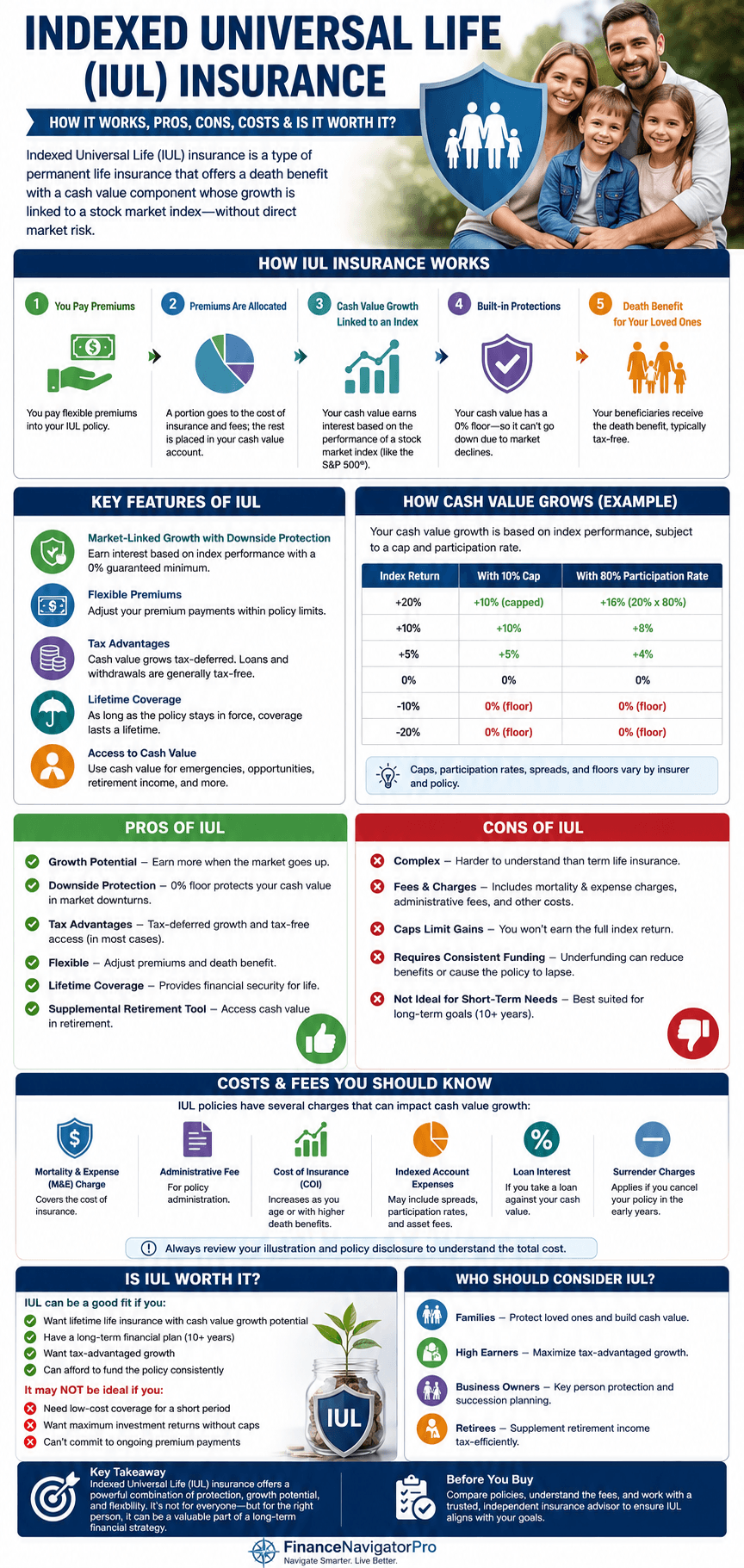
How IUL index crediting works: premiums, caps, floors, and participation rates at a glance.
This is where people often get confused — and where some agents do a disservice by oversimplifying the explanation. Let’s clear this up once and for all.
Your IUL cash value does not earn money by investing in the stock market. You own no shares, no ETFs, no mutual funds. So where does the interest come from?
Here’s what actually happens: the insurance company invests your premium money in its own general account — primarily in bonds and other fixed-income instruments. Separately, the company uses a portion of the returns from that general account to purchase options contracts on a stock market index. If the index performs well, those options pay off, and the insurance company passes some of those gains to you as interest credits. If the index performs poorly, the options expire worthless, but your principal isn’t at risk — your floor protection kicks in and you simply earn 0%.
Think of it like this: you’re a silent partner watching a dice game. If the roller gets a high number, you get a share of the winnings (up to a limit). If the roller gets a low number, you simply don’t win — but you also don’t lose your buy-in.
Real-World Example of Index Crediting
Imagine your IUL policy has these terms: S&P 500 index, an 11% cap rate, 100% participation rate, and a 0% floor. Here’s how four different market years would play out for a $100,000 cash value:
| Year | S&P 500 Return | Credited Rate | Cash Value After Credits |
|---|---|---|---|
| Year 1 (Bull) | +22% | 11% (capped) | $111,000 |
| Year 2 (Flat) | +3% | 3% | $114,330 |
| Year 3 (Bear) | −18% | 0% (floored) | $114,330 |
| Year 4 (Bull) | +15% | 11% (capped) | $126,907 |
Notice that in Year 3 (bear market), the cash value holds steady. In Year 4, it resumes growth. This is the appeal of the floor protection. However, also notice that the cap rate limits upside — you miss out on big market gains in years like Year 1. This table doesn’t account for ongoing Cost of Insurance deductions, which would reduce these figures in a real policy.
A Realistic IUL Example: Meet Sarah
Let’s walk through a fictional but realistic scenario to see how an IUL might play out over a lifetime.
Sarah is a 38-year-old non-smoking professional in good health. She earns $180,000 a year, has already maxed out her 401(k) and Roth IRA, and is looking for additional tax-advantaged growth. She purchases an IUL policy with a $1,000,000 death benefit, an $18,000 annual premium, an S&P 500 index strategy, a 10% cap rate, 100% participation rate, and a 0% floor.
Years 1–5: Building the Foundation
In the early years, a larger portion of Sarah’s premium goes toward the Cost of Insurance and policy fees. The COI at age 38 is relatively low, so most of her $18,000 annual premium flows into cash value. By Year 5, she has accumulated roughly $65,000–$75,000 in cash value, depending on market performance.
Years 6–20: The Accumulation Phase
This is where IUL can really shine — for people who stay disciplined and keep the policy funded. Assuming average credited rates around 6–7% annually after caps and floor years, Sarah’s cash value grows substantially. By her mid-50s, she may have $450,000–$600,000 accumulated.
However, this is also where a critical risk emerges: as Sarah ages, the Cost of Insurance rises — sometimes sharply. If the market underperforms during a stretch of years, the COI charges can begin eating meaningfully into cash value. An underfunded policy during this phase can deteriorate quickly.
Years 21–30: Retirement Income
At age 65, Sarah begins taking tax-free policy loans against her cash value — perhaps $40,000–$60,000 a year. Because these are loans, not withdrawals, she owes no income tax on them, regardless of how much her cash value has grown. This is the central appeal of IUL as a retirement income tool.
The Death Benefit
When Sarah eventually passes away, her beneficiaries receive the death benefit (reduced by any outstanding loan balances) income-tax-free. Depending on her age and policy structure, this might range from $500,000 to over $1,000,000 — a meaningful legacy while also having provided decades of retirement income.
Note
This is an illustrative example only. Actual results will vary significantly based on the insurance company, policy design, market performance, COI charges, fees, and funding discipline.
Key Features of Indexed Universal Life Insurance
1. Flexible Premiums
Unlike whole life insurance with its rigid required premium schedule, IUL allows you to adjust how much you pay each year. You can pay more in good income years and less in lean years — as long as you maintain enough cash value to cover ongoing costs. This flexibility is double-edged: it’s great for income variability, but it tempts some policyholders to underfund the policy, creating long-term problems.
2. Permanent Coverage
IUL doesn’t expire. As long as the policy remains properly funded and in force, you’re covered for life. This contrasts with term life insurance, which provides coverage only for a specified period.
3. Market-Linked Growth with Downside Protection
The combination of participation in index gains (up to a cap) and a 0% floor is the defining feature of IUL. It occupies a middle ground between fixed products (predictable but lower returns) and variable products (higher potential returns but full market risk).
4. Tax Advantages
IUL offers a trifecta of tax benefits under IRC Section 7702: tax-deferred growth, tax-free death benefit, and tax-free access to cash value via policy loans (when managed properly and the policy doesn’t become a Modified Endowment Contract, or MEC).
5. Living Benefits / Accelerated Death Benefit Riders
Many IUL policies now include living benefit riders that allow you to access a portion of your death benefit while still alive if you’re diagnosed with a terminal, chronic, or critical illness. These can be valuable, but they’re also sometimes used as a sales hook without full disclosure of the costs or conditions.
6. Multiple Index Options
Modern IUL policies often allow you to allocate your cash value across multiple index strategies — S&P 500, Nasdaq-100, international indices, multi-year strategies, and more. This gives you some degree of diversification within the policy.
Pros of Indexed Universal Life Insurance
1. Potential Tax-Free Retirement Income
For high-income earners who’ve maxed out traditional retirement accounts, IUL can serve as an additional tax-advantaged savings bucket. Policy loans in retirement are not reported as income to the IRS, creating a stream of tax-free cash flow — provided the policy is structured and maintained correctly.
2. Downside Protection in Market Crashes
The 0% floor means your accumulated cash value can’t decrease due to a market crash. During major downturns, IUL holders simply earn 0% for that period — they don’t watch years of savings evaporate. This can be genuinely valuable for risk-averse savers.
3. Flexible Premiums and Adjustable Death Benefit
Life changes. Income goes up and down. Family situations evolve. IUL’s premium flexibility lets you adapt the policy to your circumstances in a way that rigid whole life insurance doesn’t.
4. Permanent Death Benefit
Unlike term insurance, an IUL provides lifelong coverage (when properly funded), which matters for estate planning, business succession, and leaving a legacy.
5. No Federal Contribution Limits
The IRS limits how much you can put into a 401(k) or Roth IRA each year. An IUL has no federally mandated contribution limit (though you must stay under MEC limits based on the policy’s death benefit size). For high earners wanting to shelter more money from taxes, this is a significant advantage.
6. Estate Planning Benefits
The income-tax-free death benefit can be a powerful estate planning tool. Combined with an Irrevocable Life Insurance Trust (ILIT), an IUL can help pass wealth to the next generation while potentially reducing estate taxes.
7. Living Benefits
Many policies include riders that let you access your death benefit early if you become terminally or chronically ill — providing financial relief during some of life’s most difficult moments.
Cons of Indexed Universal Life Insurance
1. High Fees and Costs
IUL is one of the more expensive insurance products available. You’re paying for the death benefit coverage (COI), administrative fees, the cost of the index options that enable market-linked growth, potential rider fees, and surrender charges in the early years. These costs can significantly reduce your net return, especially early in the policy.
2. The Cap Rate Limits Your Upside
In strong bull market years, your IUL return is capped. If the S&P 500 returns 25% and your cap is 10%, you earn 10%. Someone invested directly in an S&P 500 index fund would have earned 25%. Over long periods with strong markets, this gap compounds significantly.
3. Complexity — and Risk of Misunderstanding
IUL is genuinely complex. Participation rates, cap rates, index crediting methods, Cost of Insurance schedules, MEC limits — these are not concepts the average person understands intuitively. Complexity is a breeding ground for misrepresentation and unrealistic expectations.
4. Policy Lapse Risk
If your cash value is depleted — due to underfunding, excessive loans, poor market performance, or rising COI charges — your policy can lapse, leaving you with no coverage and potentially triggering a large taxable event.
5. Rising Cost of Insurance with Age
The COI in an IUL is not level — it rises each year as you get older. In later years (75, 80, 85+), COI can rise dramatically and, if cash value hasn’t grown sufficiently, can cannibalize the policy.
6. Illustrated Returns May Not Reflect Reality
Agents are required to show both a maximum illustration and a lower-return illustration, but people often focus on the rosier projection. Policies funded based on optimistic projections can significantly underperform.
7. Long Commitment with Early Exit Penalties
Surrendering an IUL policy in the first 10–15 years typically triggers surrender charges, meaning you may receive substantially less than you’ve paid in. IUL is a long-term commitment and simply isn’t the right fit for anyone who might need the money sooner.
8. Insurance Company Controls Key Parameters
Unlike a fixed annuity with a locked rate, your IUL’s cap rates and participation rates can be adjusted by the insurance company within the bounds of the policy contract. If the company lowers your cap rate, your long-term projections change substantially.
Who Should Consider an IUL?
✓ Good Fit
- ✓High-income professionals who’ve maxed out 401(k) and Roth IRA contributions
- ✓Business owners using IUL for executive bonus plans or key-person insurance
- ✓People with a genuine, long-term permanent insurance need
- ✓Estate planners looking to transfer wealth tax-efficiently
- ✓Conservative savers who value downside protection
- ✓Long-term thinkers with a 20–30 year time horizon
✕ Probably Not
- ✕You need life insurance mainly for temporary income replacement
- ✕You haven’t maxed out your 401(k), Roth IRA, or HSA yet
- ✕You expect stock-market-level returns from your policy
- ✕You might need to exit within 10–15 years
- ✕You’re on a tight budget — underfunding is risky
- ✕You don’t fully understand how the product works
Indexed Universal Life vs Other Life Insurance Products
IUL vs Whole Life Insurance
| Feature | IUL | Whole Life | Winner |
|---|---|---|---|
| Premium Flexibility | Flexible | Fixed | IUL |
| Cash Value Growth | Index-linked | Fixed/guaranteed | Depends on goals |
| Downside Protection | 0% floor | Guaranteed | Whole Life |
| Upside Potential | Higher (capped) | Lower but stable | IUL |
| Complexity | High | Low–Medium | Whole Life |
| Dividends | Not typical | Common | Whole Life |
IUL vs Term Life Insurance
| Feature | IUL | Term Life |
|---|---|---|
| Duration | Permanent (lifetime) | 10–30 year term |
| Monthly Cost | Higher | Much lower |
| Cash Value | Yes, grows over time | None |
| Tax Benefits | Multiple advantages | Death benefit tax-free |
| Best For | Permanent needs + wealth building | Temporary income replacement |
IUL vs Variable Universal Life (VUL)
| Feature | IUL | VUL |
|---|---|---|
| Investment Risk | None (0% floor) | Full market risk |
| Return Potential | Capped at cap rate | Uncapped (but losable) |
| Direct Market Investing | No | Yes (sub-accounts) |
| SEC Regulation | No (not a security) | Yes (registered security) |
| Best For | Conservative/moderate investors | Aggressive investors |
Indexed Universal Life vs Retirement Accounts
IUL vs Roth IRA
| Feature | IUL | Roth IRA |
|---|---|---|
| 2026 Contribution Limit | No federal limit (MEC limits apply) | $7,000 / $8,000 (age 50+) |
| Income Limit | None | Yes (phases out ~$161K–$240K+) |
| Tax-Free Growth | Yes (within policy) | Yes |
| Tax-Free Withdrawals | Via policy loans | Yes (qualified distributions) |
| Death Benefit | Yes | No |
| Best Strategy | After Roth IRA is maxed | Fund this first |
Bottom Line
Always max your Roth IRA before considering IUL for tax-advantaged savings.
IUL vs 401(k)
| Feature | IUL | 401(k) |
|---|---|---|
| 2026 Contribution Limit | No federal limit | $23,500 / $31,000 (age 50+) |
| Employer Match | No | Common and valuable |
| Tax Treatment | After-tax; tax-free loans | Pre-tax or Roth |
| RMDs | No | Yes (Traditional, from age 73) |
| Best Strategy | After 401(k) is maxed | Fund this first (especially with match) |
Bottom Line
Always capture the full employer 401(k) match before considering IUL. That match is free money — IUL’s tax benefits can’t compete with a 50–100% immediate return from your employer.
Understanding IUL Fees
Fees are arguably the most under-discussed aspect of IUL policies during the sales process. Let’s go through each one honestly.
1. Cost of Insurance (COI)
This is the charge for your actual death benefit coverage. It’s calculated based on your age, health, gender, and the net amount at risk to the insurance company. COI is generally low when you’re young and rises each year — sometimes dramatically in your 70s and 80s.
2. Administrative Fees
A flat monthly or annual charge for policy maintenance. Small individually, but they add up over decades.
3. Premium Load Charges
Some policies deduct a percentage off the top of each premium before it enters the cash value account — often 5–10% in the early years. This is sometimes called a “load.”
4. Surrender Charges
If you cancel or significantly reduce the policy during the surrender period (typically the first 10–15 years), you’ll incur a surrender charge that reduces the cash value you receive.
5. Index Account Charges (Spread)
Some index crediting strategies use a “spread” rather than (or in addition to) a cap rate. The spread is a percentage deducted from your index gain before crediting.
6. Rider Charges
Living benefit riders, waiver of premium, overloan protection riders — each adds a fee. Some are worth it; some are marketing add-ons that inflate the cost.
7. Loan Interest
When you take a policy loan, the insurance company charges interest. Some policies offer “wash loans” or “zero-cost loans” where the credited rate offsets the loan interest — valuable in retirement income planning.
How Much Does Indexed Universal Life Insurance Cost?
Pricing varies enormously based on individual factors. Here are the key variables that determine your IUL premium:
- Age: The younger you are, the lower the Cost of Insurance and the more years of compounding you benefit from.
- Health: Insurers underwrite IUL policies based on your health.
- Gender: Women statistically live longer, which means lower COI in many policies.
- Coverage Amount: A $500,000 death benefit costs less than a $2,000,000 benefit.
- Smoking Status: Smokers pay significantly higher rates.
- Funding Level: A heavily funded IUL creates more cash value per dollar spent because the COI is small relative to the premium.
- Policy Design: An IUL designed for maximum cash value functions very differently from one designed for maximum death benefit.
Illustrative Premium Ranges (Not Quotes)
A general benchmark for a healthy 40-year-old non-smoker:
| Funding Level | Approx. Monthly Range | Notes |
|---|---|---|
| Minimum to keep $500K IUL in force | $200–$400/mo | Likely underfunds the policy |
| Recommended for meaningful growth | $800–$2,000+/mo | For a $500K coverage level |
| Aggressive retirement-income funding | $2,500–$10,000+/mo | Common for high earners |
These ranges are illustrative only. Get an actual illustration from a licensed professional to understand the true economics for your situation.
Tax Benefits of Indexed Universal Life Insurance
Taxes are often the primary reason high earners consider IUL. Let’s walk through the tax treatment carefully — because the devil is in the details.
Tax-Deferred Growth
Interest credited to your IUL cash value accumulates without being taxed each year. Compare this to a taxable brokerage account, where dividends and capital gains are taxable events annually. The compounding effect of tax deferral is significant over 20–30 years.
Tax-Free Death Benefit
The death benefit paid to your beneficiaries is generally income-tax-free under IRC Section 101. This is true for virtually all life insurance, not just IUL.
Tax-Free Policy Loans (Under Certain Conditions)
This is the big one for retirement planning. Policy loans are not considered income by the IRS — they’re borrowing against an asset you own. As long as the policy remains in force, you never “realize” a gain, so you owe no income tax. This is the mechanism that makes IUL an attractive supplemental retirement income tool.
The Modified Endowment Contract (MEC) Trap
Here’s the critical caveat: if you overfund an IUL too aggressively in the early years, the IRS can classify it as a Modified Endowment Contract (MEC). A MEC loses the tax-free loan treatment — withdrawals and loans become taxable (and subject to a 10% penalty before age 59½). A skilled insurance professional will structure the policy to maximize funding without triggering MEC status.
Potential Tax Pitfalls
- Policy Lapse with Outstanding Loans: If your policy lapses while you have unpaid loans, those loans can become taxable income.
- MEC Violations: Overfunding in early years can trigger MEC status and eliminate the key tax advantages.
- Estate Taxes: If you own the policy at death, the death benefit may be included in your taxable estate. An ILIT can address this.
Common IUL Myths — Debunked
Myth #1: “My money is invested directly in the stock market.”
FALSE
Your cash value is not invested in any stock market index. The insurance company buys options contracts on the index to generate the interest it credits to your account. You own no shares and have no direct market exposure.
Myth #2: “I can’t lose money with an IUL.”
MISLEADING
The 0% floor means you won’t lose money due to index performance alone. However, your cash value absolutely can decrease — and a policy can lapse — if fees and Cost of Insurance exceed the cash value.
Myth #3: “IUL always beats the stock market.”
FALSE
Cap rates mean you will underperform the market in strong bull years. Over long periods with consistently strong returns, a low-cost index fund will generally outperform an IUL — but the IUL provides insurance coverage and downside protection that a fund doesn’t.
Myth #4: “IUL is only for wealthy people.”
PARTLY TRUE
IUL works best when funded substantially. The fees become a smaller percentage of a large premium than a small one. That said, some middle-income earners with genuine permanent insurance needs may find IUL appropriate.
Myth #5: “IUL is a scam.”
FALSE
IUL is a legitimate product with real benefits for the right people. The ‘scam’ reputation comes from agents who misrepresent it and sell it to people who don’t need it. The product isn’t the problem — the misrepresentation sometimes is.
Common Mistakes IUL Buyers Make
1. Underfunding the Policy
This is the single most common IUL mistake. A policy funded at the minimum required level is essentially a death benefit with a tiny savings component. The real value of IUL comes from funding it aggressively — close to MEC limits — so the cash value grows substantially and fees become a small percentage of the overall value.
2. Focusing Only on the Rosy Illustration
Insurance illustrations must show a “current” (often optimistic) scenario and a “lower” scenario. Always look at the lower scenario, then imagine reality sitting somewhere between them.
3. Taking Excessive Policy Loans
Policy loans are powerful, but reckless borrowing can deplete cash value to the point where the policy can’t sustain rising COI. This can trigger a catastrophic lapse in your 70s or 80s — exactly when you least want it.
4. Ignoring Fees
Asking “what’s the return?” without understanding what’s being deducted before it reaches the cash value account gives you an incomplete picture. Always ask for the full fee disclosure.
5. Misunderstanding Caps
“Get stock market returns without the risk!” is a common pitch. The cap rate is the fine print. When you understand that a 10% cap in a year the market returned 28% means you earned 10%, the pitch sounds different.
6. Working with Inexperienced Agents
IUL is complex. Look for someone with CFP (Certified Financial Planner) or CLU (Chartered Life Underwriter) credentials, or at minimum extensive documented experience with IUL.
How to Choose the Right IUL Policy
1. Evaluate Financial Strength Ratings
You’re potentially in a relationship with this insurance company for 30+ years. Check ratings from AM Best (A or better preferred), Moody’s, S&P Global, and Fitch.
2. Compare Cap Rates and Participation Rates — With Skepticism
Higher caps look attractive, but remember: the insurance company can lower them. Focus on the guaranteed minimum cap (if any) and the company’s historical track record of maintaining competitive rates.
3. Understand the Index Crediting Method
“Annual point-to-point” is the most common and straightforward. Monthly averaging, monthly point-to-point, and multi-year strategies all work differently and can produce very different results.
4. Request Multiple Illustrations
Always ask for illustrations at multiple credited rate assumptions — not just the current (maximum) rate. A trustworthy agent will show you what happens at lower return assumptions without being asked.
5. Assess Rider Value
Chronic illness, terminal illness, and disability riders can genuinely add value — but they also add cost. Evaluate whether each rider is worth its price for your situation.
Questions to Ask Your Advisor
- ✓What is the current cap rate, and what is the guaranteed minimum cap?
- ✓How has this company’s cap rate changed over the past 10 years?
- ✓Can you show me an illustration at a 4%, 6%, and 8% credited rate assumption?
- ✓What are the total fees and charges in Year 1, Year 10, and Year 20?
- ✓How is the Cost of Insurance structured at age 70, 75, and 80?
- ✓What happens to the policy if I miss premium payments for 2–3 years?
- ✓What is the surrender charge schedule?
Evaluating IUL Companies: What to Look For
We’re not going to publish a definitive “best IUL company” ranking here, because the right company depends entirely on your age, health, goals, funding level, and state of residence. What we can tell you is what criteria matter most when comparing carriers.
Financial Strength
Look for companies rated A or better by AM Best. Companies like Pacific Life, Nationwide, North American Company, Protective Life, Corebridge Financial, Securian, and Penn Mutual are commonly discussed in the IUL market — each with different product strengths. Research current ratings independently.
Cap Rate History
Some companies have a track record of maintaining more competitive cap rates over time; others have a history of reducing them when interest rate environments shift. Ask your agent for documented cap rate history going back at least 5–10 years.
Overloan Protection Riders
This rider prevents your policy from lapsing due to excessive loans in retirement — a critical feature for those using IUL primarily for retirement income.
Frequently Asked Questions About IUL Insurance
Q1. Is IUL worth it?
It depends entirely on your financial situation. For high-income earners who have maxed out other tax-advantaged accounts, have a genuine permanent life insurance need, and can commit to substantial long-term funding, IUL can be a valuable component of a diversified financial plan. For most middle-income families, the fees and complexity typically make other options more efficient.
Q2. Can you lose money with an IUL?
Not due to market index losses — the 0% floor protects you from that. However, your cash value can decrease if fees and Cost of Insurance charges exceed the credited interest. In the extreme, an underfunded policy can lapse, leaving you with nothing.
Q3. How long should you keep an IUL?
IUL is designed for the long term — ideally 20–30+ years. In the first 10–15 years, surrender charges apply and cash value may be modest.
Q4. Can I borrow against my IUL?
Yes. Policy loans are one of the primary ways to access IUL cash value. They are generally tax-free, but interest accrues and unpaid loans reduce your death benefit.
Q5. How are IUL returns calculated?
Returns are determined by index performance during the crediting period, subject to a cap rate, participation rate, and floor rate (typically 0%). The specific crediting method also affects results.
Q6. What happens if I stop paying premiums?
IUL has flexible premiums, so missing a payment doesn’t immediately cancel the policy — available cash value covers costs for a period. But if cash value is depleted, the policy can eventually lapse.
Q7. Can I cash out an IUL?
Yes, you can surrender the policy for the cash surrender value — but surrender charges apply in the early years. Gains above your basis are also taxable as ordinary income upon surrender.
Q8. What is a cap rate in IUL?
The cap rate is the maximum interest rate your cash value can earn in any given crediting period, regardless of how well the index performs.
Q9. What is a participation rate in IUL?
The participation rate determines what percentage of the index gain you receive. A 100% rate means you get all of the gain (up to the cap).
Q10. Is IUL taxable?
Cash value growth is tax-deferred, death benefits are generally income-tax-free, and policy loans are not taxable income. However, gains become taxable if you surrender the policy or it lapses with outstanding loans.
Q11. What is a Modified Endowment Contract (MEC)?
A MEC is a life insurance policy overfunded beyond IRS limits (the 7-pay test). Once a policy becomes a MEC, withdrawals and loans lose favorable tax treatment.
Q12. How does IUL compare to a Roth IRA?
A Roth IRA should generally be funded first — it’s simpler, has lower fees, and offers genuine market returns. IUL is a supplement for those who’ve maxed Roth IRA contributions or exceed income limits.
Q13. Does IUL have required minimum distributions (RMDs)?
No. Unlike Traditional 401(k)s and IRAs, IUL policies are not subject to IRS Required Minimum Distribution rules.
Q14. Can IUL be used for estate planning?
Yes. The income-tax-free death benefit makes IUL a useful estate planning tool, especially combined with an Irrevocable Life Insurance Trust (ILIT).
Q15. What is an IUL rider?
Riders are optional add-ons that expand coverage, such as chronic/terminal illness accelerated benefit riders, waiver of premium, and overloan protection.
Q16. Can a business owner use IUL?
Yes — common uses include executive bonus plans, key-person insurance, and buy-sell agreement funding.
Q17. What happens to the cash value when I die?
In most standard configurations (Option A/Level), the company pays the stated death benefit and retains the cash value. In Option B/Increasing configurations, heirs receive both the benefit and the cash value.
Q18. Can I change my index allocation?
Yes, typically annually on the policy anniversary, between different index strategies.
Q19. Is there a free look period?
Yes. Most states require a free look period — typically 10–30 days — during which you can cancel and receive a full refund of premiums paid.
Q20. What is the difference between IUL and universal life insurance?
Traditional universal life credits a fixed interest rate. IUL credits interest based on an index, with a floor and cap, offering higher potential returns but more complexity and typically higher fees.
Final Verdict: Is Indexed Universal Life Insurance Right for You?
After everything we’ve covered, here’s the honest bottom line.
Indexed Universal Life insurance is a legitimate, potentially valuable financial tool for a specific subset of people. It is not a universal solution, not a market investment, and not a replacement for basic financial planning fundamentals.
IUL Makes Sense When…
- ✓You have a genuine, long-term permanent insurance need
- ✓You’ve maxed out 401(k), Roth IRA, HSA, and other tax-advantaged accounts
- ✓You’re in a high income tax bracket seeking additional tax-advantaged savings
- ✓You can fund the policy substantially and consistently for 20+ years
- ✓You understand and accept the fees, caps, and complexity involved
- ✓You’re working with a qualified, experienced professional
Consider Alternatives When…
- ✕You primarily need cost-effective protection — term life is far cheaper
- ✕You haven’t maxed out tax-advantaged retirement accounts yet
- ✕You want uncapped stock market exposure and growth potential
- ✕You need flexibility to exit within 10–15 years
- ✕You’re not prepared to engage with the policy’s complexity
Important Disclaimer
This guide is for educational purposes only and does not constitute financial, tax, or legal advice. Life insurance policies vary significantly by company, product, state, and individual underwriting. Always consult a licensed insurance professional and, for tax implications, a qualified tax advisor before purchasing any life insurance product. Past performance of index strategies does not guarantee future results.
Take the Next Step
Ready to explore whether IUL might fit your financial plan? A few good places to continue your research:
- Learn the basics in our guide to what life insurance actually covers.
- Compare how Roth 401(k) vs Roth IRA accounts stack up before adding IUL to the mix.
- See how insurance quotes are calculated so you know what underwriters look at.
- Review ways to lower your insurance premium across any policy type.
- If a financial professional is part of your plan, see what a financial advisor typically costs.
About the Author
Jaykishan Panchal is a financial content strategist with 15+ years of experience explaining complex financial products to everyday Americans.