
Everything American Drivers Need to Know About Automobile Insurance Rental Reimbursement
● ~24 min read
● Sources: III • NAIC • CFPB
It’s Monday morning. You’re running five minutes late, coffee in hand, when another driver blows through a red light and rear-ends your car. Nobody’s seriously hurt, thank goodness—but your vehicle is badly damaged. The repair shop gives you the news: it’s going to take three weeks, maybe more, depending on parts availability.
Three weeks. Without a car.
You still have to get to work. Your kids need to be picked up from school. There are grocery runs, doctor appointments, soccer practices. Life doesn’t pause because your car is in a body shop.
So you call a rental company. And then the sticker shock hits: $65 to $85 per day for a basic sedan. Run that out over 21 days and you’re looking at $1,365 to $1,785—just for a temporary car. That doesn’t count gas, insurance for the rental itself, or the occasional upgrade fee when they’re out of economy models.
This is exactly where Rental Reimbursement Coverage quietly earns its keep—or where the absence of it quietly drains your savings account.
I’ve been helping American drivers navigate auto insurance for over two decades. I’ve seen people cry tears of relief because they had rental reimbursement coverage during a three-month repair nightmare. I’ve also watched people scramble for Uber credits and bum rides from coworkers because they skipped this $2-a-month add-on to save a little money on their premium.
In this guide, I’ll explain exactly how rental reimbursement coverage works, what it actually covers (and what it doesn’t), how much it costs, how to file a claim, and—most importantly—whether it makes financial sense for your specific situation. I’ll also walk through the most common mistakes people make when buying or using this coverage.
Quick Note:
Coverage terms, limits, and rules vary significantly between insurance companies and states. Everything in this guide reflects common industry practices. Always review your specific policy documents and check with your insurer for details that apply to your coverage.
📌 Quick Answer
What is Rental Reimbursement Coverage?
Rental reimbursement coverage is an optional auto insurance add-on that pays for a temporary rental car—up to a daily and total dollar limit—while your own vehicle is being repaired after a covered claim like a collision, theft, or storm damage. It is not automatically included with “full coverage” and typically costs just $2–$10 per month.
1. What Is Rental Reimbursement Coverage?
Rental reimbursement coverage—sometimes called rental car reimbursement insurance or transportation expense coverage—is an optional add-on to your auto insurance policy that pays for a temporary rental vehicle while your own car is being repaired after a covered claim.
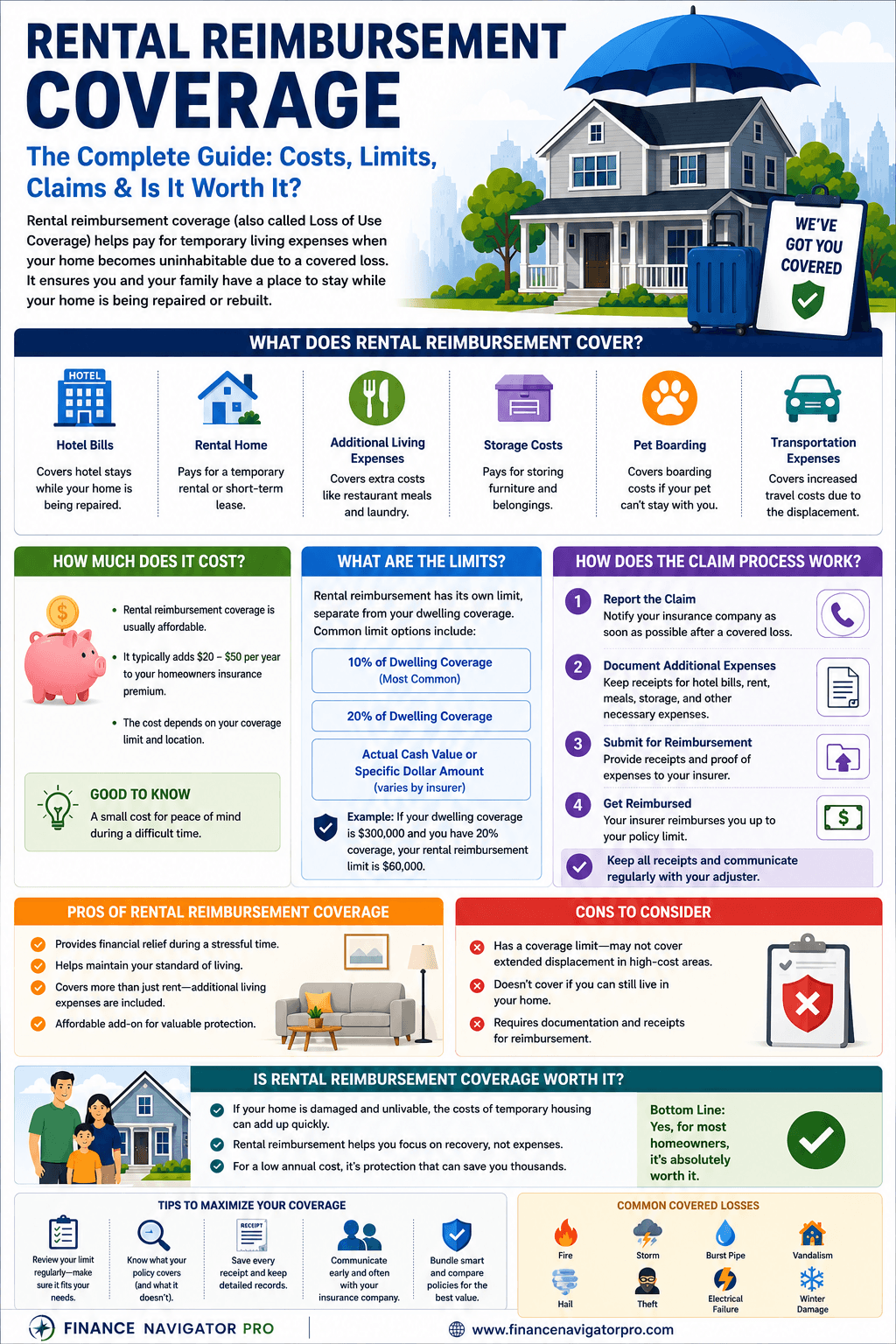
In plain English: if your car is in the shop because of an accident, theft, or other covered loss, your insurance company will reimburse you (up to a daily and total dollar limit) for the cost of renting a replacement vehicle.
It’s not a separate standalone insurance policy. It’s an endorsement—an add-on rider—that you attach to an existing personal auto policy that includes collision and/or comprehensive coverage. To understand how this fits into your broader policy, it helps to first understand what insurance is and how it works at a foundational level.
How It Works in a Nutshell
Your car is involved in a covered incident (collision, theft, hail, etc.). You file a claim with your insurer. Once the claim is approved and your car heads to the repair shop, you’re authorized to rent a vehicle. Your insurer pays the rental company directly—or reimburses you—up to your daily limit until your car is repaired or your maximum benefit is exhausted.
✅ Key Takeaway Box
• Rental reimbursement covers temporary transportation costs when your car is being repaired after a covered claim.
• It does NOT cover rentals for vacations, business trips, or mechanical breakdowns.
• It IS optional—not automatically included with standard full coverage.
• The coverage comes with two limits: a daily cap and a total (maximum) cap.
2. How Rental Reimbursement Coverage Works — Step by Step
Understanding the claims process helps you avoid surprises and get your rental faster. Here’s exactly how it typically works:
💡 Pro Tip:
If your insurer has a direct-billing arrangement with the rental agency, you won’t have to pay out of pocket at all. Ask your claims rep specifically whether they work with Enterprise, Hertz, or National on a direct-pay basis—most major insurers do.
3. What Rental Reimbursement Actually Covers
Here’s what rental reimbursement coverage typically pays for:
✓ The daily rental vehicle cost (up to your daily limit)
✓ Applicable rental taxes and mandatory fees
✓ Reasonable class of vehicle (typically economy to midsize)
✓ Rental from approved or national rental agency locations
✓ The rental period while your vehicle is under active repair
Coverage Limits — How They Work:
Daily Limit: The maximum your insurer pays per day. Common tiers: $30/day, $40/day, $50/day, $75/day.
Maximum Total Limit: The cap on what they’ll pay over the entire rental period. Example: $30/day up to $900 total = max 30 days.
If repairs take longer than your total limit covers, you pay the difference out of pocket.
Example: You have $40/day up to $1,200 coverage. A basic rental costs $38/day. Your car takes 28 days to repair. Total rental cost: $1,064. Your insurer covers all of it because it’s under both your daily and total limits.
But if you upgrade to a $55/day SUV, you’d owe $15/day out of pocket, or $420 total—even though you’re within your maximum total limit. This is similar to how an insurance deductible works—your insurer covers what falls within your agreed limits, and you cover the rest.
4. What Rental Reimbursement Does NOT Cover
This is where a lot of policyholders get caught off guard. Here’s a clear breakdown:
| What’s NOT Covered | Details |
|---|---|
| Fuel | You fill the tank yourself—insurance never covers gas. |
| Security deposits | You provide the credit card. Deposits are your responsibility. |
| Traffic & parking tickets | Any violations during the rental period are 100% yours. |
| Luxury vehicle upgrades | Your insurer covers a reasonable class, not a Cadillac Escalade. |
| Optional GPS / SiriusXM | Add-on rental features are not reimbursed. |
| Child car seats | You supply your own or pay for it yourself. |
| Late return fees | Return the car on time. Late fees are your problem. |
| Smoking or pet damage fees | Rental company damage fees are not insurance claims. |
| Damage to the rental car | Rental reimbursement does NOT cover damage to the rental itself—you’d need rental car insurance or your credit card’s coverage for that. |
| Mileage penalties | Some rental agreements have mileage caps—overages are yours. |
| Intentional damage | Insurance never covers intentional acts. |
⚠️ Important Distinction:
Rental reimbursement coverage pays for the COST of renting a car. It does NOT provide insurance for the rental car itself. If you damage the rental, you need separate collision damage waiver (CDW) coverage, which is offered by the rental company or through certain credit cards.
5. Rental Reimbursement vs. Rental Car Insurance — Key Differences
These two things sound similar but serve completely different purposes. Confusing them is one of the most common mistakes drivers make.
| Factor | Rental Reimbursement | Rental Car Insurance (CDW/LDW) |
|---|---|---|
| Purpose | Covers cost to RENT a car while yours is repaired | Covers DAMAGE TO the rental car |
| Who pays | Your auto insurer (up to your limit) | Rental company, your credit card, or travel insurance |
| When it applies | After a covered claim on YOUR vehicle | Whenever you rent any vehicle |
| Personal vehicle accident | Yes — primary purpose | No |
| Vacation car rental | No | Yes |
| Business trip rental | No | Possibly (check credit card) |
| Covers liability | No | Depends on policy |
Bottom line: You want BOTH types of protection, but they come from different sources and serve different scenarios.
► Compare Auto Insurance Quotes — Check If Rental Reimbursement Is Included
6. Rental Reimbursement vs. Loaner Cars
Dealer Loaners
Some dealerships and authorized repair shops provide loaner vehicles while your car is being serviced. This sounds great, but there are important caveats: loaner availability is not guaranteed, it may be limited to warranty repairs only, and you may need to schedule it in advance. Many independent body shops don’t offer loaners at all.
Insurance-Paid Rentals
When your rental reimbursement kicks in, you typically have access to any of the rental agency’s available fleet (within your authorized class), from any of their locations. This offers more flexibility than a dealer loaner—but it comes with the daily and total dollar limits built into your policy.
| Factor | Dealer Loaner | Insurance Rental |
|---|---|---|
| Availability | Limited; not guaranteed | Available at most rental locations |
| Cost to you | Usually free | Covered up to your daily limit |
| Vehicle choice | Whatever’s available | Economy to midsize typically |
| Coverage trigger | Depends on repair type | Covered claim only |
| Independent shops | Rarely offered | Available at rental agencies |
7. When Rental Reimbursement Applies
Your rental reimbursement kicks in when you file a covered claim under your collision or comprehensive coverage. Here’s a full breakdown of qualifying events:
Collision Claims
• Accident with another vehicle (regardless of fault, in most policies)
• Single-car accident (hitting a pole, guardrail, pothole damage)
• Hit-and-run where your vehicle is damaged
• Rollover accidents
Comprehensive Claims
• Vehicle theft (while your car is missing or until recovery/total loss settlement)
• Vandalism or intentional damage by third parties
• Fire damage (including wildfire)
• Hail damage
• Flood damage
• Fallen trees or other objects
• Animal strikes (deer, etc.)
• Glass damage (in some policies, only if the windshield claim exceeds deductible)
✅ Good to Know:
If you file a comprehensive claim for hail damage and the repairs take 10 days, rental reimbursement covers your transportation for those 10 days—even if you weren’t in an accident. Many policyholders don’t realize comprehensive claims also trigger rental benefits.
8. Situations Where Rental Reimbursement Does NOT Apply
Equally important is knowing when rental reimbursement won’t help you—no matter how badly you need a car.
Mechanical or Maintenance Issues
• Routine oil changes or tire rotations
• Brake or rotor replacement
• Transmission failure (not accident-related)
• Engine failure from wear and tear
• Battery replacement
• Heating or air conditioning breakdown
Other Exclusions
• Vehicle recalls — when your car is at the dealer for a recall fix
• Voluntary repairs or upgrades you’ve chosen to make
• Service visits that don’t stem from a covered claim
• Rentals for business or personal travel unrelated to your car being repaired
💡 Worth Knowing:
For breakdowns and mechanical failures, you’d need a separate product—either a mechanical breakdown insurance (MBI) policy or a roadside assistance plan with rental benefits. These are different products from rental reimbursement.
9. How Much Does Rental Reimbursement Cost?
Here’s one of the best-kept secrets in auto insurance: rental reimbursement coverage is remarkably inexpensive relative to the protection it provides.
Typical Cost Ranges
| Coverage Level | Monthly Cost (Est.) | Annual Cost (Est.) |
|---|---|---|
| $30/day up to $900 | $2 – $4/month | $24 – $48/year |
| $40/day up to $1,200 | $3 – $6/month | $36 – $72/year |
| $50/day up to $1,500 | $4 – $8/month | $48 – $96/year |
| $75/day up to $2,250 | $5 – $10/month | $60 – $120/year |
These are estimates. Your actual cost depends on several factors:
• Vehicle type — More expensive cars typically cost more to add coverage for
• Your ZIP code — Urban areas with more accidents often see slightly higher premiums
• State regulations — Some states have minimum coverage requirements or restrictions
• Your driving history — Accident history can affect all coverage add-on costs
• Your insurance company — Pricing varies significantly between carriers
• Your existing coverage levels — The base policy you’re adding to affects cost
If you’re trying to manage your overall premium while still adding valuable coverage like this, it’s worth reviewing how to lower your insurance premium and checking insurance discounts most people don’t know about—both can offset the small cost of this add-on.
✅ Reality Check:
Spending $3–$7 per month for coverage that could pay $1,000–$2,000 in rental costs is arguably one of the best value add-ons available in personal auto insurance. Most Americans pay less annually for rental reimbursement than they’d spend on a single week of renting a car.
► Check Rental Reimbursement Pricing — Compare Rates for Your Vehicle & ZIP Code
10. Understanding Coverage Limits
Coverage limits are the most misunderstood aspect of rental reimbursement. Let me break this down clearly.
Every rental reimbursement policy has two limits:
• Daily limit: The maximum your insurer pays per rental day.
• Total (maximum) limit: The maximum they’ll pay over the entire claim period.
Common Limit Combinations
| Coverage Tier | Daily Limit | Max Total | Max Rental Days |
|---|---|---|---|
| Basic | $30/day | $900 | 30 days |
| Standard | $40/day | $1,200 | 30 days |
| Enhanced | $50/day | $1,500 | 30 days |
| Premium | $75/day | $2,250 | 30 days |
Notice that in most tiers, dividing the maximum by the daily limit gives you 30 days. That’s the typical cap for most rental reimbursement policies. But repairs don’t always follow a 30-day schedule—especially for luxury vehicles, EVs, or cars with structural damage requiring OEM parts.
What Happens When You Hit Your Limits?
If your repair takes 45 days but your policy pays for 30, you’re on the hook for days 31–45. At $65/day for an average rental, that’s $975 out of pocket. This is exactly why choosing the right limits matters.
💡 My Recommendation:
If you drive a newer vehicle, an SUV, or an EV, consider the $50/day or $75/day tier. Repairs on these vehicles routinely take 30+ days due to parts delays, specialized labor, and calibration requirements for advanced safety systems.
11. Real Cost Examples — What You’d Actually Pay
🚗 Scenario A: 7-Day Repair (Minor Fender Bender)
Rental cost: $55/day × 7 days = $385. With $30/day coverage, you’d pay: $25/day × 7 = $175 out of pocket. With $50/day coverage: fully covered.
🚗 Scenario B: 14-Day Repair (Moderate Collision Damage)
Rental cost: $62/day × 14 days = $868. With $40/day coverage, you’d pay: $22/day × 14 = $308 out of pocket. With $50/day coverage, you’d pay: $12/day × 14 = $168 out of pocket.
🚗 Scenario C: 30-Day Repair (Major Structural Damage)
Rental cost: $65/day × 30 days = $1,950. With $50/day coverage: ($50 × 30 = $1,500 covered), you’d pay $450. With $75/day coverage: ($75 × 30 = $2,250 max), you’d be fully covered.
🚗 Scenario D: 45-Day Repair (Luxury Vehicle, OEM Parts Delay)
Rental cost: $80/day × 45 days = $3,600. With $50/day up to $1,500 coverage: you’d pay $3,600 − $1,500 = $2,100 out of pocket. With $75/day up to $2,250: you’d pay $3,600 − $2,250 = $1,350 out of pocket.
✅ Lesson:
For extended repairs—which are increasingly common due to supply chain issues and the complexity of modern vehicles—having higher limits makes a significant difference in your out-of-pocket costs.
12. How to File a Rental Reimbursement Claim
Here’s a complete step-by-step checklist for getting your rental reimbursement claim handled efficiently. This builds on the general process described in how insurance claims and deductibles work together.
💡 Claim Efficiency Tip:
The fastest claim experiences happen when you call your insurer’s claims line (not a general customer service number), have your policy number ready, and specifically ask about rental authorization in that first call. Insurers with direct-billing agreements can have you in a rental car the same day.
13. How Long Will Insurance Pay for Your Rental?
This is one of the most common questions I hear. The short answer: your insurer pays for the rental while your car is actively under repair—up to your policy’s maximum limit.
Standard Repair Claims
Coverage typically begins the day your vehicle enters the repair shop and ends the day repairs are completed. Weekends and holidays count toward your rental days, but if the shop isn’t working those days, you may be able to appeal for additional rental days.
Total Loss Situations
If your insurer declares your vehicle a total loss, rental reimbursement typically continues for a reasonable period after the settlement offer—usually 3 to 5 business days—to give you time to arrange replacement transportation. After that, your coverage ends whether or not you’ve found a new vehicle.
Claim Processing Delays
Rental reimbursement generally kicks in after the claim is approved, not immediately after you report it. If there’s a delay in claim processing, you may not be covered during that gap. This is another reason to report claims promptly.
Parts Shortages and Supply Chain Delays
If your car is sitting at a body shop waiting for parts to arrive, your rental reimbursement is still ticking. OEM parts shortages—particularly for newer vehicles, EVs, and cars with advanced driver assistance systems—can extend repairs to 60 or even 90 days. If your policy only covers 30 days, you’ll need to cover the rest yourself or appeal to your insurer for an extension.
📋 Rental Coverage Timeline Summary:
• Coverage START: Day your vehicle enters the repair shop
• Coverage END: Day your vehicle repairs are completed (or a few days after total loss settlement)
• Weekends/holidays: Count toward rental days even if shop is closed
• Extensions: Available in some cases—but require insurer approval
14. What Happens If Repairs Take Longer Than Expected?
Extended repairs are increasingly common. When your vehicle sits in a body shop for 45, 60, or even 90 days due to parts shortages, labor backlogs, or additional damage discovered during repair, your rental costs can spiral well beyond your policy’s total limit.
Can You Get an Extension?
Sometimes, yes. But it’s not automatic. You’ll need to proactively contact your insurer and request an extension. Your best arguments for an extension are: documented proof that the repair delay was beyond your control (supplier delay letters, shop documentation), evidence that you’ve been checking on the progress, and a clear projected completion date from the shop.
The Out-of-Pocket Gap
If your insurer won’t extend coverage, you’ll have to decide: keep paying for the rental yourself until repairs are done, find cheaper alternative transportation, or appeal further up your insurer’s chain of command.
Filing an Appeal
Most insurers have a formal appeal or escalation process for disputed or denied extension requests. Document everything in writing, get the shop’s repair timeline in writing, and request a written response from your insurer. If you’ve hit a wall, your state’s insurance department can provide guidance on your rights.
💡 Insider Tip:
When repairs are taking unusually long, ask the body shop to provide your insurer with written documentation of the delay cause (parts unavailability, supply chain issues, etc.). Insurers are more likely to approve extensions when they see formal shop documentation rather than just your word.
15. Rental Car Size Rules — What Can You Actually Drive?
Rental reimbursement doesn’t give you a blank check to rent whatever you want. Your insurer will authorize a ‘reasonable’ or ‘comparable’ class of vehicle—which typically means an economy, compact, or midsize car, regardless of what you normally drive.
| Vehicle Class | Typically Covered? | Notes |
|---|---|---|
| Economy / Compact | Yes — always | Standard authorization for most claims |
| Midsize Sedan | Yes — usually | Commonly approved |
| Full-Size Sedan | Usually | May require daily limit upgrade |
| Standard SUV | Sometimes | Usually if your vehicle was an SUV |
| Minivan | Sometimes | May be approved if your vehicle was a minivan |
| Pickup Truck | Sometimes | May be approved if your vehicle was a truck |
| Luxury / Premium | No | Not covered—you’d pay the upgrade difference |
| Electric Vehicle (EV) | Sometimes | Availability varies; EV rentals cost significantly more |
The guiding principle: your insurer will pay for a vehicle that gets you from A to B, not a vehicle that matches your lifestyle preferences. If you normally drive a luxury SUV, you may be authorized for a midsize sedan—not another luxury SUV.
💡 Practical Advice:
If you need a specific vehicle type for legitimate reasons (large family, medical equipment, mobility accessibility), document this and discuss it with your claims adjuster before booking. In many cases, insurers will work with you on approving a slightly larger class with documentation.
16. Is Rental Reimbursement Worth It?
This is the question I get most often. The answer, for most American drivers, is yes. But it depends on your specific situation. Let me break it down by driver type.
| Driver Type | Is It Worth It? | Reasoning |
|---|---|---|
| Daily Commuter | Strongly Yes | Without your car, you need a rental immediately. Even a short repair = big expense. |
| Remote Worker | Probably Not Urgent | If you work from home and drive rarely, a rental gap is more manageable. |
| Family with Kids | Strongly Yes | School runs, activities, errands—you can’t function without a vehicle. |
| Retiree (Low Mileage) | Situational | Depends on public transit options and household transportation alternatives. |
| College Student | Yes (if dependent on car) | If they need the car for class, work, or daily life, coverage makes sense. |
| Business Traveler | Situational | Employer may cover rentals; check before adding coverage. |
| Gig Worker (Rideshare/Delivery) | Strongly Yes | Loss of vehicle = loss of income. Coverage is essential. |
| Luxury Vehicle Owner | Strongly Yes | Luxury repairs take longer and cost more. Premium coverage limits are essential. |
The Math Is Simple
If rental reimbursement costs $4/month ($48/year) and a single claim pays out $800 in rental costs, the coverage pays for 16 years of premium in one event. The actuarial reality is that the average American driver files a collision claim roughly once every 10–18 years. At those odds, this is extremely cost-effective coverage.
The only drivers who might reasonably skip it: those with multiple vehicles (where a second car serves as a backup), those with very low car dependency, or those with a sufficiently large emergency fund that $1,500 in rental costs wouldn’t be a significant financial event.
► Review Your Current Auto Insurance Coverage Limits — Is Rental Reimbursement Included?
17. Pros and Cons of Rental Reimbursement Coverage
| Pros | Cons |
|---|---|
| Extremely affordable — typically $2–$8/month | Doesn’t cover mechanical repairs or routine maintenance |
| Prevents major out-of-pocket rental expenses | Coverage limits may be insufficient for long repairs |
| Provides peace of mind during stressful claim situations | Doesn’t cover damage to the rental car itself |
| Direct-billing with rental agencies = zero upfront cost | Only applies to covered claims, not all car outages |
| Covers both collision and comprehensive claims | Rental class may be lower than your vehicle class |
| Easy to add to existing policy mid-term | Some insurers have restrictive rental agency networks |
18. Common Mistakes Drivers Make
After two decades in this industry, I’ve seen these mistakes repeatedly. Don’t let them cost you money.
Mistake 1: Buying the Lowest Limits to Save a Dollar
The $30/day limit is increasingly inadequate. The average daily rate for a basic rental car has risen significantly in recent years. In many markets, even economy vehicles exceed $30/day, especially during peak travel seasons. Pay the extra $1–2/month for the $50/day tier.
Mistake 2: Assuming “Full Coverage” Includes Rental Reimbursement
It doesn’t—at least not automatically. “Full coverage” is industry shorthand for liability + collision + comprehensive. Rental reimbursement is a separate, optional endorsement. Many drivers only discover this gap when they’re already stranded.
Mistake 3: Waiting Too Long to Report the Claim
The clock doesn’t start on your rental coverage until your claim is approved. Delay reporting = delay getting into a rental car. Report the incident promptly, even if you’re not sure you’ll file a claim.
Mistake 4: Using an Unauthorized Rental Agency
Some insurers require you to use a network rental agency (Enterprise, Hertz, National) for direct billing. If you book through an independent agency or a premium brand outside the network, you may have to pay out of pocket and submit receipts—or worse, get denied coverage entirely. Always confirm your insurer’s rental partners.
Mistake 5: Returning the Rental Late
Insurance coverage ends when repairs are complete. If you keep the car an extra two days because it’s convenient, you pay for those days. Return promptly.
Mistake 6: Ignoring Exclusions
Fuel, GPS rentals, late fees, deposits, rental car damage—none of these are covered. Read the endorsement language, not just the marketing summary.
Mistake 7: Not Getting a Police Report for Hit-and-Run
If your car is damaged in a parking lot hit-and-run and you want to file a comprehensive claim, having a police report dramatically strengthens your claim and speeds up rental authorization.
📌 Save This Checklist:
Before you ever need to use rental reimbursement coverage, know: (1) Your daily limit, (2) Your total limit, (3) Your insurer’s direct-billing rental partners, (4) How to reach the claims line (not main customer service), (5) What’s excluded from coverage.
19. State-Specific Considerations
Auto insurance is regulated at the state level, and rental reimbursement rules, availability, and pricing can vary based on where you live. Here are some important general points:
• Some states have mandatory coverage requirements that affect how rental reimbursement interacts with liability claims.
• No-fault states (like Florida, Michigan, and New York) have specific rules about when your own insurer versus the at-fault driver’s insurer covers your rental.
• California’s Proposition 103 affects how all auto insurance add-ons are priced.
• Michigan’s reformed no-fault law has changed how rental benefits interact with PIP (Personal Injury Protection) coverage.
• In some states, if the other driver was at fault, their liability insurance may cover your rental—making your own rental reimbursement redundant in at-fault accidents.
📌 Always Verify:
The rules described in this guide reflect common national practices. Your state may have different requirements, and your insurer may have state-specific policy language. Review your declarations page and policy documents or call your agent to confirm the specifics for your state.
20. Rental Reimbursement by Major Insurance Companies
Here’s a comparative overview of how major U.S. auto insurers handle rental reimbursement. Note that specific terms, limits, and availability change frequently—verify current offerings directly with each insurer.
| Insurer | Availability | Typical Limits | Direct Billing | Mobile App | Rental Partners |
|---|---|---|---|---|---|
| GEICO | Yes | $25–$50/day | Yes | Yes | Enterprise, National |
| Progressive | Yes | $30–$50/day | Yes | Yes | Enterprise, Hertz |
| State Farm | Yes | $25–$50/day | Yes | Yes | Enterprise, National |
| Allstate | Yes | $25–$60/day | Yes | Yes | Enterprise, Hertz |
| Farmers | Yes | $30–$50/day | Yes | Yes | Enterprise |
| USAA | Yes (members) | $20–$75/day | Yes | Yes | Enterprise, National |
| Nationwide | Yes | $25–$50/day | Yes | Yes | Enterprise |
| Liberty Mutual | Yes | $30–$60/day | Yes | Yes | Enterprise, Hertz |
| Travelers | Yes | $30–$50/day | Yes | Yes | Enterprise |
| American Family | Yes | $25–$50/day | Yes | Yes | Enterprise, National |
All coverage details above are general estimates based on commonly available policy options. Limits, availability, and rental partners vary by state, policy type, and individual underwriting. Contact each insurer directly or use a licensed agent for accurate, personalized quotes. For more on how insurers calculate your rates, see how insurance quotes are calculated, and for a broader cost benchmark, see average insurance costs in the U.S.
► Compare Coverage Options Side by Side — Get Personalized Rental Reimbursement Quotes
21. Frequently Asked Questions
General Coverage Questions
Does rental reimbursement cover vacations?▾
No. Rental reimbursement coverage specifically applies when your own vehicle is being repaired after a covered claim. It does not apply to personal, recreational, or business travel car rentals. For vacation rentals, look at travel insurance or credit card rental protection.
Does full coverage include rental reimbursement?▾
No. “Full coverage” is an industry term for liability + collision + comprehensive. Rental reimbursement is a separate optional endorsement that must be specifically added to your policy. Check your declarations page to confirm whether you have it.
Can I choose any rental company?▾
It depends on your insurer. Many major insurers have direct-billing agreements with Enterprise, Hertz, or National, and prefer (or require) you to use these partners for direct payment. If you use an independent agency, you may need to pay out of pocket and submit receipts for reimbursement.
Does the insurance company pay upfront?▾
If your insurer has a direct-billing arrangement with the rental agency, yes—they pay the rental company directly and you don’t pay anything out of pocket (except fuel and extras). If you’re booking independently, you typically pay and submit receipts for reimbursement.
Can I rent an SUV?▾
Possibly, but it depends on your vehicle type and insurer. If you normally drive an SUV, your adjuster may authorize an SUV rental. If you drive a sedan, you’ll typically be authorized for a compact or midsize—not an SUV.
Can I rent a Tesla or other EV?▾
Some insurers will authorize an EV rental if your own vehicle was electric, but EV rentals are significantly more expensive. If the daily cost exceeds your coverage limit, you’ll pay the difference. EV rental availability is also limited at many agencies.
Can I upgrade my rental to a larger or premium vehicle?▾
Yes, but you pay the difference above your daily limit. If your insurer authorizes $40/day and you upgrade to a $65/day model, you pay $25/day out of pocket.
What if repairs take two months?▾
Your coverage pays until your total maximum is exhausted. With $50/day up to $1,500, you’d be covered for 30 days. For days 31 through 60, you pay out of pocket—unless your insurer approves an extension based on documented repair delays.
Can I use Uber or Lyft instead of a rental car?▾
Some insurers allow reimbursement for rideshare costs (Uber, Lyft) as an alternative to renting. However, this varies significantly by insurer and policy. Ask your claims adjuster specifically about rideshare reimbursement before assuming it’s covered.
Does rental reimbursement cover Turo (peer-to-peer car sharing)?▾
Typically no. Most traditional auto insurance rental reimbursement policies require rentals from licensed commercial rental agencies. Turo is not a traditional rental agency. Check your policy language specifically if you prefer Turo.
Does rental reimbursement apply even if I caused the accident?▾
Yes—if you have rental reimbursement coverage on your own policy, it applies regardless of fault. This is one of its key advantages: you don’t have to wait for fault determination or another driver’s liability insurer to cover your rental.
Does my deductible affect rental reimbursement?▾
Your collision or comprehensive deductible applies to your vehicle repair claim, not to the rental reimbursement separately. However, if your vehicle damage is below your deductible (making it not worth filing a claim), rental reimbursement won’t activate either.
Does rental reimbursement cover me if my car is stolen?▾
Yes. Vehicle theft triggers a comprehensive claim, and rental reimbursement typically applies while your car is missing—up to your policy’s maximum. Coverage continues until the vehicle is recovered or a total loss settlement is reached, plus a short period after settlement.
What if I need a rental car while waiting for claim approval?▾
Coverage typically doesn’t start until the claim is approved and the repair is authorized. If you rent a car during the pending-claim period, you may not be reimbursed for those days. Prompt claim reporting is essential to minimize this gap.
Is rental reimbursement taxable income?▾
Generally, insurance reimbursements for personal loss expenses are not considered taxable income. However, tax rules can be complex. Consult a tax professional if you have concerns about a very large reimbursement.
Coverage Limit Questions
What’s the highest rental reimbursement limit I can get?▾
Most major insurers offer tiers up to $75/day or $100/day. Some specialty or premium insurers offer higher limits. If you own a luxury or exotic vehicle, discuss higher-limit options specifically with your insurer.
Can I increase my rental reimbursement limits mid-policy?▾
Yes, in most cases. You can request to add or increase rental reimbursement coverage at any time. Changes typically take effect on the next billing period. Some insurers allow immediate changes through their mobile apps.
What happens if my total limit is used before repairs are done?▾
Once your total limit is exhausted, your rental reimbursement coverage stops. You pay the daily rental cost out of pocket for any remaining repair days. You can also appeal to your insurer for an extension with documentation.
Special Situations
Does rental reimbursement apply to leased vehicles?▾
Yes. If you lease a vehicle and have collision and comprehensive coverage (which most lease agreements require), you can add rental reimbursement to your policy just like you would for a purchased vehicle.
Does it apply to financed vehicles?▾
Yes. Lenders typically require collision and comprehensive for financed vehicles, and you can add rental reimbursement to that policy.
What about rental coverage if someone else hits me?▾
If the other driver is clearly at fault and their liability insurance is valid, their insurer may cover your rental under their property damage liability. However, this can take days or weeks to sort out. Your own rental reimbursement coverage can step in immediately—and let you pursue reimbursement from the at-fault driver’s insurer later.
Can I use rental reimbursement if I only have liability coverage?▾
No. Rental reimbursement is an add-on to collision and/or comprehensive coverage. Without collision or comprehensive on your policy, rental reimbursement is not available.
22. Expert Tips — Insider Advice from 20+ Years in the Industry
1. Check your coverage BEFORE you need it. Look at your declarations page right now and confirm whether you have rental reimbursement and what your daily and total limits are.
2. Upgrade your limits when you upgrade your vehicle. If you buy a newer, more expensive car, increase your rental reimbursement limits too—repairs take longer and rentals cost more for newer vehicles.
3. For EV owners: seriously consider the $75/day tier. EV-authorized body shops are scarcer, parts take longer, and battery calibration adds significant repair time.
4. Save your insurer’s claims number in your phone right now—not the customer service number. The claims line gets you to rental authorization faster.
5. Know your rental partners before an accident. Which agencies do your insurer work with directly? Knowing this removes one decision from a stressful moment.
6. If the at-fault driver was someone else, file with your own insurer first if you have rental reimbursement. Get into a car the same day. Let the subrogation process sort out reimbursement between insurers later.
7. Don’t rent an exotic because you “deserve it.” Your insurer will cover the authorized class only. Treat the extra cost like an upgrade fee—totally your responsibility.
8. Document your repair timeline in writing. Email the body shop weekly asking for a status update. Written documentation helps if you need to appeal for a rental extension.
9. Ask about “transportation expense” vs. “rental reimbursement”—these sometimes differ in scope. Some policies cover transportation expenses (which might include rideshare or bus passes) more broadly than rental reimbursement alone.
10. Review your policy limits annually—especially when rental rates in your area have increased significantly. What used to be a comfortable $40/day limit may not cover a basic economy car in major cities today.
11. If you have multiple vehicles and someone else in your household can drive you, honestly assess whether you need rental reimbursement at all. For some households, the second car eliminates the need for this coverage.
12. Ask your insurer whether your policy includes a “diminished value” clause. If so, understanding how it interacts with your rental period can save confusion later.
13. Take photos and video of your rental car BEFORE and AFTER—even with insurance covering the rental cost, you don’t want to be held responsible for pre-existing damage.
14. Report theft-related claims at once—even if there’s a chance the vehicle is recovered. Delay costs you rental days, and if the car is found unharmed, you simply return the rental.
15. If you’re near the end of your maximum rental days, proactively ask the body shop for an estimated completion date and share it with your insurer. They may be more willing to extend if they see a clear end in sight.
16. Don’t assume the “recommended” rental limit is sufficient for your zip code. Urban markets (NYC, LA, Miami, Chicago) have significantly higher rental rates than rural areas.
17. Gig drivers—if your personal auto policy has rental reimbursement but you’re in an accident during a gig period, coverage may not apply. Review your rideshare insurance gap coverage carefully.
18. When bundling policies, confirm rental reimbursement is explicitly included. Bundling discounts are great, but confirm the add-on coverage survived the bundle process.
19. Keep your insurance card in the rental car when you drive it—you’re still responsible for liability while driving the rental, and your own auto policy’s liability coverage typically extends to rental vehicles.
20. If your insurer denies an extension and you feel it’s unjustified, file a formal complaint with your state’s Department of Insurance. It’s your right, and it often prompts a second review.
23. Checklist Before Adding Rental Reimbursement to Your Policy
Use this checklist to decide whether and how to add rental reimbursement coverage:
☐ Do I have collision and/or comprehensive coverage? (Required to add rental reimbursement)
☐ Do I rely on my car for daily commuting or essential tasks?
☐ Would losing my car for 2–4 weeks significantly disrupt my life?
☐ Do I have a backup vehicle in my household?
☐ What is the average daily rental rate in my area? (Check current rates—this affects which limit tier to choose)
☐ What vehicle do I drive? (Newer/luxury vehicles = longer repairs = need higher limits)
☐ Am I a gig worker who depends on my vehicle for income?
☐ Do I have a large enough emergency fund to self-insure $1,000–$2,500 in rental costs?
☐ What rental reimbursement limit tiers does my insurer offer?
☐ Which rental agencies does my insurer direct-bill (for zero out-of-pocket)?
☐ What does the coverage cost per month at each limit tier?
☐ Have I checked whether the other driver’s liability insurance would cover my rental in an at-fault accident?
24. Final Verdict — Should You Add Rental Reimbursement Coverage?
Who Should Definitely Add It
• Daily commuters who depend on their vehicle to get to work
• Families with children who rely on their car for school, activities, and errands
• Gig workers (rideshare, delivery) whose car is their income source
• Luxury, EV, or newer vehicle owners facing potentially long repair timelines
• Single-vehicle households with no backup transportation
• Drivers in urban areas where rental rates regularly exceed $50–$70/day
• Anyone financing or leasing a vehicle (you’re already required to carry collision/comprehensive)
Who May Reasonably Skip It
• Multi-vehicle households where another car is always available
• Remote workers with minimal driving needs and flexible schedules
• Retirees with flexible schedules who live near public transit or rideshare options
• Drivers with very large emergency funds who prefer to self-insure
How to Choose the Right Limits
Don’t just add the cheapest tier to save a dollar. Assess your market:
• Check current rental rates in your area for economy and midsize vehicles.
• If rates routinely exceed $40/day, get the $50/day or $75/day tier.
• If you drive a newer vehicle, EV, luxury car, or truck, expect longer repairs and choose higher limits accordingly.
• The difference between $30/day and $50/day coverage is often just $1–3/month. Choose appropriately.
The Bottom Line
Rental reimbursement coverage is one of the most cost-effective add-ons available in personal auto insurance. For $48–$96 per year, it can protect you from $500–$2,500 or more in out-of-pocket rental costs during an already stressful claim experience. The math almost always works in your favor if you’re a car-dependent American driver.
Check your policy today, confirm whether you have this coverage, verify your limits are appropriate for current rental rates in your market, and make adjustments at your next renewal if needed. It’s a small decision with a potentially large payoff.
► Get Personalized Auto Insurance Quotes — Compare Rental Reimbursement Coverage Options
Related Auto Insurance Guides
Explore these related resources to build a complete understanding of your auto insurance coverage:
What Is Insurance? →
Insurance basics & how coverage works
Insurance Deductibles Explained →
What you pay before insurance kicks in
How to Lower Your Insurance Premium →
Practical ways to cut your costs
Insurance Discounts Most People Miss →
Hidden savings on your policy
Cheapest Car Insurance Companies →
Compare top U.S. insurers
How Insurance Quotes Are Calculated →
What drives your premium pricing
Average Insurance Costs in the U.S. →
Benchmark your rates nationally
Mistakes That Make Insurance Expensive →
Avoid common costly errors
How to Build an Emergency Fund →
Cushion for deductibles & gaps in coverage
Authoritative Sources & Further Reading
The following U.S. government and industry organizations provide authoritative information on auto insurance. We recommend consulting these resources for regulatory guidance and consumer protection information:
• Insurance Information Institute (III) — iii.org — Comprehensive consumer auto insurance education
• National Association of Insurance Commissioners (NAIC) — naic.org — State insurance regulatory information
• Consumer Financial Protection Bureau (CFPB) — consumerfinance.gov — Consumer financial protection resources
• Federal Trade Commission (FTC) — ftc.gov — Consumer protection and fraud prevention
• Your state’s Department of Insurance — Find your state regulator at naic.org/state_web_map.htm
📢 Disclosure:
This guide is provided for general educational purposes only. It does not constitute legal, financial, or insurance advice. Coverage terms, limits, exclusions, pricing, and availability vary by insurer, policy, and state. Always review your actual policy documents and consult a licensed insurance professional for guidance specific to your situation. Information reflects general industry practices as of 2026 and may not reflect specific insurer or state-level requirements.