✓
Reviewed for accuracy against current U.S. insurance industry standards
If your family depends on your income, one unexpected event could leave them struggling to cover the mortgage, childcare, groceries, or college tuition. That single fact is why millions of Americans — parents, homeowners, business owners, and anyone with people who rely on them financially — choose term life insurance over any other type of coverage.
Term life insurance is, by most measures, the simplest and most affordable way to protect the people you love from a financial gap they didn’t create and shouldn’t have to absorb. But “simple” doesn’t mean “easy to understand at a glance.” There are term lengths, riders, conversion options, underwriting classes, and a whole vocabulary that insurance companies assume you already know.
This guide walks through everything: what term life insurance actually is, how it works step by step, what it costs at different ages and health profiles, how it compares to whole and universal life insurance, how much coverage you actually need, the mistakes that trip up first-time buyers, and the riders that are genuinely worth paying for. By the end, you should be able to walk into a conversation with an agent — or a quote comparison tool — and know exactly what you’re looking at.
One note before we start: this article is educational. It explains how term life insurance works in general terms so you can make an informed decision, but it isn’t personalized financial, legal, or tax advice. For decisions specific to your situation, a licensed insurance agent, financial planner, or tax professional can review your numbers directly.
Quick Definition: What Is Term Life Insurance?
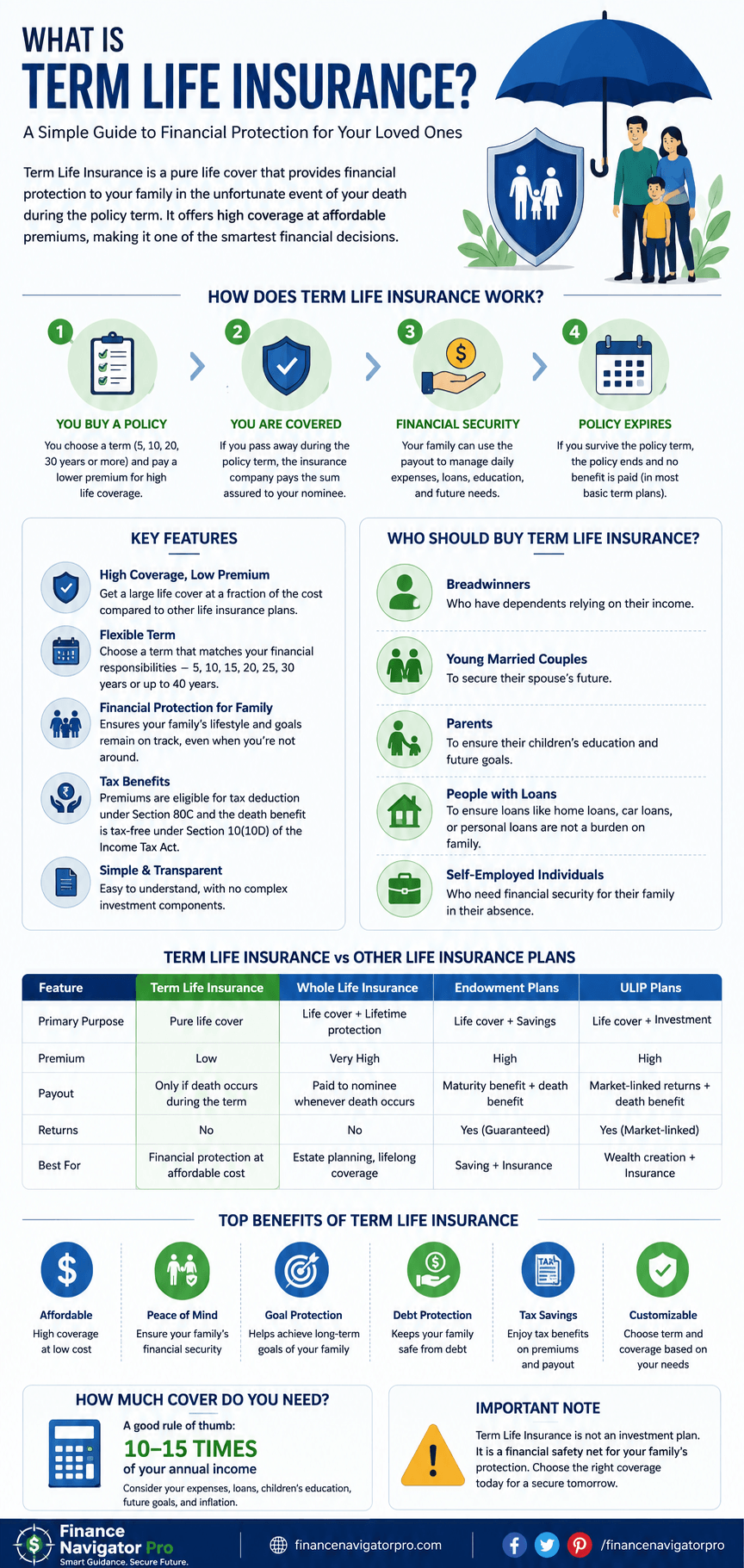
Term life insurance is a life insurance policy that provides a death benefit to your beneficiaries if you die within a set period — typically 10, 20, or 30 years. Unlike permanent life insurance, it has no cash value and expires at the end of the term. In exchange for giving up lifelong coverage, you get significantly lower premiums, which is why term life is the most common type of life insurance sold in the United States.
Quick Answer Box
Here’s the short version, before we get into the details:
| Definition | Temporary life insurance that pays a death benefit if you die during the policy term. |
| Purpose | Replace lost income and cover financial obligations if you die unexpectedly. |
| Who needs it | Anyone with dependents, a mortgage, debt, or income others rely on. |
| Coverage period | Typically 10, 15, 20, 25, 30, or sometimes 35–40 years. |
| Average cost | Often $15–$40/month for a healthy 30–40-year-old with $500,000 in coverage. |
| Cash value? | No. Term life builds no savings or investment component. |
| Medical exam required? | Usually yes for traditional policies; some “no-exam” policies exist at higher cost. |
| Best for | Income replacement, mortgage protection, and temporary financial obligations. |
Table of Contents
- 1.What Is Term Life Insurance?
- 2.How Does Term Life Insurance Work?
- 3.Why Do People Buy Term Life Insurance?
- 4.What Does Term Life Insurance Cover?
- 5.What Doesn’t Term Life Insurance Cover?
- 6.Types of Term Life Insurance
- 7.Term vs. Whole Life Insurance
- 8.Term vs. Universal Life Insurance
- 9.How Much Term Life Insurance Do You Need?
- 10.How Much Does Term Life Insurance Cost?
- 11.Factors That Affect Premiums
- 12.Choosing the Right Policy Length
- 13.Best Time to Buy Term Life Insurance
- 14.Pros and Cons
- 15.Common Mistakes to Avoid
- 16.Important Riders to Consider
- 17.How to Buy Term Life Insurance
- 18.Evaluating Term Life Insurance Companies
- 19.Frequently Asked Questions
- 20.Final Verdict
What Is Term Life Insurance?
Term life insurance is a contract between you and an insurance company. You pay a premium — usually monthly or annually — and in exchange, the insurer promises to pay a lump sum, called the death benefit, to the people you name as beneficiaries if you die while the policy is active. The catch, and the reason it’s called “term” insurance, is that this promise only lasts for a fixed period: the term.
That term is typically 10, 15, 20, 25, or 30 years, chosen when you buy the policy. If you die during that window, your beneficiaries receive the full death benefit, generally income tax-free. If you outlive the term, the coverage simply ends. There’s no payout, no refund of premiums (unless you specifically bought a return-of-premium policy, which we’ll cover later), and no leftover value. You’d need to either let the policy expire, renew it at a much higher rate, convert it to permanent insurance, or buy a new policy.
This is the core trade-off of term life insurance: you give up permanence in exchange for a dramatically lower price. A permanent policy with a $500,000 death benefit might cost a healthy 35-year-old eight to fifteen times more per month than an equivalent term policy, because permanent insurance is designed to pay out eventually — you will die at some point, and the insurer knows it has to pay. Term insurance, by contrast, is priced around the much narrower chance that you’ll die within a specific 10–30-year window.
How It Differs From Permanent Insurance
Permanent life insurance — whole life and universal life are the two main types — never expires as long as premiums are paid, and it builds cash value over time that you can borrow against or withdraw. Term life insurance does neither of those things. It’s pure protection with no savings component, which is exactly why it’s cheaper. Think of it like the difference between renting and owning: term life insurance is like renting protection for the years you need it most, while permanent insurance is like buying a property that holds value long after the original need has passed.
A Real-Life Example
Say Maria and David, both 34, just bought a house with a 30-year mortgage and have a 2-year-old daughter. They each buy a 30-year term life policy with a $750,000 death benefit. If David dies unexpectedly at 50, Maria receives $750,000 — enough to pay off the remaining mortgage, cover their daughter’s college costs, and replace several years of David’s income while she adjusts. If David is still alive when the policy expires at 64, the coverage simply ends. By then, the mortgage is paid off, their daughter is independent, and the original need for that much coverage has mostly disappeared — which is exactly how term insurance is supposed to work.
Key Takeaway
Term life insurance is temporary, no-frills death benefit protection. It’s not an investment, a savings account, or a permanent safety net — it’s a financial tool designed to cover a specific window of risk, usually the years when your family depends most heavily on your income.
How Does Term Life Insurance Work?
The process of getting and using a term life policy follows a fairly predictable sequence. Here’s what actually happens, from application to (eventually) either expiration or a death benefit payout.
Application
You choose a coverage amount and term length, then complete an application with personal, health, and lifestyle information — including any tobacco use, medical history, family health history, occupation, and hobbies.
Underwriting
The insurer evaluates your risk level. This includes reviewing your application, checking the MIB (a database insurers use to flag prior applications), your prescription history, motor vehicle record, and sometimes a phone interview.
Medical Exam
For most traditional policies, a paramedical professional measures height, weight, and blood pressure, and collects blood and urine samples to check for nicotine, cholesterol, glucose, and other health markers. No-exam policies skip this step but usually cost more or cap coverage amounts.
Approval and Rate Class
Based on underwriting results, the insurer assigns you a rate class — such as Preferred Plus, Preferred, Standard Plus, Standard, or a substandard/table rating — which determines your premium. Healthier applicants get better rate classes and lower premiums.
Premium Payments
Once approved, you pay your premium on the schedule you choose (monthly, quarterly, or annually). With level term policies, this amount is locked in for the entire term.
Coverage Period
Your policy stays active as long as premiums are paid. If you die during this period and the policy is in force, your beneficiaries file a claim.
Death Benefit Payout
If a covered death occurs, beneficiaries submit a claim with a death certificate. Insurers typically pay out within 30–60 days for straightforward claims, often via lump sum, income tax-free under current IRS rules for life insurance proceeds.
Policy Expiration
If you outlive the term, coverage ends. Depending on the policy, you may have the option to renew annually at a much higher rate, convert to permanent coverage, or simply let it lapse and shop for a new policy if you still need coverage.
Key Takeaway
Term life insurance works on a simple promise: pay your premium, stay covered. The underwriting process determines your price, but once you’re approved on a level term policy, your rate and coverage amount are locked in for the life of the term — no matter what happens to your health afterward.
Why Do People Buy Term Life Insurance?
Term life insurance isn’t bought for its own sake — it’s bought to solve specific financial problems that would otherwise fall on the people left behind. Here are the most common reasons.
- Income replacement: If your household depends on your paycheck, your family would need a way to replace years of lost income. A $1,000,000 policy isn’t an arbitrary number — it’s often calculated as a multiple of annual income.
- Mortgage protection: A 20- or 30-year term policy is frequently matched to a mortgage term specifically so the loan can be paid off if the primary earner dies, protecting the family from losing the home.
- Raising children: Parents with young children often buy enough coverage to fund another 15–20 years of childcare, schooling, and daily living expenses.
- Education funding: Some families size their coverage to include a future college fund, so a child’s education isn’t derailed by a parent’s death.
- Debt protection: Co-signed loans, private student debt, and other obligations don’t disappear when someone dies — they can become the responsibility of a surviving spouse or co-signer.
- Business obligations: Business owners and partners often use term life insurance to fund buy-sell agreements or key person insurance, protecting the business itself from the financial shock of losing a founder or partner.
- Funeral and final expenses: The average funeral in the U.S. costs several thousand dollars. Even smaller term policies are often purchased just to prevent funeral costs from becoming a financial burden.
- General family security: Beyond any single line item, many people simply want peace of mind that their family won’t face a financial crisis on top of a personal one.
Consider James, a self-employed contractor with $40,000 in business debt he personally guaranteed. If he died, that debt wouldn’t disappear — it could fall to his estate or co-signers. A term policy sized to cover that debt, plus a cushion for his family’s living expenses, prevents one tragedy from becoming two.
What Does Term Life Insurance Cover?
Term life insurance pays a single death benefit, but how that money gets used is entirely up to your beneficiaries — there’s no requirement to spend it on any particular expense. That said, most families end up using the payout to cover some combination of the following:
- Death benefit: The core payout, paid as a lump sum (or sometimes in installments, depending on the policy and insurer).
- Mortgage payoff: Eliminating the home loan so a surviving spouse or family isn’t at risk of losing the house.
- Ongoing living expenses: Groceries, utilities, transportation, and the everyday costs of running a household.
- College and education costs: Tuition, fees, and related expenses for children who would otherwise have had a parent’s income supporting them.
- Existing debt: Credit cards, auto loans, personal loans, and other obligations a survivor might otherwise have to manage alone.
- Childcare: Daycare, after-school care, or even the cost of a surviving parent reducing work hours to care for children.
- Final expenses: Funeral, burial or cremation, and related costs, which can run into the thousands of dollars.
- Estate and tax obligations (when applicable): In some cases, the payout can help cover estate settlement costs or, for larger estates, estate tax exposure — this is a more advanced planning consideration best discussed with a tax professional.
What Doesn’t Term Life Insurance Cover?
Term life insurance is broad, but it’s not unconditional. Insurers build in specific exclusions and limitations to manage fraud risk and keep premiums affordable for everyone. Here’s what typically isn’t covered, or is covered only under specific conditions:
- Fraud or material misrepresentation: If you lie on your application about health, smoking status, or other material facts, the insurer can deny a claim or rescind the policy entirely if discovered, particularly within the contestability period.
- The contestability period: Most U.S. policies include a two-year contestability period after issue. If you die during this window, the insurer can investigate the application more closely before paying out, and can deny claims tied to misrepresentation.
- The suicide clause: Nearly all policies exclude suicide within the first two years (sometimes one year, depending on the state and insurer). After that period, suicide is typically covered like any other cause of death.
- Lapsed policies: If premiums aren’t paid and the policy lapses (after any grace period), there is no coverage — the policy is no longer in force, regardless of cause of death.
- Certain high-risk activities (when excluded): Some policies include exclusions or rate adjustments for high-risk hobbies like aviation, scuba diving, or motorsports, though this varies significantly by insurer and is often handled through pricing rather than outright exclusion.
- Acts excluded by the contract: Specific contract exclusions vary by insurer and state; always review your policy’s exclusions section rather than assuming based on general industry norms.
Key Takeaway
The biggest risk to your coverage usually isn’t a fine-print exclusion — it’s letting the policy lapse from missed payments, or being inaccurate on your application. Pay on time and answer underwriting questions honestly, and the vast majority of term life claims are paid without dispute.
Types of Term Life Insurance
“Term life insurance” isn’t one single product — it’s a category with several distinct structures, each suited to different needs. Here’s how the main types compare.
Level Term
The most common type of term life insurance. The death benefit and premium both stay the same for the entire term, whether that’s 10, 20, or 30 years.
- Best for: Most buyers — anyone who wants predictable, stable pricing for the length of their need.
- Pro: Predictable budgeting since premiums never change during the term.
- Pro: Widely available and easy to compare across insurers.
- Con: Premiums are higher at the start than annual renewable term, since the insurer is locking in a long-term average rate.
Example: A 35-year-old buys a 20-year level term policy with a $500,000 death benefit. The premium and coverage amount stay identical every year for 20 years.
Decreasing Term
The death benefit gradually decreases over the life of the policy, often on a schedule that mirrors a shrinking financial obligation, while the premium typically stays level or also declines.
- Best for: Covering an amortizing debt, like a mortgage, where the outstanding balance falls over time.
- Pro: Generally cheaper than level term since the insurer’s payout risk shrinks over time.
- Pro: Aligns naturally with a mortgage payoff schedule.
- Con: Less flexible — if your needs change, the shrinking benefit may no longer match them.
- Con: Less commonly sold today than level term or mortgage protection riders.
Example: A homeowner ties a decreasing term policy to a 30-year mortgage so the death benefit roughly tracks the remaining loan balance.
Increasing Term
The death benefit rises over time, often to help keep pace with inflation or a growing financial need, with premiums that increase accordingly.
- Best for: Buyers concerned that a fixed death benefit will lose purchasing power over a long term.
- Pro: Helps offset inflation eroding the real value of the death benefit over a long policy term.
- Con: Less common and not offered by every insurer.
- Con: Higher cost over time compared to level term.
Example: A policy might start at $300,000 and increase by a set percentage every few years to help keep pace with rising costs of living.
Annual Renewable Term (ART)
Provides one-year coverage that automatically renews each year, usually without a new medical exam, but at a premium that increases annually as you get older.
- Best for: Short-term or temporary needs, or as a bridge while arranging longer-term coverage.
- Pro: Low cost in the early years.
- Pro: No new underwriting required at each renewal.
- Con: Becomes expensive quickly as you age, since the premium recalculates every year.
- Con: Not cost-effective for long-term needs.
Example: Someone waiting for a longer-term policy to be approved might use ART to stay covered in the interim.
Convertible Term
A term policy (often level term) that includes the right to convert some or all of the death benefit into a permanent policy, without new medical underwriting, generally before a certain age or within a set window.
- Best for: Buyers who want term-level pricing now but may want permanent coverage later, especially if future insurability is uncertain.
- Pro: Locks in insurability — valuable if health declines later, since conversion doesn’t require new underwriting.
- Pro: Provides flexibility without committing to permanent insurance upfront.
- Con: Converted permanent premiums are based on your age at conversion, which can be a meaningful cost increase.
- Con: Conversion windows and rules vary significantly by insurer.
Example: A 40-year-old with a family history of heart disease buys convertible term, preserving the option to convert to whole life at 55 without a new medical exam.
Return of Premium (ROP) Term
A term policy that refunds all (or most) premiums paid if you outlive the term, in exchange for a significantly higher premium than standard level term.
- Best for: Buyers who want the safety net of term insurance but dislike the idea of “losing” premiums if they outlive the policy.
- Pro: Premiums are returned tax-free if you outlive the term, functioning like a forced savings vehicle.
- Con: Premiums can run two to three times higher than equivalent level term.
- Con: If the policy lapses before the end of the term, you typically forfeit the refund.
Example: A buyer chooses a 30-year ROP policy paying roughly double the level term premium, with the expectation of getting those premiums back at the end if they’re still living.
Key Takeaway
For most buyers, level term is the simplest, most cost-effective choice. The other types solve specific problems — decreasing term for amortizing debt, convertible term for future flexibility, ROP for buyers who want their premiums back — but they come at a cost in either price or flexibility.
Term Life Insurance vs. Whole Life Insurance
This is the comparison most first-time buyers actually need to make. Whole life insurance is a type of permanent insurance that lasts your entire life and builds guaranteed cash value, but it costs substantially more than term life for the same death benefit.
| Factor | Term Life Insurance | Whole Life Insurance |
|---|---|---|
| Cost | Low — often 8–15x cheaper for the same death benefit | High — premiums can be hundreds of dollars per month |
| Premium structure | Level for the term, then expires or renews much higher | Level for life, guaranteed never to increase |
| Coverage duration | Fixed term (10–30+ years) | Lifetime, as long as premiums are paid |
| Cash value | None | Yes — grows on a guaranteed schedule |
| Investment component | None | Cash value grows tax-deferred; can be borrowed against |
| Flexibility | Limited — mainly conversion options on convertible term | Some — policy loans, dividend options (with participating policies) |
| Best for | Temporary needs: income replacement, mortgage, raising kids | Permanent needs: estate planning, final expenses, lifelong dependents |
| Tax treatment | Death benefit generally income tax-free | Death benefit generally income tax-free; cash value grows tax-deferred |
| Estate planning use | Limited, unless paired with a trust for a specific purpose | Common tool for estate liquidity and wealth transfer planning |
The honest, balanced recommendation: most people with temporary needs — a mortgage, young children, a working career ahead of them — are better served by term life insurance, simply because it provides far more coverage per dollar during the years that coverage matters most. Whole life insurance tends to make more sense for specific, lasting needs: permanent dependents, estate tax planning for larger estates, or specific cash-value strategies. It’s rarely an either/or decision made on cost alone — it depends on what you’re actually trying to accomplish, and is worth discussing with a licensed advisor if your situation isn’t straightforward.
Term Life Insurance vs. Universal Life Insurance
Universal life insurance is another form of permanent insurance, but unlike whole life, it offers flexible premiums and a death benefit that can sometimes be adjusted, with cash value growth tied to current interest rates (or, in variable and indexed versions, to investment or index performance).
| Factor | Term Life Insurance | Universal Life Insurance |
|---|---|---|
| Cost | Low and predictable for the term | Higher than term; varies by product and funding level |
| Premium structure | Fixed for the term | Flexible — can adjust within limits, but underfunding risks lapse |
| Coverage duration | Fixed term | Designed to be permanent, but not guaranteed if underfunded |
| Cash value | None | Yes — growth tied to interest rates, index performance, or investments |
| Risk | Low — simple, fixed contract | Higher — cash value growth and even policy duration can vary with performance and funding |
| Flexibility | Low | High — adjustable premiums and death benefits within product limits |
| Best for | Temporary, clearly defined coverage needs | Buyers wanting permanent coverage with flexible premium funding, comfortable with more complexity |
Universal life products are more complex than either term or whole life, and the flexibility that makes them appealing can also work against policyholders who underfund their premiums — the policy can lapse even after years of payments if cash value runs too low. For most people seeking straightforward, affordable protection, term life remains the simpler choice; universal life is generally a decision made with a financial professional, often as part of a broader estate or business planning strategy.
Try the Term Life Insurance Calculator
Not sure whether term, whole, or universal life fits your situation? Compare the basics side by side with our free Term Life Insurance Calculator before talking to an advisor.
How Much Term Life Insurance Do You Need?
This is the question that trips up more buyers than any other. Too little coverage leaves your family exposed; too much means overpaying for protection you don’t need. There’s no single right number — but there are several established methods that get you to a reasonable estimate.
Method 1: The Income Multiplier
The simplest approach: multiply your annual income by a factor, typically 10–15x, depending on your age and how many years of income replacement your family would need.
Worked example: If you earn $70,000 per year and want roughly 12 years of income replacement, you’d target a death benefit around $840,000 ($70,000 × 12).
Method 2: The DIME Method
DIME stands for Debt, Income, Mortgage, and Education — a more detailed method that adds up specific obligations rather than relying on a single multiplier.
- Debt: Total non-mortgage debt (credit cards, auto loans, student loans, personal loans).
- Income: Annual income × the number of years your family would need replacement income.
- Mortgage: The remaining balance on your mortgage.
- Education: Estimated future college costs for each child.
Worked example: $25,000 in debt + ($70,000 × 10 years = $700,000) + $250,000 mortgage balance + $120,000 in estimated education costs = $1,095,000 in coverage.
Method 3: Mortgage Calculation (Simplified)
If your primary concern is making sure your family can keep the house, a simpler calculation just covers the outstanding mortgage balance, sometimes paired with a separate, smaller policy or savings for living expenses.
Method 4: Family Needs Analysis
A more comprehensive method that adds up every category of need — immediate cash needs (funeral, debt payoff, emergency fund), ongoing income replacement, and future expenses (college, weddings, etc.) — then subtracts existing assets and coverage you already have (such as employer-provided life insurance) to find the gap.
Other Factors Worth Adding In
- Emergency fund: Many financial educators recommend building in 3–6 months of expenses as a buffer for your family.
- Childcare costs: If a surviving spouse would need to pay for care previously provided by the deceased parent, that’s a real cost to plan for.
- Existing coverage: Subtract any group life insurance through an employer, since that coverage typically ends if you leave the job.
Key Takeaway
There’s no universally “correct” coverage amount — but underinsuring is the more common and more costly mistake. Run the numbers with at least one of these methods rather than picking a round number that feels right.
Try the Life Insurance Needs Calculator
Get a personalized estimate in under two minutes with our free Life Insurance Needs Calculator — it walks through the DIME method automatically using your numbers.
How Much Does Term Life Insurance Cost?
Term life insurance is priced almost entirely on risk — the insurer’s best estimate of how likely you are to die during the term. That means age and health do most of the work in determining your premium, with several other factors layered on top. See how insurance quotes are calculated for more on the general pricing process, and how it compares to the average insurance cost in the U.S.
Sample Monthly Premiums by Age
20-Year Level Term, $500,000, Non-Smoker, Healthy. These figures are illustrative industry-typical ranges, not quotes from a specific insurer. Actual premiums vary by company, health class, and state.
| Age | Male (approx.) | Female (approx.) |
|---|---|---|
| 25 | $18–$24/mo | $15–$20/mo |
| 30 | $19–$26/mo | $16–$22/mo |
| 35 | $22–$30/mo | $19–$26/mo |
| 40 | $31–$42/mo | $26–$36/mo |
| 45 | $48–$65/mo | $40–$55/mo |
| 50 | $75–$105/mo | $62–$88/mo |
| 55 | $120–$165/mo | $98–$135/mo |
| 60 | $200–$280/mo | $160–$225/mo |
What Drives the Price Up or Down
| Factor | How It Affects Cost |
|---|---|
| Age | The single biggest factor. Premiums rise every year you wait, since mortality risk increases with age. |
| Gender | Women statistically live longer than men on average, which is generally reflected in lower premiums for the same age and health profile. |
| Health | Conditions like diabetes, high blood pressure, high cholesterol, or a history of cancer or heart disease typically increase premiums or affect rate class. |
| Smoking and tobacco use | Smokers often pay 2–3x more than non-smokers for identical coverage, due to significantly higher mortality risk. |
| Coverage amount | Larger death benefits cost more in absolute dollars, though the rate per $1,000 of coverage often improves at higher amounts. |
| Policy length | Longer terms cost more per year than shorter ones, since the insurer is committing to a fixed rate over a longer window of risk. |
| Occupation | High-risk occupations (certain aviation, commercial fishing, logging, etc.) can increase premiums or require special underwriting. |
| State | Insurance regulation and risk pools vary by state, which can shift pricing for otherwise identical applicants. |
| Lifestyle and hobbies | High-risk hobbies like skydiving, scuba diving, or auto racing can affect pricing or underwriting decisions. |
| Family health history | A family history of certain hereditary conditions can be a factor insurers weigh, even if you’re currently healthy. |
Try the Term Life Insurance Calculator
Premiums vary significantly between insurers for the exact same health profile. Run your numbers through our free Term Life Insurance Calculator to see a more personalized range before you apply.
Factors That Affect Premiums
We touched on cost drivers in the last section, but it’s worth understanding these factors in more depth, since several of them are within your control — and addressing them before you apply can meaningfully lower your rate.
| Factor | How to Think About It |
|---|---|
| Age | Premiums increase every year, often by 8–10% or more annually as you move through your 40s and 50s. This is the single strongest argument for buying sooner rather than later if you know you’ll need coverage. |
| Health (general) | Underwriters look at blood pressure, cholesterol, blood sugar, and overall medical history. Well-managed chronic conditions usually rate better than poorly controlled ones. |
| BMI | Being significantly outside a healthy weight range for your height can affect your rate class, independent of other health markers. |
| Smoking | Tobacco use of any kind — cigarettes, cigars, vaping, or chewing tobacco — typically triggers smoker rates, which can be two to three times higher than non-smoker rates. Most insurers require 12 months of being tobacco-free to qualify for non-smoker pricing. |
| Alcohol use | A documented history of heavy alcohol use or alcohol-related health issues can affect underwriting decisions. |
| Medical history | Past diagnoses, surgeries, hospitalizations, and current medications are reviewed; many conditions are still insurable, often at a slightly higher rate class. |
| Family history | A family history of early-onset heart disease, cancer, or other hereditary conditions can factor into underwriting, even with a clean personal health record. |
| Driving record | DUIs, reckless driving citations, or a pattern of moving violations can increase premiums or trigger additional underwriting scrutiny. |
| Occupation | Certain occupations with elevated on-the-job mortality risk may see rate adjustments or require occupational questionnaires. |
| Hobbies | High-risk hobbies like skydiving, scuba diving below certain depths, or auto racing are typically flagged on applications and may add a flat extra charge. |
| Coverage amount | Larger policies cost more in total dollars, though larger policies often get better per-thousand-dollar pricing than very small policies. |
| Term length | A 30-year term costs more per month than a 10-year term for the same coverage amount, since the insurer is locking in pricing over a much longer risk window. |
Practical Tip
If you smoke, have a few extra pounds to lose, or have a manageable health condition, it may be worth spending a few months improving what you can before applying — then locking in a better rate class for the next 10–30 years. For most people, though, waiting too long to address minor issues costs more in rising age-based premiums than it saves in rate-class improvement.
Choosing the Right Policy Length
The right term length usually maps to how many years you’ll have a meaningful financial dependency — not an arbitrary number. Here’s how each common term length tends to get used.
| Term Length | Best Use Cases |
|---|---|
| 10-Year Term | Short-term obligations: a loan you’re paying down, bridging coverage while switching jobs, or supplementing a longer policy during a specific high-risk window. |
| 15-Year Term | Mid-length needs, such as covering the remaining years on a shorter mortgage or a specific debt payoff timeline. |
| 20-Year Term | The most commonly purchased term length. Often matches a 20-year mortgage or covers a family until children are expected to be financially independent. |
| 25-Year Term | A middle ground for buyers who want more runway than 20 years but don’t need the full 30, often used for slightly longer mortgages or younger families. |
| 30-Year Term | Popular for buyers with a 30-year mortgage or very young children, since it covers the full span of the most demanding financial years. |
| 35-Year Term | Less widely available, offered by a smaller number of insurers, generally for younger buyers who want maximum runway locked in early. |
| 40-Year Term | Rare and offered by only a handful of insurers, typically for younger applicants seeking the longest possible level-term coverage. |
A practical approach: match your term length to your longest financial dependency. If you have a 30-year mortgage and a newborn, a 30-year term often makes more sense than stacking multiple shorter policies — though laddering policies (buying several smaller policies with different term lengths) is itself a legitimate strategy some buyers use to reduce costs as obligations decrease over time.
Best Time to Buy Term Life Insurance
There’s a simple, consistent truth in life insurance pricing: the younger and healthier you are when you apply, the less you’ll pay, both per month and over the life of the policy. Premiums are locked in at your age and health class at the time of purchase, so waiting doesn’t just risk a higher rate — it locks in that higher rate for the entire term.
Why Younger Is Cheaper
Mortality risk increases with age, and insurers price accordingly. Someone who buys a 20-year term policy at 30 will generally pay meaningfully less per month than someone who buys the same policy at 45, even adjusting for identical health. Waiting five or ten years to “think about it” can mean paying a noticeably higher rate for the rest of the term — or facing new health issues that affect insurability altogether.
Life Events That Should Trigger a Look at Coverage
- Marriage: Combining finances and futures often means combining financial risk — a good moment to review whether either spouse needs new or additional coverage.
- Having children: A new dependent is one of the clearest, most common triggers for buying or increasing term life coverage.
- Buying a home: A new mortgage creates a long-term obligation that didn’t exist before — many buyers size a new term policy specifically around the mortgage term.
- Starting a business: New business debt, personal guarantees, or a need for key person insurance can all justify new or additional coverage.
- Taking on new debt: Co-signing a loan, taking out private student loans, or other new obligations are worth covering before they become someone else’s burden.
Key Takeaway
If you’re already weighing whether you need coverage, that’s usually a sign you do. The cost of waiting compounds every year — in both higher premiums and the risk that a new health issue makes coverage harder or more expensive to get at all.
Pros and Cons of Term Life Insurance
Advantages
- Significantly more affordable than permanent insurance for the same death benefit.
- Simple to understand — a fixed death benefit for a fixed period, with no investment component to track.
- Flexible term lengths that can be matched to specific financial obligations like a mortgage or a child’s path to independence.
- Many policies include conversion options, preserving the ability to switch to permanent coverage later without new underwriting.
- High coverage amounts are achievable at relatively low premiums, especially for younger, healthier applicants.
Disadvantages
- No cash value — premiums paid are gone if you outlive the term (unless you bought return-of-premium coverage).
- Coverage expires, potentially leaving you without insurance later in life when health issues may make new coverage expensive or unavailable.
- Renewing after the term ends, if offered, is typically priced at a much higher rate based on your age at renewal.
- Not designed for lifelong needs like permanent estate planning or funding a special needs trust indefinitely.
Who Should Probably Avoid (or Look Beyond) Term Insurance
Term life insurance isn’t the right fit for everyone. People with a genuinely permanent need — such as a lifelong dependent with special needs, a desire for guaranteed lifelong coverage regardless of future health, or specific estate-tax planning goals — are often better served by whole or universal life insurance, sometimes alongside term coverage rather than instead of it. Buyers purely looking for an investment vehicle should also generally look elsewhere; term life insurance was never designed to build wealth, and using it that way misses both its strengths and its purpose.
Common Mistakes to Avoid
Most term life insurance regrets aren’t about the product itself — they’re about how it was bought. Here are the mistakes that show up most often.
- Buying too little coverage: Choosing a round number like $250,000 because it sounds like “enough,” without actually calculating income replacement, debt, and future needs, often leaves a significant gap.
- Waiting too long to apply: Every year of delay means a higher premium locked in for the entire term — and an increasing chance that a new health issue complicates or blocks future coverage.
- Choosing the wrong term length: A 10-year term on a 30-year mortgage leaves a gap; a 30-year term for a short-term debt may mean paying for coverage well past when it’s needed.
- Naming incorrect or outdated beneficiaries: Forgetting to update beneficiaries after a marriage, divorce, or birth can result in a payout going to the wrong person — insurers pay based on what’s on file, not what you intended.
- Ignoring useful riders: Skipping riders like a waiver of premium or child rider to save a few dollars a month can leave real gaps in protection for a relatively small cost.
- Not comparing quotes across insurers: Premiums for the same coverage can vary meaningfully between companies for the same health profile — buying from the first quote you see often means overpaying.
- Letting a policy lapse over a missed payment: Missing payments and letting coverage lapse, especially without realizing a grace period has passed, can leave a family with zero coverage at the worst possible time.
- Assuming employer coverage is enough: Group life insurance through work is valuable, but it typically ends when you leave the job and is often only 1–2x salary — rarely enough on its own.
Key Takeaway
Most of these mistakes cost nothing to avoid — they just require running the numbers once, comparing a few quotes, and keeping beneficiary information current. The mistakes that are expensive are the ones that go unnoticed until a claim is filed.
Important Riders to Consider
Riders are optional add-ons that modify or extend your base policy, usually for an additional cost. Not every rider is worth paying for, but several are popular because they address common, realistic scenarios.
Accelerated Death Benefit (ABR)
Allows you to access a portion of your death benefit while still living if you’re diagnosed with a qualifying terminal illness. Many insurers now include this at no extra cost, but it’s worth confirming.
Is it worth it? Worth having on nearly every policy, especially when offered free.
Waiver of Premium
Waives your premium payments if you become totally disabled and unable to work, keeping the policy active without out-of-pocket payments during that period.
Is it worth it? Worth considering if your income depends heavily on your physical ability to work.
Child Rider
Adds a small amount of term coverage for each child on your policy, often convertible to their own permanent policy later regardless of their health at that time.
Is it worth it? Worth it for many families given the low cost, though it’s not a substitute for separate planning if a child has significant needs.
Spouse Rider
Adds term coverage for a spouse under the primary policyholder’s contract, often at a lower cost than a separate standalone policy.
Is it worth it? Useful for spouses who want coverage without going through a fully separate application, though a standalone policy is often more flexible long-term.
Critical Illness Rider
Pays a lump sum if you’re diagnosed with a covered critical illness, such as cancer, heart attack, or stroke, regardless of whether the illness is fatal.
Is it worth it? Worth evaluating for buyers concerned about the financial impact of a serious diagnosis, not just death.
Terminal Illness Rider
Similar to an accelerated death benefit rider, allowing early access to funds upon a terminal diagnosis, sometimes structured slightly differently by insurer.
Is it worth it? Often bundled with or similar to ABR; check policy language to avoid paying twice for overlapping benefits.
Disability Income Rider
Provides a regular income payment if you become disabled, rather than a lump sum, helping replace lost wages during a disability.
Is it worth it? Worth considering for those without separate, robust disability insurance coverage.
Riders are also one area where it’s easy to overspend — stacking every available rider can meaningfully increase your premium. A reasonable approach is to prioritize the accelerated death benefit (often free), then evaluate waiver of premium and child riders against your specific situation, rather than defaulting to every option offered.
How to Buy Term Life Insurance
Once you understand what you need and roughly what it should cost, the buying process itself is fairly linear. Here’s the step-by-step path from start to an active policy.
Determine your coverage need
Use one of the methods covered earlier (income multiplier, DIME method, or a full needs analysis) to land on a target death benefit and term length.
Shop and compare quotes
Get quotes from multiple insurers for the same coverage amount and term, since pricing for identical risk profiles can vary meaningfully between companies.
Compare more than price
Look at financial strength ratings, available riders, conversion options, and customer service reputation — not just the lowest monthly premium.
Complete the application
Provide accurate personal, health, financial, and lifestyle information. Inaccurate answers can jeopardize a future claim, even years later.
Complete the medical exam (if required)
Schedule the paramedical exam promptly, since underwriting timelines depend on receiving these results.
Underwriting review
The insurer reviews your application, exam results, medical records, and other databases to assign a final rate class.
Review your offer
Confirm the final premium and rate class match what you expected; if the offer comes back higher than your initial quote, you generally have the option to accept, negotiate, or shop elsewhere.
Accept and pay your first premium
Once you accept the offer and submit your first payment, the policy becomes active (subject to the insurer’s specific activation terms).
Review your policy documents
Confirm your beneficiaries, coverage amount, term length, and any riders are recorded correctly once your policy documents arrive.
Try the Insurance Quote Comparison Tool
Before you apply anywhere, it’s worth comparing a few policy structures side by side. Our free Insurance Quote Comparison Tool can help you see how coverage amount, term length, and riders affect estimated pricing.
Evaluating Term Life Insurance Companies
Rather than ranking specific companies — ratings, pricing, and product lineups change frequently, and the “best” insurer depends heavily on your individual health profile and state — it’s more useful to understand the criteria that actually separate strong insurers from weaker ones. Use these to evaluate any company you’re considering.
| Evaluation Criteria | What to Look For |
|---|---|
| Financial strength ratings | Independent rating agencies evaluate insurers’ ability to pay future claims. Strong ratings indicate the company is well-positioned to honor claims decades into the future, which matters enormously for a 20–30-year commitment. |
| Customer satisfaction | Look at independent customer satisfaction surveys and complaint ratios, which are often tracked by state insurance departments and industry research firms. |
| Policy options | Strong insurers typically offer multiple term lengths, conversion options, and coverage amount flexibility rather than a one-size-fits-all product. |
| Digital experience | Many insurers now offer online applications, accelerated underwriting, and digital policy management — valuable if you prefer a faster, simpler process over working with an agent. |
| Available riders | Compare what riders are included at no cost (like accelerated death benefit) versus what’s available as a paid add-on. |
| Pricing competitiveness | Get quotes for the same coverage amount and term across several companies; pricing for identical risk profiles can differ noticeably. |
| Claims-paying reputation | Look at claims payment timelines and dispute rates where available — a policy is only as good as the company’s track record of actually paying claims. |
The practical takeaway: don’t choose an insurer based on a single “best of” list or the first quote you receive. Compare at least three companies on the criteria above, using your own health profile and coverage needs, since the right fit is genuinely personal.
Frequently Asked Questions
Can term life insurance expire?
Yes. Term life insurance is designed to expire at the end of the chosen term — 10, 20, 30 years, or another length you select. If you outlive the term and haven’t renewed, converted, or replaced the policy, you no longer have coverage. This is the defining feature that separates term life from permanent life insurance, which doesn’t expire as long as premiums are paid.
Can I renew my term life insurance policy?
Many term policies include a renewal option once the initial term ends, typically converting to annual renewable term at a substantially higher premium based on your age at renewal. Renewal isn’t always guaranteed by every policy, and even when available, the cost increase can be significant — it’s worth comparing renewal cost against a brand-new policy or conversion option before deciding.
Can I convert my term policy to permanent insurance?
If you purchased a convertible term policy, yes — you can typically convert some or all of the death benefit to a permanent policy without new medical underwriting, usually within a specific window or before a certain age. The new premium is based on your age (and sometimes health class) at the time of conversion, not your original purchase age.
Can I cancel my term life insurance policy?
Yes, you can cancel at any time by simply stopping premium payments or formally requesting cancellation through your insurer. Most term policies don’t have cash value, so canceling generally doesn’t return any money unless you purchased a return-of-premium policy and meet its specific terms.
Can I have multiple term life insurance policies?
Yes, it’s legal and fairly common to hold multiple policies, sometimes from different insurers. Some buyers use this strategy — called laddering — to match different term lengths to different financial obligations, reducing overall cost as some needs (like a shrinking mortgage balance) decrease over time.
Does term life insurance cover accidental death?
Yes, in most cases. Standard term life insurance covers death by accident the same way it covers death by illness, as long as the death isn’t specifically excluded (such as within the suicide clause period or due to fraud). Some buyers also add a separate accidental death and dismemberment (AD&D) rider or policy for additional accident-specific coverage.
Is a term life insurance payout taxable?
Generally, no. Under current IRS rules, life insurance death benefits paid to a named beneficiary are typically not subject to federal income tax. There are exceptions in certain situations — such as if the policy was transferred for value, or in some estate tax scenarios for very large estates — so it’s worth confirming your specific situation with a tax professional.
Can seniors buy term life insurance?
Yes, though options narrow and premiums rise significantly with age. Many insurers offer term coverage up to ages 70–80 for application, often with shorter available term lengths. Seniors with health conditions may also explore simplified-issue or guaranteed-issue policies, which trade lower coverage limits and higher per-dollar costs for easier qualification.
Can people with diabetes qualify for term life insurance?
In most cases, yes. Well-managed diabetes, particularly Type 2 diagnosed in adulthood with good control, often qualifies for standard or even preferred rate classes with many insurers. Less controlled diabetes or diabetes with complications may result in a higher rate class, but outright denial is relatively uncommon for manageable cases.
Can I increase my coverage later?
It depends on your policy. Some policies include a guaranteed insurability rider allowing set increases at specific life events without new underwriting. Without such a rider, increasing coverage typically means applying for an entirely new policy, which will be underwritten based on your current age and health.
What happens if I miss a premium payment?
Most policies include a grace period, often 30 days, during which coverage remains active even if payment is late. If payment still isn’t made after the grace period, the policy typically lapses, ending coverage. Some insurers offer reinstatement within a certain window, sometimes requiring proof of insurability.
Do I need a medical exam for every term life policy?
Not necessarily. Traditional fully underwritten policies usually require a paramedical exam, but many insurers now offer simplified-issue (no-exam, but with health questions) or accelerated underwriting options that use data sources instead of a physical exam. These alternatives often come with higher premiums or lower maximum coverage amounts.
How long does it take to get approved for term life insurance?
Timelines vary by insurer and underwriting method. Traditional fully underwritten policies can take two to six weeks due to exam scheduling and records requests. Simplified or accelerated underwriting programs can sometimes approve coverage within days, occasionally even the same day, for qualifying applicants.
Can I buy term life insurance for my spouse or partner?
Yes, as long as there’s an insurable interest — generally a financial relationship where the policyholder would suffer financial loss from the insured’s death. Spouses and domestic partners typically qualify easily; the insured person will also need to participate in the application and any required medical underwriting.
What’s the difference between beneficiaries and contingent beneficiaries?
A primary beneficiary is the first person (or people) in line to receive the death benefit. A contingent beneficiary only receives the payout if the primary beneficiary has already passed away or can’t be located. Naming both is good practice to avoid the payout defaulting to your estate, which can mean delays and probate involvement.
Can I name a trust as my beneficiary?
Yes. Naming a trust as beneficiary is a common estate planning strategy, particularly for parents of minor children or those with more complex wishes for how funds should be distributed and managed. This typically involves coordination with an estate planning attorney to set up correctly.
What happens to my term life insurance if I change jobs?
Personal term life insurance policies (purchased individually, not through an employer) aren’t tied to your job and remain in force as long as you keep paying premiums directly. This is different from employer-provided group life insurance, which typically ends when you leave the company, sometimes with limited conversion options.
Is term life insurance worth it if I’m single with no dependents?
It depends on your situation. If no one depends on your income and you have no significant debt that would burden someone else, the case for term life insurance is weaker. However, some single people still buy modest coverage for final expenses, co-signed debt, or to lock in low rates while young and healthy in case future dependents or health changes make insurance more important or harder to get later.
Can I get term life insurance with a pre-existing condition?
Often, yes, though pricing and qualification depend heavily on the specific condition and how well it’s managed. Conditions like controlled high blood pressure, well-managed diabetes, or a past health issue with a long, stable recovery often qualify at standard or near-standard rates. More severe or recent conditions may result in higher rate classes, exclusions, or in some cases, decline — though simplified or guaranteed-issue options may still be available.
How is term life insurance different from mortgage life insurance?
Mortgage life insurance (sometimes called mortgage protection insurance) is typically a decreasing term policy specifically structured to pay off your remaining mortgage balance, with the mortgage lender often named as beneficiary in some product structures. Standard term life insurance offers more flexibility — your beneficiaries (not just the lender) receive the payout and can use it however they choose, including paying off the mortgage if they decide to.
Can I buy term life insurance online without an agent?
Yes. Many insurers now offer fully digital application processes, including simplified underwriting that may not require a medical exam for qualifying applicants. Online purchasing can be faster and more convenient, though working with a licensed agent or broker can still be valuable for comparing multiple insurers or navigating more complex health situations.
Final Verdict
Who Should Buy Term Life Insurance
If anyone depends on your income — a spouse, children, a business partner, or a co-signer on debt — term life insurance is very likely worth having. It’s the most cost-effective way to make sure a temporary financial dependency doesn’t turn into a permanent financial crisis if something happens to you. It’s especially valuable for parents, homeowners with a mortgage, people carrying significant debt, and anyone whose family couldn’t comfortably absorb the loss of their income.
Who Might Not Need It (Or Should Look Further)
If you have no dependents, no debt that would burden someone else, and sufficient assets to cover final expenses, the case for term life insurance is weaker — though many people in this category still buy modest coverage to lock in low rates while young and healthy. On the other end, if your need is genuinely permanent — a lifelong dependent, specific estate planning goals, or a desire for coverage that never expires — it’s worth discussing whole or universal life insurance with a licensed advisor rather than relying on term alone.
Key Takeaways
- Term life insurance provides temporary, affordable death benefit protection for a fixed period — typically 10 to 30 years.
- It’s significantly cheaper than permanent insurance because it doesn’t build cash value and isn’t guaranteed to pay out.
- The right coverage amount comes from calculating your actual needs (income replacement, debt, mortgage, education), not picking a round number.
- Age and health are the biggest cost drivers — buying sooner, while healthy, generally means a better rate locked in for the life of the policy.
- Comparing quotes across multiple insurers, and understanding riders like accelerated death benefit and waiver of premium, can meaningfully improve the value of your policy.
Next Steps
Start by estimating how much coverage you actually need using one of the methods in this guide, then compare quotes across several insurers for the same coverage amount and term length. If your situation involves significant assets, a permanent dependent, or complex estate considerations, loop in a licensed financial advisor or insurance professional before finalizing a decision.
Explore Our Free Calculators
Ready to see what coverage might cost for your specific situation? Estimate your family’s coverage needs with our free Life Insurance Calculator, then compare policy costs using our Term Life Insurance Calculator.
This article is for general educational purposes only and does not constitute personalized financial, legal, insurance, or tax advice. Insurance products, pricing, and underwriting standards vary by company and state, and change over time. Before purchasing a policy, consult a licensed insurance agent, financial planner, or tax professional who can evaluate your specific circumstances.