

Coverage Without Medical Exams — What It Costs, Who Qualifies, and How to Decide If It’s Right for Your Family
If you’ve been turned down for life insurance — or you’re afraid to even apply because of a health condition — you’re not alone, and you’re not out of options.
Every year, hundreds of thousands of Americans in their 50s, 60s, 70s, and 80s discover that the life insurance they assumed would be easy to get suddenly isn’t. Diabetes, a cancer diagnosis, heart trouble, or just being in your 80s can close the door on traditional policies. That’s the gap guaranteed issue life insurance was built to fill.
This guide walks through everything you need to know before you buy: how guaranteed issue life insurance actually works, what it costs at different ages, the waiting period nobody explains clearly enough, which companies are worth your time, and — just as important — when you should walk away from guaranteed issue and look at something else instead.
We wrote this for the people Google searches like “guaranteed issue life insurance” are really coming from: a daughter trying to help her 78-year-old mother get covered, a 61-year-old cancer survivor who just got a denial letter in the mail, a veteran on a fixed income trying to make sure his funeral doesn’t become his family’s financial burden. If that’s you, you’re in the right place.
Who This Guide Is For
- You’ve been declined for traditional or simplified issue life insurance because of your health history.
- You’re age 50 or older and want final expense coverage without a medical exam.
- You’re comparing guaranteed issue against simplified issue, term, or whole life and want a straight answer about which fits your situation.
- You’re helping a parent or grandparent shop for coverage and want to understand the fine print before you sign anything.
Quick Answer
What Is Guaranteed Issue Life Insurance?
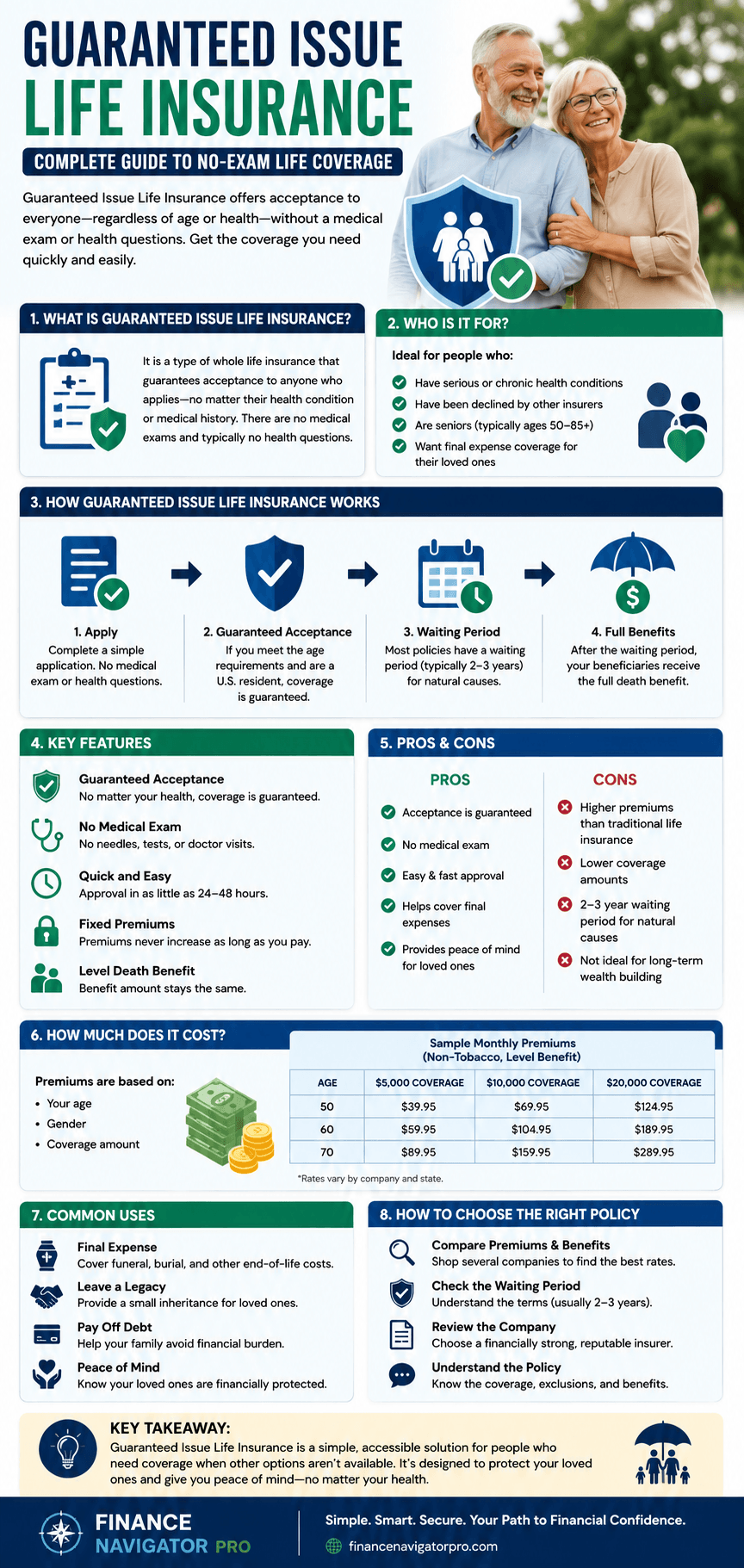
Guaranteed issue life insurance is a type of whole life policy that accepts every applicant within its age range — typically 40 to 85 — with no medical exam and no health questions. In exchange for guaranteed approval, coverage amounts are capped (usually $2,000–$25,000), premiums run higher than other policy types, and a 2-to-3-year graded death benefit waiting period applies before natural-cause deaths pay the full benefit.
Key Takeaways
- Guaranteed issue life insurance cannot deny you coverage based on health — approval is automatic if you fall within the age range and pay your premium.
- There are no medical exams and no health questions on the application, which is what separates it from simplified issue life insurance.
- Coverage amounts are small, generally $2,000 to $25,000, designed to cover final expenses rather than replace income or pay off a mortgage.
- Nearly every policy includes a 2- to 3-year graded death benefit: if you die of natural causes during that window, beneficiaries typically receive a refund of premiums paid plus interest, not the full face amount.
- Accidental death is usually covered at the full benefit amount from day one, even during the waiting period.
- Premiums are higher per dollar of coverage than simplified issue or fully underwritten policies because the insurer is taking on risk blind.
- It’s a permanent policy — coverage lasts your whole life and builds modest cash value, as long as you keep paying premiums.
- Guaranteed issue makes the most sense for people in their 70s and 80s, or anyone with a serious health condition that’s already led to a decline elsewhere.
- If you can pass simplified issue underwriting, you’ll almost always get more coverage for less money — guaranteed issue should be a last resort, not a first stop.
- Death benefits are paid to your named beneficiary income-tax-free in virtually all cases; estate tax only becomes a factor for estates above the federal exemption (currently $15 million).
Guaranteed Issue vs. Every Other Policy Type, At a Glance
Before you dive into the details, here’s the big picture. This table compares guaranteed issue against the four policy types people most often confuse it with.
| Feature | Guaranteed Issue | Simplified Issue | Term Life | Whole Life | Final Expense |
|---|---|---|---|---|---|
| Medical exam required? | No | No | Usually yes | Usually yes | No |
| Health questions asked? | No | Yes (few) | Yes (many) | Yes (many) | Yes (few) |
| Approval speed | Instant–48 hrs | 24–72 hrs | 1–8 weeks | 1–8 weeks | 24–72 hrs |
| Waiting period for full benefit | 2–3 years | Usually none | None | None | Usually none |
| Typical coverage amount | $2,000–$25,000 | $5,000–$50,000 | $100,000–$2M+ | $25,000–$1M+ | $5,000–$50,000 |
| Builds cash value? | Yes (slow) | Yes (slow) | No | Yes | Yes (slow) |
| Relative premium cost | Highest | High | Lowest | High | Moderate–High |
| Best for | Health declines, ages 70–85 | Most seniors | Income replacement | Lifelong + cash value | Funeral costs, ages 50–80 |
| Maximum issue age | ~80–85 | ~80–85 | ~75–80 | ~85 | ~85 |
| Approx. monthly cost (65-yr-old, $10,000) | $60–$80 | $35–$55 | N/A (term) | N/A (higher face needed) | $45–$70 |
Rates above are illustrative monthly ranges based on industry quoting data for nonsmokers in 2026 and will vary by carrier, state, gender, and health classification.
What Is Guaranteed Issue Life Insurance?
Guaranteed issue life insurance is a small permanent life insurance policy that any applicant within the eligible age range can buy, no matter their health history. There’s no medical exam. There’s no health questionnaire. The insurance company can’t say no based on what’s wrong with you — that’s the entire point of the product, and it’s right there in the name.
It’s almost always structured as whole life insurance, which means three things stay true for as long as you keep paying premiums: your coverage never expires, your premium never goes up, and the policy slowly builds a small amount of cash value you could theoretically borrow against (though most people never touch it — the policy exists to pay a death benefit, not to be a savings account).
How Insurers Can Afford to Say Yes to Everyone
Here’s the part that trips people up: if the company has no idea about your health, how do they avoid losing money on people who are seriously ill? The answer is actuarial math, not optimism. Insurers price guaranteed issue policies assuming every applicant is in worse health than average, then build in two protections — a low coverage cap and a multi-year graded death benefit — so the math works out across their whole pool of policyholders, even if some of those policyholders are quite sick when they apply.
Put plainly: the insurer isn’t betting on you individually. They’re betting on the group, and they’ve structured the contract so a handful of early deaths don’t sink the whole pool.
Who Actually Qualifies
Qualification for guaranteed issue is refreshingly simple. There are really only two requirements:
- Age. You generally need to be between 40 and 85 years old, though some carriers start as young as 18 (typically for accidental death-only products) and a few extend to 90.
- State of residence. A handful of carriers don’t offer guaranteed issue in every state, and rules in New York, for example, sometimes set a tighter age band (50–75 instead of 45–85).
That’s it. Your blood pressure, your cancer history, your COPD, your dialysis schedule — none of it matters to whether you’re approved. It can absolutely affect what you pay relative to a healthier person of the same age in some pricing models, but it cannot get you declined.
Real-Life Example
Carol is 74. She had a heart attack four years ago and takes medication for atrial fibrillation. When she applied for a simplified issue final expense policy, she was declined because of the AFib diagnosis within the lookback period. Her agent then walked her through a guaranteed issue policy from a different carrier. She filled out one page with her name, birth date, and beneficiary information — no health questions at all — and was approved the same day for $15,000 in coverage at $94 a month. Because of the 2-year graded benefit, if she passes away from a natural cause in the first two years, her son would receive a refund of her premiums plus interest rather than the full $15,000. After two years, the full death benefit applies no matter the cause of death.
How Guaranteed Issue Life Insurance Works
Once you understand the lifecycle of a guaranteed issue policy, the product stops feeling like a mystery. Here’s what happens from application to claim.
1. The Application Process
The application is usually one page, sometimes completed entirely online or over the phone in under fifteen minutes. You’ll provide your name, date of birth, Social Security number, state of residence, beneficiary names, and payment information. That’s the whole list. Some carriers ask whether you’re currently hospitalized or in hospice care, since most policies exclude coverage if you die during an active hospital stay that began before the policy was issued — but this is a yes/no confirmation, not medical underwriting.
2. Approval Timeline
Because there’s no exam to schedule and no medical records to request, approval is fast. Many carriers approve and issue a policy number within minutes online; others take 24 to 48 hours if a human reviews the paperwork. Compare that to a fully underwritten whole life policy, where you might wait four to eight weeks for labs, an exam, and a medical records pull (called an APS, or attending physician statement) before you hear back.
3. When Coverage Begins
Coverage typically starts the day your first premium clears, or the policy’s official “issue date” — whichever your contract specifies. This is important: the policy being active is not the same thing as the full death benefit being active. That distinction is the entire substance of the graded death benefit, which we’ll unpack in detail in its own section below.
4. Naming Beneficiaries
You’ll name one or more beneficiaries when you apply, and you can change them later by submitting a simple form to the insurer — no medical re-underwriting required. Most people covering final expenses name an adult child, a spouse, or a funeral home directly. A quick but important practice: name a primary and at least one contingent (backup) beneficiary, in case your first choice predeceases you.
5. Paying Premiums
Premiums are level, meaning the dollar amount you pay on day one is the same amount you’ll pay at 100, assuming you bought the policy correctly. Most people pay monthly via bank draft or debit card, though annual payment is usually available and sometimes earns a small discount. Miss a payment and most policies offer a 30- or 31-day grace period before lapsing; some include a short paid-up nonforfeiture provision once the policy has built enough cash value to self-fund a missed premium.
6. Cash Value Accumulation
Like other whole life policies, guaranteed issue builds cash value on a guaranteed schedule set out in your policy’s illustration. Growth is slow in the early years — insurers need time to recover the cost of issuing the policy and the risk they took on without underwriting — and accelerates somewhat in later years. Most buyers never plan to use this cash value; the point of the policy is the death benefit, and the cash value functions mainly as a cushion that keeps the policy from lapsing and, in some contracts, as the basis for the graded benefit refund.
7. The Death Benefit
When you pass away, your beneficiary files a claim with a death certificate and a claim form. If you died after the graded period ended (or from a covered accident, regardless of timing), the full face amount is paid, generally within a few weeks. If you died from a natural cause during the graded period, the insurer pays back the premiums you contributed, usually with a stated interest rate (often 10% to 40% depending on carrier) instead of the face amount.
8. Policy Maturity
Most guaranteed issue whole life policies are designed to be “paid up” or mature at age 100 or 121, meaning if you’re still alive at that age, the policy either pays out the face amount to you directly or continues with no further premiums due. In practical terms, almost no policyholder reaches this point — it’s a contractual technicality, not something you need to plan around.
Who Should Buy Guaranteed Issue Life Insurance?
Guaranteed issue isn’t the right policy for everyone, but for specific groups of people, it solves a real problem that no other product can solve as reliably. Here’s an honest look at who actually benefits.
Seniors (Ages 70–85)
Age alone is one of the most common reasons people end up here. Many simplified issue and term carriers stop issuing new policies somewhere between 75 and 85. If you’re 78 and in decent health but every term quote you’re getting says “not eligible due to age,” guaranteed issue may be the only door still open — and that’s fine. It exists for exactly this situation.
Retirees on a Fixed Income
If your income is mostly Social Security and a modest pension, a $15,000–$25,000 final-expense-sized policy is usually a more realistic and useful goal than a $250,000 policy you’d struggle to afford. Guaranteed issue lets you lock in a fixed, never-increasing premium while you’re still able to qualify for anything at all.
People With Diabetes
Type 2 diabetes, especially when combined with insulin use, neuropathy, or A1C levels outside a carrier’s preferred range, is one of the most common reasons for a simplified issue decline. Guaranteed issue sidesteps the question entirely — your A1C is never asked about.
Cancer Survivors
Even cancer that’s fully in remission can trigger an automatic decline or a multi-year waiting period on simplified issue applications, particularly within the first two to five years after treatment ends. Guaranteed issue doesn’t care how recent your diagnosis was or what stage it reached.
People With Heart Disease
A history of heart attack, bypass surgery, stents, or congestive heart failure is heavily scrutinized in traditional underwriting. Guaranteed issue removes that scrutiny completely, which is exactly why people with cardiac histories make up a meaningful share of guaranteed issue policyholders.
People With COPD or Serious Respiratory Conditions
COPD, emphysema, and similar conditions are treated harshly by underwriters because they’re strongly correlated with reduced life expectancy. If you’re on oxygen or have been hospitalized for a respiratory flare-up, guaranteed issue is likely your most realistic path to coverage.
People With High Blood Pressure (Uncontrolled)
Well-controlled hypertension on medication often still qualifies for simplified issue. Uncontrolled or poorly managed high blood pressure, especially alongside other risk factors, is a more common reason for decline — and a more common reason people land here.
Smokers, Especially Older Smokers
Tobacco use roughly doubles premiums across almost every policy type, and combined with age or other health issues, it can tip a simplified issue application into decline territory. Guaranteed issue accepts smokers at the same rate structure as anyone else in that carrier’s pricing band (though smoker-specific rate classes still typically apply and cost more than nonsmoker rates).
Veterans Without VA Life Insurance Coverage
Not every veteran is automatically covered by VA life insurance programs, and coverage gaps are common for older veterans, those who left service decades ago, or those who let SGLI/VGLI lapse after separation. Guaranteed issue fills that gap without requiring proof of service-connected disability or anything else.
Low-Income Families Without an Emergency Fund
The U.S. median funeral cost is now in the $8,000–$10,000 range. For a family without savings set aside for that expense, even a modest $10,000 guaranteed issue policy can be the difference between a manageable goodbye and a financial crisis layered on top of grief. Building toward an emergency fund alongside a small policy gives families a stronger overall safety net.
Anyone Already Denied Traditional Coverage
If you’ve been declined once, twice, or three times by different carriers for different reasons, guaranteed issue is built specifically for you. It’s the safety net underneath the entire life insurance industry’s underwriting system.
Who Should Avoid Guaranteed Issue Life Insurance?
Guaranteed issue is a specialty product, not a default choice. If any of the situations below describe you, there’s almost certainly a better-value policy available, and you should rule those out before settling for guaranteed issue.
- You’re under 50 and in reasonably good health. Simplified issue or even fully underwritten term life will almost always cost less and offer more coverage. Guaranteed issue’s premium-per-dollar-of-coverage is its biggest weakness, and that weakness is hardest to justify when you don’t need it.
- You haven’t actually tried simplified issue yet. A surprising number of people assume they’ll be declined and skip straight to guaranteed issue. Simplified issue underwriting is more forgiving than people expect for conditions like controlled diabetes, well-managed hypertension, or cancer that’s been in remission for five-plus years.
- You need coverage above $25,000–$30,000. Guaranteed issue coverage caps out low. If you need to cover a mortgage, replace income, or leave a meaningful inheritance, this product structurally cannot do that job.
- You’re not confident you’ll survive the graded period and need full coverage immediately. If your health situation is acute — for example, a terminal diagnosis with a short prognosis — a guaranteed issue policy’s 2- to 3-year graded benefit means your family may only receive a refund of premiums, not the full face amount, if you pass away from a natural cause in that window. In that specific situation, it’s worth speaking with an agent about whether any product can offer immediate full coverage, though options narrow considerably.
- You qualify for free or low-cost coverage elsewhere. Veterans with VA life insurance eligibility, employees with employer-provided group life insurance, or union members with negotiated coverage should max those out first — they’re typically cheaper and don’t carry a graded benefit.
- You’re shopping primarily on price and you’re healthy enough to qualify elsewhere. Because guaranteed issue prices in the assumption that some buyers are unhealthy, healthy buyers are effectively subsidizing that risk pool. If you don’t need to be in that pool, don’t pay to be in it.
A Note on “Is It Worth Buying?”
For the right person — someone who’s been declined elsewhere, or who’s aging past the cutoff for other products — guaranteed issue is absolutely worth it. The honest caveat is that it’s worth buying as a last resort, not a first choice. If you haven’t been declined by at least one other carrier or product type, it’s worth getting a simplified issue quote before committing to guaranteed issue’s higher price tag.
Pros and Cons of Guaranteed Issue Life Insurance
No policy is perfect for everyone. Here’s the honest tradeoff, laid out side by side.
| Pros | Cons |
|---|---|
| Guaranteed approval — no health questions, no exam, no denial based on medical history. | Coverage caps out low, usually $25,000 or less, sometimes as little as $2,000. |
| Fast approval, often same-day or within 48 hours. | Highest premium per $1,000 of coverage of any major policy type. |
| Premiums are fixed for life and never increase. | 2- to 3-year graded death benefit delays full payout for natural-cause deaths. |
| Coverage is permanent and never expires as long as premiums are paid. | Not designed for income replacement, mortgage payoff, or large estate needs. |
| Builds modest cash value over time. | Cash value growth is slower than fully underwritten whole life policies. |
| Accidental death is typically covered at full value from day one. | Some carriers exclude deaths during an ongoing hospital stay that predates the policy. |
| Available even after multiple declines from other insurers. | A smaller pool of carriers offer it compared to term or simplified issue, limiting comparison shopping. |
| Simple, short application — usually one page. | Premiums can feel expensive relative to the modest death benefit, especially for healthier applicants. |
Coverage Limits: How Much Can You Actually Get?
Guaranteed issue policies are intentionally capped. Insurers limit the face amount precisely because they’re accepting risk blind, and a low ceiling keeps any single claim from being financially catastrophic to the risk pool.
Typical Face Amount Ranges by Carrier
| Coverage Tier | Typical Range | Best For |
|---|---|---|
| Minimum | $1,000–$2,500 | Supplementing an existing policy or covering a small specific cost |
| Common final expense tier | $5,000–$10,000 | Cremation or a modest funeral service |
| Standard tier | $10,000–$15,000 | A traditional funeral plus minor remaining debts |
| Maximum tier (most carriers) | $20,000–$25,000 | A full funeral, outstanding medical bills, and a small cushion for family |
| Highest available (select carriers) | Up to $30,000–$50,000 | Buyers wanting the largest guaranteed issue benefit obtainable |
A small number of carriers, particularly through partnership programs like AARP’s New York Life-backed offering or USAA’s Mutual of Omaha-backed product, occasionally allow combining multiple guaranteed issue certificates to stack toward a higher total, but this varies by carrier and is the exception rather than the rule.
Why Coverage Stays Capped No Matter How Much You’re Willing to Pay
This surprises a lot of shoppers: you usually can’t simply pay more to get a $100,000 guaranteed issue policy. The cap exists because of the underwriting structure itself, not affordability. If you need six figures of coverage, guaranteed issue is the wrong tool — look at simplified issue or fully underwritten whole life instead, even if it means a short health questionnaire or an exam.
How Much Does Guaranteed Issue Life Insurance Cost?
There’s no getting around it: guaranteed issue is the most expensive type of life insurance per dollar of coverage you can buy. Understanding why — and what actually moves your price — helps you shop smarter even within that constraint.
What Determines Your Premium
- Age. This is, by far, the largest factor. Premiums climb steadily through your 50s, 60s, and 70s, then accelerate further in your 80s.
- Gender. Women generally pay less than men at the same age, reflecting longer average life expectancy.
- State. Insurance is regulated at the state level, and approved rate filings differ from state to state, sometimes by a noticeable margin for the same carrier and the same applicant profile.
- Coverage amount. Larger face amounts cost more in total dollars, though the per-$1,000 rate often improves slightly at higher tiers.
- Tobacco use. Most guaranteed issue carriers apply a separate, higher rate class for smokers, similar to other policy types, even though tobacco use can’t get you declined.
Monthly Premium Examples by Age
The table below shows illustrative monthly premiums for a $10,000 guaranteed issue whole life policy, based on 2026 industry quoting data for nonsmokers in average health. Actual rates vary by carrier and state, so treat these as a planning benchmark rather than a quote.
| Age | Female (Monthly) | Male (Monthly) |
|---|---|---|
| 50 | $38–$48 | $45–$58 |
| 55 | $45–$56 | $54–$68 |
| 60 | $55–$68 | $64–$80 |
| 65 | $64–$80 | $77–$95 |
| 70 | $80–$99 | $92–$115 |
| 75 | $98–$122 | $112–$140 |
| 80 | $120–$150 | $135–$170 |
| 85 | $148–$185 | $165–$210 |
To put these numbers in context: at age 70, guaranteed issue runs roughly 40% more per month than a comparable simplified issue final expense policy for the same $10,000 of coverage — the price of skipping health questions entirely.
$15,000 and $25,000 Coverage Examples
| Age | $15,000 (Male, Monthly) | $25,000 (Male, Monthly) |
|---|---|---|
| 60 | $94–$118 | $155–$195 |
| 65 | $113–$140 | $187–$232 |
| 70 | $135–$170 | $224–$280 |
| 75 | $165–$207 | $273–$340 |
| 80 | $198–$250 | $328–$410 |
Expert Tip: Don’t Round Up Out of Habit
It’s tempting to buy the maximum available face amount “just in case.” But because premiums scale directly with coverage, the right move is to calculate your actual expected final expenses first — average funeral costs, any outstanding medical bills, a small buffer — and buy to that number. An extra $10,000 of face amount you don’t need is an extra $60–$100 a month you’ll pay for the rest of your life.
The Waiting Period, Explained Clearly
If there is one feature of guaranteed issue life insurance that catches people off guard, it’s this one. Plenty of buyers think guaranteed means immediate, full coverage, no exceptions. It doesn’t. Here’s exactly how it works.
What the Graded Death Benefit Actually Means
Almost every guaranteed issue policy includes what’s called a graded death benefit, sometimes called a modified benefit, for the first two to three years of the contract. During that window, if the policyholder dies of natural causes, meaning illness rather than an accident, the insurer does not pay the full face amount. Instead, it typically refunds all premiums paid up to that point, often with interest added, commonly somewhere between 10% and 40%, depending on the carrier.
After the graded period ends, the full face amount is payable for any cause of death, with no further restrictions.
2-Year vs. 3-Year Waiting Periods
Most carriers use a 2-year graded period. A smaller number use 3 years, generally as a tradeoff for a slightly lower premium or a higher available face amount. When you’re comparing two guaranteed issue quotes that look similar in price, checking the graded period length is one of the most important details to verify. A 3-year wait is meaningfully different from a 2-year wait if something happens to you in year two and a half.
Immediate Coverage for Accidental Death
This is the part that softens the blow of the waiting period: nearly all guaranteed issue policies pay the full face amount immediately, from day one, if death results from a covered accident. There’s no graded period for accidents. So if a new policyholder is killed in a car accident one month after buying a $20,000 policy, the full $20,000 is generally payable to the beneficiary, not a refund of premiums.
Worked Example
James buys a $20,000 guaranteed issue policy at age 72 with a 2-year graded benefit and pays $145 a month.
Scenario A: James passes away from a stroke 14 months into the policy. His total premiums paid are $2,030. With a 20% interest credit, his beneficiary receives roughly $2,436, not the full $20,000.
Scenario B: James passes away in a traffic accident at the same 14-month mark. His beneficiary receives the full $20,000 death benefit, because accidental death isn’t subject to the graded period.
Scenario C: James survives past the 2-year mark and later passes away from any cause, natural or accidental. His beneficiary receives the full $20,000.
One more nuance worth knowing: a few carriers structure the early years slightly differently, paying a percentage of the face amount that increases each year, for example 30% in year one, 60% in year two, 100% from year three onward, rather than a flat premium refund. Always read your specific policy’s graded benefit clause rather than assuming every carrier handles it identically.
Guaranteed Issue vs. Simplified Issue Life Insurance
This is the single most important comparison in this whole guide, because it’s the one decision that affects the most shoppers. Simplified issue life insurance is the middle ground between guaranteed issue and fully underwritten coverage: no medical exam, but a short health questionnaire, typically 5 to 15 yes or no questions, that can result in a decline.
| Feature | Guaranteed Issue | Simplified Issue |
|---|---|---|
| Medical exam | Never required | Never required |
| Health questions | None | 5–15 yes/no questions |
| Can you be declined? | No | Yes, based on answers |
| Approval speed | Minutes to 48 hours | Minutes to 72 hours |
| Typical coverage cap | $2,000–$25,000 | $5,000–$50,000 |
| Waiting period | 2–3 years (graded) | Usually none, sometimes a 2-year graded period for specific conditions |
| Relative premium | Highest | 20–50% lower than guaranteed issue |
The practical decision rule is simple: try simplified issue first. If your health profile includes one or two manageable conditions, such as controlled blood pressure, well-managed type 2 diabetes, or a remote and resolved health event, you stand a real chance of approval at a meaningfully lower price with no waiting period. Guaranteed issue should be the fallback when simplified issue has already said no, or when you’re confident your health history will trigger a decline.
Guaranteed Issue vs. Final Expense Insurance
Here’s a source of real confusion: final expense insurance isn’t a distinct underwriting category the way guaranteed issue and simplified issue are. It’s a marketing term that describes the purpose of a policy, covering funeral and end-of-life costs, and it can be sold as either guaranteed issue or simplified issue underneath that label.
So when you see an ad for final expense insurance, the real question to ask is: is this specific policy guaranteed issue or simplified issue? Most final expense policies sold in the market are actually simplified issue, because it’s cheaper and most applicants can pass the health questions. Guaranteed issue final expense exists specifically for applicants who can’t.
| Guaranteed Issue Final Expense | Simplified Issue Final Expense | |
|---|---|---|
| Health screening | None | Brief questionnaire |
| Who it’s for | Applicants likely to be declined elsewhere | Most seniors in fair-to-good health |
| Typical monthly cost (age 70, $10,000) | $92–$115 | $60–$80 |
| Waiting period | 2–3 years graded | Often none |
Guaranteed Issue vs. Traditional Whole Life Insurance
Both are technically whole life policies, meaning permanent coverage, level premiums, and cash value, but they sit at opposite ends of the underwriting spectrum. Traditional, fully underwritten whole life requires health questions and often a medical exam, in exchange for dramatically higher coverage limits and lower cost per dollar of protection for anyone who can qualify.
| Feature | Guaranteed Issue Whole Life | Traditional Whole Life |
|---|---|---|
| Underwriting | None | Full medical underwriting, often including an exam |
| Coverage available | Up to roughly $25,000–$50,000 | $25,000 to $1 million or more |
| Cash value growth | Slow | Faster, sometimes with dividend potential |
| Cost for a healthy 50-year-old ($100,000 face) | Not available at this face amount | Roughly $214–$250/month |
| Waiting period | 2–3 years graded | None, full benefit from day one |
If you can qualify medically, traditional whole life is almost always the better value for any meaningful coverage amount. Guaranteed issue exists for the specific case where qualifying isn’t possible.
Guaranteed Issue vs. Term Life Insurance
Term life insurance is the most affordable way to buy a large amount of coverage, but it’s built on a completely different premise than guaranteed issue: it covers you for a fixed window of time, such as 10, 15, 20, or 30 years, and requires underwriting, then expires with no payout if you outlive the term.
| Feature | Guaranteed Issue | Term Life |
|---|---|---|
| Underwriting | None | Health questions and often a medical exam |
| Duration | Lifetime (permanent) | Fixed term, e.g. 10–30 years |
| Coverage amount available | $2,000–$25,000 typically | $50,000–$2 million or more |
| Cash value | Yes, modest | No |
| Cost for $500,000 of coverage, age 50, healthy male | Not offered at this size | Roughly $69/month, 20-year term |
| Best use case | Final expenses when health or age rules out other options | Income replacement during working years |
These two products aren’t really competing for the same buyer in most cases. Someone shopping for $500,000 of income-replacement coverage in their 40s should be looking at term, not guaranteed issue. Someone shopping for funeral coverage in their late 70s after a health decline is the guaranteed issue buyer. The confusion mostly comes from both being marketed under the broad umbrella of life insurance.
Best Guaranteed Issue Life Insurance Companies
Not every life insurer offers a guaranteed issue product, and the ones that do vary meaningfully in pricing, age limits, financial strength, and how they treat claims. Below is a comparison of carriers that consistently show up among the top-rated guaranteed issue providers in independent 2026 industry analyses, based on financial strength ratings, NAIC complaint data, and coverage terms.
Important Disclosure
This comparison is for educational purposes and reflects publicly available carrier information and third-party research as of 2026. It is not personalized advice, and it is not an endorsement of any single company. Rates, age limits, and state availability change, and a licensed agent can confirm current terms in your state before you apply.
Carrier Comparison
| Carrier | AM Best Rating | Age Range | Max Coverage | Graded Period | Best For |
|---|---|---|---|---|---|
| Mutual of Omaha | A+ (Superior) | 45–85 | $25,000 | 2 years | Widely available, strong brand recognition, sold direct or through USAA |
| Physicians Mutual | A- (Excellent) | 45–85 | $25,000–$30,000 | 2 years | Most affordable guaranteed issue rates in several independent 2026 comparisons |
| AAA Life Insurance | A (Excellent) | 45–85 | $25,000 | 2 years | AAA members; includes a free lifetime membership perk after 2 years |
| Gerber Life | A (Excellent, via Western and Southern) | 50–80 | $25,000 | 2 years | Simple online application and established final-expense focus |
| AIG | A (Excellent) | Varies by state | $25,000–$30,000 | 2 years | Competitive pricing; includes chronic and terminal illness riders at no extra cost |
| USAA (issued by Mutual of Omaha) | A++ (Superior, USAA brand) | 45–85 (50–75 in NY) | $5,000–$25,000 | 2 years | Military families and veterans seeking a trusted, familiar brand |
| New York Life / AARP program | A++ (Superior) | 50–80 (varies) | Up to $25,000 | 2–3 years | AARP members wanting a long-established, highly rated insurer |
| Vantis Life (Penn Mutual) | A+ (Superior) | 50–80 | $25,000 | 2 years | Buyers who prioritize a mutual insurer’s long-term financial stability |
A useful, often-overlooked data point when comparing carriers is the NAIC complaint index, which measures how many complaints a company receives relative to its size, against an industry average of 1.00. Independent analyses have found wide variation among guaranteed issue carriers on this metric, with some scoring far below the industry average and others scoring several times above it. If two quotes are close in price, the carrier with the lower complaint index is generally the safer bet for a smooth claims experience.
What to Verify Before You Buy From Any Carrier
- Financial strength rating. Look for an AM Best rating of A- or higher, which signals a strong ability to pay future claims decades from now.
- State availability. Not every carrier sells guaranteed issue in every state; confirm availability and any state-specific age or coverage adjustments.
- Exact graded period length and terms. Get the specific number of years and the exact refund formula in writing, not just a verbal summary.
- Included riders. Some carriers bundle a chronic illness or terminal illness rider at no extra cost; others charge for similar features or do not offer them at all.
- Premium payment options and grace period length. Confirm how many days you have to catch up on a missed payment before the policy lapses.
How to Choose the Right Policy: A Step-by-Step Framework
Use this sequence rather than jumping straight to guaranteed issue. It’s designed to make sure you don’t overpay for a product you didn’t actually need.
Step 1: Calculate what you actually need to cover
Add up realistic final expenses: average funeral and burial or cremation costs, commonly $8,000–$10,000 nationally, any outstanding medical bills, and a small buffer. Resist the urge to round up to the maximum available face amount.
Step 2: Check what you might already have access to
Look into employer group life insurance, VA life insurance programs if you’re a veteran, or union-negotiated benefits. These are often cheaper or free and should be maximized before buying anything new.
Step 3: Get a simplified issue quote first
Apply or get quoted for simplified issue final expense coverage before assuming you’ll be declined. Many conditions that feel disqualifying, especially when well-managed, still pass simplified issue underwriting.
Step 4: If declined or unsure, move to guaranteed issue
If you’ve been declined, or your health history makes a decline highly likely, guaranteed issue is your next stop. Get quotes from at least three carriers, since pricing for the same age and coverage amount can vary meaningfully between companies.
Step 5: Compare the graded period and included riders, not just the premium
Two policies priced within a few dollars of each other can have very different graded period lengths or included benefits. Don’t choose on price alone.
Step 6: Confirm the carrier’s financial strength and complaint history
A slightly cheaper policy from a financially shakier or poorly reviewed carrier isn’t a bargain if it makes claims harder for your family decades from now.
Step 7: Name and review your beneficiaries carefully
Name a primary and at least one contingent beneficiary, and revisit the designation after major life events like a divorce, remarriage, or the death of a named beneficiary.
Step 8: Set up automatic payment and tell a trusted family member the policy exists
A lapsed policy from a missed payment, or a policy nobody knew to file a claim on, defeats the entire purpose. Automate payments and keep a copy of the policy where your beneficiary can find it.
15 Common Mistakes to Avoid
Most of the regret people feel about a guaranteed issue policy traces back to one of these avoidable mistakes.
Buying guaranteed issue without trying simplified issue first
You may be leaving meaningful savings and higher coverage on the table if you’d actually qualify for simplified issue.
Assuming the policy pays full value immediately
The 2–3 year graded death benefit catches people off guard. Read the exact terms before you sign.
Not comparing multiple carriers
Pricing for the same age, gender, and coverage amount can vary by 20% or more between companies.
Overbuying coverage you do not need
Every extra $5,000 of face amount adds real monthly cost for the rest of your life. Calculate your actual need first.
Forgetting to name a contingent beneficiary
If your primary beneficiary predeceases you and no backup is named, the payout can end up tied to your estate and subject to probate.
Letting the policy lapse over a missed payment
Missing the grace period deadline can terminate coverage entirely, sometimes after years of premiums paid in.
Not telling anyone the policy exists
A policy nobody knows about does not get claimed. Keep a copy where your family or executor can find it.
Confusing guaranteed issue with guaranteed renewable term
These are different concepts entirely. Guaranteed renewable means a term policy cannot be canceled for health reasons at renewal; it says nothing about underwriting at purchase.
Assuming all final expense policies are guaranteed issue
Most final expense policies sold are actually simplified issue, which is cheaper. Ask explicitly which underwriting type you are being quoted.
Ignoring the carrier’s financial strength rating
A cheap policy from a poorly rated insurer is a bigger risk than it looks decades down the road.
Buying based on a TV or radio ad alone without comparing quotes
Heavily advertised brands are not always the most competitively priced for your specific age and state.
Not disclosing accurate information on the limited application questions that do exist
Even guaranteed issue applications sometimes include a hospitalization or hospice status question; misrepresenting it can jeopardize a future claim.
Choosing monthly payment without checking for an annual discount
Some carriers offer a meaningful discount for paying annually instead of monthly.
Forgetting to update beneficiaries after a divorce or remarriage
An outdated beneficiary designation can send the payout to an unintended person.
Treating the policy’s cash value as a retirement savings vehicle
Guaranteed issue cash value grows slowly and is not designed to be a meaningful investment; its purpose is the death benefit, not wealth building.
Real-Life Scenarios
These composite scenarios reflect common situations guaranteed issue buyers actually face, to help you see where your own circumstances might fit.
The Widow on a Fixed Income
Patricia, 76, lost her husband two years ago and is living on Social Security alone. She wants to make sure her children are not left covering funeral costs. She does not need a large policy, just enough to cover a modest service. A $10,000 guaranteed issue policy at roughly $80 a month fits her budget and gives her peace of mind without straining her income.
The Newly Retired Professional
Daniel, 67, retired healthy but assumed term life would be unaffordable or unavailable at his age. After comparing quotes, he found a simplified issue policy that approved him at a lower rate than guaranteed issue would have cost, since his health profile was strong. His situation is a reminder to always check simplified issue first.
The Cancer Survivor
Linda, 58, finished breast cancer treatment three years ago and is in remission. Two simplified issue carriers declined her application, citing the recency of her diagnosis. A guaranteed issue policy from a third carrier approved her the same day for $20,000 in coverage, with a 2-year graded benefit she understood clearly going in.
The Diabetic Retiree
Robert, 69, has managed type 2 diabetes with insulin for over a decade. Several agents told him simplified issue was unlikely to approve him given his insulin use. He went directly to guaranteed issue and was approved without any health questions, locking in a level premium he can budget around for the rest of his life.
The Low-Income Couple
Maria and Carlos, both in their early 70s, wanted to make sure neither would burden their adult children with funeral costs. They each purchased a $12,500 guaranteed issue policy, splitting the cost across two modest monthly premiums rather than one larger policy, which fit their tight monthly budget more comfortably.
The Veteran Without VA Coverage
Gary, 74, served decades ago and let his military life insurance lapse after separation, never replacing it. Discovering he was not automatically covered by current VA programs, he used guaranteed issue to close the gap, choosing a carrier with strong ratings among military families. Veterans navigating other financial gaps may also want to review options like personal loans for veterans.
The Single Parent Planning Ahead
Denise, 61, is raising a grandchild and wants to ensure funeral costs never fall on the child she is raising. Despite being younger than the typical guaranteed issue buyer, a recent kidney condition made simplified issue approval unlikely, so she chose guaranteed issue with a clear understanding of the 2-year waiting period.
Tax Considerations
Tax questions come up often with life insurance, and the good news for most guaranteed issue buyers is that the rules are simpler than people expect.
Death Benefits Are Generally Income-Tax-Free
According to IRS guidance, life insurance death benefits paid in a lump sum to a named beneficiary are generally not considered taxable income at the federal level. This applies to guaranteed issue policies the same way it applies to term or fully underwritten whole life. Your beneficiary typically will not owe federal income tax on the payout.
Estate Tax: Only a Factor for Very Large Estates
Estate tax becomes relevant only if the death benefit is paid to your estate rather than a named individual, and your total estate, including that payout, exceeds the federal estate tax exemption, which stands at $15 million as of 2026. For the overwhelming majority of guaranteed issue buyers, whose policies max out around $25,000 to $30,000, this simply is not a practical concern. Naming an individual beneficiary directly, rather than your estate, also helps keep the payout out of the probate process.
Cash Value and Policy Loans
If you ever withdraw more from your policy’s cash value than you have paid in total premiums, the excess can be taxed as income. Policy loans are not taxed as you take them, but an outstanding loan balance when a policy lapses or is surrendered can trigger a tax bill. For the small cash values typical of guaranteed issue policies, this scenario is uncommon, but it is worth knowing if you ever consider borrowing against the policy.
Installment Payouts and Interest
If a beneficiary chooses to receive the death benefit as installments or an annuity instead of a lump sum, any interest that accrues on the unpaid balance is taxable as income, even though the principal death benefit itself remains tax-free.
This Is General Information, Not Tax Advice
Tax rules vary by state, by how a policy is structured, and by individual circumstances. This section reflects general IRS guidance as of 2026 and should not replace a conversation with a tax professional or financial advisor about your specific situation.
Frequently Asked Questions
Straight answers to the questions people ask most often about guaranteed issue life insurance, written to be useful whether you read all of them or jump straight to the one you need.
What is guaranteed issue life insurance?
Guaranteed issue life insurance is a permanent whole life policy that accepts every applicant within its age range, typically 40 to 85, with no medical exam and no health questions. Coverage is capped, usually at $25,000 or less, and a 2- to 3-year graded death benefit applies before natural-cause deaths pay the full amount.
Who qualifies for guaranteed issue life insurance?
Anyone who falls within the carrier’s age range and lives in a state where the policy is sold qualifies automatically. There is no health screening of any kind, so a serious illness, recent diagnosis, or advanced age cannot disqualify you the way it could with other policy types.
Is there a waiting period for guaranteed issue life insurance?
Yes. Nearly all guaranteed issue policies include a 2- to 3-year graded death benefit period. If the insured dies of natural causes during that window, the beneficiary typically receives a refund of premiums paid plus interest rather than the full face amount. Accidental death is usually covered in full immediately.
How much does guaranteed issue life insurance cost?
Monthly premiums for a $10,000 policy typically range from about $38 at age 50 to $185 or more at age 85, depending on gender, carrier, and state. Guaranteed issue costs more per dollar of coverage than simplified issue or fully underwritten policies because the insurer accepts every applicant regardless of health.
Can seniors qualify for guaranteed issue life insurance?
Yes, seniors are the core market for this product. Most carriers issue guaranteed issue policies to applicants up to age 80 or 85, making it one of the few life insurance options reliably available to people in their late 70s and 80s.
Can you be denied guaranteed issue life insurance?
No, as long as you meet the age requirement and live in an eligible state, approval is guaranteed. The insurer cannot decline you based on health history, current medical conditions, or any other personal health factor.
Is guaranteed issue life insurance worth buying?
It is worth buying for people who have been declined elsewhere or who are past the age cutoff for other policy types. For healthier or younger applicants who could qualify for simplified issue or term life, those options typically offer more coverage at a lower price and are usually the better choice.
What is the difference between guaranteed issue and simplified issue life insurance?
Simplified issue requires answering a short health questionnaire and can result in a decline based on your answers, but it costs less and usually has no waiting period. Guaranteed issue asks no health questions at all and cannot deny you, but it costs more and includes a multi-year graded death benefit.
What is the maximum coverage amount for guaranteed issue life insurance?
Most carriers cap guaranteed issue policies between $20,000 and $25,000, with a small number offering up to $30,000 or $50,000. The exact maximum varies by carrier, state, and sometimes age.
What is the minimum age to buy guaranteed issue life insurance?
Most carriers set the minimum age at 40 or 45, though some accidental death-focused guaranteed issue products start as young as 18. Standard whole life guaranteed issue policies are mostly purchased by people 50 and older.
Does guaranteed issue life insurance require a medical exam?
No. A defining feature of guaranteed issue is that no medical exam is ever required, regardless of age, health condition, or coverage amount requested.
Does guaranteed issue life insurance ask health questions?
No. Unlike simplified issue, guaranteed issue applications ask no medical or health questions at all. The only information typically required is age, state of residence, and basic identifying and beneficiary details.
What happens if I die during the waiting period?
If you die of natural causes during the 2- to 3-year graded period, your beneficiary generally receives a refund of all premiums you paid, often with added interest, rather than the full face amount. If you die from a covered accident during that same period, the full face amount is typically paid immediately.
Does guaranteed issue life insurance cover accidental death immediately?
Yes, in almost all policies. The graded death benefit waiting period applies specifically to natural-cause deaths. Accidental death is generally covered at the full face amount from the very first day of the policy.
Can I get guaranteed issue life insurance with cancer?
Yes. A current or past cancer diagnosis, including cancer in active treatment, cannot disqualify you from guaranteed issue life insurance, since no health questions are asked.
Can I get guaranteed issue life insurance with diabetes?
Yes. Diabetes, including insulin-dependent diabetes, has no effect on guaranteed issue eligibility, since the application does not ask about it.
Can I get guaranteed issue life insurance with heart disease?
Yes. A history of heart attack, bypass surgery, or other cardiac conditions does not affect approval for guaranteed issue life insurance.
Can I get guaranteed issue life insurance on oxygen or with COPD?
Yes. Being on supplemental oxygen or having COPD does not prevent approval, since guaranteed issue does not screen for respiratory or any other health conditions.
Does guaranteed issue life insurance build cash value?
Yes. As a form of whole life insurance, guaranteed issue policies build cash value over time on a guaranteed schedule, though growth is generally slower than with fully underwritten whole life policies.
Can guaranteed issue life insurance premiums increase over time?
No. Premiums on a guaranteed issue whole life policy are fixed at the rate locked in when you purchase the policy and do not increase as you age, as long as you keep the policy in force.
What is a graded death benefit?
A graded death benefit, also called a modified benefit, is a provision in most guaranteed issue policies that limits the payout for natural-cause deaths during the first two to three years of coverage, usually to a refund of premiums paid plus interest, rather than the full face amount.
Is guaranteed issue life insurance permanent or temporary?
It is permanent. Guaranteed issue policies are structured as whole life insurance, meaning coverage lasts your entire life as long as premiums are paid, unlike term life, which expires after a fixed number of years.
How fast can I get approved for guaranteed issue life insurance?
Approval is often instant or within 48 hours, since there is no medical exam to schedule and no health records to review. Some carriers issue a policy number the same day you apply.
Can I have more than one guaranteed issue life insurance policy?
Generally yes, though most carriers limit the total coverage they will issue to a single person across their guaranteed issue products. Buying from more than one carrier is one way some people increase their total coverage beyond a single carrier’s cap.
Is guaranteed issue life insurance the same as burial insurance?
Burial insurance and final expense insurance are marketing terms for small whole life policies meant to cover funeral costs. They can be sold as either guaranteed issue or simplified issue underneath that label, so guaranteed issue is one type of burial insurance, not a synonym for it.
Can a 90-year-old get guaranteed issue life insurance?
Most carriers cap guaranteed issue eligibility at 85, though a small number extend slightly higher. Coverage options narrow significantly for applicants over 85, and a licensed agent can confirm current carrier limits.
Does smoking affect guaranteed issue life insurance approval?
No, smoking cannot get you declined from guaranteed issue life insurance. It typically does affect which rate class and premium you are assigned, since most carriers price smokers separately from nonsmokers.
What documents do I need to apply for guaranteed issue life insurance?
You generally only need your name, date of birth, Social Security number, state of residence, beneficiary information, and a payment method. No medical records or exam results are required.
Can my family get the death benefit quickly after I pass away?
After the graded period has passed, claims on guaranteed issue policies are typically processed within a few weeks once the beneficiary files a death certificate and claim form, similar to other whole life policies.
Is the death benefit from guaranteed issue life insurance taxable?
Generally no. Death benefits paid in a lump sum to a named beneficiary are typically not subject to federal income tax. Estate tax could apply only if the payout is part of an estate that exceeds the federal exemption, which is $15 million as of 2026.
Can I cancel a guaranteed issue life insurance policy?
Yes. Most policies include a free-look period, often 10 to 30 days, during which you can cancel for a full refund. After that period, you can typically cancel anytime, though doing so means forfeiting future coverage and any accumulated cash value beyond what the policy’s surrender terms specify.
Why is guaranteed issue life insurance more expensive than other policies?
Because the insurer accepts every applicant without any health information, it prices the product assuming a higher average risk across its entire pool of policyholders. That blind-risk pricing, combined with low coverage caps designed to limit the insurer’s exposure, results in a higher cost per dollar of coverage.
What is the difference between guaranteed issue and guaranteed renewable?
Guaranteed issue refers to how a policy is underwritten at the time of purchase, meaning no health screening. Guaranteed renewable refers to a feature of some term policies that prevents the insurer from canceling coverage at renewal based on declining health. The two terms describe different stages of a policy and are not interchangeable.
Will my premium change if my health gets worse after I buy the policy?
No. Once issued, a guaranteed issue policy’s premium is locked in regardless of any changes to your health afterward. This is one of the product’s most reliable features.
What is the best age to buy guaranteed issue life insurance?
There is no single best age, but premiums are lower the younger you buy, and locking in coverage before a health decline or before aging out of other product options is generally the smartest timing. Many buyers purchase between ages 65 and 80.
Myth vs. Fact
Misconceptions about guaranteed issue life insurance are common, partly because of confusing marketing. Here are the most persistent myths, corrected.
Guaranteed issue pays the full death benefit from day one.
Most policies include a 2- to 3-year graded period during which natural-cause deaths pay only a refund of premiums, not the full face amount.
You can get any amount of coverage if you are willing to pay more.
Coverage is capped by the carrier, typically at $20,000–$25,000, regardless of how much you offer to pay.
Guaranteed issue and simplified issue are the same thing.
Simplified issue requires answering health questions and can result in a decline. Guaranteed issue asks no health questions and cannot deny you.
All final expense insurance is guaranteed issue.
Most final expense policies sold in the market are actually simplified issue. Guaranteed issue final expense is a subset, usually for applicants who cannot pass a health questionnaire.
You need a medical exam to get any whole life policy.
Guaranteed issue and simplified issue whole life policies never require an exam, though fully underwritten whole life often does.
Guaranteed issue life insurance is a scam.
It is a legitimate, regulated insurance product offered by well-established, highly rated carriers. The cost and limitations are real tradeoffs, not deception, as long as you understand them before buying.
Your premium will go up if you get sicker after buying the policy.
Premiums are fixed at issue and never increase due to a change in your health, regardless of how your condition progresses afterward.
Smokers cannot get guaranteed issue life insurance.
Smokers can absolutely get approved. Tobacco use affects which rate class you are assigned, not whether you are approved.
There is no point in buying it if you are already very sick.
It can still be valuable, since the policy guarantees approval regardless of how advanced a condition is, though the graded period is an important factor to understand for someone with a short life expectancy.
The death benefit is always taxed.
In the vast majority of cases, lump-sum death benefits paid to a named individual beneficiary are not subject to federal income tax.
Guaranteed issue life insurance builds significant retirement savings.
Cash value growth is real but slow and modest. The product is designed to provide a death benefit, not to function as an investment or retirement account.
Once declined by one guaranteed issue carrier, you will be declined by all of them.
Because guaranteed issue has no health screening at all, a decline from one carrier would typically only happen due to age or state availability — not health. Other carriers with different age ranges may still approve you.
Guaranteed issue policies expire like term life.
Guaranteed issue is permanent whole life coverage. It does not expire after a set number of years the way term life does, as long as premiums are paid.
Checklist Before You Buy
Go through each item before you sign anything — this will save you from the most common regrets.
- ☐I have calculated my actual final expense need rather than assuming I need the maximum coverage available.
- ☐I have checked whether I already have free or low-cost coverage through an employer, union, or VA benefits.
- ☐I have gotten at least one simplified issue quote before committing to guaranteed issue.
- ☐I understand the exact length of the graded death benefit period for the policy I am considering.
- ☐I know exactly what my beneficiary would receive if I died during the graded period versus after it.
- ☐I have confirmed the carrier’s AM Best financial strength rating is A- or higher.
- ☐I have compared at least three carriers’ pricing for the same age, gender, and coverage amount.
- ☐I have named a primary beneficiary and at least one contingent beneficiary.
- ☐I understand my premium payment schedule, grace period, and what happens if I miss a payment.
- ☐I have checked whether paying annually instead of monthly offers a discount.
- ☐I have told a trusted family member or kept a copy of the policy somewhere they can find it.
- ☐I understand whether any riders, like chronic or terminal illness benefits, are included or available.
- ☐I have read the policy’s free-look period terms in case I want to cancel shortly after purchase.
- ☐I have confirmed the policy is available and properly licensed for sale in my state.
Final Verdict
Who Should Buy Guaranteed Issue Life Insurance
Guaranteed issue is the right call if you have already been declined for simplified issue or traditional coverage, if you are past the age cutoff most other carriers allow, or if a serious health condition makes a decline elsewhere highly likely. For these buyers, it is not a compromise — it is the only reliable path to locking in coverage at all, and the modest death benefit it provides is genuinely useful for covering funeral costs and final expenses.
Who Should Not Buy It
If you are under 50, in reasonably good health, and have not actually tried applying for simplified issue or term life, guaranteed issue is probably costing you more than it should. The same is true if you need coverage above $25,000–$30,000 for purposes like income replacement or paying off a mortgage. This product simply is not built for that job.
Best Alternatives to Consider First
- Simplified issue final expense insurance — lower cost, usually no waiting period, and more forgiving underwriting than people expect.
- Term life insurance — if you are under roughly 65–70 and in decent health and need a larger amount of coverage for a defined period.
- Traditional whole life or universal life insurance — if you can pass medical underwriting and want permanent coverage with stronger cash value growth.
- Group life insurance through an employer or VA life insurance benefits — often free or low-cost, and worth exhausting before buying anything new.
Final Recommendation
Treat guaranteed issue as the safety net it was designed to be, not the first product you reach for. Work through the framework earlier in this guide, get quotes from a few carriers, and read the graded benefit terms carefully. Done that way, guaranteed issue life insurance does exactly what it promises: it gets your family covered when nothing else will.
Related Guides
Continue researching with these related topics:
- Final Expense Insurance: A Complete Buyer’s Guide
- Universal Life Insurance: How It Works
- Indexed Universal Life Insurance Explained
- Group Term Life Insurance Through Your Employer
- What Insurance Coverage Do You Actually Need?
- Insurance Deductibles Explained
- How Insurance Quotes Are Calculated
- Insurance Discounts Most People Don’t Know About
- How to Lower Your Insurance Premium
- How to Build an Emergency Fund
Sources and further reading: National Association of Insurance Commissioners (naic.org), LIMRA (limra.com), Internal Revenue Service (irs.gov), Social Security Administration (ssa.gov), CFP Board (cfp.net), Consumer Financial Protection Bureau (consumerfinance.gov), and the Insurance Information Institute (iii.org).
This guide is for educational purposes and does not constitute financial, legal, or tax advice. Insurance rates, terms, and availability vary by carrier, state, and individual circumstances, and change over time. Speak with a licensed insurance agent or financial advisor before purchasing a policy.