

A complete 2026 guide to fast approval, real costs, honest pros and cons, and how to pick the right no-exam policy for your situation.
Quick Answer
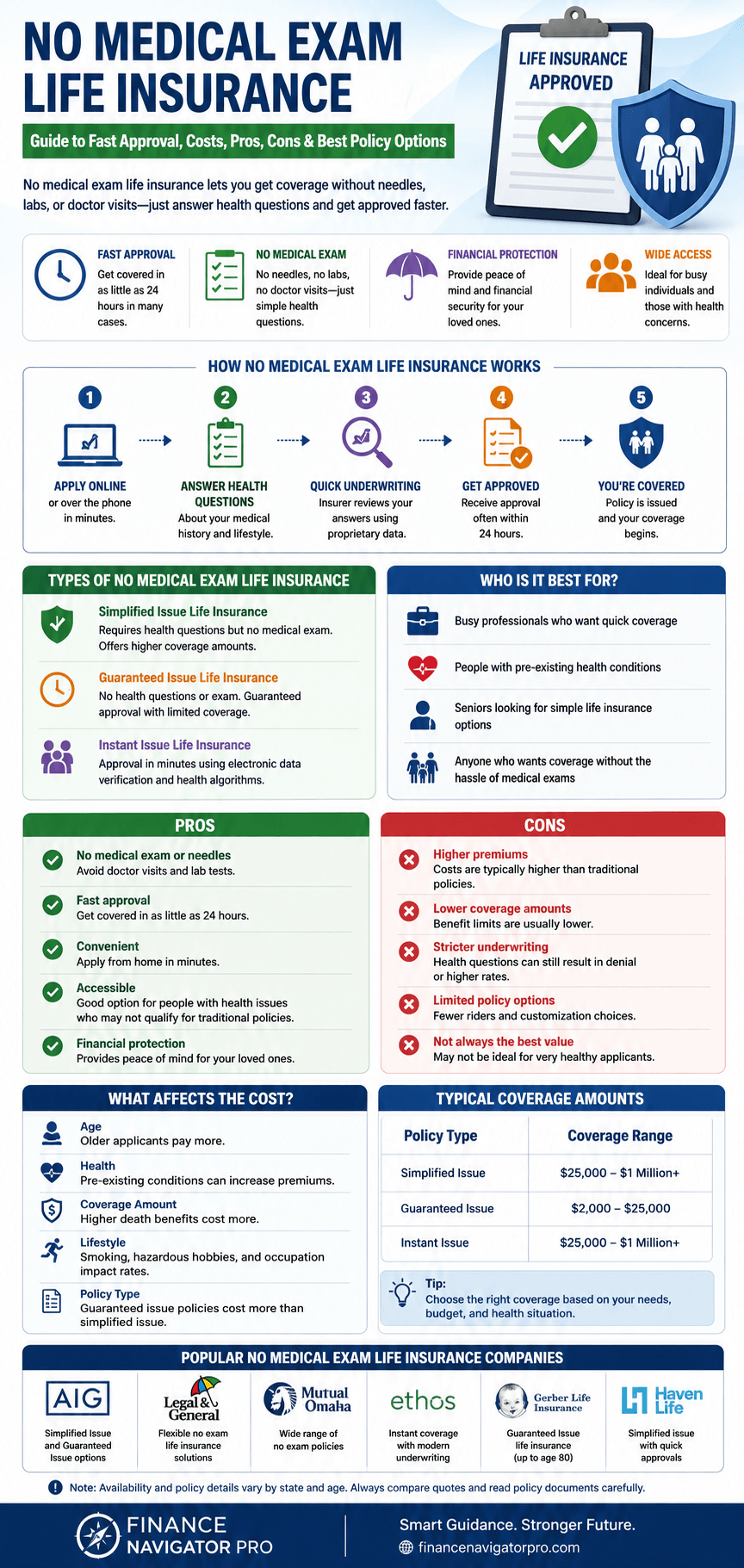
No medical exam life insurance lets you get coverage without a paramedical exam, blood draw, or urine sample — underwriting relies instead on application answers, prescription history, and public records. It’s best for people who need coverage fast, have mild-to-moderate health conditions, or want a smaller policy, typically under $500,000–$2 million.
| How fast | Simplified issue: minutes to a few days. Accelerated underwriting: often 24–72 hours. Guaranteed issue: usually instant. |
| Average cost | Roughly 10%–40% higher than fully underwritten policies for healthy applicants — though the gap narrows or disappears for people who’d otherwise be rated up after a medical exam. |
| Pros | Speed, convenience, fewer barriers for manageable health conditions, no needles. |
| Cons | Higher premiums for the healthiest buyers, lower coverage limits, and a graded death benefit in the early years on guaranteed issue policies. |
| Best for | Quick coverage needs, moderate health histories, and policies generally under $1–2 million. |
Introduction
Nobody wakes up excited to schedule a blood draw and a paramedical exam just to buy life insurance. That single fact explains why no medical exam life insurance has gone from a niche product for people with health problems to one of the fastest-growing corners of the entire life insurance market.
Millions of Americans now buy coverage without ever seeing a nurse, stepping on a scale for an insurer, or waiting six to eight weeks for a decision. Some of that shift is about convenience. A lot of it is about speed: insurers can now pull prescription histories, motor vehicle records, and public health data in seconds, which means a policy that used to take a month and a half can sometimes be approved in minutes.
This guide walks through exactly how no medical exam life insurance works, who it’s actually built for, what it costs compared to traditional underwritten policies, and where it falls short. You’ll see real pricing examples, a breakdown of every major no-exam policy type, a comparison of leading carriers, and a 25-plus question FAQ pulled straight from what people search before they buy.
By the end, you should be able to answer one simple question for yourself: is skipping the exam worth it for your situation, or are you better off booking the nurse visit?
One more thing before we dive in: this guide draws a hard line between marketing language and how underwriting actually works behind the scenes. Terms like “instant approval” and “no medical exam” get used loosely across the industry, sometimes to describe meaningfully different products. We’ll be precise about which underwriting path you’re actually looking at, because that distinction is usually what determines your real price and your real approval odds — not the catchy name on the landing page.
What Is No Medical Exam Life Insurance?
No medical exam life insurance is exactly what it sounds like: a life insurance policy you can apply for and get approved without a paramedical exam, blood draw, or urine sample. Instead of sending a nurse to your home or office, the insurer relies on the information you provide on the application plus data it can pull electronically, like your prescription drug history, driving record, and (in some cases) medical records from your doctor.
How it differs from traditional life insurance: Traditional, fully underwritten policies require a paramedical exam (height, weight, blood pressure, blood and urine samples) and sometimes an attending physician statement pulled from your doctor’s office. That process is thorough, but it’s also slow — often four to eight weeks from application to approval. No medical exam policies trade some of that depth for speed, using algorithms and data sources instead of a nurse visit.
Who offers it: Most major carriers now sell at least one no-exam product, including Haven Life (backed by MassMutual), Ladder, Bestow, Ethos, Fabric by Gerber Life, Banner Life, AIG, Prudential, Transamerica, Mutual of Omaha, and Globe Life, among others. Some sell exclusively online; others offer it as one option alongside traditional fully underwritten policies.
Common Misconceptions
- “No exam” doesn’t mean “no questions.” Most no-exam policies (outside of guaranteed issue) still ask detailed health questions and check prescription and driving records.
- It isn’t automatically more expensive. For someone who’d be rated up at a traditional exam due to a manageable condition, a no-exam policy can actually cost less.
- It isn’t only for sick or older applicants. Plenty of healthy 30- and 40-year-olds buy no-exam term policies purely for the speed and convenience.
- Coverage amounts aren’t unlimited. Most no-exam term policies cap out between $500,000 and $3 million, depending on the carrier and your age.
How No Medical Exam Life Insurance Works
Skipping the exam doesn’t mean the insurer is flying blind. It just means they’re getting their information from different places, faster.
The Application
You’ll answer questions about your age, gender, height, weight, occupation, hobbies, family health history, tobacco use, and any current medical conditions or treatments. Honesty matters here more than with traditional underwriting, because there’s no exam to catch a discrepancy — if you misrepresent something material, the insurer can deny a claim later.
The Health Questionnaire
Simplified issue policies typically include 10–30 yes/no health questions covering things like heart disease, cancer history, diabetes complications, and recent hospitalizations. Answer “yes” to certain disqualifying questions and you may be routed to a guaranteed issue product instead.
Prescription History (the MIB and Rx Databases)
Insurers pull your prescription drug history through services like Milliman IntelliScript or Rx Health Data Hub, plus a check against the Medical Information Bureau (MIB), a database that flags prior insurance applications and certain medical conditions reported by other insurers. This is often the single biggest factor in instant decisions.
Medical Records
Some accelerated underwriting programs pull electronic health records (EHRs) directly from your doctor or a health information exchange instead of ordering a full Attending Physician Statement, which speeds up the decision without skipping medical history entirely.
Motor Vehicle Reports
Your driving record gets pulled too. Multiple DUIs, reckless driving charges, or a suspended license can affect both your eligibility and your rate class, even though it has nothing to do with a blood test.
Identity Verification and Fraud Prevention
Online insurers cross-check your identity against credit header data and public records to confirm you are who you say you are and to flag inconsistent applications before they reach underwriting.
Digital Underwriting and Instant Decision Technology
This is the engine behind “instant approval.” Algorithms weigh your application answers against the prescription, MIB, and driving data in real time. If everything lines up cleanly, you can get a decision in minutes. If something needs a closer look — an unclear answer, a flagged prescription — it gets kicked to a human underwriter, which can add a day or two.
💡 Curious what your premium might look like? Comparing quotes from two or three no-exam carriers takes about ten minutes and can reveal a meaningful price difference for the exact same coverage.
Types of No Medical Exam Life Insurance
“No medical exam” is an umbrella term that covers several genuinely different products. The type you qualify for depends heavily on your health and how much coverage you want.
Think of these nine categories less as separate brands and more as a spectrum. On one end you’ve got guaranteed issue, which asks zero health questions and accepts anyone in the eligible age range. On the other end sits accelerated underwriting, which still skips the exam but digs almost as deep as traditional underwriting using electronic data instead of a needle. Most buyers land somewhere in the middle, with simplified issue or a standard no-exam term policy. Knowing where you fall on that spectrum before you start comparing quotes will save you a lot of wasted applications.
Simplified Issue Life Insurance
How it works: You answer a health questionnaire; no exam, no labs. The insurer relies on your answers plus prescription and MIB data.
Pros: Fast (often same day to a few days), available to a wide range of health profiles, simple application.
Cons: Higher cost than fully underwritten term for healthy applicants; coverage caps are lower.
Ideal buyers: People in reasonably good health who want speed and simplicity over the lowest possible price.
Approval speed: minutes to about two weeks • Coverage limits: typically $25,000–$500,000, occasionally higher.
Guaranteed Issue Life Insurance
How it works: No health questions at all. If you’re within the eligible age range (usually 50–85) and pay the premium, you’re approved.
Pros: Can’t be declined for health reasons; ideal for serious or terminal conditions.
Cons: Highest cost per dollar of coverage; low coverage limits; includes a graded death benefit (typically 2–3 years) where natural-cause deaths in that window pay back only premiums plus interest, not the full face value.
Ideal buyers: Seniors with significant health issues who’ve been declined elsewhere.
Approval speed: instant • Coverage limits: usually $2,000–$25,000, designed for final expenses.
Accelerated Underwriting
How it works: A hybrid approach. You skip the exam, but the insurer pulls more data — sometimes including electronic health records — and can offer rates close to fully underwritten pricing for healthy, lower-risk applicants.
Pros: Can get traditional-level pricing without the exam if you’re healthy.
Cons: Not everyone qualifies; some applicants get routed to a full exam anyway.
Ideal buyers: Healthy applicants under roughly 60 seeking larger term policies.
Approval speed: 24 hours to about a week • Coverage limits: can reach $1–3 million depending on carrier and age.
Instant Approval Life Insurance
How it works: A marketing term for simplified issue or accelerated underwriting policies where the algorithm renders a decision in real time during the online application.
Pros: Decision in minutes; entirely online.
Cons: Not everyone gets an instant “yes” — ambiguous answers get referred for manual review.
Ideal buyers: Anyone comfortable buying insurance online without an agent.
Approval speed: minutes for clean applications • Coverage limits: varies by carrier, often up to $1–2 million.
Term Life Insurance Without Medical Exam
How it works: Standard term coverage (10, 15, 20, or 30 years) sold through simplified issue or accelerated underwriting instead of full underwriting.
Pros: Affordable, straightforward, available fast.
Cons: Premiums run higher than fully underwritten term for the healthiest applicants.
Ideal buyers: Anyone who wants temporary coverage — to protect a mortgage or income replacement window — without the wait.
Approval speed: minutes to a few days • Coverage limits: up to $2–3 million with some carriers.
Whole Life Without Medical Exam
How it works: Permanent coverage with a cash value component, sold via simplified or guaranteed issue underwriting.
Pros: Lifetime coverage, builds cash value, premiums never increase.
Cons: Significantly more expensive than term; coverage amounts are modest.
Ideal buyers: People who want lifelong, fixed coverage — often for final expenses or legacy planning — without an exam.
Approval speed: minutes to about two weeks • Coverage limits: generally $25,000–$500,000.
Final Expense Insurance
How it works: A small whole life policy, usually simplified or guaranteed issue, designed specifically to cover funeral and burial costs.
Pros: Easy to qualify for, low monthly premiums, fast approval.
Cons: Small face amounts; cost per $1,000 of coverage is high relative to term.
Ideal buyers: Seniors who want to cover funeral costs without burdening family.
Approval speed: often instant to a few days • Coverage limits: typically $2,000–$50,000.
Employer Group Coverage
How it works: Many employers offer a baseline amount of group term life insurance (often 1–2x salary) with no individual underwriting at all, sometimes with the option to buy supplemental coverage up to a guaranteed issue limit without health questions.
Pros: Free or low-cost, no exam, no questions up to the guaranteed issue amount.
Cons: Coverage ends when you leave the job; rarely enough on its own.
Ideal buyers: Anyone with access to it — it’s a good supplement, not a replacement, for an individual policy.
Approval speed: instant during open enrollment • Coverage limits: varies by employer, commonly $10,000–$500,000.
Online Instant Policies
How it works: Direct-to-consumer carriers like Bestow, Ethos, and Ladder run the entire process — application, underwriting, and policy issue — through a website or app, often with a real-time decision.
Pros: No agent required, transparent pricing, fast.
Cons: Less personalized guidance for complex situations.
Ideal buyers: Comfortable, self-directed shoppers who know roughly what they need.
Approval speed: minutes in many cases • Coverage limits: commonly up to $1–3 million depending on age and carrier.
Who Should Consider No Medical Exam Life Insurance?
No-exam coverage isn’t a compromise product reserved for people who can’t qualify for anything else. For a lot of buyers, it’s genuinely the better fit.
The thread running through nearly every good fit for no-exam coverage is some combination of urgency, a health profile that’s good-but-not-perfect, or a coverage need that fits comfortably under the typical $1–2 million ceiling. If any of those describe you, the math usually works in your favor, even before you factor in the time you’d save not scheduling a nurse visit.
- Busy professionals who don’t have a free morning for a paramedical exam and want coverage locked in this week, not next month.
- Parents and new homeowners who need protection in place fast — a new mortgage or a new baby doesn’t wait six weeks for underwriting.
- Young families building a financial safety net for the first time and prioritizing speed over shaving a few dollars off the premium.
- Seniors who may not qualify for the most competitive fully underwritten rates anyway and want a faster, simpler path.
- People with diabetes, as long as it’s well-controlled, since many simplified issue and accelerated underwriting programs now accommodate type 2 diabetes specifically.
- People with high blood pressure that’s managed with medication — a common reason traditional applications get rated up, but often a non-issue for no-exam pricing.
- Smokers and vapers who want to avoid an even longer, more invasive underwriting process and are willing to accept smoker rates either way.
- Frequent travelers whose itinerary makes scheduling an in-home exam a genuine hassle.
- Veterans, particularly those managing service-connected conditions that complicate traditional underwriting.
- Self-employed workers without an employer plan to fall back on who want coverage without juggling exam scheduling around client work.
- People who’ve been denied traditional insurance before, often the strongest case for simplified or guaranteed issue products.
- Anyone who simply wants the fastest possible path to a signed policy.
Who Should Avoid It?
No-exam coverage isn’t the right call for everyone, and being honest about that is part of giving good advice.
- Healthy applicants in their 20s and 30s will almost always find a lower premium with a fully underwritten policy, since insurers reward a clean exam with their best rate classes.
- Anyone seeking large coverage amounts — $3 million-plus — will likely need full underwriting, since no-exam products cap out well below that for most carriers.
- Young adults with no major health concerns are leaving savings on the table by skipping the exam purely for convenience.
- Buyers laser-focused on the lowest possible premium should run the numbers on both paths before deciding; the exam often pays for itself in savings over a 20- or 30-year term.
- People doing estate planning typically need larger, more flexible policies (often permanent) that no-exam products aren’t designed to support.
- Business owners arranging buy-sell agreements or key person coverage usually need higher face amounts with full underwriting.
- High-net-worth individuals generally need coverage well beyond no-exam limits and should work with an agent on a fully underwritten, possibly multi-policy strategy.
How Much Does No Medical Exam Life Insurance Cost?
Pricing depends on age, gender, health, coverage amount, term length, and policy type. As a general rule, expect to pay somewhere between 10% and 40% more than a fully underwritten policy would cost a healthy applicant of the same profile — though that gap shrinks or disappears entirely for people who’d otherwise be rated up at a traditional exam.
Sample Monthly Premiums: 20-Year Term, Simplified Issue (Non-Smoker)
| Age | Gender | $250,000 | $500,000 | $1,000,000 |
|---|---|---|---|---|
| 30 | Female | $18 | $28 | $48 |
| 30 | Male | $21 | $33 | $57 |
| 40 | Female | $26 | $42 | $74 |
| 40 | Male | $31 | $50 | $88 |
| 50 | Female | $58 | $98 | $176 |
| 50 | Male | $71 | $121 | $219 |
Figures above are illustrative national averages for 2026 and will vary by carrier, state, and your specific health answers. Smokers typically pay two to three times the non-smoker rate at the same age and face amount.
Why Prices Vary So Much
- Age and gender: Both are the single biggest pricing levers in any life insurance product, exam or not.
- Coverage amount: Premiums don’t scale perfectly linearly — larger face amounts often have a better per-thousand-dollar rate.
- Term length: A 30-year term costs meaningfully more per month than a 10-year term for the same coverage.
- Smoking status: Nicotine use of any kind (cigarettes, vaping, chewing tobacco) typically doubles or triples the premium.
- Health answers: Conditions like diabetes, sleep apnea, or high cholesterol can move you into a different rate class even without an exam.
- Policy type: Guaranteed issue costs the most per dollar of coverage; accelerated underwriting can come close to fully underwritten pricing for healthy applicants.
It helps to think about cost in two separate buckets. The first is the underwriting premium — what you pay because of the speed and convenience of skipping the exam. The second is your personal risk premium — what any insurer, exam or not, would charge based on your age, health, and habits. For a healthy 35-year-old, the underwriting premium might be the bigger factor, pushing a no-exam quote noticeably above a traditional one. For someone managing type 2 diabetes, the no-exam policy might actually undercut a traditional quote, because the traditional exam would likely trigger a rate-up that the simplified questionnaire doesn’t.
Pros and Cons
| Pros | Cons |
|---|---|
| Approval in minutes to days, not weeks | Premiums often run higher for healthy applicants |
| No needles, no nurse visit, no scheduling hassle | Lower maximum coverage limits than fully underwritten policies |
| Easier path for people with manageable health conditions | Guaranteed issue includes a graded death benefit period |
| Entirely online application with most carriers | Health questions still required for simplified issue and accelerated underwriting |
| Good option for people previously declined elsewhere | Fewer rider and customization options with some products |
No Medical Exam vs Traditional Life Insurance
| Factor | No Medical Exam | Traditional (Fully Underwritten) |
|---|---|---|
| Approval time | Minutes to ~2 weeks | 4–8 weeks |
| Price (healthy applicant) | 10–40% higher | Lowest available rates |
| Medical exam required | No | Yes |
| Waiting period | None (term/simplified); graded for guaranteed issue | None |
| Maximum coverage | Typically up to $2–3 million | $10 million-plus available |
| Speed | Fast | Slow |
| Eligibility | Wider for moderate health issues | Stricter; best rates need excellent health |
| Ideal buyers | Need speed or have manageable health conditions | Healthy applicants seeking the lowest cost or largest coverage |
No Medical Exam vs Simplified Issue
This comparison trips people up because simplified issue is actually a type of no medical exam insurance, not a separate category. “No medical exam” is the umbrella term; simplified issue is one specific underwriting method under that umbrella, defined by its short health questionnaire and reliance on database checks instead of an exam. When people compare the two, they’re usually really comparing simplified issue against accelerated underwriting or guaranteed issue — the other no-exam paths.
No Medical Exam vs Guaranteed Issue
Guaranteed issue is the most restrictive (and most expensive per dollar of coverage) form of no-exam insurance. There are no health questions at all — acceptance is based on age alone, within a defined range, usually 50 to 85. The tradeoff is a graded death benefit: if you die from natural causes within the first two to three years, your beneficiaries typically receive only the premiums paid plus interest, not the full face value. Accidental death is usually covered at the full amount from day one. Simplified issue and accelerated underwriting, by contrast, ask health questions and pay the full death benefit immediately for both natural and accidental causes, assuming no misrepresentation on the application.
No Medical Exam vs Instant Approval
“Instant approval” describes the speed of the decision, not a distinct underwriting category. A simplified issue or accelerated underwriting policy can be “instant approval” if the algorithm clears your application without manual review. Not every no-exam application gets an instant decision — ambiguous health answers, prescription flags, or coverage amounts near a carrier’s threshold can route your file to a human underwriter, which adds a day or two even though you still never take an exam.
How Much Coverage Do You Need?
There’s no single right number, but a few methods get you close fast. If you’re starting from scratch, our guide on how much insurance coverage you actually need walks through this in more depth.
Income Replacement Method
A common rule of thumb is 10–15 times your annual income. If you earn $75,000 a year, that points to roughly $750,000–$1,125,000 in coverage — enough for your family to replace your income for a decade or more while they adjust.
DIME Method (Debt, Income, Mortgage, Education)
Add up your outstanding debt, years of income you want replaced, remaining mortgage balance, and future education costs for your kids. This tends to produce a more tailored number than a flat income multiple.
Real-Life Examples
Young parent: A 32-year-old with a $300,000 mortgage, two kids, and a $65,000 salary might land on roughly $750,000: mortgage payoff, 8 years of income replacement, and a contribution toward college.
Dual-income couple, no kids: Lower need, often $250,000–$400,000 each, mainly to cover debt and give a surviving spouse breathing room during a transition.
Single parent: Often needs more relative to income, since there’s no second earner to fall back on — frequently 15–20 times annual income plus dedicated childcare and education funds.
Other factors to fold in: remaining debt, anticipated college costs, funeral and final expenses (commonly $7,000–$12,000), and a cushion of three to six months of emergency savings for your family.
Factors That Affect Premiums
- Age — the earlier you buy, the lower your locked-in rate.
- Gender — women statistically live longer and typically pay less.
- State — regulations and risk pools vary, shifting pricing by a meaningful margin in some states.
- Health — conditions disclosed on the questionnaire directly affect your rate class.
- Smoking — the single largest controllable factor; quitting can cut your premium dramatically after the carrier’s required smoke-free period.
- Occupation — high-risk jobs (commercial fishing, logging, certain aviation roles) can increase cost or limit eligibility.
- Lifestyle — hobbies like skydiving, scuba diving, or auto racing can trigger rating adjustments or exclusions.
- Coverage amount — higher face amounts generally have better per-thousand-dollar pricing, up to a point.
- Term length — longer terms mean higher monthly premiums for the same coverage.
- Family history — some simplified issue applications ask about parents’ or siblings’ early deaths from heart disease or cancer.
- Driving record — DUIs and reckless driving citations can affect both eligibility and pricing.
- Prescription history — certain medications or combinations can flag additional review even with no exam.
No single factor decides your premium in isolation — underwriters weigh them together. A 45-year-old non-smoker with well-controlled high blood pressure and a desk job will usually land a far better rate than the raw “high blood pressure” label might suggest, because the other factors in their profile are favorable. That’s part of why getting an actual quote — rather than guessing from a list of factors, as explained in our breakdown of how insurance quotes are calculated — is worth the ten minutes it takes.
Best No Medical Exam Life Insurance Companies
This comparison is built around objective factors — financial strength, product range, coverage limits, and approval speed — not commission structures. Always confirm current ratings and product availability directly with the carrier or a licensed agent, since offerings shift over time.
| Company | Financial Strength | Policy Types | Max Coverage | Speed | Ideal For |
|---|---|---|---|---|---|
| Haven Life | A++ (MassMutual) | Term, simplified & accelerated | $3M | Minutes–days | Healthy applicants wanting speed |
| Ladder | A+ (multiple carriers) | Term, flexible/decreasing | $8M (combined) | Minutes | Adjusting coverage over time |
| Bestow | A+ (multiple carriers) | Term, simplified issue | $1.5M | Minutes | Fully online, fast applicants |
| Ethos | A+ (multiple carriers) | Term & final expense | $2M (varies) | Minutes–days | Wide age and health range |
| Fabric by Gerber Life | A (Western & Southern) | Term, simplified issue | $1.5M | Minutes–days | Young families |
| Mutual of Omaha | A+ | Term, whole, final expense, GI | $2M (term) | Days | Wide range incl. seniors |
| Globe Life | A | Whole, term, GI | $100K (varies) | Minutes–days | Smaller policies, seniors |
| AIG Direct | A | Term, simplified & accelerated | $2M+ | Days | Larger no-exam term needs |
Financial strength ratings shown are illustrative of typical 2026 ratings ranges (A.M. Best scale) and should be verified directly before purchase, since ratings can change.
A Closer Look at a Few Standouts
Haven Life: Backed by MassMutual’s financial strength, Haven Life pairs a fully digital application with both simplified issue (Haven Simple) and accelerated underwriting (Haven Term) products, which means healthy applicants aren’t necessarily stuck paying simplified issue pricing.
Ladder: Ladder’s standout feature is the ability to adjust your coverage amount up or down over time without starting a new policy from scratch, which suits buyers whose needs — a mortgage balance, kids’ ages — are likely to shrink over the years.
Mutual of Omaha: A long-standing, well-rated carrier that offers a genuinely wide range of no-exam products, from term to whole life to guaranteed issue, making it a solid one-stop comparison point across age groups.
Ethos: Known for accommodating a broad range of health histories through its simplified and guaranteed issue tracks, with a streamlined online experience that works well for buyers who aren’t sure which product they need yet.
Step-by-Step Application Process
- Compare quotes from at least two or three carriers — pricing for the identical coverage can vary by 20% or more between insurers.
- Choose a policy type and term length that matches your coverage goal and budget.
- Complete the online application and health questionnaire, answering every question accurately.
- Underwriting runs in the background — prescription database, MIB, and motor vehicle checks happen automatically.
- Receive your approval decision — instant for clean applications, 24–72 hours if referred for manual review.
- Submit your first premium payment to activate the policy.
- Your policy is issued electronically, often the same day as approval.
Expected timeline: a clean simplified issue or accelerated underwriting application can go from start to an active policy in under 30 minutes. Applications that get referred for manual review typically resolve within one to three business days.
Common Reasons Applications Get Declined
Skipping the exam doesn’t mean every application sails through. Insurers still decline applicants, just for different reasons than a traditional underwriter might flag.
- Significant or recent health issues, especially conditions not well-managed or recently diagnosed.
- Suspected fraud or misrepresentation on the application.
- Prescription history that conflicts with the health questions answered.
- High-risk hobbies not disclosed upfront, discovered during underwriting review.
- A poor driving history, including recent DUIs or multiple serious violations.
- A criminal record involving certain felony convictions.
- Incorrect or inconsistent information across the application.
- Requesting a coverage amount that exceeds what your income or net worth supports (insurable interest limits).
Common Mistakes Buyers Make
Most of the regret people feel about a life insurance purchase doesn’t come from the policy itself — it comes from rushing one of these steps.
- Buying too little coverage just to keep the premium low, leaving a real financial gap for your family.
- Ignoring exclusions and the graded death benefit period on guaranteed issue policies.
- Not comparing multiple companies, which leaves real savings on the table given how much pricing varies.
- Choosing the cheapest policy without checking financial strength ratings or claim-paying history.
- Skipping or forgetting to update beneficiaries, which can create real complications later.
- Not reading the policy details, including renewal terms and conversion options.
- Waiting too long to apply — premiums only go up with age, and health can change unexpectedly.
How to Save Money
A few of these tie directly into broader habits worth building — see our guide on how to lower your insurance premium for more.
- Buy younger — locking in a rate in your 30s instead of your 40s can cut lifetime premiums significantly.
- Improve your health before applying, even modest changes to blood pressure or weight can shift your rate class.
- Quit smoking — most carriers offer non-smoker rates after 12 months of being tobacco-free.
- Choose term over whole life if you mainly need coverage for a defined period, like until the mortgage is paid off.
- Compare quotes across several carriers before committing — don’t settle for the first offer.
- Pay annually instead of monthly when you can, since many insurers offer a discount for it.
- Avoid riders you don’t actually need — each one adds to your premium.
- Review your coverage every few years and adjust as your debts and income change.
Riders Worth Considering (and Ones to Skip)
A rider is an optional add-on that modifies your base policy, usually for an extra cost. No-exam policies typically offer a smaller rider menu than fully underwritten ones, but a few are worth knowing about.
- Accelerated death benefit rider — often included automatically at no extra cost, this lets you access a portion of your death benefit early if you’re diagnosed with a terminal illness.
- Waiver of premium rider — waives your premium payments if you become disabled and can’t work, keeping the policy active without you paying out of pocket.
- Child term rider — adds a small amount of term coverage on your children under your own policy, often convertible to their own permanent policy later without new underwriting.
- Accidental death benefit rider — pays an additional amount on top of the base death benefit if death results from a covered accident; worth evaluating against its added cost since base coverage already includes accidental death.
Riders that mainly duplicate coverage you already have elsewhere — say, a return-of-premium rider when you’re already maximizing retirement contributions — are usually not worth the added monthly cost. When in doubt, ask what each rider actually changes about your payout, not just what it’s called.
Key Terms to Know
A quick glossary of terms that come up throughout this guide and across most carrier websites.
Frequently Asked Questions
Is no medical exam life insurance worth it?
For most people who need coverage quickly or have a manageable health condition, yes. You’ll likely pay somewhat more than a fully underwritten policy if you’re in excellent health, but the speed, convenience, and broader acceptance criteria make it worth it for a large share of buyers. If you’re young, healthy, and not in a rush, it’s worth comparing both paths before deciding.
Can I get $1 million in coverage without a medical exam?
Yes, several carriers offer no-exam term policies up to $1–3 million for qualifying applicants, especially through accelerated underwriting. Simplified issue products usually cap out lower, often around $500,000. Your exact limit depends on your age, income, and the specific carrier’s underwriting guidelines.
Can diabetics qualify for no medical exam life insurance?
Many can, particularly with well-controlled type 2 diabetes. Several simplified issue and accelerated underwriting programs specifically accommodate diabetes, though your rate class and approval will depend on how long you’ve had it, your A1C levels, and whether you have any complications.
Can seniors qualify for no medical exam life insurance?
Yes. Guaranteed issue and simplified issue policies are commonly designed for applicants in their 50s through 80s, often used for final expense coverage. Seniors with more significant health conditions may be steered toward guaranteed issue, which accepts nearly everyone within the eligible age range.
Does approval happen instantly?
For many simplified issue and accelerated underwriting applications, yes — a clean application can be approved within minutes. If your answers need a closer look, prescription records raise a question, or you’re near a coverage threshold, your application may be referred for manual review, adding a day or two.
Is blood work required for no medical exam life insurance?
No. That’s the defining feature of these policies. Instead of blood and urine samples, the insurer relies on your application answers, prescription history, and other electronic data sources to make an underwriting decision.
Can I buy no medical exam life insurance online?
Yes, most no-exam policies are designed to be purchased entirely online, from quote to application to policy issue, often without ever speaking to an agent unless you want to.
Can smokers qualify for no medical exam life insurance?
Yes, smokers can typically qualify, though they’ll be placed in a smoker rate class with higher premiums, often two to three times the non-smoker rate. Some carriers also offer rates for vapers or occasional cigar smokers that differ from cigarette smoker rates.
What happens if I lie on my application?
Misrepresenting health information can give the insurer grounds to deny a claim or rescind the policy, particularly within the contestability period (usually the first two years). Because there’s no exam to catch discrepancies upfront, accuracy on the application matters even more.
Can I switch from a no-exam policy to a traditional one later?
Many term policies include a conversion option that lets you convert to a permanent policy without new underwriting, but switching from one company’s no-exam term to a different fully underwritten policy generally requires a brand-new application and underwriting process.
Which company is best for no medical exam life insurance?
There’s no single best carrier for everyone — it depends on your age, health, and coverage goals. Haven Life and Ladder are strong for healthy applicants wanting speed; Mutual of Omaha and Ethos cover a wider age and health range; Globe Life specializes in smaller policies for seniors.
Can I get coverage today?
Often, yes. Many simplified issue and instant-approval policies can be applied for, approved, and activated the same day, assuming your application clears underwriting without needing manual review.
Is there a waiting period?
Term and simplified issue policies typically have no waiting period — the full death benefit applies from day one. Guaranteed issue policies usually include a graded death benefit period of two to three years for natural-cause deaths.
Does no medical exam life insurance cover accidental death?
Yes, in nearly all cases, including during a guaranteed issue policy’s graded period, when natural-cause deaths are only partially covered but accidental death is typically paid at the full face value from day one.
Can I cancel my policy anytime?
Yes, life insurance policies are generally cancelable at any time without penalty, though you’ll lose coverage once you stop paying premiums and won’t get a refund for whole life cash value built up unless you formally surrender the policy.
Will my rates increase over time?
With level term policies, no — your premium is locked in for the full term. Guaranteed issue whole life premiums are also typically fixed for life. Rates only change if you let a term policy lapse and reapply later at an older age.
How long does underwriting take for a no-exam policy?
Simplified issue and accelerated underwriting decisions often arrive within minutes to a few days. If your file is referred for manual review, expect anywhere from one to five business days.
What’s the maximum age to apply for no medical exam life insurance?
It varies by carrier and product, but many simplified issue and term policies accept applicants up to age 60–70, while guaranteed issue policies often extend coverage up to age 80 or 85.
Can I have multiple no medical exam policies?
Yes, as long as your total coverage across all policies stays within reasonable insurable interest limits based on your income and net worth. Some people stack a no-exam policy for immediate coverage with a fully underwritten policy applied for separately.
Do no-exam policies have a contestability period?
Yes, almost all life insurance policies, exam or not, include a two-year contestability period during which the insurer can investigate and potentially deny a claim if it finds material misrepresentation on the application.
Is term or whole life better without a medical exam?
Term is usually the better value for pure protection needs, since it’s far less expensive for the same coverage. No-exam whole life makes more sense if you specifically want lifelong coverage with a cash value component and are willing to pay more for it.
Can I get no medical exam life insurance with sleep apnea?
In most cases, yes, especially if it’s being treated with a CPAP machine and well-managed. Untreated or severe sleep apnea may affect your rate class or eligibility depending on the carrier.
Does my job affect my eligibility for no-exam coverage?
It can. High-risk occupations like commercial fishing, logging, or certain aviation roles may lead to higher premiums, exclusions, or in some cases a referral to full underwriting instead.
Can I add riders to a no medical exam policy?
Many carriers offer riders such as accidental death benefit, child term riders, or waiver of premium, though the selection is often more limited than with fully underwritten policies.
How is no medical exam life insurance underwritten without an exam?
Underwriters rely on your application answers, prescription drug history, Medical Information Bureau records, motor vehicle reports, and sometimes electronic health records, using algorithms to assess risk in place of a physical exam.
Is guaranteed issue life insurance a scam?
No, it’s a legitimate product, but it’s priced for the fact that the insurer can’t screen for health risk at all. It’s appropriate for people who genuinely can’t qualify elsewhere, not a good value for healthy applicants.
Can a felon get no medical exam life insurance?
It depends on the nature and recency of the conviction. Minor or older offenses often don’t prevent approval, while serious or recent felony convictions can lead to a decline, particularly for traditional underwriting paths.
What documents do I need to apply?
Typically just your driver’s license or another form of ID, your Social Security number, and basic financial information to support the coverage amount you’re requesting. No medical paperwork is needed.
Can I get no medical exam life insurance after a heart attack?
It’s possible, particularly through guaranteed issue, though pricing will be significantly higher and simplified issue or accelerated underwriting may decline you depending on how recent and severe the event was.
Do beneficiaries pay taxes on the death benefit?
Generally, no. Life insurance death benefits are typically received income tax-free by beneficiaries under federal law, though it’s worth confirming your specific situation with a tax professional, especially for larger estates.
Can I buy no medical exam life insurance for my spouse?
Yes, spouses can each apply for their own policy, and many carriers offer simplified joint applications, though each person still goes through individual underwriting.
How is no medical exam life insurance different from accidental death and dismemberment (AD&D) insurance?
They’re not the same product. No medical exam life insurance pays out for death from nearly any cause (subject to standard exclusions like suicide in the first two years), while AD&D coverage only pays for deaths or injuries resulting directly from an accident, and typically pays a smaller benefit for dismemberment than for death.
Can pregnant women get no medical exam life insurance?
Yes, pregnancy itself generally doesn’t affect eligibility or pricing for no-exam life insurance, since insurers are evaluating long-term mortality risk rather than current physical status the way they might for short-term disability coverage.
What’s the difference between simplified issue and accelerated underwriting pricing?
Simplified issue almost always costs more than fully underwritten coverage regardless of your health, because the insurer is pricing in the uncertainty of skipping a deeper look. Accelerated underwriting, by contrast, can match or come close to fully underwritten pricing for applicants who turn out to be low-risk once the available data is reviewed.
Does Availability Vary by State?
Yes. Life insurance is regulated at the state level, so product availability, maximum coverage amounts, and even specific policy language can differ depending on where you live. New York, for example, has its own approval process that sometimes lags behind other states for newly launched products. Before you fall in love with a specific carrier or policy based on something you read online, confirm it’s actually licensed and available in your state — most insurers show this clearly during the online quote process, or you can check directly with your state’s department of insurance.
Expert Take
If you’re weighing this decision, here’s the honest framework worth using. No medical exam life insurance makes the most sense when speed matters, when you have a health condition that’s well-managed but might trigger a higher rating at a traditional exam, or when you want a moderate amount of coverage and don’t want the process to drag on for weeks.
Traditional, fully underwritten insurance still wins on price for genuinely healthy applicants, and it’s the only realistic path for very large coverage amounts. If you’re 28, run three miles a day, and need $3 million in coverage for estate planning, skipping the exam is probably costing you money for no good reason.
When comparing policies, look past the headline premium. Check the carrier’s financial strength rating, the maximum coverage available at your age, whether the policy is convertible to permanent coverage later, and — for guaranteed issue specifically — the exact length and terms of the graded death benefit period.
What most buyers overlook: the difference between simplified issue and accelerated underwriting. Both skip the exam, but accelerated underwriting can get healthy applicants pricing close to fully underwritten rates, while simplified issue almost always costs more regardless of health. If you’re healthy and want to avoid the exam, ask specifically whether a carrier offers accelerated underwriting before defaulting to simplified issue.
Final Thoughts
No medical exam life insurance has earned its growing popularity honestly. It solves a real problem — the friction, scheduling hassle, and weeks-long wait that keep a lot of people from buying coverage they know they need. For moderate coverage amounts and a wide range of health profiles, it’s a genuinely good option, not just a fallback for people who can’t qualify any other way.
That said, it isn’t automatically the cheapest or the best fit for everyone. Healthy applicants chasing the lowest possible premium, and anyone needing very large coverage amounts, should still get a traditional quote before committing. The smartest move, regardless of which path you lean toward, is comparing quotes from two or three carriers — medical exam and no-exam alike — so you can see the real tradeoff in dollars rather than guessing.
Whatever you decide, the worst outcome isn’t picking the slightly more expensive option — it’s leaving your family without coverage at all while you keep “meaning to get around to it.” No medical exam life insurance exists precisely to remove that excuse.
💡 Ready to see real numbers? Comparing no-exam and traditional quotes side by side, for your exact age, health profile, and coverage amount, is the only way to know for sure which path actually saves you money.
Related Guides
| Final Expense Insurance Guide → | Group Life Insurance Explained → |
| Universal Life Insurance Guide → | Indexed Universal Life (IUL) → |
| How Much Coverage Do You Need? → | How to Lower Your Insurance Premium → |
About the Author
This guide was written and reviewed by FinanceNavigatorPro’s editorial team, drawing on licensed insurance industry research and publicly available carrier data. Reviewed for accuracy by a contributor with professional financial services experience. Policy availability, pricing, and underwriting guidelines vary by state and carrier and change over time — always confirm current details directly with the insurer or a licensed agent before purchasing. This article is for educational purposes and isn’t personalized financial or insurance advice; consult a licensed insurance professional for guidance specific to your situation.