

Joint life insurance is a single policy covering two people, usually spouses. A first-to-die policy pays out when the first insured dies; a second-to-die (survivorship) policy pays only after both have died. It’s typically cheaper than two separate policies of equal size but offers less flexibility and can create coverage gaps after death, divorce, or remarriage.
Think about the last time you and your spouse sat down to talk about money. Chances are the conversation eventually circled back to the same handful of worries: the mortgage, the kids’ college fund, what happens to the business if one of you isn’t around to run it, and whether the IRS is going to take a bite out of everything you’ve spent a lifetime building. Joint life insurance was built for exactly that kind of conversation.
It’s a single policy that insures two people instead of one. For some couples, that simplicity is a relief. For others, it quietly creates problems they don’t discover until it’s too late to fix them. The honest answer to whether joint life insurance is a good idea is: it depends entirely on who you are, what you’re trying to protect, and how your life is likely to change over the next twenty or thirty years.
This guide walks through everything you need to know, from how first-to-die and second-to-die (survivorship) policies actually work, to real premium ranges, to the estate planning math that makes survivorship life insurance one of the most efficient tools available to wealthy families in 2026. We’ll cover the mistakes that trip up otherwise smart couples, the questions to ask before you sign anything, and the situations where joint coverage is the wrong answer entirely. By the end, you’ll know exactly where you stand.
What Is Joint Life Insurance?
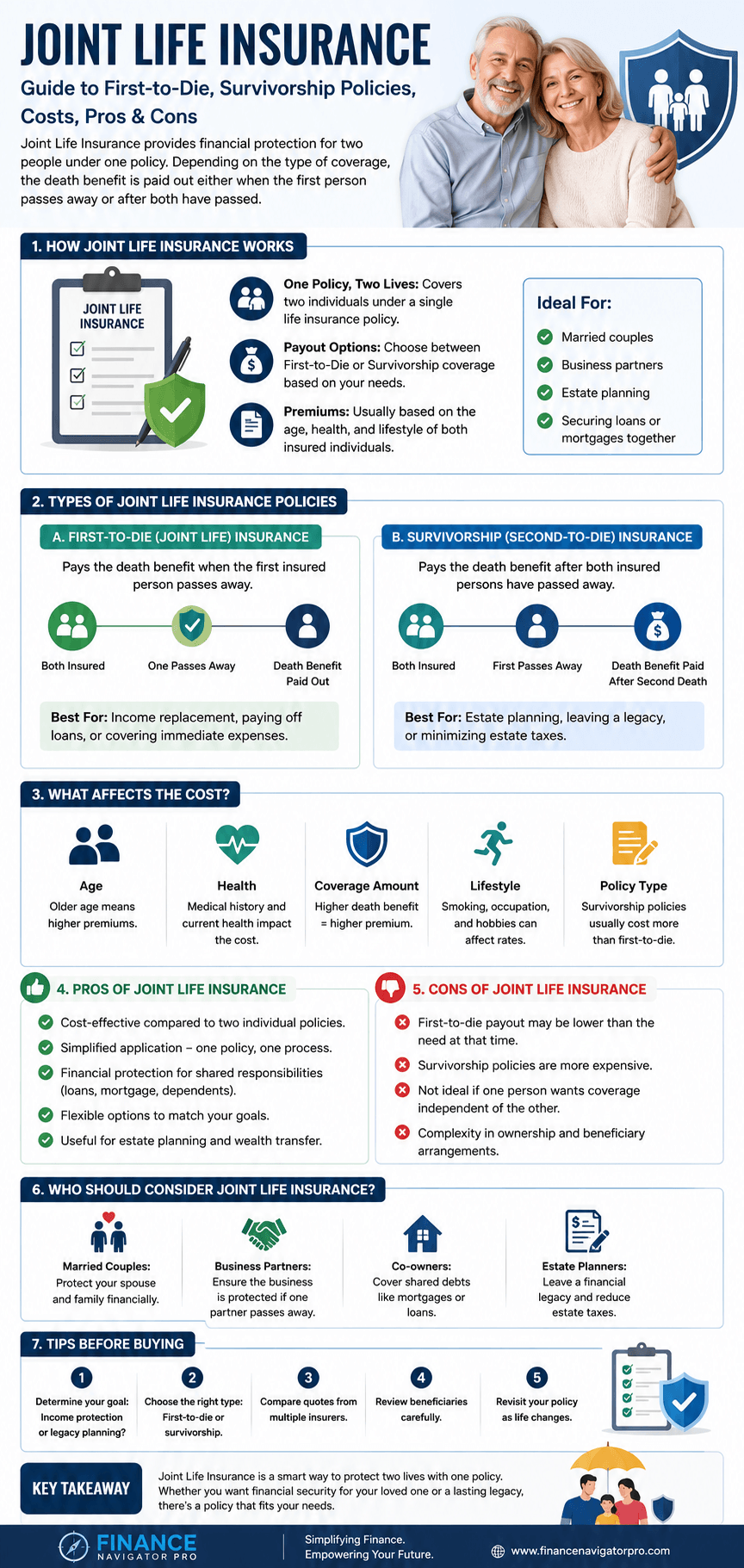
Joint life insurance is a life insurance policy written on two people under a single contract, instead of two separate contracts. The two insureds are almost always spouses or domestic partners, though business partners sometimes use a similar structure for buy-sell funding. There is one premium, one policy number, and one death benefit, but how and when that death benefit gets paid depends entirely on which type of joint policy you buy.
There are two fundamentally different structures, and confusing them is the single most common mistake people make when shopping for this coverage. A first-to-die policy pays the death benefit the moment the first insured person dies, then the coverage ends. A second-to-die policy, also called survivorship life insurance, pays nothing until both insureds have died, and the payout goes to the beneficiaries after the second death.
Why would anyone buy a policy that insures two lives but pays out only once? Because the purpose isn’t really about insuring “two people.” It’s about insuring an event, a transition, or a financial obligation that’s tied to a couple rather than an individual. A mortgage doesn’t care which spouse dies first, it just needs to be paid off. An estate tax bill doesn’t get triggered until both spouses are gone, thanks to the unlimited marital deduction. Joint life insurance lets you match the policy structure to the financial event you’re actually worried about.
Why People Buy Joint Life Insurance
A Simple Example
Picture Mark and Renee, both 42, with two kids in elementary school and a $480,000 mortgage. If Mark dies tomorrow, Renee still has to make the mortgage payment, cover childcare, and replace his income. The same is true in reverse. Their risk is a first-death risk, so a first-to-die joint term policy (or, more commonly, two separate term policies) makes sense for them.
Now picture Howard and Diane, both 71, with a $22 million estate built from a family manufacturing business. Federal estate tax doesn’t touch their estate until after the second spouse dies, because of the unlimited marital deduction between spouses. Their risk is a second-death risk. A survivorship policy, timed to pay out exactly when the estate tax bill comes due, is the more natural fit. These two couples have completely different problems, and that’s why “joint life insurance” isn’t really one product. It’s two very different tools that happen to share a name.
How Joint Life Insurance Works
Once you understand the first-to-die versus second-to-die distinction, the mechanics of joint life insurance are fairly straightforward. Here’s what actually happens from application to claim.
Premiums
You pay a single premium for the joint policy, calculated using both insureds’ ages, health, and risk factors together. For first-to-die policies, the insurer is essentially betting on whichever death happens sooner, so pricing leans more heavily on the less healthy or older applicant. For second-to-die policies, the insurer is betting on the second death, which statistically happens later than either individual’s death would, so survivorship premiums are typically lower per dollar of coverage than a comparable single-life policy on either spouse alone.
Coverage and the Death Benefit
The face amount (the death benefit) is set when you buy the policy and, for term and most permanent designs, stays level for the life of the contract. On a first-to-die policy, the full face amount pays out at the first death and the policy terminates. On a second-to-die policy, nothing pays out at the first death; the policy simply continues (often at the same premium) until the second insured dies, at which point the full face amount is paid.
Beneficiaries and Claims
You name beneficiaries just as you would on any individual policy. They don’t have to be the other insured spouse, and on a survivorship policy they almost never are, since by definition both insureds are deceased before a claim is paid. Common beneficiary choices include adult children, a trust (especially an ILIT), or a charity. The claims process itself works the same way as a single-life policy: the beneficiary files a claim with proof of death, and the insurer pays out, typically within 30 to 60 days for a clean claim.
Policy Ownership
Ownership matters more than most buyers realize, particularly for estate planning. If a married couple personally owns a survivorship policy on their own two lives, the death benefit is generally included in the surviving spouse’s taxable estate when added to other assets, which can defeat the purpose of buying the policy to cover estate taxes in the first place. That’s why high-net-worth families very often have an ILIT, rather than the spouses themselves, own the policy. We’ll cover this in detail in the estate planning section.
Step-by-Step: How a Joint Policy Moves From Application to Claim
Types of Joint Life Insurance
Every joint policy falls into one of two camps based on when it pays out. Get this distinction right and almost everything else about joint life insurance starts to make sense.
First-to-Die Life Insurance
A first-to-die policy insures two people and pays the full death benefit when the first of the two dies. After that payout, the policy ends entirely, even though the surviving spouse is still alive. There’s no remaining coverage on the survivor unless the policy included a conversion or “split option” rider purchased in advance.
How It Works
Underwriting considers both lives, and pricing is generally closer to the cost of insuring the higher-risk (often older or less healthy) spouse than to simply averaging the two. The policy is medically underwritten once, issued once, and the single premium covers both people for as long as both remain alive and the policy stays in force.
Advantages
Disadvantages
Best For
Couples with a shared financial obligation, like a mortgage or business loan, that needs to be paid off no matter which spouse dies first, and who are comfortable that the survivor will need to buy new, separate coverage afterward. In practice, most financial advisors today recommend two separate term policies over a first-to-die joint policy for the simple reason that two separate policies leave the survivor with continuing protection. First-to-die contracts have become a smaller niche product as a result, but they still show up in certain mortgage protection and small-business contexts.
Example
Two business partners, Aaron and Priya, take out a $1 million first-to-die policy to fund their buy-sell agreement. If either dies, the surviving partner uses the payout to buy out the deceased partner’s share from their estate, keeping the business intact. Because the obligation ends once one partner has been bought out, a first-to-die structure fits their need precisely; there’s no reason to insure a “second death” that has no bearing on the buy-sell agreement.
Second-to-Die (Survivorship) Life Insurance
A second-to-die policy, far more common in practice than first-to-die today, insures two people but pays nothing until both have died. It’s almost always purchased for a single purpose: covering a tax bill, equalizing an inheritance, or guaranteeing a legacy gift that, by its nature, only becomes due after both spouses are gone.
How It Works
Because the insurer is pricing the probability of two deaths having occurred, rather than one, the actuarial math works in the buyer’s favor. Statistically, two people are less likely to both be deceased at any given point than either one is individually, so survivorship premiums per dollar of coverage tend to be meaningfully lower than equivalent individual permanent coverage on either spouse, and the policy can often be issued even when one spouse has health issues that would make them difficult or impossible to insure on their own, because the healthier spouse’s life expectancy carries much of the underwriting weight.
Estate Planning Uses
Legacy Planning, Trust Funding, and Charitable Giving
Survivorship policies are frequently owned by an ILIT specifically so the death benefit lands outside both spouses’ taxable estates. The trust pays the premiums (often funded by annual exclusion gifts from the grantors), owns the policy, and receives the death benefit, which it can then use to pay estate taxes or distribute to beneficiaries according to the trust’s terms. For charitably inclined couples, naming a donor-advised fund, family foundation, or favorite charity as beneficiary turns a survivorship policy into a guaranteed future gift that costs pennies on the dollar compared to its eventual payout.
High-Net-Worth Families
This is where survivorship life insurance earns its reputation as one of the most efficient estate planning tools available. A relatively modest annual premium, paid over years, can guarantee millions of dollars in liquidity precisely when it’s needed, at exactly the moment a large, illiquid estate would otherwise be forced to sell assets at a discount to cover a tax bill.
Example
Robert and Linda, both 68, own a $19 million estate that includes a commercial real estate portfolio. Even with the 2026 federal exemption at $15 million per person ($30 million combined for a married couple using portability), they have meaningful exposure once future growth and their state’s estate or inheritance tax rules are factored in. They purchase a $4 million survivorship policy inside an ILIT. When Linda, the second to pass, dies years later, the trust receives the death benefit tax-free and uses it to cover estate settlement costs and final expenses, without the family needing to sell a single property under pressure.
Joint Life Insurance vs. Separate Policies
This is the comparison that matters most for the majority of couples, and it’s where a lot of well-meaning insurance shoppers get steered wrong. On paper, one joint policy looks simpler and sometimes cheaper than two individual policies. In practice, separate policies win for most married couples, for reasons that aren’t always obvious until you lay them out side by side.
| Factor | Joint Policy (First-to-Die) | Two Separate Policies |
|---|---|---|
| Cost | Often cheaper upfront, but priced around the higher-risk spouse | Each spouse priced individually; total cost can be lower if one spouse is younger/healthier |
| Coverage after first death | Ends completely; survivor has zero coverage | Survivor’s policy stays fully in force |
| Flexibility | One contract; hard to adjust one spouse’s coverage independently | Each policy can be increased, decreased, or dropped independently |
| Underwriting | Combined; one spouse’s health issue can affect the whole policy | Independent; one spouse’s rating doesn’t affect the other’s price |
| Divorce | Must be split, converted, or replaced entirely | Each spouse simply keeps their own policy |
| Beneficiary control | Single death benefit, single distribution event | Each spouse can name different beneficiaries for different purposes |
| Claims | One claim, one time, then the contract is closed | Each policy files and pays independently |
| Estate planning fit | Better suited to second-to-die (survivorship) designs | Works well when paired with trust planning per spouse |
| Business planning fit | Common for buy-sell agreements between two owners | Common when partners have very different ages/health |
| Best use case | Shared first-death obligation, simplified buying | Most married couples with children, mortgages, or income replacement needs |
Recommendations by Situation
Joint Term Life Insurance
Joint term life insurance applies the first-to-die structure to a term contract, typically with level premiums for 10, 15, 20, or 30 years. It’s the most affordable form of joint coverage because term insurance has no cash value component and is priced purely for the death benefit risk over a defined period.
Benefits
Limitations
Who Should Choose It
Joint term works best for couples who want the absolute lowest-cost way to cover a shared, time-limited obligation, such as a 15-year mortgage, and who understand and accept that the survivor will need new coverage afterward. For most families, though, two separate term policies sized to each spouse’s individual income-replacement need remain the more protective and only modestly more expensive choice.
Joint Whole Life Insurance
Joint whole life insurance is permanent coverage, almost always structured as second-to-die (survivorship) whole life, designed to remain in force for both insureds’ entire lives as long as premiums are paid. It builds cash value on a guaranteed schedule and is the design most often chosen by estate planning attorneys for ILIT funding because of its predictability.
Cash Value
A portion of every premium goes into a guaranteed cash value account that grows on a fixed schedule set by the insurer. While the cash value is rarely the main reason families buy a survivorship policy, it does provide a guaranteed, conservative asset that can be borrowed against if needed, and it supports the guaranteed nature of the death benefit.
Lifetime Coverage
As long as premiums are paid (or the policy is structured as fully guaranteed with a defined premium schedule), the death benefit is locked in regardless of how long both spouses live. This certainty is exactly what makes whole life survivorship policies attractive for estate tax planning, where the entire point is guaranteeing liquidity decades in advance, regardless of when the second death actually occurs.
Dividends
If the policy is issued by a mutual insurance company, it may be eligible to receive dividends, which are not guaranteed but have historically been paid by many long-established mutual carriers. Dividends can be taken in cash, used to reduce premiums, or, most commonly in survivorship designs, used to purchase additional small amounts of paid-up insurance, gradually increasing the death benefit over time.
Long-Term Wealth Transfer
Because the premium is fixed and the death benefit is guaranteed, joint whole life is often described as the most “set it and forget it” option for families focused purely on guaranteeing a wealth transfer event decades into the future. The tradeoff is premium cost: guaranteed permanent coverage is meaningfully more expensive than term insurance, which is one reason it’s used almost exclusively for survivorship designs rather than first-to-die coverage.
Joint Universal Life Insurance
Joint universal life insurance, again typically structured as survivorship universal life insurance, offers the same lifetime, second-to-die coverage as joint whole life but with flexible premiums and a cash value account that can grow based on current interest rates (or, for indexed universal life designs, partly on the performance of a market index).
Flexible Premiums
Within limits, you can increase or decrease your premium payments year to year, which can be useful for business owners or high earners whose cash flow varies. Underpaying for too long, however, can erode the policy’s cash value and put the guaranteed death benefit at risk, so flexibility has to be managed carefully, not treated as optional.
Cash Value
Cash value in a universal life policy grows based on credited interest rates set by the insurer (or index-linked returns, subject to caps and floors, in an indexed universal life design), rather than the fixed schedule used in whole life. This gives more upside potential but less certainty than a guaranteed whole life chassis.
Indexing Options
Survivorship indexed universal life (often shortened to survivorship IUL) ties some cash value growth to the performance of a stock market index, like the S&P 500, while typically guaranteeing a 0% floor so the cash value doesn’t decline due to market losses. These products can offer attractive long-term growth potential but come with caps on upside and more complexity, making them best suited to buyers working closely with an experienced advisor.
Best Use Cases
Who Should Consider Joint Life Insurance?
Married Couples
Couples whose primary goal is leaving a guaranteed legacy, covering final expenses for whichever of them dies last, or funding a shared estate planning need are good candidates for survivorship coverage. Couples focused on income replacement are usually better served by separate policies, as covered above.
Parents
Parents of young children most often need first-death protection, which argues for separate term policies. Parents focused on guaranteeing an inheritance for adult children, regardless of which parent passes last, sometimes use a smaller survivorship policy alongside their individual coverage.
Retirees
Retired couples without significant ongoing income-replacement needs, but with a desire to leave a guaranteed, tax-free legacy or cover final expenses and estate settlement costs, are a classic fit for survivorship whole life or universal life.
Business Partners
Two business partners can use joint coverage to fund a buy-sell agreement, ensuring that if either partner dies, the survivor has guaranteed liquidity to buy out the deceased partner’s ownership stake from their estate, rather than being forced into a partnership with an unwilling heir.
Estate Planning Families
Families with estates large enough to face federal estate tax exposure (above $15 million per individual or $30 million per married couple in 2026) or state-level estate or inheritance tax exposure are the textbook use case for survivorship life insurance owned inside an ILIT.
Blended Families
Survivorship policies can help blended families guarantee that children from a first marriage receive a defined inheritance, separate from assets that pass to a current spouse, without forcing awkward conversations about dividing up the family home or business while everyone is still alive.
Special Needs Planning
Families with a child who has special needs often use a survivorship policy, paired with a special needs trust, to guarantee that funds will be available for that child’s lifetime care after both parents have passed, without jeopardizing the child’s eligibility for means-tested government benefits.
High-Net-Worth Families
Beyond estate tax funding, wealthy families use survivorship insurance to equalize inheritances among children (especially when one child is inheriting an illiquid family business), fund charitable bequests, and provide liquidity for estate settlement costs, probate expenses, and final income taxes.
Who Should Avoid Joint Life Insurance?
Joint coverage isn’t the wrong answer for everyone who falls into these categories, but each one deserves real caution before signing.
Pros and Cons of Joint Life Insurance
Cost of Joint Life Insurance
Pricing for joint life insurance depends on the same core variables as individual life insurance, applied to two people instead of one, plus the structural choice between first-to-die and second-to-die. The figures below are general, illustrative ranges meant to help you understand relative cost relationships, not quotes from any specific insurer. Always get personalized quotes, since actual pricing varies significantly by carrier, underwriting class, and state.
Pricing Factors
Illustrative Premium Ranges
These are general illustrative ranges for healthy, non-tobacco applicants and are intended only to show how cost relationships typically work across policy types and ages. They are not guaranteed rates from any carrier.
| Policy Type | Couple’s Combined Age (approx.) | Coverage Amount | Illustrative Monthly Range |
|---|---|---|---|
| Joint Term (20-year) | Both age 35 | $500,000 | $45 – $85 |
| Joint Term (20-year) | Both age 50 | $500,000 | $110 – $210 |
| Survivorship Whole Life | Both age 60 | $1,000,000 | $650 – $1,200 |
| Survivorship Whole Life | Both age 70 | $2,000,000 | $1,800 – $3,400 |
| Survivorship Universal Life | Both age 65 | $2,000,000 | $1,400 – $2,800 |
Ranges are illustrative and for educational comparison only. Actual premiums depend on full underwriting, the specific carrier, health classification, and current interest-rate or dividend environment.
Factors That Affect Premiums
Age
Age is the single biggest driver of cost. Because survivorship pricing is based on the joint probability of both insureds being deceased, the age gap between spouses matters too: a wider age gap generally lowers survivorship premiums (since the younger spouse extends the expected payout date), while it has a more mixed effect on first-to-die pricing.
Health and Underwriting Class
Each insured is typically assigned an underwriting class (such as Preferred Plus, Preferred, Standard, or various rated classes) based on health exam results, medical records, and family history. On first-to-die policies, the lower-rated spouse’s class often has an outsized effect on overall pricing. On survivorship policies, a poor rating on one spouse is frequently offset by a strong rating on the other, which is part of why survivorship coverage can be obtainable even when one spouse has a serious health condition.
Tobacco and Nicotine Use
Tobacco use of any kind, including vaping, typically pushes an applicant into a smoker-rated class, which can roughly double premiums compared to non-tobacco rates. Most insurers require 12 months of tobacco-free status before reclassifying an applicant as a non-smoker.
Coverage Amount and Policy Type
Larger face amounts cost more in absolute dollars but often come with better per-thousand-dollar pricing at higher bands. Term coverage is dramatically less expensive than permanent coverage of the same face amount, because term insurance has no cash value and a defined end date.
Occupation, Lifestyle, and Driving Record
Hazardous occupations (commercial fishing, logging, certain aviation roles), high-risk hobbies (skydiving, scuba diving, auto racing), and a poor driving record can each trigger rating adjustments or, in extreme cases, exclusion riders for specific causes of death.
Best Joint Life Insurance Companies
A number of well-established U.S. life insurance carriers have long track records in the survivorship and joint life insurance market, including Lincoln Financial Group, Nationwide, Pacific Life, Prudential Financial, Protective Life, Penn Mutual, MassMutual, John Hancock, Securian Financial (Minnesota Life), and Transamerica, among others. Rather than ranking specific carriers, which can change year to year and depends heavily on your individual underwriting outcome, here’s what actually matters when evaluating any insurer for joint coverage.
Financial Strength
Because survivorship policies are designed to stay in force for decades, financial strength matters more here than almost anywhere else in insurance shopping. Check each carrier’s current rating from independent agencies like AM Best, Moody’s, S&P Global Ratings, and Fitch before applying, and look for insurers with consistently strong ratings across multiple agencies rather than relying on a single source.
Survivorship Product Depth
Not every carrier that sells individual life insurance offers a competitive survivorship product. Carriers with a long history in the estate planning and high-net-worth market tend to have more refined underwriting guidelines for joint applications, including the ability to issue coverage when one spouse has a significant health impairment.
Customer Service Reputation and Claims Experience
Check each state’s insurance department complaint index and the National Association of Insurance Commissioners (NAIC) consumer information system, which tracks complaint ratios relative to a company’s market share. A low complaint ratio relative to premium volume is a good sign of consistent claims handling.
Application and Underwriting Experience
Some carriers offer accelerated or simplified underwriting for joint applications below certain face amounts, which can mean a decision in days rather than weeks. If speed matters to you, ask your agent which carriers in their portfolio offer accelerated joint underwriting at your desired coverage level.
Working With an Independent Agent or Broker
Because survivorship underwriting guidelines vary so much carrier to carrier, working with an independent agent or broker who has access to multiple insurers, rather than a captive agent tied to one company, generally gives you the broadest view of which carrier will offer the best combination of price and underwriting outcome for your specific situation.
How to Choose the Right Policy
Use this decision framework to narrow down whether joint coverage makes sense, and if so, which structure fits your situation.
Joint Life Insurance for Estate Planning
Estate Taxes in 2026
Federal estate tax law changed materially heading into 2026. Under the One Big Beautiful Bill Act (OBBBA), the federal estate and gift tax exemption was permanently set at $15 million per individual for 2026, or $30 million for a married couple using portability, with future annual inflation indexing and no scheduled sunset. The top federal estate tax rate remains 40% on amounts above the exemption.
That high exemption means federal estate tax now affects a small percentage of American families. But two important caveats remain. First, portability requires the deceased spouse’s executor to file a timely federal estate tax return (IRS Form 706) electing portability, even if no tax is owed; skipping this step can permanently forfeit the unused exemption. Second, roughly a dozen states plus the District of Columbia impose their own estate or inheritance taxes, several with exemption thresholds far below the federal level, in some cases as low as $1 million to $2 million. A family that owes nothing federally can still face a meaningful state-level estate tax bill.
Trusts and the ILIT
An irrevocable life insurance trust (ILIT) is the standard vehicle for owning a survivorship policy intended for estate liquidity. Because the trust, not the insured spouses, owns the policy, the death benefit is generally excluded from both spouses’ taxable estates, assuming the trust is properly drafted and funded and the three-year lookback rule for transferred existing policies doesn’t apply. The trust pays premiums, often funded through annual exclusion gifts ($19,000 per recipient in 2026, or $38,000 for a married couple gift-splitting), and the trustee manages the policy and eventual death benefit according to the trust document.
Wealth Transfer and Business Succession
Survivorship insurance gives families a way to transfer guaranteed, tax-free wealth to the next generation without forcing a sale of a family business, farm, or real estate portfolio to cover settlement costs. For business-owning families specifically, this can be the difference between a smooth ownership transition and a forced fire sale under time pressure.
Charitable Giving
Naming a charity, donor-advised fund, or family foundation as beneficiary of a survivorship policy lets a couple guarantee a substantial future gift for a relatively modest, predictable annual premium, often allowing a far larger ultimate gift than the same dollars could achieve invested and given outright.
Legacy Planning
Beyond pure tax mechanics, survivorship insurance is frequently used simply to guarantee that a defined inheritance reaches the next generation, regardless of how long either spouse lives or how market conditions affect other assets at the time of the second death. For many families, that certainty is the real value, separate from any tax calculation.
Joint Life Insurance for Business Owners
Buy-Sell Agreements
When two business partners (or a husband-and-wife ownership team) want to guarantee that the business can be smoothly transferred if one of them dies, a buy-sell agreement funded by life insurance is the standard approach. For two-partner businesses, a first-to-die joint policy can fund the agreement at a single, often lower combined cost than two separate cross-purchase policies, though separate policies offer more flexibility if the partners’ ownership percentages or ages differ significantly.
Key Person Planning
Beyond ownership transfer, businesses sometimes insure two critical co-founders or key executives jointly to fund the cost of replacing both, or the disruption caused by losing either, particularly in smaller companies where two people jointly hold knowledge or relationships that are difficult to replace quickly.
Partnership Protection
A well-funded buy-sell agreement protects everyone involved: the deceased partner’s family receives fair value for their ownership stake in cash, rather than an illiquid, hard-to-sell minority interest in a private business, and the surviving partner retains full control without an unwilling or unfamiliar new co-owner.
Tax Considerations
Tax treatment of life insurance is generally favorable, but the details matter and depend heavily on individual circumstances. The information below is general education, not personalized tax advice; always consult a qualified tax professional or estate planning attorney about your specific situation.
Death Benefits
Life insurance death benefits, including from joint and survivorship policies, are generally received income-tax-free by the beneficiary under Internal Revenue Code Section 101(a). This is one of life insurance’s most fundamental tax advantages and applies regardless of how large the death benefit is.
Cash Value
Cash value inside a permanent policy grows tax-deferred. Policy loans are generally not treated as taxable income as long as the policy remains in force, though an outstanding loan that causes a policy to lapse can trigger taxable income on the gain. Surrendering a policy for its cash value can also create taxable income to the extent the cash value exceeds the premiums paid.
Estate Taxes
If the insured spouses personally own a survivorship policy, the death benefit is typically included in the surviving spouse’s gross estate for federal estate tax purposes, which can work against the very purpose of buying the policy to cover estate tax liability. This is the core reason ILIT ownership is so widely used for estate-planning-driven survivorship purchases.
Gift Taxes
When an ILIT owns the policy and the grantors fund premiums through gifts to the trust, those gifts can generally be structured to qualify for the annual gift tax exclusion ($19,000 per recipient in 2026, or $38,000 for a married couple gift-splitting) using properly drafted Crummey withdrawal rights, avoiding any use of the lifetime exemption for routine premium funding.
Trust Implications
Trust ownership introduces its own compliance requirements: separate trust tax filings in some cases, proper Crummey notice procedures, and careful attention to the three-year rule if an existing policy is transferred into the trust rather than purchased directly by the trust from inception. Mistakes in trust administration are a common reason an otherwise well-designed ILIT strategy fails to deliver its intended estate tax benefit.
Common Mistakes
After decades of helping families work through these decisions, the same mistakes show up again and again. Here are the ones worth watching for.
Real-Life Examples
These composite scenarios illustrate how different households actually apply joint life insurance concepts. Names and details are illustrative, not based on real individuals.
The Young Couple
Jenna and Tom, both 29, just bought their first home with a $380,000 mortgage and are expecting their first child. They considered a joint first-to-die term policy but ultimately bought two separate 20-year term policies, $500,000 on Tom and $400,000 on Jenna, reflecting their different incomes. The combined cost was only about 8% more than the joint quote, and both retain full coverage if the other passes away.
The Family With Children
Dev and Asha, 38 and 36, have three kids and a $620,000 mortgage. They each carry individual 25-year term policies sized to fully replace their income and cover the mortgage. They also added a small $250,000 survivorship whole life policy, owned outside their personal estate by a simple trust, specifically earmarked to fund a college trust for the kids regardless of which parent dies last.
The Retired Couple
Walter and Pat, both 69, have paid off their home, raised their children, and built a comfortable but not estate-tax-exposed retirement portfolio. They purchased a $200,000 survivorship whole life policy specifically to cover final expenses, probate costs, and a modest guaranteed gift to their grandchildren, choosing survivorship coverage because it was meaningfully cheaper than insuring either of them individually at their age.
Business Partners
Carlos and Mei co-own a $6 million specialty manufacturing business as 50/50 partners. Their buy-sell agreement is funded by a $3 million first-to-die joint policy. When Carlos unexpectedly passes away at 54, the policy pays out within six weeks, and Mei uses the proceeds to buy Carlos’s ownership stake from his estate at the pre-agreed valuation, keeping full operational control of the company.
High-Net-Worth Estate Planning
Bill and Sandra, both 64, have a combined net worth of $34 million, including a real estate portfolio and a closely held investment business. Even at the 2026 federal exemption levels, their estate’s continued growth and their state’s separate estate tax create meaningful exposure. Their attorney establishes an ILIT, which purchases a $6 million survivorship universal life policy. Premiums are funded through annual exclusion gifts to the trust. When Sandra, the second to pass, dies at 91, the trust receives the death benefit income-tax-free and outside both of their taxable estates, providing immediate liquidity to cover estate settlement costs without selling a single asset.
Blended Family
Frank, 58, is in his second marriage to Donna, 52, and has two adult children from his first marriage. Frank wants to guarantee his children receive a defined inheritance without contesting Donna’s right to remain in the family home. He purchases an individual permanent policy, naming his children directly as beneficiaries, rather than a joint policy, specifically to keep that inheritance separate and uncomplicated by his and Donna’s shared estate.
Special Needs Child
Greg and Lisa have a 19-year-old son with a developmental disability who will require lifetime care and support. They purchase a $1.5 million survivorship whole life policy, with the death benefit directed into a properly drafted special needs trust rather than to their son directly, ensuring funds are available for his care for life after both parents are gone, without jeopardizing his eligibility for Medicaid and Supplemental Security Income.
Step-by-Step Buying Guide
Claims Process
How Beneficiaries File a Claim
The named beneficiary (or the trustee, for trust-owned policies) contacts the insurance company’s claims department, typically by phone or through the company’s website, to begin the claims process. The insurer will provide a claim form to complete and return.
Required Documents
Timeline
Most clean claims, meaning claims with no investigation needed, are paid within 30 to 60 days of the insurer receiving complete documentation. Claims filed within the policy’s contestability period (typically the first two years after issue) may take longer, as the insurer can review the original application for material misstatements before paying.
Common Issues
Frequently Asked Questions
Is joint life insurance cheaper than two separate policies?
Sometimes, but not always. First-to-die joint policies can be cheaper than two separate policies when both spouses are similar in age and health. Survivorship policies are typically cheaper per dollar of coverage than individual permanent insurance, but the comparison depends heavily on the ages, health, and coverage amounts involved.
Can unmarried couples buy joint life insurance?
Yes. Most insurers allow joint policies for unmarried couples who can demonstrate an insurable interest, such as shared finances, a jointly owned home, or shared dependents. Requirements vary by carrier and state.
What happens to a joint policy after a divorce?
The policy doesn’t automatically split. Typically, the couple must work with the insurer to either convert it into two individual policies, have one spouse buy out and keep the existing policy, or cancel it and apply for new individual coverage.
Can you convert a joint term policy to permanent coverage?
Many joint term policies include a conversion rider that allows either or both insureds to convert some or all of the coverage to permanent insurance without new medical underwriting, typically within a specified window such as before a certain age or policy year.
Is survivorship life insurance worth it?
For families with meaningful estate tax exposure, a desire to fund a guaranteed legacy gift, or one spouse who is difficult to insure individually, survivorship insurance is often a cost-efficient and purpose-built solution. For couples without those specific needs, it’s usually unnecessary.
Who receives the payout on a joint policy?
The named beneficiary receives the payout, regardless of which type of joint policy it is. On a first-to-die policy, this is typically the surviving spouse or another named beneficiary. On a survivorship policy, since both insureds are deceased before any claim, the beneficiary is usually children, a trust, or a charity.
Can business partners purchase joint life insurance?
Yes. A first-to-die joint policy is a common way to fund a two-person buy-sell agreement, ensuring the surviving partner has funds to buy out the deceased partner’s ownership stake.
What happens if one insured becomes uninsurable after the policy is issued?
Once a policy is in force, the insurer cannot cancel or reprice it due to a later decline in either insured’s health, as long as premiums continue to be paid. The original underwriting class is locked in for the life of the contract.
What is the difference between first-to-die and second-to-die life insurance?
First-to-die pays the death benefit at the first insured’s death and the policy ends. Second-to-die (survivorship) pays nothing until both insureds have died, then pays the full death benefit.
Do both spouses need a medical exam for a joint policy?
Usually yes, for larger coverage amounts and most permanent policies. Some carriers offer simplified or accelerated underwriting for smaller term amounts, which may waive the exam for one or both applicants.
Can a joint policy be split into two individual policies later?
Some carriers offer a built-in “split option” rider, particularly for divorce or a significant change in the insurable interest between the insureds, allowing the policy to be divided into two individual contracts without new underwriting.
Is the death benefit from a joint policy taxable?
Generally no. Life insurance death benefits, including from joint and survivorship policies, are typically received income-tax-free by the beneficiary under federal law.
How does survivorship life insurance help with estate taxes?
It guarantees liquidity at exactly the moment estate taxes come due, after the second spouse’s death, without forcing heirs to sell illiquid assets like a business or real estate under time pressure.
What is an ILIT and why is it used with survivorship policies?
An irrevocable life insurance trust (ILIT) owns the policy instead of the insureds themselves, which generally keeps the death benefit outside both spouses’ taxable estates, preserving more of the proceeds for the intended estate tax or legacy purpose.
What is the 2026 federal estate tax exemption?
For 2026, the federal estate and gift tax exemption is $15 million per individual, or $30 million for a married couple using portability, under the One Big Beautiful Bill Act. This figure is indexed for inflation going forward.
Do all states follow the federal estate tax exemption?
No. About a dozen states plus the District of Columbia impose their own estate or inheritance taxes, often with exemption thresholds well below the federal level.
Can a joint policy be canceled at any time?
Yes, either insured (or the policy owner, if different) can typically request cancellation, though this usually requires the consent of all parties named in the contract, depending on how ownership is structured.
What happens if only one spouse wants to keep the coverage after a separation?
That spouse may be able to take over the policy as sole owner, sometimes with the other party removed from the contract through a split-option rider, or the policy may need to be replaced with new individual coverage.
Is joint whole life insurance a good investment?
Whole life insurance, including survivorship designs, isn’t primarily an investment vehicle; it’s a guaranteed insurance contract with a modest, conservative cash value component. It’s best evaluated for its guaranteed protection value, not compared directly to market investments.
How much survivorship coverage do we need for estate planning?
Generally enough to cover the projected estate tax liability (federal and state), probate costs, and any other settlement expenses, calculated with the help of an estate planning attorney or financial advisor based on projected estate growth.
Can a joint policy cover more than two people?
Standard joint life insurance covers exactly two people. Some specialized products exist for multiple business partners, but those are typically structured as separate individual policies rather than a single multi-person joint contract.
What’s the difference between joint life insurance and a joint annuity?
Joint life insurance pays a death benefit based on the death of one or both insureds. A joint annuity is a retirement income product that pays regular income, often continuing for as long as either of two named annuitants is alive, with no death benefit purpose.
Does joint life insurance make sense for unmarried business partners?
Yes, particularly to fund a buy-sell agreement, though separate cross-purchase policies are also common and may offer more flexibility if the partners differ significantly in age or health.
Can we change beneficiaries on a joint policy?
Yes, as long as the policy owner has retained the right to do so (it’s a revocable designation, which is standard unless an irrevocable beneficiary was specifically named). Trust-owned policies follow the terms of the trust document instead.
What happens to a joint policy if both insureds die at the same time?
Most policies and state law address simultaneous death through a presumed order of death or a simultaneous death clause, which determines how the claim is processed and paid; the contingent beneficiary provisions become especially important in this scenario.
Is survivorship life insurance only for the very wealthy?
While it’s most commonly associated with estate tax planning for high-net-worth families, it’s also used by middle-income retired couples for final expenses, legacy gifts, and guaranteeing an inheritance, regardless of how long either spouse lives.
What’s the minimum coverage amount for a joint policy?
Minimums vary by carrier and product but often start around $100,000 to $250,000 for survivorship products, and can be lower for term-based joint policies.
Can a joint policy be used to fund a charitable gift?
Yes. Naming a charity, donor-advised fund, or family foundation as beneficiary is a common and tax-efficient way to guarantee a future charitable gift.
How long does it take to get a joint life insurance policy issued?
Simplified or accelerated underwriting products can issue in days. Fully underwritten policies, especially larger survivorship policies requiring medical exams for both insureds, typically take four to eight weeks.
What if one spouse has a serious health condition?
Survivorship policies are often easier to obtain in this scenario than individual coverage on the higher-risk spouse alone, since the healthier spouse’s life expectancy carries significant underwriting weight.
Does joint life insurance cover accidental death differently?
Most joint policies cover death from any cause, accidental or otherwise, subject to standard exclusions like suicide within the contestability period. Riders for additional accidental death benefits are sometimes available separately.
Can we add a long-term care rider to a joint policy?
Some survivorship products offer riders allowing early access to a portion of the death benefit for qualifying long-term care or chronic illness needs, though availability varies significantly by carrier.
What is portability and how does it relate to joint life insurance?
Portability lets a surviving spouse use their deceased spouse’s unused federal estate tax exemption, which can reduce or eliminate the need for as large a survivorship policy in some cases, depending on the family’s overall estate plan.
Can a joint policy lapse if only one spouse stops paying attention to it?
Yes, particularly for flexible-premium universal life designs, where underfunding by either party responsible for payment can erode cash value and eventually cause the policy to lapse if not monitored.
Is it better to buy joint life insurance through an agent or directly online?
For straightforward term coverage, either can work. For survivorship and estate-planning-driven coverage, working with an experienced independent agent or advisor, often alongside an estate planning attorney, is generally recommended given the complexity involved.
What is a Crummey notice and why does it matter for an ILIT?
A Crummey notice is a required notification to trust beneficiaries giving them a temporary right to withdraw a gifted amount, which allows gifts used to fund ILIT premiums to qualify for the annual gift tax exclusion.
Can a joint policy be 1035 exchanged?
Existing cash-value joint or individual policies can often be exchanged tax-free into a new policy under IRC Section 1035, subject to the rules and limitations of that provision; consult a tax advisor before initiating an exchange.
How does age difference between spouses affect survivorship pricing?
A wider age gap generally lowers survivorship premiums, since the younger spouse’s life expectancy extends the expected time until the second death and the eventual payout.
What’s the difference between joint life insurance and a joint mortgage protection policy?
Mortgage protection insurance is typically a simplified, often decreasing-term joint or individual policy specifically marketed to pay off a mortgage balance; standard joint life insurance is a more general-purpose, often more flexible and cost-competitive alternative.
Can retirees get approved for survivorship life insurance?
Yes, survivorship coverage is commonly issued well into the 70s and sometimes 80s, particularly because the underwriting weight of the healthier spouse can offset age-related risk in the other.
What happens to an ILIT-owned policy if the trust runs out of money to pay premiums?
If the trust isn’t adequately funded through ongoing gifts, the policy can lapse just like any other underfunded policy, which is why trustees need to actively monitor funding levels rather than treating the trust as “set and forget.”
Does a will override the beneficiary designation on a joint policy?
No. Life insurance proceeds pass according to the beneficiary designation on file with the insurer, regardless of what a will says, which is why keeping designations current is so important.
Can joint life insurance help equalize an inheritance among children?
Yes. It’s commonly used when one child is set to inherit an illiquid asset, like a family business, while other children receive cash from the policy’s death benefit, keeping the overall inheritance fair without forcing a sale of the business.
Is there a difference in joint life insurance availability by state?
Yes, product availability, underwriting guidelines, and state-specific regulations can all vary, which is part of why working with a licensed agent in your state matters.
What questions should I ask before buying a joint policy?
Ask what happens to coverage for the survivor after the first death, who should own the policy, how premiums are guaranteed to behave over time, and how the policy fits with your overall estate plan.
Can a joint policy be used alongside individual policies?
Yes, and this is common. Many families layer individual term policies for income replacement with a smaller joint survivorship policy specifically earmarked for estate planning or legacy goals.
What is the contestability period and how does it apply to joint policies?
Most policies, joint or individual, include a two-year contestability period during which the insurer can investigate and potentially deny a claim based on material misstatements in the original application.
Should we talk to a financial advisor before buying joint life insurance?
Yes. Because the right structure depends heavily on your overall financial picture, debts, estate size, and goals, working with a licensed financial advisor or insurance professional, and an estate planning attorney where relevant, is strongly recommended before purchasing.
Glossary
Plain-English definitions for the insurance and estate planning terms used throughout this guide.
Conclusion
Joint life insurance isn’t a single product, it’s two very different tools wearing the same name. First-to-die coverage pays out the moment the first spouse dies and then disappears entirely, which makes it a reasonable, if increasingly uncommon, fit for couples with a shared, time-limited obligation who are comfortable that the survivor will need new coverage afterward. Second-to-die survivorship coverage pays only after both spouses are gone, and for families focused on estate taxes, legacy gifts, or guaranteeing an inheritance, it’s often one of the most efficient tools available, especially when owned correctly inside an irrevocable life insurance trust.
The right choice comes down to one question, asked honestly: does your financial risk end at the first death, or only at the second? Most married couples raising children or carrying a mortgage are better served by two separate, properly sized individual policies, preserving full coverage for the survivor. Couples and families focused on estate liquidity, business succession, or a guaranteed legacy gift are often better served by a joint survivorship policy built specifically for that purpose.
Whichever direction fits your situation, take the time to compare multiple carriers, understand exactly what happens to coverage at the first death, and coordinate any estate-planning-driven purchase with a qualified attorney and tax professional. A policy bought for the wrong reason, or structured incorrectly, can leave a family exposed at exactly the moment it was supposed to provide protection. A policy bought thoughtfully, with the right structure and ownership, can be one of the most reliable promises you ever make to the people who depend on you.
Coverage Needs Checklist
Next Steps
Related Reading on FinanceNavigatorPro
Universal Life Insurance – Guide to Flexible Permanent Life Insurance →Indexed Universal Life (IUL) Insurance Explained →Final Expense Insurance for Seniors →Group Life Insurance Through an Employer →What Insurance Coverage Do You Need? →How Much Does a Financial Advisor Cost? →
This guide is for educational purposes only and does not constitute financial, legal, or tax advice. Insurance products, underwriting guidelines, and tax laws vary and change over time. Always consult a licensed insurance professional, financial advisor, and qualified tax or legal professional regarding your specific situation before making any insurance or estate planning decisions.