
On this page
A certificate of deposit (CD) locks in a fixed rate for a set term, so you know exactly what your savings will earn. That makes CDs useful for money you will not need for a while, such as a house fund or cash you want to protect from falling rates. Here are five strong CD options and how to choose the right term.
Disclosure: Some links may earn us a commission at no cost to you. It never affects our rankings. See our affiliate disclaimer.

Our top picks at a glance
- Best for long-term rates: Sallie Mae Bank — a top five-year CD rate.
- Best mid-term CD: Bread Savings — a strong 18-month rate.
- Best with no minimum: Barclays — competitive two- and five-year rates with $0 to open.
- Best from a household name: Marcus by Goldman Sachs — strong one-year rate and other CD types.
- Best for branch access: Capital One 360 — no minimum and in-person options in some areas.
CD rates change often. The APYs below were published rates as of November 13, 2026, and apply to new CDs only. Pricing and features checked November 2026; confirm on the provider’s site before opening a CD.
| Bank | Best for | Top APY (term) | Minimum deposit |
|---|---|---|---|
| Sallie Mae Bank | Long-term rates | 5.00% (5 years) | $2,500 |
| Bread Savings | Mid-term CD | 4.85% (18 months) | $1,500 |
| Barclays | No minimum | 4.75% (2 and 5 years) | $0 |
| Marcus by Goldman Sachs | Household name | 4.50% (1 year) | $500 |
| Capital One 360 | Branch access | 4.45% (1 year) | $0 |
1. Sallie Mae Bank — Best for long-term rates
Sallie Mae Bank, best known for student loans, also runs an online bank with competitive CDs. Its five-year CD offered one of the highest published rates in November 2026, making it a strong choice if you want to lock in a rate for years.
Pros
- Top-tier five-year rate
- Range of terms
- FDIC insured
Cons
- $2,500 minimum deposit
- Long terms tie up your money; check the early withdrawal penalty
Rate: 5.00% APY on a five-year CD as of November 13, 2026, with a $2,500 minimum.
Who it’s for: Savers who want to lock in a high rate for five years.
2. Bread Savings — Best mid-term CD
Bread Savings is an online bank offering CDs from one to five years. Its 18-month CD stood out in November 2026, giving you a strong rate without committing for five years.
Pros
- Strong 18-month rate
- Terms from one to five years
- Penalties are clearly disclosed
Cons
- $1,500 minimum deposit
- Early withdrawal penalty of about six months’ interest on shorter terms and a year’s interest on longer terms
Rate: 4.85% APY on an 18-month CD as of November 13, 2026, with a $1,500 minimum.
Who it’s for: Savers with a goal one to two years away.
3. Barclays — Best with no minimum
Barclays offers online CDs with no minimum deposit and competitive rates on two- and five-year terms. Its early withdrawal penalty is capped at 180 days’ interest for terms over two years, which is milder than many banks.
Pros
- No minimum deposit
- Competitive two- and five-year rates
- Penalty capped at 180 days’ interest on longer terms
Cons
- Online only, with no branches
- No checking account
Rate: 4.75% APY on two- and five-year CDs as of November 13, 2026, with no minimum.
Who it’s for: Savers starting with a small amount who still want a strong rate.
4. Marcus by Goldman Sachs — Best from a household name
Marcus, the consumer banking brand of Goldman Sachs Bank USA, offers high-yield CDs and other CD types, including no-penalty CDs that let you withdraw early without a fee. Its one-year CD rate was competitive in November 2026.
Pros
- Strong one-year rate
- No-penalty CD option for flexibility
- No account fees
Cons
- $500 minimum deposit
- No branches or checking account
Rate: 4.50% APY on a one-year CD as of November 13, 2026, with a $500 minimum.
Who it’s for: Savers who want a short term from a well-known bank.
5. Capital One 360 — Best for branch access
Capital One 360 CDs have no minimum deposit and pair easily with Capital One checking and savings. Capital One also has branches and Cafés in select cities if you prefer in-person help.
Pros
- No minimum deposit
- Easy to manage alongside Capital One 360 accounts
- In-person service in some areas
Cons
- Top rate slightly below the leaders
- Check the early withdrawal penalty for your term
Rate: 4.45% APY on a one-year CD as of November 13, 2026, with no minimum.
Who it’s for: Existing Capital One customers and anyone who values branch access.
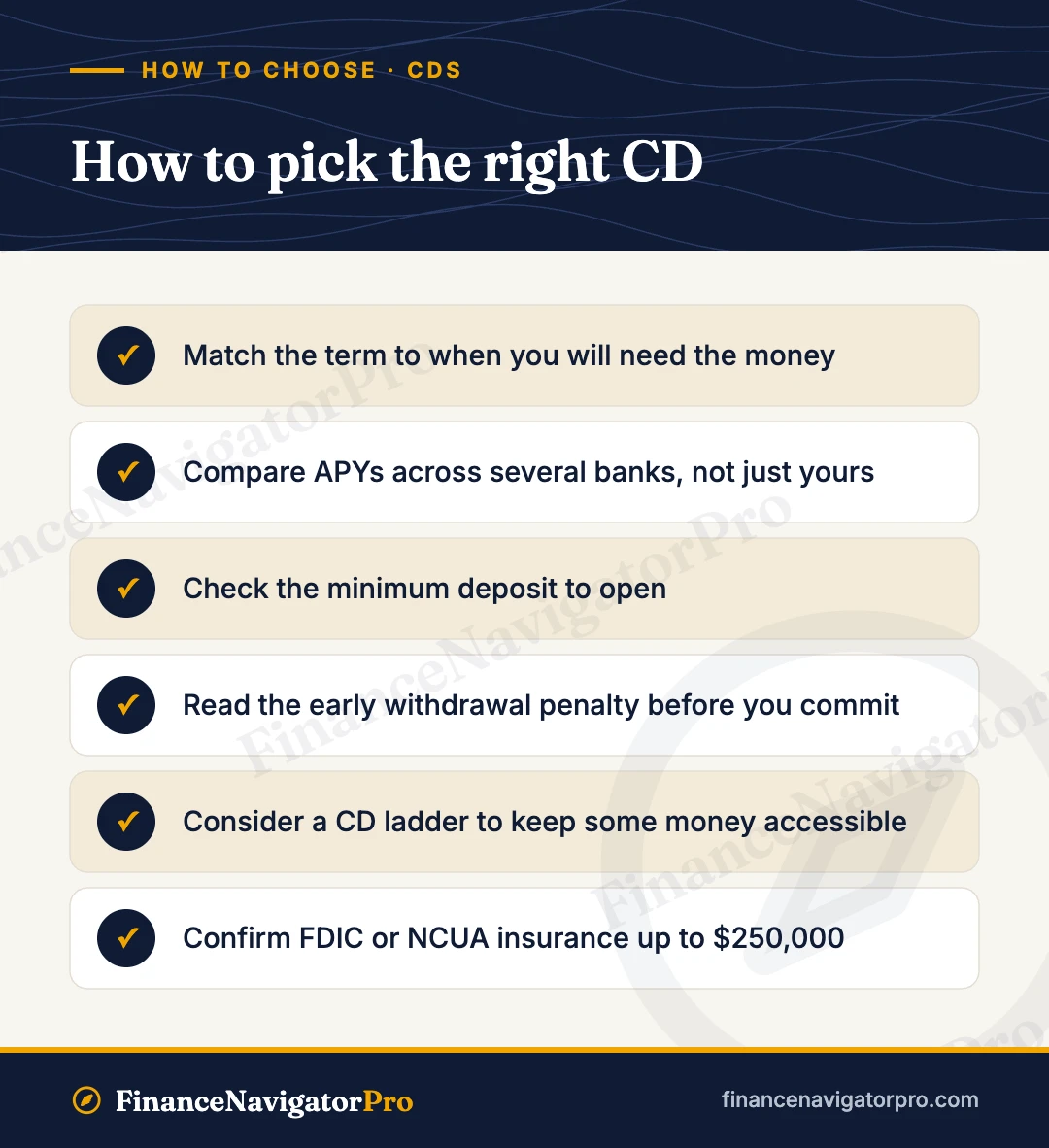
How to choose a CD
Match the term to your goal
Pick a term that ends when you need the money. A house fund for next year fits a one-year CD; money you will not touch for five years can earn more in a longer term.
Compare APYs across banks
Online banks and credit unions usually pay far more than big branch banks. Compare a few before you buy.
Read the early withdrawal penalty
Penalties are usually a set number of months’ interest and vary widely. A no-penalty CD gives flexibility at a slightly lower rate.
Consider a CD ladder
Splitting money across several terms means part of your savings matures each year, so you keep access while earning higher long-term rates. Learn how to build a CD ladder.
Plan for maturity
Many CDs automatically renew at the current rate. Set a reminder before the grace period ends so you can move or reinvest the money.
CDs vs. high-yield savings
A CD locks your rate, while a high-yield savings rate can change at any time. Savings accounts let you withdraw any time without penalty, making them better for emergency funds. Compare both in CD vs. savings account and see the best high-yield savings accounts.
How we chose
We compared widely available, FDIC-insured CDs using published rates and terms as of November 2026. We did not accept payment for placement.
- Top APY and the term required to earn it
- Minimum deposit
- Early withdrawal penalties
- Range of terms and CD types
Run your numbers
- See what a CD will earn with the savings calculator or compound interest calculator.
- Compare with a savings account using the high-yield savings calculator.
- Plan your target with the savings goal calculator.
Frequently asked questions
Are CDs safe?
Yes. CDs at FDIC-insured banks or NCUA-insured credit unions are generally protected up to $250,000 per depositor, per institution, for each ownership category.
Is CD interest taxable?
Yes. CD interest is taxed as ordinary income in the year it is credited, even if you do not withdraw it. See taxes on savings account interest.
What happens if I withdraw early?
You usually pay a penalty equal to a set amount of interest, which can reduce your principal if you withdraw very early.
Should I choose a CD or Treasury bills?
Both are low-risk. Treasury bill interest is exempt from state and local income tax, which can help in high-tax states. See our guide to Treasury bills.
Bottom line
Sallie Mae Bank stands out for long terms, Bread Savings for an 18-month goal, Barclays for no minimum, Marcus for a short term with a no-penalty option and Capital One 360 for branch access. Choose a term that matches when you need the money, and confirm today’s rate before you open a CD.
Keep reading