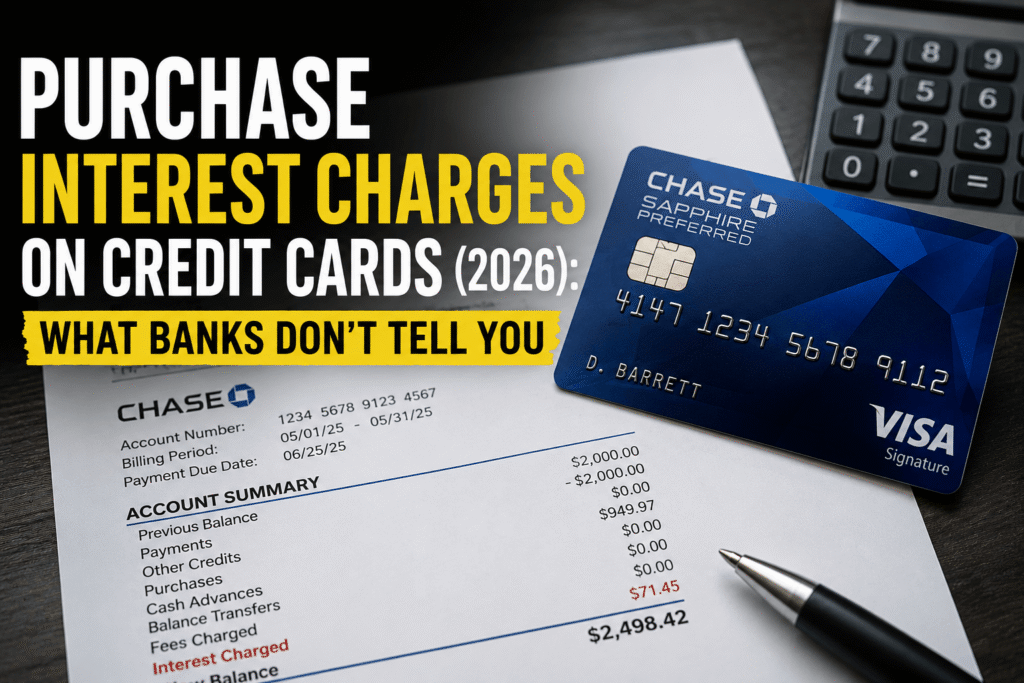
A purchase interest charge is the fee your credit card issuer adds to your balance when you don’t pay your full statement balance by the due date. Interest is calculated using your card’s Annual Percentage Rate (APR), divided into a daily rate, and applied to your unpaid balance every single day. The best way to avoid it entirely? Pay your full statement balance — not just the minimum — before each due date.
- → Purchase interest charges apply when you carry a balance past your due date.
- → Interest compounds daily — small balances grow faster than most people expect.
- → The grace period (usually 21–25 days) only protects you if you paid the previous balance in full.
- → Even one missed full payment can eliminate your grace period for the next billing cycle.
- → Minimum payments are designed to keep you in debt longer — they barely cover interest.
- → You can stop paying interest by paying your full statement balance every month.
- → APR types differ: Purchase APR, Cash Advance APR, and Penalty APR all work differently.
- → Free tools like budgeting apps and autopay settings make staying interest-free much easier.
What Are Purchase Interest Charges?
Let’s start simple. When you swipe your credit card at the grocery store, at Amazon, or anywhere else, you’re borrowing money from your card issuer. That’s the whole premise of a credit card — it’s a short-term loan for every purchase you make.
If you pay back every dollar you borrowed by your due date, the card issuer doesn’t charge you anything extra. That’s the deal. But if you don’t pay the full balance? They start charging you interest on what you owe. That interest charge is called a purchase interest charge — and it’s how credit card companies make billions of dollars every year.
Here’s the thing most people don’t realize: it’s not a flat fee. It’s a percentage-based charge that compounds daily. That means the longer you wait, and the bigger the balance, the more it costs you.
How Is the Interest Rate Set?
Your card’s purchase interest rate is expressed as an APR — Annual Percentage Rate. You’ll find it in your card agreement and on your monthly statement. The average credit card APR in 2026 sits around 21–24%, but it varies widely depending on your credit score, the card type, and the issuer’s policies.
A higher credit score generally means a lower APR. A rewards card or travel card often carries a higher APR than a basic no-frills card. And if you’ve missed payments or your credit profile changed, the issuer can sometimes raise your rate — that’s the Penalty APR, which we’ll cover later.
The CFPB requires card issuers to clearly disclose your APR in your card agreement and on every statement. You can review federal disclosure requirements at the Consumer Financial Protection Bureau website.
How Credit Card Interest Actually Works
Here’s where it gets interesting — and where most people have a fuzzy understanding of what’s really happening.
APR vs. Daily Periodic Rate
Your APR is the annual rate, but credit card interest isn’t charged once a year. It’s charged every single day. To get from APR to what you’re actually paying each day, the bank divides your APR by 365.
So if your APR is 22%, your Daily Periodic Rate (DPR) is: 22% ÷ 365 = 0.0603% per day
That sounds tiny. And on any given day, it is. But it adds up quickly.
Daily Compounding — A Simple Example
Let’s say you carry a $1,000 balance. Here’s what happens:
- Day 1: $1,000 × 0.0603% = $0.60 in interest added
- Day 2: $1,000.60 × 0.0603% = $0.603 added
- Day 3: $1,000.60 + $0.603 = $1,001.20 × 0.0603% …
Each day, interest is added to the principal, and then the next day’s interest is calculated on that larger amount. That’s compounding. After 30 days with no payments, that $1,000 becomes roughly $1,018. After 12 months? You’ve paid about $220 in interest on a balance you never grew — just by not paying it off.
And that’s assuming you made no new purchases, which most people do.
Average Daily Balance Method
Most card issuers calculate your interest using the Average Daily Balance method. Here’s how it works: they add up your balance for every single day in the billing cycle, then divide by the number of days. That number is your average daily balance, and that’s what they apply the DPR to.
If you made a big purchase on Day 1 of the cycle and paid some of it mid-cycle, your average daily balance will reflect both — which can actually reduce your interest charge slightly if you’re paying down the balance during the month.
You carry a $1,500 balance at 22% APR for a 30-day billing cycle.
Daily Periodic Rate: 22% ÷ 365 = 0.0603%
Monthly interest: $1,500 × 0.0603% × 30 = $27.14
That’s $27 for doing nothing. If you do that for 12 months, it’s $325+ in interest on a balance you never added to. Now scale that to the average American household credit card balance of around $6,000 — and you’re looking at $1,300+ a year in pure interest.
When You Actually Get Charged Interest (This Is Where People Mess Up)
Honestly, this is the section most people need to read twice. Because the rules around when interest kicks in are more nuanced than most people think.
Sarah uses her credit card for everything — groceries, gas, subscriptions. She’s great about paying her bill, but last November she was a little short on cash and paid $800 of her $1,100 balance instead of the full amount. No big deal, right? Wrong.
Here’s what happened: by paying less than the full balance, Sarah lost her grace period. The remaining $300 started accruing interest immediately. But so did every new purchase she made in the next billing cycle. That new tank of gas? Interest from Day 1. Those groceries? Interest from Day 1.
Two months later, she noticed her interest charges were higher than expected and couldn’t figure out why. The answer? One partial payment, one lost grace period.
Marcus carries a $3,200 balance on a card with a 24% APR. His minimum payment is $64 — about 2% of the balance. He pays it every month, on time, and thinks he’s doing fine.
But here’s the math: at minimum payments only, it will take Marcus over 14 years to pay off that $3,200. And by the time he’s done, he’ll have paid over $3,800 in interest — more than the original balance. The minimum payment isn’t designed to help you get out of debt. It’s designed to keep you in it.
Jessica paid her credit card balance in full — or so she thought. She paid the amount shown on her statement. But she’d also made a few purchases after the statement closed, and those didn’t show up on that statement. They appeared on the next one.
Because she had a balance (the new purchases) when the due date came, and she didn’t pay the full current balance, she lost her grace period. She was charged interest — even though she’d technically paid everything she owed at the time. This is the statement balance vs. current balance confusion that trips up a lot of people.
What Is a Grace Period — And How You Lose It
The grace period is honestly one of the greatest features of credit cards that nobody talks about enough. Here’s the deal: when you use your credit card, you’re borrowing money. But if you pay back the full balance by your due date, the issuer charges you zero interest. That window between your statement closing date and your due date is the grace period.
By law (under the CARD Act of 2009), if your card has a grace period, it must be at least 21 days from when your statement is sent. Most cards offer 21 to 25 days.
How the Grace Period Works in Practice
Your billing cycle closes on, say, the 15th of each month. Your statement is generated, showing everything you bought that cycle. Your due date is set for the 10th of the following month — that’s about 25 days later. If you pay your full statement balance by that due date, you owe zero interest on those purchases.
That’s the grace period working perfectly. You essentially borrowed money interest-free for an entire billing cycle plus 25 days.
How You Lose It
Here’s the catch most people don’t know: the grace period only applies if you paid your previous statement’s balance in full. The moment you carry a balance into the next cycle, your grace period disappears. New purchases start accruing interest from the date of purchase — not from the statement date.
Let’s say you miss the full payment just once. Here’s what happens:
- Month 1: You pay less than the full balance. Grace period is gone.
- Month 2: All new purchases start accruing interest immediately. There’s no free window.
- Month 3 and beyond: Until you pay off the entire balance in full AND complete one full billing cycle, the grace period doesn’t come back.
So it can take two to three billing cycles to fully restore your grace period after even one partial payment. Most people have no idea how long it takes to get back to ‘free money territory.’
When There Is No Grace Period
Some card types don’t have a grace period at all. Cash advances — when you use your credit card to withdraw cash — typically start accruing interest the moment the transaction happens. Same for balance transfers, depending on the promotional terms. Always check your card agreement for details specific to your card.
Why Minimum Payments Cost You So Much More
Let’s talk about the psychology of minimum payments for a second, because I think it’s important.
Credit card statements are designed to make the minimum payment feel like the ‘normal’ option. It’s listed prominently. It’s the number that keeps your account in good standing. And for a lot of people, especially when money is tight, it feels like a responsible choice.
But here’s what’s really happening: the minimum payment is usually 1–2% of your balance or $25, whichever is greater. That barely covers the interest charges — and sometimes it doesn’t even do that. Your actual balance barely moves.
The Real Cost of Minimum Payments
Take a $5,000 balance at 22% APR. If you pay only the minimum (2% of balance, minimum $25):
| Minimum Payments Only | Fixed $200/month | |
|---|---|---|
| Time to pay off | ~27 years | ~30 months (2.5 years) |
| Total interest paid | ~$9,400 | ~$981 |
| Total amount paid | $14,400+ | You save ~$8,400 |
You can run your own numbers using the CFPB’s Credit Card Payoff Calculator or any reputable payoff calculator to see the difference.
The Behavioral Trap
There’s also a psychological angle worth understanding. When you make a minimum payment, your brain registers it as ‘bill paid, task done.’ You feel okay about it. You move on. You don’t think about the interest that just got added to your balance.
It doesn’t feel expensive in the moment. But interest is silent — it accumulates in the background while you’re living your life, and by the time it gets your attention, it’s already cost you hundreds or thousands of dollars.
Common Mistakes That Trigger Purchase Interest Charges
Most people don’t end up paying interest because they’re irresponsible — they end up paying it because of misunderstandings. Here are the most common ones:
APR Types Compared: Purchase, Cash Advance, and Penalty
Not all APRs on your card are the same. Most cards have multiple rates that apply in different situations. Here’s how they compare:
| Feature | Purchase APR | Cash Advance APR | Penalty APR |
|---|---|---|---|
| When It Applies | When you carry a purchase balance past the due date | Immediately when you withdraw cash or use convenience checks | After a late payment or returned payment |
| Typical Rate (2026) | 18% – 29.99% | 25% – 31% | Up to 29.99% |
| Grace Period? | Yes — if you paid in full last cycle | No — interest starts immediately | No — applies to existing and new balances |
| How to Avoid | Pay full balance by due date every cycle | Avoid cash advances entirely; use debit or emergency fund instead | Pay on time and in full; restore good standing over 6 months |
| On Your Statement? | Yes — listed as ‘Purchase APR’ | Yes — separate rate disclosed | Yes — disclosed with notice period |
The cash advance APR is probably the most dangerous of the three because there’s no grace period at all. If you take out $500 from an ATM with your credit card at 30% APR, interest starts that same day. By the time your statement comes, you’ve already accrued charges — even if you pay it off ‘on time.’
What Happens If… (Edge Cases Explained)
Here are the ‘what if’ questions people actually Google — and the real answers:
What Happens If I Make a Late Payment?
A few things happen at once. First, you’ll likely be hit with a late fee — up to $30 for a first offense, up to $41 for subsequent late payments. Second, you lose your grace period going forward. Third, and most seriously, you may trigger a Penalty APR. Under the CARD Act, issuers can only apply the Penalty APR to new transactions, but if it was already in your agreement as a possible rate, they’ll apply it going forward. One late payment can also ding your credit score, especially if it’s more than 30 days late and gets reported to the credit bureaus.
What Happens If I Pay Partial (But More Than Minimum)?
Better than minimum, but the grace period still disappears. Any amount less than the full statement balance triggers interest on the unpaid portion — and on new purchases made after the statement closed. The more you pay, the lower your average daily balance, so you’ll owe less interest — but it won’t be zero.
What Happens If I Make a New Purchase While Carrying a Balance?
That new purchase starts accruing interest immediately, from the transaction date. There’s no grace period for new purchases when you’re carrying a balance. This is one of the biggest hidden costs of the ‘I’ll pay it off eventually’ mindset.
What Happens If I Ignore My Statement?
Besides the obvious late fees and credit score damage, ignoring statements long enough can result in your account being sent to collections, a charge-off on your credit report, and potential legal action. None of these are reversible quickly.
What If My APR Changes?
Card issuers must give you 45 days’ notice before raising your APR on future transactions. You have the right to opt out — though opting out means the issuer may close your account (you’d still pay off the balance at the old rate). Any APR increase can only apply to new balances, not the existing balance you already carry.
The Psychological Side of Credit Card Interest
Let’s be real for a second — credit cards are engineered to make spending feel painless and make debt feel manageable. Tap-to-pay means you never hand over cash. Minimum payments look small. Due dates feel far away.
The disconnect between spending and cost is intentional. When you pay cash, the pain of loss is immediate. With a credit card, it’s deferred — sometimes by months or years. Research in behavioral economics has shown that people consistently underestimate how much they’ll spend when using credit vs. cash.
And here’s the thing about interest: it doesn’t feel expensive on any given day. $0.60 added to your balance? Whatever. But $0.60 a day is $219 a year. On a bigger balance, it’s a house payment. The ‘it’s not that much’ feeling is exactly what makes it so costly over time.
Once you understand this psychological trap, you can set up systems to avoid it entirely — which is what the next section is all about.
How to Avoid Purchase Interest Charges Completely
Good news: avoiding purchase interest is actually one of the simpler personal finance goals out there. You don’t need a financial advisor, a spreadsheet, or a major lifestyle change. You just need a few solid habits.
Pay Your Full Statement Balance Every Month
This is the golden rule. Not the minimum. Not ‘most of it.’ The full statement balance. If you do this consistently, you’ll never pay a single dollar in purchase interest — and the credit card essentially becomes a free short-term loan plus rewards.
Set Up Autopay for the Full Balance
This is probably the single most powerful change you can make. Set autopay to cover your full statement balance, not just the minimum. Your bank automatically pays the right amount on the due date, every month, without you having to think about it.
Most major banks and credit unions allow this. Log into your card’s online account, navigate to payment settings, and select ‘Statement Balance’ for autopay. The Federal Reserve’s guide on autopay and credit cards has useful background on using automated payments to stay on track.
One caveat: make sure your checking account has enough funds to cover the balance when it auto-drafts. An overdraft can create its own set of fees.
Know Your Statement Closing Date
Your statement closes on the same day each month. After that date, a new billing cycle begins. Any purchases made after your statement closes will appear on the next statement — not the current one. This is useful to know: if you’re about to make a big purchase and you’re close to your statement close date, waiting a few days means you get almost an extra month before that balance is due.
Don’t Confuse Statement Balance and Current Balance
When you log into your app to make a payment, you may see two numbers: your statement balance (what you owe from the last closed cycle) and your current balance (what you owe including all recent charges). For most people, paying the statement balance is the right move — but if you made significant purchases after the statement closed and want to stay completely ahead, you can pay the current balance.
Use Balance Alerts
Most card apps let you set alerts for when your balance hits a certain threshold, when a payment is due, or when your available credit drops below a certain level. These nudges can keep you from being surprised by a larger-than-expected balance at payment time.
Avoid Cash Advances
There’s almost no scenario where a credit card cash advance makes financial sense. The fees are high (typically 3–5% of the advance), the APR is even higher than your purchase rate, and there’s no grace period. If you need emergency cash, explore personal loans, a line of credit, or even a 0% APR promotional offer instead.
How to Stop Paying Credit Card Interest: Step-by-Step
Tools That Help You Stay Interest-Free
You don’t have to manage this alone. There are some excellent free and low-cost tools that make staying on top of credit card interest genuinely easy.
Budgeting Apps
Apps like Mint (now integrated with Credit Karma), YNAB (You Need A Budget), and PocketGuard help you track exactly how much you’re spending on your credit card in real time. When you can see your running balance throughout the month, you’re less likely to overspend and end up with a balance you can’t pay off.
Credit Monitoring Services
Free credit monitoring tools — like those offered through Credit Karma or your bank — let you track your credit score, see your card balances, and get alerts if anything looks unusual. They keep you informed about your overall credit health, which is closely tied to the APRs you qualify for.
Debt Payoff Calculators
If you’re already carrying a balance, a debt payoff calculator can show you exactly how long it will take to pay off your balance at different payment amounts — and how much interest you’ll save by paying more each month.
Bank-Native Autopay
Don’t overlook your card issuer’s own app or website. Most major issuers now offer autopay settings, balance alerts, spending summaries, and payment scheduling directly in the app. Set your autopay once, and let the system handle the rest.
Rate Negotiation
If you have a good payment history, it’s worth calling your card issuer and asking for a lower APR. Studies show that a significant percentage of cardholders who ask for a lower rate receive one. It takes five minutes and could save you hundreds of dollars in interest.
Frequently Asked Questions
Final Thoughts
Here’s the takeaway I want you to leave with: credit cards aren’t expensive. Carrying a balance is.
The interest system is designed to be invisible until it isn’t. One missed full payment. One month of minimum payments. One ‘I’ll pay it next month’ decision. That’s all it takes to slip into a cycle where you’re paying hundreds of dollars a year for the privilege of spending money you already spent.
But once you understand how it works — grace periods, daily compounding, the difference between statement and current balance — you can use credit cards entirely to your advantage. Cash back, travel rewards, fraud protection, purchase guarantees. All the benefits, none of the interest.
The system that costs uninformed consumers billions every year? It can work completely in your favor. You just have to know the rules.
Pay your full statement balance.
Set it on autopay. Check your due dates.
That’s it. That’s the whole strategy.
Disclaimer: This article is for informational purposes only and does not constitute financial or legal advice. Credit card terms vary by issuer and individual account. Always review your card’s terms and conditions and consult a qualified financial advisor for personalized guidance. APR ranges and fee amounts cited reflect typical 2026 market conditions and may vary.