On this page
If you have several debts, the order you pay them off matters. The debt snowball and debt avalanche are the two most popular payoff methods. One is built for motivation and the other for saving money. Here is how each works, with an example, so you can pick the plan you will actually stick with.
How both methods start
Both methods follow the same basic rules:
- List every debt with its balance, interest rate and minimum payment.
- Pay the minimum on every debt so you stay current.
- Put every extra dollar toward one target debt.
- When that debt is paid off, roll its full payment into the next target.
The only difference is which debt you target first.
The debt snowball
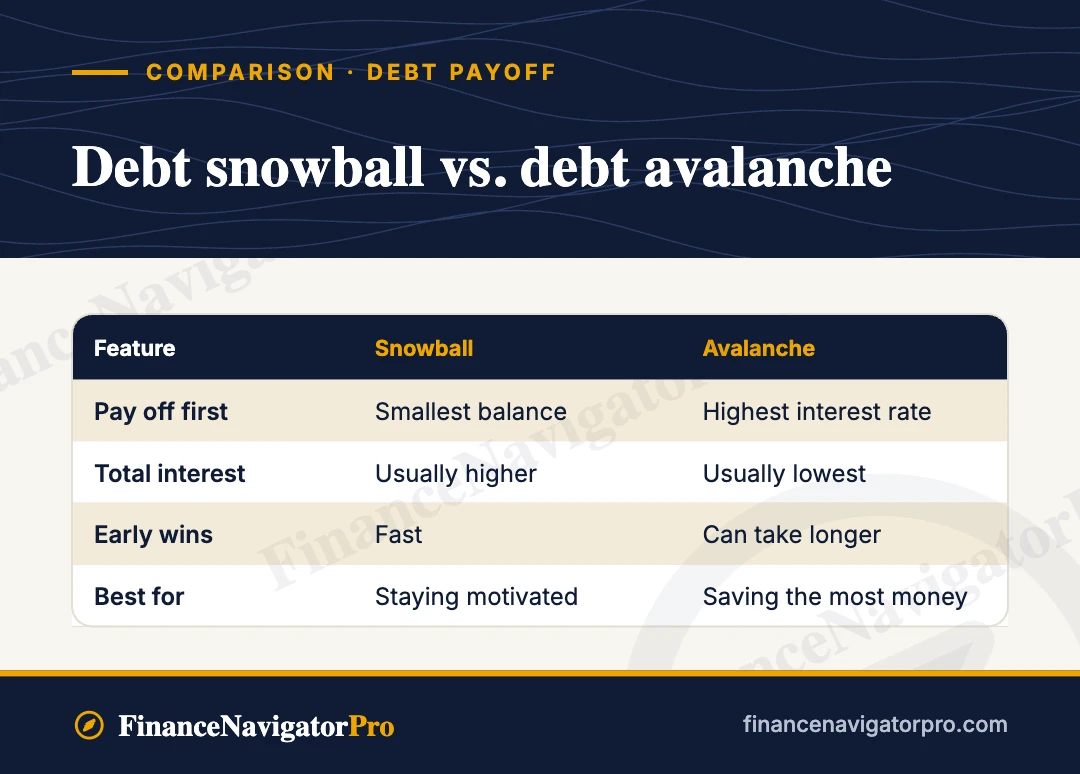
With the snowball, you pay off the smallest balance first, regardless of interest rate. Each payoff frees up cash for the next debt, so your payment “snowballs” as you go.
Pros
- Quick wins build motivation and confidence.
- Fewer accounts to manage sooner.
- Simple to follow.
Cons
- Usually costs more in total interest.
- Can take longer if a large debt has a high rate.
The debt avalanche
With the avalanche, you pay off the highest interest rate first. Because you attack the most expensive debt first, you pay less interest overall and often finish sooner.
Pros
- Usually saves the most money in interest.
- Often the fastest route to debt-free.
- Mathematically the most efficient method.
Cons
- The first payoff can take a long time if your highest-rate debt is large.
- Slower early wins can make it harder to stay motivated.
An example
| Debt | Balance | Interest rate |
|---|---|---|
| Store card | $800 | 27% |
| Credit card | $5,000 | 22% |
| Personal loan | $3,000 | 12% |
| Car loan | $9,000 | 7% |
Snowball order: store card ($800), personal loan ($3,000), credit card ($5,000), car loan ($9,000).
Avalanche order: store card (27%), credit card (22%), personal loan (12%), car loan (7%).
Both plans knock out the store card first. After that, the avalanche goes after the 22% credit card while the snowball pays off the cheaper 12% loan, so the avalanche saves more interest. Run your own debts through the debt snowball calculator and the debt avalanche calculator to see the exact difference.
Which method should you choose?
Choose the avalanche if:
- You are motivated by saving money and can stay disciplined.
- Your highest-rate debts are also among your larger balances.
- The interest rate gap between your debts is wide.
Choose the snowball if:
- You have tried to pay off debt before and lost motivation.
- You have several small balances you can clear quickly.
- Your interest rates are fairly similar.
The best method is the one you will finish. A hybrid works too: clear one or two tiny balances for momentum, then switch to the avalanche.
Ways to speed up either plan
- Find extra money: trim subscriptions, sell unused items or put windfalls toward your target debt. A budget planner can help.
- Lower your rates: a 0% balance transfer card or a debt consolidation loan can cut interest while you pay down balances. Homeowners can also compare a HELOC or home equity loan, though that puts your home on the line.
- Stop adding new debt: pause card use while you follow your plan. Read how to avoid credit card debt.
- Track progress: the best debt payoff apps can automate either method.
Run your numbers
- See your timeline with the debt payoff calculator.
- Compare methods with the snowball and avalanche calculators.
- See what minimum payments really cost with the minimum payment calculator.
Frequently asked questions
Which method is faster?
The avalanche is usually faster and cheaper because it reduces interest costs. The snowball can feel faster because you pay off individual debts sooner.
Should I include my mortgage?
Most people leave the mortgage out and focus on consumer debts like credit cards, personal loans and car loans.
Should I stop saving while I pay off debt?
Keep at least a small emergency fund so a surprise expense does not send you back into debt, and keep getting any 401(k) employer match.
Does paying off debt raise my credit score?
Paying down credit card balances lowers your utilization, which often helps your score. See how credit utilization works.
Comparing more options? See all six strategies in how to pay off credit card debt.
Bottom line
The avalanche saves the most money, and the snowball builds momentum with quick wins. Pick the one that fits your personality, automate your payments and keep rolling each freed-up payment into the next debt until you are debt-free.
Keep reading