
On this page
If you are paying 20% or more on a credit card balance, a balance transfer card can pause the interest for well over a year so every payment goes toward what you owe. We compared five no-annual-fee cards with long 0% intro APR periods, and explain how to pick one and avoid the traps.
Disclosure: Some links may earn us a commission at no cost to you. It never affects our rankings. See our affiliate disclaimer.
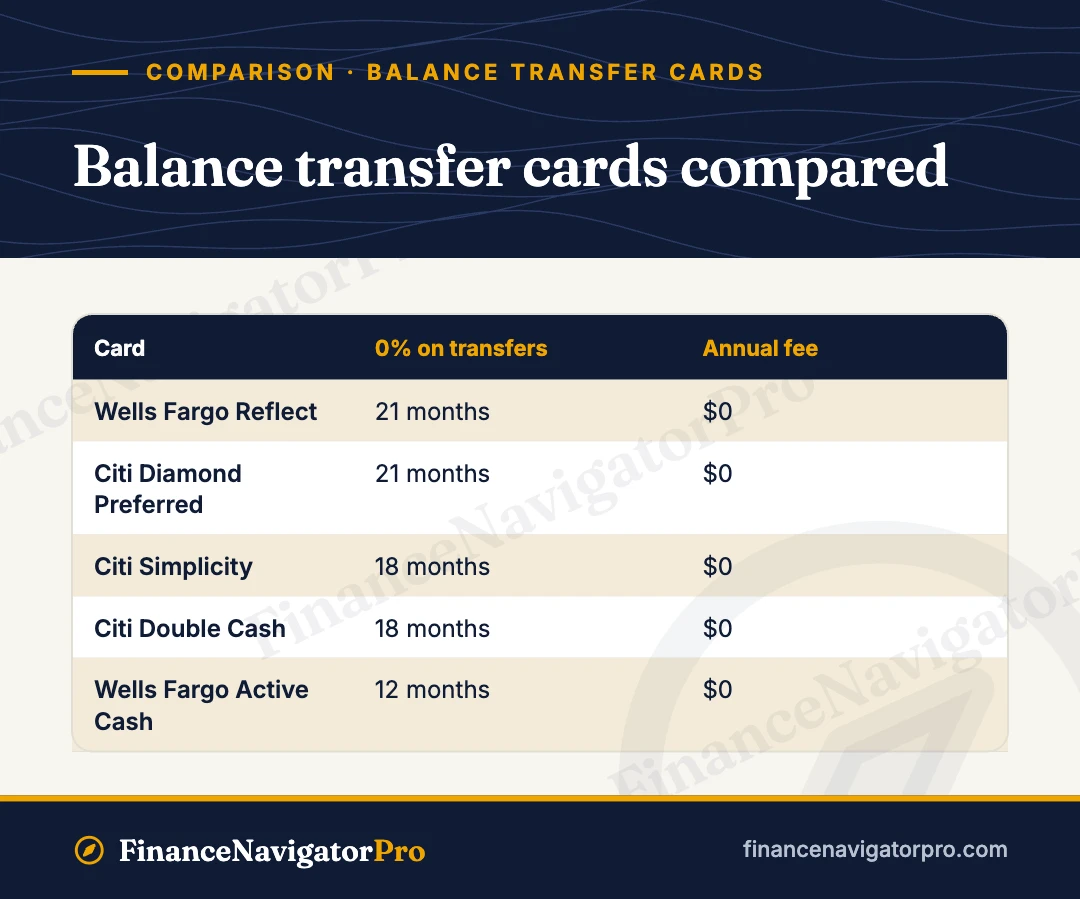
Our top picks at a glance
- Best for transfers and new purchases: Wells Fargo Reflect Card — 0% intro APR for 21 months on both.
- Best for a low intro transfer fee: Citi Diamond Preferred Card — 21 months on transfers and four months to move your balance.
- Best for forgiving terms: Citi Simplicity Card — no late fees and no penalty APR.
- Best for earning rewards after payoff: Citi Double Cash Card — 18 months on transfers, then 2% cash back.
- Best all-in-one card: Wells Fargo Active Cash Card — 2% cash rewards and a reduced intro transfer fee.
Intro offers change often, and approval and your credit limit depend on your credit. Pricing and features checked November 2026; confirm on the provider’s site before signing up.
| Card | Best for | 0% intro on transfers | 0% intro on purchases | Annual fee |
|---|---|---|---|---|
| Wells Fargo Reflect | Transfers and purchases | 21 months | 21 months | $0 |
| Citi Diamond Preferred | Low intro transfer fee | 21 months | 12 months | $0 |
| Citi Simplicity | Forgiving terms | 18 months | 18 months | $0 |
| Citi Double Cash | Rewards after payoff | 18 months | None | $0 |
| Wells Fargo Active Cash | All-in-one | 12 months | 12 months | $0 |
1. Wells Fargo Reflect Card — Best for transfers and new purchases
The Wells Fargo Reflect Card offers one of the longest 0% intro APR periods available: 21 months from account opening on both purchases and qualifying balance transfers. Transfers must be made within 120 days of opening the account to get the intro rate. The card has no rewards, which keeps the focus on paying down debt.
Pros
- 21 months of 0% intro APR on purchases and balance transfers
- 120 days to complete your transfers
- No annual fee
Cons
- Balance transfer fee of 5% (minimum $5)
- No rewards program
Price: $0 annual fee. Balance transfer fee of 5%, minimum $5. A variable APR applies after the intro period.
Who it’s for: People who need the longest runway and also have a large upcoming purchase to spread out.
2. Citi Diamond Preferred Card — Best for a low intro transfer fee
The Citi Diamond Preferred Card gives you 0% intro APR on balance transfers for 21 months and on purchases for 12 months. Citi advertises a low intro balance transfer fee for transfers completed in the first four months, which can save real money on a large balance compared with a standard 5% fee.
Pros
- 21 months of 0% intro APR on balance transfers
- Reduced intro transfer fee for transfers in the first four months
- Free access to your FICO score
- No annual fee
Cons
- Shorter 12-month intro period on purchases
- No rewards
- You cannot transfer balances from other Citi cards
Price: $0 annual fee. Check Citi’s current terms for the intro and standard transfer fee.
Who it’s for: Anyone moving a large balance who wants to keep the upfront fee as low as possible.
3. Citi Simplicity Card — Best for forgiving terms
The Citi Simplicity Card offers 0% intro APR for 18 months on both purchases and balance transfers. Its standout feature is forgiveness: it charges no late fees and has no penalty APR, so one missed payment will not suddenly raise your rate.
Pros
- 18 months of 0% intro APR on purchases and transfers
- No late fees and no penalty APR
- No annual fee
Cons
- Shorter intro period than the Reflect or Diamond Preferred
- No rewards
Price: $0 annual fee. A balance transfer fee applies; check Citi’s current terms.
Who it’s for: People who worry about slipping up on a payment while they pay off debt.
4. Citi Double Cash Card — Best for earning rewards after payoff
The Citi Double Cash Card pairs an 18-month 0% intro APR on balance transfers with a strong long-term rewards rate: 2% cash back on purchases, 1% when you buy and 1% as you pay. Once your transferred balance is gone, you keep a useful everyday card instead of one you put in a drawer.
Pros
- 18 months of 0% intro APR on balance transfers
- Earn 2% cash back on purchases (1% when you buy, 1% when you pay)
- Welcome bonus of $200 cash back after you spend $1,500 in the first six months
- No annual fee
Cons
- No intro APR on new purchases
- Balance transfer fee applies
Price: $0 annual fee. A balance transfer fee applies; check Citi’s current terms.
Who it’s for: People who want to clear debt now and keep a strong cash back card afterward.
5. Wells Fargo Active Cash Card — Best all-in-one card
The Wells Fargo Active Cash Card earns unlimited 2% cash rewards on purchases and offers 0% intro APR for 12 months on purchases and qualifying balance transfers. Its intro transfer fee is 3% for the first 120 days, then up to 5%, which keeps the upfront cost down if you move quickly.
Pros
- Unlimited 2% cash rewards on purchases
- $200 cash rewards bonus after spending $500 in the first three months
- 3% intro balance transfer fee for 120 days
- No annual fee
Cons
- 12-month intro period is short for large balances
- Foreign transaction fees
Price: $0 annual fee. Balance transfer fee of 3% intro for 120 days, then up to 5% (minimum $5).
Who it’s for: People with a smaller balance they can clear within a year who want one card for everything.
How to choose a balance transfer card
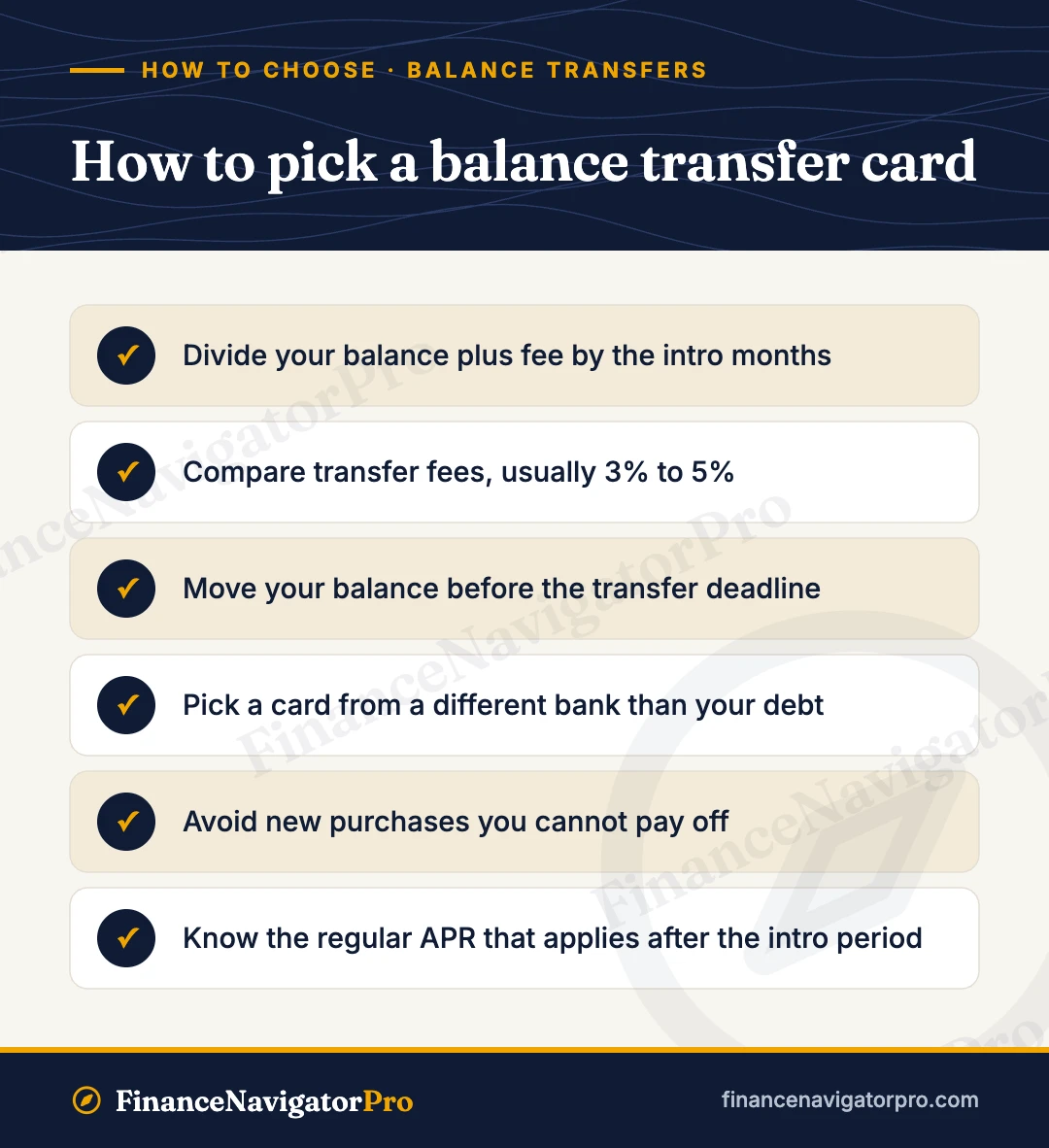
Match the intro period to your payoff plan
Divide your balance (plus the fee) by the number of intro months. If you cannot afford that monthly payment, choose a longer intro period. Our balance transfer calculator does this for you.
Factor in the transfer fee
Most cards charge 3% to 5% of the amount you move. On a $6,000 balance, that is $180 to $300 upfront, which is usually still far less than a year of interest at 20% or more.
Check the transfer deadline
Intro rates usually apply only to transfers made within a set window, such as 120 days or four months from account opening.
Use a different bank
You generally cannot transfer a balance between two cards from the same issuer, so pick a card from a different bank than the one holding your debt.
Plan for after the intro period
Any balance left when the intro period ends starts accruing interest at the regular variable APR. Avoid new purchases you cannot pay off, and learn how credit card interest works so the end date does not surprise you.
How we chose
We compared no-annual-fee balance transfer cards from major US issuers using the issuers’ published terms and reputable 2026 card reviews. We did not accept payment for placement.
- Length of the 0% intro APR on balance transfers and purchases
- Balance transfer fee and transfer deadline
- Annual fee and penalty terms
- Rewards value after the intro period
Run your numbers first
- See your monthly target with the balance transfer calculator.
- Build a payoff plan with the credit card payoff calculator.
- See what minimum payments really cost with the minimum payment calculator.
- Check how a new card affects your ratio with the credit utilization calculator.
Also read how to avoid credit card debt and why you see purchase interest charges. Want rewards instead? See the best cash back credit cards.
Frequently asked questions
Does a balance transfer hurt my credit score?
Applying for a new card causes a hard inquiry and a small, temporary dip. Over time, paying down the balance and the extra available credit can lower your utilization and help your score. See how credit utilization works.
What credit score do I need?
The best balance transfer cards usually require good to excellent credit, often a score of about 670 or higher.
How long does a balance transfer take?
Transfers often take a few days to two weeks to complete. Keep paying your old card until you confirm the balance has moved.
Can I transfer more than my credit limit?
No. The amount you can move, including the fee, is limited by the credit line on the new card.
What happens if I do not pay it off in time?
The remaining balance begins accruing interest at the card’s regular variable APR once the intro period ends.
Is a balance transfer better than a personal loan?
If you can pay off the balance within the intro period, a transfer card usually costs less. For larger debts that need several years, a fixed-rate loan may fit better. Compare options in our guides to the best personal loans and best debt consolidation loans.
Bottom line
For the longest runway, the Wells Fargo Reflect and Citi Diamond Preferred both offer 21 months of 0% intro APR on transfers. Choose Citi Simplicity if you want protection from late fees, Citi Double Cash to keep earning 2% after payoff, and Wells Fargo Active Cash for a smaller balance you can clear in a year. Whichever you choose, make a payoff plan on day one and stop adding new debt.
Keep reading