On this page
The right cash back card turns spending you already do into real money, often hundreds of dollars a year, with no points to decode. The best choice depends on where your money goes: a flat 2% card wins for simple spenders, while category cards pay more on groceries, dining or rotating bonuses. Here are five strong options and how to match one to your budget.
Disclosure: Some links may earn us a commission at no cost to you. It never affects our rankings. See our affiliate disclaimer.
Our top picks at a glance
- Best flat-rate card: Wells Fargo Active Cash Card — unlimited 2% cash rewards on purchases with no annual fee.
- Best all-around no-fee card: Chase Freedom Unlimited — 1.5% on everything plus bonus rates on dining, drugstores and Chase Travel.
- Best for groceries and families: Blue Cash Preferred Card from American Express — top rate at US supermarkets.
- Best for dining and entertainment: Capital One Savor Cash Rewards — 3% on dining, entertainment, groceries and streaming.
- Best for rotating bonus categories: Chase Freedom Flex — 5% in quarterly categories you activate.
Welcome offers and bonus categories change often. Pricing and features checked November 2026; confirm on the provider’s site before signing up.
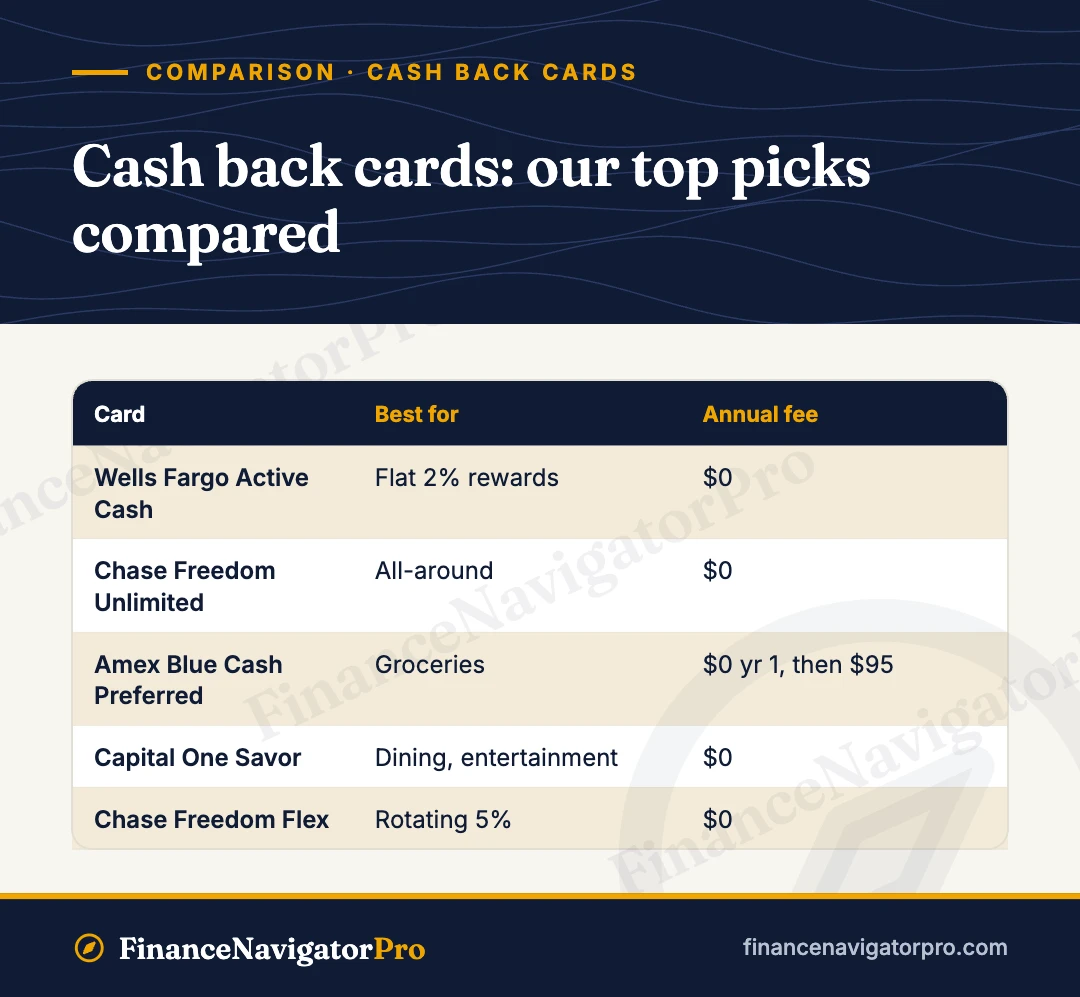
| Card | Best for | Rewards rate | Annual fee |
|---|---|---|---|
| Wells Fargo Active Cash | Flat-rate rewards | 2% on purchases | $0 |
| Chase Freedom Unlimited | All-around | 1.5% to 5% | $0 |
| Amex Blue Cash Preferred | Groceries | 1% to 6% | $0 first year, then $95 |
| Capital One Savor | Dining and entertainment | 1% to 3% (more via Capital One portals) | $0 |
| Chase Freedom Flex | Rotating categories | 1% to 5% | $0 |
1. Wells Fargo Active Cash Card — Best flat-rate card
The Wells Fargo Active Cash Card keeps it simple: unlimited 2% cash rewards on purchases, with no categories to track and no annual fee. It also comes with an easy welcome bonus and a 0% intro APR period, which makes it a strong first rewards card or an everyday catch-all.
Pros
- Unlimited 2% cash rewards on purchases
- $200 cash rewards bonus after you spend $500 in the first three months
- 0% intro APR for 12 months on purchases and qualifying balance transfers
- Cell phone protection when you pay your bill with the card
Cons
- Foreign transaction fees make it a poor choice abroad
- No bonus categories to earn more on big spending areas
Price: $0 annual fee.
Who it’s for: Anyone who wants a high, flat return without thinking about categories.
2. Chase Freedom Unlimited — Best all-around no-fee card
Chase Freedom Unlimited earns 1.5% back on every purchase, with higher rates in common categories: 3% on dining and at drugstores and 5% on travel booked through Chase Travel. If you also hold a Chase Sapphire card, you can combine rewards for more value on travel.
Pros
- 1.5% base rate plus 3% on dining and drugstores
- 5% on travel purchased through Chase Travel
- Welcome bonus for new cardholders
- Pairs well with other Chase cards
Cons
- 1.5% base rate is lower than a flat 2% card
- Foreign transaction fees
Price: $0 annual fee.
Who it’s for: People who eat out often and want a no-fee card that also works for everything else.
3. Blue Cash Preferred Card from American Express — Best for groceries and families
The Blue Cash Preferred Card pays one of the highest grocery rates available: 6% cash back at US supermarkets on up to $6,000 in purchases per year (then 1%). It also earns elevated rewards on select US streaming services, US gas stations and transit. The annual fee is waived for the first year, then $95.
Pros
- 6% cash back at US supermarkets on up to $6,000 a year
- Bonus rewards on select streaming, gas stations and transit
- Welcome offer for new cardholders
Cons
- $95 annual fee after the first year
- Superstores and warehouse clubs generally do not count as supermarkets
- Rewards come as Reward Dollars redeemed as a statement credit
Price: $0 intro annual fee for the first year, then $95.
Who it’s for: Households that spend about $50 or more a week at supermarkets, where the extra rewards easily cover the fee.
4. Capital One Savor Cash Rewards — Best for dining and entertainment
The Capital One Savor Cash Rewards card earns unlimited 3% cash back on dining, entertainment, popular streaming services and grocery stores, plus 1% on everything else. It charges no annual fee and no foreign transaction fees, which is rare for a cash back card.
Pros
- Unlimited 3% on four everyday categories, with no caps
- Higher rates on travel and entertainment booked through Capital One’s portals
- No foreign transaction fees
- Welcome bonus for new cardholders
Cons
- Only 1% on purchases outside its bonus categories
- Grocery rate excludes superstores such as Walmart and Target
Price: $0 annual fee.
Who it’s for: People who spend a lot on restaurants, concerts, streaming and groceries, and travelers who want no foreign fees.
5. Chase Freedom Flex — Best for rotating bonus categories
Chase Freedom Flex earns 5% cash back in quarterly bonus categories on up to $1,500 in combined purchases each quarter you activate, plus 5% on Chase Travel and 3% on dining and drugstores. Everything else earns 1%. It rewards people who are willing to activate categories and shift spending.
Pros
- 5% in rotating quarterly categories when activated
- 3% on dining and drugstores year-round
- Welcome bonus for new cardholders
Cons
- You must activate each quarter, and the 5% rate is capped
- Only 1% on everything else
- Foreign transaction fees
Price: $0 annual fee.
Who it’s for: Organized spenders who like to maximize bonuses, often paired with a flat-rate card.
How to choose a cash back card
Start with your spending
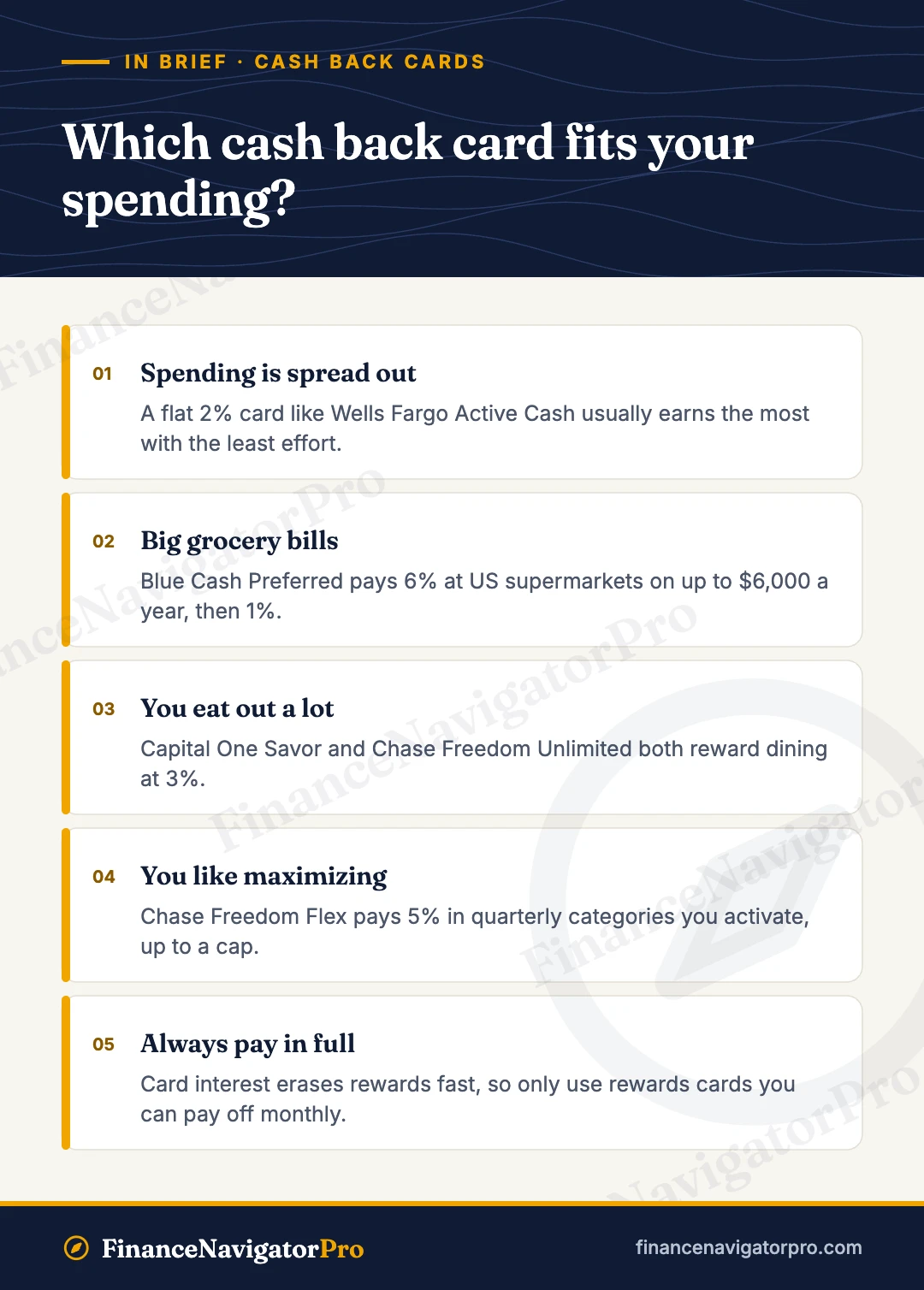
Look at the last three months of statements. If groceries or dining make up a big share, a category card will probably beat a flat 2%. If your spending is spread out, a flat-rate card is simpler and often pays more.
Do the annual fee math
A $95 fee is worth it only if the extra rewards exceed $95 a year. At 6% versus 2% on groceries, you would need to spend about $2,400 a year at supermarkets to break even.
Watch the caps and activation rules
Rotating 5% categories and some grocery bonuses have spending caps. Missing an activation means earning the base rate instead.
Never carry a balance for rewards
Interest at a typical card APR wipes out any cash back. Rewards cards work best when you pay in full every month. Learn how credit card interest works and how credit card rewards programs are structured.
Consider a two-card combo
Many people pair a category card for their biggest spending area with a flat 2% card for everything else. Read how many credit cards you should have before you apply for several.
How we chose
We compared popular cash back cards from major US issuers using the issuers’ published terms and reputable 2026 card reviews. We did not accept payment for placement.
- Base and bonus rewards rates, and any caps
- Annual fee and how much spending it takes to justify it
- Welcome offers and intro APR periods
- Extra costs such as foreign transaction fees
- How easy rewards are to earn and redeem
Run your numbers first
- Map where your money goes with the expense tracker calculator.
- Build a plan with the budget planner.
- See what carrying a balance costs with the credit card interest calculator.
- Keep your ratio healthy with the credit utilization calculator.
Have debt to clear first? See the best balance transfer cards. Still building credit? Start with our picks for fair credit, students or no credit history.
Frequently asked questions
What credit score do I need for a cash back card?
Most of the cards on this list are designed for good to excellent credit, generally a score of about 670 or higher. Check our guide to what counts as a good credit score.
Is cash back taxable?
Cash back earned on purchases is generally treated as a rebate, not income, so it is usually not taxable. Bonuses earned without a purchase requirement can be different.
Is a flat 2% card better than a category card?
It depends on your spending. A flat 2% card is better for spread-out spending, while category cards win when a large share goes to their bonus categories.
Do cash back rewards expire?
With these cards, rewards generally do not expire while your account is open and in good standing, but you may lose them if you close the account. Check each card’s terms.
Will opening a new card hurt my credit?
A new application causes a hard inquiry and lowers your average account age slightly. The effect is usually small and fades over time if you pay on time.
Prefer points and miles for trips? Compare the best travel credit cards.
Want to avoid fees entirely? See the best no annual fee credit cards.
Bottom line
For most people, the Wells Fargo Active Cash Card is the easiest way to earn a strong return. Choose Chase Freedom Unlimited for dining and a Chase ecosystem, the Blue Cash Preferred if groceries dominate your budget, Capital One Savor for going out and travel without foreign fees, and Chase Freedom Flex if you enjoy maximizing rotating categories. Pay your balance in full each month and the rewards are pure profit.
Keep reading