DISCLAIMER: The information in this article is for educational purposes only and does not constitute financial or insurance advice. Rates are estimates based on industry data. Always consult a licensed insurance professional for personalized quotes.
Quick Answer: What Does Renters Insurance Cost in 2026?
The national average cost of renters insurance in 2026 is roughly $14 to $18 per month — that works out to about $168 to $216 per year. But here’s the thing: your actual rate could land anywhere from $9 a month (if you’re in a low-risk Midwestern state) to $30+ a month (hello, Florida). Your location, the amount of coverage you choose, your deductible, and even your credit score all play a role.
Bottom line? Renters insurance is one of the most affordable insurance products on the market. A decent policy costs less than a Netflix subscription — and it protects thousands of dollars’ worth of your belongings.
What Is the Average Cost of Renters Insurance in 2026?
Let’s get right to the numbers. According to industry data aggregated from major U.S. insurers, the average renter in 2026 pays somewhere between $14 and $18 per month for a standard policy. That’s roughly $168 to $216 annually.
But “average” can be a little misleading here. If you live in a low-risk state with minimal weather events and a solid credit score, you might pay as little as $9–$11 a month. If you’re renting an apartment in Miami or Los Angeles — two of the most expensive cities for renters — you could easily pay $25–$35 a month or more.
Here’s a quick snapshot of the national picture:
| Metric | 2026 Estimate |
|---|---|
| National Avg (Monthly) | $14 – $18 |
| National Avg (Annual) | $168 – $216 |
| Cheapest State (ND/SD) | ~$10/month |
| Most Expensive State (FL) | ~$19–$25/month |
| Typical Coverage Amount | $30K property / $100K liability |
One thing worth noting: renters insurance rates rose modestly between 2023 and 2026, driven by broader inflation in the insurance industry, increased catastrophic weather events, and higher repair costs. Even so, renters insurance remains significantly cheaper than homeowners insurance, which averages over $150 a month nationally.
The standard renters policy includes three core types of protection: personal property coverage (your stuff), liability coverage (if someone gets hurt), and additional living expenses (ALE) coverage (hotel bills if your place becomes uninhabitable). The prices above reflect a typical policy with $30,000 in personal property coverage, $100,000 in liability, and a $500–$1,000 deductible.
Average Renters Insurance Cost by State in 2026
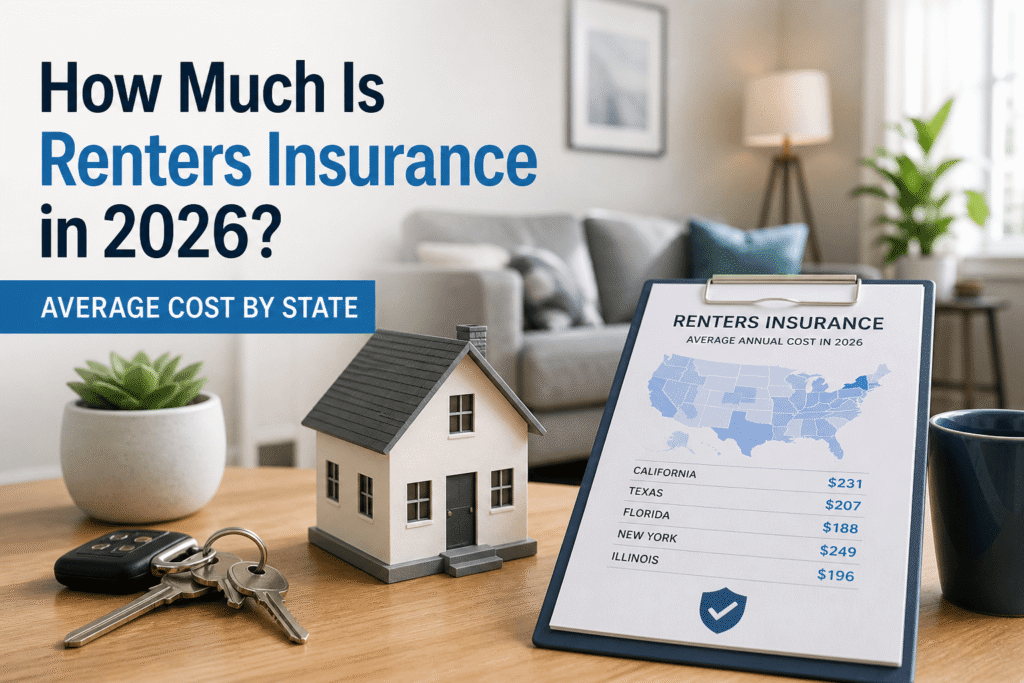
Where you live is the single biggest factor affecting your premium. Insurers price risk, and risk varies wildly from state to state based on natural disasters, crime rates, population density, and local construction costs. Here’s a comprehensive look at estimated monthly costs across the U.S.:
| State | Avg/Month | Avg/Year | Risk Level | Key Factor |
|---|---|---|---|---|
| Florida | $19/mo | $228/yr | High | Hurricane capital — most expensive state |
| Oklahoma | $9/mo | $108/yr | High | Tornado Alley — highest risk in nation |
| Louisiana | $11/mo | $132/yr | High | Hurricane & flooding exposure |
| Mississippi | $10/mo | $120/yr | High | Severe weather, high crime rates |
| Texas | $15/mo | $180/yr | High | Hail, tornadoes, flooding |
| California | $17/mo | $204/yr | High | Wildfire, earthquake proximity |
| New York | $17/mo | $204/yr | High | Dense urban areas, high theft risk |
| Alabama | $14/mo | $168/yr | High | Hurricane risk on coast, tornadoes inland |
| Illinois | $15/mo | $180/yr | Medium | Mixed weather, Chicago urban crime |
| Georgia | $14/mo | $168/yr | Medium | Growing urban areas, storm risk |
| Kansas | $13/mo | $156/yr | Med-High | Frequent tornado activity |
| Missouri | $13/mo | $156/yr | Med-High | Tornado and flood risk |
| North Carolina | $15/mo | $180/yr | Med-High | Hurricane & tropical storm exposure |
| New Jersey | $15/mo | $180/yr | Med-High | Dense coastal population, Nor’easters |
| Arizona | $13/mo | $156/yr | Medium | Monsoon season, wildfire risk |
| Colorado | $13/mo | $156/yr | Medium | Hail storms, wildfire risk |
| Pennsylvania | $13/mo | $156/yr | Medium | East coast storms, urban density varies |
| Ohio | $13/mo | $156/yr | Medium | Tornado risk, average crime rates |
| Michigan | $13/mo | $156/yr | Medium | Winter storms, urban vs rural mix |
| Nevada | $14/mo | $168/yr | Medium | Urban theft risk in Las Vegas area |
| Maryland | $14/mo | $168/yr | Medium | Mid-Atlantic storms, urban density |
| Oregon | $13/mo | $156/yr | Medium | Wildfire season risk rising |
| Washington | $13/mo | $156/yr | Medium | Earthquake & wildfire exposure |
| Virginia | $13/mo | $156/yr | Medium | Hurricane risk on coast, diverse terrain |
| Wisconsin | $12/mo | $144/yr | Low-Med | Cold winters, low crime statewide |
| Minnesota | $12/mo | $144/yr | Low-Med | Harsh winters, low property crime |
| Iowa | $11/mo | $132/yr | Low | Low crime, manageable weather risk |
| North Dakota | $10/mo | $120/yr | Low | Lowest in nation, sparse population |
| South Dakota | $10/mo | $120/yr | Low | Very low crime, minimal urban density |
| Utah | $11/mo | $132/yr | Low | Low crime, limited severe weather |
Why Is Florida the Most Expensive State for Renters Insurance?
Florida earns its reputation as the most expensive state for renters insurance. The combination of hurricane season (June through November), flooding risk, and one of the most litigation-heavy insurance markets in the country pushes premiums sky-high. If you’re renting in Miami, Tampa, or Orlando, budget at least $20–$30/month — and make sure your policy includes named storm coverage, because some standard policies exclude it.
Why Are Midwest States So Cheap?
States like North Dakota, South Dakota, Iowa, and Nebraska consistently rank among the cheapest for renters insurance. It’s not complicated: lower population density means less crime, fewer claims, and lower liability risk. The weather can be rough — blizzards and the occasional tornado — but those risks are well-understood and priced in at manageable levels. Plus, lower costs of living in these areas mean replacement costs (what it costs to replace your stuff) are also lower.
What About California and New York?
Both California and New York sit above the national average, but for different reasons. In California, the exploding wildfire risk — particularly in the Bay Area, Los Angeles, and inland counties — has pushed insurers to raise premiums dramatically over the last five years. Some ZIP codes now command $30–$50/month just for renters insurance. New York’s high costs are driven mostly by dense urban environments (higher theft and liability risk), expensive replacement costs, and Nor’easter storm exposure.
What Factors Affect Your Renters Insurance Cost?
Your neighbor pays $11/month and you’re paying $22. Why? Renters insurance is highly individualized. Here are the factors that matter most — and how each one actually affects your rate.
Your Location (The #1 Factor)
State is just the start. Your specific city, ZIP code, and even your apartment building’s neighborhood all matter. Insurers use granular geographic data — local crime statistics, weather event history, proximity to a fire station, and more — to price your individual risk. A renter in downtown Chicago pays more than someone in a quiet Chicago suburb, even within the same state.
Live in Florida? Hurricanes will push your premium up, full stop. Renting near wildfire-prone hillsides in California? Same story. It’s not personal — it’s just math.
How Much Coverage You Choose
This is the most direct lever you have. Higher coverage limits = higher premiums. The difference between a $15,000 personal property policy and a $50,000 one can be $10–$15/month.
Most renters dramatically underestimate the value of their belongings. Do a quick mental walkthrough: TV, laptop, gaming console, furniture, clothes, kitchen appliances, jewelry. It adds up faster than you think. Many insurance advisors suggest doing a home inventory — a simple spreadsheet of your possessions and their approximate values — before choosing a coverage limit.
Your Deductible
Your deductible is what you pay out-of-pocket before insurance kicks in. Standard deductibles are typically $250, $500, or $1,000. Choosing a $1,000 deductible vs. a $250 one can save you $5–$10/month on your premium — but it means you’re on the hook for more if you ever file a claim.
Your Credit Score (Big in Most States)
In most U.S. states, insurers use a version of your credit score — called an “insurance score” — as a pricing factor. The logic (debated but legally permitted in most states) is that people with lower credit scores file more claims. The impact can be significant: moving from a fair (580–669) credit score to a good (670–739) one could lower your premium by 10–20%. States like California, Massachusetts, and Hawaii have banned the use of credit scores in insurance pricing.
Your Claims History
Filed a renters insurance claim in the past three to five years? Expect to pay more. Insurers see past claims as predictors of future ones. If you filed for theft two years ago, you’re statistically more likely to file again. Multiple claims in a short period can make some insurers unwilling to cover you at standard rates at all.
Safety Features in Your Home
This one’s often overlooked — and it can actually save you money. Living in a building with a security system, deadbolt locks, sprinkler systems, smoke detectors, or a 24-hour doorman? Many insurers offer 5–15% discounts for these features. Ask your insurer specifically about safety discounts when you get a quote.
Dog Ownership and Other Liability Factors
Own a dog? Depending on the breed, this can raise your renters insurance premium or even trigger an exclusion. Certain breeds (Pit Bulls, Rottweilers, German Shepherds, and others) are considered higher liability risks by many insurers. If you have a dog, disclose this upfront and ask specifically how it affects your rate.
Renters Insurance Coverage Levels: What Do You Actually Get?
Not all renters insurance policies are created equal. Here’s a breakdown of the most common coverage tiers and what they typically cost:
| Plan Tier | Monthly Cost | Coverage | Best For |
|---|---|---|---|
| Basic | $5–$10/mo | $15K property / $100K liability | Minimalist renter, student dorms |
| Standard | $12–$18/mo | $30K property / $300K liability | Most renters — best value tier |
| Comprehensive | $20–$35/mo | $60K+ property / $500K liability | Professionals, high-value belongings |
| Luxury | $35–$60/mo | $100K+ property / $1M liability | High-end electronics, jewelry, art |
💡 ACV vs. RCV: Cheaper policies often pay out actual cash value (ACV), which factors in depreciation — meaning a 5-year-old laptop might only be worth $200 even if it costs $800 to replace today. Replacement cost coverage (RCV) pays what it actually costs to replace the item new. RCV policies cost about 10–15% more but are almost always worth it.
Real-Life Renters Insurance Scenarios: What People Actually Pay
Numbers are one thing. Real stories help put it in context. Here are three representative scenarios based on typical renters in 2026:
Is Renters Insurance Actually Worth It? (Honest Answer)
Short answer: yes, almost always. Here’s the honest case for renters insurance.
The Risk Is Real
Here’s a sobering stat: according to the Insurance Information Institute, the average renters insurance claim is in the range of $10,000–$15,000. That’s the kind of hit that could wipe out a savings account. Theft, fire, water damage — these aren’t rare events. They happen to real people in ordinary apartments every single day.
And theft isn’t just about someone breaking in. Your laptop gets stolen at a coffee shop? That’s often covered under renters insurance (off-premises theft). Your bike gets taken from outside your building? Many policies cover that too.
Liability Coverage Is Underrated
Let’s be honest — most renters think about protecting their stuff. But liability coverage might actually be the more important part. If a guest slips and falls in your apartment, or your dog bites a neighbor, or you accidentally leave a candle burning and it damages the building, you could be personally liable for tens of thousands of dollars in damages. The $100,000–$300,000 liability coverage in a standard renters policy protects your financial future in these scenarios.
The Math Is Simple
One stolen laptop, one burst pipe, one small kitchen fire — a $2,000 claim pays for more than 11 years of premiums. The math heavily favors carrying insurance.
When Might It Not Be Worth It?
The only scenario where renters insurance might not be necessary: you genuinely have almost no possessions of value, your landlord’s building has exceptional coverage, and you have substantial liquid savings to cover any loss out-of-pocket. For most renters, especially young adults and families, this scenario doesn’t apply.
How to Get Cheap Renters Insurance: Step-by-Step Guide
Ready to get covered without overpaying? Here’s exactly how to approach it in 2026:
Compare Quotes Online (Don’t Skip This Step)
This is the single most impactful thing you can do. Rates for the exact same coverage can vary by 40–60% between insurers. Comparison tools and insurance marketplaces make it easy to see multiple quotes in minutes. The process takes about 10–15 minutes and could save you $50–$100 or more per year.
Bundle Your Auto and Renters Insurance
If you have car insurance, adding renters insurance from the same company almost always comes with a multi-policy discount. This can knock 5–25% off both policies. It’s legitimately one of the easiest ways to save — you’re getting the bundled price just for consolidating your policies.
Increase Your Deductible
Moving from a $250 deductible to a $1,000 deductible can reduce your monthly premium by $5–$10. The tradeoff: you’re responsible for more out-of-pocket if you ever file a claim. This makes sense if you have an emergency fund and haven’t filed claims in recent years.
Improve Your Credit Score
In states where credit scoring is allowed, improving your credit score from the fair range (580–669) to good (670–739) can meaningfully reduce your insurance rate. Pay bills on time, reduce credit card balances, and avoid opening multiple new accounts. You may see the premium improvement at your next policy renewal.
Install Safety Devices
Ask your insurer exactly which devices qualify for discounts. Common ones include: deadbolt locks, smoke detectors, carbon monoxide detectors, fire extinguishers, and security alarms. Some insurers offer 5–15% discounts for these. Many of these items are inexpensive to install and pay for themselves quickly through premium savings.
Review Your Coverage Annually
Most renters set a policy and forget it for years. But your life changes — you get rid of things, acquire new stuff, move to a safer or riskier neighborhood. Review your coverage every year at renewal. You might find you’re overinsured for personal property (and paying for coverage you don’t need), or that new discounts have become available.
Ask About Loyalty and Paperless Discounts
Many insurers offer small discounts for going paperless (receiving documents digitally), paying annually instead of monthly, or simply being a long-term customer. These savings are modest individually — usually $5–$20/year each — but they add up.
Check Employer and Association Benefits
Some employers, credit unions, alumni associations, and professional organizations have negotiated group insurance rates for members. It’s worth asking your HR department or any professional groups you belong to whether group renters insurance is available. Group rates can sometimes be 10–20% below retail pricing.
What Does Renters Insurance Cover (and What Doesn’t It Cover)?
|
|
⚠️ Important: Standard renters insurance does NOT cover floods. If you live in a flood zone — or even a moderate-risk area — you should seriously consider purchasing separate flood insurance through the National Flood Insurance Program (NFIP) or a private insurer. Learn more at FEMA’s National Flood Insurance Program.
Renters Insurance for Specific Situations
🎓 College Students
If you’re a college student living in university housing (dorms), your parents’ homeowners or renters policy may extend coverage to your belongings — but limits are usually low (often 10% of the parent’s total coverage). If you’re living off-campus in an apartment, you almost certainly need your own policy. The good news: student renters insurance is among the cheapest categories, often $8–$12/month.
💎 High-Value Items (Jewelry, Electronics, Instruments)
Standard renters policies cap coverage on specific categories of valuables. Jewelry is often limited to $1,000–$1,500 total. Cameras, musical instruments, and collectibles may have similar per-category caps. If you own items worth more than these limits, ask about a “scheduled personal property” endorsement — also called a “floater” — which covers specific items at their appraised value. These add-ons are typically very affordable: insuring a $3,000 engagement ring might cost $15–$25/year.
💻 Work-From-Home Renters
If you work from home and have significant business equipment — a high-end computer setup, professional cameras, recording equipment — be aware that standard renters insurance may have limits on business property (often capped at $2,500). You may need a home business endorsement or a separate business owner’s policy (BOP) to fully protect your work equipment.
🏖️ Short-Term and Vacation Rentals
If you’re staying in an Airbnb or short-term rental, your existing renters policy may extend some coverage to your belongings while traveling — but you should verify this with your insurer. Traditional renters policies are written for your primary residence; coverage in temporary lodgings varies significantly by policy.
How to File a Renters Insurance Claim (Step-by-Step)
Knowing what to do when something happens is just as important as having coverage. Here’s the process:
Frequently Asked Questions About Renters Insurance in 2026
Is renters insurance required by law?
No federal or state law currently requires renters to carry insurance in the U.S. However, many landlords include a renters insurance requirement in their lease agreements — especially in newer or professionally managed properties. If your lease requires it, failing to maintain coverage can be grounds for lease termination. Always read your lease carefully.
Why is renters insurance so cheap compared to homeowners insurance?
Because you don’t own the building. Homeowners insurance covers both the structure (which can cost hundreds of thousands to rebuild) and personal belongings. Renters insurance covers only your personal property and your liability — the building itself is the landlord’s responsibility. That’s why a renter can pay $15/month for solid coverage while a homeowner pays $150+.
Does renters insurance cover my roommate’s belongings?
Not automatically. Standard renters insurance covers the named insured — you. If you want your roommate’s belongings covered, they need to be explicitly added to your policy (which may raise your premium), or they need their own separate policy. Most insurance professionals recommend each roommate carry their own policy for cleaner claims handling.
Can my landlord require renters insurance?
Yes, absolutely. It’s legal in all 50 states for landlords to require tenants to carry renters insurance as a condition of the lease. From a landlord’s perspective, it protects them from liability claims and ensures tenants can cover damage. This requirement has become increasingly common, particularly in large apartment complexes and professionally managed buildings.
How much coverage do I actually need?
A good rule of thumb: add up the replacement value of everything you’d want replaced if your apartment burned down tomorrow — electronics, furniture, clothing, appliances, sports equipment, jewelry, musical instruments. Many people are surprised to find their belongings total $20,000–$40,000 or more. For liability, $100,000 is the standard minimum, but $300,000 is often recommended for most renters and costs surprisingly little extra.
Does renters insurance cover my belongings in my car?
Yes — this is one of the most underrated benefits of renters insurance. If someone breaks into your car and steals your laptop bag or sports equipment, that’s covered under renters insurance (not auto insurance). Your auto policy covers your car and its built-in components, not personal items stored inside it. Check your specific policy for off-premises theft limits.
What’s the difference between actual cash value and replacement cost coverage?
Actual cash value (ACV) pays you what your stuff is worth today, factoring in depreciation. A 4-year-old TV purchased for $600 might only pay out $180. Replacement cost value (RCV) pays what it costs to buy that same TV new today. RCV policies cost 10–15% more per month but can make an enormous difference in a real claim. If you have any meaningful possessions, RCV is almost always worth the extra cost.
How quickly can I get covered?
Very fast. Most major insurers offer same-day coverage for renters insurance — you can get a quote, purchase a policy, and have a certificate of insurance in your inbox within 20–30 minutes online. Some landlords require proof of insurance before you move in, so don’t wait until the last minute.
Will filing a renters insurance claim raise my rates?
It can, yes — especially if you file multiple claims. Many insurers offer a “claim-free discount” that disappears after a claim. For small claims (under $500–$1,000), it may actually be more cost-effective to pay out of pocket rather than file, to preserve your clean claims history. For larger losses, filing is usually the right call — that’s what insurance is for.
Does renters insurance cover identity theft?
Standard policies don’t, but many insurers offer identity theft protection as an affordable add-on rider for $5–$10/month. Given the frequency of data breaches, this can be a worthwhile addition. It typically covers expenses related to restoring your identity, legal fees, and lost wages from time spent dealing with the aftermath.
Notable Renters Insurance Providers to Consider in 2026
The renters insurance market is competitive, with dozens of national and regional providers. When evaluating options, consider not just price but also: financial strength ratings (A.M. Best ratings indicate insurer stability), claims processing reputation, digital tools and app quality, and available discounts.
Rather than recommending specific insurers (rates and offerings change frequently), here’s what to look for when comparing providers:
For unbiased insurer financial strength data, visit A.M. Best. For general insurance consumer information, the Insurance Information Institute (III) is a comprehensive resource for unbiased insurance education.
Final Thoughts: Getting the Right Coverage in 2026
Here’s the bottom line on renters insurance in 2026: it’s cheap, it’s important, and most renters who don’t have it are one bad day away from a financial setback they didn’t plan for.
The average renter pays $14–$18/month. That’s less than most people spend on a single lunch. And in exchange, you get financial protection against theft, fire, water damage, liability lawsuits, and the cost of temporary housing. That’s genuinely excellent value.
If you don’t have renters insurance yet, the best time to get it was yesterday. The second-best time is right now. Compare a few quotes online — the process literally takes 10–15 minutes — and you could have a policy active by end of day.
If you already have a policy, use this as a reminder to review it. Has your coverage kept up with what you own? Are you still getting the best rate? Have you added or removed significant items? A quick annual review costs nothing and could save you money or prevent a coverage gap. Whatever your situation, the goal is simple: understand what you have, know what you need, and make sure the math works in your favor. With renters insurance in 2026, it almost always does.
📚 Related Reading on Finance Navigator Pro
This article was written and reviewed by our editorial team with expertise in personal finance and insurance. Data points reflect aggregated industry estimates from publicly available sources including the Insurance Information Institute (III), the National Association of Insurance Commissioners (NAIC), and published insurer rate data. All rates are estimates and actual premiums will vary. This article is updated regularly to reflect current market conditions. For personalized advice, consult a licensed insurance professional in your state.