Quick Answer
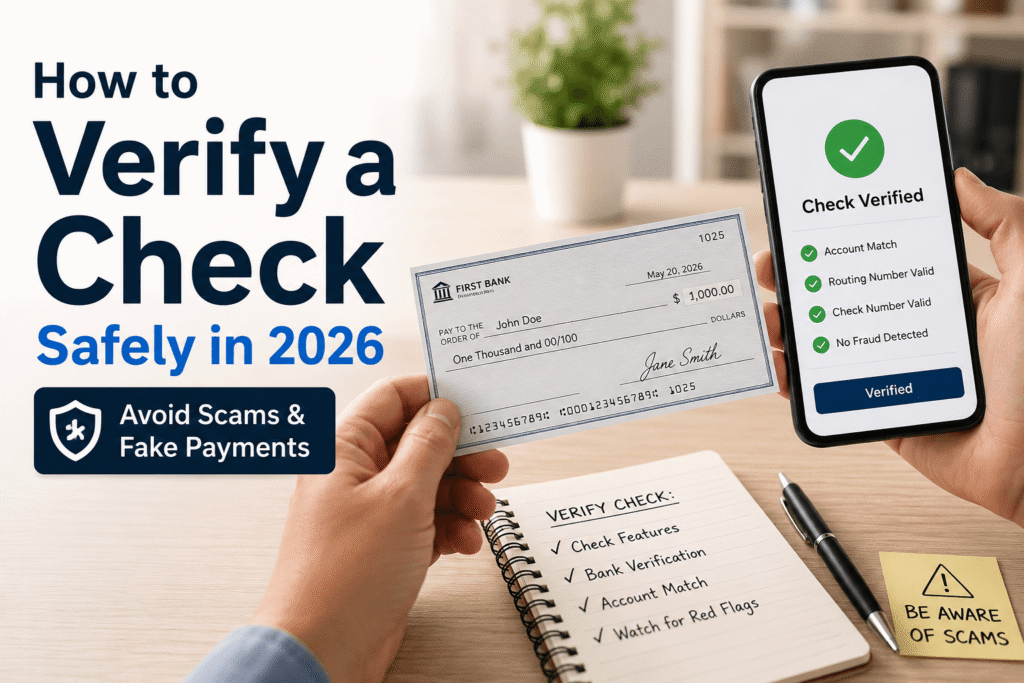
To verify a check, contact the issuing bank directly using a phone number from their official website — not one printed on the check itself — and confirm the check is legitimate and backed by sufficient funds. Also inspect the check for security features like watermarks, microprinting, and a legitimate routing number. Remember: a check that “clears” in your account is not the same as a check that is real — banks can reverse funds days later once a fake is detected.
Quick Summary: What You Need to Know
- ✓Always call the issuing bank to confirm a check is real — use the number from their official site.
- ✓Inspect the check for watermarks, microprinting, and a MICR line at the bottom.
- ✓Never spend deposited funds before the check fully and permanently clears (this can take days).
- ✓Overpayment, job offer, and lottery checks are the most common fake check scams in the U.S.
- ✓Cashier’s checks and money orders can be faked — do not assume they are automatically safe.
- ✓Mobile deposit does not detect counterfeit checks — your phone camera cannot spot fakes.
- ✓If you suspect a fake check, contact your bank and file a report with the FTC immediately.
What Is Check Verification?
Check verification is the process of confirming that a check is genuine, funded, and safe to deposit before you hand over any goods, services, or cash in return. It’s not just about whether the check will bounce — it’s about making sure the check itself is real and was written by someone with the authority and funds to back it up.
Here’s the thing most people don’t realize: a check appearing to “clear” in your bank account does not mean it’s legitimate. Banks make funds provisionally available, often within one to two business days. But if the check turns out to be fraudulent, the bank can reverse the transaction — sometimes weeks later — and you’ll be on the hook for every dollar you already spent.
According to the Federal Trade Commission (FTC), fake check scams cost Americans tens of millions of dollars every year. Victims often don’t realize they’ve been scammed until long after they’ve wired money, bought gift cards, or shipped products. That’s why knowing how to verify a check before you act on it is one of the most valuable financial skills you can have in 2026.
Why You Should Always Verify a Check
Let’s be honest — most of us don’t think twice when a check arrives. Someone hands it to you, it looks official, it has your name on it, and you head straight to the bank. But that moment of trust is exactly what scammers count on.
Here’s what can go wrong if you skip verification:
- ⚠You lose the money you spent. Banks hold you responsible for depositing a bad check. Once you spend those provisional funds, you owe the bank.
- ⚠Your account gets frozen. Depositing fraudulent checks can trigger fraud flags that lock your account while the bank investigates.
- ⚠You may face fees. Most U.S. banks charge returned check fees ranging from $15 to $35 — and that’s on top of the lost funds.
- ⚠Criminal liability is possible. In some cases, unknowing participants in check scams have been investigated for money laundering. It’s rare, but it happens.
Would you hand a stranger a $500 product just because they waved a piece of paper at you? Probably not. So why trust a check without verifying it first?
A freelancer on a job board receives a $4,500 check for a project. The client asks them to wire $3,000 of it to a vendor. The freelancer deposits the check, wires the money, and three weeks later learns the check was fake. They’re out $3,000 and still owe their bank. This exact scenario plays out thousands of times a year across the U.S.
How to Verify a Check: Step-by-Step
Verifying a check doesn’t require a magnifying glass and a law degree. It takes about five minutes, and these steps will walk you through exactly what to do.
Inspect the Check for Physical Security Features
Before you do anything else, take a close look at the check itself. Legitimate checks from banks and businesses include built-in security features that are hard (and expensive) to replicate.
What to look for:
- •Watermark: Hold the check up to light. A genuine check typically shows a faint watermark that can’t be photocopied.
- •Microprinting: Look along the signature line or borders for tiny printed text. It’s almost invisible to the naked eye but blurry on counterfeits.
- •Security thread or color-shifting ink: Some checks use these features, common in government-issued checks.
- •Rough edges: Real checks are often cut with perforated or matte edges. Smooth, perfectly cut edges can be a red flag.
- •Check stock texture: Genuine check paper has a slightly rough feel. If a check feels thin or flimsy like regular printer paper, be suspicious.
Many fake checks look incredibly realistic today thanks to high-resolution printing. Physical inspection alone is not enough — always follow up with the steps below.
Verify the Routing and Account Numbers
Look at the bottom of the check. You’ll see a row of printed numbers called the MICR line (Magnetic Ink Character Recognition). These are printed in special magnetic ink and include:
- •Routing number (9 digits): Identifies the issuing bank.
- •Account number: Identifies the account the funds are drawn from.
- •Check number: Should match the number in the top right corner of the check.
You can verify the routing number using the ABA Routing Number Lookup tool from the American Bankers Association. If the routing number doesn’t match any real U.S. bank, the check is fake. Full stop.
If the MICR line looks printed (glossy or slightly raised like regular ink), rather than having a flat matte finish, that’s a sign it’s been printed on a regular printer rather than produced by a real check printer.
Contact the Issuing Bank Directly
This is the single most important step. Call the bank that issued the check — not the check writer, not your own bank — and ask them to verify it.
How to do it correctly:
- •Look up the bank’s phone number on their official website or via a Google search. Do NOT use any phone number printed on the check itself.
- •Call the bank’s main customer service or fraud line.
- •Tell them you received a check and want to verify if it is legitimate and if funds are available.
- •Provide the check number, account number, and routing number when asked.
Never assume a phone number printed on the check is real. Scammers frequently print fake bank names with a number that goes straight to their own accomplices.
Verify the Check Writer’s Identity
Verifying the bank is step one. Verifying the person who wrote the check is step two. This matters especially for personal checks and business checks from parties you haven’t worked with before.
- •For personal checks: Ask for a government-issued photo ID and note the driver’s license number. In many states, this is legally required for merchants.
- •For business checks: Confirm the business is real. Search the company name at your state’s Secretary of State business registry. You can also check them on the Better Business Bureau.
- •For online transactions: Be extremely cautious. Never accept a check from a buyer you met online who is paying more than the agreed amount and asking for change back.
Cross-reference the name printed on the check with the name and contact details of the person you’re dealing with. Discrepancies are a major red flag.
Use Your Bank’s Verification Tools
Many U.S. banks and credit unions now offer fraud alert tools and check verification features through their mobile apps and online banking portals. While these won’t always catch a sophisticated fake, they can flag suspicious patterns.
- •Review your bank’s fraud alert settings and turn on notifications for large deposits.
- •Ask your bank whether they offer “positive pay” or check verification services (more common for business accounts).
- •Use your bank’s mobile deposit feature only for checks you’re already confident in — the app camera does not detect fakes.
If you frequently receive checks in your business, ask your bank about Positive Pay — a fraud prevention service where you upload a list of issued checks and the bank matches them before clearing. Learn more from the Consumer Financial Protection Bureau (CFPB).
Wait for Full Clearance Before Spending
This is where most people get burned. A check appearing in your available balance does not mean it has permanently cleared. It means your bank has made the funds provisionally available as required by federal Regulation CC.
Here’s the real timeline:
| Timeframe | What Actually Happens |
|---|---|
| Day 1–2 | Funds appear available. Your balance shows the amount. |
| Day 3–5 | The check is processed through the banking system. |
| Day 5–10+ | If the check is fraudulent, the bank reverses the deposit. You owe the money back. |
Rule of thumb: For any check from an unknown or unverified source, wait at least 10 business days before spending the money. For large amounts, consult your bank directly.
This rule applies to cashier’s checks and money orders too. People assume these are as good as cash. They are not — they can be forged just like personal checks.
Check Verification Methods: Quick Comparison
| Method | Speed | Safety Level | Best For | Limitations |
|---|---|---|---|---|
| Call the issuing bank | 15–30 min | Very High | Any unknown check | Requires correct bank number |
| Inspect physical features | 2–3 min | Medium | Quick first screen | Not foolproof on its own |
| Routing number lookup | 2–3 min | High | Confirming bank identity | Doesn’t verify funds |
| Ask bank to hold funds | Varies | High | Large or suspicious checks | Takes longer to access money |
| Mobile banking tools | Fast | Low–Medium | Trusted payors only | Cannot detect counterfeits |
| Third-party check services | Medium | Medium | Business check volumes | Costs money; may have delays |
Common Fake Check Scams to Watch Out For
Scammers are creative, but their playbooks follow familiar patterns. Here are the most common fake check scams targeting Americans in 2026.
🚨 The Overpayment Scam
You’re selling something on Craigslist, Facebook Marketplace, or another platform. A buyer offers to pay by check — and the check arrives for more than the asking price. They apologize for the “mistake” and ask you to wire or send back the difference.
The check is fake. You send back real money. The check bounces. You’re out both the item and the cash you returned.
Any buyer who sends a check for more than the agreed amount and asks you to send back the difference is almost certainly running a scam.
🚨 The Work-From-Home or Job Offer Scam
A job offer arrives — often for a mystery shopper, personal assistant, or remote payment processing role. They send you a check to “get started” and ask you to use part of the funds to buy gift cards or wire money to a supplier.
The scenario sounds completely logical until the check bounces. The job never existed. The money you sent is gone.
The FTC has extensive guidance on this scam at consumer.ftc.gov.
🚨 The Lottery or Prize Scam
Congratulations! You’ve won a lottery you never entered. A check arrives to cover your “winnings” but you’re asked to pay taxes or processing fees upfront using wire transfer or gift cards. The check is fake.
Real lotteries never ask you to pay before receiving your winnings. If you have to pay to win, it’s a scam.
🚨 The Rental Scam
You’re looking for an apartment. The landlord is “traveling” and can’t show you the property, but they’ll send the keys once you confirm your interest. A check arrives that’s “more than expected” — they ask you to wire back the difference as a security deposit. The apartment doesn’t exist. The check is fake. The money you wired is gone.
🚨 The Inheritance or Windfall Scam
Someone contacts you claiming to be a lawyer, government official, or distant relative with news that a long-lost relative left you money. To release the funds, you’ll receive an advance check — and must pay fees to unlock the full amount. Classic advance-fee fraud with a check twist.
The Complete Check Verification Checklist
Use this checklist every time you receive a check from someone you haven’t done business with before:
Look at the check carefully — check for watermarks, microprinting, MICR line quality, and paper texture.
Write down the check number, routing number, and account number from the MICR line.
Look up the routing number using the official ABA tool to confirm the bank exists.
Find the bank’s phone number independently (Google or official site — not from the check).
Call the bank and ask to verify the check — confirm the account is active and the check amount is valid.
Verify the identity of the check writer: ID for individuals, business registry for companies.
Deposit the check but do not spend the funds until you are certain it has fully and permanently cleared.
For large checks, ask your bank to place a hold and get written confirmation that the funds are real before releasing them.
Tools and Services That Can Help Protect You
Verifying checks manually is essential, but if you deal with checks regularly — as a small business owner, landlord, or freelancer — a few extra tools can add meaningful protection.
|
🔍
Identity Theft ProtectionServices from major financial institutions monitor your financial info for suspicious activity. If someone uses a fake check as part of a broader identity theft scheme, early alerts help you respond quickly. Many available for $10–25/month. |
📊
Credit MonitoringCheck fraud can be linked to identity theft. Under U.S. law, you’re entitled to free credit reports from each of the three major bureaus at AnnualCreditReport.com — the only official government-authorized source. |
|
🔔
Bank Fraud Alert FeaturesMost major U.S. banks offer free fraud alert notifications through their mobile apps. Enable these to get instant alerts when large deposits or unusual transactions occur. Gives you a faster window to catch and report issues. |
🏢
Positive Pay for BusinessesIf you run a small business and issue or receive checks regularly, ask your bank about Positive Pay. You upload details of every check you issue, and the bank automatically matches incoming checks against your list before clearing them. |
What to Do If You Deposit a Fake Check
If this has happened — or you suspect it might have — here’s what to do immediately.
The sooner you act, the more options you have.
Explain that you may have deposited a fraudulent check. Ask them to place a hold on the funds and flag the deposit for review.
If you haven’t already done so, stop. Once money leaves your account via wire transfer or gift card, it’s nearly impossible to recover.
Go to reportfraud.ftc.gov and file a detailed report. The FTC uses these reports to build cases against scammers.
Many states have consumer protection offices that investigate check fraud. Your state AG’s website will have contact information.
If the check was mailed to you, this is federal territory. Contact the USPS Inspection Service.
Save the check, the envelope, any emails or texts from the sender, and all correspondence. Don’t throw anything away.
Banks are required by law to credit your account provisionally when you deposit a check, but they are also legally entitled to reverse that credit if the check is returned as fraudulent. You will owe the money back even if you’ve already spent it. This is why prevention is so much better than recovery.
Special Cases: Cashier’s Checks, Money Orders & Digital Checks
🏦 Are Cashier’s Checks Safe?
Cashier’s checks are issued and guaranteed by the bank itself, not by an individual account holder. This makes them more reliable than personal checks — but they are absolutely not immune to fraud.
Counterfeit cashier’s checks are widely used in scams precisely because victims assume they’re safe. A fake cashier’s check can look indistinguishable from a real one to the naked eye.
Always verify a cashier’s check by calling the issuing bank directly. Most banks can confirm a cashier’s check in under five minutes.
📮 Are Money Orders Safe?
Money orders are considered more secure than personal checks for small amounts. However, they can be altered (especially the payee name and amount) and counterfeit money orders are not uncommon.
For USPS money orders specifically, you can verify them using the USPS Money Order Inquiry tool.
💻 What About Digital or eChecks?
eChecks (electronic checks) use the ACH network and are generally processed through established payment platforms. The fraud risk is lower than physical checks, but not zero. Ensure any eCheck request comes through a legitimate and verified payment platform — not a random email asking for your bank routing details.
Related Guides You Might Find Helpful
Frequently Asked Questions
Final Thoughts
Check fraud is one of the oldest financial scams in the book — and one of the most persistent. Scammers keep using fake checks because they keep working. People see a physical object with their name on it and assume it’s real. That assumption costs Americans hundreds of millions of dollars every year.
The good news? Protecting yourself isn’t complicated. It just takes a few minutes of deliberate action. Call the bank. Inspect the check. Wait for real clearance. Don’t wire money to people you’ve never met.
And remember this above all:
“A check might look like money — but until it permanently clears, it’s just a promise. And promises from strangers aren’t worth your savings.”
Stay careful. Stay skeptical. And when in doubt, wait.
Disclaimer: This article is for informational purposes only and does not constitute financial or legal advice. Always consult with your bank or a qualified professional for guidance specific to your situation.