⚡ Quick Answer
A counter check is a temporary check printed at your bank branch when you don’t have your personal checkbook handy. It works like a regular check — but it’s issued on the spot, typically costs $1–$3 per check, and isn’t accepted everywhere. Most people use them for emergency one-time payments, but they come with real limitations that most banks gloss over.
Quick Summary
What Is a Counter Check? (Simple Explanation)
Let’s start with the basics — no banking jargon, no fluff.
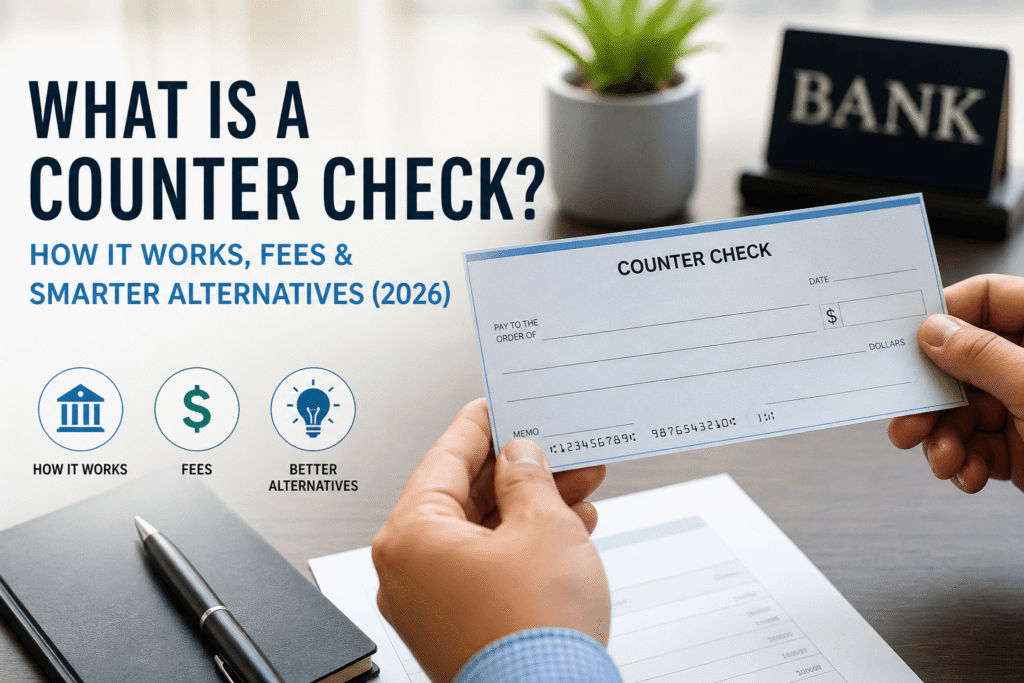
A counter check is a check that a bank teller prints for you right there at the counter (hence the name). It has your account number and routing number on it, just like your personal checks, but it usually doesn’t have your name or address pre-printed. You fill in the remaining details — the payee, amount, date, and your signature — yourself.
They’ve been around for decades and were originally designed as a convenience for customers who either forgot their checkbook or just opened a new account and hadn’t received their checks yet. In those cases, a counter check bridges the gap.
Here’s what makes them slightly different from a regular personal check:
Who typically uses them? People who just opened a bank account and need to make an immediate payment. People who’ve misplaced or run out of their checkbook mid-month. Anyone who needs to write a check on the spot and doesn’t carry one.
💡 Did You Know?
Counter checks are considered “demand drafts” — meaning they draw directly from your checking account, just like a regular check. The funds are not guaranteed like a cashier’s check, so they can bounce if your account balance is insufficient.
How Counter Checks Work (Step-by-Step)
Understanding how counter checks actually function can help you avoid mistakes — and there are a few common ones.
You Visit a Bank Branch
Counter checks can only be obtained in person at a bank or credit union branch. You can’t request one over the phone, online, or at an ATM. This is a teller-issued document that requires your presence and account verification.
The Teller Prints It
Once the teller confirms your identity and verifies your account, they’ll print a check encoded with your routing number and account number at the bottom (the MICR line). This is the same information that appears on all your personal checks. Some banks hand you a partially blank check and ask you to complete it. Others may pre-fill the date or leave the payee and amount for you to write in.
You Fill in the Details
Here’s where people sometimes go wrong. Since counter checks often don’t have your name pre-printed, you’ll need to write it in yourself. Same goes for the date, payee, and amount. Double-check every field before handing it over — mistakes are harder to dispute after the fact.
The Payee Deposits or Cashes It
The counter check clears through the normal banking system, just like any other check. It goes through ACH processing, the funds are held or debited from your account, and the transaction is complete. Here’s the part most blogs skip: not every payee will accept a counter check. Because it lacks a pre-printed name and address, some businesses, landlords, and government offices treat it with extra skepticism. Always confirm acceptance before you write one.
⚠️ Important
Counter checks are NOT the same as cashier’s checks. A cashier’s check is guaranteed by the bank — the funds are drawn from the bank’s own account. A counter check is drawn from your personal account and can bounce if you don’t have sufficient funds.
When Should You Use a Counter Check?
There are some situations where a counter check genuinely makes sense. Here are three real-life scenarios where people reach for them — and why.
Scenario 1
You Just Moved Into a New Apartment
You signed the lease on a Monday. Move-in day is Thursday. Your new checkbook won’t arrive for 7–10 business days, and your landlord doesn’t accept Venmo or Zelle. You need to pay your first month’s rent and deposit — today. This is a textbook counter check situation. You head to your bank, request two counter checks (one for rent, one for the deposit), and hand them over to your landlord. The key here: confirm your landlord accepts counter checks before you visit the bank. Some landlords want a cashier’s check for the deposit specifically because it’s guaranteed. Ask first.
Scenario 2
You’re at the DMV and They Only Accept Checks
Some state DMV offices — surprisingly — still don’t accept debit cards or digital payments for certain transactions. Title transfers, registration renewals, and fees sometimes require a check. If you’re caught without one, a counter check pulled from your account that morning can save a wasted trip. Just make sure the DMV location specifically accepts personal-style checks (most do), and double-check that the counter check doesn’t look too “unofficial” for their processing requirements.
Scenario 3
Your Regular Checks Ran Out Mid-Month
You’ve got three payments to make this week — your insurance premium, a contractor, and a medical bill. You thought you had checks left. You don’t. You could order a new checkbook (which takes up to two weeks), pay the fees for expedited delivery, or just head to your bank for a couple of counter checks to tide you over. For most people, the counter check is the faster, cheaper solution for this specific pinch.
When NOT to Use a Counter Check (The Section Most Blogs Skip)
Now here’s where it gets important. Counter checks have real limitations — and ignoring them can cost you.
For High-Value or Time-Sensitive Payments
If you’re paying $2,000 or more for something — a car down payment, a contractor, a security deposit — a counter check introduces unnecessary risk. If it bounces for any reason (even a temporary hold or account discrepancy), you’ve just created a serious problem with your payee. For large payments, use a cashier’s check. Yes, it costs more ($8–$15 at most banks), but the funds are guaranteed by the bank itself.
When You Need Proof of Payment or a Paper Trail
Because counter checks are often handwritten and lack some standard pre-printed identifiers, they’re harder to track. If you ever need to dispute a charge, prove a payment was made, or produce a record for tax purposes, a counter check is your weakest option. Personal checks, cashier’s checks, and digital payments all leave cleaner, more verifiable trails.
For Online Transactions
This should go without saying, but counter checks cannot be used for online payments. They’re physical paper checks. If you’re trying to pay a bill online, use a debit card, ACH transfer, or Zelle.
When the Payee Doesn’t Know You
A business, government office, or private party that doesn’t have a relationship with you may not accept a counter check because it looks different from a standard personal check. No name pre-printed, possibly no address — it can raise flags. Always call ahead. A five-second conversation can save you an unnecessary trip.
If You’re Applying for a Mortgage or Major Loan Soon
This one surprises people: the activity on your checking account — including the frequency and amounts of checks written — can be reviewed during mortgage underwriting. Using multiple counter checks in unusual patterns isn’t going to help your case. Stick to conventional payment methods when your finances are under a microscope.
🔑 The Rule of Thumb
Use counter checks for small, one-time, emergency payments where you’re confident the payee accepts them. For anything larger, recurring, or high-stakes — use a cashier’s check, money order, or digital payment instead.
Counter Check Fees (Real Numbers)
One of the most searched questions about counter checks is: how much do they cost? Here’s an honest breakdown. The typical range is $1 to $3 per check. Some banks charge per check; others charge per visit (covering a small batch of 2–3 checks at once). And a handful of premium or relationship accounts include counter checks at no charge as a perk.
| Account Type | Typical Counter Check Fee | Notes |
|---|---|---|
| Basic Checking | $1.50–$3.00 per check | Most common scenario |
| Premium / Relationship Checking | Free (included as account perk) | Check your account perks |
| Credit Union Accounts | $0.50–$2.00 per check | Often lower than big banks |
| Online-Only Banks | N/A — no branches | Use digital transfers instead |
Honestly, the fee itself is rarely the problem. The bigger cost is the time it takes to visit a branch — which is why most people are willing to pay it in a genuine pinch, but smart enough to avoid relying on counter checks regularly.
Pros and Cons of Counter Checks
Let’s keep this honest — not promotional, not alarmist.
✅ Pros
❌ Cons
Counter Check vs. Other Payment Options
Before you reach for a counter check, it’s worth knowing what your other options look like. Here’s a plain-English comparison of the most common payment methods.
| Payment Method | Speed | Typical Cost | Best For | Risk |
|---|---|---|---|---|
| Counter Check | Same day | $1–$3 | Emergency one-time payments | Medium |
| Cashier’s Check | Same day | $8–$15 | Large, secure payments | Low |
| Money Order | Same day | $1–$5 | Small payments w/o bank acct | Low |
| Zelle / Venmo | Instant | Free | Everyday digital payments | Low |
| Personal Check | 2–5 days clear | Free | Regular bill payments | Low–Med |
Counter Check vs. Cashier’s Check
This is the most common comparison people search for — and the distinction matters.
Counter check: Drawn from your personal checking account. The funds are not pre-cleared. It can bounce. It’s printed at the teller window and may not have your name on it.
Cashier’s check: Drawn from the bank’s own account. The funds are guaranteed. It won’t bounce. It costs more ($8–$15 at most banks), but payees trust it for large or important payments.
The bottom line: use a counter check for small, informal payments. Use a cashier’s check when the stakes are high and the payee needs payment certainty.
Counter Check vs. Money Order
Money orders are prepaid — you pay the face value upfront, and the money order is essentially cash. They’re accepted nearly everywhere, cost $1–$5, and are traceable. They’re a solid alternative to counter checks, especially if you want a guaranteed, cash-equivalent payment without a bank account. One caveat: money orders have a maximum face value (typically $1,000 at USPS). For larger amounts, you’d need multiple money orders — which is inconvenient.
Counter Check vs. Zelle / Digital Payments
For most everyday payments, Zelle, Venmo, and similar digital transfer platforms are faster, free, and easier to track. If your payee has a smartphone and a bank account, this is almost always the better option. Where digital payments fall short: some landlords, small businesses, and government offices don’t accept them. And if you’re dealing with someone who specifically requires a check, you don’t have a choice. For more on digital payment tools and how to use them safely, the Consumer Financial Protection Bureau (CFPB) has excellent, unbiased guidance.
How to Get and Use a Counter Check: Step-by-Step Guide
If you’ve decided a counter check is the right tool for your situation, here’s exactly how to get one — and how to use it correctly.
Visit your bank branch in person. Bring a valid government-issued photo ID (driver’s license, passport, or state ID). You’ll also need your account number if you don’t have your debit card.
Tell the teller you need a counter check. They’ll verify your identity, confirm your account is in good standing, and print the check. This usually takes 5–10 minutes.
Pay the fee. Confirm the per-check cost before they print multiple copies if you need more than one.
Fill in the check carefully. You’ll need to write: payee name, payment amount (numerals and written), today’s date, memo (optional but helpful), and your signature. Double-check every field.
Confirm the payee accepts counter checks. Do this before you go to the bank if possible. A quick phone call or text saves time and frustration.
Record the payment. Write it in your check register or note it in your banking app immediately. Counter checks don’t track themselves — you need to record the check number, amount, and payee so you can reconcile your account later.
Follow up on clearance. Counter checks generally clear within 1–2 business days. Check your account balance to confirm the payment went through.
📝 Pro Tip: Keep a Copy
Before handing over a counter check, take a quick photo of both the front and back with your phone. If any dispute arises later — about the amount, the payee, or whether the payment was made — you’ll have visual proof. This tiny habit has saved people from major headaches.
Counter Check Safety: Fraud Risks You Should Know
Here’s something most guides gloss over: counter checks carry a unique set of fraud risks. Not because they’re inherently dangerous, but because of how they’re constructed.
Because a counter check often lacks your pre-printed name and address, a bad actor with access to your account information could theoretically create a similar-looking document. This is why some businesses are hesitant to accept them — they can be harder to authenticate on sight.
Here are the key safety habits to follow:
Never leave blank fields. Fill in every field — especially the amount — before handing the check over. Use a pen with permanent ink.
Draw a line through empty spaces. After writing the amount in words, draw a horizontal line to fill the remaining space so nothing can be added.
Keep your account number private. A counter check exposes your full routing and account number, just like any check. Be selective about who you give it to.
Monitor your account. After issuing a counter check, watch your account for unexpected debits. Report anything suspicious to your bank immediately.
Use fraud protection tools. Many banks offer free transaction alerts via text or email. Enable these — they’re one of the easiest and most effective security measures available.
The Federal Trade Commission (FTC) provides detailed guidance on check fraud — including how to spot it, report it, and protect yourself. Worth bookmarking.
Smarter Alternatives to Counter Checks
Honestly, for most situations where someone reaches for a counter check, there’s a better option available. Here’s what to consider.
📦 Order a New Checkbook
If you’ve run out of checks, the cleanest solution is to simply order more. Most banks allow you to reorder through their website or app, and standard delivery takes 7–10 business days. Expedited options are usually available for a small fee. If you use checks regularly, keep an eye on your supply and reorder when you’re halfway through — don’t wait until the last one.
🏦 Use a Cashier’s Check for High-Value Payments
For any payment over $500 where the payee wants guaranteed funds — a security deposit, a used car purchase, a contractor — a cashier’s check is the gold standard. Yes, it costs $8–$15, but it’s worth every cent for the security it provides both parties. You can typically request a cashier’s check at any bank branch. Read more about how they work from Investopedia’s guide on cashier’s checks — a reliable, non-competitor source.
📮 Money Orders for Mid-Size Payments
If you need to pay someone who doesn’t accept personal checks but needs a guaranteed form of payment, a money order from the USPS or a grocery store is quick, cheap, and traceable. Great for paying landlords, small businesses, or anyone unfamiliar to you.
⚡ Zelle for Instant Bank Transfers
If your payee has a U.S. bank account and is enrolled in Zelle, this is almost always faster, cheaper, and more trackable than a counter check. It’s built into most major banking apps. Transfers happen within minutes, fees are typically zero, and both parties have a digital record.
🔄 ACH Transfers for Bill Payments
For recurring payments like rent, utilities, or insurance, setting up an ACH (Automated Clearing House) transfer through your bank is far more reliable than writing checks at all. You provide your routing and account numbers once, and the payment is automated. Most billers offer this for free.
🏛 Consider Switching to a Bank With Better Tools
If you find yourself regularly navigating workarounds like counter checks, it might be worth evaluating your banking setup. Many online banks and credit unions offer features like instant transfers, free cashier’s checks, and digital check tools that eliminate these hassles entirely. The FDIC’s BankFind Suite is a government tool that lets you verify and compare banks by features, insurance status, and financial health — useful when you’re evaluating a switch.
Frequently Asked Questions About Counter Checks
Are counter checks safe?
Generally, yes — but with caveats. Counter checks are processed through the same banking infrastructure as personal checks. The main risks are that they can bounce (if you lack sufficient funds) and that they expose your account and routing numbers. Follow the fraud-prevention tips above and you’ll minimize your exposure.
Do all banks offer counter checks?
No. Traditional brick-and-mortar banks and credit unions almost universally offer them. Online-only banks — like Ally, Chime, or Marcus — do not, because they have no teller windows. If you bank exclusively online and occasionally need checks, you’ll need to plan ahead (order a checkbook) or use money orders as an alternative.
Can a counter check bounce?
Yes. Unlike a cashier’s check or money order, a counter check is not guaranteed. It draws directly from your personal checking account. If you don’t have enough money in the account when the check is presented for payment, it will bounce — and you’ll likely face an NSF (non-sufficient funds) fee from your bank, plus a returned check fee from the payee. Always make sure your balance covers the check before you write it.
Are counter checks accepted everywhere?
No — and this is probably the most common surprise people encounter. While most payees who accept personal checks will accept counter checks, some businesses, landlords, and government offices are more cautious about them because they lack standard identifying information (name, address). Always confirm in advance.
What’s the difference between a counter check and a cashier’s check?
Counter check: Drawn from your account, not guaranteed, may lack pre-printed name, typically $1–$3.
Cashier’s check: Drawn from the bank’s account, guaranteed payment, bank-printed with full details, typically $8–$15. If someone asks you to pay with a “guaranteed check,” they want a cashier’s check — not a counter check.
How long does a counter check take to clear?
Counter checks clear on the same timeline as personal checks — typically 1–2 business days for local banks, and up to 5 business days for out-of-state or international banks. Under federal Regulation CC, the first $225 of a check deposit must be available the next business day; the rest may have a hold placed on it.
Can I use a counter check for online payments?
No. Counter checks are physical paper documents and cannot be used for online transactions. For online payments, use your bank account and routing number for ACH payments, or use digital platforms like Zelle, PayPal, or your bank’s online bill pay.
What happens to my counter check record?
Counter checks appear in your bank statement as regular check transactions. However, unlike pre-printed checkbooks that have sequential numbers you can track, counter checks may have temporary or generic check numbers. This makes reconciliation harder. That’s why photographing the check before you hand it over is such a good habit.
Final Thoughts: A Useful Tool — But Not a Regular Habit
Counter checks fill a genuine need. When you’re in a bind — just opened an account, ran out of checks, need to write one right now — they do the job. They’re real checks, they clear through the normal system, and for most one-time payments, they work fine.
But they’re not something you want to lean on. The per-check fee, the branch visit requirement, the spotty acceptance rate, and the fraud risks all add up to a payment method that’s useful in a pinch but not practical as a routine.
Here’s a simple decision framework to take with you:
💬 Bottom Line
Counter checks can be helpful in a pinch — but they’re not something you want to rely on regularly. The smarter move is to build payment habits that don’t put you in a pinch in the first place.
Related Guides on Finance Navigator Pro
💳
How Credit Utilization Works
📊
Best Credit Cards for Bad Credit (2026)
📈
Average Credit Score in the United States
🏗
How to Build Credit from Scratch
✂️
How to Cancel a Credit Card Without Hurting Your Score
Disclaimer: This article is for informational purposes only and does not constitute financial, legal, or banking advice. Fees and policies vary by institution and are subject to change. Always verify current terms with your bank directly.