
On this page
A Roth conversion moves money from a traditional IRA or pre-tax 401(k) into a Roth IRA. You pay income tax on the amount now, and in exchange, future qualified withdrawals are tax-free and you never face required minimum distributions on the Roth during your lifetime. Here is how Roth conversions work, how they are taxed and when converting makes sense.
Roth conversion at a glance
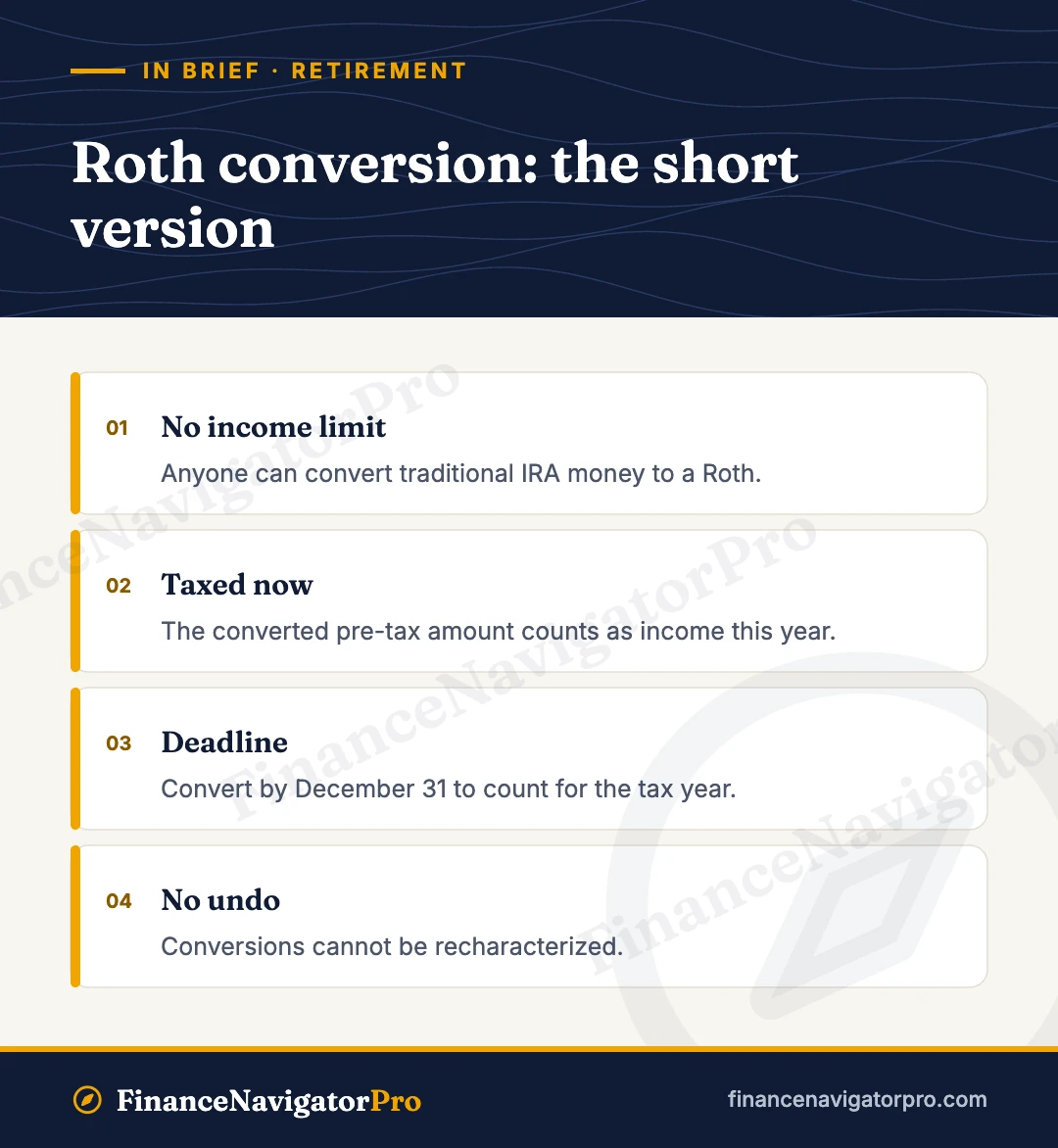
- Who can convert: anyone; there is no income limit.
- Tax: the converted pre-tax amount is added to your taxable income for the year.
- Deadline: December 31 to count for that tax year.
- No do-overs: conversions cannot be undone (recharacterized).
- Five-year rule: each conversion has its own five-year clock for penalty-free withdrawal of the converted amount before age 59½.
How a Roth conversion works
- Open a Roth IRA if you do not have one.
- Ask your IRA custodian or plan to move a chosen amount from the traditional account to the Roth IRA. You can convert cash or move investments in kind.
- Report the conversion on your tax return; you will receive Form 1099-R.
- Pay the resulting tax, ideally from savings outside the IRA.
You can convert all of your balance or just part of it, and you can convert in as many years as you like.
How Roth conversions are taxed
The converted amount that has never been taxed is added to your ordinary income for the year. A large conversion can push you into a higher bracket, so many people convert just enough to “fill up” their current bracket. See the 2027 tax brackets.
The pro-rata rule
If you have both pre-tax and after-tax (nondeductible) money across all your traditional, SEP and SIMPLE IRAs, the IRS treats every conversion as a proportional mix of the two. You cannot choose to convert only the after-tax dollars. Rolling pre-tax IRA money into a workplace 401(k) first can sometimes avoid this.
When a Roth conversion makes sense
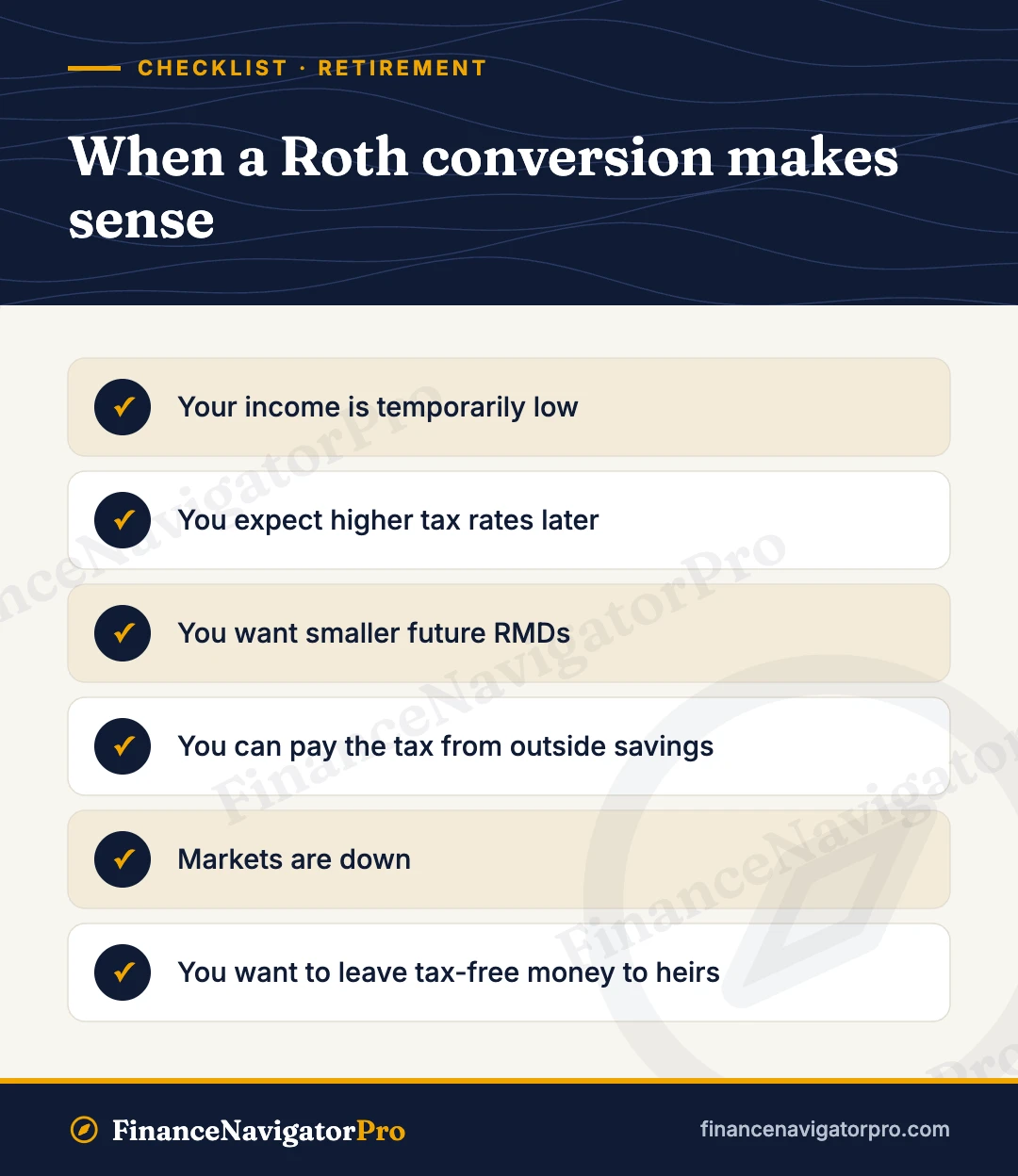
- Your income is temporarily low: a gap year, early retirement before Social Security and RMDs, or a year with large deductions.
- You expect higher tax rates later: because your income will rise or tax rates may increase.
- You want to reduce future RMDs: smaller pre-tax balances mean smaller required minimum distributions.
- You want to leave tax-free money to heirs: beneficiaries generally withdraw inherited Roth money tax-free.
- Markets are down: converting when investments are lower means paying tax on a smaller amount, with the rebound growing tax-free.
- You can pay the tax from other savings: paying from the IRA itself reduces the benefit.
When to think twice
- You expect a lower tax rate in retirement.
- You would need to use IRA money to pay the tax, especially before age 59½, when a withdrawal may also face a 10% penalty.
- The extra income could raise your Medicare premiums through IRMAA two years later. See Medicare costs in 2027.
- The extra income could reduce credits or deductions tied to your income, or make more of your Social Security taxable.
- You will need the converted money within five years and are under 59½.
Roth conversion strategies
Partial conversions over several years
Converting a set amount each year can keep you in a lower bracket and spread the tax bill.
The retirement gap years
The years between retiring and starting Social Security and RMDs are often the lowest-income years of your life, which can make them ideal for conversions.
Backdoor Roth IRA
If your income is too high to contribute to a Roth IRA directly, you can contribute to a nondeductible traditional IRA and then convert it. Watch the pro-rata rule if you have other pre-tax IRA balances.
Run your numbers
- Model the tax and payoff with the Roth conversion calculator.
- Compare account types with the Roth vs. traditional IRA calculator.
- Estimate retirement taxes with the retirement tax calculator.
Frequently asked questions
Is there a limit on how much I can convert?
No. You can convert any amount, though larger conversions mean a larger tax bill for that year.
Can I undo a Roth conversion?
No. Since 2018, conversions cannot be recharacterized back to a traditional IRA, so plan the amount carefully.
Can I convert my 401(k) to a Roth?
Many plans allow in-plan Roth conversions, or you can roll the 401(k) into an IRA and convert from there. See what is a 401(k).
Do I need to make estimated tax payments on a conversion?
Possibly. A large conversion can create an underpayment penalty if you do not increase withholding or make an estimated payment. Check with the estimated tax calculator.
Bottom line
A Roth conversion trades a tax bill today for tax-free growth and withdrawals later. It works best in low-income years, when you can pay the tax from outside savings and expect equal or higher tax rates in retirement. Convert before December 31 to count for the year; see more year-end tax moves. Compare traditional vs. Roth IRA to decide. This article is educational and not personal tax advice.
Keep reading