On this page
Most tax planning has a hard deadline: December 31. Once the year ends, many of the moves that could lower your 2026 tax bill are gone. Here are the year-end tax moves worth checking now, plus a few that can still wait until you file in April 2027.

Do these by December 31, 2026
- Raise your 401(k) contributions toward the $24,500 limit through payroll.
- Sell losing investments to offset gains (tax-loss harvesting).
- Take your required minimum distribution if you are 73 or older.
- Make charitable gifts, or a qualified charitable distribution from your IRA if you are 70½ or older.
- Spend any flexible spending account (FSA) money your plan will not carry over.
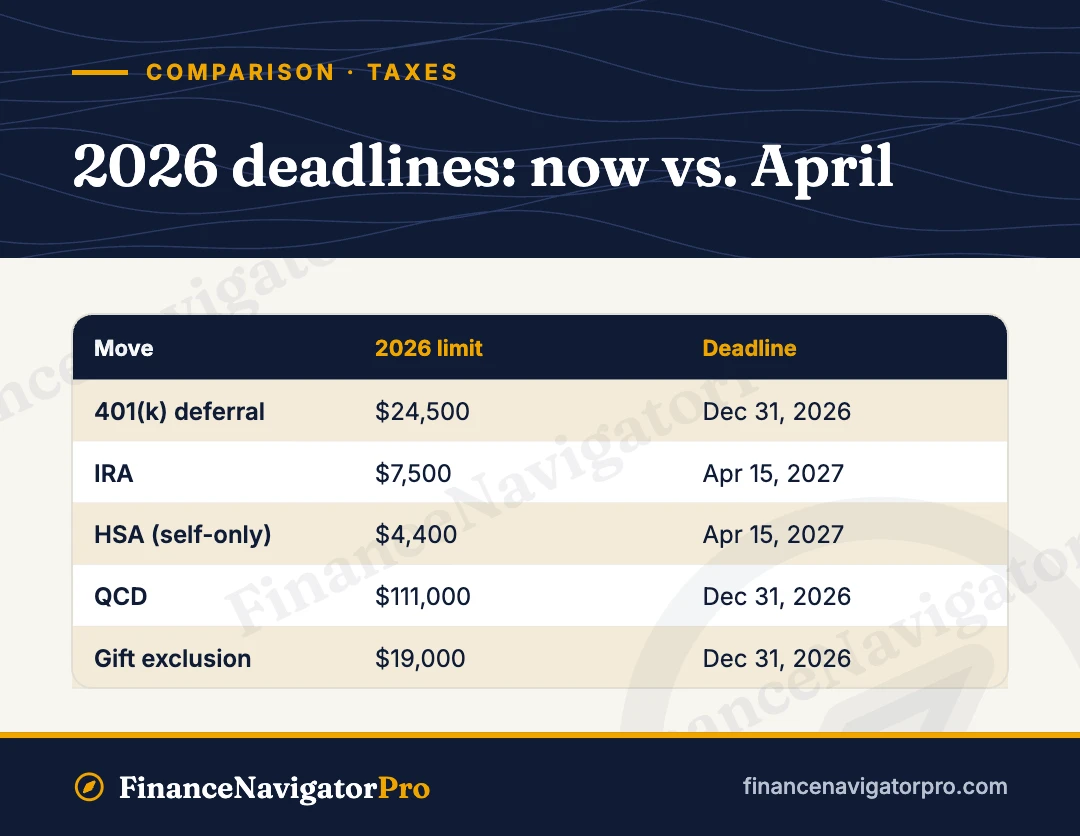
Can wait until April 15, 2027: IRA and HSA contributions for 2026.
1. Max out your 401(k) or 403(b)
For 2026, you can defer up to $24,500 into a 401(k), 403(b) or most 457 plans. Workers 50 and older can add an $8,000 catch-up, and those aged 60 to 63 can add a larger catch-up of $11,250 instead. Workplace contributions must come out of a 2026 paycheck, so ask HR or payroll to raise your rate for the last pay periods of the year. Traditional (pre-tax) contributions lower your 2026 taxable income dollar for dollar.
2. Harvest investment losses
If you sold investments at a gain this year, selling others at a loss can offset that gain. Losses beyond your gains can reduce ordinary income by up to $3,000 a year, and any remaining loss carries forward to future years. Watch the wash-sale rule: if you buy the same or a substantially identical investment within 30 days before or after the sale, the loss is disallowed. This applies only to taxable brokerage accounts, not IRAs or 401(k)s. See capital gains tax rates and estimate your bill with the capital gains tax calculator.
3. Take your required minimum distribution
If you are 73 or older, you generally must take a required minimum distribution (RMD) from traditional IRAs and 401(k)s by December 31. The only exception is your very first RMD, which can wait until April 1 of the following year. Missing an RMD can trigger a 25% excise tax on the shortfall, reduced to 10% if corrected promptly. Our guide to required minimum distributions walks through the rules.
4. Give to charity the tax-smart way
- Bunch your gifts: If your itemized deductions are close to the standard deduction ($16,100 single, $32,200 married filing jointly for 2026), giving two years’ worth of donations in one year can push you over the line.
- Use a donor-advised fund: You get the deduction this year and can recommend grants to charities later.
- Give appreciated stock: Donating shares you have held more than a year can avoid capital gains tax on the growth.
- Make a qualified charitable distribution (QCD): If you are 70½ or older, you can give up to $111,000 directly from an IRA to charity in 2026. A QCD counts toward your RMD and is not included in your taxable income.
Starting with 2026 returns, people who take the standard deduction can also deduct a limited amount of cash gifts to qualifying charities, so keep receipts even if you do not itemize.
5. Use your FSA money
Many flexible spending accounts are use-it-or-lose-it. Some plans allow a limited carryover or a grace period, so check your plan. If money will be forfeited, schedule eligible appointments or buy eligible supplies before the deadline. Compare HSA vs. FSA for next year’s enrollment.
6. Make annual gifts to family
You can give up to $19,000 per person in 2026 without filing a gift tax return; married couples can give $38,000 per recipient together. The exclusion resets each year, so unused 2026 room does not carry forward.
7. Consider a Roth conversion
A Roth conversion moves money from a traditional IRA to a Roth IRA. You pay income tax on the converted amount this year, and future qualified withdrawals are tax-free. Conversions often make sense in a lower-income year. Conversions must be completed by December 31 to count for 2026. Model one with the Roth conversion calculator, and read traditional vs. Roth IRA.
8. Time income and expenses
If you are self-employed or expect a lower bracket next year, it may help to delay invoicing until January or prepay deductible business expenses in December. If you expect a higher bracket next year, the opposite can make sense. Self-employed workers should also plan their fourth-quarter estimated payment, due January 15, 2027, with the estimated tax calculator.
9. Review your withholding
If you owed a large amount last spring or expect to this year, increasing withholding on your last paychecks can help avoid an underpayment penalty, since withholding is treated as paid evenly through the year. Check it with the tax withholding calculator.
10. Moves that can wait until April 15, 2027
| Move | 2026 limit | Deadline |
|---|---|---|
| 401(k) / 403(b) deferrals | $24,500 (+$8,000 at 50+) | December 31, 2026 |
| Traditional or Roth IRA | $7,500 (+$1,100 at 50+) | April 15, 2027 |
| HSA | $4,400 self-only / $8,750 family | April 15, 2027 |
| Qualified charitable distribution | $111,000 | December 31, 2026 |
| Annual gift exclusion | $19,000 per recipient | December 31, 2026 |
You can make 2026 IRA and HSA contributions up to the tax filing deadline. See HSA contribution limits and the 2027 contribution limits to plan ahead.
Run your numbers
- Estimate your 2026 bill with the federal income tax calculator.
- Preview your refund with the tax refund estimator.
- Find your bracket with the tax bracket calculator.
Frequently asked questions
Can I still contribute to my IRA for 2026 after December 31?
Yes. You can make 2026 IRA contributions until the filing deadline, April 15, 2027. Tell your provider the contribution is for 2026.
Does tax-loss harvesting work in a 401(k)?
No. It only applies to taxable brokerage accounts. Gains and losses inside 401(k)s and IRAs are not taxed each year.
What happens if I miss my RMD?
The IRS can charge a 25% excise tax on the amount you failed to withdraw, reduced to 10% if you correct it promptly. Take the missed amount as soon as possible and ask a tax professional about requesting a waiver.
Is it too late to lower my 2026 taxes in January?
Mostly, yes, for moves tied to the calendar year. IRA and HSA contributions are the main exceptions.
Bottom line
Before December 31, 2026, raise your 401(k) contributions, harvest losses, take any RMD, plan charitable gifts and use your FSA. IRA and HSA contributions can wait until April 15, 2027. When you are ready to file, follow our guide on how to file your taxes in 2027. This article is educational and not personal tax advice; consider a tax professional for complex situations.
Keep reading