
On this page
Almost every major online broker now charges $0 to trade U.S. stocks and ETFs, so the real differences are in investment choices, research, trading tools and customer service. Here are five of the best brokerage accounts for 2026 and how to pick the one that fits the way you invest.
Disclosure: Some links may earn us a commission at no cost to you. It never affects our rankings. See our affiliate disclaimer.
Our top picks at a glance
- Best overall: Fidelity — strong research, low costs and an excellent app.
- Best for customer service: Charles Schwab — round-the-clock support and the thinkorswim platform.
- Best for advanced traders: Interactive Brokers — global markets and professional-grade tools.
- Best for education: E*TRADE — deep learning library and paper trading.
- Best for simple mobile trading: Robinhood — a clean, easy app for basic trades.
All five charge $0 commissions for online U.S. stock and ETF trades and have no account minimum for a standard brokerage account. Fees for options, mutual funds, broker-assisted trades and transfers vary. Pricing and features checked November 2026; confirm on each broker’s site before opening an account.
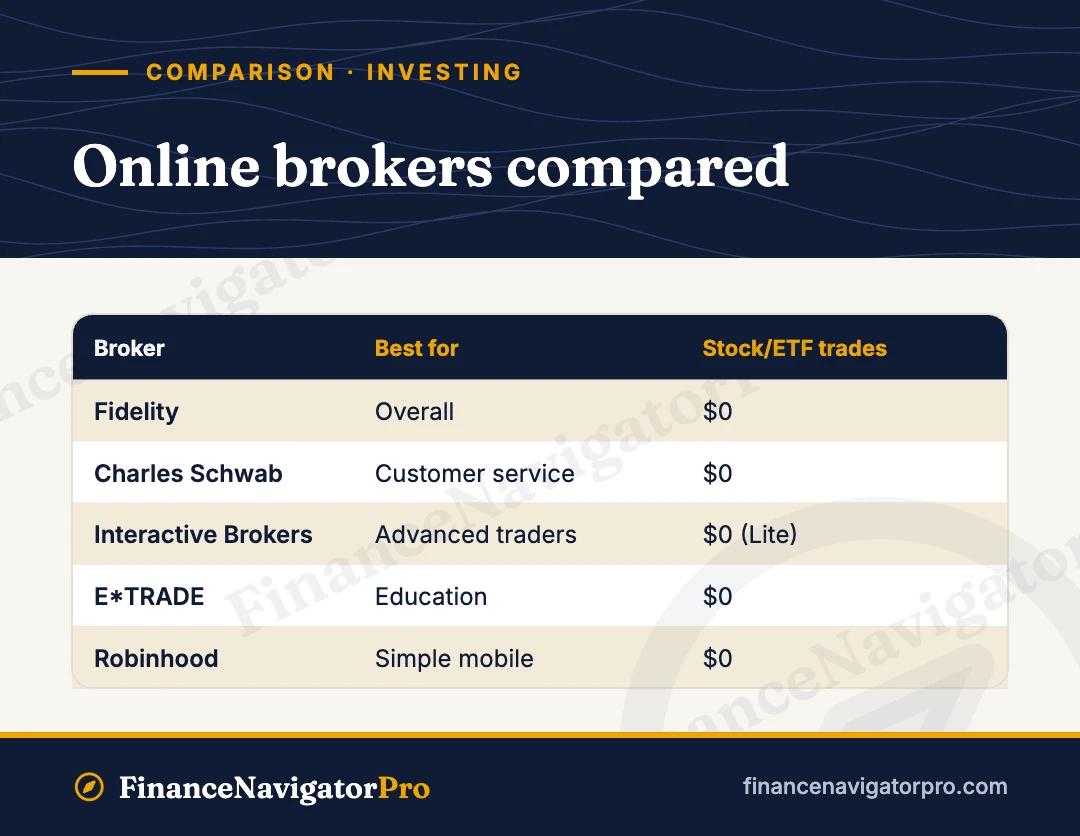
| Broker | Best for | Stock/ETF trades | Standout |
|---|---|---|---|
| Fidelity | Overall | $0 | Research, fractional shares |
| Charles Schwab | Customer service | $0 | 24/7 support, thinkorswim |
| Interactive Brokers | Advanced traders | $0 (IBKR Lite) | Global market access |
| E*TRADE | Education | $0 | Learning tools, paper trading |
| Robinhood | Simple mobile trading | $0 | Easy-to-use app |
1. Fidelity — Best overall
Fidelity routinely tops broker rankings for good reason: low costs, a huge selection of no-transaction-fee mutual funds, strong research and an app that works well for beginners and experienced investors alike. It also offers fractional shares, so you can invest in expensive stocks with small amounts.
Pros
- Excellent research and education
- Fractional shares and thousands of no-fee mutual funds
- Strong retirement account options
Cons
- Advanced trading platform has a learning curve
- No cryptocurrency trading in standard brokerage accounts
Who it’s for: most investors, from first-timers to long-term retirement savers.
2. Charles Schwab — Best for customer service
Schwab combines $0 trades with 24/7 customer support, a large branch network and the thinkorswim platform it brought over from TD Ameritrade. It is a strong choice if you value being able to reach a person quickly.
Pros
- Round-the-clock support and in-person branches
- thinkorswim for active traders
- Broad investment selection
Cons
- Uninvested cash earns a low default rate
- Several platforms to choose between
Who it’s for: investors who want strong service and tools in one place.
3. Interactive Brokers — Best for advanced traders
Interactive Brokers offers access to stocks, options, futures and bonds across many international markets, with powerful trading software and low margin rates. Its IBKR Lite plan offers $0 U.S. stock and ETF trades.
Pros
- Access to global markets
- Low margin rates
- Professional-grade trading tools
Cons
- Complex for beginners
- Pro plan charges commissions
Who it’s for: active and international traders.
4. E*TRADE — Best for education
E*TRADE, owned by Morgan Stanley, pairs $0 stock trades with a deep library of articles, videos and webinars, plus paper trading to practice strategies without real money. Its Power E*TRADE platform suits options traders.
Pros
- Strong educational content
- Paper trading and Power E*TRADE platform
- Frequent new-account bonuses
Cons
- Uninvested cash earns a low default rate
- Some mutual funds carry transaction fees
Who it’s for: investors who want to learn as they go.
5. Robinhood — Best for simple mobile trading
Robinhood helped popularize commission-free investing and remains one of the easiest apps for buying stocks and ETFs. It offers fractional shares, cryptocurrency and IRAs, with optional paid Gold membership for extra features.
Pros
- Clean, easy-to-use app
- Fractional shares and crypto
- IRAs available
Cons
- Limited research and no mutual funds
- Easy trading can encourage overtrading
Who it’s for: mobile-first investors making simple trades.
How to choose a brokerage account
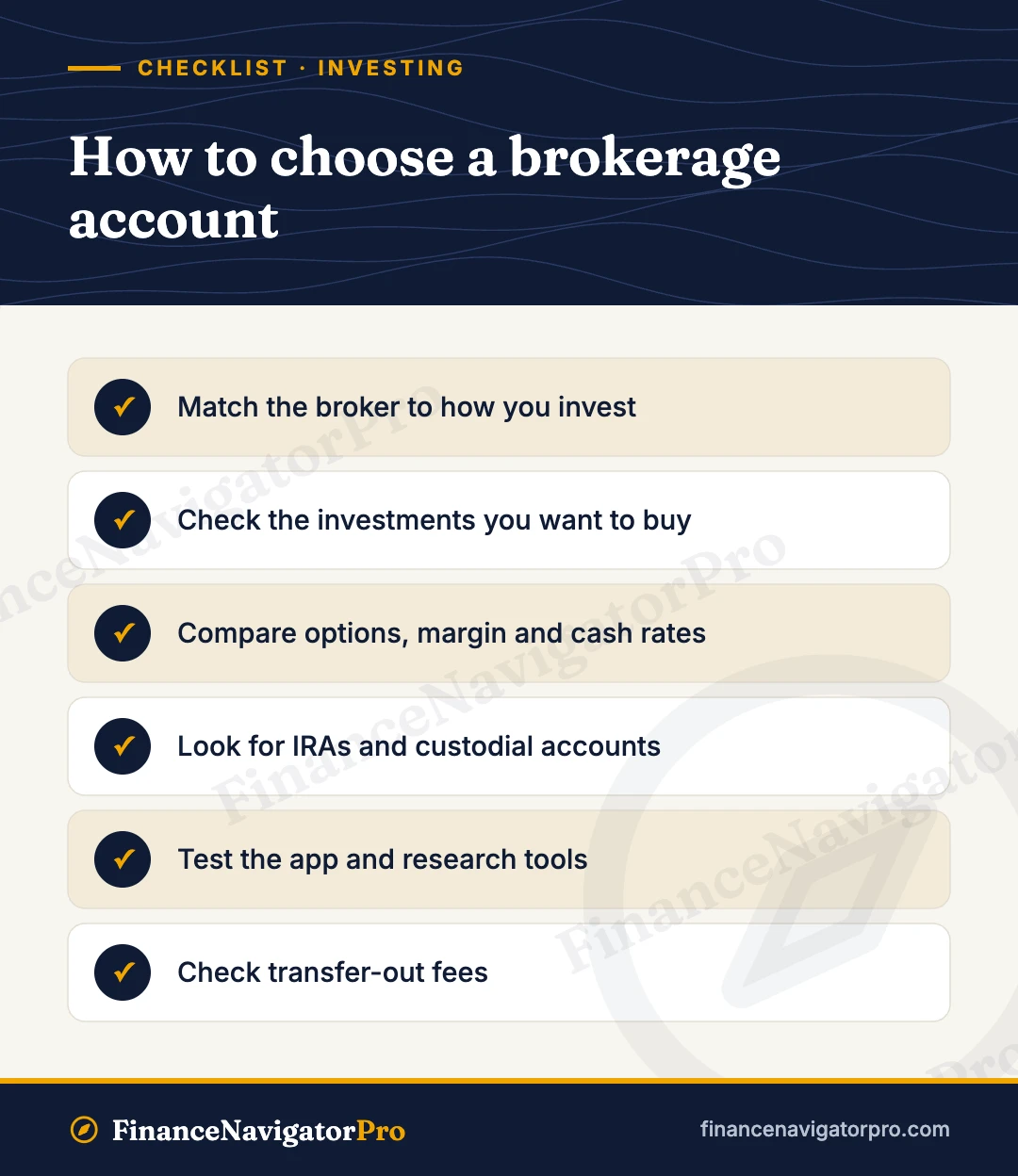
Match the broker to your style
Long-term investors should prioritize low-cost funds and retirement accounts; active traders need fast platforms, good options pricing and low margin rates.
Check what you can buy
Make sure the broker offers what you want: mutual funds, bonds, options, international stocks or crypto.
Look beyond commissions
Compare options contract fees, margin rates, the interest paid on uninvested cash and fees to transfer your account out.
Consider account types
Most brokers offer taxable accounts, IRAs and custodial accounts. Read what is a brokerage account and what is a Roth IRA.
Want it done for you?
If you prefer automated investing, compare the best robo-advisors. New investors can also see the best investing apps for beginners.
How we chose
We compared large U.S. online brokers using broker information and reputable 2026 broker reviews. We did not accept payment for placement.
- Trading costs and account fees
- Investment selection
- Research, education and tools
- Mobile and desktop platforms
- Customer service
Run your numbers
- Project growth with the investment calculator.
- See compounding at work with the compound interest calculator.
- Estimate taxes on gains with the capital gains tax calculator.
Frequently asked questions
Is my money safe at an online broker?
Brokers that are SIPC members protect customer securities up to $500,000, including $250,000 for cash, if the firm fails. SIPC does not protect against market losses.
How much money do I need to open a brokerage account?
All five brokers here have no minimum for a standard brokerage account, and most offer fractional shares so you can start with a few dollars.
Can I have more than one brokerage account?
Yes. Many investors keep retirement accounts at one firm and a trading account at another.
How do I move my account to a new broker?
Start the transfer at the new broker using the ACATS system. Your old broker may charge an outgoing transfer fee, which some new brokers will reimburse.
Bottom line
Fidelity is the best all-around brokerage account, Schwab leads on service, Interactive Brokers suits advanced traders, E*TRADE is great for learning and Robinhood keeps simple trading easy. All five offer $0 stock and ETF trades, so choose based on the tools and support you need. New to investing? Start with index funds for beginners. This article is educational and not investment advice.
Keep reading