
On this page
A Roth IRA is one of the most powerful retirement accounts available to everyday savers. You pay tax on the money now, and in exchange, your investments can grow and come out tax-free in retirement. Here is how it works, who can contribute in 2027 and how to open one in about 15 minutes.
Key takeaways
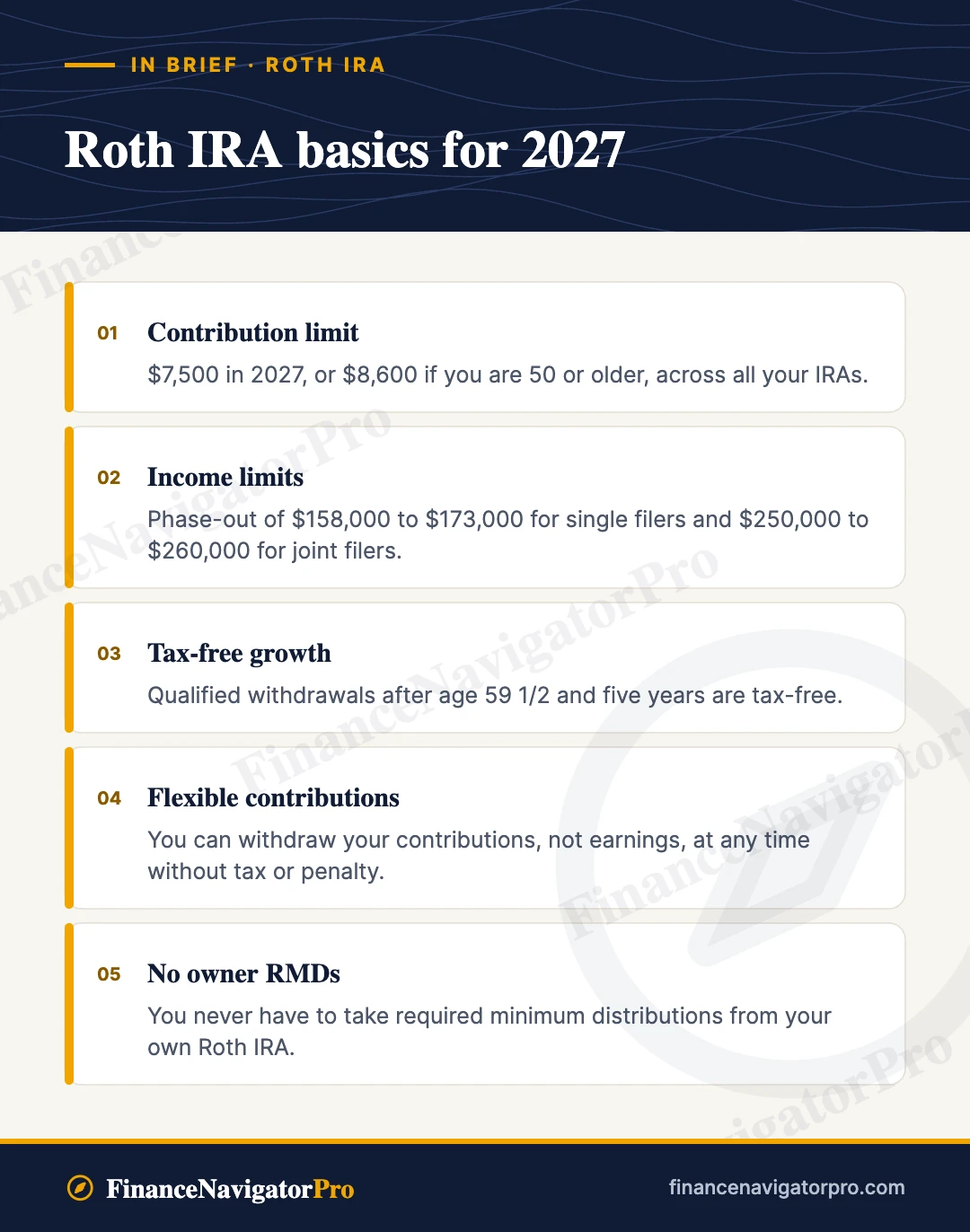
- You contribute after-tax money, and qualified withdrawals in retirement are tax-free.
- The 2027 limit is $7,500, or $8,600 if you are 50 or older, shared across all your IRAs.
- You can contribute directly only if your income is below IRS limits.
- You can take out your contributions at any time; earnings follow stricter rules.
- There are no required minimum distributions for the original owner.
How a Roth IRA works
An individual retirement account (IRA) is a tax-advantaged account you open on your own, separate from any workplace plan. With a Roth IRA, contributions are made with money you have already paid income tax on, so there is no tax deduction today. The trade-off is valuable: your investments grow without yearly taxes on dividends or gains, and qualified withdrawals in retirement are completely tax-free.
A Roth IRA is an account, not an investment. Once you deposit money, you choose what to buy inside it, such as index funds, ETFs, individual stocks, bonds or a target-date fund. If you leave the cash uninvested, it will not grow much.
Roth IRA contribution limits for 2027
For 2027, you can contribute up to $7,500 to IRAs, the same as in 2026. If you are 50 or older, you can add a $1,100 catch-up contribution, for a total of $8,600. This limit is shared across all your traditional and Roth IRAs, so you cannot put $7,500 in each.
You also need earned income, such as wages or self-employment income, at least equal to what you contribute. A non-working spouse can contribute through a spousal IRA based on the working spouse’s income if you file jointly.
You have until the tax filing deadline, usually April 15 of the following year, to make contributions for a given tax year. See all the new numbers in our guide to 401(k) and IRA contribution limits for 2027.
Roth IRA income limits for 2027
Your ability to contribute directly depends on your modified adjusted gross income (MAGI). If your income falls inside the phase-out range, you can make a reduced contribution. Above the range, you cannot contribute directly.
| Filing status | Phase-out range (2027 MAGI) |
|---|---|
| Single or head of household | $158,000 to $173,000 |
| Married filing jointly | $250,000 to $260,000 |
| Married filing separately | $0 to $10,000 |
Source: IRS news release IR-2026-136. Higher earners sometimes use a “backdoor” Roth strategy, contributing to a traditional IRA and converting it. That approach has tax traps, so it is worth discussing with a tax professional first.
Roth IRA withdrawal rules
Contributions: available any time
You can withdraw the money you contributed at any time, for any reason, without tax or penalty. This is why some people treat a Roth IRA as a backup emergency fund, although it is better to leave it invested.
Earnings: the 59 1/2 and five-year rules
Withdrawals of investment earnings are tax-free and penalty-free only when they are qualified. Generally, that means you are at least 59 1/2 and your first Roth IRA contribution was made at least five tax years earlier. Early withdrawals of earnings can trigger income tax plus a 10% penalty, though exceptions exist, including up to $10,000 for a first home purchase and certain disability cases.
For the full details, read our guide to Roth IRA withdrawal rules.
No required minimum distributions
Traditional IRAs force you to start withdrawals in your 70s. Roth IRAs do not require withdrawals during the original owner’s lifetime, so the money can keep growing tax-free.
Roth IRA vs. traditional IRA
The main difference is when you pay tax. A traditional IRA may give you a deduction now, but withdrawals in retirement are taxed as income. A Roth IRA gives no deduction now, but qualified withdrawals are tax-free. A Roth usually makes more sense if you expect your tax rate to be the same or higher in retirement. Compare them side by side in traditional vs. Roth IRA, and see how a Roth IRA fits with a workplace plan in Roth 401(k) vs. Roth IRA.
How to open a Roth IRA
- Confirm you are eligible. Check that you have earned income and that your MAGI is below the limits above.
- Choose a provider. Most large online brokerages offer Roth IRAs with no account fees. If you want your investments managed for you, compare the best robo-advisors.
- Open the account online. You will need your Social Security number, ID and bank details.
- Fund it. Transfer money from your bank, either as a lump sum or with automatic monthly contributions.
- Invest the money. A low-cost target-date fund or a mix of broad index funds is a simple starting point.
Run your numbers
- Project your balance with the Roth IRA calculator.
- Compare account types with the Roth vs. traditional IRA calculator.
- Check how much you can put in with the IRA contribution calculator.
- Thinking about converting? Try the Roth conversion calculator.
Frequently asked questions
Can I have a Roth IRA and a 401(k)?
Yes. Having a workplace plan does not stop you from contributing to a Roth IRA. Only your income determines Roth eligibility.
What happens if I contribute too much?
Excess contributions are charged a 6% tax each year they stay in the account. You can avoid it by withdrawing the excess and any earnings on it before your tax filing deadline.
Can I open a Roth IRA for my child?
Yes, if your child has earned income, such as from a part-time job. A parent opens a custodial Roth IRA and the child can contribute up to the amount they earned, within the annual limit.
Is a Roth IRA FDIC insured?
Cash held at a bank inside an IRA can be FDIC insured, but investments such as stocks and funds are not. Brokerage accounts are generally protected by SIPC if the broker fails, which does not cover investment losses.
When does the five-year clock start?
It starts on January 1 of the tax year for which you made your first contribution to any Roth IRA.
Have pre-tax savings? Learn how a Roth conversion works and when it makes sense.
Bottom line
A Roth IRA trades a tax break today for tax-free income later, plus flexible access to your contributions and no required withdrawals. If your income qualifies, opening one and contributing regularly, even a small amount each month, is one of the simplest ways to build long-term wealth. This article is educational and not personal tax advice.
Keep reading