On this page
A debt consolidation loan rolls several high-interest balances into one fixed monthly payment, ideally at a lower rate and with a clear payoff date. The best lenders for consolidation go a step further and pay your creditors directly, so the money goes where it should. We compared five lenders built for paying off credit card and other debt.
Disclosure: Some links may earn us a commission at no cost to you. It never affects our rankings. See our affiliate disclaimer.
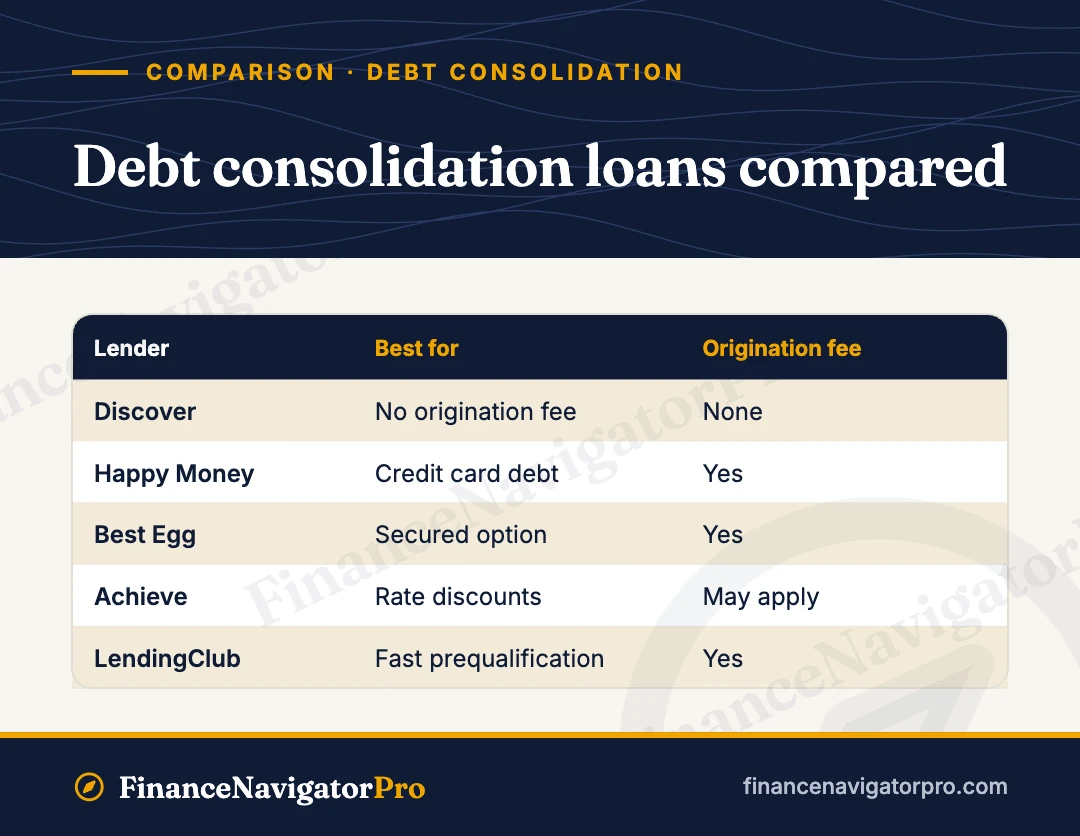
Our top picks at a glance
- Best for no origination fee: Discover Personal Loans — no origination fee and direct payment to creditors.
- Best for credit card debt: Happy Money — loans designed specifically to pay off credit cards.
- Best for a secured option: Best Egg — direct pay plus secured loans that may lower your rate.
- Best for rate discounts: Achieve — several ways to cut your rate, including a co-borrower.
- Best for fast prequalification: LendingClub — soft-pull rate checks and direct payment to creditors.
Your rate depends on your credit score, income and existing debt. Pricing and features checked November 2026; confirm on the provider’s site before signing up.
| Lender | Best for | Loan amounts | Origination fee | Pays creditors directly |
|---|---|---|---|---|
| Discover | No origination fee | $2,500 to $40,000 | None | Yes |
| Happy Money | Credit card debt | $5,000 to $40,000 | Yes | Yes |
| Best Egg | Secured option | $2,000 to $50,000 | Yes | Yes |
| Achieve | Rate discounts | Varies; check offer | May apply | Yes |
| LendingClub | Fast prequalification | Varies; check offer | Yes | Yes |
1. Discover Personal Loans — Best for no origination fee
Discover personal loans charge no origination fee, so you receive the full amount you borrow. For debt consolidation, Discover can send payments straight to your creditors, which makes the process simpler and keeps the money from being spent elsewhere. Discover is now a division of Capital One, N.A., and its loans cannot be used to directly pay off any Capital One account, including Discover and Capital One credit cards.
Pros
- No origination fee
- Direct payment to creditors
- Fixed rates and fixed monthly payments
Cons
- Maximum loan of $40,000 may not cover very large debts
- No rate discount for autopay
- Cannot be used to pay off Capital One or Discover credit cards directly
Price: No origination fee. Rates vary by credit profile.
Who it’s for: Borrowers with good credit who want to avoid upfront fees.
2. Happy Money — Best for credit card debt
Happy Money focuses on one goal: helping people pay off credit card balances. It works with partner lenders, lets you check rates with a soft credit pull and can pay your card issuers directly. It also offers hardship assistance if you run into trouble during repayment.
Pros
- Built specifically for credit card payoff
- Soft-pull prequalification
- Direct payment to creditors and hardship assistance
Cons
- Origination fee on loans
- Loans cannot be used for most other purposes
- No co-signed or joint loans
Price: Origination fee applies; rates vary by credit profile.
Who it’s for: People whose debt is mainly on credit cards and who want a focused payoff plan.
3. Best Egg — Best for a secured option
Best Egg offers personal loans from $2,000 to $50,000 with direct payment to creditors and next-day funding for many borrowers. It also offers secured loans backed by your vehicle or home fixtures, which may help you qualify or get a lower rate.
Pros
- Direct payment to creditors
- Secured loan options that can lower your rate
- Fast funding for many approved borrowers
Cons
- Origination fee on every loan
- No co-signed or joint loans
- A secured loan puts your collateral at risk if you default
Price: Origination fee charged on every loan; rates vary by credit profile and collateral.
Who it’s for: Borrowers who want direct pay and are open to securing the loan for a better rate.
4. Achieve — Best for rate discounts
Achieve offers several ways to reduce your rate: having Achieve send at least 85% of the loan directly to your creditors, applying with a qualified co-borrower or showing sufficient retirement savings. It is available in most, but not all, states.
Pros
- Multiple rate discounts, including for direct payment to creditors
- Co-borrower applications allowed
- Prequalify with a soft credit check
Cons
- An origination fee may apply
- Not available in every state
Price: Origination fee may apply; check your offer.
Who it’s for: Borrowers who can stack discounts, such as by adding a creditworthy co-borrower.
5. LendingClub — Best for fast prequalification
LendingClub lets you check your rate with a soft credit pull, offers direct payment to creditors and is known for quick approval and funding. It is a good benchmark to compare against even if you end up choosing another lender.
Pros
- Soft-pull prequalification
- Direct payment to creditors
- Fast approval and funding
Cons
- Origination fee on loans
- Best rates require strong credit
Price: Origination fee applies; rates vary by credit profile.
Who it’s for: Borrowers who want to see an offer quickly and compare it with others.
How to choose a debt consolidation loan
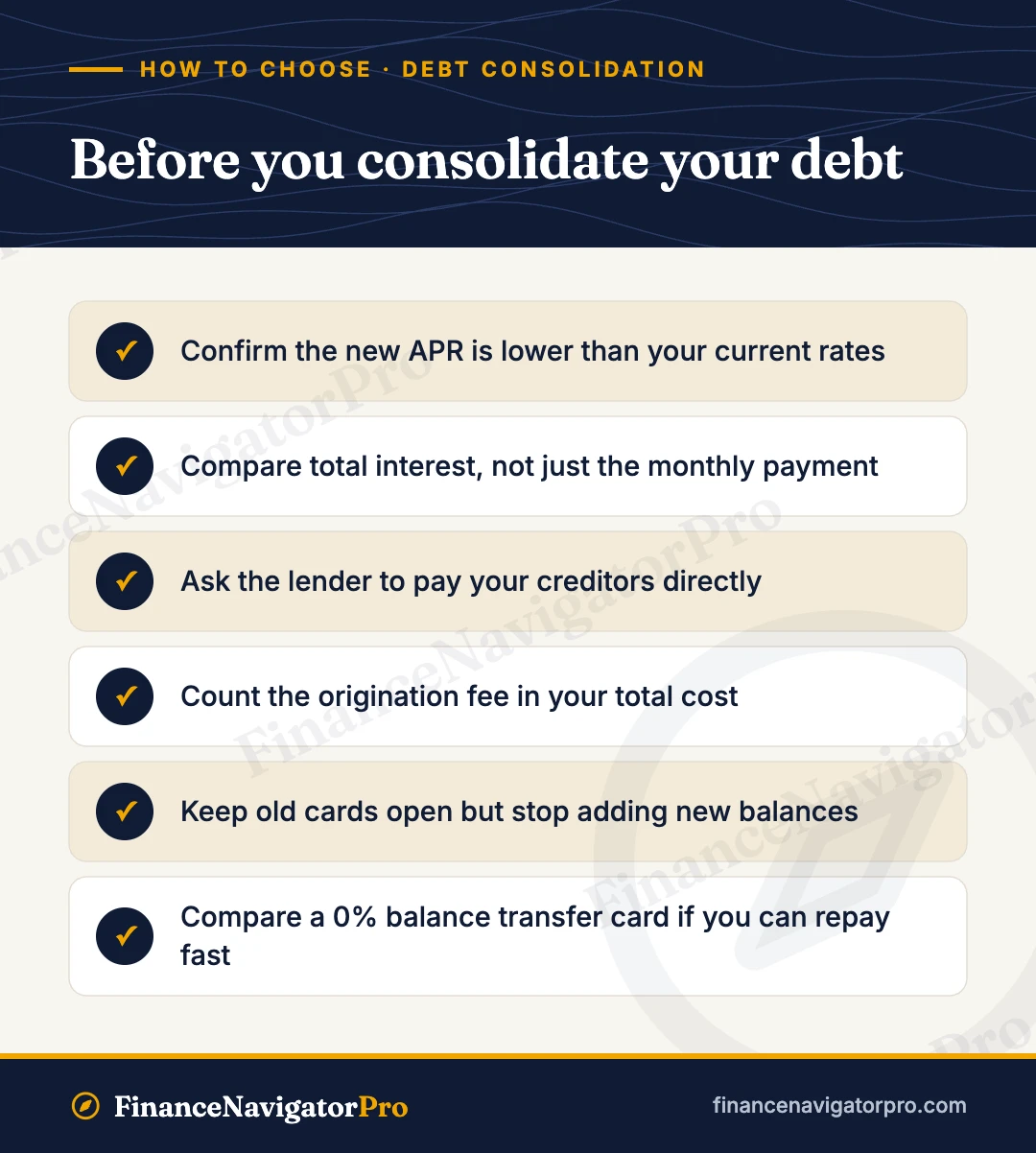
Make sure the new APR is lower
Add up your current balances and their rates. A consolidation loan only saves money if its APR, including any origination fee, is meaningfully lower than what you pay now.
Compare total cost, not just the monthly payment
A longer term can shrink your payment but raise the total interest. If it would take you longer to repay the loan than your current debts, you may pay more overall.
Use direct payment to creditors
Having the lender pay your cards directly removes temptation and sometimes earns a rate discount.
Stop adding new debt
Consolidation fails if you run the paid-off cards back up. Keep the cards open for your credit history if you can, but put them away. Read how to avoid credit card debt.
Consider the alternatives
If you can repay within about 18 to 21 months, a 0% balance transfer card may cost less. Compare the best balance transfer cards, and if you have debts in collections, start with how to pay debt in collections.
How we chose
We compared lenders that commonly fund debt consolidation loans, using information from their websites and reputable 2026 lender reviews. We did not accept payment for placement.
- Direct payment to creditors
- Origination and other fees
- Loan amounts and repayment terms
- Soft-pull prequalification and funding speed
- Rate discounts and hardship support
Run your numbers first
- Compare your current debts with a new loan in the debt consolidation calculator.
- Estimate the loan payment with the personal loan calculator.
- Compare methods with the debt avalanche and debt snowball calculators.
- Check your debt-to-income ratio before you apply.
For broader options, see our guide to the best personal loans and the best debt payoff apps.
Frequently asked questions
Does a debt consolidation loan hurt your credit?
Applying causes a hard inquiry and a small temporary dip. Paying off card balances can lower your utilization and help your score over time. Read does debt consolidation hurt your credit score for details.
What credit score do I need?
Many consolidation lenders look for scores in the 600s or higher, with the best rates for scores of 700 or more.
Should I close my credit cards after consolidating?
Usually not. Keeping them open helps your utilization and credit age. Just avoid running up new balances.
Is debt consolidation the same as debt settlement?
No. Consolidation replaces your debts with a new loan that you repay in full. Debt settlement negotiates to pay less than you owe and can seriously damage your credit.
Can I consolidate debt with bad credit?
It is possible, but rates can be high. A secured loan or a co-borrower may help. If the new APR is not lower than your current rates, consolidation will not save money.
Bottom line
Choose Discover to avoid an origination fee, Happy Money if your debt is mostly on credit cards, Best Egg for a secured option, Achieve to stack rate discounts and LendingClub for a fast benchmark offer. Prequalify with two or three, confirm the new APR is truly lower and commit to keeping the old balances at zero.
Keep reading