On this page
Mortgage rates climbed in 2026, and most forecasters now expect them to stay near 7% through 2027. Here is where rates stand today, what the major housing forecasters predict for 2027, what moves rates and how buyers and homeowners can plan around them.
The short version
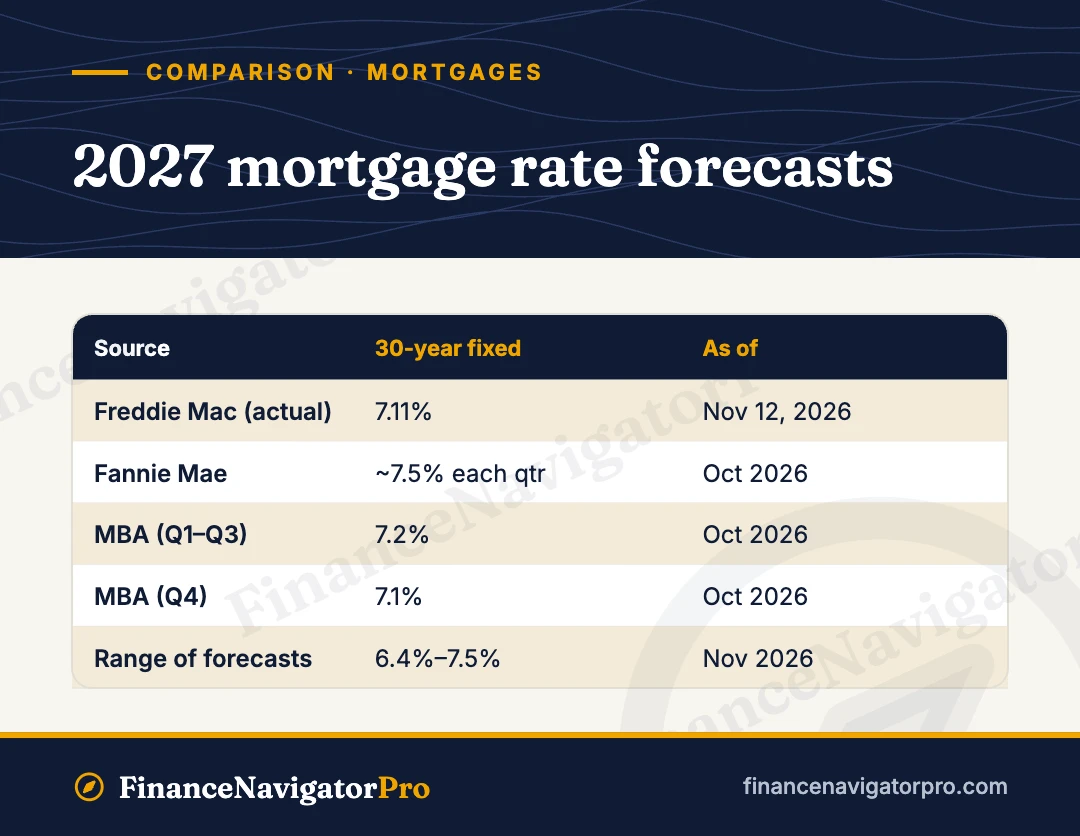
- Today: Freddie Mac’s average 30-year fixed rate was 7.11% for the week of November 12, 2026, down from a 2026 peak of 7.40% in mid-October.
- Fannie Mae: its October forecast called for the 30-year rate to average about 7.5% in every quarter of 2027.
- MBA: expects rates to stay above 7% through 2027, around 7.2% early in the year and 7.1% by the fourth quarter.
- Range: as of mid-November, major published forecasts see the 30-year rate ending 2027 somewhere between about 6.4% and 7.5%.
Where mortgage rates stand now
The 30-year fixed rate started 2026 near 6% and briefly dipped below that level in late February before rising sharply as inflation picked up. It reached 7.40% in mid-October, its highest level in about three years, then eased for several weeks to 7.11% in mid-November. A year earlier, rates were around 6.2%.
2027 mortgage rate forecasts
| Forecaster | 30-year fixed forecast for 2027 | Forecast date |
|---|---|---|
| Fannie Mae | About 7.5% each quarter | October 2026 |
| Mortgage Bankers Association | 7.2% in Q1–Q3, 7.1% in Q4 | October 2026 |
| Range of major forecasts | About 6.4% to 7.5% by year-end | November 2026 |
Forecasts change often, and they have been revised significantly during 2026. Fannie Mae had projected 6.7% for 2027 as recently as September before raising its outlook. Treat any forecast as a range, not a promise.
What drives mortgage rates
- Inflation: higher inflation pushes long-term rates up, and it has been the main reason rates rose in 2026.
- The 10-year Treasury yield: 30-year mortgage rates tend to move with it.
- Federal Reserve policy: the Fed raised its benchmark rate in September 2026 to a range of 3.75% to 4.00%. Fed decisions affect mortgage rates indirectly through expectations and bond markets.
- The economy and jobs: a slowing economy usually brings lower rates; strong growth can keep them higher.
- Your own profile: credit score, down payment, loan type and points all change the rate you are offered.
What it means for buyers
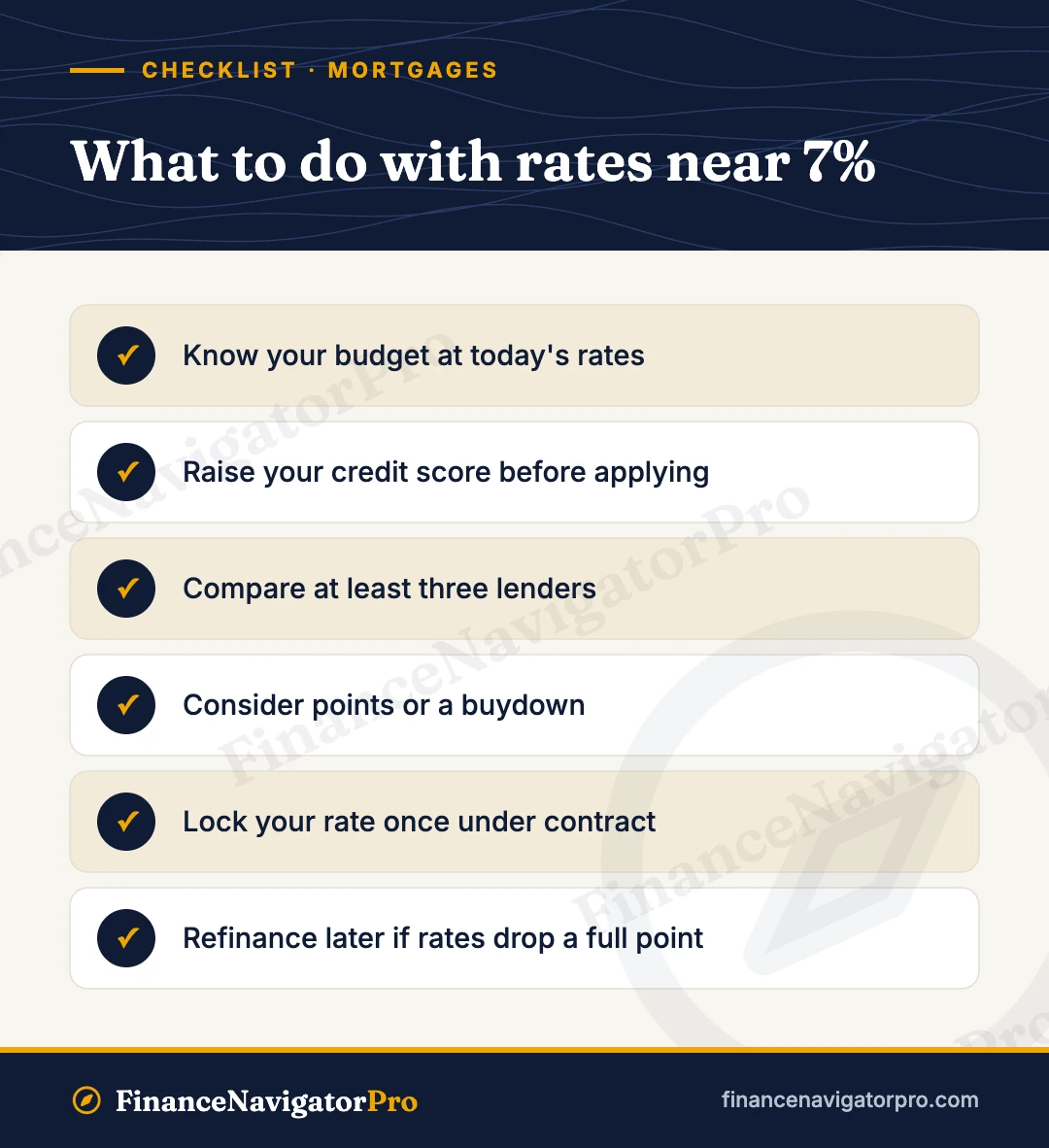
With rates expected to stay elevated, waiting for a big drop may not pay off. Focus on what you can control:
- Know your budget at today’s rates: use the mortgage affordability calculator and read how much house you can afford.
- Raise your credit score: a higher score can lower your rate. See how to raise your credit score fast.
- Compare at least three lenders: rates can differ meaningfully. Start with the best mortgage lenders for first-time buyers.
- Consider points or a buydown: check the math with the mortgage points calculator.
- Lock your rate: once you have a contract, a rate lock protects you if rates rise before closing.
What it means for homeowners
If your current rate is well below 7%, refinancing is unlikely to make sense in 2027. If you need cash, a home equity line of credit lets you borrow without giving up a low first-mortgage rate; compare options in HELOC vs. home equity loan and the best HELOC lenders. If you bought at a higher rate, watch for a drop of roughly a percentage point or more and run the numbers with the refinance calculator. Learn more in refinancing a mortgage.
Run your numbers
- Estimate your payment with the mortgage calculator.
- Compare buying and renting with the rent vs. buy calculator.
- Plan your down payment with the down payment calculator.
Frequently asked questions
Will mortgage rates go down in 2027?
Most major forecasts expect only small changes, with the 30-year rate staying around 7%. A sharp drop would likely require inflation to cool faster than expected.
Should I wait to buy a house until rates drop?
Waiting carries its own risks, including higher home prices and rent. Buy when the payment fits your budget, and refinance later if rates fall enough to make it worthwhile.
How much does a 1% rate difference cost?
On a $350,000 30-year loan, the monthly principal and interest payment is about $2,330 at 7% versus about $2,100 at 6%, roughly $230 a month.
Are 15-year mortgage rates lower?
Yes. 15-year fixed rates are typically lower than 30-year rates, but the monthly payment is higher because you repay the loan faster.
Bottom line
Mortgage rates are about 7% and most forecasters expect them to stay close to that through 2027. Rather than trying to time the market, improve your credit, compare lenders and buy when the payment fits your budget. Forecasts are as of November 2026 and will change. This article is educational and not personal financial advice.
Keep reading