🚗 Complete Guide to Coverage, Cost, Benefits & Whether It’s Worth It
📌 Quick Summary
Roadside Assistance is optional auto insurance coverage that provides emergency help when your vehicle breaks down. It commonly includes towing, flat tire changes, battery jump-starts, fuel delivery, lockout assistance, and winching. It usually costs $3–$10/month when added to an auto insurance policy — often the smartest few dollars you’ll spend on your car.
1. What Is Roadside Assistance Insurance?
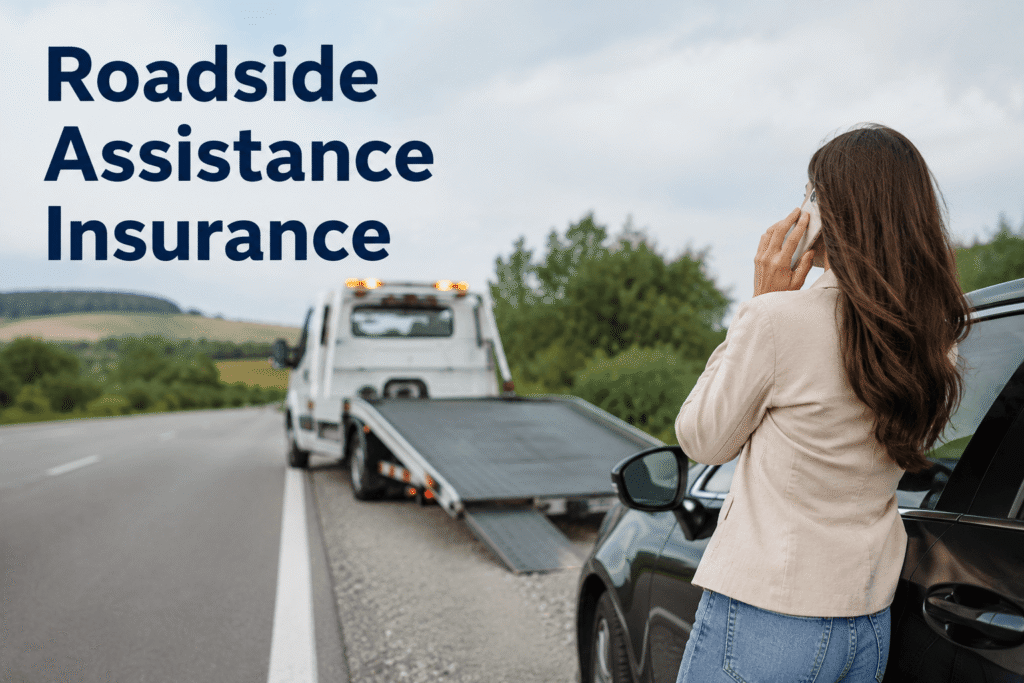
Picture this: a family driving from Dallas to Austin on a Friday evening hits a flat tire on I-35 — in the dark, with two kids in the backseat and a busy highway roaring past. No spare. No nearby service station. That’s exactly the moment roadside assistance was built for.
Roadside assistance insurance is optional coverage you can add to your existing auto insurance policy (called an endorsement) or purchase as a standalone membership. When your car breaks down, you call your insurer or open their mobile app, and they dispatch a local service provider to help you — usually 24 hours a day, 7 days a week, 365 days a year.
Unlike collision or comprehensive coverage, roadside assistance doesn’t pay for accident damage or repairs at a shop. It handles the immediate roadside emergency: getting you unstuck, getting your car started, or getting your vehicle towed to a facility where it can be properly repaired. If you’re not sure which protections your policy already includes, it helps to first review what insurance coverage you actually need before adding this endorsement.
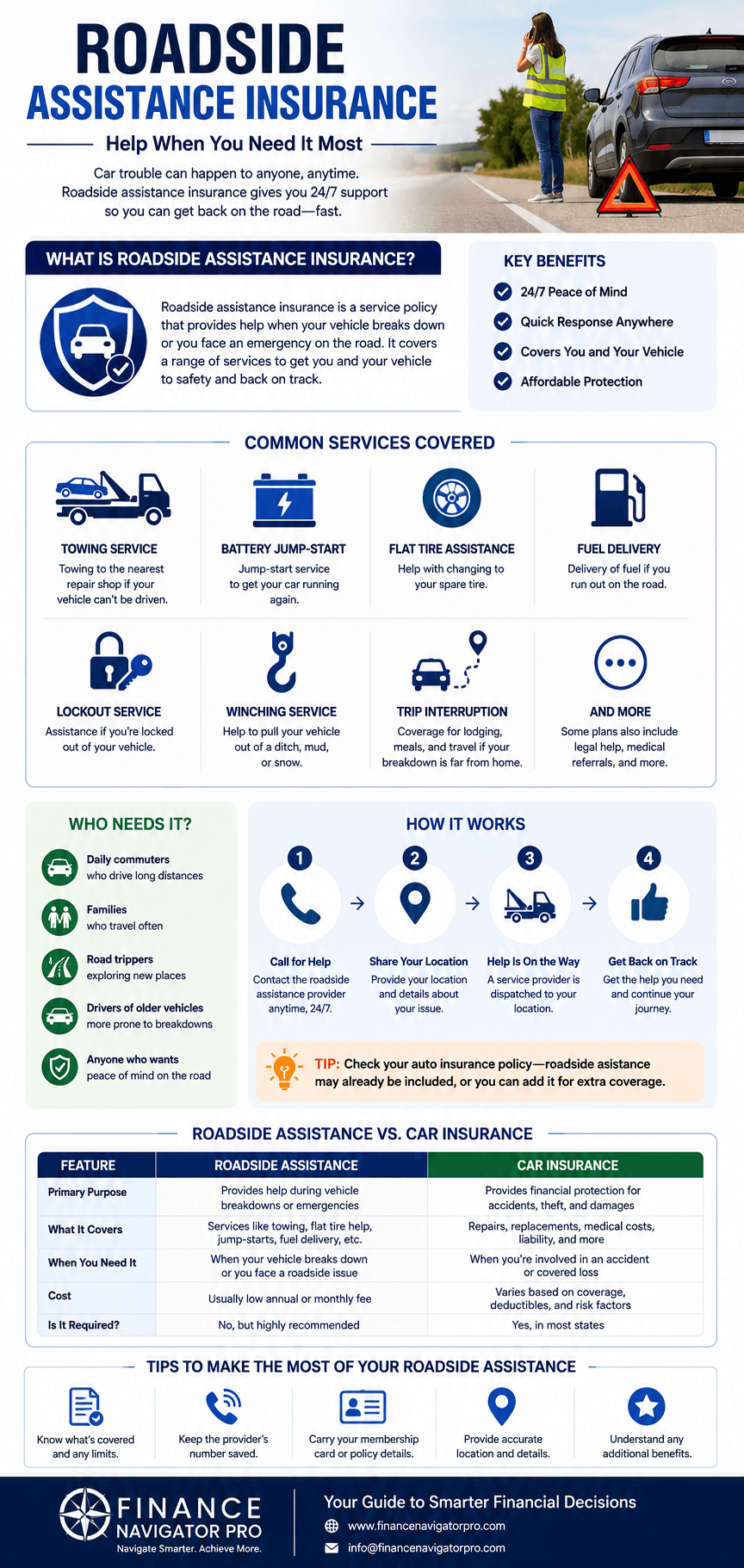
Roadside assistance at a glance: coverage, cost, and how a claim works
🔍 Featured Answer: What is roadside assistance?
Roadside assistance is optional auto insurance coverage (or a membership plan) that sends emergency help when your vehicle breaks down. It covers towing, flat tire changes, battery jump-starts, lockout service, fuel delivery, and winching — available 24/7 by phone or mobile app.
🤖 AI Overview Summary
Roadside assistance is optional auto insurance coverage that provides emergency help when your vehicle breaks down. It commonly covers towing, flat tire changes, battery jump-starts, fuel delivery, lockout assistance, and winching. Added to most auto policies for just a few dollars per month, it removes the stress of being stranded — day or night.
2. How Roadside Assistance Works (Step-by-Step)
When the unexpected happens, here’s exactly what the process looks like:
- Your vehicle breaks down — flat tire, dead battery, empty gas tank, or you’re locked out.
- Contact your insurer by calling the number on your insurance card or opening the insurer’s mobile app.
- Provide your location — GPS-sharing through most apps makes this automatic.
- A dispatcher locates the nearest available service provider in your area.
- You receive an estimated time of arrival (ETA) — typically 30–60 minutes, depending on location.
- A technician arrives and attempts to resolve the problem on-site (tire change, jump-start, fuel delivery, etc.).
- If the issue can’t be fixed roadside, your vehicle is towed to the nearest authorized repair facility or your preferred mechanic within covered mileage limits.
- You pay little or nothing out of pocket — most covered services are included in your policy.
💡 Pro Tip
Always save your insurer’s roadside assistance number in your phone BEFORE you need it. When you’re stranded at night in the rain, the last thing you want to be doing is hunting through your glove box for a card.
3. What Does Roadside Assistance Cover?
Coverage varies by insurer and policy tier, but here’s what you’ll typically find included:
| Emergency | Description | Typical Coverage | Customer Pays? | Avg. Response Time |
|---|---|---|---|---|
| Flat Tire | Technician swaps your flat for your spare | Yes (spare required) | Usually $0 | 30–45 min |
| Battery Jump-Start | Portable charger restarts dead battery | Yes | $0 | 20–40 min |
| Dead Battery Replacement | New battery purchased & installed roadside | Sometimes (partial) | Battery cost | 30–60 min |
| Fuel Delivery | Technician brings 1–3 gallons of gas | Yes | Fuel cost only | 30–60 min |
| Lockout Service | Unlocks vehicle when keys are inside | Yes | $0 | 30–45 min |
| Lost Key Assistance | Locksmith cuts/programs replacement key | Sometimes | Key/programming cost | 60–90 min |
| Towing | Vehicle towed to nearest repair shop | Yes (mileage limits apply) | $0 within limit | 45–90 min |
| Winching | Vehicle pulled out of ditch, mud, or snow | Yes (within road distance) | $0 | 30–60 min |
| Stuck in Snow/Mud | Recovery from off-pavement situations | Sometimes (limits apply) | Varies | 45–90 min |
| Minor Roadside Repairs | Temporary fix to get you to a shop | Limited | Parts cost | Varies |
| EV Towing (Flatbed) | Flatbed tow for electric vehicles | Yes (EV-specific plans) | $0 | 60–90 min |
| EV Charging Assistance | Mobile charge to nearest charging station | Some insurers | Varies | Varies |
| Motorcycle Assistance | Same services for motorcycles | Policy-dependent | Varies | Varies |
4. What ISN’T Covered? (Common Exclusions)
Every roadside assistance plan has fine print. These are the most common reasons claims get denied:
| Exclusion | Why It’s Excluded | What to Do Instead |
|---|---|---|
| Routine Maintenance | Oil changes, tune-ups not ‘emergencies’ | Schedule at a shop |
| Major Repairs | Engine overhauls, transmission work | Use collision/comprehensive coverage |
| Accident Damage | Collision damage is separate coverage | File collision or comp claim |
| Vehicles Over Weight Limit | Heavy trucks, RVs (unless RV plan) | Get specialty RV coverage |
| Commercial Use Vehicles | Work trucks, delivery vehicles | Commercial auto policy |
| Off-Road Recovery | Stuck deep in woods/private land | Specialty off-road coverage |
| Illegal Parking Situations | Vehicle impounded | Not covered — pay tow lot |
| Repeated Abuse | 5+ claims in a policy period | May trigger non-renewal |
| Pre-existing Breakdown | Car was already broken before policy | Coverage starts at policy date |
| Unauthorized Repairs | Repairs done before contacting insurer | Always call insurer first |
| Weather Delays | Extra wait time due to storms | Coverage still applies; just delayed |
5. How Much Does Roadside Assistance Cost?
One of the biggest surprises for new buyers: roadside assistance is remarkably affordable — especially when bundled with your auto policy.
| Plan Type | Monthly Cost | Annual Cost | Best For |
|---|---|---|---|
| Insurance Add-on (bundled) | $3–$10/mo per vehicle | $36–$120/yr | Current policyholders wanting simplicity |
| AAA Classic | $5–$7/mo | $60–$84/yr | Frequent drivers wanting extra perks |
| AAA Plus | $9–$12/mo | $108–$144/yr | Road trippers needing 100-mile towing |
| AAA Premier | $13–$17/mo | $156–$204/yr | High-mileage drivers, RV owners |
| Standalone (Agero, etc.) | $4–$8/mo | $48–$96/yr | Drivers without insurer coverage |
| Manufacturer Plan (new car) | Often $0 (first 2–4 years) | Included | New vehicle owners |
| Credit Card Benefit | $0 (card fee varies) | Included with card | Light users, backup option |
| Per-Use (no plan) | $75–$200+ per call | N/A | Very rare breakdown drivers |
The extra dollar or two for a higher tier is usually worth it — and if you’re trying to keep your overall premium in check while still adding coverage like this, it’s worth pairing it with a broader review of how to lower your insurance premium and checking insurance discounts most people don’t know about — both can offset the small cost of this add-on.
💰 Key Takeaway
The math is simple: if you use roadside assistance just once per year, you’ll almost certainly recoup the entire annual cost of adding it to your policy. A single tow can easily cost $75–$200+ out of pocket.
6. Is Roadside Assistance Worth It?
For most American drivers, yes — but there are exceptions. Here’s a straightforward decision matrix:
Great Value For:
- New and teen drivers who may not know how to handle breakdowns
- College students driving older cars on limited budgets
- Frequent long-distance drivers and road trippers
- Owners of vehicles over 5 years old with higher breakdown probability
- Families with multiple vehicles (multi-car discounts are common)
- Long commuters logging 20,000+ miles per year
- Drivers in rural areas where roadside help is hard to find
May Not Be Worth It If:
- Your new vehicle (under 3 years old) already includes manufacturer roadside assistance
- You carry an active AAA membership — no need to pay twice
- Your premium credit card already provides robust roadside benefits (call to confirm limits)
- You drive a fleet vehicle with employer-provided assistance
- You rarely drive and keep a well-maintained vehicle in pristine condition
⚠️ Watch Out
Before adding roadside assistance to your policy, check whether it’s already included. Some insurers (especially USAA and Nationwide) include limited roadside as a standard policy feature. You could be paying for duplicate coverage without knowing it.
7. What Services Are Included?
Flat Tire Changes
A technician arrives with the tools to safely remove your flat and install your spare. If you don’t have a usable spare (or only have a run-flat tire), your vehicle will be towed instead. Note: the coverage doesn’t pay for a new tire itself — just the labor to change it.
Battery Jump-Starts
Dead battery from leaving your lights on? A technician brings a portable jump-starter and gets you going. If your battery is genuinely dead (not just drained), they may perform a basic test. Battery replacement cost is typically on you.
Fuel Delivery
Ran out of gas? Most plans deliver 1–3 gallons of gas to get you to the nearest station. You pay only for the fuel itself — delivery is free under your coverage. Diesel and premium fuel delivery is available but confirm with your insurer first.
Lockout Assistance
Left your keys inside? A technician or licensed locksmith arrives to unlock your vehicle. This is fully covered with no charge in most plans. Lost or broken key replacement (especially for smart keys) may cost extra.
Winching / Extrication
Slid into a ditch? Got stuck in the mud or soft ground near a road? Winching services pull your vehicle back to solid, drivable ground. Coverage typically applies only within a certain distance of a paved road — deep off-road recovery often isn’t included.
Towing
If your car can’t be repaired roadside, it gets towed. This is where towing mileage limits become important — most insurance-based plans cover 10–25 miles, while AAA Plus covers 100 miles and AAA Premier covers 200+ miles. Going beyond your limit means paying per extra mile.
Emergency EV Charging
A growing number of insurers now offer mobile charging assistance for electric vehicles. A technician provides enough charge to reach the nearest charging station. EV towing is almost always done with a flatbed (not a wheel-lift) to protect the vehicle’s drivetrain.
8. Roadside Assistance vs. AAA — Full Comparison
This is the question we get most often. Here’s a detailed head-to-head — and if pricing is your main concern, it’s also worth cross-checking rates against our list of cheapest car insurance companies before you decide which route to take:
| Feature | Insurance Add-on | AAA Classic | AAA Plus | AAA Premier |
|---|---|---|---|---|
| Monthly Cost (approx.) | $3–$10 | $5–$7 | $9–$12 | $13–$17 |
| Annual Cost (approx.) | $36–$120 | $60–$84 | $108–$144 | $156–$204 |
| Towing Mileage | 10–25 miles | 5–7 miles | Up to 100 miles | 200+ miles |
| Battery Jump-Start | Yes | Yes | Yes | Yes |
| Flat Tire Change | Yes | Yes | Yes | Yes |
| Fuel Delivery | Yes | Yes | Yes | Yes |
| Lockout Service | Yes | Yes | Yes | Yes |
| Winching | Limited | Yes | Yes | Yes |
| RV Assistance | Rarely | No | Add-on | Add-on |
| Motorcycle Coverage | Sometimes | No | Add-on | Add-on |
| Family/Household Members | Per vehicle | Yes (+family fee) | Yes | Yes |
| Travel Discounts | No | Hotels, car rental | Hotels, car rental | Hotels, car rental |
| Identity Protection | No | Some plans | Some plans | Yes |
| Trip Interruption | Rarely | No | Yes | Yes |
| Mobile App | Yes (most) | Yes | Yes | Yes |
| Available 24/7 | Yes | Yes | Yes | Yes |
🔑 Bottom Line
If towing distance is your biggest concern (long rural drives, frequent road trips), AAA Plus or Premier wins hands down. If you just want affordable peace of mind and already have solid auto insurance, the insurance add-on is all most drivers need.
9. Roadside Assistance vs. Towing Coverage
Many drivers use these terms interchangeably — but they’re not the same thing. Towing coverage is a single, narrow benefit: it pays to haul your car from Point A to Point B after a covered incident (like a collision or breakdown).
Roadside assistance is a broader package that includes towing plus all the other services (jump-starts, lockout, fuel delivery, flat tire changes, winching). Think of towing as a subset of roadside assistance.
Some policies offer towing coverage separately — often useful if your comprehensive or collision coverage already pays for the tow after an accident, but you still want emergency help for non-accident situations. A related add-on worth understanding is rental reimbursement coverage, which pays for a temporary car while yours is being repaired — a different protection that pairs well with roadside assistance.
10. Roadside Assistance vs. Mechanical Breakdown Insurance (MBI)
Roadside assistance handles the immediate crisis — it gets you unstuck or towed. Mechanical Breakdown Insurance (MBI) is more like an extended warranty: it covers the actual cost to repair mechanical failures after the fact.
Example: your alternator dies on the highway. Roadside assistance pays for the tow. MBI (if you have it) pays for the alternator replacement at the shop. They work together — you need both for full protection.
MBI is typically sold through insurers like GEICO as an endorsement and is separate from both roadside assistance and standard collision/comprehensive coverage. Not all insurers offer it.
11. Best Auto Insurance Companies Offering Roadside Assistance
| Company | Approx. Monthly | Key Strengths | Best For |
|---|---|---|---|
| State Farm | $5–$9/mo | App-based dispatch, massive agent network, fast response | Best for drivers who value local agent relationships |
| GEICO | $3–$6/mo | Highly rated mobile app, competitive pricing, wide network | Best for budget-conscious drivers who prefer digital management |
| Progressive | $4–$7/mo | Snapshot telematics pairs well, strong multi-car discounts | Best for tech-savvy drivers tracking driving habits |
| Allstate | $5–$10/mo | Good Hands Rescue app, strong customer support | Best for customers wanting full-service insurer experience |
| Nationwide | $3–$7/mo | On Your Side Review perks, sometimes included in base policy | Best for existing Nationwide customers — may already be covered |
| Farmers Insurance | $5–$9/mo | Broad network, strong regional coverage in rural areas | Best for rural and suburban drivers in the Midwest/South |
| Liberty Mutual | $4–$8/mo | Customizable coverage, strong app experience | Best for drivers who want à-la-carte policy building |
| Travelers | $4–$8/mo | Solid towing network, good for multi-vehicle households | Best for multi-policy bundlers (home + auto) |
| USAA | $2–$5/mo | Outstanding service, sometimes included in base policy, lowest rates for military | Best for active military, veterans, and eligible family members |
| AAA (all tiers) | $5–$17/mo | Best towing mileage, extensive travel perks, widest network | Best for road trippers, long-distance drivers, RV owners |
12. Average Roadside Assistance Response Times
Response times vary significantly based on where you are and when you call:
| Location/Condition | Average Wait Time | Key Factors |
|---|---|---|
| Urban / Metro Area | 20–40 minutes | High provider density, traffic congestion |
| Suburban Area | 30–55 minutes | Good coverage, moderate provider availability |
| Rural / Remote Area | 45–90+ minutes | Limited providers, longer travel distances |
| Holiday Weekends | 60–120+ minutes | High call volume, reduced technician availability |
| Severe Weather (ice, heavy snow) | 60–180+ minutes | Technician safety delays, road conditions |
| Peak Hours (5–7 PM weekdays) | 45–75 minutes | High call volume during commuter breakdown peak |
13. Roadside Assistance for Electric Vehicles
EV ownership introduces unique roadside challenges that traditional plans weren’t designed for. Here’s what you need to know:
- Flatbed towing is essential for EVs — wheel-lift towing can damage the electric drivetrain. Always confirm your plan includes flatbed service.
- Mobile charging assistance is available through some insurers and newer roadside apps. A technician delivers enough charge to reach the nearest charging station — typically 10–30 miles of range.
- Tesla vehicles have their own Roadside Assistance program through Tesla, though coverage varies after the standard warranty period ends. Third-party coverage is worth having as backup.
- Range anxiety incidents (running out of charge) may be treated differently than mechanical breakdowns — check your policy language carefully.
- Charging network coverage is improving: apps like GEICO’s and Progressive’s now show EV-specific providers in their dispatch systems.
⚡ EV Tip
If you own an EV, look for roadside assistance plans that explicitly mention ‘flatbed towing’ and ‘mobile charging assistance’ in the coverage details. Generic plans sometimes exclude these or charge extra.
14. Does Using Roadside Assistance Increase Your Insurance Rates?
For most drivers, using roadside assistance will not raise your insurance premiums. Unlike collision or comprehensive claims, roadside assistance claims typically don’t trigger a surcharge or mark against your driving record.
However, there are exceptions to be aware of:
- Excessive claim frequency: If you file 5+ roadside claims in a single policy year, some insurers may flag your policy for review during renewal.
- Policy non-renewal: Extremely frequent use (sometimes called ‘abuse’) can lead an insurer to drop roadside coverage from your policy — though this is uncommon.
- Underlying risk signal: If you’re calling for breakdowns on an aging, high-mileage vehicle constantly, your insurer may use that as an underwriting signal when you renew — but this is rarely the direct mechanism for rate increases.
Bottom line: using your roadside benefit occasionally (1–3 times per year) is exactly what the coverage is designed for. Don’t hesitate to call.
15. How Many Times Can You Use Roadside Assistance?
Limits vary by plan, but here’s the typical landscape:
- Insurance add-ons: Most allow 3–5 service calls per policy period (usually 6 or 12 months).
- AAA Classic: Up to 4 service calls per year.
- AAA Plus / Premier: Up to 4 service calls per year, but with higher limits per call.
- Standalone plans: Some offer unlimited calls with fair-use policies built in.
- Credit card benefits: Often 4–6 service events per year; fuel and labor are sometimes capped at a dollar amount rather than number of calls.
⚠️ Important Note
If you’re approaching your annual call limit, prioritize using roadside for the most critical situations — mechanical breakdowns and towing. For a dead battery you can jump with cables, save your annual call count for emergencies where you truly need a tow.
16. When Should You File a Roadside Assistance Claim?
Use this simple decision tree:
- Is your situation an immediate safety risk? (Dark highway, severe weather, unsafe location) → Call immediately.
- Can you safely fix it yourself? (If you know how to change a tire and have a spare) → Handle it yourself, save your claim count.
- Is the problem beyond your ability to fix? → Call roadside assistance.
- Is a tow truck already on scene (accident)? → Contact your insurer first before authorizing any tow — unauthorized tows may not be reimbursed.
- Are you past your annual call limit? → Ask about paying out-of-pocket rates through the insurer’s network vs. finding your own provider.
17. State-Specific Differences in Roadside Assistance
While roadside assistance is available nationwide, a few state-level factors affect your experience:
| State | Notable Considerations |
|---|---|
| California | Dense urban network in LA/SF means faster response. Rural areas like the Sierra Nevada can see 90+ min waits. CA DOT operates a Freeway Service Patrol on major highways during peak hours. |
| Texas | Huge geographic coverage gaps in West Texas and the Panhandle. Long towing distances mean AAA Plus/Premier is especially valuable. Hurricane season can spike demand August–October. |
| Florida | High humidity and heat stress batteries severely — breakdown rates are above average. Hurricane evacuation routes get congested. Some plans limit service during declared emergencies. |
| New York | NYC has excellent provider density but heavy traffic delays. Rural Upstate NY and Adirondack region can have very slow response times. Winter conditions November–March are demanding. |
| Illinois | Chicago metro is well-served. Deep winter storms in January–February cause serious delays. Rural southern Illinois has thinner coverage networks. |
| Pennsylvania | Mountain terrain (Appalachians) means some areas are hard to reach. Turnpike breakdowns are common; PA Turnpike has emergency call boxes at intervals. |
| Arizona | Extreme summer heat is the #1 battery killer — Phoenix sees very high summer breakdown rates. Desert highway breakdowns can be dangerous; prioritize fast coverage. |
| Colorado | Mountain passes and winter driving conditions create unique challenges. High altitude can affect some vehicles. AAA or a plan with longer towing mileage is smart for mountain residents. |
| Georgia | Atlanta traffic makes response times variable 4–7 PM weekdays. Rural South Georgia has thinner coverage. Hurricane season affects coastal areas. |
| Washington | Seattle metro is well-covered. Cascade Mountain passes create remote breakdown risks. Rainy season increases flat tire and battery claims October–March. |
18. Common Mistakes Drivers Make with Roadside Assistance
- Calling a random tow truck before contacting their insurer — unauthorized tows are often not reimbursed.
- Providing an inaccurate location. In rural areas especially, giving the wrong highway exit or mile marker can add 30–45 minutes to your wait.
- Not knowing their towing mileage limit — and getting surprised by a $4/mile overage charge at the shop.
- Assuming roadside assistance covers on-site repairs — most plans cover labor to get you unstuck or towed, not actual parts and repair costs.
- Ignoring the policy’s call limits and burning 3 of 4 annual calls on issues they could handle themselves.
- Not checking if they already have coverage (manufacturer warranty, credit card, employer fleet).
- Waiting too long to call — especially in extreme heat or cold, where vehicle and driver safety becomes a concern quickly.
19. Real-Life Roadside Assistance Scenarios
Scenario 1: Dead Battery (Atlanta, 7:30 AM)
Marcus heads to work Monday morning — nothing. Dead battery. He opens his insurer’s app, shares his location, and a technician arrives in 28 minutes. Jump-start successful. Total out-of-pocket cost: $0. He still makes his 9 AM meeting.
Scenario 2: Flat Tire (I-10, West Texas, 11 PM)
Sandra is driving between El Paso and San Antonio when she hits debris and blows her rear tire. She calls roadside assistance — response time is 65 minutes in that rural stretch. Technician swaps in her spare, she drives to the next town for a replacement tire. Total paid: $0 for the service, $180 for a new tire at the shop.
Scenario 3: Locked Out (Minneapolis Parking Garage, -8°F)
Tom locks his keys in his car while loading groceries. He calls in via the mobile app. A locksmith arrives in 40 minutes (longer due to winter congestion). Car unlocked, no damage. Total out-of-pocket: $0.
Scenario 4: Running Out of Gas (Florida I-75)
Alicia misjudges how far she can go on E and coasts to the shoulder. She calls roadside — technician arrives with 2 gallons of regular in 35 minutes. She drives to the next exit. Alicia pays for the gas ($7.40). The delivery is free under her policy.
Scenario 5: Stuck in Snow (Colorado Mountain Pass)
David spins out on an icy mountain road and gets stuck in a snowdrift off the pavement edge. Winching service pulls him back to the road in 55 minutes. No damage to the vehicle. Total cost: $0 — covered under his AAA Plus membership.
Scenario 6: EV Range Depletion (Phoenix, 108°F)
Priya’s Tesla Model Y runs out of charge during an unusually long detour. Her insurer offers mobile EV assistance — a technician arrives with a portable charger and provides 15 miles of range, enough to reach a Supercharger 8 miles away. Flatbed tow would have been the backup. Total cost: $0.
20. Roadside Assistance Buying Checklist
Before purchasing, run through this checklist:
- Check existing coverage: Do I already have roadside through my manufacturer warranty, AAA, credit card, or employer?
- Compare towing mileage: Does the towing limit make sense for where I live and drive?
- Confirm 24/7 availability and mobile app support.
- Check the annual call limit — is 3 calls/year enough, or do I need more?
- Verify EV-specific coverage if I own or plan to buy an electric vehicle.
- Review the exclusion list — particularly off-road recovery and commercial vehicle clauses.
- Ask about multi-vehicle and household discounts.
- Confirm whether using the benefit will affect my premium.
- Read response time reviews for my specific geographic area.
- Compare the insurance add-on price vs. standalone membership value.
21. Pros and Cons of Roadside Assistance Coverage
| ✅ Pros | ❌ Cons |
|---|---|
| ✓ Very affordable ($3–$10/month) | ✗ Towing mileage limits can catch you off guard |
| ✓ Available 24/7 — day, night, holidays | ✗ Annual call limits (usually 3–5) |
| ✓ Peace of mind for long drives | ✗ Doesn’t cover actual repair costs |
| ✓ No premium impact for normal usage | ✗ Response times vary (especially rural) |
| ✓ Mobile app dispatch makes it easy | ✗ Some plans exclude winching or off-road recovery |
| ✓ Covers multiple common emergencies | ✗ Duplicate coverage if you already have AAA or manufacturer plan |
| ✓ Often covers whole vehicle, not driver | ✗ Credit card coverage often has low dollar caps |
| ✓ EV-specific options growing | ✗ Quality of local dispatch providers can vary |
If you own a classic or older vehicle that’s more breakdown-prone, it’s also worth reading up on collector car insurance or antique car insurance, since standard roadside plans sometimes treat these vehicles differently.
22. Expert Tips to Save Money on Roadside Assistance
- Bundle with your existing auto policy — almost always cheaper than a standalone membership.
- Avoid duplicate coverage — if your new car has manufacturer roadside for 3 years, wait until it expires before adding a separate plan.
- Compare towing mileage before buying, not after — if you live close to a repair shop, a basic 10-mile plan is fine. Road trippers need more.
- Check your credit cards — Visa Signature, Chase Sapphire, and Amex Platinum all include some roadside benefits. Read the fine print on caps.
- Use family or household coverage to cover multiple drivers under one membership (AAA allows this).
- Review your plan annually — as your vehicle ages or you change driving habits, your needs may shift.
23. Frequently Asked Questions (35 FAQs)
Q1: What is roadside assistance?
Roadside assistance is optional auto insurance coverage (or a membership) that provides 24/7 emergency help when your vehicle breaks down. It typically covers towing, flat tire changes, battery jump-starts, fuel delivery, lockout service, and winching.
Q2: Is roadside assistance worth it?
For most drivers, yes — especially if you drive an older vehicle, commute long distances, or frequently road trip. At $3–$10/month, a single tow pays for the entire year.
Q3: Does auto insurance cover towing?
Not by default. Towing is typically only covered if you add roadside assistance or a towing endorsement to your policy.
Q4: Can I use roadside assistance immediately after purchasing?
Usually yes — most policies activate immediately. However, some insurers have a brief waiting period (24–72 hours). Confirm with your insurer at purchase.
Q5: How many times can I use roadside assistance?
Most insurance-based plans allow 3–5 service calls per policy period. AAA typically allows 4 per year. Some standalone plans offer unlimited calls.
Q6: Will using roadside assistance raise my insurance rates?
Typically no. Roadside claims don’t affect your driving record or premium in most cases. Excessive use (5+ calls/year) may draw review at renewal.
Q7: Does roadside assistance cover flat tires?
Yes — a technician will change your flat with your spare if one is available. If you have no spare, your car will be towed.
Q8: Will roadside assistance bring me gasoline?
Yes — most plans deliver 1–3 gallons to your location. You pay only for the fuel itself; delivery is covered.
Q9: Can someone else use my roadside assistance?
Coverage is usually tied to the vehicle, not the driver. Anyone driving your covered vehicle can request service. Some policies vary — confirm with your insurer.
Q10: Does roadside assistance cover motorcycles?
Sometimes, but not always automatically. Some insurers offer motorcycle-specific roadside coverage as an add-on. AAA offers a separate motorcycle plan.
Q11: Is roadside assistance tax deductible?
Generally, no — for personal vehicles. If the vehicle is used for business purposes, there may be deductibility; consult a tax professional.
Q12: Can I cancel roadside assistance at any time?
Yes — it’s an optional endorsement you can remove at renewal or mid-term (you may receive a prorated refund). AAA memberships are cancelable with refund policies that vary.
Q13: Does roadside assistance cover rental cars?
Some plans do, some don’t. Check your policy. Credit card roadside benefits often cover rental cars you’ve charged to that card.
Q14: Does roadside assistance cover EV charging?
A growing number of insurers offer mobile EV charging assistance, but it’s not universal. Verify before you buy if you own an electric vehicle.
Q15: How long does roadside assistance take to arrive?
Typically 20–60 minutes in urban and suburban areas. Rural areas can see 60–90+ minute waits, especially during bad weather or holidays.
Q16: What if my car can’t be fixed on the spot?
If the problem can’t be resolved roadside, your vehicle will be towed to the nearest authorized repair facility within your covered towing mileage.
Q17: Does roadside assistance cover winching?
Yes, most plans cover winching to pull your vehicle out of a ditch or off soft ground, provided you’re not deep off-road. Check your plan’s specific language.
Q18: Is roadside assistance the same as towing insurance?
No. Towing insurance only covers getting your vehicle hauled. Roadside assistance is a broader package that includes towing plus many other emergency services.
Q19: Can I use roadside assistance for a vehicle that isn’t mine?
Coverage is vehicle-specific, not driver-specific. You need to be driving a vehicle listed on your policy (or a vehicle on an AAA membership) to use the benefit.
Q20: What happens if I go over my towing mileage limit?
You’ll typically pay a per-mile overage fee — often $3–$6 per extra mile. For long tows, this can add up fast. Consider AAA Plus if you often need long-distance tows.
Q21: Does roadside assistance cover me in another state?
Yes — coverage is typically nationwide across the continental U.S. Some plans also cover Canada and Mexico. Confirm coverage geography when you buy.
Q22: What should I do while waiting for roadside assistance?
Stay in your vehicle if on a busy highway (especially at night). Turn on your hazard lights. If you must exit, stay well off the road. Use flares or reflective triangles if available.
Q23: Does roadside assistance cover new cars?
New vehicles often come with manufacturer roadside assistance (1–5 years). Check your warranty documentation — you may already be covered and can skip paying for it separately.
Q24: Can I get roadside assistance without a car insurance policy?
Yes. Standalone plans (AAA, Agero, Better World Club, etc.) and credit card benefits are available independently of an auto insurance policy.
Q25: What is the difference between AAA and roadside assistance through insurance?
AAA is a standalone membership with travel perks, longer towing distances, and household coverage. Insurance-based roadside is cheaper, vehicle-tied, and simpler — but with shorter towing limits.
Q26: Does roadside assistance cover a dead battery replacement?
Jump-starting a dead battery is covered. Buying and installing a new battery typically isn’t — you pay for the battery itself, though some plans may offer a discount on batteries.
Q27: Does roadside assistance cover accidents?
No. After an accident, your collision or comprehensive coverage applies. Roadside assistance handles mechanical breakdowns and emergency non-accident situations.
Q28: Can I add roadside assistance to my policy mid-term?
Usually yes. Contact your insurer to add the endorsement anytime. Coverage typically starts immediately or the next day.
Q29: Does roadside assistance cover RVs or motorhomes?
Standard plans often don’t cover large RVs. Specialty RV roadside coverage is available through some insurers and through AAA’s RV add-on.
Q30: What is a towing mileage limit?
The maximum distance your insurer will tow your vehicle for free. Basic plans cover 10–25 miles; AAA Plus covers 100 miles; AAA Premier covers 200+ miles. Beyond the limit, you pay per mile.
Q31: Does roadside assistance cover trailers?
Many plans don’t cover trailers automatically. Some extend coverage to trailers attached to a covered vehicle. Confirm with your insurer before you hit the road with a boat or camper trailer.
Q32: Is there a deductible for roadside assistance?
No — roadside assistance claims don’t have a deductible. Covered services are included in your plan, with the only out-of-pocket cost being for things like fuel or the battery itself.
Q33: What is ‘dispatch’ in roadside assistance?
Dispatch is the process where your insurer’s coordination center finds and contacts a local service provider to come to your location. Modern apps automate this using GPS.
Q34: Can I call my own tow truck and get reimbursed?
Some plans allow reimbursement if you pay out of pocket for a covered service in an area with no network provider. The reimbursement limit is usually capped. Always try the insurer’s number first.
Q35: Does roadside assistance cover locksmith services for lost keys?
Unlocking your car (lockout service) is typically covered. Creating a new smart key or programming a key fob usually isn’t — you’d pay the locksmith or dealership for that.
24. Glossary of Roadside Assistance & Auto Insurance Terms
| Term | Definition |
|---|---|
| Battery Jump-Start | A service where a technician uses a portable power pack or cables to restart a vehicle with a dead battery. |
| Breakdown | A situation where a vehicle stops functioning and cannot be driven due to mechanical failure. |
| Comprehensive Coverage | Auto insurance that covers non-collision damage such as theft, weather, and fire. |
| Collision Coverage | Auto insurance that pays for damage to your vehicle caused by a collision with another vehicle or object. |
| Dead Battery | A battery that has lost its charge and cannot start the vehicle’s engine. |
| Deductible | The amount a policyholder pays out of pocket before insurance coverage kicks in — see how insurance deductibles work. Roadside assistance typically has no deductible. |
| Dispatch | The process of a coordination center locating and sending a service provider to an insured’s location. |
| Endorsement | An add-on to a standard insurance policy that extends or modifies coverage — roadside assistance is typically added as an endorsement. |
| Extrication | Pulling a vehicle out of a stuck situation, such as a ditch, mud, or snowbank — also called winching. |
| ETA (Estimated Time of Arrival) | The approximate time a technician or tow truck is expected to reach your location. |
| EV (Electric Vehicle) | A vehicle powered entirely or partially by an electric motor drawing energy from rechargeable batteries. |
| Fair Use Policy | A clause in unlimited-call plans that limits claims to a reasonable number per year to prevent abuse. |
| Flatbed Tow Truck | A tow truck with a flat platform that carries the vehicle entirely off the road — required for EVs and many modern vehicles. |
| Fuel Delivery | A service where a technician delivers a small amount of fuel (usually 1–3 gallons) to a stranded driver who has run out. |
| Gap Insurance | Coverage that pays the difference between a totaled vehicle’s actual cash value and the outstanding loan balance. |
| Hazard Lights | Flashing vehicle lights used to signal a breakdown or emergency — also called four-ways or flashers. |
| Household Coverage | A benefit structure (common in AAA) that covers all eligible household members under one membership. |
| Key Fob | An electronic device that remotely locks, unlocks, or starts a vehicle. Replacement requires programming, which is usually not covered under roadside. |
| Labor Coverage | Coverage for on-site labor costs for emergency repairs — typically limited to roadside labor, not shop repairs. |
| Lockout Service | Emergency service to unlock a vehicle when the driver is locked out — typically when keys are left inside the vehicle. |
| Mechanical Breakdown Insurance (MBI) | An insurance product that covers the cost of repairing mechanical failures — not to be confused with roadside assistance. |
| Mobile App Dispatch | A smartphone-based method of requesting roadside assistance that uses GPS to share your location automatically. |
| Policy Endorsement | See Endorsement. |
| Policy Period | The duration your insurance policy is active — typically 6 or 12 months. |
| Premium | The amount you pay for insurance coverage, typically monthly or annually. |
| Remote Start | An electronic feature allowing you to start a vehicle remotely — not a roadside assistance service. |
| Roadside Assistance | Emergency service coverage that helps drivers when their vehicle breaks down — covering towing, tire changes, jump-starts, fuel delivery, lockout, and winching. |
| Run-Flat Tire | A tire designed to continue operating after a puncture for a limited distance — vehicles with run-flats often don’t carry a spare. |
| Service Call | Each use of a roadside assistance benefit. Most plans limit calls to 3–5 per policy period. |
| Spare Tire | A backup tire stored in a vehicle for emergency use when a primary tire fails. |
| SR-22 | A form required by some states to prove minimum liability insurance — unrelated to roadside, but sometimes confused. |
| Towing Mileage Limit | The maximum distance an insurer will tow your vehicle under a covered roadside claim before per-mile charges apply. |
| Underinsured Motorist Coverage | Coverage that pays when the at-fault driver has insufficient insurance to cover your damages. |
| Uninsured Motorist Coverage | Coverage that pays when the at-fault driver has no insurance. |
| Winching | Using a motorized cable and drum mechanism to pull a stuck vehicle back onto a drivable surface. |
| Wheel-Lift Tow | A tow method using a frame to lift two wheels off the ground — not appropriate for EVs or AWD vehicles. |
25. Final Verdict — Should You Get Roadside Assistance?
After 25 sections, 35 FAQs, and a full glossary, here’s the straight answer:
For most American drivers, roadside assistance coverage is one of the highest-value, lowest-cost additions you can make to your auto insurance policy. At $3–$10 per month, you’re buying 24/7 peace of mind that a single breakdown would otherwise cost you $75–$200+ out of pocket.
Buy Roadside Assistance If You:
- Drive a vehicle more than 4–5 years old
- Commute long distances or frequently road trip
- Are a new, teen, or senior driver
- Live in a rural area or frequently drive remote highways
- Own an electric vehicle (ensure EV-specific coverage)
- Don’t have AAA, manufacturer warranty, or credit card coverage already
Consider Skipping (or Delaying) If You:
- Own a new vehicle still under manufacturer roadside warranty
- Already have active AAA membership
- Have a premium credit card with confirmed, robust roadside benefits
- Drive a fleet vehicle with employer-provided assistance
Money-Saving Final Tips:
- Always add roadside as an insurance endorsement rather than standalone — it’s almost always cheaper.
- Confirm you don’t have duplicate coverage before paying.
- If you’re a road tripper or rural driver, spend the extra few dollars for higher towing mileage (AAA Plus or equivalent).
- Review your coverage annually — your needs change as your vehicle ages.
🏁 The Bottom Line
Roadside assistance won’t fix your engine or pay for new tires. But when you’re stranded on a dark highway at midnight with two kids in the car and a flat tire, it’s worth every penny of the $5 a month you paid. Get it, keep it, and drive with confidence.
Related Auto Insurance Guides
Explore these related resources to build a complete understanding of your auto insurance coverage:
- What Insurance Coverage Do You Need? — Build a complete policy around the right protections
- Rental Reimbursement Coverage Guide — A temporary car while yours is being repaired
- Usage-Based Insurance (UBI) — How telematics programs can lower your premium
- Cheapest Car Insurance Companies — Compare top U.S. insurers
- Insurance Deductibles Explained — What you pay before insurance kicks in
- How to Lower Your Insurance Premium — Practical ways to cut your costs
- Insurance Discounts Most People Miss — Hidden savings on your policy
- Mistakes That Make Insurance Expensive — Avoid common costly errors
- Collector Car Insurance — Coverage built for classic and collectible vehicles
- Antique Car Insurance — Specialty coverage for vintage vehicles
Sources & External References
- National Highway Traffic Safety Administration (NHTSA) — nhtsa.gov
- Insurance Information Institute (III) — iii.org
- National Association of Insurance Commissioners (NAIC) — naic.org
- Federal Highway Administration (FHWA) — fhwa.dot.gov
- AAA Membership Information — aaa.com