⚡ Quick Answer
Personal Injury Protection (PIP) is a mandatory or optional auto insurance coverage that pays for medical expenses, lost wages, funeral costs, and essential services for you and your passengers after a car accident — regardless of who was at fault. Required in 12 no-fault states, PIP typically covers up to your selected policy limit ($2,500–$250,000 or more depending on the state).
Picture this: you’re driving home after a long day at work, stopped at a red light, when — bam — a car rear-ends you at 30 miles per hour. Airbags don’t deploy. You walk away shaken but think you’re fine. Two days later, your neck is stiff, your back is aching, and your doctor wants an MRI. The bill? Nearly $3,000. And the insurance companies are still fighting over who’s at fault.
That’s exactly the situation Personal Injury Protection (PIP) was designed to solve.
Unlike traditional liability coverage that waits for fault to be determined, PIP kicks in immediately after an accident. It pays your medical bills, covers your lost wages while you’re recovering, and even helps with childcare if your injuries sideline you. No blame game. No months of waiting.
In this complete guide, you’ll learn exactly how PIP works, what it covers, how much it costs, which states require it, and how to decide whether you need it. Whether you’re shopping for a new policy, reviewing your existing coverage, or just trying to understand your options after an accident, you’re in the right place. If you’re still weighing which coverages actually belong on your policy, our guide to what insurance coverage you need is a useful starting point.
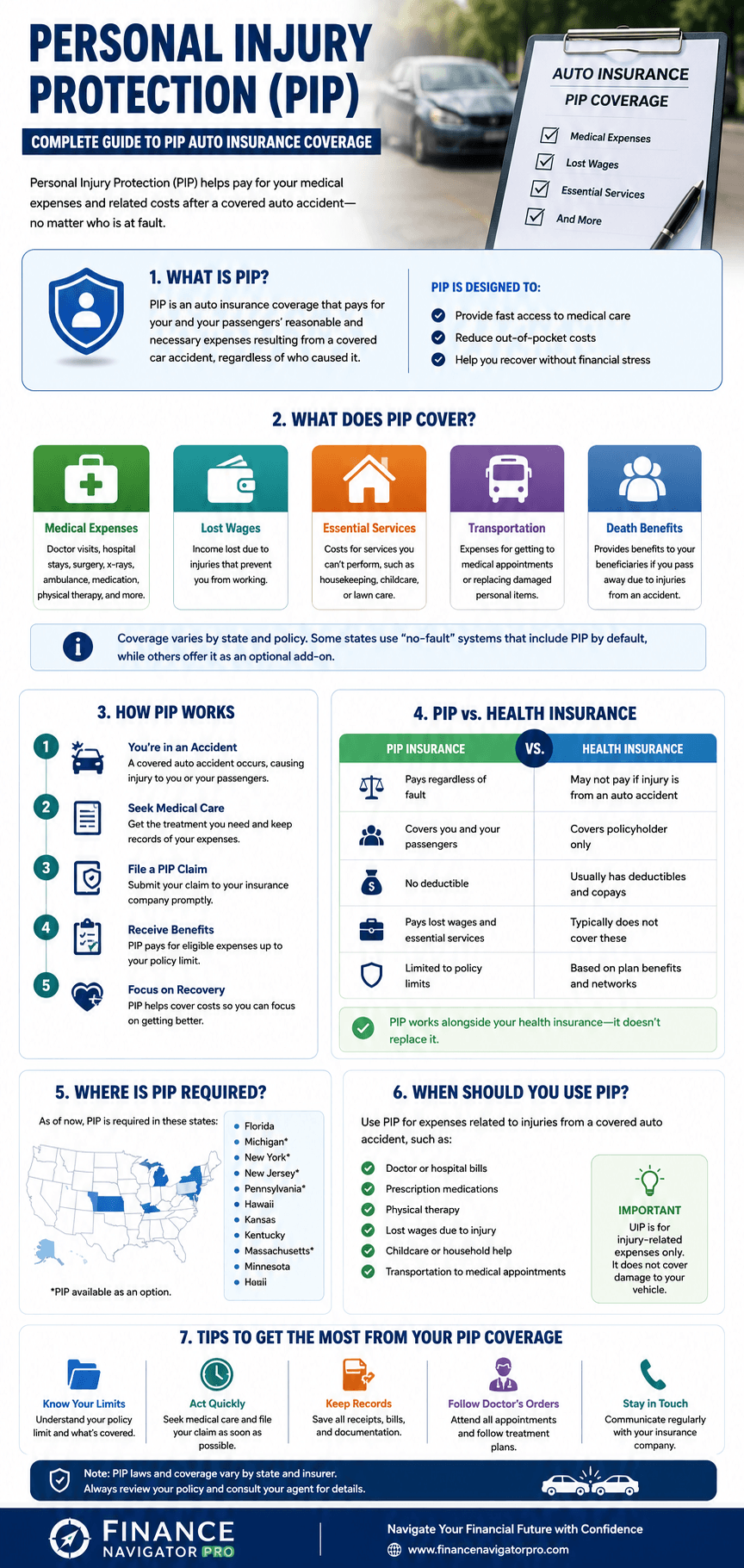
Personal Injury Protection (PIP) at a glance: what it covers, who it protects, and state-by-state requirements.
Section 1: What Is Personal Injury Protection (PIP)?
Personal Injury Protection, almost always shortened to PIP, is an auto insurance coverage that pays for medical and related expenses after a car accident — no matter who caused it. That last part is the key: PIP doesn’t care about fault. You don’t have to wait for police reports, insurance investigations, or lawsuits to conclude. You file a claim, and PIP pays.
The History Behind PIP
PIP emerged in the 1970s as a response to a broken system. Back then, every accident turned into a legal battle over fault before any injured person received a dime. Courts were flooded, insurance companies were overwhelmed, and accident victims were left waiting months — sometimes years — for medical bills to be settled.
States started adopting “no-fault” insurance laws, which required drivers to carry PIP coverage so their own insurance would cover basic medical expenses regardless of who was responsible. The goal was to reduce litigation, get accident victims treated faster, and lower overall costs across the system.
Today, 12 states have mandatory PIP requirements: Florida, Hawaii, Kansas, Kentucky, Massachusetts, Michigan, Minnesota, New Jersey, New York, North Dakota, Oregon, and Utah. Several others offer it as an optional add-on.
No-Fault vs. At-Fault: The Foundation
The concept of “no-fault” insurance is central to understanding PIP. In a no-fault state, drivers turn to their own insurance company after an accident for basic injury expenses — regardless of who hit whom. In exchange for faster payment, no-fault laws often restrict your ability to sue the other driver unless your injuries meet a certain threshold of severity.
In at-fault states, the driver responsible for the accident (or their insurance company) pays for the injured party’s expenses. This can create delays and disputes. PIP is often available as optional coverage in at-fault states to provide a financial cushion while fault is determined.
💡 Expert Insight
Think of PIP as your personal financial first responder. When an accident happens, PIP doesn’t wait for the courts or other insurance companies to decide who’s responsible. It gets you the money you need, when you need it most.
✅ Key Takeaway
PIP is your own insurance covering your own injuries after an accident, regardless of fault. It’s required in no-fault states and optional (but valuable) in many others.
Section 2: How Does PIP Insurance Work?
Understanding how PIP functions in the real world helps you use it effectively when it matters most. Here’s the step-by-step process from accident to payment:
Step 1 — The Accident Occurs
An auto accident happens — whether you rear-ended someone, were T-boned at an intersection, or were hit by a driver running a red light. PIP coverage is triggered by the accident itself, not by the determination of fault.
Step 2 — Seek Medical Treatment
Get medical treatment immediately. Most PIP policies require you to seek treatment within a specific window — often 14 days — to qualify for benefits. Don’t delay. Going to the emergency room or urgent care right away not only protects your health but also protects your PIP claim.
Step 3 — File Your PIP Claim
Contact your own auto insurance company and report the accident. You’ll file a PIP claim with your insurer — not the other driver’s company. Your insurer will assign a claims adjuster and provide the forms you need. Keep records of everything: doctor visits, prescriptions, and time missed from work.
Step 4 — Your Insurance Reviews and Pays
Your insurance company reviews your medical bills, lost wage documentation, and other submitted expenses. In most no-fault states, insurers are required to pay valid PIP claims within 30 days of receiving complete documentation. This is dramatically faster than waiting for a liability claim to settle.
Step 5 — Benefits Continue Until Exhausted
PIP pays benefits until either your medical treatment is complete or your policy limits are reached — whichever comes first. If your bills exceed your PIP limit, you may need to turn to your health insurance or pursue a claim against the at-fault driver (if your state allows it).
⚠️ Important Deadline Warning
Most states require you to file a PIP claim within a set timeframe — commonly 30 days to 2 years after the accident. Missing this deadline can result in a denied claim. Know your state’s rules and file promptly.
✅ Key Takeaway
PIP is a straightforward, first-party claim process. You deal with your own insurer, not the at-fault driver’s company, which typically means faster resolution and payment.
Section 3: What Does PIP Cover?
PIP is broader than most people realize. It’s not just a medical payment plan — it covers the real-life financial disruptions caused by an accident injury. Here’s a comprehensive breakdown:
| Expense Category | Typically Covered? | Details |
|---|---|---|
| Emergency Room Visits | Yes | ER treatment immediately following the accident |
| Ambulance Bills | Yes | Ground and air ambulance transport costs |
| Surgery & Hospital Stays | Yes | Inpatient and outpatient surgical procedures |
| Doctor Visits | Yes | Follow-up care, specialist consultations |
| Prescription Drugs | Yes | Medications related to accident injuries |
| Physical Therapy | Yes | Rehab and physical therapy sessions |
| Rehabilitation Services | Yes | Occupational therapy, chiropractic care (varies by state) |
| Dental Treatment | Varies | Injury-related dental treatment (state-dependent) |
| Mental Health Counseling | Varies | Some states cover psychological treatment |
| Lost Wages | Yes (most states) | Income lost due to inability to work (usually 60–80%) |
| Childcare Expenses | Yes (some states) | When injuries prevent you from caring for children |
| Household Services | Yes (some states) | Cleaning, lawn care you can no longer perform |
| Funeral Expenses | Yes | Death benefits for accident fatalities |
| Survivor Benefits | Yes (some states) | Income replacement for surviving family members |
| Passenger Injuries | Yes | Passengers in your vehicle are typically covered |
| Pedestrian Injuries | Varies | Pedestrians struck by your vehicle (state-dependent) |
Medical Expenses in Depth
The most critical component of PIP is medical expense coverage. This includes everything from the ambulance ride to the hospital, through surgery and hospitalization, to follow-up appointments and physical therapy. Some states, like Michigan (before the 2019 reform), offered unlimited medical coverage under PIP. Most states have fixed maximums.
One important nuance: PIP covers medically necessary treatment. If your doctor orders chiropractic care or acupuncture, PIP may cover it — but your insurer has the right to review whether it’s medically necessary. Keep all documentation from your healthcare providers.
Lost Wages: The Often-Overlooked Benefit
One of PIP’s most valuable features is wage replacement. If your injuries prevent you from working, PIP typically replaces 60% to 80% of your gross weekly wage, up to your policy’s limit. This can be a lifeline if you’re self-employed, a gig worker, or someone without robust sick leave.
Wage benefits have caps. In many states, the maximum weekly benefit is $200 to $500 per week. Higher earners should consider increasing their PIP limits or having supplemental disability coverage.
Household Services Coverage
If you’re injured and can no longer mow your lawn, clean your house, or perform other domestic tasks you regularly handled, PIP can reimburse you for hiring someone else to do them. This benefit is often overlooked but can be genuinely helpful during a recovery period.
💡 Expert Tip
If you have a high-deductible health plan (HDHP), robust PIP coverage can significantly reduce your out-of-pocket medical costs after an accident. PIP often pays first before your health insurance kicks in, helping you avoid large deductible payments.
✅ Key Takeaway
PIP covers medical bills, lost wages, childcare, household services, and funeral costs — making it one of the most comprehensive injury coverages you can carry.
Section 4: What Doesn’t PIP Cover?
PIP has clear limitations. Knowing what’s excluded helps you understand when you’ll need other coverage to fill the gaps:
| Exclusion | Why It’s Not Covered |
|---|---|
| Vehicle Damage | Vehicle repair is covered by collision or liability insurance, not PIP |
| Pain and Suffering | Non-economic damages require a separate liability or lawsuit claim |
| Property Damage | Property damage liability or collision coverage handles this |
| Intentional Self-Injury | Deliberate injuries are excluded from all insurance coverage |
| Injuries While Committing a Crime | Coverage is voided for accidents during criminal activity |
| Racing or Speed Events | Organized racing is explicitly excluded by virtually all PIP policies |
| Non-Covered Treatments | Experimental or non-medically-necessary procedures are typically denied |
| Work-Related Accidents | Workers’ compensation is primary for on-the-job driving injuries |
| Rideshare Driving (without endorsement) | Standard PIP may not cover commercial rideshare driving |
⚠️ Important Note
PIP does not cover pain and suffering. If you want compensation for physical pain, emotional distress, or other non-economic damages, you would need to file a liability claim against the at-fault driver (if your state’s tort threshold is met) or have uninsured/underinsured motorist coverage.
✅ Key Takeaway
PIP is an injury and wage coverage — not a replacement for property damage, liability, or pain-and-suffering claims. Know its limits and supplement accordingly.
Section 5: Who Does PIP Cover?
PIP coverage is generally broader in terms of who it protects compared to most other auto insurance types. Here’s who typically qualifies:
The Policyholder
You, as the named insured, are always covered when driving your own vehicle or, in many states, when riding in someone else’s vehicle or even as a pedestrian struck by a car.
Household Family Members
Most PIP policies automatically extend to resident relatives — your spouse, children, and other family members living in your household. This means if your teenage driver is in an accident with the family car, your PIP coverage applies to their injuries too.
Passengers
Anyone riding in your vehicle at the time of an accident is typically covered under your PIP, regardless of their relationship to you. A friend, coworker, or even a stranger you gave a ride to can all receive PIP benefits from your policy.
Authorized Drivers
If you lend your car to someone and they’re in an accident, PIP generally covers the driver and any passengers, provided the driver had your permission.
Pedestrians (State-Dependent)
In some no-fault states, a pedestrian struck by your vehicle may be able to claim PIP benefits from your policy. This varies considerably by state — check your specific state’s rules.
ℹ️ State Variation Alert
Coverage for pedestrians, household members, and passengers can differ significantly from state to state. Michigan’s PIP historically offered some of the broadest coverage in the country, while other states have much narrower definitions. Always review your specific policy and state requirements.
✅ Key Takeaway
PIP coverage typically extends beyond just the policyholder to include family members, passengers, and authorized drivers — making it a valuable layer of protection for everyone in your vehicle.
Section 6: PIP vs. Medical Payments Coverage (MedPay)
PIP and Medical Payments Coverage (MedPay) are often confused — and for good reason. Both pay medical bills after an accident regardless of fault. But they’re not the same thing, and choosing between them (or stacking both) matters.
| Feature | PIP | MedPay |
|---|---|---|
| Medical Bills | Yes | Yes |
| Lost Wages | Yes (most states) | No |
| Funeral Costs | Yes | Yes (some policies) |
| Childcare/Household Services | Yes (some states) | No |
| Passenger Coverage | Yes | Yes |
| Coverage as Pedestrian | Yes (many states) | Yes (some policies) |
| State Requirements | Mandatory in 12 states | Rarely mandatory |
| Typical Limits | $2,500 – $250,000+ | $1,000 – $25,000 |
| Average Monthly Premium | $5 – $30 | $2 – $15 |
| Best For | No-fault states; those needing wage replacement | At-fault states; supplemental medical coverage |
Which Should You Choose?
If you’re in a state that mandates PIP, you don’t have a choice — you must carry it. But in states where both are optional, your decision comes down to what you need most. PIP offers a fuller safety net, particularly the lost wage replacement that MedPay lacks entirely.
If you have excellent health insurance with low deductibles and strong disability coverage through your employer, MedPay might be sufficient as a supplemental layer. If you’re self-employed, have a high-deductible health plan, or work in a job where time off isn’t paid, PIP is the better choice.
💡 Expert Tip
In states where both PIP and MedPay are available, some drivers carry both to stack coverage. MedPay can cover your PIP deductible and fill gaps that PIP might exclude. Ask your agent whether stacking these coverages makes sense for your situation.
✅ Key Takeaway
PIP is more comprehensive than MedPay — it covers wages, childcare, and household services that MedPay doesn’t touch. However, MedPay is typically cheaper and may suffice if you already have strong health and disability insurance.
Section 7: PIP vs. Health Insurance — Which Pays First?
A lot of people wonder: “If I have health insurance, do I really need PIP?” It’s a fair question, but the answer is almost always yes — and here’s why.
Coordination of Benefits: Who Pays First?
In most no-fault states, PIP is primary — meaning it pays first before your health insurance comes into play. Once your PIP benefits are exhausted, your health insurance steps in to cover remaining bills. This is called “coordination of benefits.”
In states where you can choose, some people elect to have their health insurance pay first and their PIP act as a secondary payer. This can reduce your PIP premium but may expose you to higher out-of-pocket costs.
Key Differences
Health insurance has deductibles, co-pays, and out-of-pocket maximums that can quickly add up after an accident. If you go to an out-of-network emergency room, your health plan might cover much less than you expect. PIP doesn’t have network restrictions — it covers treatment from any licensed medical provider.
Health insurance also won’t touch your lost wages, childcare costs, or household services. PIP will. And health insurance premiums don’t rise because you filed a claim for an accident; but your auto insurance renewal price can be affected differently depending on fault and state rules.
When Health Insurance Isn’t Enough After an Accident
- High-deductible health plans (HDHPs) can leave you owing thousands before coverage kicks in
- Out-of-network emergency care may be covered minimally
- Health insurance doesn’t replace lost income during recovery
- Medicaid and Medicare have their own complicated rules for auto accident coordination
ℹ️ Medicare/Medicaid Note
If you have Medicare or Medicaid, PIP coordination rules are especially important. These federal programs generally expect to be reimbursed if they pay for accident-related care and you later receive a settlement. Working with a licensed insurance professional or attorney is wise in these situations.
✅ Key Takeaway
Health insurance and PIP are complementary, not interchangeable. PIP fills gaps that health insurance leaves open — especially wages, co-pays, out-of-pocket costs, and non-medical expenses.
Section 8: PIP vs. Bodily Injury Liability Insurance
While PIP covers YOUR injuries, Bodily Injury Liability (BIL) covers injuries you cause to OTHER people. They operate on opposite sides of the insurance equation:
| Feature | PIP | Bodily Injury Liability |
|---|---|---|
| Who Is Covered | You, your passengers, family members | Other people you injure |
| When It Pays | Any accident, regardless of fault | When you are at fault |
| What It Pays For | Medical bills, wages, services | Medical bills, pain & suffering, lost wages |
| Who Files the Claim | You (first-party) | Injured third party against you |
| Required In | 12 no-fault states + optional others | Almost all states |
| Protects Against | Your own financial loss | Lawsuits and liability claims against you |
Together, PIP and Bodily Injury Liability form a critical pairing. PIP takes care of you and your passengers; BIL protects you from financial ruin if you injure someone else. Think of them as two complementary shields — one pointing inward, one pointing outward.
✅ Key Takeaway
Don’t confuse PIP with liability coverage. You need both — PIP for your own injuries and BIL for injuries you cause to others.
Section 9: PIP Requirements by State (2026)
PIP requirements vary enormously across the country. Here is a comprehensive 50-state reference table:
| State | PIP Status | Minimum Limit | Key Notes |
|---|---|---|---|
| Alabama | Not Available | — | MedPay available as alternative |
| Alaska | Optional | $2,500 | Available but not required |
| Arizona | Optional | Varies | MedPay common alternative |
| Arkansas | Optional | Varies | Opt-in available |
| California | Not Standard | — | MedPay used; no standard PIP |
| Colorado | Optional | Varies | No-fault repealed 2003; PIP optional |
| Connecticut | Optional | Varies | Uninsured motorist medical also required |
| Delaware | Required | $15,000 per person | No-fault state |
| Florida | Required | $10,000 | Mandatory PIP; limited tort threshold |
| Georgia | Optional | Varies | Not required; MedPay common |
| Hawaii | Required | $10,000 | No-fault state |
| Idaho | Optional | Varies | Available add-on |
| Illinois | Optional | Varies | At-fault state |
| Indiana | Optional | Varies | At-fault state |
| Iowa | Optional | Varies | At-fault state |
| Kansas | Required | $4,500 medical, $900/mo wages | Full no-fault state |
| Kentucky | Required (or waivable) | $10,000 | Can opt out with written waiver |
| Louisiana | Optional | Varies | At-fault state; MedPay popular |
| Maine | Optional | Varies | Available as optional add-on |
| Maryland | Required | $2,500 | Partial no-fault requirements |
| Massachusetts | Required | $8,000 | No-fault state; 80% medical coverage |
| Michigan | Required | Varies (tiered) | Unlimited or $250K/$500K/$50K options |
| Minnesota | Required | $40,000 total ($20K med / $20K non-med) | No-fault; strong wage replacement |
| Mississippi | Optional | Varies | At-fault state |
| Missouri | Optional | Varies | At-fault state |
| Montana | Optional | Varies | At-fault state |
| Nebraska | Optional | Varies | At-fault state |
| Nevada | Optional | Varies | At-fault state |
| New Hampshire | Optional | Varies | No mandate; MedPay common |
| New Jersey | Required | $15,000 basic / $250,000 standard | No-fault; lawsuit threshold applies |
| New Mexico | Optional | Varies | At-fault state |
| New York | Required | $50,000 per person | Comprehensive no-fault; strict threshold |
| North Carolina | Optional | Varies | At-fault state |
| North Dakota | Required | $30,000 per person | No-fault state |
| Ohio | Optional | Varies | At-fault state |
| Oklahoma | Optional | Varies | At-fault state |
| Oregon | Required | $15,000 | Hybrid; limited no-fault elements |
| Pennsylvania | Required | $5,000 | Choice no-fault state (limited/full tort) |
| Rhode Island | Optional | Varies | At-fault state |
| South Carolina | Optional | Varies | At-fault state |
| South Dakota | Optional | Varies | At-fault state |
| Tennessee | Optional | Varies | At-fault state |
| Texas | Optional | $2,500 | Available add-on; not required |
| Utah | Required | $3,000 | No-fault state |
| Vermont | Optional | Varies | At-fault state |
| Virginia | Optional | Varies | At-fault state |
| Washington | Optional | Varies | PIP available; not mandatory |
| West Virginia | Optional | Varies | At-fault state |
| Wisconsin | Optional | Varies | At-fault state |
| Wyoming | Optional | Varies | At-fault state |
| Washington D.C. | Required | $50,000 per person | No-fault; follows D.C. law |
Scroll sideways on mobile to see all columns.
ℹ️ Always Verify State Requirements
State insurance laws change. Always verify current minimum requirements with your State Department of Insurance or a licensed insurance professional before purchasing a policy.
Section 10: No-Fault vs. At-Fault States Explained
The no-fault vs. at-fault distinction is one of the most fundamental concepts in auto insurance — and it directly determines how much PIP matters in your state.
How No-Fault Insurance Works
In no-fault states, your own insurance company pays your injury-related expenses after an accident, regardless of who caused it. You don’t have to prove the other driver was negligent to get your medical bills paid. The tradeoff: no-fault states typically restrict your right to sue for non-economic damages (like pain and suffering) unless your injuries exceed a legal threshold — such as a permanent disability, significant disfigurement, or medical bills above a certain dollar amount.
How At-Fault Insurance Works
In at-fault (tort) states, the driver who caused the accident is responsible for the damages. If someone hits you, their Bodily Injury Liability insurance pays your medical bills. If fault is disputed, you may have to wait months for a resolution — or sue. This is where optional PIP in at-fault states becomes enormously valuable as a bridge: it covers your bills while liability is sorted out.
No-Fault State Examples
- Florida — Required PIP of $10,000; strict threshold to sue
- Michigan — Most comprehensive no-fault system in the U.S.; major reform in 2019
- New York — $50,000 mandatory PIP; serious injury threshold for lawsuits
- Minnesota — $40,000 total PIP; strong wage and medical coverage
Advantages and Disadvantages
| Factor | No-Fault System | At-Fault System |
|---|---|---|
| Speed of Payment | Fast — your own insurer pays immediately | Slow — depends on fault determination |
| Litigation | Less common for minor accidents | More common; fault disputes lead to lawsuits |
| Cost | Higher premiums (everyone carries PIP) | Can vary; higher where fraud is common |
| Right to Sue | Restricted by injury threshold | Unrestricted in most cases |
| Best Situation | Urban areas; high accident frequency | Rural areas; clearer fault situations |
✅ Key Takeaway
Your state’s fault system determines how PIP interacts with your overall insurance strategy. In no-fault states, PIP is the cornerstone of your injury coverage. In at-fault states, it’s a valuable optional bridge.
Section 11: How Much Does PIP Insurance Cost?
PIP premiums vary widely depending on where you live, your driving profile, and the coverage limits you choose. Here’s what typically influences the price:
Key Factors That Affect PIP Cost
| Factor | How It Affects Your Premium |
|---|---|
| State & Location | No-fault states generally have higher PIP premiums; urban areas cost more than rural |
| Coverage Limit | Higher limits ($50,000 vs. $2,500) significantly increase premium |
| Deductible | Higher deductibles reduce your premium; zero-deductible costs more |
| Age | Younger and older drivers typically pay more |
| Driving Record | Accidents and violations raise premiums |
| Vehicle Type | Higher-value vehicles may carry slightly higher PIP rates |
| Household Members | More drivers in the household increases exposure |
| Medical Cost Index | States with high healthcare costs (FL, NY, NJ) have higher PIP premiums |
Typical PIP Annual Cost Ranges
- Basic ($2,500 limit): $30 – $120 per year
- Moderate ($10,000 limit): $100 – $350 per year
- Higher ($25,000 limit): $200 – $600 per year
- Florida minimum PIP ($10,000): Average $130 – $250 per year
- Michigan (post-reform, $250K limit): Average $800 – $1,500+ per year in some areas
- New York ($50,000 mandatory): Average $300 – $700 per year
ℹ️ Cost Perspective
According to the Insurance Information Institute, the average annual cost of auto insurance in the United States is approximately $1,700 per year for full coverage. PIP typically represents only 5%–15% of that total — a relatively modest amount for significant financial protection. See how your own rate compares in our breakdown of average insurance costs in the U.S..
✅ Key Takeaway
PIP is generally affordable relative to the protection it provides. The biggest driver of cost is your state’s minimum requirement and the coverage limit you select. Compare quotes from multiple insurers to find the best rate — our guide to how insurance quotes are calculated explains what carriers look at.
Section 12: How Much PIP Coverage Do You Need?
Your ideal PIP coverage depends on your personal financial situation, your health insurance, your income, and your family structure. Here are common scenarios to help you think through the right amount:
Scenario: Young Driver with Good Health Insurance
If you’re 25, healthy, have employer-provided health insurance with a low deductible, and no dependents, minimum state PIP may be sufficient. Your health insurance provides a safety net, and the lost wage risk is lower since you have fewer financial obligations.
Scenario: Married with Children
A family of four depends on your income. If you’re incapacitated after an accident, your family needs you financially. Carrying $25,000 – $50,000 in PIP provides real wage replacement and covers household services your spouse may have to outsource during your recovery.
Scenario: High-Income Professional or Business Owner
If you earn $150,000 per year and most state PIP wage caps max out at $200 – $500 per week, the gap between your actual earnings and PIP benefits will be enormous. Consider maximum PIP limits and add disability insurance to bridge the gap.
Scenario: Self-Employed or Gig Worker
Self-employed individuals, freelancers, Uber/Lyft drivers, and delivery workers often don’t have employer-sponsored disability coverage. For you, PIP’s lost wage benefit is critical. Carry as much as your state allows and budget allows.
Scenario: Retiree
If you’re retired with Medicare and no wage income to replace, the most important PIP benefits for you are medical expense coverage. Consider whether your Medicare Supplement plan covers auto accident injuries sufficiently before reducing PIP limits.
Scenario: College Student
College students are often still on a parent’s policy. Verify that the policy covers them while driving away at school. If they live off-campus and have their own vehicle, they need their own policy with appropriate PIP coverage.
ℹ️ General Guideline
Most insurance experts recommend carrying at least $10,000 – $25,000 in PIP coverage, even in states where minimums are lower. The average ER visit in the U.S. now exceeds $2,000 — and a serious accident can easily generate $50,000 or more in medical bills within days.
✅ Key Takeaway
Don’t default to the state minimum. Calculate your real financial exposure — monthly expenses, annual income, health insurance gap — and choose a PIP limit that covers a realistic worst-case scenario.
Section 13: How to File a PIP Claim — Step-by-Step
Filing a PIP claim doesn’t have to be stressful. Follow this checklist to make the process as smooth as possible:
Immediately After the Accident
- Call 911 if anyone is injured and get a police report
- Exchange insurance information with all drivers involved
- Document the scene: photos of vehicles, injuries, road conditions, and signage
- Get contact information from any witnesses
- Seek medical treatment immediately — even if you feel okay. Symptoms can appear days later.
Within 24–72 Hours
- Notify your auto insurance company of the accident
- Request a PIP claim form from your insurer
- Begin tracking all medical appointments, expenses, and missed work days
- Request copies of medical records, bills, and doctor’s notes
Ongoing Claim Management
- Submit all medical bills and expense receipts to your insurer promptly
- Provide wage verification from your employer if claiming lost wages
- Document household services you’ve needed to hire out
- Keep a daily journal of your symptoms, limitations, and recovery progress
- Follow up with your claims adjuster regularly — don’t let the claim sit idle
PIP Claim Timeline (Typical)
| Timeframe | Action |
|---|---|
| Day 0 (Accident) | Seek medical care; notify insurer |
| Day 1–3 | File official PIP claim; receive claim forms |
| Day 3–14 | Submit initial medical bills and documentation |
| Day 14–30 | Insurer reviews claim; may request additional records |
| Day 30–45 | First payment issued (most states require payment within 30 days of complete documentation) |
| Ongoing | Continue submitting bills as treatment progresses until limit exhausted |
⚠️ Deadline Warning
State PIP claim filing deadlines range from 30 days (Michigan) to 2 years (some states). Filing late — even by a single day in strict states — can result in a full denial of your claim. Don’t wait to file.
✅ Key Takeaway
The key to a successful PIP claim is documentation and promptness. Seek treatment immediately, file quickly, and keep records of every expense and doctor visit throughout your recovery.
Section 14: Common Reasons PIP Claims Are Denied
Not every PIP claim gets approved. Understanding common denial reasons helps you avoid them:
| Reason for Denial | How to Avoid It |
|---|---|
| Late Filing | File within your state’s required window — often 14–30 days after the accident |
| Missed Treatment Deadline | Most states require initial medical treatment within 14 days of the accident |
| Incomplete Documentation | Submit all medical records, bills, and physician notes together |
| Pre-Existing Conditions | Document how the accident aggravated (not caused) existing conditions |
| Policy Exclusions | Review your policy before an accident so you understand what’s covered |
| Fraud Suspicions | Keep honest, consistent records; avoid embellishing or misrepresenting injuries |
| Treatment Deemed Unnecessary | Ensure all treatment is prescribed or recommended by a licensed physician |
| Wrong Provider | Some states require treatment from approved providers; verify your doctor qualifies |
| Coverage Lapse | Ensure your policy was active at the time of the accident; pay premiums on time |
If your PIP claim is denied, you have options. You can file an appeal with your insurer, request an independent medical examination review, or consult with a personal injury attorney. In many states, insurers who deny valid claims without basis can face penalties.
✅ Key Takeaway
Most PIP denials are preventable. File promptly, document thoroughly, and seek legitimate medical treatment from the beginning.
Section 15: PIP Insurance — Pros and Cons
| ✔ Advantages | ✘ Disadvantages |
|---|---|
| Pays regardless of fault — no waiting | Does not cover pain and suffering |
| Covers lost wages, not just medical bills | Does not cover vehicle or property damage |
| Covers household services and childcare | Coverage limits may be exhausted quickly |
| Protects passengers automatically | Mandatory in some states even if you have health insurance |
| No network restrictions on medical providers | Can increase overall auto insurance premium |
| Reduces need to sue for minor injuries | May restrict right to sue in no-fault states |
| Available immediately after an accident | Fraud in no-fault states can drive up everyone’s rates |
| Covers funeral expenses for fatal accidents | Wage replacement caps may not reflect actual income |
Section 16: When Is PIP Worth It?
PIP is most valuable when you have the most to lose financially from an accident-related injury. Here are situations where carrying PIP is clearly worth it:
PIP Is Essential If You:
- Live in a no-fault state where it’s mandatory
- Are self-employed or a freelancer without employer disability coverage
- Have a high-deductible health insurance plan
- Have family members regularly in your vehicle
- Have a long commute or drive frequently
- Drive for a rideshare company (check commercial endorsement requirements)
- Have limited emergency savings to cover unexpected medical bills
PIP May Be Less Critical If You:
- Have comprehensive health insurance with low deductibles and out-of-pocket maximums
- Have strong short-term and long-term disability coverage through your employer
- Rarely drive or have a very low-risk driving profile
- Live in an at-fault state with generous uninsured/underinsured motorist coverage
Decision Framework: Do You Need PIP?
| Your Situation | Recommendation |
|---|---|
| No-fault state resident | Required — no choice; maximize limits if budget allows |
| At-fault state; no health insurance | Strongly recommended; provides critical medical safety net |
| At-fault state; good health insurance | Consider $10K–$25K minimum for wage replacement gap |
| Self-employed, any state | Highly recommended; your income protection depends on it |
| Excellent employer health + disability | Minimum PIP or MedPay may suffice |
| Retiree with Medicare | Review Medicare accident coverage first; supplement if gaps exist |
Section 17: Real-Life PIP Examples
Example 1 — The Minor Fender-Bender
Sarah is rear-ended at a stoplight in Florida. Damage to her car is minor, but she develops neck pain two days later. Her doctor diagnoses whiplash and recommends 6 weeks of physical therapy.
Without PIP: She’d need to wait for fault determination and file against the other driver’s liability policy — a process that could take months.
With PIP: Sarah files a claim with her own insurer. Her $10,000 PIP limit covers 12 physical therapy sessions ($3,600), three doctor visits ($450), and prescription anti-inflammatories ($120). Total PIP payout: $4,170. Fault determination never mattered.
Example 2 — The Serious Hospital Stay
Marcus, a software developer earning $95,000 a year in New York, is seriously injured in a multi-car accident. He spends 4 days in the hospital and can’t work for 8 weeks.
PIP pays: $50,000 medical (New York’s mandatory limit covers his $38,000 hospital bill entirely). Lost wage benefit pays roughly $1,300 per week (New York’s cap), replacing a portion of his lost income during recovery. Without PIP, Marcus would have faced thousands in out-of-pocket costs and a prolonged fight with the at-fault driver’s insurer.
Example 3 — Passenger Injuries
Lexi is driving three coworkers to a team lunch when she’s T-boned at an intersection. All four people in the vehicle sustain injuries requiring emergency care. Each passenger’s bills are approximately $4,000.
Lexi’s PIP coverage (in a no-fault state) provides benefits to all injured passengers in her vehicle. Her $25,000 limit covers $16,000 in total claims across the four of them. Her comprehensive PIP prevented what could have been a financial and legal nightmare.
Example 4 — The Freelance Consultant
David is a freelance marketing consultant earning $6,000 per month. He’s injured in an accident and can’t work for 10 weeks. He has no employer-provided disability insurance.
His $40,000 Minnesota PIP policy provides 85% of his average monthly income (capped at Minnesota’s limits) — approximately $5,100 per month. Without PIP’s lost wage benefit, David would have drained his savings entirely during recovery.
Section 18: Biggest Myths About PIP Insurance
| Myth | The Truth |
|---|---|
| Myth 1: Health insurance makes PIP unnecessary | Health insurance doesn’t cover lost wages, household services, or childcare — and co-pays/deductibles can be steep |
| Myth 2: PIP only matters if the accident is your fault | PIP pays regardless of fault — that’s its defining feature |
| Myth 3: PIP covers vehicle damage | It does not — you need collision coverage for vehicle repairs |
| Myth 4: PIP covers pain and suffering | It does not — pain and suffering claims require a liability claim or lawsuit |
| Myth 5: Minimum PIP is always enough | State minimums are often set decades ago and may not reflect current medical costs |
| Myth 6: PIP is only for serious accidents | Even minor accidents can generate thousands in medical and therapy bills covered by PIP |
| Myth 7: PIP will raise my premiums after a claim | In most no-fault states, first-party PIP claims don’t trigger surcharges the way at-fault accidents do |
| Myth 8: PIP only covers the driver | PIP typically extends to passengers, family members, and sometimes pedestrians |
| Myth 9: PIP and MedPay are the same | MedPay is medical-only; PIP is broader, covering wages, childcare, and services |
| Myth 10: PIP fraud doesn’t affect me | No-fault fraud (particularly in Florida and New York) drives up everyone’s premiums |
| Myth 11: I can’t see my own doctor under PIP | Most states allow you to choose your own licensed provider |
| Myth 12: PIP pays 100% of my salary | Most PIP wage benefits cap at a weekly dollar amount or a percentage, not your full salary |
Section 19: Costly Mistakes People Make With PIP Coverage
Mistake 1: Buying the State Minimum and Forgetting About It
State minimums exist for regulatory compliance — not to actually protect your finances. A $2,500 PIP limit can be exhausted by a single ambulance ride. Review your coverage limits annually and adjust as your income and family obligations change.
Mistake 2: Skipping Optional PIP in At-Fault States
Just because PIP isn’t required in your state doesn’t mean you don’t need it. Fault determination takes time. Having PIP means your bills get paid immediately, regardless of whose fault it was. In at-fault states with high accident rates, optional PIP is often worth every penny.
Mistake 3: Assuming Health Insurance Fully Replaces PIP
Your health plan won’t replace your lost income while you’re recovering. It won’t pay your babysitter or house cleaner. And if you have an HDHP, your out-of-pocket costs before insurance kicks in could be $3,000 to $7,000 — all of which PIP might have covered.
Mistake 4: Missing Filing Deadlines
This is one of the most common — and most costly — errors. State PIP claim deadlines can be as short as 14 days for initial medical treatment and 30 days for formal claim filing. Miss these windows and your entire claim may be denied, regardless of how legitimate it is.
Mistake 5: Not Documenting Household Services
Many people don’t realize that if they’re hiring someone to clean, cook, or care for children due to an accident injury, PIP may reimburse those costs. Keep receipts and connect the services to your inability to perform them yourself. These kinds of oversights are exactly why our roundup of mistakes that make insurance more expensive is worth a read before your next renewal.
Section 20: How to Save Money on PIP Insurance
| Strategy | Potential Savings |
|---|---|
| Bundle auto + home insurance with same insurer | 5%–25% discount on both policies |
| Increase your PIP deductible | Higher deductible = lower premium; consider $500–$2,000 deductible |
| Compare quotes annually | Rates vary widely; shopping every 12 months can save $200–$500+ |
| Maintain a clean driving record | Accident-free drivers typically pay 15%–30% less |
| Improve your credit score | Most states allow credit-based insurance scoring; better credit = lower rates |
| Use telematics / usage-based programs | Safe driving apps can reduce premiums by 10%–30% |
| Pay in full rather than monthly | Many insurers offer 5%–10% discount for annual payment |
| Reduce coverage if health/disability is robust | If you have strong health + disability, consider minimum PIP |
A few of these levers deserve a closer look. Bundling and comparing quotes annually are the fastest wins — see our breakdown of the cheapest car insurance companies in the U.S. for a starting point. If credit-based pricing applies in your state, it helps to understand how your credit score affects your insurance score, and if your insurer offers a telematics program, our guide to usage-based auto insurance (UBI) walks through how those discounts are actually calculated. For a broader list of savings levers beyond PIP itself, see how to lower your insurance premium and insurance discounts most people don’t know about.
💡 Expert Money-Saving Tip
Don’t reduce PIP to save a few dollars per month if it leaves you underprotected. The better strategy is to shop around — the same PIP coverage can cost significantly different amounts from different insurers. A 15-minute quote comparison can save you hundreds annually without sacrificing protection.
Section 21: Key Statistics About Auto Accidents and PIP
| Statistic | Figure | Source |
|---|---|---|
| Average ER visit cost in U.S. | $2,200 – $3,000+ | Healthcare Cost Institute |
| Average ambulance bill | $1,200 – $2,500 | NAIC / Consumer Reports |
| Average hospital inpatient stay after accident | $57,000+ | Agency for Healthcare Research and Quality |
| Annual motor vehicle accidents in U.S. | ~6 million | NHTSA |
| Auto accident injuries per year | ~2.3 million | NHTSA |
| Average auto accident medical cost (serious injury) | $78,900 | III / NAIC |
| Percentage of ER visits from motor vehicle traffic | ~12% | CDC |
| Medical cost inflation rate (annual) | 5%–8% | Bureau of Labor Statistics CPI |
| Average PIP claim payment | $8,000 – $12,000 | NAIC industry data |
| Percentage of accident costs covered by PIP in no-fault states | 60%–80% of initial medical costs | Insurance Information Institute |
These statistics underscore why even “moderate” PIP coverage is essential. A single serious accident can generate medical bills that dwarf the cost of carrying higher PIP limits for years.
Section 22: Frequently Asked Questions (FAQ)
Q: What is Personal Injury Protection (PIP)?
A: PIP is auto insurance that pays for medical expenses, lost wages, and other related costs after a car accident, regardless of fault. It’s mandatory in 12 no-fault states and optional in many others.
Q: Is PIP mandatory?
A: PIP is legally required in 12 states: Florida, Hawaii, Kansas, Kentucky, Massachusetts, Michigan, Minnesota, New Jersey, New York, North Dakota, Oregon, and Utah. Delaware, Maryland, Oregon, and Pennsylvania also have related requirements.
Q: Does PIP cover passengers?
A: Yes. Passengers in your vehicle at the time of an accident are typically covered under your PIP policy, regardless of their relationship to you.
Q: Does PIP pay lost wages?
A: Yes, in most states. PIP typically replaces 60%–85% of your gross weekly wages up to a specified weekly cap. Self-employed individuals benefit particularly from this feature.
Q: Is PIP the same as MedPay?
A: No. Both cover medical bills regardless of fault, but PIP also covers lost wages, childcare, household services, and other non-medical expenses that MedPay excludes.
Q: How much PIP coverage should I buy?
A: At minimum, carry enough to cover a realistic ER visit and 4–6 weeks of lost income. Most experts recommend $10,000–$25,000 as a baseline, with more if you’re self-employed or have a high-deductible health plan.
Q: Can I use health insurance instead of PIP?
A: Health insurance is a complement to PIP, not a replacement. It doesn’t cover lost wages, childcare, or household services. It also has deductibles and network restrictions that PIP does not.
Q: Does PIP cover physical therapy?
A: Yes. Physical therapy and rehabilitation services are typically covered under PIP as medically necessary treatment following an accident.
Q: Can I sue if I have PIP?
A: In no-fault states, your right to sue is limited unless injuries meet the state’s tort threshold (e.g., permanent disability, significant scarring). In at-fault states, PIP doesn’t restrict your right to sue.
Q: Does PIP cover pedestrians?
A: In many no-fault states, a pedestrian struck by your vehicle can receive PIP benefits from your policy. The specific rules vary by state.
Q: Does PIP pay for childcare?
A: Yes, in most states that offer robust PIP. If your injuries prevent you from caring for your children, PIP can reimburse you for hired childcare costs.
Q: Is PIP worth it?
A: For most drivers, yes — especially those who are self-employed, have a high-deductible health plan, or have family members regularly in their vehicles. Even in at-fault states, optional PIP provides valuable financial protection.
Q: Does PIP cover pain and suffering?
A: No. PIP is limited to economic losses — medical bills, wages, services. Pain and suffering are non-economic damages that require a separate liability or legal claim.
Q: Does PIP cover motorcycles?
A: Typically no. Standard auto PIP does not extend to motorcycles. Motorcycle-specific medical payment endorsements may be available depending on your state and insurer.
Q: Does PIP expire?
A: Your PIP benefits are tied to your active policy. As long as you maintain your auto insurance policy, PIP coverage remains in force. Within a claim, PIP pays until your limit is exhausted.
Q: Can I stack PIP coverage?
A: In some states, you can stack PIP coverage across multiple vehicles on your policy, effectively doubling or tripling your available benefits. Check your state’s rules and policy language.
Q: How long do PIP benefits last?
A: PIP benefits last until your policy limit is exhausted or your treatment is complete, whichever comes first. There is no time limit per se, but your dollar limit caps total payments.
Q: What documents are required for a PIP claim?
A: Typically: accident report or police report, medical bills and records, wage verification letter from your employer, receipts for any household services, and your completed claim form provided by your insurer.
Q: Can I choose my own doctor under PIP?
A: In most states, yes — you can see any licensed medical provider. Some states have lists of approved providers or require initial treatment within a specified timeframe.
Q: What happens if my medical bills exceed my PIP limit?
A: Once PIP is exhausted, your health insurance becomes the next payer. If the accident was someone else’s fault, you may also file a claim against their liability insurance or pursue legal action.
Q: How do I increase my PIP coverage?
A: Contact your auto insurance agent or company and request a higher coverage limit. You can typically increase PIP limits in increments at any policy renewal.
Q: Does PIP cover ambulance costs?
A: Yes. Ambulance transportation (both ground and air) is covered under PIP as a medical expense following an accident.
Q: Does PIP cover dental injuries?
A: In some states and policies, dental treatment for injuries sustained in an accident (such as broken teeth) is covered under PIP. Check your specific policy.
Q: What is a PIP deductible?
A: Some states allow you to choose a PIP deductible — an amount you pay out-of-pocket before PIP benefits kick in. A higher deductible lowers your premium but increases your immediate costs after an accident. Our explainer on how insurance deductibles work covers this trade-off in more detail.
Q: Is PIP insurance tax deductible?
A: PIP premiums are generally not deductible for personal vehicles. However, business-use vehicle insurance premiums, including PIP, may be deductible as a business expense. Consult a tax professional.
Q: Does PIP cover mental health treatment?
A: Some state PIP programs cover psychological counseling related to accident trauma. This varies by state. Florida and New York, for example, include mental health benefits under certain conditions.
Q: What is the tort threshold in no-fault states?
A: A tort threshold is the minimum severity of injury required before you can sue the at-fault driver in a no-fault state. It may be monetary (e.g., $2,000 in medical bills) or verbal (e.g., permanent injury or significant disfigurement).
Q: Can I get PIP if I don’t own a car?
A: If you’re injured in an accident as a passenger or pedestrian and don’t own a vehicle, you may be covered under the driver’s PIP policy, a resident family member’s policy, or your state’s assigned claims plan.
Q: Does PIP cover rental car accidents?
A: PIP coverage from your personal auto policy generally follows you to rental vehicles. However, verify this with your insurer before declining rental car coverage at the counter.
Q: What is the difference between PIP and no-fault insurance?
A: “No-fault insurance” is the broader system; PIP is the specific coverage that makes no-fault work. PIP is the product you buy; no-fault is the legal framework that requires or incentivizes it.
Final Thoughts: Is PIP Right for You?
Personal Injury Protection is one of those insurance coverages that most people don’t think about until they desperately need it. And by then, it’s too late to add it.
The bottom line is this: if you’re injured in an accident — whether it’s your fault or not — you will face medical bills. You may miss work. Your family may need extra help around the house. PIP is the coverage that steps in immediately, without delay, to cover those real-world costs.
In no-fault states, carrying PIP isn’t optional — it’s the law. In at-fault states, it’s a strategic decision that most financial experts recommend, especially for self-employed workers, people with high-deductible health plans, and anyone with significant income to protect.
The cost is modest. The protection is real. And in a country where over 6 million car accidents occur every year, having PIP means one less thing to worry about if you’re ever in one of them.
👉 Recommended Next Step
Compare PIP quotes from at least 3–5 auto insurance companies in your state. Coverage limits and premiums can vary significantly — and the right coverage at the right price can make a meaningful difference when it matters most.
Related Coverage Topics to Explore
- Liability Insurance — Bodily Injury & Property Damage
- Collision Coverage — What It Covers and When It Pays
- Comprehensive Coverage — Protection Beyond Collisions
- Medical Payments Coverage (MedPay) — PIP’s Simpler Cousin
- Uninsured Motorist Coverage — When the Other Driver Has No Insurance
- Underinsured Motorist Coverage — When the Other Driver’s Limits Are Too Low
- Full Coverage Auto Insurance — What It Means and What It Doesn’t
- Auto Insurance Deductibles — How They Work and How to Choose
- No-Fault Insurance — The Complete State-by-State Guide
Authoritative Sources
- Insurance Information Institute (III) — www.iii.org
- National Association of Insurance Commissioners (NAIC) — www.naic.org
- National Highway Traffic Safety Administration — www.nhtsa.gov
- Centers for Medicare & Medicaid Services — www.cms.gov
- Consumer Financial Protection Bureau — www.consumerfinance.gov
- Your State Department of Insurance (see your state’s official .gov website)
This article was written by an experienced U.S. insurance and personal finance writer and reviewed by a licensed insurance professional. It is intended for informational purposes only and does not constitute legal or insurance advice. Coverage details, state requirements, and cost estimates are subject to change. Always consult a licensed insurance agent or your State Department of Insurance for advice specific to your situation.
Last Updated: 2026 | FinanceNavigatorPro.com