

| A Complete Guide to Employer-Provided Life Coverage |
Most employees check the box for group term life insurance during onboarding without ever asking who pays for it, how much coverage they’re actually getting, or what happens to it the day they leave their job. This guide answers all of that — in plain English — and walks through how to figure out whether your employer’s coverage is enough to actually protect the people who depend on you.
Picture this: you just started a new job. HR hands you a benefits packet, and you start checking boxes. Health insurance? Obviously. Dental? Sure, why not. Then you hit a line item called “Group Term Life Insurance,” and you check that box too, mostly because everyone else seems to and it doesn’t cost you anything.
Here’s the catch: most employees never look much further than that checkbox. They don’t know who’s actually paying for the coverage, whether the amount is enough to matter, or what happens to it the day they quit, get laid off, or retire. They definitely don’t know whether their family would actually see a payout, or how fast.
Those aren’t small questions. Group term life insurance is one of the most common employee benefits in the country, and it’s also one of the most misunderstood. It feels like “free life insurance,” and in many ways, it is. But free coverage usually comes with strings attached — limits on the amount, an expiration date tied to your job, and tax rules that can catch people off guard.
This guide walks through exactly how group term life insurance works: who pays for it, how much coverage you can expect, what happens when you leave your job, whether it’s taxable, and — the big one — whether it’s actually enough to protect your family. By the end, you’ll know exactly where you stand and what, if anything, you should do about it.
|
Quick Answer: What Is Group Term Life Insurance? Group term life insurance is a life insurance policy that an employer buys for a group of employees, usually at no cost or low cost to the worker. It pays a death benefit to your chosen beneficiary if you die while the coverage is active. Coverage is typically tied to your job — it usually ends when you leave, retire, or get let go — and the amount is often capped at one to two times your annual salary unless you buy supplemental coverage. |
|
Key Takeaways
|
What Is Group Term Life Insurance?
Let’s start with the plain-English definition, then build from there.
Group term life insurance is a single life insurance policy that covers a whole group of people — usually the employees of one company — under one master contract. Instead of each person filling out a separate application and going through underwriting, the employer (or sometimes an association, like a union or professional group) buys one policy that automatically covers everyone who’s eligible, often without a medical exam.
The word “term” matters here too. Term life insurance covers you for a specific period of time — a “term” — rather than for your entire life. With group term coverage, that term is generally your period of active employment. There’s no cash value building up in the background like there is with whole life insurance. It’s pure, simple death benefit protection: if you die while covered, your beneficiary gets a payout. If you don’t, the coverage simply ends when your employment does, and nothing is paid out.
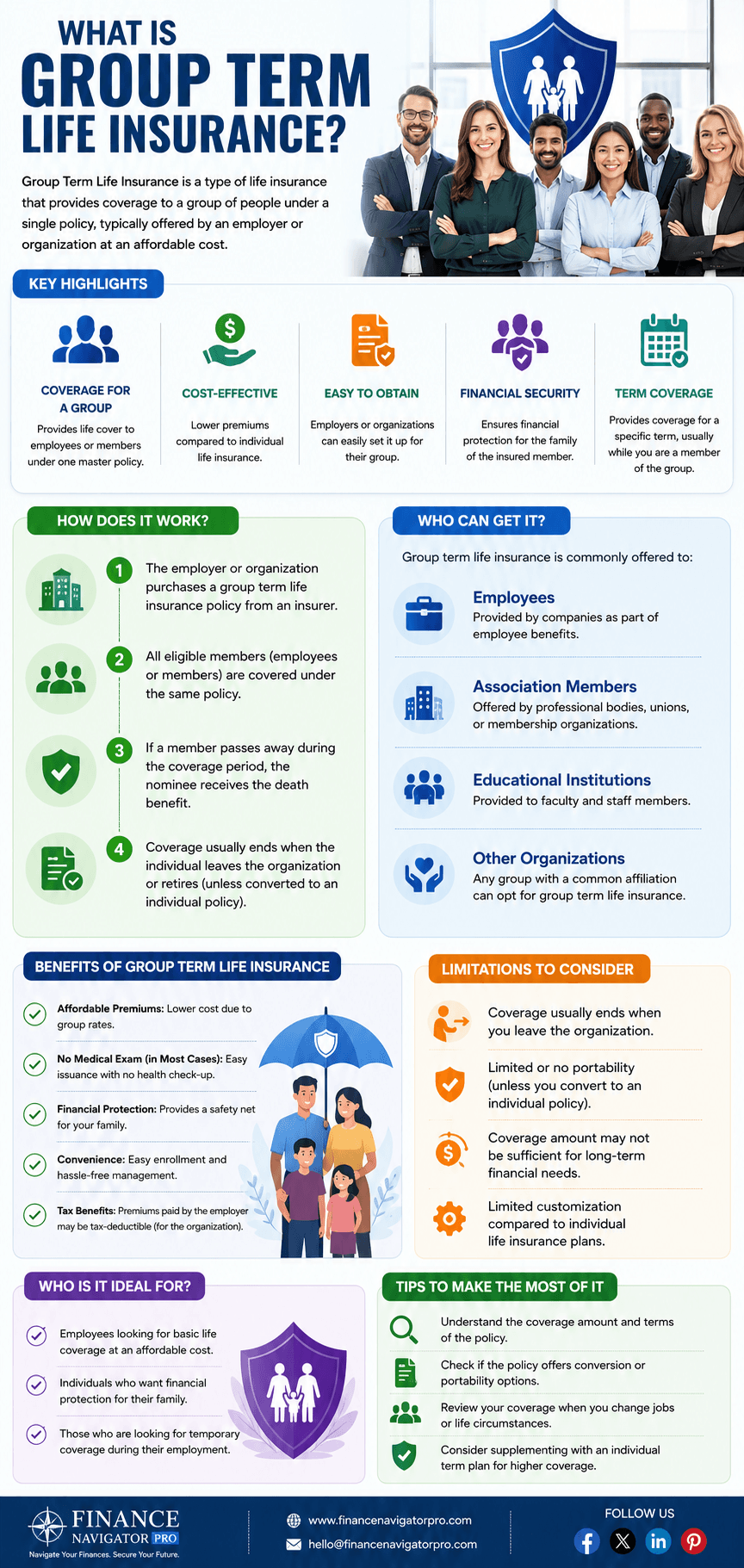
A quick visual breakdown of how group term life insurance works. |
Who Does What: Employer, Insurer, and Employee Roles
Three parties are involved in almost every group term life policy:
| • | The employer purchases the master policy from an insurance company and decides how much coverage to offer, whether it’s free or shared-cost, and what supplemental options exist. |
| • | The insurance company underwrites the group as a whole (not each person individually in most cases), sets the premium rates, and pays out claims. |
| • | The employee enrolls (often automatically for basic coverage), names a beneficiary, and in many cases has the option to add supplemental coverage through payroll deduction. |
How Long Does Coverage Last?
This is the part that surprises people most: coverage duration is tied to your job, not to a fixed number of years like a typical 20-year term policy you’d buy on your own. As long as you’re an eligible, actively working employee, your coverage stays in force. The moment that relationship ends — you quit, get fired, get laid off, or retire — the group coverage generally ends too, sometimes within 30 days or even immediately.
A Real-World Example
|
📌 Example: Maria’s First Job Benefits Maria takes a job at a mid-sized marketing firm earning $60,000 a year. On day one, she’s automatically enrolled in $60,000 of group term life insurance (1x her salary), fully paid by her employer. She names her mother as beneficiary. Three years later, Maria is recruited away to a competitor. Her last day at the marketing firm is also the last day her $60,000 policy is in force — unless she acts fast to convert or port it. At her new job, she’ll start the process over with a new group policy. |
How Does Group Term Life Insurance Work?
The mechanics behind group term life insurance are more straightforward than they sound. Here’s the step-by-step version.
The Workflow, Step by Step
| 1 | The employer selects and purchases a group policy. HR or benefits leadership shops for a group life insurance plan and negotiates rates based on the size and makeup of the workforce. |
| 2 | Employees become eligible. Eligibility is usually based on being a full-time employee, sometimes after a short waiting period (30 to 90 days is common). |
| 3 | Coverage begins. Once eligible, employees are typically enrolled automatically for the base amount — no application, no medical exam, no health questions in most cases. |
| 4 | The employer pays the premiums for the base amount. For basic coverage, this cost is usually absorbed entirely by the company as part of the overall benefits package. |
| 5 | Employees may add supplemental or voluntary coverage. Many plans let workers buy additional coverage on top of the base amount, paid through payroll deduction. |
| 6 | The employee designates a beneficiary. This is the person (or people, or entity) who will receive the death benefit. |
| 7 | If the employee dies while covered, the beneficiary files a claim. The insurance company reviews the claim and, once approved, pays the death benefit — usually as a lump sum. |
|
The Flow, at a Glance Employer Buys Policy → Employee Becomes Eligible → Coverage Begins → Employee Names Beneficiary → (If applicable) Employee Adds Supplemental Coverage → Death Benefit Paid to Beneficiary. |
What Does Group Term Life Insurance Cover?
Group term life insurance is built to be simple, and that simplicity shows up in what it covers. In most standard policies, the death benefit pays out regardless of the cause of death, as long as it isn’t specifically excluded by the policy.
Typically Covered
| ✓ | Death from natural causes (illness, disease, organ failure, and so on) |
| ✓ | Death from accidents (car accidents, falls, workplace accidents) |
| ✓ | Death from most illnesses diagnosed after coverage begins |
Often Not Covered or Limited
| ✕ | Suicide within the first one to two years of coverage (a common contestability period) |
| ✕ | Death resulting from acts of war or participation in a riot, in some policies |
| ✕ | Death while engaging in an illegal act |
| ✕ | Coverage doesn’t apply at all once employment ends, regardless of cause of death |
Waiting Periods
Some employers require a waiting period — commonly 30, 60, or 90 days — before a new hire’s coverage actually kicks in. If something happens during that window, before coverage is active, there’s no benefit. This is one more reason to read your specific plan documents rather than assume coverage starts on day one.
Who Pays for Group Term Life Insurance?
This is one of the first questions people ask, and the answer depends on how the employer structures the benefit.
Employer-Paid (Basic Coverage)
In most companies, basic group term life insurance — often 1x salary or a flat amount like $25,000 or $50,000 — is fully paid for by the employer. It shows up on your benefits summary as a perk, not a deduction.
Shared Cost
Some employers split the cost: the company covers a base amount, and the employee pays a small premium (often through payroll deduction) for any coverage above that base.
Employee-Paid Supplemental Coverage
Most plans let you buy additional coverage — sometimes called supplemental or voluntary life insurance — entirely at your own cost. Because it’s part of a group plan, rates are usually still cheaper than buying an individual policy on the open market, and there’s often no medical exam required up to a certain coverage limit.
Example: Payroll Deduction in Action
|
📌 Example: David’s Supplemental Coverage David’s employer provides $50,000 in free basic life insurance. David, who has two young kids and a mortgage, decides that’s not nearly enough. He elects to buy $200,000 in supplemental coverage through the same group plan. The cost — about $14 a month based on his age — is deducted directly from his paycheck. He never has to write a check or deal with a separate insurer. |
How Much Coverage Do Employers Typically Provide?
There’s no single industry standard, but most employer-paid group life policies fall into a fairly predictable range.
| • | 1x annual salary — the most common baseline for basic, no-cost coverage |
| • | 2x annual salary — offered by some employers, especially larger companies or those with richer benefits packages |
| • | 3x annual salary — less common, usually reserved for senior employees or premium benefits tiers |
| • | Flat dollar amounts — some employers simply offer a fixed amount, such as $25,000 or $50,000, regardless of salary |
Most group policies also set a coverage cap — a maximum dollar amount regardless of salary multiple, often somewhere between $200,000 and $500,000 for basic coverage, with higher limits available through supplemental options.
Example Coverage Calculations
These numbers are illustrative — your actual plan documents will spell out the exact formula and any coverage caps that apply to you.
Is Group Term Life Insurance Enough?
This is, honestly, the most important section in this entire guide. The short answer: for most people with real financial responsibilities, employer-provided life insurance alone is not enough.
Here’s why. A typical 1x salary policy on a $60,000 income provides $60,000 in coverage. That might cover a few months of expenses, a funeral, and some breathing room. But ask yourself: would $60,000 actually replace your income for the next 10, 15, or 20 years? For most families, the honest answer is no.
When Employer Coverage Might Be Enough
| ✓ | You’re young, single, with no dependents and no significant debt |
| ✓ | You have no mortgage, no children relying on your income, and modest final expenses to cover |
| ✓ | You already have substantial savings or other life insurance outside of work |
When It’s Probably Not Enough
| ✕ | You have a mortgage that would be difficult for your family to pay without your income |
| ✕ | You have children who will need years of financial support, including future education costs |
| ✕ | Your household relies on your income to cover everyday living expenses |
| ✕ | You’re carrying significant debt — student loans, car loans, credit cards — that wouldn’t disappear if you died |
| ✕ | You’re the primary or sole income earner in your household |
A Quick Reality Check
|
📌 Example: The Coverage Gap Jordan earns $75,000 a year and has a $300,000 mortgage, a spouse who works part-time, and two kids in elementary school. Jordan’s employer provides 1x salary in free coverage — $75,000. If Jordan died tomorrow, that payout wouldn’t even cover the remaining mortgage, let alone provide years of income replacement for the family. This is a textbook case of needing supplemental or individual coverage on top of the employer-provided benefit. |
Pros of Group Term Life Insurance
Despite its limitations, group term life insurance earns its place in a benefits package. Here’s what it does well.
Cons of Group Term Life Insurance
Now for the other side of the coin — the limitations that make supplemental planning worth considering.
| ✕ | Coverage ends with employment. Quit, get fired, or get laid off, and the policy typically ends too. |
| ✕ | Limited coverage amounts. Caps and salary multiples often fall short of real financial needs. |
| ✕ | Not portable in most cases. You generally can’t simply take the policy with you to a new job. |
| ✕ | Little customization. You usually can’t adjust term length, riders, or underwriting class the way you could with an individual policy. |
| ✕ | Higher relative cost for supplemental coverage as you age, since group rates are often age-banded and increase over time. |
| ✕ | Potential tax issues. Employer-paid coverage above $50,000 can create taxable “imputed income” — more on this below. |
Group Term Life Insurance vs. Individual Term Life Insurance
Here’s how the two stack up side by side.
Group Term Life Insurance vs. Whole Life Insurance
Term and whole life insurance solve different problems. Here’s the comparison.
What Happens If You Leave Your Job?
This is where group term life insurance shows its biggest limitation. Because the policy belongs to your employer, not to you, your connection to it generally ends along with your employment.
Layoffs
If you’re laid off, your group coverage typically ends on your last day or at the end of that month, depending on the policy. Severance packages sometimes extend benefits for a short period — it’s worth asking HR specifically about life insurance continuation, not just health insurance.
Retirement
Some employers offer reduced group life coverage that continues into retirement, but this is the exception rather than the rule. Most basic group coverage ends at retirement unless your specific plan states otherwise.
Changing Jobs
When you voluntarily leave for a new job, your old employer’s group coverage ends, and you’ll typically become eligible for a new group policy at your new employer — often after a waiting period. There can be a coverage gap in between if you don’t take action.
Common Mistakes When Leaving a Job
| ✕ | Assuming coverage automatically continues (it usually doesn’t) |
| ✕ | Missing the conversion deadline, which is often just 30 to 31 days after coverage ends |
| ✕ | Not checking whether a new job’s waiting period leaves a coverage gap |
| ✕ | Forgetting to review whether supplemental coverage purchased at the old job is portable |
Can You Convert Group Coverage Into an Individual Policy?
In many cases, yes — this is called the conversion privilege, and it’s one of the more underused features of group life insurance.
| • | Conversion privilege: Most group policies allow you to convert some or all of your group coverage into an individual whole life policy without a medical exam, regardless of your current health. |
| • | Deadlines: This window is typically short — commonly 30 to 31 days from the date your group coverage ends. Miss it, and the option disappears. |
| • | Costs: Converted policies are usually priced based on your age at conversion and the type of individual policy offered, which often means significantly higher premiums than your old group rate. |
| • | When it makes sense: Conversion is most valuable if you have a health condition that would make it difficult or expensive to qualify for a new individual policy on the open market. If you’re healthy, shopping for a new individual term policy is often cheaper than converting. |
Is Group Term Life Insurance Taxable?
This is one of those topics that sounds complicated but boils down to one key number: $50,000.
Under federal tax rules, the cost of the first $50,000 of employer-paid group term life insurance is excluded from your taxable income — meaning it’s truly free from a tax standpoint. This comes from a section of the tax code that specifically governs group-term life insurance benefits.
Coverage Above $50,000
Once your employer-paid coverage exceeds $50,000, the value of the coverage above that threshold becomes what’s known as “imputed income.” The IRS uses a published premium table, based on your age, to calculate the taxable value of that excess coverage — and it gets added to your taxable wages and reported on your W-2, typically subject to Social Security and Medicare taxes.
Employee-Paid Premiums
If you pay for supplemental coverage entirely with after-tax payroll deductions, that portion generally doesn’t create additional imputed income — with one exception. If your employer’s group rates are age-banded in a way that some employees effectively pay less than the IRS table rate and others pay more (sometimes called “straddling”), imputed income rules can still apply even to employee-paid coverage.
Spouse and Dependent Coverage
If your employer also covers your spouse or dependents, there’s no $50,000 exclusion the way there is for your own coverage. Employer-paid spouse or dependent coverage is tax-free only up to $2,000 in face value. Above that amount, the full value (not just the excess) is generally treated as taxable income to you.
Death Benefit Taxation
Here’s the good news: in almost all cases, the death benefit itself — the money your beneficiary actually receives — is not subject to federal income tax. The imputed income rules described above apply to the value of the coverage while you’re alive, not to the payout your family eventually receives.
|
📌 Example: Calculating Imputed Income Alex, age 47, has $150,000 in employer-paid group term life coverage. That’s $100,000 above the $50,000 tax-free threshold. Using the IRS premium table for Alex’s age bracket, that excess coverage generates a small amount of imputed income each month, which Alex’s employer adds to taxable wages and reports on Form W-2. Alex doesn’t pay anything extra out of pocket — the cost is simply that a small additional amount of income becomes taxable. |
Who Should Buy Supplemental Life Insurance?
Supplemental coverage isn’t right for absolutely everyone, but for a lot of people, it closes a real gap. Consider adding supplemental coverage if you’re any of the following:
| • | Parents — especially with young children who’ll need years of financial support |
| • | High earners — whose income would be especially hard to replace with a flat 1x or 2x salary benefit |
| • | Business owners — who may have business debts, partners, or succession concerns tied to their life insurance |
| • | Mortgage holders — anyone who’d leave a spouse or family with a home loan they couldn’t easily cover |
| • | Single adults with dependents — such as caring for an aging parent or a sibling |
| • | Young professionals — rates are cheapest early in life, making it a good time to lock in affordable supplemental or individual coverage |
| • | Stay-at-home parents — often overlooked, but replacing childcare and household labor costs real money if something happens to them |
How Much Life Insurance Do You Actually Need?
There’s no perfect formula, but a few well-established methods can get you to a reasonable estimate.
The Income Replacement Method
This approach estimates how many years of income your family would need replaced, then multiplies your salary by that number. It’s simple but doesn’t account for specific debts or goals.
The 10x Salary Rule
A common rule of thumb: aim for roughly 10 times your annual salary in total life insurance coverage. It’s an easy starting point, though it doesn’t factor in your specific debt, savings, or family situation.
The DIME Method
DIME stands for Debt, Income, Mortgage, and Education — a more detailed needs analysis that adds up:
| • | Debt: Total non-mortgage debt (credit cards, loans, etc.) |
| • | Income: Annual income multiplied by the number of years your family would need support |
| • | Mortgage: The remaining balance on your home loan |
| • | Education: Estimated future education costs for your children |
Add those four numbers together, and you get a more personalized coverage target than a flat multiple of salary.
Other Factors to Consider
| • | Existing savings and investments that could offset some of the need |
| • | Final expenses, including funeral and burial costs |
| • | Any existing life insurance you already have outside of work |
Common Mistakes Employees Make
| 1 | Assuming employer-provided coverage is automatically enough |
| 2 | Never updating beneficiaries after marriage, divorce, or having children |
| 3 | Ignoring supplemental life insurance options entirely |
| 4 | Not reviewing benefits during annual open enrollment |
| 5 | Missing the short conversion deadline after leaving a job |
| 6 | Believing the coverage “follows” them automatically to a new employer |
| 7 | Forgetting to factor in a stay-at-home spouse’s economic contribution |
| 8 | Overlooking spouse or dependent coverage options that may be available |
| 9 | Not understanding the $50,000 imputed income tax rule |
| 10 | Assuming a flat dollar amount (like $50,000) will keep pace with inflation and rising costs |
| 11 | Waiting until a health scare to think about supplemental or individual coverage |
| 12 | Not comparing employer rates to open-market individual term rates, especially when young and healthy |
Frequently Asked Questions
What is group term life insurance?
It’s a life insurance policy purchased by an employer that covers a group of employees under one master contract, typically at no cost or low cost, paying a death benefit to your beneficiary if you die while actively covered.
Is employer life insurance free?
Basic coverage is very often free to the employee, fully paid by the employer. Supplemental or voluntary coverage beyond that base amount is usually paid by the employee through payroll deduction.
Does group life insurance end when I quit?
In almost all cases, yes. Coverage is tied to active employment, so it typically ends on your last day or shortly after, unless you convert or port the policy.
Can I keep my group life insurance after I retire?
Sometimes, but it’s not the norm. Some employers offer reduced continued coverage into retirement; many do not. Check your specific plan documents.
Can I name anyone as my beneficiary?
Generally yes — most group policies let you name any person, multiple people, a trust, or even a charity as your beneficiary, though employer plan rules can vary slightly.
Is group term life insurance taxable?
The first $50,000 of employer-paid coverage is tax-free. Coverage above that amount creates imputed income based on IRS premium tables, which is added to your taxable wages.
Can my spouse be covered under my group plan?
Many employers offer optional spouse and dependent coverage. Be aware that the tax-free threshold for spouse/dependent coverage is much lower — just $2,000 — compared to your own coverage.
Can I buy more coverage than the employer-provided base amount?
Yes, most plans offer supplemental or voluntary life insurance you can purchase on top of the base amount, often without a medical exam up to certain limits.
Do I need another life insurance policy outside of work?
For most people with dependents, debt, or a mortgage, yes. Employer coverage alone is rarely enough to fully replace lost income or cover major financial obligations.
Is there a medical exam for group life insurance?
Usually not for basic coverage, and often not for supplemental coverage up to a certain dollar limit. Amounts above that limit may require evidence of insurability.
What is evidence of insurability?
It’s a health questionnaire (and sometimes a medical exam) that some insurers require for higher coverage amounts, used to confirm you’re an acceptable risk.
What happens to my coverage if I’m laid off?
It typically ends on your last day or at the end of that month. Some severance packages extend benefits temporarily — ask HR specifically about life insurance, not just health coverage.
Can I convert my group policy to an individual policy?
Many plans offer a conversion privilege, usually within 30 to 31 days of losing group coverage, letting you convert to an individual whole life policy without a medical exam.
Is group life insurance portable?
Some plans offer portability, allowing you to keep group-type term coverage after leaving your job, though this is less common than conversion and usually requires acting quickly.
How much group life insurance do most employers provide?
Most basic plans provide 1 to 2 times annual salary, sometimes capped at a flat dollar maximum regardless of salary.
Why did the cost of my supplemental coverage go up this year?
Group life rates are often age-banded, meaning the cost per $1,000 of coverage increases as you move into a new age bracket.
What’s the difference between basic and supplemental life insurance?
Basic coverage is the base amount typically provided free by your employer. Supplemental (or voluntary) coverage is additional coverage you elect and usually pay for yourself.
Does group term life insurance build cash value?
No. It’s pure term insurance with no investment or savings component, unlike whole or universal life insurance.
What happens if I die from suicide while covered?
Most policies include a contestability period, often one to two years from when coverage begins, during which a suicide death may not be covered. After that period, it’s typically treated like any other covered death.
Can I add my children to my group life insurance?
Many employer plans offer optional dependent child coverage, usually at a modest flat amount, for a small additional payroll deduction.
What is the IRS premium table used for?
It’s a table the IRS publishes to determine the taxable value of employer-paid group life coverage above $50,000, used to calculate imputed income.
Will my family have to pay taxes on the death benefit?
In almost all cases, no. Life insurance death benefits are typically received income tax-free by the beneficiary.
What is a discriminatory group life plan?
It’s a plan structured in a way that favors highly compensated or key employees. Such plans can lose certain tax advantages for those key employees specifically.
Should I rely only on my employer’s life insurance?
For most people with financial dependents or debt, no. It’s best used as one layer of protection alongside supplemental or individual coverage.
Final Thoughts
Group term life insurance is one of the easiest financial wins built into a typical benefits package — it’s often free, requires no medical exam, and gives your family a financial cushion with zero effort on your part. That’s genuinely valuable, and there’s no reason to opt out of it.
But it was never designed to be your entire safety net. It’s a floor, not a ceiling. The amount is limited, the coverage disappears the moment you leave your job, and it doesn’t follow you the way a personal policy would.
One thing many employees overlook: the best time to fill that gap is while you’re young and healthy, when individual or supplemental rates are at their lowest. Waiting until a health scare or a career change often means paying more — or qualifying for less.
So as open enrollment rolls around each year, take ten minutes to actually look at your numbers. Review what your employer provides. Run a quick needs estimate using the DIME method or the 10x salary rule. And if there’s a gap — and for most people with a mortgage, kids, or debt, there usually is — compare your employer’s supplemental options against individual term life quotes on the open market. A little homework now can mean the difference between your family having real financial breathing room and having to make hard choices at the worst possible time.
This guide is for general educational purposes only and does not constitute personal financial, tax, or insurance advice. Insurance terms, coverage amounts, and tax rules vary by employer, insurer, and individual circumstances. Speak with a licensed insurance professional, tax advisor, or your HR benefits team about your specific situation.
Next Steps: Take Control of Your Coverage
If this guide raised questions about your own coverage, here’s where to go next.
| • | Download a Life Insurance Needs Checklist to walk through your own DIME calculation step by step. |
| • | Compare individual term life quotes to see what supplemental protection would cost outside your group plan. |
| • | Read related guides on term life insurance, whole life insurance, and how much life insurance you actually need. |
| • | Request a free coverage estimate based on your income, debts, and family situation. |
| • | Sign up for our newsletter for ongoing, plain-English guidance on employee benefits and personal finance. |
Related Reading
Continue exploring these related topics:
Sources
This guide draws on guidance from the following primary sources: