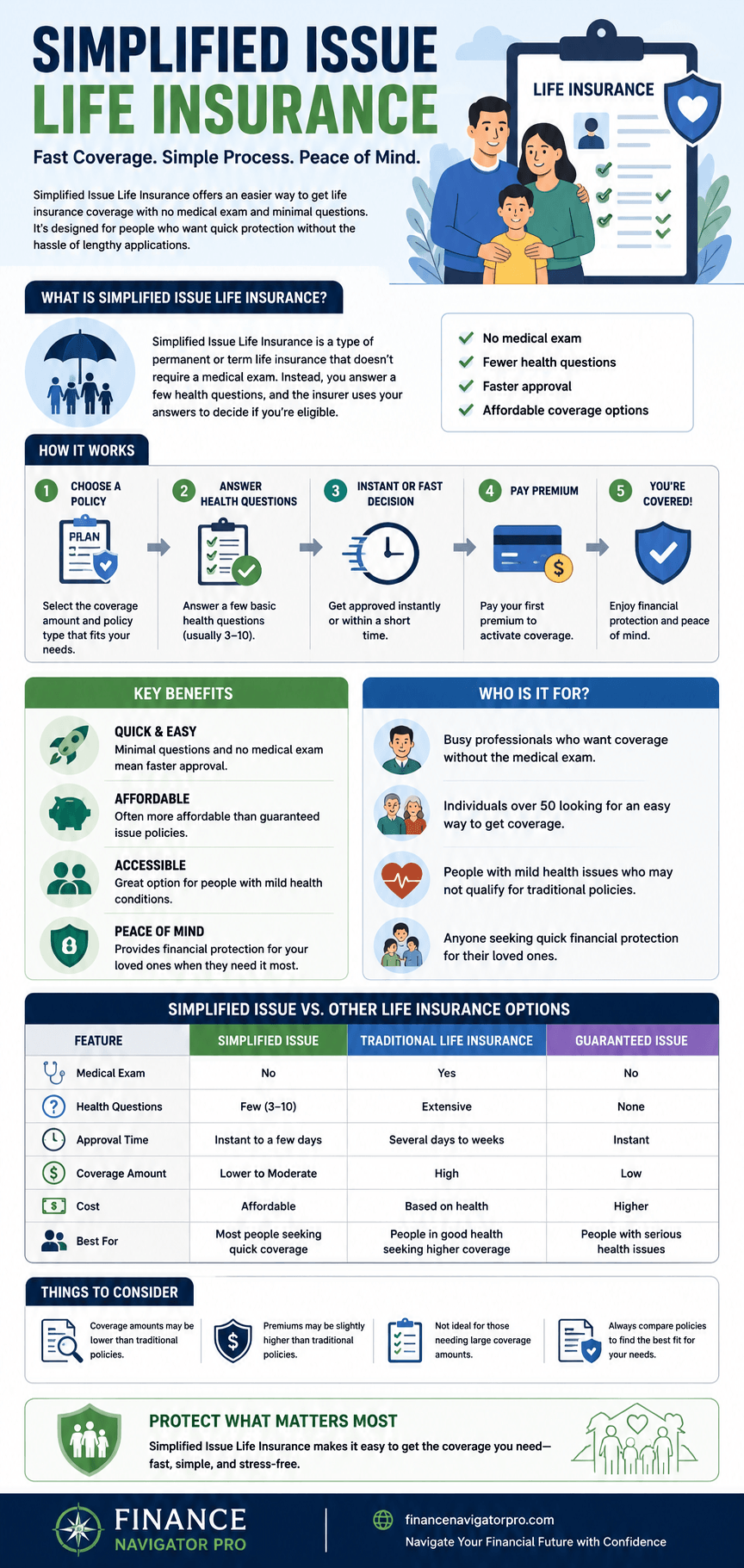
What is Simplified Issue Life Insurance? Simplified issue life insurance is a type of life insurance policy that skips the medical exam and instead asks you a short series of health questions. Most people get a decision within minutes to days. It’s designed for adults aged 40–80, people with health conditions, or anyone who wants fast, hassle-free coverage. Coverage amounts typically range from $10,000 to $500,000. Premiums run higher than traditional policies, but the speed and convenience are unmatched.
🔑 Key Takeaways
✓
No medical exam required — just answer health questions honestly.
✓
Approval decisions often come within minutes to 48 hours.
✓
Coverage ranges from $10,000 to $500,000 depending on the insurer.
✓
Premiums are higher than fully underwritten policies but lower than guaranteed issue.
✓
Ideal for seniors, people with manageable health conditions, and busy professionals.
✓
Insurers check your prescription history and the MIB database — even without an exam.
✓
A two-year contestability period applies to most policies.
✓
Not the right fit if you’re in excellent health — traditional policies will save you money.
✓
Always compare quotes from multiple companies before buying.
Imagine you’ve just turned 62. Your kids are grown, your mortgage still has ten years left, and your spouse depends on your income. You know you need life insurance — but the last time you tried to buy a policy, the company wanted a full medical exam, two vials of blood, an EKG, and a three-month wait for a decision. You gave up.
Or maybe you’re a 55-year-old diabetic who was flat-out declined. Or a 70-year-old who just retired and wants enough coverage to handle final expenses without burdening her children.
Sound familiar? You’re not alone. Millions of Americans find themselves in exactly this situation every year. And for many of them, simplified issue life insurance turns out to be the answer.
In this guide, you’ll learn everything about how simplified issue life insurance works, who it’s right for, what it costs, what health conditions qualify, and how to avoid the mistakes most people make when shopping for it. By the time you’re done reading, you’ll know more than most insurance agents — and you’ll be ready to make a smart decision.
Section 1: What Is Simplified Issue Life Insurance?
Let’s start with the basics.
Simplified issue life insurance is a life insurance policy that doesn’t require a medical exam. Instead of poking you with needles and making you fast for 12 hours, the insurer asks you a series of health questions — usually between 4 and 20 — and uses that information plus a few electronic data checks to decide whether to approve you.
Think of it like this: a standard life insurance policy is like applying for a mortgage. Lenders want two years of tax returns, pay stubs, bank statements, and a full credit audit. Simplified issue is more like getting approved for a car loan — they still check your credit, but the process is faster and less invasive.
Why Do Insurers Offer It?
Traditional underwriting — the process of evaluating risk — takes time and money. Medical exams, lab work, and reviewing physician records can cost hundreds of dollars per applicant. For people who need smaller coverage amounts, or who are older and statistically more likely to die sooner (which sounds blunt, but that’s actuarial reality), this full process isn’t always worth it for either side.
Simplified issue policies let insurers move faster, serve more customers, and still price the risk appropriately. They just accept slightly less information about your health in exchange for charging somewhat higher premiums.
What Does the Underwriting Process Look Like?
Even though there’s no exam, simplified issue underwriting isn’t a free-for-all. Here’s what insurers actually do when you apply:
•
Review your health questionnaire: You answer questions about diagnoses, treatments, medications, and habits.
•
Check the MIB (Medical Information Bureau): A database that tracks prior insurance applications and certain health disclosures. If you’ve applied for life, health, or disability insurance before, there’s likely a record.
•
Pull your prescription history: Through pharmacy databases, insurers can see every medication you’ve been prescribed for the past 5–10 years. This often tells them more than a medical questionnaire would.
•
Verify your driving record: DUI, reckless driving, and at-fault accidents affect your risk profile.
•
Sometimes request an Attending Physician Statement (APS): For borderline cases, an insurer may request records from your doctor, though this isn’t universal for simplified issue policies.
The result? An approval decision that typically arrives within minutes for instant-decision policies, or within 24–72 hours for those requiring a bit more review.
⚠️ Important
Lying on your application is insurance fraud and can result in your policy being voided and your family receiving nothing. Always answer health questions honestly.
Section 2: How Simplified Issue Life Insurance Works
Here’s the step-by-step process from application to policy in hand:
Step-by-Step Application Timeline
1
Apply online, by phone, or with an agent. Most simplified issue policies can be started in under 15 minutes. You’ll provide your name, date of birth, address, and the coverage amount you want.
2
Answer health questions. These typically include questions about serious diagnoses (cancer, heart disease, HIV), hospitalizations, medications, tobacco use, and risky activities. You answer yes or no — no lengthy medical histories required.
3
Consent to database checks. You’ll sign a form allowing the insurer to check the MIB, your prescription history, and your motor vehicle record.
4
Instant or same-week decision. Many companies now offer instant underwriting decisions powered by algorithms. Others may take 24–72 hours for a human underwriter to review.
5
Policy is issued. Once approved, your policy is issued electronically or mailed to you. Coverage often begins immediately upon payment of the first premium.
6
Free-look period begins. Most states require insurers to give you 10–30 days to review your policy and cancel for a full refund if you change your mind.
Application Timeline at a Glance
| Timeline |
What Happens |
Duration |
| Day 1 |
Submit application and health questions |
~15 minutes |
| Day 1–3 |
Database checks (MIB, prescriptions, MVR) |
Automatic |
| Day 1–5 |
Underwriting review |
Minutes to 72 hours |
| Day 1–7 |
Approval and policy issue |
Same day to 1 week |
| Day 1–30 |
Free-look period |
Review and cancel anytime |
Section 3: Simplified Issue vs. Traditional Life Insurance
People often ask: “If I’m relatively healthy, should I bother with simplified issue?” That’s a fair question. Here’s how the two types of policies compare head-to-head.
| Feature |
Simplified Issue |
Traditional (Fully Underwritten) |
Notes |
| Medical Exam Required |
No |
Yes |
Simplified wins on convenience |
| Blood Work & Lab Tests |
No |
Yes |
No needles with simplified issue |
| Health Questions |
4–20 questions |
Full medical history |
Traditional is more thorough |
| Prescription History Check |
Yes (electronic) |
Yes (electronic + physical) |
Both check this |
| MIB Database Check |
Yes |
Yes |
Both check this |
| Approval Speed |
Minutes to 1 week |
4 to 8 weeks |
Simplified is much faster |
| Coverage Amounts |
$10K–$500K |
Up to $10M+ |
Traditional offers more coverage |
| Premiums |
Higher |
Lower (if healthy) |
Traditional is cheaper for healthy applicants |
| Waiting Period |
Usually none or 2 years |
Usually none |
Traditional slightly better |
| Best For |
Health issues, age 50+, speed |
Young, healthy, large coverage needs |
Depends on your situation |
Bottom line: if you’re under 50 and in excellent health, traditional life insurance will almost certainly give you more coverage for less money. But if you’re older, have health conditions, or simply can’t wait two months for a decision, simplified issue is a practical and often excellent choice.
Section 4: Simplified Issue vs. Guaranteed Issue Life Insurance
This is where a lot of people get confused, and understandably so. Both types skip the medical exam. But they work very differently — and choosing the wrong one could mean paying hundreds of dollars a year more than necessary, or being stuck with a waiting period when you don’t need one.
The Key Differences
Simplified Issue Life Insurance
Health Questions Required?
Yes — typically 4–20 questions
Medical Exam Required?
No
Who Can Qualify?
Most people with manageable health conditions
Coverage Amounts
$10,000–$500,000
Waiting Period
Usually none (immediate death benefit)
Premiums
Moderate (higher than traditional, lower than guaranteed issue)
Approval Rate
70–90% of applicants
Best For
Seniors with diabetes, heart disease, past cancer, or other manageable conditions
Guaranteed Issue Life Insurance
Health Questions Required?
No — acceptance is guaranteed
Medical Exam Required?
No
Who Can Qualify?
Anyone who meets age requirements (typically 45–85)
Coverage Amounts
$2,000–$25,000
Waiting Period
Almost always 2–3 years (graded death benefit)
Premiums
High — often the most expensive option per dollar
Approval Rate
100% — you cannot be declined
Best For
People with serious health conditions who’ve been declined everywhere else
Which One Should You Choose?
Choose Simplified Issue if: You have manageable health conditions (diabetes, high blood pressure, past heart attack more than 2 years ago) and can honestly answer yes/no health questions without major concerns.
Choose Guaranteed Issue if: You’ve been declined by every other type of policy, have a terminal illness, or have serious health conditions that would disqualify you from simplified issue.
A huge mistake people make is jumping straight to guaranteed issue because they’re worried about being declined. That fear costs them real money. Many people who assume they won’t qualify for simplified issue actually do — and they end up paying 30–60% more per month for a policy that also has a two-year waiting period. Always try simplified issue first.
Section 5: Types of Simplified Issue Policies
1. Simplified Issue Term Life Insurance
Term life insurance covers you for a specific period — 10, 15, 20, or 30 years. If you die during that term, your beneficiary receives the death benefit. If you outlive it, the policy expires with no payout.
Simplified issue term policies are ideal for people who need coverage for a specific purpose: paying off a mortgage, funding a child’s college education, or replacing income during working years. Because term insurance is temporary, it’s generally more affordable than whole life — even with simplified underwriting.
Example: Maria is 52 and recently diagnosed with Type 2 diabetes. She wants a $200,000 policy to cover the remaining balance on her home. A simplified issue 15-year term policy lets her get approved without a medical exam, protecting her family until the house is paid off.
2. Simplified Issue Whole Life Insurance
Whole life insurance is permanent — it lasts your entire life as long as premiums are paid. It also builds cash value over time, which you can borrow against or surrender for cash. Simplified issue whole life is popular among seniors who want permanent coverage that won’t expire. The premiums are fixed and never increase. The death benefit is guaranteed. And in most cases, coverage begins immediately upon policy issue.
This is a type of whole life policy specifically designed to cover end-of-life costs: funeral expenses, burial, medical bills, and outstanding debts. Coverage amounts are typically lower — $5,000 to $50,000 — making premiums more manageable.
Example: Robert is 71 and wants to make sure his family isn’t burdened with funeral costs when he passes. A $15,000 final expense policy costs him about $80–$120 per month and provides immediate coverage. His children won’t need to dip into savings or go into debt.
4. Simplified Issue Burial Insurance
Burial insurance and final expense insurance are often used interchangeably. Both are small whole life policies aimed at covering burial and funeral costs. The term “burial insurance” tends to be used more in direct-to-consumer marketing, while “final expense insurance” is the more technical industry term.
5. Simplified Issue Permanent Life Insurance
Beyond whole life, some insurers offer simplified issue versions of universal life insurance, which offers more flexibility in premiums and death benefits. While less common in the simplified issue space, these policies exist and can be worth exploring if you want lifelong coverage with some adjustability. You may also want to explore indexed universal life (IUL) insurance as a related permanent coverage option.
Section 6: Who Should Buy Simplified Issue Life Insurance?
Simplified issue life insurance isn’t for everyone — and we’ll get to who should avoid it in the next section. But for a large segment of the American public, it’s not just a good option; it’s often the best option available.
Ideal Candidates
| Who They Are |
Why Simplified Issue Works for Them |
| Seniors (ages 50–80) |
Traditional underwriting gets harder and more expensive with age. Simplified issue offers faster approvals without a full medical workup. |
| People with Type 2 Diabetes |
Well-managed diabetes often qualifies. Many insurers look at A1C levels, medication, and whether complications are present. |
| Heart Disease History |
A heart attack that occurred more than 2 years ago and has been treated may qualify for simplified issue with some insurers. |
| High Blood Pressure |
One of the most common conditions — and one that rarely disqualifies you from simplified issue if it’s controlled with medication. |
| Cancer Survivors |
Depends heavily on the type of cancer, stage, treatment, and how long ago you were in remission. Some cancers qualify after 5 years cancer-free. |
| Self-Employed Individuals |
No group life insurance through an employer? Simplified issue makes it easy to get individual coverage quickly. |
| Busy Professionals |
If scheduling a medical exam sounds like a hassle you’ll keep putting off, simplified issue removes that barrier entirely. |
| Smokers and Tobacco Users |
Tobacco users pay higher premiums regardless of policy type. Simplified issue at least gets you covered quickly, without an exam showing other potential issues. |
| Veterans with Service-Related Conditions |
Some VA-related health conditions that scare off traditional insurers are accepted by simplified issue underwriting guidelines. |
| Parents Seeking Fast Coverage |
New parents who need coverage immediately — and can’t wait 6–8 weeks for traditional underwriting — benefit from simplified issue’s speed. |
Section 7: Who Should Avoid Simplified Issue Life Insurance?
Here’s the honest truth most agents won’t tell you up front: if you’re young and in excellent health, simplified issue life insurance will cost you more money than it should.
Traditional fully underwritten policies reward healthy applicants with significantly lower premiums. A 40-year-old male non-smoker in excellent health might pay $35–$45 per month for a $500,000 20-year term policy with full underwriting. The same person buying a simplified issue policy for the same coverage might pay $80–$100 or more.
That’s a difference of $500–$700 per year. Over 20 years, that’s $10,000–$14,000 extra spent unnecessarily.
Skip Simplified Issue If You…
✗
Are under 50 and in good to excellent health
✗
Have never been diagnosed with a serious chronic illness
✗
Don’t take regular prescription medications for ongoing conditions
✗
Can reasonably schedule a medical exam within a few weeks
✗
Need more than $500,000 in coverage (traditional policies go much higher)
✗
Are a non-smoker with a clean driving record
If you fit most of the bullets above, get a quote for a fully underwritten policy first. You might be surprised how affordable it is — and how straightforward the exam process can be.
💡 Pro Tip
Many online life insurance services let you run quotes for both traditional and simplified issue policies side by side. If the price difference is under $20/month, simplified issue might be worth the convenience. If it’s $50 or more, traditional underwriting is almost always the smarter financial decision.
Section 8: What Health Questions Will You Be Asked?
The health questionnaire is the heart of simplified issue underwriting. While the exact questions vary by insurer and state, here are the most common questions you can expect — and why insurers ask them.
Common Simplified Issue Health Questions
| Health Question |
Why Insurers Ask It |
| Have you been diagnosed with or treated for cancer in the past 2 years? |
Active cancer is a high-mortality risk. |
| Have you ever been diagnosed with terminal illness? |
Terminal diagnoses make coverage financially unviable for most insurers. |
| Have you been diagnosed with HIV/AIDS? |
High-risk condition that disqualifies most applicants. |
| Have you been hospitalized in the past 12 months? |
Recent hospitalization signals serious health events. |
| Have you had a stroke or TIA in the past 2 years? |
Recent strokes indicate neurological risk. |
| Have you been diagnosed with congestive heart failure? |
High-severity cardiac condition. |
| Have you had a heart attack in the past 2 years? |
Recent cardiac events signal elevated mortality risk. |
| Do you have end-stage renal (kidney) disease? |
Dialysis and kidney failure are high-mortality conditions. |
| Have you been diagnosed with COPD or emphysema? |
Severe respiratory conditions increase mortality. |
| Do you require oxygen therapy? |
Oxygen dependency indicates advanced respiratory disease. |
| Have you been diagnosed with cirrhosis of the liver? |
Advanced liver disease signals high risk. |
| Do you have Alzheimer’s disease or dementia? |
Degenerative conditions with high care costs and mortality. |
| Have you been diagnosed with Parkinson’s disease? |
Progressive neurological condition. |
| Are you currently bedridden or confined to a care facility? |
Indicates severe disability or illness. |
| Do you use tobacco or nicotine products? |
Tobacco significantly raises mortality risk and premiums. |
| Have you been diagnosed with diabetes? |
Type 2 diabetes often qualifies; Type 1 depends on the insurer. |
| Are you currently taking insulin? |
Some insurers treat insulin use differently than oral medication. |
| Have you been treated for substance abuse in the past 5 years? |
Indicates behavioral health risk. |
| Have you had any DUI or reckless driving convictions in the past 3 years? |
Behavioral risk factor. |
| Have you been diagnosed with bipolar disorder? |
Mental health conditions affect underwriting at some insurers. |
| Have you been declined for life insurance in the past 3 years? |
Prior declines signal known risk factors. |
| Are you currently under investigation or awaiting surgery? |
Pending procedures indicate unresolved health events. |
| Have you had a major organ transplant? |
Post-transplant risk is high and ongoing. |
| Have you been diagnosed with lupus or a serious autoimmune condition? |
Depends on severity and organ involvement. |
| Do you have a pacemaker or defibrillator? |
Indicates serious cardiac condition. |
Remember: the prescription history database often catches discrepancies between what you report and what medications you’ve actually been prescribed. Answer everything honestly.
Section 9: Medical Conditions That May Still Qualify
One of the biggest myths about simplified issue life insurance is that having any health condition means automatic rejection. That’s simply not true. Many chronic and managed conditions qualify — sometimes easily.
| Medical Condition |
Typical Outcome |
Key Factors |
| Type 2 Diabetes |
Usually qualifies |
A1C control, medications, complications |
| High Blood Pressure |
Usually qualifies |
Controlled with medication is fine |
| High Cholesterol |
Usually qualifies |
Medication-controlled rarely causes issues |
| Asthma (mild-moderate) |
Usually qualifies |
Severe asthma may face higher rates |
| Sleep Apnea |
Usually qualifies |
CPAP use is viewed positively |
| Anxiety / Depression |
Often qualifies |
Depends on treatment, hospitalizations, severity |
| Arthritis |
Usually qualifies |
Common; rarely a disqualifier |
| Hypothyroidism |
Usually qualifies |
Well-managed with medication |
| Obesity / High BMI |
Often qualifies |
May face rated premiums; depends on BMI |
| GERD / Acid Reflux |
Usually qualifies |
Very common; rarely a concern |
| Atrial Fibrillation (A-Fib) |
Sometimes qualifies |
Duration, treatment, associated conditions |
| Past Heart Attack (2+ years ago) |
Sometimes qualifies |
More common if cardiac rehab completed |
| Past Stroke (2+ years ago) |
Sometimes qualifies |
Severity, recovery, ongoing medications |
| Cancer History (5+ years in remission) |
Sometimes qualifies |
Type, stage, time since treatment |
| Kidney Disease (early stage) |
Sometimes qualifies |
End-stage renal disease typically disqualifies |
| COPD (mild) |
Sometimes qualifies |
Moderate to severe often causes declination |
| Type 1 Diabetes |
Sometimes qualifies |
Fewer insurers accept Type 1; higher premiums |
| HIV (well-managed) |
Rarely qualifies |
A few specialized insurers now offer policies |
| Neuropathy |
Sometimes qualifies |
Diabetic neuropathy without complications may qualify |
| Bipolar Disorder (stable) |
Sometimes qualifies |
Depends on hospitalization history and medications |
| Multiple Sclerosis (relapsing-remitting) |
Sometimes qualifies |
Depends on severity and disability status |
| Crohn’s Disease / Colitis |
Sometimes qualifies |
Remission with manageable symptoms often qualifies |
| Hepatitis C (treated and cured) |
Sometimes qualifies |
Cleared viral load is viewed much more favorably now |
| Congestive Heart Failure |
Rarely qualifies |
Most simplified issue policies decline CHF diagnoses |
| Cirrhosis of the Liver |
Rarely qualifies |
High-mortality condition; usually disqualifies |
Remember: “Sometimes qualifies” doesn’t mean you’ll be declined. It means outcomes vary by insurer. Shopping multiple companies is essential — one company’s decline is another’s approval.
Section 10: Conditions That May Cause a Decline
Some conditions are serious enough that most — or all — simplified issue insurers will decline coverage. This isn’t about discrimination; it’s about the statistical reality of mortality risk. Insurance companies must remain financially solvent to pay claims to all policyholders.
Conditions that typically disqualify applicants include:
✗
Active cancer (diagnosed or under treatment within the past 1–2 years)
✗
Terminal illness (any diagnosis with life expectancy under 12–24 months)
✗
HIV/AIDS (though a handful of specialized insurers now offer limited coverage)
✗
End-stage renal disease or dialysis
✗
Congestive heart failure with recent hospitalization
✗
Severe COPD or emphysema requiring oxygen therapy
✗
Organ transplants (recent or requiring ongoing anti-rejection medication)
✗
Alzheimer’s disease or advanced dementia
✗
ALS (amyotrophic lateral sclerosis)
✗
Active substance abuse or dependency (within past 2 years)
✗
Recent major stroke with significant disability
If you’ve been declined for simplified issue, guaranteed issue life insurance may still provide a path to coverage — though it comes with a graded death benefit and higher premiums. Speak with a licensed insurance broker who specializes in high-risk applicants.
Section 11: How Much Coverage Can You Get?
Coverage limits for simplified issue policies are generally lower than fully underwritten policies — but they’ve expanded significantly in recent years. Here’s what you can typically expect:
| Policy Type |
Typical Coverage Range |
| Final Expense / Burial Insurance |
$5,000 – $50,000 |
| Simplified Issue Whole Life |
$10,000 – $250,000 |
| Simplified Issue Term Life |
$25,000 – $500,000 |
| Simplified Issue Universal Life |
$25,000 – $400,000 |
| Instant-Decision Policies |
$10,000 – $500,000 |
Coverage Scenario Examples
•
Covering final expenses: A $15,000–$25,000 policy is typically enough to cover funeral costs, burial, and outstanding medical bills. Monthly premiums for a healthy 65-year-old woman might run $50–$85.
•
Replacing income for a spouse: A $250,000 policy provides a meaningful income replacement buffer. A 58-year-old man with controlled diabetes might pay $200–$280 per month.
•
Paying off a mortgage: If you have $100,000 left on your mortgage, a $100,000–$150,000 term policy ensures your family doesn’t lose the home. See our
mortgage refinancing guide for related planning.
•
Leaving an inheritance: A $50,000 simplified issue whole life policy guarantees your grandchildren receive something meaningful regardless of what happens to your estate.
If your coverage need exceeds $500,000, you’ll likely need traditional underwriting. Some applicants combine a simplified issue policy with a smaller traditional policy — getting immediate coverage while a larger traditionally underwritten policy is in process.
Section 12: Average Cost of Simplified Issue Life Insurance
Let’s talk numbers. Premiums for simplified issue policies depend on your age, gender, tobacco use, health rating, and the type and amount of coverage. Here are realistic estimates based on typical market rates.
Simplified Issue Whole Life — $25,000 Coverage
| Age |
Profile |
Monthly Premium (Est.) |
Notes |
| 50 |
Female, Non-Smoker |
$65–$80/month |
Standard health |
| 50 |
Male, Non-Smoker |
$80–$100/month |
Standard health |
| 60 |
Female, Non-Smoker |
$100–$130/month |
Standard health |
| 60 |
Male, Non-Smoker |
$125–$165/month |
Standard health |
| 65 |
Female, Non-Smoker |
$130–$170/month |
Standard health |
| 65 |
Male, Non-Smoker |
$160–$210/month |
Standard health |
| 70 |
Female, Non-Smoker |
$175–$225/month |
Standard health |
| 70 |
Male, Non-Smoker |
$215–$275/month |
Standard health |
| 75 |
Female, Non-Smoker |
$240–$310/month |
Standard health |
| 75 |
Male, Non-Smoker |
$295–$385/month |
Standard health |
Simplified Issue Term Life — $100,000 / 15-Year Term
| Age |
Profile |
Monthly Premium (Est.) |
Notes |
| 50 |
Female, Non-Smoker |
$75–$100/month |
Lower rate class |
| 50 |
Male, Non-Smoker |
$90–$125/month |
Lower rate class |
| 55 |
Female, Non-Smoker |
$110–$145/month |
Standard health |
| 55 |
Male, Non-Smoker |
$135–$180/month |
Standard health |
| 60 |
Female, Non-Smoker |
$160–$210/month |
Standard health |
| 60 |
Male, Non-Smoker |
$200–$260/month |
Standard health |
| 65 |
Female, Non-Smoker |
$230–$300/month |
Limited availability |
| 65 |
Male, Non-Smoker |
$285–$375/month |
Limited availability |
Why Premiums Vary So Much
•
Age: The older you are, the higher the statistical risk of dying during the policy term — premiums reflect this.
•
Gender: Women statistically live longer than men, so they pay lower premiums.
•
Tobacco use: Smokers pay 50–100% more than non-smokers. This applies to cigarettes, cigars, vaping, chewing tobacco, and patches.
•
Health rating class: Applicants are rated as Standard, Substandard, or Declined. Most simplified issue policies offer 2–3 health classes rather than the 5–8 found in traditional underwriting.
•
Coverage amount: More coverage = higher premium. But the rate per $1,000 of coverage often decreases as coverage amount increases.
•
Policy type: Whole life premiums are significantly higher than term premiums because coverage is permanent and accumulates cash value.
📊 Rate Comparison Tip
Premiums for the same applicant can vary by 30–50% between simplified issue insurers.
Always compare at least 3–5 quotes before deciding. An independent insurance broker can do this comparison for you at no charge.
Section 13: Pros and Cons of Simplified Issue Life Insurance
| ✅ PROS |
❌ CONS |
| No medical exam required |
Higher premiums than traditional policies |
| Fast approval — often within hours |
Lower coverage limits (usually max $500,000) |
| Available to people with health conditions |
May still be declined based on health questions |
| Multiple policy types available (term, whole life, final expense) |
No option for preferred rates if you’re very healthy |
| Prescription and MIB checks are non-invasive |
Cash value grows slowly on simplified issue whole life |
| Premiums are typically fixed for life (whole life) |
Not ideal for large coverage needs |
| Immediate coverage in most cases (no waiting period) |
Fewer rate classes mean less customization |
| Free-look period allows penalty-free cancellation |
Contestability period still applies (2 years) |
| Good for people who’ve been declined before |
Tobacco users still pay significantly elevated rates |
| Competitive option between traditional and guaranteed issue |
Some riders may not be available on all simplified policies |
Section 14: Best Simplified Issue Life Insurance Companies
Rather than declaring a single universal “best” company, the truth is that the right insurer depends entirely on your specific age, health history, coverage needs, and budget. That said, here’s what to look for — and what separates the best companies from the rest.
What to Look For in a Simplified Issue Insurer
| Evaluation Criteria |
What to Look For |
| Financial Strength Rating |
Look for AM Best ratings of A or higher. This indicates the company can pay claims reliably for decades. |
| Underwriting Flexibility |
The best companies offer multiple health rating classes and accept a wider range of managed conditions. |
| Coverage Range |
Ideally, options from $10,000 to $500,000 or more — not one-size-fits-all amounts. |
| Policy Types Offered |
Look for term, whole life, and final expense options under one roof. |
| Available Riders |
Accelerated death benefit, waiver of premium, and accidental death riders add meaningful value. |
| Digital Application Experience |
The best companies offer seamless online applications with instant or same-day decisions. |
| Customer Service Reputation |
Check NAIC complaint ratios and J.D. Power ratings for post-sale service quality. |
| Claims Reputation |
Read policyholder reviews specifically about the claims experience — not just the purchase process. |
| State Availability |
Not all insurers are licensed in every state. Confirm availability in your state before applying. |
| Free-Look Period |
Most states require 10–30 days. Some companies voluntarily offer longer periods. |
Company Features Checklist
| Feature |
Priority |
| AM Best Rating A or Higher |
✅ Must Have |
| Instant Decision Available |
✅ Strongly Preferred |
| No Medical Exam Required |
✅ Must Have |
| Coverage up to $250,000+ |
✅ Strongly Preferred |
| Term Life Option Available |
✅ Preferred if applicable |
| Whole Life Option Available |
✅ Preferred if applicable |
| Accelerated Death Benefit Rider |
✅ Strongly Preferred |
| State Licensed in Your State |
✅ Must Have |
| Positive NAIC Complaint Ratio |
✅ Must Have |
| Multiple Health Rating Classes |
✅ Preferred |
| Flexible Premium Payment Options |
✅ Preferred |
| Online Policy Management |
✅ Preferred |
🏆 Independent Broker Advantage
Rather than applying to one company at a time, working with an independent broker allows you to compare multiple simplified issue insurers simultaneously. They can identify which underwriting guidelines best match your specific health profile — potentially saving you from unnecessary declines.
Section 15: How to Choose the Right Simplified Issue Policy
Choosing a policy isn’t complicated if you approach it systematically. Here’s a seven-step framework:
1
Determine why you need coverage. Is it to replace income, cover a mortgage, fund a final expense, or leave an inheritance? Your purpose determines the type and amount of coverage you need.
2
Estimate the coverage amount. For income replacement: multiply your annual income by 10–12 years. For a mortgage payoff: match the remaining balance. For final expenses: $15,000–$25,000 is typically sufficient.
3
Decide on policy type. Need coverage for a specific period? Choose term. Want permanent, lifelong coverage? Choose whole life. Just covering burial costs?
Final expense insurance is purpose-built for that.
4
Review your health history honestly. Before applying anywhere, make a list of every health condition you’ve been diagnosed with and every prescription you take. This lets you assess which companies are most likely to approve you.
5
Compare quotes from 3–5 companies. Use an independent broker or multi-company comparison platform. Look at premiums, riders, coverage amounts, and the insurer’s AM Best rating. Understanding
how insurance quotes are calculated helps you compare effectively.
6
Read the policy documents before signing. Pay attention to the contestability period, the definition of “total disability” for any waiver of premium rider, exclusions, and whether the death benefit is graded or level.
7
Use the free-look period. After you receive your policy, you have 10–30 days (depending on your state) to review it and return it for a full premium refund if something doesn’t look right.
Section 16: Common Riders for Simplified Issue Life Insurance
Riders are add-ons that customize your policy. Not all simplified issue policies offer all riders, but here are the most common ones and what they do.
| Rider |
How It Works |
| Accelerated Death Benefit (ADB) |
If you’re diagnosed with a terminal illness (typically life expectancy under 12–24 months), this rider lets you access a portion of your death benefit while you’re still alive. This can be used for medical care, end-of-life expenses, or simply living your final months without financial stress. This rider is included free on many simplified issue policies. |
| Child Rider |
Adds a small amount of term life insurance on each of your children (usually $5,000–$25,000 per child) for a low flat fee. Useful for final expense protection if a child passes. Typically convertible to a permanent policy when the child reaches adulthood. |
| Waiver of Premium |
If you become totally disabled and unable to work, this rider waives your premium payments while keeping your coverage intact. Definition of “disability” varies by insurer — read the fine print carefully. |
| Accidental Death Benefit |
Pays an additional death benefit (often double or triple the face amount) if you die as the result of an accident. Sometimes called double indemnity. Relatively inexpensive, but be aware it only pays out for accidental deaths — not illness, which is how most people die. |
| Guaranteed Insurability Rider |
Allows you to purchase additional coverage at certain life events (marriage, birth of a child, policy anniversary) without new medical questions or exams. Useful if you anticipate needing more coverage in the future but worry your health may prevent you from qualifying. |
Section 17: Real-Life Examples
👤 Example 1 — 62-Year-Old Diabetic Retiree
Profile
James, 62, retired, Type 2 diabetic for 8 years, A1C of 7.4, taking Metformin and Jardiance. Wife is 60 and depends on their joint savings.
Need
$100,000 to cover remaining mortgage and provide his wife with a financial buffer.
✅ Recommendation
Simplified issue whole life. James’s diabetes is controlled, and most simplified issue insurers accept applicants with A1C under 8.0. He should compare 4–5 companies. Expected monthly premium: $280–$380 for $100,000 whole life.
👤 Example 2 — 55-Year-Old Cancer Survivor
Profile
Linda, 55, breast cancer survivor (Stage 2, diagnosed 6 years ago, cancer-free for 5 years, no recurrence).
Need
$50,000 final expense and inheritance for two adult children.
✅ Recommendation
Simplified issue whole life. At 5 years post-remission, some insurers will approve her. She’ll likely pay substandard rates but may avoid the guaranteed issue route entirely. Expected: $130–$180/month for $50,000 permanent coverage.
👤 Example 3 — 45-Year-Old Self-Employed Non-Smoker
Profile
David, 45, healthy non-smoker, self-employed freelance contractor. No employer life insurance. Has a wife and two children.
Need
$500,000 to replace income for 20 years if he dies.
✅ Recommendation
David is actually a POOR candidate for simplified issue. At 45 in excellent health, he should get a traditional underwritten 20-year term policy for $500,000, which might cost him $35–$50/month — versus $100–$130/month for simplified issue. He should do a traditional exam.
👤 Example 4 — 71-Year-Old with Heart Condition
Profile
Dorothy, 71, had a heart attack 3 years ago, stent placed, taking blood thinners and a beta blocker. Overall health is stable.
Need
$15,000 to cover funeral and burial without burdening her son.
✅ Recommendation
Final expense simplified issue policy. Her heart attack was over 2 years ago and she’s stable, which many insurers accept. Expected: $90–$130/month for $15,000 coverage. If declined, guaranteed issue is the fallback — just accept the two-year waiting period.
👤 Example 5 — 68-Year-Old Smoker
Profile
Ron, 68, smokes a pack a day. No other major health issues besides mildly elevated blood pressure (controlled with medication).
Need
$25,000 for final expenses and to help his daughter with her student loans.
✅ Recommendation
Simplified issue whole life with tobacco rating. Ron will pay significantly higher premiums as a smoker — potentially 60–80% more than a non-smoker of the same age. Expected: $180–$250/month for $25,000. Quitting smoking for 12 months and getting re-rated could dramatically reduce his premium.
👤 Example 6 — 52-Year-Old with Anxiety and Depression
Profile
Karen, 52, diagnosed with anxiety and depression, managed with Lexapro. No hospitalizations. Works full-time as a nurse.
Need
$75,000 to pay off her car loan and credit card debt so her daughter doesn’t inherit it.
✅ Recommendation
Simplified issue term or whole life. Managed anxiety and depression without hospitalization is accepted by most simplified issue insurers. Karen should compare at least 4 companies, as underwriting guidelines vary widely for mental health conditions. Expected: $120–$180/month for $75,000 whole life.
👤 Example 7 — 78-Year-Old in Declining Health
Profile
Harold, 78, COPD requiring occasional oxygen use, kidney disease Stage 3.
Need
$10,000 for funeral coverage.
✅ Recommendation
Harold will likely be declined for simplified issue due to oxygen dependency. He should look at guaranteed issue life insurance. A $10,000 guaranteed issue policy will have a 2-year graded benefit but will ensure his family isn’t burdened with funeral costs. Expected: $80–$120/month.
Section 18: Common Mistakes to Avoid
These are the mistakes that cost real people real money — or worse, leave their families without the protection they were counting on.
✗
Lying on the health questionnaire. The insurer will find out. Between MIB records, prescription databases, and physician records, most material misrepresentations are discovered during the contestability period — meaning your family gets nothing.
✗
Assuming you can’t qualify. Many people self-disqualify before even applying. A licensed broker can often find you coverage even with conditions you thought were disqualifying.
✗
Not comparing quotes. The price difference between the highest- and lowest-cost simplified issue insurer for the same coverage can be 30–50%. One quote is not enough. Read more on
how insurance quotes are calculated.
✗
Buying guaranteed issue when simplified issue would approve you. GI policies cost more and have a 2-year waiting period. Always try simplified issue first.
✗
Forgetting to name a beneficiary. An unfilled beneficiary designation means your death benefit goes through probate — a slow, expensive process that delays your family’s access to money.
✗
Naming your estate as beneficiary. Same problem as above. Name a specific person (or persons).
✗
Buying too little coverage. A $10,000 policy sounds better than nothing — but if you have $30,000 in outstanding debts and a $5,000 funeral, it leaves your family scrambling.
✗
Buying too much coverage. Paying for $500,000 of simplified issue when you only need $50,000 for final expenses wastes money on unnecessarily high premiums.
✗
Ignoring the contestability period. Most life insurance policies have a two-year contestability window during which the insurer can investigate a claim more deeply. This isn’t unusual — but it’s important to know about it.
✗
Not reading the free-look period notice. You have 10–30 days to return the policy for a full refund. Most people don’t read the policy until after this window closes.
✗
Choosing a company solely based on premium. A cheap insurer with poor claims-paying history or a low AM Best rating is a risk you don’t want your family to discover after you’re gone.
✗
Forgetting to update your beneficiary after major life events. Divorce, remarriage, or the death of a beneficiary requires you to update your designation. Many people forget.
✗
Confusing burial insurance with funeral pre-payment plans. Pre-payment plans are paid to a funeral home, not a life insurance company. They’re not the same as insurance — and if the funeral home closes, your money may be gone.
✗
Not disclosing tobacco use. If you use tobacco in any form and don’t disclose it, your claim can be denied. The lab work from your autopsy or death certificate may reveal nicotine use.
✗
Failing to notify the insurer of address changes. If your insurer can’t reach you for billing issues, your policy can lapse without warning.
✗
Buying a policy you can’t afford long-term. If you miss premium payments, your policy lapses. Buy coverage at a premium level you can sustain for years — not just the first few months.
✗
Not asking about graded vs. level benefits. Some final expense policies have a graded benefit in the first 2 years (paying only a portion of the death benefit if you die in year 1 or 2). Make sure you know which type you’re buying.
✗
Overlooking riders that provide real value. An accelerated death benefit rider is often included free of charge and can be enormously valuable if you’re diagnosed with a terminal illness.
✗
Waiting too long. Every birthday raises your premium. A year’s delay at age 68 can mean paying 10–15% more per month for the rest of your life.
✗
Not considering the insurer’s complaint record. The NAIC maintains a complaint index for all licensed insurers. A high complaint ratio is a red flag, especially for claims handling. Also review
common mistakes that make insurance expensive.
Section 19: Frequently Asked Questions
Q: What is simplified issue life insurance?
Simplified issue life insurance is a type of policy that doesn’t require a medical exam. Instead, applicants answer a short series of health questions — typically 4 to 20 — and the insurer uses those answers plus electronic data checks (prescription history, MIB records) to make an underwriting decision. Approvals often come within hours to days.
Q: Who qualifies for simplified issue life insurance?
Most adults between ages 40 and 80 who don’t have active terminal illnesses, recent serious diagnoses (active cancer, end-stage renal disease, congestive heart failure), or other high-mortality conditions can qualify. Common manageable conditions like Type 2 diabetes, high blood pressure, and high cholesterol frequently qualify.
Q: Is simplified issue life insurance worth it?
For people who have health conditions, are over 50, or need coverage quickly, simplified issue life insurance often provides excellent value. It’s more expensive than traditional underwriting but much cheaper than guaranteed issue — and there’s no waiting period in most cases. If you’re young and healthy, traditional underwriting is almost always the better financial choice.
Q: Can diabetics qualify for simplified issue life insurance?
Yes — many people with Type 2 diabetes qualify for simplified issue life insurance. Insurers typically look at A1C levels, medications, and whether complications such as neuropathy, retinopathy, or kidney disease are present. Well-managed diabetes (A1C under 8.0–9.0) is approved by many insurers. Type 1 diabetes has fewer options but is not automatically excluded.
Q: Can seniors over 70 get simplified issue life insurance?
Yes. Many simplified issue policies are available to applicants up to age 80 or 85, depending on the insurer and policy type.
Final expense and whole life policies are specifically designed with senior applicants in mind. Coverage amounts may be more limited at older ages, but coverage is generally available.
Q: Is there a waiting period for simplified issue life insurance?
Most simplified issue life insurance policies provide immediate coverage — meaning there’s no waiting period and the full death benefit pays out from day one. However, some policies, especially for higher-risk applicants, may have a graded benefit in the first 2 years. Always confirm whether your policy has a level benefit or a graded benefit before you sign.
Q: How long does it take to get approved?
Many simplified issue policies offer instant or same-day decisions through automated underwriting systems. Others may take 24–72 hours for manual review. In rare cases where an Attending Physician Statement is requested, it may take one to two weeks. Overall, the process is dramatically faster than traditional underwriting, which can take 4–8 weeks.
Q: What does the MIB have to do with my application?
The Medical Information Bureau (MIB) is a database that records coded information from prior life, health, and disability insurance applications. When you apply for simplified issue life insurance, the insurer checks this database to see if you’ve made prior applications or disclosures that might affect underwriting. It’s not a medical file — but it does flag certain patterns from past applications.
Q: Can smokers get simplified issue life insurance?
Yes, smokers can get simplified issue life insurance — but they’ll pay significantly higher premiums, typically 50–100% more than non-smokers of the same age. This applies to cigarettes, cigars, pipes, chewing tobacco, vaping, and nicotine patches. Most insurers classify any nicotine use in the past 12 months as a tobacco rating.
Q: How much does simplified issue life insurance cost?
Costs vary based on age, gender, tobacco use, coverage amount, and policy type. A 65-year-old non-smoking female might pay $100–$170 per month for $25,000 of simplified issue whole life insurance. A 60-year-old male smoker seeking $100,000 in term coverage might pay $300–$400 per month. Comparing multiple quotes is essential.
Q: What happens during the contestability period?
The contestability period is typically the first two years of a life insurance policy. During this window, if a claim is filed, the insurer has the right to review the application for material misrepresentations. If the insured lied about a health condition and dies in the first two years, the insurer can deny the claim and return only the premiums paid. After two years, this right expires in most cases.
Q: What is a graded death benefit?
A graded death benefit means the policy doesn’t pay the full face amount if you die in the first one or two years. Instead, it pays a partial amount — often 30% in year one, 70% in year two, and 100% thereafter. This is common in guaranteed issue policies and some simplified issue final expense policies. Confirm whether your policy has a graded or level benefit before purchasing.
Q: Can I get simplified issue life insurance if I’ve been declined before?
Possibly — yes. A decline from one company doesn’t mean every company will decline you. Underwriting guidelines vary significantly between insurers. Some companies specialize in higher-risk applicants. A licensed broker who works with multiple carriers can help identify which insurer’s guidelines best match your health profile.
Q: What is a free-look period?
The free-look period is a window — typically 10 to 30 days after you receive your policy — during which you can review the policy and return it for a full premium refund if you’re not satisfied. State law requires this in most jurisdictions, and some insurers offer voluntarily longer periods. Always read your policy documents during this window.
Q: What is the cash value of a simplified issue whole life policy?
Whole life policies build cash value over time — a portion of each premium payment goes into a savings component that grows tax-deferred. In simplified issue whole life, cash value accumulates more slowly than in traditional whole life policies. You can borrow against it, surrender the policy for it, or use it to pay premiums. It’s not a primary investment tool, but it does add a financial asset to your estate.
Q: Can I buy simplified issue life insurance online?
Yes. Many simplified issue policies can be applied for entirely online, with instant decision and digital policy delivery. However, for complex health situations or larger coverage amounts, working with a licensed broker — even by phone — ensures you get guidance on which companies are most likely to approve your specific health profile.
Q: What is the difference between simplified issue and no-medical-exam life insurance?
These terms are often used interchangeably. Technically, “no-medical-exam life insurance” is a broader category that includes simplified issue (health questions required) and guaranteed issue (no questions required). If someone says “no-exam life insurance,” they could mean either type. Simplified issue is the middle-ground option that offers better pricing and no waiting period compared to guaranteed issue.
Q: Can I have multiple simplified issue policies?
In most cases, yes — there’s no rule against owning multiple life insurance policies from different companies. However, total coverage across all policies will be evaluated during underwriting. Insurable interest must also be demonstrated. Some insurers cap total non-medical coverage across all carriers at $500,000 or a similar limit.
Q: Will my premium ever go up?
For simplified issue whole life insurance, premiums are typically fixed for life — they never increase regardless of age or health changes. For simplified issue term insurance, premiums are level for the term period (10, 15, 20 years), then either expire or renew at higher rates.
Universal life policies may have more flexible premium structures.
Q: Is simplified issue life insurance the same as final expense insurance?
Not exactly. Final expense insurance is a type of simplified issue life insurance — specifically a small whole life policy ($5,000–$50,000) designed to cover end-of-life costs. All final expense insurance is simplified issue, but not all simplified issue policies are final expense insurance. Simplified issue also includes term life and larger whole life policies.
Q: What happens if I stop paying my premiums?
If you miss premium payments, your policy may lapse — meaning coverage ends. Most whole life policies have a grace period (typically 30 days) before lapsation. Some policies have automatic premium loan provisions that use existing cash value to cover missed premiums, preventing lapsation for a period. A lapsed policy means your beneficiary receives nothing if you die while coverage is not in force.
Q: Can I get a simplified issue policy if I’m on oxygen?
Typically no. Requiring oxygen therapy is a strong indicator of advanced respiratory disease (severe COPD, emphysema, or pulmonary fibrosis). This condition disqualifies most applicants from simplified issue life insurance. In this situation, guaranteed issue life insurance is usually the only remaining option.
Q: What does it mean to name a beneficiary?
Your beneficiary is the person (or people) who receives the death benefit when you pass away. You designate them by name on your application. You should keep this designation updated — especially after major life events like marriage, divorce, or the death of a previously named beneficiary. Without a living beneficiary, the death benefit passes through probate, delaying payout.
Section 20: Final Verdict
After spending years helping families navigate the sometimes overwhelming world of life insurance, here’s the honest bottom line on simplified issue life insurance:
Buy Simplified Issue Life Insurance If…
✓
You’re between 50 and 80 and want coverage without a medical exam
✓
You have a manageable chronic health condition like diabetes, hypertension, or past heart attack
✓
You need coverage quickly — within days rather than months
✓
You’ve been declined for traditional insurance but don’t want a guaranteed issue policy’s waiting period
Consider Traditional Underwriting Instead If…
•
You’re under 50 and in good health — you’ll save hundreds per year
•
You need more than $500,000 in coverage
•
You have time to wait 4–8 weeks for a traditional decision
•
Getting the absolute lowest premium for your health profile matters most to you
Use Guaranteed Issue as a Last Resort If…
✗
You’ve been declined by all simplified issue options
✗
You have a terminal or very serious active health condition
✗
You can live with a 2-year waiting period and higher premiums
🏆 Final Recommendation
Before settling on any policy, work with an independent licensed insurance broker who specializes in life insurance. They can compare simplified issue policies across multiple carriers simultaneously, identify the best underwriting match for your health profile, and help you avoid the two biggest mistakes: overpaying for coverage you don’t need, and underpaying for protection your family deserves.
Ready to compare quotes? Request a personalized comparison from a licensed agent who works with multiple simplified issue carriers. Most comparisons are free, and you’ll know your options within minutes.
📚 Related Topics to Explore
| Related Article |
Best For |
| Guaranteed Issue Life Insurance |
For those who don’t qualify for simplified issue |
| Final Expense Insurance |
Small whole life policies for burial and end-of-life costs |
| Whole Life Insurance |
Permanent coverage with cash value accumulation |
| Term Life Insurance |
Temporary, affordable coverage for specific needs |
| No Medical Exam Life Insurance |
Broader category including both simplified and guaranteed issue |
| Life Insurance for Seniors |
Specialized coverage options for adults 65 and older |
| Life Insurance Riders |
Optional add-ons that customize your coverage |
| Universal Life Insurance |
Flexible permanent coverage with adjustable premiums |
| Group Term Life Insurance |
Employer-sponsored coverage options |
| Life Insurance with Pre-existing Conditions |
Navigating health history and underwriting |
📋 Disclaimer
This guide is for educational and informational purposes only. Premium estimates, underwriting guidelines, and coverage details are approximations based on typical market conditions as of 2026 and may vary significantly by insurer, state, and individual health profile. This content does not constitute professional financial, insurance, or legal advice. Always consult with a licensed insurance professional before purchasing a life insurance policy. Policy terms, availability, and pricing are subject to change.