
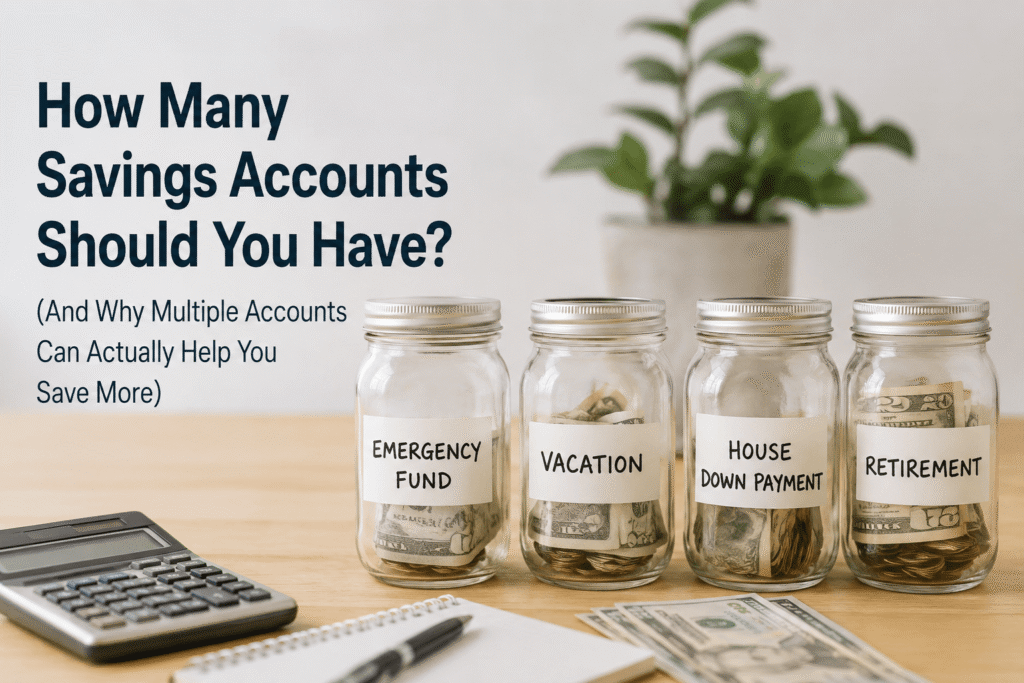
Most financial experts recommend having at least 3 to 5 savings accounts — one dedicated emergency fund, one for short-term goals, and one or more for specific longer-term goals like a down payment or vacation. There’s no hard rule, but separating your savings by purpose makes it way easier to stay on track without accidentally raiding your emergency fund for a weekend trip.
Quick Summary
Most People Are Using Their Savings Account Wrong
Be honest — how many of you have one savings account that does everything? It’s got your emergency fund, your vacation money, your “car needs new tires” fund, and whatever’s left over from last month all jumbled together. Sound familiar?
You’re not alone. Most Americans start out with a single savings account and just… keep piling money into it. The problem? When everything lives in one place, it’s impossible to know how you’re really doing. Is that $4,200 balance enough? Too little? Is some of it spoken for? Who knows.
That’s exactly where having multiple savings accounts — each with a specific job — becomes a total game changer.
Why Separating Your Savings by Goal Actually Works
Let’s get into the why before the how, because this part matters a lot.
There’s a concept in behavioral economics called mental accounting. Basically, our brains treat money differently depending on where it “lives” — even if the dollar amount is the same. When your emergency fund is mixed in with your vacation fund, your brain doesn’t always register the difference. One stressful Monday and suddenly your vacation fund is paying for a new laptop.
Separate accounts act like invisible guardrails. You can see exactly how much is for what, which makes it harder to justify pulling from the wrong bucket. It’s not about willpower — it’s about removing the temptation entirely.
Meet Marcus, 31, living in Austin. He used to have $8,000 sitting in one savings account and constantly felt stressed about whether he was “ahead” or “behind.” He split it into three accounts: $4,000 emergency fund, $2,500 vacation fund, $1,500 car maintenance fund. His exact words? “I felt like I got a raise, even though nothing changed.” He stopped second-guessing every purchase because he could see exactly where he stood.
The Core Savings Accounts Most People Actually Need
You don’t need to go overboard with 10 different accounts on day one. Start with these three foundational accounts. From there, add more as your goals evolve.
Your Emergency Fund Account Non-Negotiable
This one isn’t optional. Your emergency fund should live in its own account, completely separate from everything else — end of discussion. Why? Because emergencies don’t care about your vacation plans. If your car breaks down and your repair fund is mixed with your trip-to-Hawaii money, you’re in a tough spot.
💡 A slight inconvenience — like a 1–2 day transfer window — works as a natural speed bump so you don’t tap it casually.
Short-Term Goals Account
This is your catch-all for things happening within the next 1 to 2 years. Think holiday gifts, back-to-school shopping, annual insurance premiums, a new phone, maybe a weekend trip. Basically anything that’s planned but doesn’t happen monthly.
A lot of people use the sinking fund method here: figure out how much something will cost, divide it by the months until you need it, and save that fixed amount every single month. The money’s already there when you need it. No stress, no credit card debt.
Long-Term Goals Account(s)
These are your big dreams — a house down payment, a new car, a wedding, a year of travel, or even just a serious investment in your home. Because these goals are bigger and further out, it’s worth giving each one its own dedicated account so progress stays visible and motivating.
Seeing your “New Car” account at $7,800 feels a lot more real than trying to mentally carve that out of a $22,000 mixed savings account.
The Sinking Fund Method: A Savings Account for Every Expense
If you’ve spent any time on personal finance TikTok or Instagram, you’ve probably heard the term “sinking fund.” It’s been everywhere lately — and for good reason.
A sinking fund is just a dedicated savings pot for a specific, predictable future expense. The idea is to spread the cost out over time so it doesn’t hit you like a freight train when it arrives. Common sinking funds include:
Now here’s where people get overwhelmed: do you need a separate bank account for every single sinking fund? Not necessarily. Some people manage 10+ sinking funds within one bank using sub-accounts or account nicknames. Others prefer to keep it simple with 3–4 accounts total.
The right number is the one you’ll actually stick to. More accounts = more precision, but also more mental overhead. Find your sweet spot.
How Many Savings Accounts Is Too Many?
Here’s the honest answer: it depends on you, not on some magic number a financial advisor plucked from thin air.
A good rule of thumb? If managing your accounts starts to feel like a part-time job, you have too many. If you can’t remember what some of them are for, you definitely have too many. For most Americans, somewhere between 3 and 7 savings accounts hits the sweet spot.
Same Bank vs. Different Banks — Which Works Better?
This is one of the most common questions, and the answer is genuinely: it depends on what you’re trying to do. Let’s break it down clearly.
| Same Bank | Different Banks | |
|---|---|---|
| Ease of Use | Super convenient — instant transfers, one login, one app | Slightly more friction — multiple logins, transfer delays |
| Interest Rates | Often lower (especially big banks like Chase or BofA) | Often higher — online banks like Marcus or Ally offer better APYs |
| Impulse Spending | Easier to dip into savings impulsively | Transfer delays create a natural “cooling off” period |
| FDIC Protection | All accounts at same bank share the $250K limit | Each bank gets its own $250K limit — better for large balances |
| Best For | Short-term goals, sinking funds you access often | Emergency fund, long-term goals, high-balance savers |
Sweet spot for most people: Keep everyday sinking funds at your main bank for convenience, and stash your emergency fund and big long-term goals at a high-yield online bank where you’ll earn real interest — and feel slightly less tempted to raid it.
Step-by-Step: How to Set Up Multiple Savings Accounts
Ready to get organized? Here’s exactly how to do it without getting overwhelmed.
List all your current and upcoming financial goals
Grab a piece of paper or open your notes app. Write down every goal you’re working toward — emergency fund, vacation, car, holiday fund, home renovations, whatever. Don’t judge the list, just get it all out.
Separate your goals into tiers
Tier 1 = non-negotiables (emergency fund). Tier 2 = within 1 year (holiday gifts, small vacation, deductible). Tier 3 = 1–3 years out (down payment, car, wedding). This helps you see how many accounts you actually need.
Pick your banks
For most goals, a high-yield savings account at an online bank is your best friend. Names like Ally, Marcus by Goldman Sachs, SoFi, and Discover consistently offer strong APYs with no monthly fees. For sinking funds you’ll tap regularly, your existing bank works fine.
Open and name your accounts
Most banks let you nickname your savings accounts. “Emergency Fund — Do Not Touch,” “Bali 2026,” “New Car Fund” — whatever makes it feel real. This step is deceptively powerful. A named account is way harder to raid than one that says “Savings 2.”
Set up automatic transfers
This is the step that separates people who talk about saving from people who actually save. Set up automatic transfers on the day after your paycheck hits. Even $25/month into a dedicated account is infinitely better than $0. You won’t miss what you never see.
Review quarterly, not obsessively
Check in on your accounts every 3 months. Are you on track? Does a goal need more funding? Did a goal disappear (trip got cancelled, car didn’t break down)? Redirect that money to the next priority. This keeps your system alive without turning into a daily ritual.
Does Opening Multiple Savings Accounts Hurt Your Credit Score?
Your credit score is built on your borrowing history — credit cards, loans, mortgages. Savings accounts are deposit accounts, not credit accounts. Banks typically do a soft pull (or no pull at all) when you open a savings account, so there’s no hard inquiry ding.
The only mild exception: some banks do a soft credit check to verify your identity, and a very small number of fintech banks might do a hard pull. But this is rare for basic savings accounts — and even then, a single hard pull usually drops your score by fewer than 5 points temporarily.
Bottom line? Don’t let credit score fears stop you from setting up a smart savings system. They’re completely unrelated.
FDIC Insurance: What to Know When Spreading Money Around
The FDIC insures deposits up to $250,000 per depositor, per bank, per account ownership category. That’s the key phrase: per bank.
So if you have $300,000 in savings all at one bank, $50,000 of that is technically uninsured. But if you split $300,000 across two banks — $150,000 each — you’re fully covered at both.
For most Americans with savings well under $250,000, FDIC coverage isn’t a day-to-day concern. But if you’re building serious wealth, spreading across banks isn’t just smart organization — it’s also smart risk management.
Pro tip: Joint accounts get $250,000 of coverage per co-owner, per bank. So a married couple with a joint account at one bank is covered up to $500,000. Good to know.
Which Type of Savings Account Is Best for Each Goal?
Not all savings accounts are built the same. Here’s a quick reference to match your goal with the right account type.
| Savings Goal | Best Account Type | Timeline | Why It Works |
|---|---|---|---|
| Emergency Fund | High-Yield Savings (online bank) | Always accessible | Earns interest, stays liquid, slightly out of sight |
| Holiday / Gift Fund | Sinking fund sub-account (same bank) | 3–12 months | Easy to automate; see progress each month |
| Vacation Fund | High-Yield Savings | 6–18 months | Earns more while you save; dedicated so you don’t raid it |
| Car Replacement | High-Yield Savings or Money Market | 2–4 years | Higher balance benefits from better interest over time |
| Home Down Payment | High-Yield Savings (separate bank) | 2–5 years | Big balance deserves top APY; keeps it out of daily view |
| Short-Term Locked Goal | CD (Certificate of Deposit) | 1–5 years | Higher rate in exchange for locking money in — great if you won’t need it early |
| Long-Term Wealth Building | Investment account (brokerage / IRA) | 5+ years | Savings accounts can’t compete with market returns for long timelines |
How to Automate Multiple Savings Accounts Without the Headache
Automation is what keeps this whole system from becoming a chore. Here are the three approaches that actually work:
Split Direct Deposit
Many employers let you split your direct deposit between multiple accounts. Just tell payroll to send $X to your main checking, $Y to your emergency fund account, $Z to your vacation account. Set it once and forget it. This is the cleanest approach if your employer supports it.
Scheduled Automatic Transfers
Set up recurring transfers from your checking to each savings account on a specific day each month — ideally 1–2 days after payday. Most banks let you do this in-app. Some people call this “paying yourself first,” and it’s probably the single most powerful habit in personal finance.
Round-Up Apps
Apps like Acorns and Chime round up every transaction and funnel the spare change into savings. Alone, it’s not a savings strategy — but as a supplement? It adds up surprisingly fast without you noticing.
Frequently Asked Questions
Final Thoughts: The Right Number Is the One You’ll Actually Use
There’s no single “correct” number of savings accounts. The right number is the one that keeps you organized, motivated, and actually saving — not the one that sounds the most sophisticated.
If three accounts feel manageable and keep you on track, that’s your number. If you’re a natural organizer who thrives on visibility and wants seven accounts, each named and automated? More power to you.
What matters is that each account has a job, you know why it exists, and you’re funding it consistently.
Start simple. Open one dedicated emergency fund account if you haven’t yet. Name it. Set up a $25 automatic transfer. That’s it. You can build from there. Small, consistent steps beat perfect, complex systems every single time.
Disclaimer: This article is for informational purposes only and does not constitute personalized financial advice. Interest rates, account features, and bank offerings change frequently — always verify current rates directly with financial institutions before opening an account.