

On this page
“Am I saving enough for retirement?” is one of the most common money questions. A popular rule of thumb from Fidelity uses multiples of your salary to set milestones by age. Here is how much you should have saved for retirement at each age, what that looks like in dollars, how real savers compare and how to catch up if you are behind.

Retirement savings benchmarks by age
- By 30: 1x your salary
- By 40: 3x your salary
- By 50: 6x your salary
- By 60: 8x your salary
- By 67: 10x your salary
These Fidelity guidelines assume you retire at 67 and want to keep a similar lifestyle.
Retirement savings by age, in dollars
Fidelity’s milestones are multiples of your current salary at each age. Here is what they look like on three salary levels:
| Age | Multiple | $50,000 salary | $75,000 salary | $100,000 salary |
|---|---|---|---|---|
| 30 | 1x | $50,000 | $75,000 | $100,000 |
| 35 | 2x | $100,000 | $150,000 | $200,000 |
| 40 | 3x | $150,000 | $225,000 | $300,000 |
| 45 | 4x | $200,000 | $300,000 | $400,000 |
| 50 | 6x | $300,000 | $450,000 | $600,000 |
| 55 | 7x | $350,000 | $525,000 | $700,000 |
| 60 | 8x | $400,000 | $600,000 | $800,000 |
| 67 | 10x | $500,000 | $750,000 | $1,000,000 |
Count everything you have saved for retirement: 401(k)s, IRAs, HSAs earmarked for retirement and taxable investment accounts.
Where do these numbers come from?
Fidelity estimates that saving about 10 times your pre-retirement income by 67, together with Social Security, should let most people maintain their lifestyle. To get there, it suggests saving about 15% of income each year, including any employer match, starting by age 25. If you plan to retire later, your target is lower; if you plan to retire early or spend more, it is higher.
How do Americans actually compare?
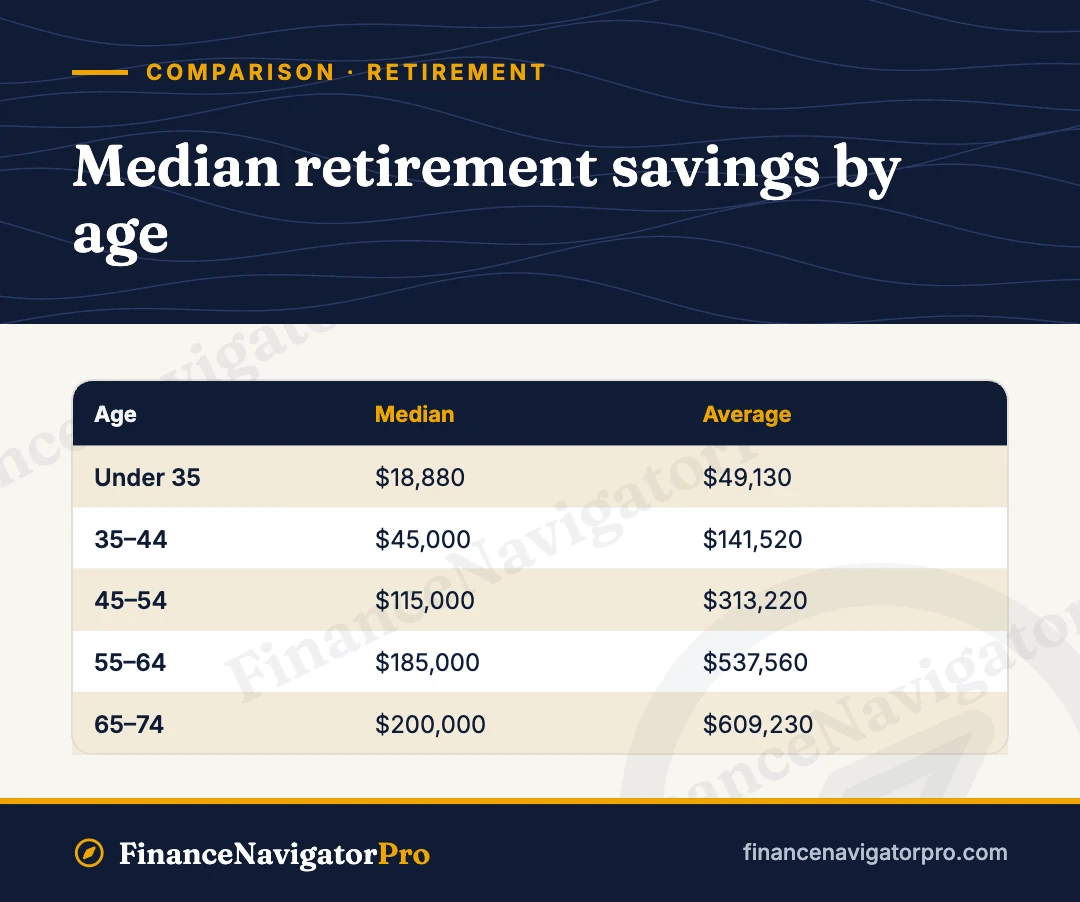
The Federal Reserve’s 2022 Survey of Consumer Finances shows a wide gap between average and typical (median) savings among families with retirement accounts:
| Age of household head | Average savings | Median savings |
|---|---|---|
| Under 35 | $49,130 | $18,880 |
| 35–44 | $141,520 | $45,000 |
| 45–54 | $313,220 | $115,000 |
| 55–64 | $537,560 | $185,000 |
| 65–74 | $609,230 | $200,000 |
| 75 and older | $462,410 | $130,000 |
The median is more useful than the average, which is pulled up by a small number of very large accounts. Many people fall short of the benchmarks, so do not panic if you are behind; focus on what you can do from here.
How much do you need in total?
Another way to set a target is the 4% rule: if you withdraw about 4% of your savings in the first year of retirement and adjust for inflation afterward, your money has historically had a strong chance of lasting about 30 years. That means multiplying the yearly income you need from savings by 25. If you need $40,000 a year on top of Social Security, aim for about $1 million.
How to catch up if you are behind
- Get the full employer match: it is an instant return on your money. Learn how it works in what is a 401(k).
- Raise your contribution rate by 1% a year: many plans can do this automatically.
- Use catch-up contributions: for 2027, workers 50 and older can add $8,500 to a 401(k), and those aged 60 to 63 can add $11,750. IRAs allow an extra $1,100 at 50 and older. See 2027 contribution limits.
- Open an IRA: compare traditional vs. Roth IRA.
- Keep costs low: choose low-cost index funds, since fees compound over decades.
- Pay off high-interest debt: freeing up cash from credit card debt gives you more to invest.
- Delay Social Security: waiting past full retirement age, up to 70, increases your monthly benefit.
- Work a little longer: each extra year adds savings and shortens the time your money must last.
Run your numbers
- See if you are on track with the retirement calculator.
- Project your workplace plan with the 401(k) calculator.
- Compare your wealth with peers using the net worth by age calculator.
- Test your withdrawal rate with the safe withdrawal rate calculator.
Frequently asked questions
How much should I have saved by 30?
A common benchmark is about one year’s salary. If you earn $60,000, that means around $60,000 in retirement savings.
How much should I have saved by 50?
Fidelity suggests about six times your salary by 50. Catch-up contributions start at 50, which can help if you are behind.
Does home equity count toward retirement savings?
These benchmarks generally count only retirement investments. Home equity can help in retirement, but it is harder to turn into income without selling or borrowing.
What percentage of my income should I save for retirement?
Fidelity suggests about 15% of pre-tax income, including any employer match, starting in your mid-20s. Start later and you may need to save more.
See the bigger picture with average net worth by age, and save for children’s education in a 529 plan.
Bottom line
Aim for about 1x your salary by 30, 3x by 40, 6x by 50, 8x by 60 and 10x by 67. These are guidelines, not pass-or-fail tests. If you are behind, capture your full match, increase contributions each year and use catch-up contributions after 50. This article is educational and not personal financial advice.
Keep reading