
⚡Quick Answer
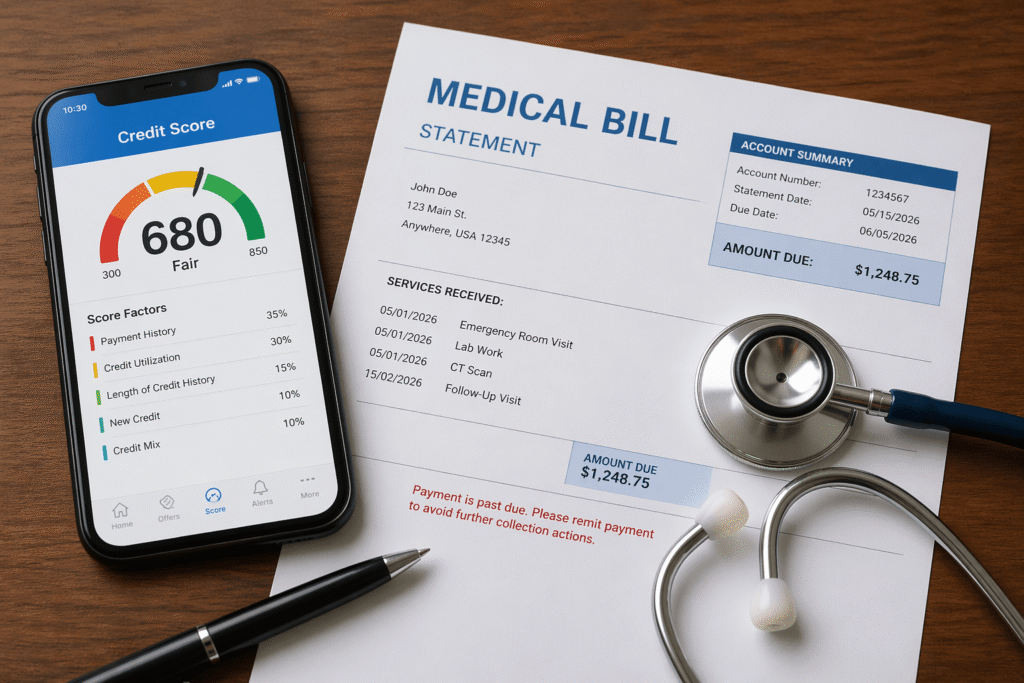
Bottom Line: Medical bills can still hurt your credit in 2026 — but the rules have changed significantly in your favor. Debts under $500 no longer appear on your credit report, paid medical collections are removed automatically, and there’s now a mandatory 1-year waiting period before any unpaid medical debt can be reported. If you have older medical collections dragging down your score, there are real steps you can take to get them removed.
📋Quick Summary
✓
Medical bills under $500 are completely excluded from credit reports as of 2023 rules now fully enforced in 2026.
✓
There is a mandatory 12-month waiting period before any medical debt can appear on your credit report.
✓
Paid medical collections must be removed from your credit report — all three bureaus (Equifax, Experian, TransUnion) are required to do this.
✓
Unpaid medical debt over $500 CAN still be reported and can lower your score by 50 to 100+ points depending on your profile.
✓
New CFPB proposals in 2025 aim to remove medical debt from credit reports entirely — final rules may be in effect by late 2026.
✓
You can dispute medical collections, especially if there was an insurance error or billing mistake.
✓
Proactive steps like setting up a payment plan or negotiating the bill can prevent collections from ever hitting your report.
Do Medical Bills Affect Your Credit Score?
Here’s the short answer: yes, they can — but a lot has changed.
For years, medical debt was treated just like any other unpaid bill. Miss a payment, ignore the collection notice, and boom — your credit score takes a serious hit. But starting around 2022 and continuing into 2026, the major credit bureaus and the Consumer Financial Protection Bureau (CFPB) have made significant changes to how medical debt is handled.
So before you panic about that hospital bill sitting on your kitchen counter, let’s break down exactly what can and can’t show up on your report.
The key distinction: Medical bills from your doctor or hospital don’t directly report to the credit bureaus. Your healthcare provider isn’t a lender. The damage happens when your unpaid bill gets sent to a third-party debt collection agency — and then that agency reports it.
That gap between getting the bill and it hitting your credit report? That’s your window to act.
When Do Medical Bills Go to Collections?
This is where most people get caught off guard. You get a hospital bill, life gets busy, maybe you’re dealing with the health issue itself — and the bill just… sits there. Here’s what typically happens:
1
Bill Received
You receive a bill from your provider — usually 30 to 60 days after your visit.
2
Internal Reminders
If unpaid, the provider may send internal reminders and make phone calls for several months.
3
Sent to Collections
After roughly 90 to 180 days, the debt is sold or assigned to a third-party collection agency.
4
Collection Agency Can Attempt to Collect
The collection agency can now attempt to collect — and potentially report the debt to credit bureaus.
5
The 12-Month Grace Period
They must wait at least 12 months before reporting it. That’s your buffer.
A $1,200 ER bill can show up out of nowhere — maybe six months after your visit when the insurance claim finally gets sorted. By then, it could already be with a collector. Knowing this timeline helps you stay ahead of it.
💡 Pro tip: Even if you can’t pay the full amount, calling your provider and setting up even a small payment plan can delay or prevent collections entirely.
How Credit Scoring Treats Medical Debt in 2026
This is where things get interesting — and actually pretty hopeful.
The three major credit bureaus — Equifax, Experian, and TransUnion — announced sweeping changes to medical debt reporting starting in 2022, with those changes now fully baked into 2026 scoring models:
Paid vs. Unpaid Medical Collections: What’s the Difference?
This is a question we see constantly, and honestly, the answer surprises most people.
Unpaid medical collections over $500 can still appear on your credit report after the 12-month grace period and can do real damage — we’re talking a potential drop of 50 to 100+ points depending on your score profile and how many other marks you have.
Paid medical collections, under 2026 rules, must be removed from your report entirely. That’s a huge deal. If you can scrape together the funds to pay even an old collection, it disappears from your report — not just marked as paid, but gone.
| Situation | Credit Report Impact | Best Action to Take |
|---|---|---|
| Medical debt under $500 | None — excluded from reports entirely | Confirm with provider; still pay if owed |
| Medical debt over $500 (under 12 months old) | Not yet reported — grace period active | Negotiate, pay, or set up a payment plan now |
| Unpaid medical collection over $500 | Can appear; may drop score 50–100+ pts | Negotiate settlement or pay in full ASAP |
| Paid medical collection | Must be removed from all 3 bureaus | Confirm removal in writing; dispute if it lingers |
| Medical debt in insurance dispute | Should not be reported during dispute | Send dispute letter to bureau with documentation |
| Medical collection older than 7 years | Must be removed by law regardless of status | Dispute with bureau if still showing |
How Much Does Medical Debt Actually Impact Your Score?
Let’s talk real numbers, because the range is wide and it depends on your specific situation.
780+ Score
Excellent Credit
A single medical collection can knock you down by 50 to 100 points or more. The higher your starting score, the harder the fall.
600s Score
Fair Credit
A medical collection adds to the pile but the marginal damage is lower — maybe 20 to 50 additional points lost.
Here’s the part most blogs won’t tell you: not all medical collections carry the same weight. A collection from 2019 hurts less than one from last month. A paid collection (which is now removed) hurts nothing. And a collection that’s the result of a billing error? That can be disputed and potentially wiped entirely.
Can You Remove Medical Collections From Your Credit Report?
Yes — and more often than you’d think.
There are a few legitimate ways to get medical collections removed. Let’s walk through each one:
If you want to track your credit and catch medical collections as soon as they appear, a credit monitoring tool can alert you the moment something new shows up on your report — giving you more time to act before it does serious damage. Check out our guide on how to check your credit score for free.
If You Have Medical Debt Right Now — Do This
Okay, let’s get practical. Here’s a step-by-step game plan depending on where you are right now.
01
Check your credit reports immediately
Go to AnnualCreditReport.com and pull all three bureau reports. Look for any medical collections you don’t recognize or that seem inaccurate. Note the creditor name, balance, and date.
02
Identify the debt’s status
Is it under $500? It shouldn’t be on your report at all. Is it less than 12 months old? It should still be in the grace period. Is it paid? It should’ve been removed. Any of these discrepancies? Dispute them.
03
Contact your original healthcare provider first
Before dealing with the collection agency, call the hospital or clinic. Ask if they have a financial assistance program, whether your insurance should have covered it, or if they’ll set up a payment plan. Many providers prefer direct payment and will recall the debt from collections if you make arrangements.
04
Negotiate the collection if it’s already out there
Collection agencies buy debt for pennies on the dollar. That means they often have room to negotiate. You may be able to settle for 40–60% of the original balance. Again — get any agreement in writing before you pay.
05
Dispute any errors in writing
File disputes online or by certified mail with each bureau that’s reporting the incorrect information. Include documentation. Bureaus have 30 days to investigate.
06
Monitor your credit going forward
Set up credit monitoring so you’re never caught off guard again. Knowing the moment something hits your report means you can act before it spirals into a bigger problem. If you’re also looking to build your credit from scratch, start there once collections are cleared.
Common Myths About Medical Debt and Credit
Real-Life Scenarios
Frequently Asked Questions
Final Thoughts: You Have More Power Than You Think
Medical debt is stressful enough on its own — worrying about what it’s doing to your credit score shouldn’t make it worse. And here’s the good news: the rules in 2026 are genuinely more in your favor than they’ve ever been.
Small debts are off the table. There’s a built-in waiting period before anything can hit your report. Paying a collection makes it disappear entirely. And if there’s a billing error — which happens all the time — you have a clear path to dispute it.
The most important thing you can do right now is pull your credit reports, check what’s actually there, and take action before things get worse. Whether it’s calling your provider to set up a payment plan, disputing an inaccurate collection, or simply setting up credit monitoring to stay informed — these are real, doable steps.
If you want to stay on top of your credit without the guesswork, a credit monitoring service can alert you the moment a new collection appears — so you’re never blindsided again.
You’ve already taken the first step by getting informed. Now go take the next one.
Disclaimer: This article is for informational purposes only and does not constitute legal or financial advice. Credit reporting rules may change — consult a certified credit counselor or financial advisor for guidance specific to your situation.