
|
Table of Contents
- What Is the Average Credit Score in the U.S.?
- Credit Score Ranges Explained
- Average Credit Score by Age (2026)
- Average Credit Score by Generation
- Average Credit Score by State (2026)
- Why the Average Score Has Been Rising
- What Is a Good Credit Score in 2026?
- How to Improve Your Credit Score: 8 Steps
- Common Credit Score Myths – Debunked
- Free Tools to Check Your Credit Score
- Key Takeaways
If you’ve ever glanced at your credit score and thought, “Is this actually good — or just average?” — you’re in very good company.
Every year, tens of millions of Americans check their credit scores. Some are preparing to buy a home. Others are applying for a car loan or a new credit card. And many are simply curious: where do I stand?
The good news? The average credit score in the U.S. has been climbing steadily for years. In 2026, the typical American has a FICO score of approximately 715–720, based on data from major credit bureaus including FICO, Experian, and TransUnion.
In this guide, you’ll get the current average, breakdowns by age, generation, and state, plus proven steps to push your own score higher.
What Is the Average Credit Score in the U.S.?
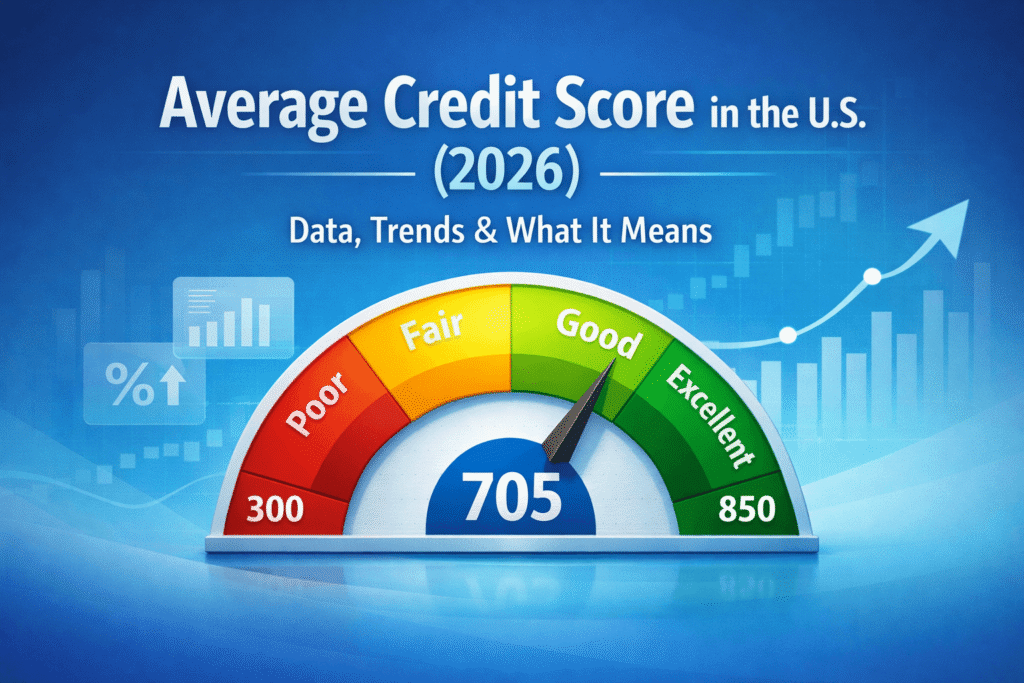
The average credit score in the United States is approximately 717 as of 2026, based on FICO Score data compiled by Experian. This places the typical American squarely in the “Good” range on the standard FICO scale of 300–850.
| Metric | Value |
|---|---|
| National Average FICO Score (2026) | ~717 |
| Score Range | 300 – 850 |
| Rating at 717 | Good |
| Primary Data Sources | FICO, Experian, TransUnion |
| Year-over-Year Trend | ↑ Slowly increasing |
FICO scores are the most widely used credit scores in the U.S., used by over 90% of top lenders when making credit decisions. The Consumer Financial Protection Bureau (CFPB) also tracks credit score trends nationwide and provides consumer education resources.
Credit Score Ranges Explained
Before benchmarking your score, it helps to understand what each range means — and how lenders interpret it. FICO scores run from 300 (lowest) to 850 (highest).
★ U.S. average of 717 falls in the “Good” tier
| Score Range | Rating | What It Means for Borrowers |
|---|---|---|
| 800 – 850 | Exceptional | Best rates on mortgages, auto loans, and premium credit cards |
| 740 – 799 | Very Good | Above-average terms; access to nearly all credit products |
| 670 – 739 | Good | Approved for most loans; rates close to average |
| 580 – 669 | Fair | May qualify for some products; expect higher interest rates |
| 300 – 579 | Poor | Limited credit access; may require secured cards or co-signers |
Think of your credit score like a financial report card. The higher it is, the more lenders trust you to repay — and the better the terms they’ll offer. With a national average around 717, most Americans sit comfortably in the “Good” tier, a significant improvement from earlier decades. Learn more about what each credit score range means for your borrowing power.
Average Credit Score by Age (2026)
One of the clearest patterns in credit data is that scores tend to rise with age. Length of credit history, payment track records, and credit mix all accumulate over time.
| Age Group | Avg. Score (2026) | Rating | Score Bar |
|---|---|---|---|
| 18–25 (Gen Z) | ~680 | Good |
|
| 26–41 (Millennials) | ~690 | Good |
|
| 42–57 (Gen X) | ~705 | Good |
|
| 58–76 (Baby Boomers) | ~742 | Very Good |
|
| 77+ (Silent Generation) | ~760 | Very Good |
|
Why do older Americans have higher scores? Several factors drive this pattern:
- → Longer credit history. Scoring models reward accounts open for many years. A 60-year-old’s oldest card may be 30+ years old.
- → Perfect payment history. Decades of on-time payments outweigh a few early missteps.
- → Lower utilization. Older consumers often carry lower balances relative to their credit limits.
- → Fewer hard inquiries. Older borrowers tend to apply for new credit less frequently.
Average Credit Score by Generation
Gen Z (Born 1997–2012) — Avg. Score: ~680
Gen Z is just entering the credit market. Many are opening their first credit cards or taking out student loans. Their scores are limited primarily by short credit histories — not poor behavior. The growing availability of credit cards for beginners and fintech apps has helped younger consumers establish credit faster than previous generations did at the same age.
Millennials (Born 1981–1996) — Avg. Score: ~690
Millennials carry more debt on average than any other generation — student loans, mortgages, and credit card balances. Despite this, their scores have improved considerably over the past five years. Many who struggled after the 2008 financial crisis have since rebuilt their profiles. Higher incomes and better financial literacy tools have contributed to this recovery.
Gen X (Born 1965–1980) — Avg. Score: ~705
Gen X sits in the middle — old enough to have substantial credit history, young enough to still be managing mortgages, car payments, and sometimes college tuition for their kids. Their scores reflect a balance of long-standing accounts and active borrowing activity. Understanding how credit utilization affects your score is especially relevant for this generation.
Baby Boomers (Born 1946–1964) — Avg. Score: ~742
Baby Boomers tend to have Very Good to Exceptional scores. Many have paid off or nearly paid off their mortgages, carry low credit utilization, and have credit histories spanning 40+ years. Their behavior aligns closely with what FICO rewards most.
Silent Generation (Born before 1946) — Avg. Score: ~760
The Silent Generation consistently posts the highest average scores of any age group. Those who actively use revolving credit tend to have pristine histories spanning many decades — a testament to long-term, disciplined financial behavior.
Average Credit Score by State (2026)
Where you live can reflect broader economic conditions that correlate with average scores. States with higher median incomes, better banking access, and stronger financial literacy tend to post higher averages.
| 🏆 States with Highest Average Credit Scores | ||
|---|---|---|
| State | Avg. Score | Notable Factor |
| Minnesota | ~742 | High median income, strong financial literacy |
| Vermont | ~738 | Low cost of living relative to income |
| New Hampshire | ~737 | High homeownership rates, low unemployment |
| Massachusetts | ~736 | High education levels, high median income |
| Wisconsin | ~735 | Low credit card delinquency rates |
| States with Lowest Average Credit Scores | ||
|---|---|---|
| State | Avg. Score | Notable Factor |
| Mississippi | ~681 | Lowest median household income in the U.S. |
| Louisiana | ~685 | High poverty rate, limited credit access |
| Alabama | ~686 | Higher rates of medical debt collections |
| Nevada | ~689 | High cost of living, tourism-driven economy |
| Texas | ~692 | Large unbanked population in some regions |
Important: Geography doesn’t determine your score — individual behavior does. People in Mississippi can and do have 800+ scores. State averages reflect broader economic conditions, not personal destiny.
Why the Average Credit Score Has Been Rising
The U.S. average credit score has risen by roughly 20–25 points over the past decade. Several converging forces have pushed the national average upward:
|
📚 Better Financial Literacy Free resources from the CFPB, nonprofits, and financial media have made credit literacy more accessible than ever. |
-
📚 Better Financial Literacy
Free resources from the CFPB, nonprofits, and financial media have made credit education more accessible than ever. -
📱 Free Score Monitoring
Services like Credit Karma, Experian, and bank-provided trackers mean more Americans check their credit regularly — and act on what they see. -
🔄 Improved Scoring Models
Newer FICO models (like FICO 10 and 10T) consider more nuanced data, rewarding responsible behavior more accurately. -
🏠 Post-Pandemic Debt Paydown
During COVID-19, many Americans paid down debt, accumulated savings, and reduced credit card utilization — all of which boosted scores. The Federal Reserve’s consumer credit reports confirm a post-pandemic shift toward more consumers paying off balances monthly. -
🌱 More Credit-Building Products
Secured cards and credit-builder loans designed for thin-file consumers have helped underserved populations establish credit histories. See our guide to building credit from scratch.
What Is a Good Credit Score in 2026?
“Good” is relative — and it depends heavily on what you’re applying for. Here’s a practical breakdown of the minimum scores most lenders want to see:
| Financial Product | Min. Score to Qualify | Best Rates Start At |
|---|---|---|
| Conventional Mortgage | ~620 | 740+ |
| FHA Mortgage | ~580 | 680+ |
| Auto Loan | ~660 | 720+ |
| Personal Loan | ~640 | 700+ |
| Premium Rewards Credit Card | ~700 | 740+ |
| 0% APR Credit Card | ~690 | 720+ |
| Apartment Rental | ~620 | 680+ |
Notice the pattern: you can often qualify with a score in the 600s, but you’ll get the best terms with 720 or higher. For mortgages, the difference between a 680 and a 760 can mean tens of thousands of dollars over the life of a loan. If your score is at the national average of 717 — you’re in solid shape, but pushing past 740 meaningfully improves your options. Check out the best personal loan options for your credit profile.
How to Improve Your Credit Score: 8 Actionable Steps
No matter where your score sits today, it can improve. Credit scores are dynamic — they respond to your behavior. Here’s what actually moves the needle:
What Makes Up Your FICO Score
|
|
35% Payment History |
|
|
30% Amounts Owed / Utilization |
|
|
15% Length of Credit History |
|
|
10% New Credit (Hard Inquiries) |
|
|
10% Credit Mix |
Common Credit Score Myths — Debunked
Bad information about credit scores is everywhere. Here are the myths that trip people up most often — and what’s actually true. We cover these in depth in our article on credit score myths debunked.
Free Tools to Check and Monitor Your Credit Score
You don’t need to pay to stay on top of your credit. Here are the most reputable free options:
| AnnualCreditReport.com | Free weekly credit reports from Equifax, Experian, and TransUnion — federally mandated and the only official source. |
| Experian Free | Free FICO score access plus alerts when your report changes — one of the few places offering a real FICO score at no cost. |
| Your Bank or Credit Union | Many major banks and credit unions now provide free FICO or VantageScore access via their apps or online portals. Check with your institution. |
| Credit Karma | Free VantageScore from TransUnion and Equifax, with personalized product recommendations. Note: shows VantageScore, not FICO. |
| CFPB Credit Tools | Government resources for understanding, monitoring, and disputing credit report information — authoritative and ad-free. |
Key Takeaways
- ✓The average U.S. credit score in 2026 is approximately 717, which falls in the “Good” range (670–739).
- ✓Scores vary significantly by age — older Americans consistently score higher due to longer credit histories.
- ✓States like Minnesota and Vermont have the highest averages; Mississippi and Louisiana have the lowest.
- ✓A score of 670+ qualifies you for most credit products; 740+ unlocks the best rates.
- ✓Payment history (35%) and credit utilization (30%) are the two most impactful FICO factors.
- ✓Small, consistent habits — paying on time, keeping balances low, not closing old accounts — compound significantly over time.
- ✓Checking your own score never hurts it. Check often and stay informed.
Conclusion
The average credit score in the U.S. may be around 717 — but your personal score is what really matters for your financial life.
Whether you’re at 650 trying to qualify for a mortgage, at 720 pushing into the “Very Good” tier, or at 780 maintaining an exceptional profile — the path forward is the same: consistent, patient, informed financial behavior.
Even small changes produce measurable results. Paying down a credit card balance, disputing an error, or simply not applying for new credit for six months can meaningfully move your score in the right direction. Your score doesn’t define you — but understanding it gives you real power over your financial future.
Related Articles
| → Credit Score Ranges Explained | → Best Credit Cards for Bad Credit |
| → How to Lower Your Credit Utilization | → Best Personal Loans for 2026 |
| → Building Credit From Scratch | → Credit Score Myths Debunked |
Sources & Further Reading