Quick Answer: Collision coverage is optional auto insurance that pays to repair or replace your own vehicle after it hits another car, object, or rolls over — regardless of who caused the accident. You pay a deductible (commonly $500 or $1,000) and your insurer covers the rest, up to your car’s actual cash value. It’s not required by state law, but lenders and leasing companies almost always require it while you owe money on the vehicle. Drivers with newer, financed, or higher-value cars typically benefit most from carrying it.
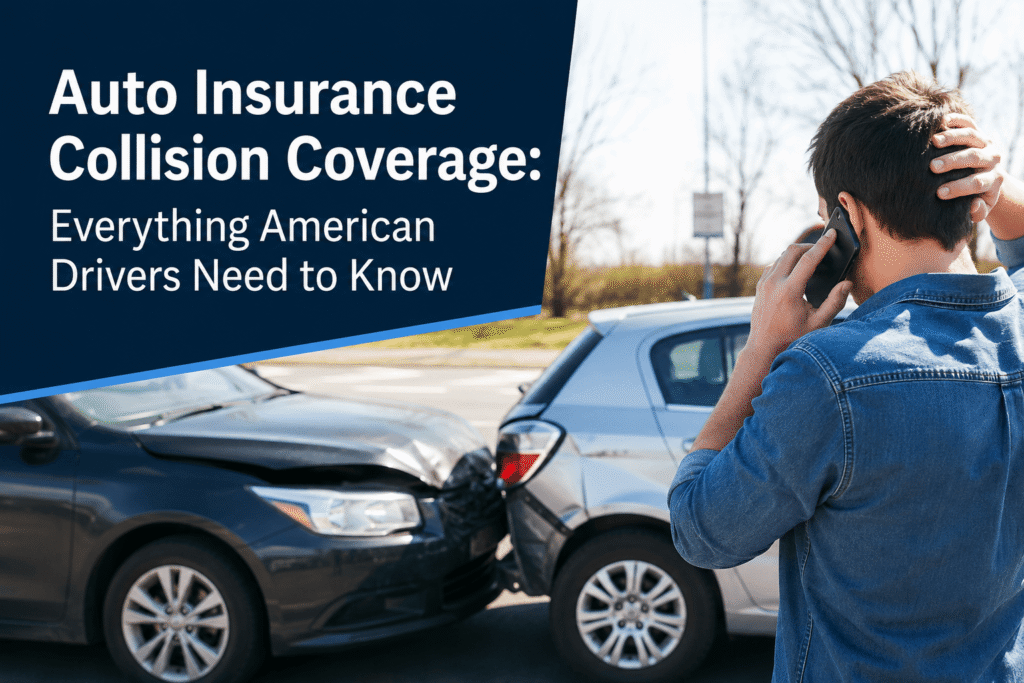
You’re backing out of a grocery store parking lot when another driver suddenly cuts behind you. Crunch. Nobody’s hurt, but your front bumper, headlights, and hood are badly damaged. The repair estimate comes back at $6,800. That’s the moment many drivers discover whether collision coverage was worth paying for.
This guide explains exactly how collision coverage works, when it’s worth the cost, and when you might be able to skip it. We’ll walk through real claim scenarios, break down the math on deductibles, and give you a straightforward framework for deciding what’s right for your situation — not just a sales pitch for more coverage.
Table of Contents
- What Is Collision Coverage?
- How Collision Coverage Works
- What Collision Coverage Pays For
- What Collision Coverage Does NOT Cover
- Collision Coverage vs. Comprehensive Coverage
- Collision vs. Liability Insurance
- Collision vs. “Full Coverage”
- Is Collision Coverage Required?
- Who Should Buy Collision Coverage?
- Who Can Probably Skip Collision Coverage?
- How Much Does Collision Coverage Cost?
- Understanding Collision Deductibles
- How Insurance Companies Calculate Your Payout
- Real Claim Examples
- Common Collision Claim Mistakes
- Ways to Lower Collision Insurance Costs
- Collision Coverage for Leased Cars
- Collision Coverage for Financed Vehicles
- Electric Vehicle Collision Coverage
- Collision Coverage for Older Cars
- How to File a Collision Insurance Claim
- Frequently Asked Questions
- Expert Tips
- Final Verdict: Should You Buy Collision Coverage?
- Interactive Tools & Worksheets
- Related Guides
- Sources & Further Reading
1. What Is Collision Coverage?
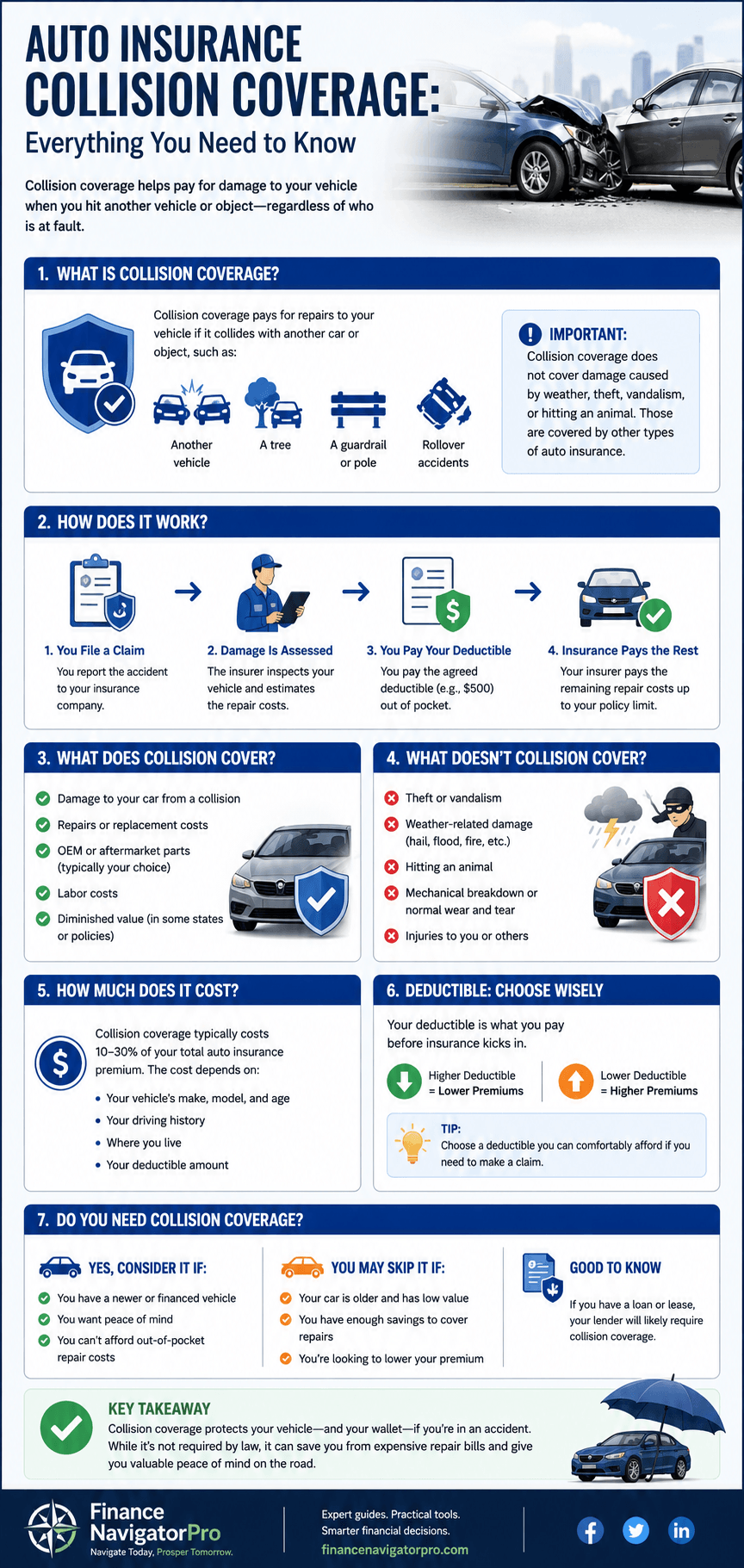
Collision coverage is a type of optional auto insurance that pays to repair or replace your own vehicle after it’s damaged in a crash — whether you hit another car, a tree, a guardrail, or simply lose control and roll over in an empty field. The key word is “yours.” Collision coverage doesn’t pay for anyone else’s car or medical bills. It’s strictly about putting your vehicle back together, or paying you its cash value if it’s totaled.
Here’s a simple example. Say you’re driving home in light rain and you hydroplane into the median barrier. There’s no other car involved — just you, your vehicle, and a concrete wall. Liability insurance wouldn’t help here at all, because liability only pays for damage you cause to other people or their property. Collision coverage is what pays for your own repair bill in this scenario.
Collision coverage exists because accidents aren’t always somebody else’s fault, and even when they are, the at-fault driver doesn’t always carry enough insurance — or any insurance at all — to make you whole. Insurers created collision coverage as a way for drivers to protect their own asset (the car) independent of fault, liability limits, or the other driver’s financial situation.
Think of collision coverage as protection for your own vehicle after a crash — regardless of who caused it.
2. How Collision Coverage Works
Filing a collision claim follows a fairly predictable sequence. Knowing the steps ahead of time makes the process far less stressful when you’re standing in a parking lot staring at a crumpled fender.
The Collision Claim Timeline
- Report the accident. Call your insurer (or use their app) as soon as it’s safe to do so. Most companies want a report within 24 to 72 hours.
- File the claim. You’ll provide details: location, time, other vehicles involved, photos, and a police report number if one exists.
- Vehicle inspection. An adjuster or a partnered body shop inspects the damage in person or reviews submitted photos.
- Repair estimate. The shop or adjuster calculates the cost to restore the vehicle to its pre-accident condition.
- Deductible applied. Your chosen deductible (for example, $500) is subtracted from the total payout.
- Insurance payment issued. The insurer pays the body shop directly, pays you, or pays a lender if there’s a loan on the car.
- Repairs completed. The shop repairs the vehicle, or, if the car is a total loss, the insurer pays out its actual cash value instead.
3. What Collision Coverage Pays For
Collision coverage applies broadly to vehicle-to-object and vehicle-to-vehicle impacts. It doesn’t matter if another car was involved or if you were completely alone when it happened.
- Hitting another vehicle, in any type of crash
- Hitting a tree or other fixed object
- Hitting a utility pole
- Hitting a guardrail
- Hitting a fence
- Hitting a mailbox or similar roadside structure
- Pothole damage severe enough to count as a collision-type loss
- Rollover accidents, even with no other vehicle involved
- Single-car accidents of almost any kind
- Parking garage collisions, including hitting a pillar or low ceiling
4. What Collision Coverage Does NOT Cover
This is where a lot of drivers get tripped up. Collision coverage is specifically for impact-related damage. Anything that isn’t a crash — weather events, theft, fire — falls under comprehensive coverage instead, which is a separate line item on your policy.
| Situation | Covered? | Explanation |
|---|---|---|
| Flood damage | Not covered | Falls under comprehensive coverage, not collision. |
| Fire damage | Not covered | Comprehensive coverage handles fire, including engine bay fires. |
| Theft of vehicle | Not covered | Comprehensive coverage pays out for stolen vehicles. |
| Vandalism | Not covered | Keyed paint, broken windows from vandalism fall under comprehensive. |
| Glass-only damage (e.g., cracked windshield from a rock) | Not covered | Usually a comprehensive claim, often with a separate low or $0 deductible. |
| Engine failure | Not covered | Mechanical failure isn’t a collision event — it’s a maintenance issue. |
| Mechanical breakdown | Not covered | Covered (if at all) by a mechanical breakdown warranty, not auto insurance. |
| Normal wear and tear | Not covered | Insurance covers sudden loss, not gradual deterioration. |
| Rust | Not covered | Considered a maintenance and age issue, not an insurable event. |
| Animal collision (e.g., hitting a deer) | Covered | Most insurers classify animal strikes as comprehensive, not collision — confirm with your carrier. |
| Weather damage (hail, falling tree branch) | Not covered | Comprehensive coverage handles weather-related losses. |
Notice that the animal-collision row reads “covered” but sits under a different policy than collision coverage. This is the single most common point of confusion in the entire category: most insurers treat deer strikes, vehicle-versus-animal accidents, and falling-object damage as comprehensive claims, not collision claims, even though the word “collision” feels like it should apply. Always confirm classification with your specific carrier, since practices can vary slightly.
5. Collision Coverage vs. Comprehensive Coverage
Collision and comprehensive are frequently bundled together and discussed in the same breath, but they protect against entirely different categories of risk. Here’s how they stack up side by side.
| Feature | Collision Coverage | Comprehensive Coverage |
|---|---|---|
| Definition | Pays for damage from crashes and impacts | Pays for non-crash damage to your vehicle |
| What it covers | Hitting vehicles, objects, rollovers | Theft, fire, vandalism, weather, animals, glass |
| Typical examples | Rear-end accident, hitting a pole | Hailstorm, stolen car, cracked windshield |
| Deductible | Usually $250–$1,000 | Usually $100–$500, sometimes $0 for glass |
| Typical annual cost | $300–$700 (varies widely by driver) | $150–$400 (varies widely by driver) |
| Claim frequency | Moderate — tied to accident rates | Lower, but spikes regionally (hail, theft zones) |
| When recommended | Financed/leased cars, newer vehicles, daily commuters | Same situations, plus areas prone to weather or theft |
Most drivers who carry one usually carry both. Lenders typically require both as a package deal anyway, and the cost difference between adding comprehensive on top of collision is often modest compared to the protection it adds against non-crash risks.
6. Collision vs. Liability Insurance
Liability insurance is required in nearly every state, while collision insurance is optional. The distinction comes down to whose vehicle is being repaired.
Scenario one: you run a red light and hit another driver’s car. Your liability coverage pays for the other driver’s vehicle damage and any injuries. It does not pay one cent toward your own car’s repair. To fix your own vehicle, you’d need collision coverage.
Scenario two: another driver runs a red light and hits you. In this case, their liability insurance should cover your vehicle’s repair, since they were at fault. But if they’re uninsured, underinsured, or their insurer disputes fault, your collision coverage becomes your fallback — you can file under your own policy and let your insurer pursue reimbursement from the at-fault driver through subrogation.
7. Collision vs. “Full Coverage”
“Full coverage” is one of the most misunderstood phrases in auto insurance — mostly because it isn’t an official insurance term at all. No policy document or state regulator defines “full coverage” with a fixed meaning. It’s industry shorthand, typically used to describe a policy that combines liability, collision, and comprehensive coverage into one package.
The problem with the phrase is that it implies total protection, when in reality “full coverage” policies still have limits, deductibles, and exclusions. A driver with “full coverage” can still be underinsured for a serious injury claim, or surprised that their policy doesn’t cover rental reimbursement unless they added it separately.
8. Is Collision Coverage Required?
No state requires collision coverage by law. Every state that mandates insurance at all requires some form of liability coverage — covering damage and injury you cause to others — but collision coverage stays optional from a pure legal standpoint.
That said, three other parties commonly force the issue:
- Lenders. If you have an auto loan, the bank or credit union financing your car almost always requires collision and comprehensive coverage until the loan is paid off, since the car is collateral.
- Leasing companies. Leased vehicles virtually always require collision coverage, often with a deductible cap, because the leasing company retains ownership of the car.
- Banks holding the title. Even outside a traditional auto loan, any institution with a lien on the vehicle title can require proof of collision coverage as a condition of the lien.
Drop the required coverage on a financed or leased vehicle and the lender can add their own “force-placed” insurance to your loan, which is typically far more expensive and less comprehensive than a policy you’d buy yourself.
9. Who Should Buy Collision Coverage?
Collision coverage makes the most sense when the cost of replacing your car out of pocket would be a genuine financial setback, or when someone else legally requires you to carry it. Here’s how that breaks down by situation.
New Cars
A brand-new car loses value the moment it leaves the lot, but its replacement cost stays high for years. Collision coverage protects that substantial investment from day one.
Used Cars
Newer used cars (roughly under seven years old) with meaningful resale value still benefit from collision coverage, especially if a loan is attached.
Luxury Cars
High-end vehicles carry expensive parts and labor costs. A single fender repair on a luxury model can easily exceed the cost of an entire used economy car, making collision coverage especially valuable.
Electric Vehicles (EVs)
EVs often carry higher repair costs due to battery packs and specialized parts (see Section 19 for a deeper breakdown), which makes collision coverage particularly important for EV owners.
Teen Drivers
Newer drivers statistically have higher accident rates. Pairing a teen driver with collision coverage protects the household vehicle from the higher likelihood of an at-fault, single-car, or minor crash.
Families
Households relying on one or two vehicles for daily logistics — school runs, work commutes, errands — often can’t easily absorb an unexpected total loss, making collision coverage a practical safety net.
Daily Commuters
More time on the road statistically means more exposure to fender-benders, parking lot mishaps, and highway accidents, all of which raise the case for collision coverage.
Rideshare Drivers
Driving for platforms like Uber or Lyft dramatically increases time behind the wheel and exposure to collisions. Many personal auto policies require a rideshare endorsement to maintain collision coverage during active trips — check with your insurer before assuming you’re covered.
Business Vehicles
Vehicles used for business purposes (deliveries, sales routes, client visits) often need commercial auto policies rather than personal ones, but the same logic applies: collision coverage protects a working asset.
10. Who Can Probably Skip Collision Coverage?
Collision coverage isn’t automatically the right call for every driver. For older, low-value, fully paid-off vehicles, the math can flip in the other direction — you may end up paying more in premiums over several years than the car is actually worth.
Use these practical decision rules to evaluate your own situation:
- Vehicle value test. If your car’s actual cash value is low (commonly cited around $3,000–$4,000 or less), a total loss payout may be smaller than several years of premiums combined.
- Emergency savings test. If you could comfortably replace the vehicle out of pocket without financial strain, self-insuring against collision risk becomes more reasonable.
- Age of car test. Vehicles beyond roughly 10–12 years old, with no loan or lease attached, are the classic candidates for dropping collision coverage.
- Repair cost test. If routine repair estimates for your make and model regularly approach or exceed the car’s value, insurers may total the car quickly anyway, reducing the practical benefit of carrying collision.
- Risk tolerance test. Some drivers are simply comfortable accepting the risk of paying for repairs themselves in exchange for lower monthly premiums — a valid choice as long as it’s a deliberate one.
11. How Much Does Collision Coverage Cost?
Collision coverage pricing varies considerably based on personal and vehicle-specific factors. Rather than quoting a single average that would oversimplify things, it helps to understand what’s actually driving your premium.
- Vehicle type. Expensive-to-repair models (luxury brands, EVs, sports cars) generally cost more to insure for collision than economy vehicles.
- ZIP code. Urban areas with higher traffic density and accident frequency typically see higher collision premiums than rural ZIP codes.
- Driving history. Clean records earn lower rates; recent at-fault accidents or tickets raise them.
- Age. Younger and newly licensed drivers generally pay more, reflecting higher statistical accident rates in that group.
- Claims history. Multiple recent claims — even not-at-fault ones in some states — can push premiums upward.
- Credit-based insurance score (where permitted). Several states allow insurers to factor in credit-based insurance scores; a few states ban this practice entirely.
- Deductible chosen. Higher deductibles lower your premium; lower deductibles raise it (more in Section 12).
- Annual mileage. More miles driven generally means more accident exposure, which can increase cost.
As a rough frame of reference, collision coverage alone often falls somewhere in the range of a few hundred dollars per year for a typical driver with a clean record, though this swings widely based on the factors above. Drivers in high-accident-rate urban areas, or those insuring expensive vehicles, can see considerably higher numbers. The only reliable way to know your actual cost is to request quotes from several insurers, since pricing models and underwriting rules vary noticeably across companies.
12. Understanding Collision Deductibles
Your deductible is the amount you pay out of pocket before insurance kicks in on a collision claim. Choosing a deductible is really a trade-off between your monthly premium and your out-of-pocket exposure if you do have an accident.
| Deductible | Repair Bill | You Pay | Insurer Pays |
|---|---|---|---|
| $250 | $3,000 | $250 | $2,750 |
| $500 | $3,000 | $500 | $2,500 |
| $1,000 | $3,000 | $1,000 | $2,000 |
| $2,000 | $3,000 | $2,000 | $1,000 |
Notice how a $2,000 deductible on a $3,000 repair bill leaves the insurer paying very little — in that scenario, some drivers might question whether filing a claim at all makes sense, since a single at-fault claim can also affect future premiums. Generally, a higher deductible makes the most sense for drivers with healthy emergency savings who want to lower their monthly premium, while a lower deductible suits drivers who’d struggle to produce a larger lump sum on short notice.
13. How Insurance Companies Calculate Your Payout
Understanding payout math helps explain why two seemingly similar accidents can result in very different settlement amounts.
Actual Cash Value (ACV)
Most standard auto policies pay out based on Actual Cash Value — essentially your car’s market value immediately before the accident, factoring in age, mileage, and condition. This is different from what you originally paid or what it would cost to buy an equivalent new model.
Depreciation
Vehicles lose value every year, and insurers apply depreciation schedules when calculating ACV. This is precisely why a five-year-old car with a $3,000 repair estimate might get totaled — its depreciated value may simply be lower than the repair cost.
Total Loss
A vehicle is typically declared a total loss when the repair cost (plus salvage value considerations) exceeds a state-specific percentage of the car’s ACV — commonly somewhere in the 70–80% range, though the exact threshold varies by state.
Repair Estimate
If the car isn’t totaled, the insurer (or its preferred body shop network) generates a line-by-line repair estimate covering parts, labor, and paint, which becomes the basis for your payout minus the deductible.
Salvage
On a total loss, the insurer typically takes ownership of the wrecked vehicle (the salvage) and sells it at auction, which is factored into the overall claim math. Some policyholders have the option to retain the salvage themselves in exchange for a reduced payout, depending on state rules and insurer policy.
14. Real Claim Examples
These illustrative scenarios show how collision coverage typically plays out across different everyday situations.
Example 1: Backing into a Pole
A driver backs out of a driveway and misjudges the distance to a utility pole, denting the rear bumper and cracking a taillight. Repair estimate: $1,400. With a $500 deductible, the insurer pays $900 and the driver pays $500. Because no other vehicle or person was involved, this is a straightforward single-car collision claim.
Example 2: Teen Driver Accident
A newly licensed teen driver misjudges a turn in a parking lot and clips a shopping cart corral, scraping the side panel. Repair estimate: $2,200. With a $1,000 deductible, the family pays $1,000 out of pocket and the insurer covers $1,200. This kind of low-speed, low-injury claim is common among newer drivers and is part of why teen-driver households often see higher premiums.
Example 3: Parking Garage Collision
A driver misjudges clearance in a parking structure and scrapes the roof and side mirror against a concrete support beam. Repair estimate: $3,100. With a $500 deductible, insurance pays $2,600. Parking garage collisions are a frequent source of claims precisely because tight clearances leave little margin for error.
Example 4: Multi-Car Accident
Three cars are involved in a chain-reaction accident on a highway during sudden braking. The middle driver is found not at fault, but rather than wait on the at-fault driver’s insurer, they file under their own collision coverage for a faster repair, while their insurer pursues reimbursement from the at-fault party’s insurer afterward (subrogation). Repair estimate: $5,600, with a $500 deductible paid upfront and later refunded once subrogation concludes successfully.
Example 5: Snow and Ice Accident
A driver loses traction on an icy road and slides into a snowbank-covered guardrail. There’s no other vehicle involved. Repair estimate: $4,000. With a $1,000 deductible, the insurer pays $3,000. Weather-related loss-of-control accidents like this are classified as collision claims, since the impact itself (hitting the guardrail) is what triggers the claim — not the icy conditions themselves.
15. Common Collision Claim Mistakes
These are the missteps that most often cost drivers money, time, or claim approval.
- Not calling the police for a report, even in minor accidents, which can complicate fault determination later.
- Admitting fault at the scene before all facts are known, which can affect liability findings.
- Failing to take enough photos of the damage, the scene, license plates, and road conditions.
- Forgetting to exchange insurance information with the other driver.
- Waiting too long to report the claim, sometimes past the insurer’s required reporting window.
- Not reading the policy’s repair shop rules before assuming any shop qualifies.
- Assuming a low-speed accident isn’t worth documenting, only to discover hidden frame or suspension damage later.
- Accepting the first settlement offer without requesting a second estimate.
- Not asking whether a rental car is included during the repair period.
- Overlooking diminished value claims on a relatively new vehicle after a significant accident.
- Failing to confirm whether the repair shop is using OEM or aftermarket parts when that distinction matters to you.
- Not understanding how a claim might affect next year’s premium before deciding whether to file.
- Letting an adjuster’s first estimate go unquestioned when visible damage suggests it’s incomplete.
- Forgetting to update the insurer with a new address or lender information, which can delay payout processing.
- Assuming collision coverage applies to a rental car without checking the policy’s specific rental car language.
- Not keeping copies of every repair invoice and communication during the claims process.
- Filing a claim for very minor damage without weighing it against the deductible and potential premium increase.
- Skipping a second opinion when a shop or adjuster recommends declaring a total loss.
16. Ways to Lower Collision Insurance Costs
- Bundle policies. Combining auto with homeowners or renters insurance at the same carrier often unlocks a multi-policy discount.
- Increase your deductible. Raising your deductible from $500 to $1,000, for example, typically lowers your premium, assuming you can comfortably cover the higher amount if needed.
- Maintain a safe driving record. Avoiding at-fault accidents and traffic violations is the single biggest lever most drivers have over their long-term rates.
- Enroll in telematics programs. Usage-based insurance programs that track driving behavior (braking, speed, mileage) can lower premiums for demonstrably safe drivers.
- Ask about discounts. Good student discounts, low-mileage discounts, defensive driving course completions, and anti-theft device discounts can all chip away at your premium.
- Choose your vehicle strategically. Cars with strong safety ratings and lower repair-cost histories tend to carry lower collision premiums than performance or luxury models.
- Review your policy annually. As your car ages and its value drops, periodically reassess whether your current deductible and coverage level still make financial sense.
17. Collision Coverage for Leased Cars
Leasing companies almost universally require collision coverage for the duration of the lease, since they retain legal ownership of the vehicle. Lease agreements typically specify minimum coverage limits and sometimes cap the maximum deductible you’re allowed to choose — often around $500.
Because lease payments are based on the car’s projected depreciation rather than its full value, a total loss during a lease can leave a gap between what your collision payout covers and what you still owe on the lease. This is exactly the scenario gap insurance is designed to address, and many leasing companies require it alongside collision coverage.
18. Collision Coverage for Financed Vehicles
If you have an auto loan, your lender almost certainly requires collision and comprehensive coverage as a condition of financing, since the vehicle serves as collateral for the loan. This requirement typically stays in place until the loan is fully paid off.
Early in a loan term, you may owe more than the car is worth — a situation often called being “upside down.” If the car is totaled during this period, your collision payout (based on ACV) might fall short of your remaining loan balance, leaving you responsible for the difference unless you also carry gap insurance.
19. Electric Vehicle Collision Coverage
Collision coverage works the same way mechanically for EVs as it does for gas-powered cars, but the economics behind it look different. EV repair costs are often higher due to specialized battery packs, advanced sensor arrays, and a smaller pool of technicians trained to work on them.
Battery pack damage in particular can be expensive enough that insurers total an EV after an accident that would have been a routine repair on a comparable gas-powered car. This is worth factoring into your deductible choice and coverage limits if you drive an EV.
20. Collision Coverage for Older Cars
Older vehicles present a genuine decision point rather than an automatic yes or no. Use this simple framework to think it through.
| Factor | Favors Keeping Collision | Favors Dropping Collision |
|---|---|---|
| Vehicle’s actual cash value | Still several thousand dollars or more | Very low (a few thousand or less) |
| Loan or lease status | Still owed on a loan or lease | Fully paid off, free and clear |
| Emergency savings | Limited savings to self-fund repairs | Strong savings cushion available |
| Annual premium vs. car value | Premium is a small fraction of car’s value | Premium approaches or exceeds 10% of car’s value |
| Reliance on the vehicle | Sole or primary household vehicle | Backup vehicle or low-stakes use |
A practical rule some advisors use: if your annual collision premium approaches roughly 10% of your car’s actual cash value, it’s worth seriously reassessing whether the coverage still pencils out.
21. How to File a Collision Insurance Claim
Use this checklist immediately after an accident and through the claims process.
At the Scene
- Check for injuries and call 911 if anyone needs medical attention.
- Move vehicles out of traffic if it’s safe to do so.
- Call the police and request an officer-generated report, even for minor accidents.
- Exchange names, contact details, insurance information, and license plate numbers with the other driver(s).
- Photograph all vehicles, license plates, the surrounding scene, road conditions, and any visible damage from multiple angles.
- Note the time, date, location, and weather conditions while details are fresh.
- Avoid admitting fault or speculating about cause while emotions are running high.
Filing the Claim
- Contact your insurer as soon as possible — by phone or app — to start the claim.
- Provide the police report number if one was generated.
- Submit your photos and a clear written account of what happened.
- Ask about rental car coverage if you have it and need a replacement vehicle during repairs.
- Confirm whether you can choose your own repair shop or must use one from the insurer’s network.
During Repairs
- Get a written repair estimate before work begins.
- Ask whether OEM or aftermarket parts will be used, if that distinction matters to you.
- Keep all receipts, invoices, and written communication with the shop and insurer.
- Inspect the completed repair carefully before accepting the vehicle back.
22. Frequently Asked Questions
Quick, direct answers to the questions drivers ask most often about collision coverage.
What is collision coverage?
Collision coverage is optional auto insurance that pays to repair or replace your own vehicle after it’s damaged in a crash, regardless of who caused it, up to the car’s actual cash value minus your deductible.
Does collision cover potholes?
Generally yes, if the pothole impact causes the kind of damage a collision claim covers (suspension, wheels, tires, body damage from the impact). Confirm with your specific insurer, since tire-only damage sometimes falls under separate rules.
Does collision cover hitting a deer?
Usually no — most insurers classify animal collisions under comprehensive coverage rather than collision coverage, even though the word “collision” seems to apply. Check your specific policy to confirm.
Does collision cover hitting a parked car?
Yes. If you hit a parked car, your liability coverage typically pays for the other vehicle, while your own collision coverage pays for your car’s damage.
Does collision cover rental cars?
It depends on your policy. Many standard auto policies extend collision coverage to a rental car you’re driving, but you should confirm this with your insurer before assuming you’re covered, especially internationally.
Does collision cover tires?
Typically not for normal wear, but tire damage directly resulting from a collision-type impact may be included as part of the overall repair estimate.
How long do collision claims take?
Many straightforward claims resolve within one to three weeks, but timing varies based on inspection scheduling, parts availability, and whether the case involves a dispute or multiple parties.
Can I choose my own repair shop?
In most states, yes — you generally have the right to choose your repair shop, though insurers often recommend (and may offer guarantees for) shops in their preferred network.
Does collision cover hit-and-run accidents?
Yes, generally. If you don’t know who hit you, collision coverage (rather than the other driver’s liability coverage, which is unavailable) typically pays for your vehicle’s damage.
Should I file a small claim?
Weigh the repair cost against your deductible and the potential effect on future premiums. If the repair cost is close to or below your deductible, paying out of pocket may make more financial sense than filing.
What’s the difference between collision and comprehensive coverage?
Collision covers impacts — hitting another vehicle, an object, or rolling over. Comprehensive covers non-crash events like theft, fire, vandalism, weather, and animal strikes.
Is collision coverage required by law?
No state requires collision coverage by law, though lenders and leasing companies almost always require it for financed or leased vehicles.
What is a collision deductible?
It’s the amount you pay out of pocket on a collision claim before your insurer pays the rest, commonly ranging from $250 to $2,000.
Can I change my deductible mid-policy?
Usually yes, by contacting your insurer, though the change typically takes effect at your next renewal or billing cycle rather than retroactively.
Does collision coverage cover the other driver’s car?
No. Collision coverage only pays for your own vehicle. The other driver’s car would be covered under your liability coverage if you were at fault.
What happens if my car is declared a total loss?
Your insurer pays out the car’s actual cash value (minus your deductible) rather than paying for repairs, and typically takes ownership of the wrecked vehicle.
Will my premium go up after a collision claim?
Often, especially for at-fault claims. The exact impact varies by insurer, state, and your claims history, so ask your agent how a specific claim might affect your renewal rate.
Do I need collision coverage on a paid-off car?
Not legally, and many drivers with older, fully paid-off vehicles choose to drop it once the car’s value no longer justifies the premium cost.
What is gap insurance and how does it relate to collision coverage?
Gap insurance covers the difference between what you owe on a loan or lease and your car’s actual cash value if it’s totaled — it works alongside collision coverage, not instead of it.
Does collision coverage cover diminished value?
Standard collision coverage typically pays for repairs, not the loss in resale value a car can suffer after being in an accident. Diminished value claims are usually pursued separately, often against an at-fault driver’s insurer.
What’s considered actual cash value?
Actual cash value (ACV) is your vehicle’s market value immediately before the accident, factoring in age, mileage, condition, and depreciation — not its original purchase price.
Can I add collision coverage anytime?
Yes, in most cases you can add collision coverage to an active policy at any time, though it will apply going forward, not retroactively to past incidents.
Does collision cover single-car accidents?
Yes. Collision coverage applies whether you hit another vehicle or simply lose control and hit an object, guardrail, or roll over with no other car involved.
What if the other driver is uninsured?
Your own collision coverage can pay for your vehicle’s damage regardless of the other driver’s insurance status, since collision coverage doesn’t depend on fault or the other party’s coverage.
Does collision coverage include towing?
Not usually by default. Towing and roadside assistance are typically separate add-ons to your policy, distinct from collision coverage itself.
How do insurers determine fault for a collision claim?
Insurers review police reports, driver statements, photos, traffic laws, and sometimes independent investigators or witness accounts to determine fault, though collision coverage pays out regardless of the fault determination.
Can collision coverage be canceled at any time?
Generally yes, though if your vehicle is financed or leased, your lender or leasing company may require you to maintain it as a condition of the loan or lease agreement.
Does collision coverage cover damage from a parking lot dent?
Yes, if the dent resulted from an actual impact (your car or someone else’s), collision coverage generally applies, subject to your deductible.
What’s the difference between collision coverage and MedPay?
Collision coverage pays for vehicle damage; Medical Payments coverage (MedPay) pays for medical expenses for you and your passengers, regardless of fault. They address entirely different types of loss.
Is collision coverage worth it for a one-car household?
Often yes, since losing your only vehicle to an at-fault accident without collision coverage could create a significant financial and logistical disruption.
Does my credit score affect my collision premium?
In states that permit it, insurers may use a credit-based insurance score as one factor in pricing. Several states prohibit this practice entirely, so the answer depends on where you live.
Can I lower my deductible after choosing a high one?
Yes, typically at renewal or by contacting your insurer directly, though your premium will adjust upward to reflect the lower deductible.
23. Expert Tips
After two decades of watching drivers make this decision — some well, some poorly — a few patterns stand out as worth sharing directly.
- If the annual collision premium approaches 10% of your vehicle’s market value, it may be time to reassess whether keeping the coverage still makes financial sense.
- Don’t make the deductible decision in a vacuum. The right deductible isn’t the cheapest one on the rate sheet — it’s the largest amount you could comfortably pay in cash within a week of an accident. Anything above that number is false savings.
- Re-shop your policy every renewal, not just when something goes wrong. Insurers price risk differently over time, and the carrier that was cheapest three years ago isn’t necessarily cheapest today. A five-minute comparison at renewal can save real money without changing your coverage at all.
- Resist the urge to file every small claim. A $400 repair on a $500 deductible isn’t a claim — it’s a future rate increase with no payout to show for it. Save your claims history for the accidents that genuinely move the needle.
24. Final Verdict: Should You Buy Collision Coverage?
There’s no single right answer for every driver, but the decision usually sorts cleanly into one of three buckets once you know your own numbers.
| Your Situation | Recommendation | Why |
|---|---|---|
| Financed or leased vehicle | Buy | Lender or leasing company requires it; you also can’t easily absorb the loss of a financed asset. |
| Newer car, paid off, strong savings | Buy | High replacement cost outweighs the premium; protects a valuable asset you’d struggle to replace quickly. |
| Mid-age car, moderate value, average savings | Maybe | Run the numbers: compare 2–3 years of premiums against the car’s actual cash value before deciding. |
| Older car, low value, no loan, strong savings | Skip | Premiums over time likely exceed any realistic payout; self-insuring is often more cost-effective. |
| Backup vehicle, rarely driven, low value | Skip | Low exposure and low payout potential make the coverage cost hard to justify. |
If you remain unsure after working through this framework, a useful gut check is this: would losing this car tomorrow, with zero insurance payout, create a real financial problem for you? If yes, keep collision coverage. If the honest answer is no, you have a legitimate case for skipping it.
25. Interactive Tools & Worksheets
The following interactive elements are recommended for the published web version of this guide to boost engagement, time on page, and AI/answer-engine extractability.
1. “Should I Keep Collision Coverage?” Quiz
A short branching quiz (5–7 questions) covering vehicle age, loan/lease status, vehicle value, emergency savings, and annual premium. Outputs a Buy / Maybe / Skip result matching the Section 24 framework, with a one-line explanation.
2. Collision Coverage Decision Checklist
A downloadable, printable checklist version of the five decision-rule tests from Section 10, formatted with checkboxes for self-assessment.
3. Deductible Comparison Worksheet
An interactive calculator mirroring the Section 12 table — user enters an estimated repair cost, and the tool displays the out-of-pocket amount and insurer-paid amount across multiple deductible tiers ($250/$500/$1,000/$2,000) side by side.
4. Claim Preparation Checklist
A condensed, mobile-friendly version of the Section 21 “At the Scene” checklist, designed to be saved or screenshotted for glovebox reference before an accident happens.
5. Annual Policy Review Worksheet
A simple fillable worksheet prompting the reader to log their car’s current estimated value, current premium, current deductible, and a yes/no decision on whether collision coverage still makes sense — designed for annual reuse at each renewal.
26. Related Guides
This article should link naturally and contextually to the following related guides as they’re published:
- Auto Insurance Liability Coverage (coming soon)
- Comprehensive Auto Insurance (coming soon)
- Uninsured Motorist Coverage
- Underinsured Motorist Coverage
- Medical Payments Coverage (coming soon)
- Personal Injury Protection (PIP) (coming soon)
- Gap Insurance (coming soon)
- Car Insurance Deductibles
- How Much Car Insurance Do I Need?
- Cheapest Car Insurance Companies
- Best Auto Insurance Companies (coming soon)
- Auto Insurance Discounts
- SR-22 Insurance Guide (coming soon)
27. Sources & Further Reading
For verification, fact-checking, and reader follow-up, this guide draws on guidance from the following authoritative organizations. Always confirm current figures and definitions directly against these sources before relying on this guide for a major financial decision:
- Insurance Information Institute (Triple-I) — industry data and consumer explainers on auto insurance coverage types
- National Association of Insurance Commissioners (NAIC) — regulatory guidance and state-by-state insurance information
- National Highway Traffic Safety Administration (NHTSA) — vehicle safety and crash data
- Consumer Financial Protection Bureau (CFPB) — consumer finance guidance relevant to auto loans and lender insurance requirements
- Individual state Department of Motor Vehicles (DMV) and state insurance department resources — for state-specific minimum coverage requirements