On this page
Once you reach a certain age, the IRS requires you to start withdrawing money from most tax-deferred retirement accounts each year. These required minimum distributions (RMDs) are taxable, and missing one is expensive. Here is who must take RMDs, when they are due and how to calculate yours.
RMD rules at a glance
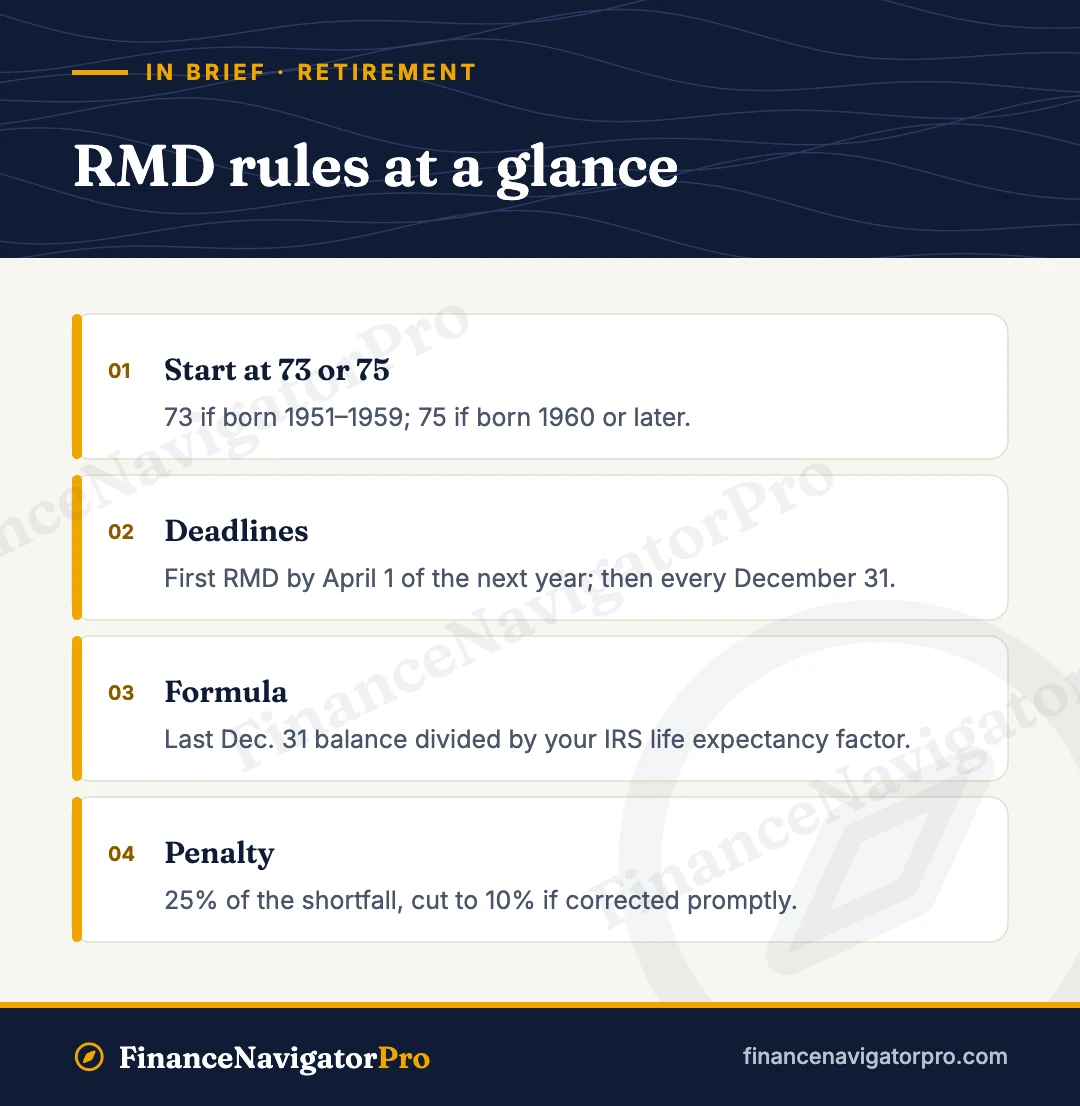
- Start age: 73 if you were born 1951–1959; 75 if born 1960 or later
- First RMD deadline: April 1 of the year after you reach your start age
- Every later RMD: December 31 each year
- Formula: prior December 31 balance ÷ IRS life expectancy factor
- Missed RMD penalty: 25% of the shortfall, cut to 10% if corrected promptly
Which accounts have RMDs?
| Account | RMDs for the owner? |
|---|---|
| Traditional IRA, SEP IRA, SIMPLE IRA | Yes |
| 401(k), 403(b), 457(b) (pre-tax) | Yes |
| Roth 401(k) and Roth 403(b) | No, since 2024 |
| Roth IRA | No, during the owner’s lifetime |
| Inherited IRA | Depends on beneficiary type |
When do RMDs start?
The SECURE 2.0 Act raised the RMD age. If you were born between 1951 and 1959, your RMDs begin at age 73. If you were born in 1960 or later, they begin at 75. Your first RMD can be delayed until April 1 of the year after you reach your start age, but your second RMD is still due by December 31 of that same year. Taking two RMDs in one year can push you into a higher tax bracket, so many people take the first one in the year they turn 73.
Example: If you turn 73 in 2026, your first RMD is due by April 1, 2027, and your 2027 RMD is due by December 31, 2027.
How to calculate your RMD
- Find your account balance on December 31 of last year.
- Look up the distribution period for your age this year in the IRS Uniform Lifetime Table.
- Divide the balance by the distribution period.
| Age | Distribution period | RMD on $500,000 |
|---|---|---|
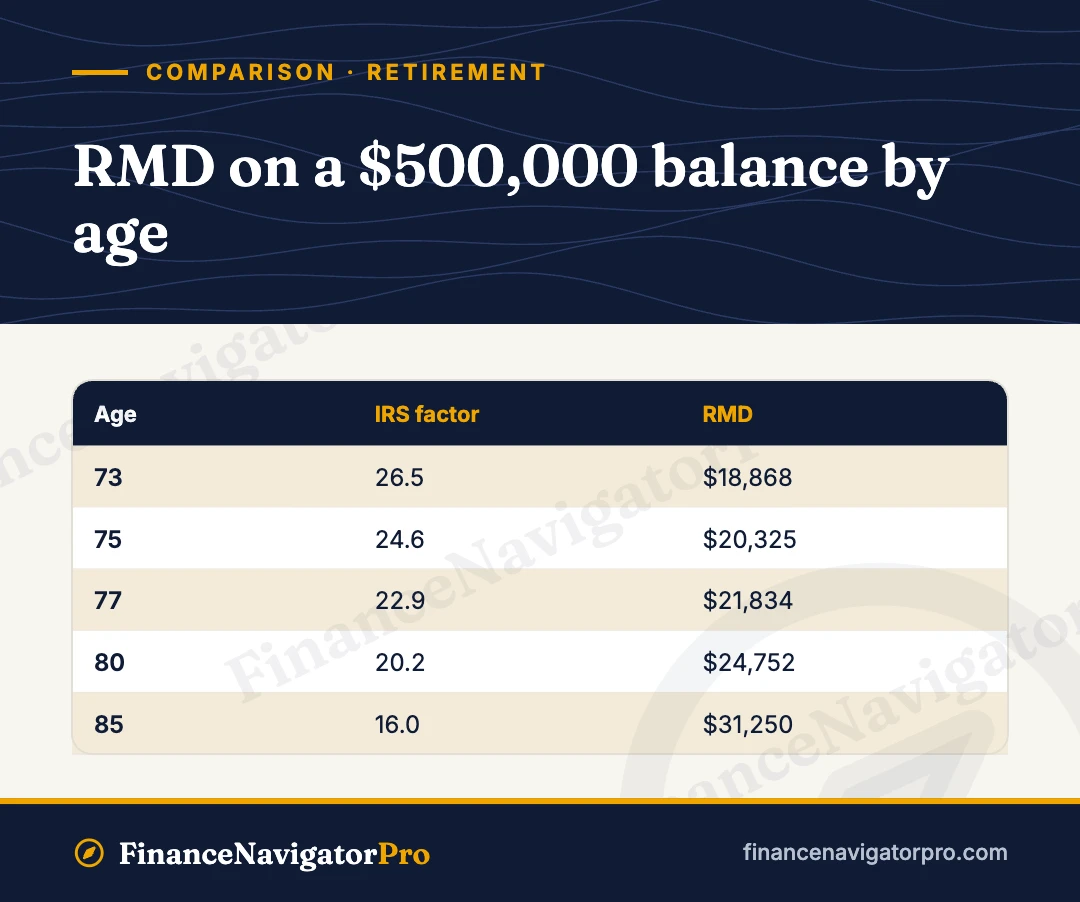
| 73 | 26.5 | $18,868 |
| 74 | 25.5 | $19,608 |
| 75 | 24.6 | $20,325 |
| 76 | 23.7 | $21,097 |
| 77 | 22.9 | $21,834 |
| 78 | 22.0 | $22,727 |
| 80 | 20.2 | $24,752 |
| 85 | 16.0 | $31,250 |
If your spouse is your sole beneficiary and more than 10 years younger, you use the IRS Joint Life and Last Survivor Table instead, which results in a smaller RMD.
Combining RMDs across accounts
- IRAs: calculate the RMD for each traditional IRA, then withdraw the total from any one or more of them.
- 403(b)s: can be combined the same way among themselves.
- 401(k)s: each plan’s RMD must be taken from that plan.
Consolidating old workplace accounts can make RMDs simpler. See rollover IRA vs. traditional IRA and how to find your old 401(k).
The still-working exception
If you are still working past your RMD age and do not own more than 5% of the company, your current employer’s plan may let you delay RMDs from that plan until you retire. This does not apply to IRAs or to plans from former employers.
What happens if you miss an RMD?
The IRS charges a 25% excise tax on the amount you should have withdrawn but did not. If you correct the mistake within the correction window, generally by the end of the second year after it was due, the tax drops to 10%. Withdraw the missed amount as soon as you notice, then file Form 5329; you can request a waiver if the shortfall was due to a reasonable error.
How RMDs are taxed, and ways to reduce the bill
RMDs from pre-tax accounts are taxed as ordinary income. A few strategies can help:
- Qualified charitable distributions (QCDs): from age 70½, you can give up to $111,000 in 2026 directly from an IRA to charity. A QCD counts toward your RMD and is excluded from taxable income.
- Roth conversions before RMDs begin: converting some pre-tax savings in lower-income years can shrink future RMDs. Try the Roth conversion calculator.
- Withholding: you can have federal tax withheld from an RMD, which counts as paid evenly through the year.
- Medicare planning: large RMDs can raise income enough to trigger Medicare IRMAA surcharges two years later. See Medicare costs in 2027.
Inherited IRAs
Most non-spouse beneficiaries who inherited an IRA in 2020 or later must empty it within 10 years, and may also need annual RMDs during that period if the original owner had already started them. Spouses have more flexible options, such as treating the account as their own. The rules are detailed, so check with your custodian or a tax professional.
Run your numbers
- Estimate the tax on withdrawals with the retirement tax calculator.
- Plan your income with the retirement withdrawal calculator.
- Check your plan with the retirement calculator.
Frequently asked questions
Do Roth IRAs have RMDs?
No. Roth IRA owners never have to take RMDs. Since 2024, Roth 401(k)s and Roth 403(b)s are also exempt for the owner. Beneficiaries who inherit Roth accounts do have withdrawal rules.
Can I take more than my RMD?
Yes. The RMD is a minimum. Extra withdrawals do not count toward future years’ RMDs.
Can I reinvest my RMD?
You cannot roll an RMD into another IRA, but you can invest it in a taxable brokerage account after you withdraw it.
Does my custodian calculate my RMD?
IRA custodians must tell you that an RMD is due and usually offer to calculate it, but you are responsible for taking the correct amount.
Want smaller RMDs later? See Roth conversions explained.
Bottom line
RMDs start at 73 for most current retirees and 75 for those born in 1960 or later. Divide last year’s December 31 balance by your IRS factor, take the amount by December 31 (April 1 for your first), and consider QCDs or Roth conversions to manage the tax. Learn more about workplace plans in what is a 401(k). This article is educational and not personal tax advice.
Keep reading