On this page
Your credit score affects your mortgage rate, your car loan, your credit card approvals, and sometimes even your apartment application. The good news is that you no longer need to pay to watch it. The harder question is which app gives you the right score, from the right bureaus, with the right level of protection. This guide compares the five best credit monitoring services and credit score apps of 2026 for beginners and anyone who wants to catch problems before a lender does.
Disclosure: Some links may earn us a commission at no cost to you. It never affects our rankings. See our affiliate disclaimer.
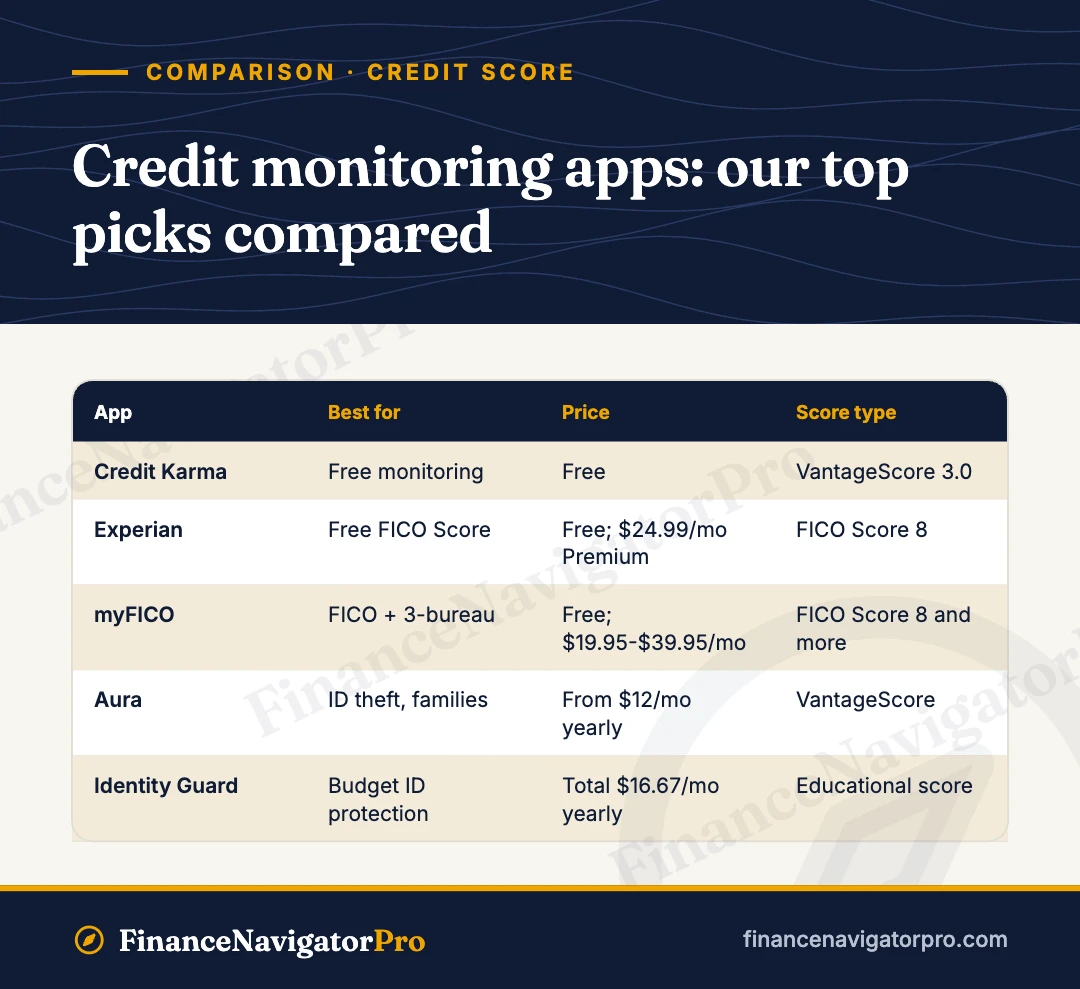
Our top picks at a glance
- Best for free monitoring: Credit Karma — free VantageScore 3.0 scores and alerts from two bureaus.
- Best free FICO Score: Experian — free FICO Score 8 and Experian report, with a paid 3-bureau upgrade.
- Best for FICO scores and 3-bureau reports: myFICO — the official FICO consumer site, from a free plan up to monthly 3-bureau FICO reports.
- Best for identity theft protection and families: Aura — 3-bureau monitoring plus $1 million insurance per adult and a plan for up to five adults.
- Best budget identity protection: Identity Guard — 3-bureau monitoring on its Total plan for less than many rivals.
| Product | Best for | Price | Score type | Bureaus monitored |
|---|---|---|---|---|
| Credit Karma | Free monitoring | Free | VantageScore 3.0 | TransUnion, Equifax |
| Experian | Free FICO Score | Free; Premium $24.99/mo | FICO Score 8 | Experian (free); all 3 (Premium) |
| myFICO | FICO scores, 3-bureau | Free; paid $19.95 to $39.95/mo | FICO Score 8 and more | Equifax (free); 1 or 3 (paid) |
| Aura | ID theft protection, families | From $12/mo billed yearly | VantageScore (Equifax) | All 3 |
| Identity Guard | Budget ID protection | Total from $16.67/mo billed yearly | Educational score (Equifax) | All 3 (Total, Ultra) |
Pricing and features checked November 2026; confirm on the provider’s site before signing up.
First, FICO vs VantageScore: why your scores do not match
Before comparing apps, it helps to know that there is no single “credit score.” Two companies build the scoring models used in the US, and each has several versions.
- FICO Scores are made by Fair Isaac Corporation. They have long been the scores most lenders use. FICO Score 8 is the general-purpose version you will see most often in consumer apps, but lenders also use older and industry-specific versions. Mortgage lenders, for example, have traditionally pulled older FICO versions, and auto and card lenders often use FICO “industry” scores.
- VantageScore is built by a company jointly owned by Equifax, Experian, and TransUnion. VantageScore 3.0 is the version most free apps display. In July 2025, the Federal Housing Finance Agency said lenders could use VantageScore 4.0 on mortgages sold to Fannie Mae and Freddie Mac, so VantageScore is gaining ground in lending too.
Both families typically use a 300 to 850 range, and both weigh the same core factors: payment history, how much of your credit you use, the age of your accounts, your mix of credit, and recent applications. But they weigh those factors differently, and each score is calculated from one bureau’s report at a time. That means your FICO Score from Experian, your VantageScore from TransUnion, and the score a lender pulls can all be different numbers on the same day. A gap of a few dozen points is normal and does not mean an app is wrong.
The practical takeaway: a free VantageScore is excellent for tracking trends and spotting errors. If you are about to apply for a mortgage or auto loan and want to see something closer to what the lender sees, a FICO Score is the better reference. Not sure where your number lands? Our guide to credit score ranges explains what each band means.
1. Credit Karma — Best for free monitoring
Credit Karma is the go-to free credit app for a reason. You get VantageScore 3.0 scores from both TransUnion and Equifax, full reports from those two bureaus, and alerts when something changes, such as a new account or a hard inquiry. It never charges you for the core service. Instead, it makes money by recommending credit cards and loans, so expect plenty of offers in the app.
Its biggest gap is Experian. Credit Karma does not show your Experian report or score, so pairing it with Experian’s free account (below) gives you free coverage from all three bureaus. It also is not a full identity theft protection product: there is no identity theft insurance or credit lock.
Pros
- Completely free, no credit card required
- Scores and reports from two bureaus
- Alerts for new accounts, inquiries, and some data breaches
- Helpful tools that show which factors are hurting your score
Cons
- VantageScore 3.0 only, no FICO Score
- No Experian data
- No identity theft insurance or restoration service
- Frequent product recommendations
Price: Free.
Who it’s for: Anyone who wants free, ongoing credit monitoring and is comfortable seeing a VantageScore rather than a FICO Score.
2. Experian — Best free FICO Score (with a 3-bureau upgrade)
Experian is one of the three nationwide credit bureaus, and its free account is one of the easiest ways to see a real FICO Score 8 at no cost. The free tier gives you your Experian credit report and FICO Score, which refresh periodically when you sign in, along with alerts for changes to your Experian file.
If you want more, Experian’s paid premium membership adds monitoring of all three bureaus, daily Experian FICO Score updates, dark web and identity alerts, dedicated fraud resolution help, and up to $1 million in identity theft insurance. A Family plan is available as well.
Pros
- Free FICO Score 8 straight from a credit bureau
- Free Experian report and change alerts
- Premium tier adds 3-bureau monitoring and $1 million insurance
Cons
- Free tier covers Experian only
- Upsells to paid plans are frequent
- Premium costs more than many identity protection services
Price: Free; Premium $24.99/month (or $299.88/year); Family $34.99/month.
Who it’s for: People who want a free FICO Score and, optionally, a one-stop paid plan from a bureau itself.
3. myFICO — Best for FICO scores and 3-bureau reports
myFICO is FICO’s own consumer site, so it is the most direct way to see the scores many lenders actually use. There is now a free plan that shows your FICO Score 8 based on Equifax data, updated monthly, with no credit card required. Paid plans add identity monitoring, up to $1 million in identity theft insurance, and access to more FICO Score versions.
The paid lineup is straightforward. Basic covers Experian with monthly updates. Advanced covers all three bureaus with reports and scores refreshed every three months. Premier covers all three bureaus monthly and includes a mortgage-focused view of older FICO versions. That makes Premier especially useful in the months before a home purchase, when you want to know exactly where you stand.
Pros
- Official FICO Scores, not estimates
- Free plan with a monthly FICO Score 8
- 3-bureau FICO reports on Advanced and Premier
- Paid plans may include extra FICO versions used for mortgages, auto loans, and cards
- Up to $1 million identity theft insurance on paid plans
Cons
- Paid plans are among the most expensive here
- Advanced only refreshes 3-bureau data every three months
- Identity protection features are lighter than dedicated services
Price: Free; Basic $19.95/month; Advanced $29.95/month; Premier $39.95/month.
Who it’s for: Borrowers preparing for a big loan, especially a mortgage, who want true FICO Scores from all three bureaus.
4. Aura — Best for identity theft protection and families
Aura is an all-in-one identity and device security service, and credit monitoring is just one part of it. Every plan monitors all three bureaus and includes an instant credit lock for your Experian file, plus identity and financial account alerts, dark web monitoring, and identity theft insurance. Aura also bundles digital security tools such as antivirus and a VPN, which can replace a separate subscription.
The Family plan is where Aura stands out. It covers up to five adults plus unlimited children and devices, with up to $5 million in total insurance coverage. Note that the monthly score Aura shows is a VantageScore based on Equifax data, provided for educational purposes, so it is not the FICO Score a lender may pull.
Pros
- 3-bureau credit monitoring on every plan
- $1 million insurance per adult; Couple $2 million, Family $5 million
- Family plan covers five adults and unlimited kids
- Includes device security tools like antivirus and VPN
- 14-day free trial and a 60-day money-back guarantee on annual plans bought directly
Cons
- Credit score is an educational VantageScore, not FICO
- Instant lock covers Experian only
- Monthly billing costs noticeably more than annual billing
Price: Individual $12/month billed yearly ($15 monthly); Couple $22/month yearly ($29 monthly); Family $32/month yearly ($50 monthly).
Who it’s for: Households that want credit monitoring, identity restoration, and online security under one subscription.
5. Identity Guard — Best budget identity theft protection
Identity Guard offers three tiers: Value, Total, and Ultra. Value is a basic identity monitoring plan and does not include credit monitoring, so for credit-focused readers the Total plan is the starting point. Total and Ultra add 3-bureau credit monitoring and a monthly credit score, while every plan includes up to $1 million in identity theft insurance per adult. Ultra adds extras such as an annual 3-bureau credit report.
Family versions of each plan cover up to five adults and unlimited children, which can make Identity Guard a cheaper alternative to Aura for a large household. Like Aura, the score it displays is calculated from your Equifax file for educational purposes.
Pros
- 3-bureau monitoring on Total and Ultra
- Up to $1 million insurance per adult on all plans
- Family plans for up to five adults plus kids
- Annual billing cuts the cost significantly
Cons
- Entry-level Value plan has no credit monitoring
- Score is educational, not FICO
- First-year promotional prices renew higher
Price: Value $8.99/month; Total $19.99/month ($16.67/month billed yearly); Ultra $29.99/month ($25/month billed yearly). Family plans start at $14.99/month. Promotional pricing changes often, so check current pricing.
Who it’s for: Budget-minded individuals and families who want 3-bureau monitoring plus insurance without paying top-tier prices.
Free options you should use no matter which app you pick
AnnualCreditReport.com
Equifax, Experian, and TransUnion have permanently extended free weekly credit reports through AnnualCreditReport.com, the only site the Federal Trade Commission directs consumers to for these reports. Reports do not include a score, but they show every account, inquiry, and public record that scores are built from. If you spot something wrong, our guide to removing negative items from your credit report walks you through the dispute process. For a full rundown of free score sources, see how to check your credit score for free.
Credit freezes
Since September 2018, federal law has made it free to freeze and unfreeze your credit at all three bureaus, and parents can freeze a child’s file for free if the child is under 16. A freeze blocks most new lenders from seeing your report, which stops most new-account fraud cold. That is stronger prevention than any monitoring app, which can only alert you after something happens. Fraud alerts are also free and last one year. Follow our step-by-step guide on how to freeze your credit, and keep the bureaus’ contact details handy using our guide on how to contact the credit bureaus.
Pro tip: You can build a strong free setup without paying anything. Freeze your credit at all three bureaus, use Credit Karma for TransUnion and Equifax alerts, add Experian’s free account for Experian alerts and a FICO Score, and pull your reports from AnnualCreditReport.com a few times a year. Pay for a service only if you want insurance, restoration help, or monthly 3-bureau FICO Scores.
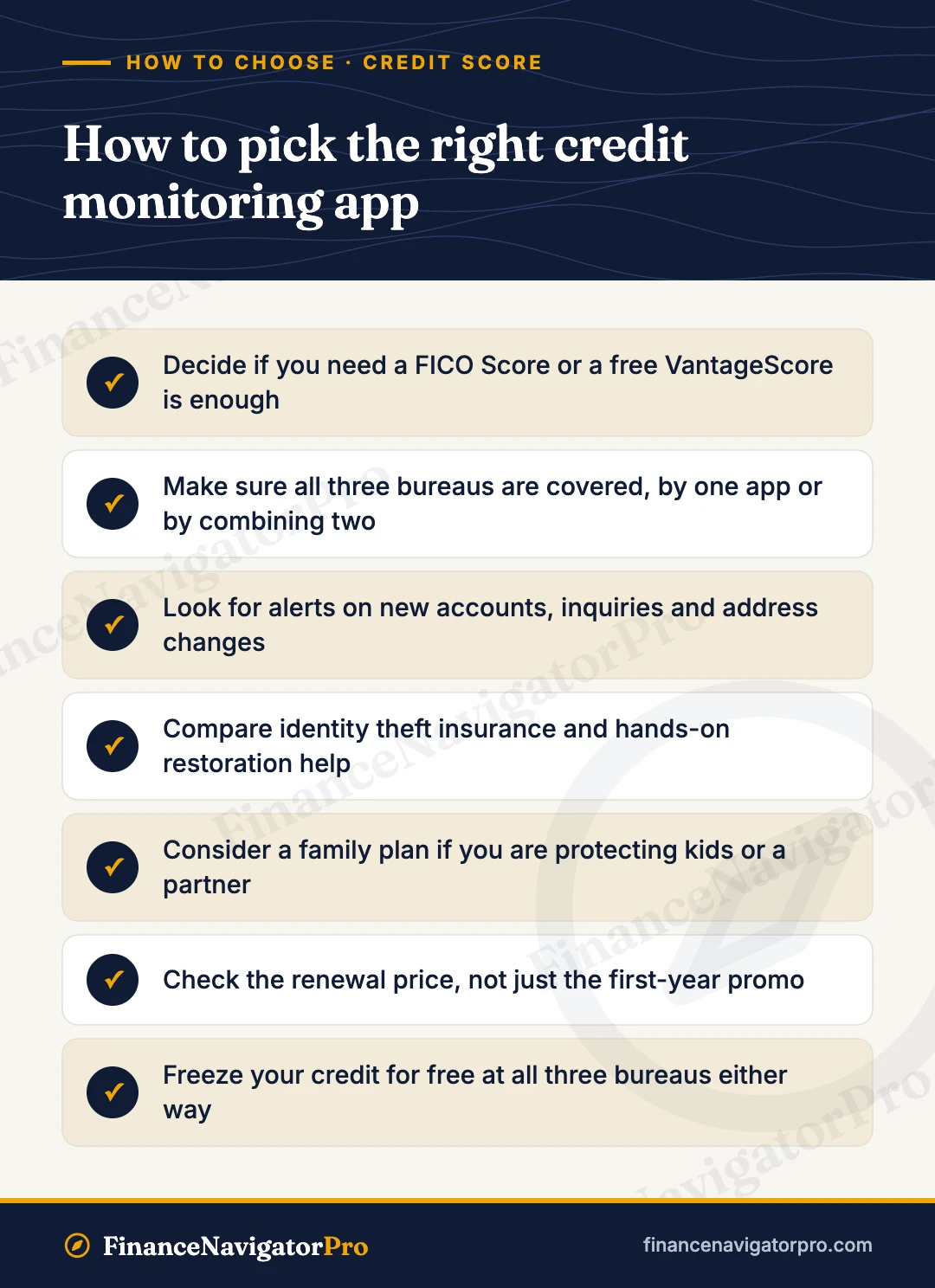
How to choose a credit monitoring service
1. Decide which score you need
If you just want to track progress and catch errors, a free VantageScore is fine. If you are applying for a mortgage or auto loan soon, look at a service that shows FICO Scores, such as Experian or myFICO.
2. Count the bureaus
Lenders do not always report to all three bureaus, and fraud can show up on just one. One-bureau monitoring leaves gaps. You can cover all three for free by combining apps, or pay for a single 3-bureau service.
3. Check alert speed and type
Look for alerts on new accounts, hard inquiries, address changes, and new collections. Identity-focused services add dark web, Social Security number, and bank account alerts.
4. Compare insurance and restoration help
Identity theft insurance typically reimburses certain expenses and losses from recovering your identity. Paid services in this list advertise up to $1 million per adult. Read the policy terms, and value hands-on restoration help as much as the dollar figure.
5. Think about your household
Family plans from Aura, Identity Guard, and Experian can cost less than separate individual plans. Children are frequent identity theft targets because their files sit unused for years.
6. Watch the renewal price
Many services advertise a discounted first year. Check what the plan renews at and whether monthly billing costs more than annual billing.
How we chose
We compared credit monitoring services and credit score apps available to US consumers in November 2026 using each provider’s published pricing and plan details, supplemented by recent independent reviews. We did not accept payment for placement, and we excluded products that have been discontinued. We looked at:
- Cost, including free tiers and renewal pricing
- Which score model each service shows (FICO or VantageScore) and how often it updates
- How many bureaus are monitored on each plan
- Identity theft insurance amounts and restoration support
- Family coverage options
- Ease of use for beginners
Run your numbers first
A monitoring app tells you what your score is. Our free calculators help you figure out what to do about it.
- See how a new card, a paid-off loan, or a late payment might move your score with the credit score simulator.
- Find out whether your balances are dragging your score down using the credit utilization calculator. For background, read how credit utilization works.
- Build a step-by-step plan with the credit score improvement calculator.
- Check how old your accounts look to lenders with the credit age calculator before you close any card.
- Estimate how a new application could affect you with the credit inquiry impact calculator.
Frequently asked questions
Is free credit monitoring good enough?
For most people, yes. Free apps like Credit Karma and Experian alert you to new accounts and inquiries. Combined with a credit freeze, that covers the basics. Paid plans mainly add 3-bureau coverage in one place, identity theft insurance, and restoration help.
Why is my Credit Karma score different from my FICO Score?
Credit Karma shows VantageScore 3.0, while lenders often use FICO Scores. The two models weigh factors differently, and each score uses one bureau’s data, which may differ. Differences of a few dozen points are common and normal.
Does checking my score with these apps hurt my credit?
No. Checking your own score or report is a soft inquiry and does not affect your credit score. Only hard inquiries from applications for new credit can lower it.
Is a credit freeze better than credit monitoring?
They do different jobs. A freeze is free and prevents most new accounts from being opened in your name. Monitoring alerts you to changes, including problems a freeze does not stop, such as fraud on existing accounts. Using both is the strongest approach. If fraud has already happened, see our guide to credit card fraud.
Do I need 3-bureau credit monitoring?
It is worth having, because some lenders report to only one or two bureaus and fraud may appear on just one file. You can get it free by combining Credit Karma (TransUnion and Equifax) with Experian’s free account, or pay for a single service like Aura, Identity Guard Total, Experian Premium, or myFICO Advanced or Premier.
What does identity theft insurance actually cover?
Policies generally reimburse eligible costs of restoring your identity, such as certain legal fees, lost wages, and some stolen funds, up to the stated limit. Coverage details vary by provider and policy, so read the terms before relying on the headline amount.
Other options worth knowing
Credit Sesame is another free app worth a look, with a daily TransUnion-based VantageScore and a plain-English letter grade for each credit factor.
Bottom line
Start free. Freeze your credit, use Credit Karma and Experian’s free account to cover all three bureaus, and pull your reports from AnnualCreditReport.com regularly. If you are preparing for a major loan, myFICO gives you the most accurate view of your FICO Scores. If you want insurance, restoration help, and protection for your whole household, Aura is our top pick, with Identity Guard as a lower-cost alternative. Whichever you choose, confirm current pricing on the provider’s site before you sign up.
Keep reading