
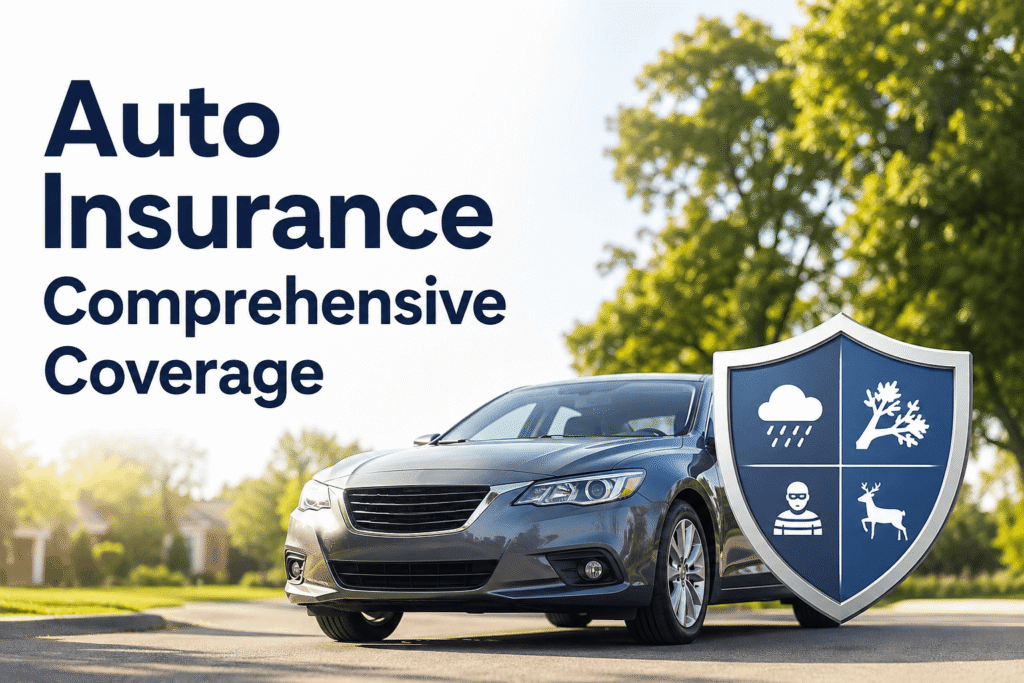
A tree falls on your parked car during a thunderstorm. No other vehicle is involved, and nobody was driving. But the repair estimate comes back at $8,400. Who pays for that?
If you only carry liability insurance, the answer is usually you. Liability only steps in when you’re at fault for hurting someone else or damaging their property. It doesn’t cover damage to your own car from a falling branch.
If you have comprehensive coverage, though, your insurer typically picks up most of that repair bill once you’ve paid your deductible. That’s the entire point of comprehensive coverage: it protects your vehicle from the things that can happen to it even when you’re not driving, and even when no other car is involved.
⚡ Quick Answer: Comprehensive Auto Insurance
Comprehensive coverage pays to repair or replace your vehicle when it’s damaged by something other than a collision with another vehicle or object you hit while driving. That includes theft, vandalism, fire, hail, flooding, falling objects, and animal strikes. It’s optional in every state, but lenders and leasing companies almost always require it while you’re still paying off the car.
| Key Takeaways | |
| What it covers | Non-collision damage like theft, weather, fire, and animal strikes |
| What it doesn’t cover | Damage from an accident with another vehicle (that’s collision coverage) or normal mechanical wear |
| Why lenders require it | It protects the value of the asset they have a financial interest in until the loan is paid off |
| Who should consider it | Anyone with a financed or leased vehicle, a car worth repairing, or exposure to theft, weather, or wildlife risk |
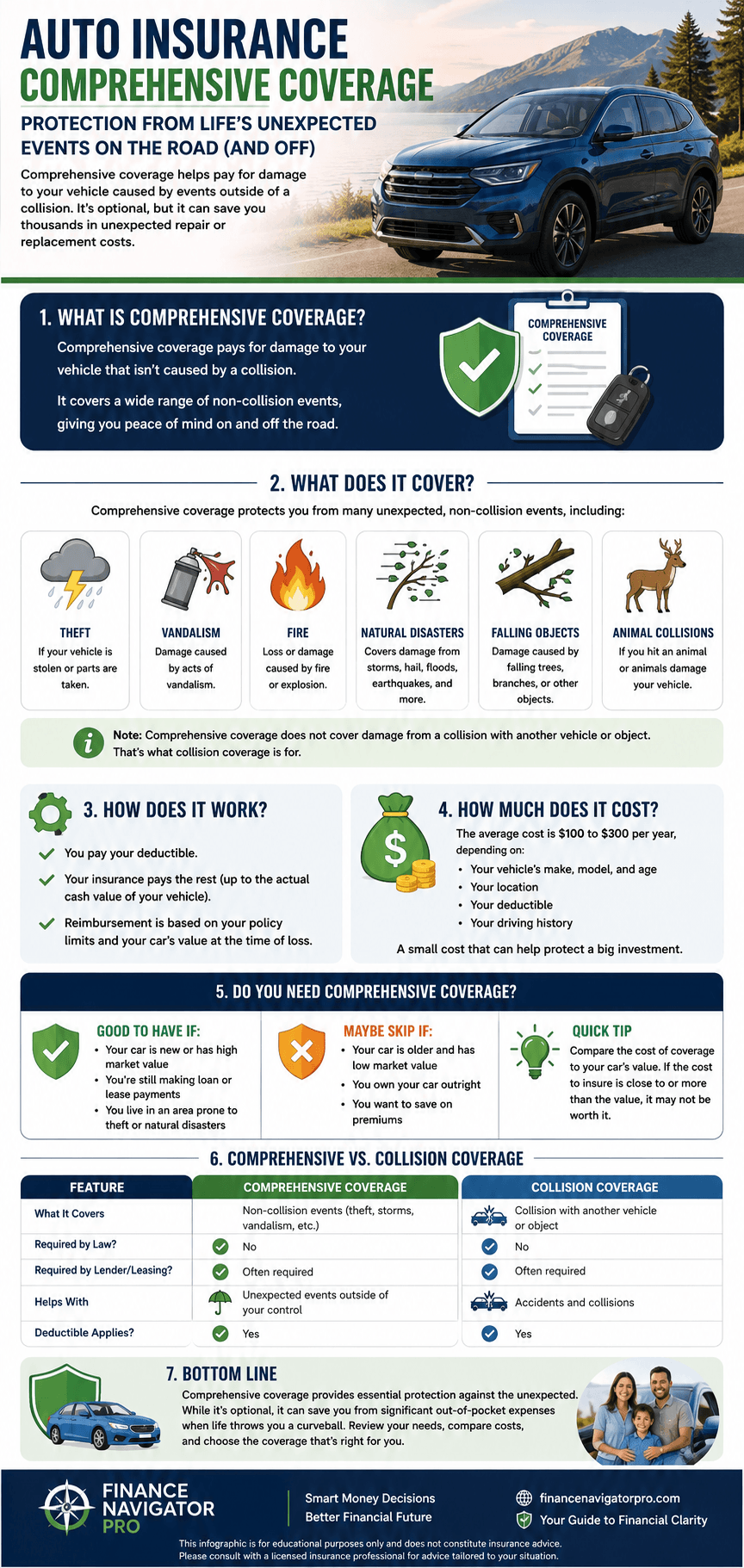
Comprehensive coverage at a glance
This guide walks through what comprehensive coverage actually pays for, what it skips, how claims work in practice, what it tends to cost, and how to decide whether it’s worth keeping on your policy. We’ll use real-world examples throughout, because abstract definitions only get you so far when you’re staring at a cracked windshield trying to figure out if you should even file a claim.
1. What Is Comprehensive Auto Insurance?
Comprehensive coverage is the part of your auto policy that handles damage to your own car from causes other than a traffic collision. Insurance companies sometimes call it “other-than-collision” coverage, which is honestly a more accurate name than “comprehensive,” even if it never caught on.
Here’s the simplest way to think about it: collision coverage deals with crashes. Comprehensive deals with almost everything else that can happen to a parked, stored, or even moving vehicle that isn’t a crash with another car or object you ran into. Hail dents your hood. Someone breaks your window to steal a stereo. A wildfire damages your garage and your car along with it. None of these involve hitting anything, so collision coverage wouldn’t apply, but comprehensive does.
The “other-than-collision” framing matters because of one edge case people get wrong constantly: hitting an animal. Even though you’re driving and you technically hit something, insurers classify animal strikes under comprehensive, not collision. We’ll cover why a little later, but it’s worth knowing upfront because it trips up a lot of policyholders when they go to file a claim.
Comprehensive coverage is optional under state law everywhere in the U.S. No state requires you to carry it. But if you have a car loan or a lease, your lender or leasing company almost certainly requires it as a condition of the financing agreement. They have a financial stake in the vehicle until it’s paid off, and they want to make sure that if something happens to it, there’s money to repair or replace it rather than leaving them holding the loan on a wrecked car with no payout coming.
Once the car is paid off, comprehensive becomes entirely your call. Plenty of drivers with older, lower-value vehicles choose to drop it because the potential payout no longer justifies the premium. We’ll walk through how to make that decision later in this guide.
2. What Does Comprehensive Coverage Include?
Comprehensive coverage applies to a long list of non-collision events. Insurers vary slightly in how they word their policies, but the core list below is fairly consistent across major U.S. carriers.
Comprehensive Coverage: What’s Typically Included
| Incident | Covered? | Example | Typical Claim Scenario |
| Theft | Yes | Entire vehicle stolen | Car stolen from apartment parking lot overnight |
| Vandalism | Yes | Keyed paint, slashed tires | Keyed during a dispute in a parking lot |
| Fire | Yes | Engine fire, wildfire, garage fire | Garage fire spreads to a parked vehicle |
| Hail | Yes | Dented hood, roof, cracked glass | Hailstorm dents hood and roof panels |
| Windstorm | Yes | Debris damage, fallen branches | High winds snap a branch onto the roof |
| Flood | Yes | Water damage to engine, interior | Car parked in a flooded street during heavy rain |
| Falling trees | Yes | Crushed roof or hood | Tree falls on a parked car during a storm |
| Falling objects | Yes | Construction debris, tree limbs | Object falls from a building onto the car |
| Animal collisions | Yes | Deer strikes, other wildlife | Deer runs into the road and is struck |
| Broken windshield | Yes | Rock chips, cracks | Rock kicked up by a truck cracks the windshield |
| Explosion | Yes | Nearby explosion damage | Damage from a nearby gas line explosion |
| Civil unrest | Yes | Riot damage | Vehicle damaged during civil disturbance |
| Lightning | Yes | Direct strike damage | Lightning strike damages electrical systems |
| Rocks hitting windshield | Yes | Highway debris | Gravel truck kicks up rock on the highway |
| Hurricane damage | Yes | Wind and water damage | Hurricane floods a coastal parking area |
3. What Doesn’t Comprehensive Coverage Cover?
Comprehensive coverage has real limits, and misunderstanding them is one of the most common reasons claims get denied. Here’s what falls outside it.
What Comprehensive Coverage Excludes
| Excluded Item | Why It’s Excluded | What Covers It Instead |
| Collision with another vehicle | Classified as a collision event | Collision coverage |
| Mechanical breakdowns | Not damage from an external event | Mechanical breakdown insurance or warranty |
| Routine maintenance (oil changes, etc.) | Maintenance, not damage | Out of pocket; not an insurable event |
| Normal wear and tear | Expected aging, not sudden damage | Out of pocket |
| Rust and corrosion | Gradual deterioration | Out of pocket |
| Engine failure from neglect | Not a covered peril | Out of pocket or warranty |
| Tire replacement from wear | Routine wear, not a peril | Out of pocket |
| Intentional damage by the owner | Insurance fraud exclusion | Not insurable |
| Business use beyond personal policy terms | Requires commercial coverage | Commercial auto policy |
| Damage from your own negligence in upkeep | Not a sudden, accidental event | Out of pocket |
| Racing or competitive driving damage | Excluded high-risk activity | Specialty racing insurance |
Notice the pattern: comprehensive covers sudden, accidental, external events. It does not cover anything that results from how you maintain (or fail to maintain) the vehicle, and it doesn’t cover ordinary aging. If your transmission dies at 140,000 miles because it finally wore out, that’s not a comprehensive claim, no matter how expensive the repair is.
4. How Comprehensive Coverage Works
Understanding how a comprehensive claim actually plays out makes the whole concept click. Here’s the sequence from start to finish.
- You pay a premium — Your premium for comprehensive coverage is calculated separately from collision and liability, based on factors like your vehicle’s value, your ZIP code, and local theft and weather risk.
- Something happens to your car — A covered event occurs: theft, hail, fire, flood, vandalism, an animal strike, or similar non-collision damage.
- You choose a deductible amount — This is the amount you agreed to pay out of pocket before your insurer covers the rest. You selected this when you set up your policy, commonly somewhere between $250 and $1,000.
- You file a claim — You report the damage to your insurer, who assigns a claims adjuster to evaluate it.
- The adjuster assesses the damage — This might involve an in-person inspection, photos you submit, or an estimate from a repair shop your insurer trusts.
- You get a repair estimate — The adjuster or a partnered repair shop calculates what it will cost to fix the damage.
- The insurer settles the claim — If the repair cost is less than your car’s value, the insurer pays the repair cost minus your deductible. If the damage exceeds a certain percentage of the car’s value (often 70-80%, depending on the state and insurer), the car is declared a total loss instead.
- Repairs happen, or a payout is issued — For repairable damage, you take the car to a shop and the insurer pays the shop directly or reimburses you. For a total loss, the insurer pays you the vehicle’s Actual Cash Value (ACV), which is what it was worth right before the damage, minus your deductible.
Understanding Actual Cash Value (ACV)
Actual Cash Value (ACV) is a term worth understanding well, because it’s the number that determines your total-loss payout. ACV is not what you paid for the car, and it’s not what a dealership would charge for a similar one. It’s the estimated market value of your specific car, accounting for its age, mileage, condition, and depreciation, right before the damage occurred. This is why a five-year-old car with high mileage might get a lower payout than the owner expects, even if it was running perfectly the day before.
How Long Does It Take?
Timeline varies by insurer and claim complexity, but a straightforward comprehensive claim (say, a cracked windshield or minor hail damage) often resolves within a few days to two weeks. Total-loss claims and major theft claims tend to take longer because they involve more documentation, valuation disputes, and sometimes a waiting period to confirm a stolen vehicle won’t be recovered.
5. Real-Life Claim Scenarios
Numbers and definitions are useful, but seeing how comprehensive coverage plays out in specific situations makes it concrete. Below are common scenarios drivers actually file claims for. Dollar figures are illustrative examples to show how the math works, not quotes or guarantees, since actual costs depend on your vehicle, location, and insurer.
| Situation | Repair Est. | Deductible | Est. Payout |
| Hailstorm dents hood and roof | $3,200 | $500 | $2,700 |
| SUV stolen from driveway overnight | Total loss (ACV $18,000) | $500 | $17,500 |
| Deer runs into the road, vehicle strikes it | $5,400 | $1,000 | $4,400 |
| Garage fire damages parked car | $12,000 | $500 | $11,500 |
| Tree branch falls on car during storm | $4,800 | $250 | $4,550 |
| Car flooded in low-lying parking lot | Total loss (ACV $9,500) | $500 | $9,000 |
| Vehicle keyed during a dispute | $1,800 | $500 | $1,300 |
| Rock cracks windshield on highway | $420 | $0 (glass waiver, where available) | $420 |
| Catalytic converter stolen from underneath car | $1,950 | $500 | $1,450 |
| Attempted theft, ignition and door damaged | $1,100 | $500 | $600 |
| Rodents chew through wiring in a parked car | $2,300 | $500 | $1,800 |
| Satellite dish falls off a roof onto the car | $2,700 | $500 | $2,200 |
| Vandalism with spray paint across the body | $2,100 | $500 | $1,600 |
| Hurricane storm surge floods the vehicle | Total loss (ACV $14,000) | $1,000 | $13,000 |
| Tornado debris dents door panels | $3,600 | $500 | $3,100 |
| Lightning strike damages electrical system | $2,950 | $500 | $2,450 |
| Wildfire smoke and ember damage to exterior | $1,750 | $500 | $1,250 |
| Shopping cart dents door in a parking lot (unknown party) | $650 | $500 | $150 |
A pattern worth noticing: in every one of these scenarios, the vehicle owner wasn’t driving recklessly, wasn’t in an accident with another car, and had no real way to prevent what happened. That’s the common thread across nearly every legitimate comprehensive claim. It’s coverage for the unpredictable, not the everyday.
6. Comprehensive Coverage vs. Collision Coverage
These two are easy to confuse because they’re often bundled together and sold as a pair, but they protect against fundamentally different things. Collision coverage deals with crashes; comprehensive deals with everything else.
| Factor | Comprehensive Coverage | Collision Coverage |
| What triggers it | Non-collision events | A crash, regardless of fault |
| Hitting another vehicle | Not covered | Covered |
| Hitting a stationary object (pole, fence) | Not covered | Covered |
| Parking lot accident with another car | Not covered | Covered |
| Animal collision (deer, etc.) | Covered | Not covered |
| Tree falling on a parked car | Covered | Not covered |
| Fire damage | Covered | Not covered |
| Flood damage | Covered | Not covered |
| Theft of the vehicle | Covered | Not covered |
| Typical deductible range | $250–$1,000 | $250–$1,000 |
| Typical relative cost | Usually cheaper than collision | Usually pricier than comprehensive |
| Required by lenders/lessors | Almost always, alongside collision | Almost always, alongside comprehensive |
| Best for | Protecting against weather, theft, and wildlife risk | Protecting against at-fault and not-at-fault crashes |
Common Misconceptions
- “Comprehensive means I’m covered for everything.” It doesn’t. The name is misleading. It covers non-collision events specifically; it has nothing to do with crashes involving your own vehicle hitting something while you’re driving (apart from animals).
- “If I have comprehensive, I don’t need collision.” These are separate coverages addressing separate risks. Most lenders require both. Dropping collision while keeping comprehensive leaves you exposed if you cause an accident or someone hits you and isn’t insured for it.
- “Hitting a deer is a collision claim because I was driving and hit something.” Insurers classify animal strikes under comprehensive almost universally, since the animal is an unpredictable external hazard similar to a falling object, not a traffic collision in the traditional sense.
7. Comprehensive Coverage vs. Liability Insurance
Liability insurance and comprehensive coverage serve completely different purposes, and the difference matters a lot once money is on the table.
Liability insurance pays for damage and injuries you cause to other people when you’re at fault in an accident. It covers their car, their medical bills, sometimes their lost wages, depending on the severity. It does not pay a cent toward repairing your own vehicle. Every U.S. state requires some minimum amount of liability coverage to legally drive (with very limited exceptions for self-insurance in a few states).
Comprehensive coverage, on the other hand, pays for damage to your own vehicle from non-collision events. It has nothing to do with whether you hurt someone else or damaged their property. It’s entirely about protecting your own asset.
Here’s a practical way to separate them: liability protects other people from you. Comprehensive protects your car from the world. Many drivers carry only liability because it’s the legal minimum, especially on older vehicles where comprehensive isn’t worth the premium anymore. But if your car is financed, leased, or has real resale value, liability alone leaves a meaningful gap, since it does nothing for theft, weather, or vandalism damage to your own vehicle.
Best use case for liability-only: an older, low-value, paid-off car where the owner has decided the comprehensive premium isn’t worth the modest payout they’d get for that vehicle. Best use case for adding comprehensive: any financed or leased vehicle, any car with real resale value, and any driver in an area with notable theft, hail, flood, or wildlife risk.
8. Comprehensive Coverage vs. Full Coverage
“Full coverage” gets thrown around constantly, but it’s not an official insurance policy type. No insurer sells a product literally called “full coverage” with a fixed, standardized definition. It’s industry shorthand, and what it includes can vary depending on who’s using the term.
In most cases, when an agent or a lender says “full coverage,” they mean a policy that bundles liability, collision, and comprehensive together. That combination protects you against the three biggest categories of risk: harming others (liability), crashing your own car (collision), and non-collision damage to your own car (comprehensive).
Some policies marketed as “full coverage” also bundle in extras like uninsured motorist protection, medical payments coverage, or roadside assistance, but that’s not universal. If a lender requires “full coverage” as a loan condition, ask them to specify exactly which coverages and minimum limits they mean, since their definition is the one that actually matters for staying compliant with the loan agreement.
The practical takeaway: comprehensive coverage is one ingredient in what people informally call full coverage, not a synonym for it. You can have comprehensive without collision (uncommon, and usually not allowed by lenders), or collision without comprehensive (also uncommon for financed vehicles), but “full coverage” generally assumes you have both plus liability.
9. How Much Does Comprehensive Coverage Cost?
Comprehensive premiums vary widely because they’re built from a mix of factors specific to you, your car, and where you live. There’s no single national average that applies to everyone, but understanding the inputs helps explain why your quote looks the way it does — see how insurance quotes are calculated for a broader breakdown.
What Drives Your Comprehensive Premium
- ZIP code: Areas with higher theft rates, severe weather, or dense traffic generally see higher comprehensive premiums.
- Vehicle value: More expensive cars cost more to repair or replace, which raises the premium.
- Claim history: A history of comprehensive claims (even non-collision ones) can affect your rate at renewal.
- Deductible choice: A higher deductible lowers your premium because you’re absorbing more of the risk yourself.
- Credit-based insurance score: Permitted in most states (not all), this factors into pricing alongside other risk indicators — see how credit scores relate to your insurance score.
- Driver history: Your overall driving record influences your total policy cost, including comprehensive.
- State regulations: Some states cap certain rating factors or have different minimum requirements that shift overall pricing.
- Weather risk: Hail-prone, hurricane-prone, and flood-prone regions typically see higher comprehensive rates.
- Local theft rates: Vehicle theft statistics in your area directly factor into comprehensive pricing, since theft is one of the perils it covers.
As a rough illustration, comprehensive coverage alone often falls somewhere in the range of $150 to $400 per year for a mid-value vehicle in a moderate-risk area, though this can run considerably higher in high-theft or severe-weather regions, or lower for an older, lower-value car with a high deductible. These figures are general examples only — for a wider look at pricing patterns, see the average insurance cost in the US. Actual rates vary by insurer, vehicle, driving record, and location, so the only reliable number is a quote from your own insurer.
10. Choosing the Right Deductible
Your deductible is the amount you pay out of pocket before insurance kicks in on a comprehensive claim. Choosing it is a balancing act between your monthly premium and your readiness to cover a repair bill yourself — for a deeper walkthrough, see insurance deductibles explained.
| Deductible | Typical Effect on Premium | Best For |
| $100 | Highest premium of the common options | Drivers who want minimal out-of-pocket exposure and don’t mind paying more monthly |
| $250 | High premium, lower than $100 deductible | Drivers with limited emergency savings who still want a relatively low threshold |
| $500 | Moderate premium; the most common choice | Most drivers seeking a balance between monthly cost and claim exposure |
| $1,000 | Lower premium than $500 | Drivers with solid emergency savings who are comfortable covering more themselves |
| $2,000 | Lowest premium of the common options | Drivers with significant savings, lower-value vehicles, or a strong preference for minimizing premiums |
The right choice depends on your emergency fund. A $2,000 deductible might save you real money every year, but if a hailstorm hits and you can’t comfortably cover $2,000 out of pocket, that “savings” becomes a financial squeeze right when you need the car repaired. A good rule of thumb: never choose a deductible higher than what you could pay in cash without disrupting your budget.
11. Is Comprehensive Coverage Worth It?
There’s no universal answer here, it genuinely depends on your situation. Use this framework to think it through rather than relying on a flat rule — or check our broader guide on what insurance coverage you need.
- Vehicle value: Higher-value cars have more to lose, which usually makes comprehensive worth keeping.
- Premium savings if dropped: Compare what you’d save annually against what you’d lose if a covered event happened.
- Risk tolerance: Some drivers are comfortable self-insuring against rare events; others sleep better knowing they’re covered.
- Loan or lease status: If you’re financing or leasing, this decision usually isn’t yours to make, since it’s typically required.
- Climate: Hail, hurricane, flood, and wildfire exposure all raise the practical value of comprehensive.
- Parking situation: Street parking in a dense urban area carries different theft and vandalism risk than a locked garage.
- Neighborhood risk: Local theft and vandalism rates matter more than people often assume.
- Vehicle age: Older vehicles have lower Actual Cash Value, which shrinks the maximum payout you could ever receive.
- Mileage: High-mileage vehicles tend to have lower ACV, which factors into the same math as vehicle age.
Rule of thumb: If your annual comprehensive premium is approaching 10% or more of your car’s current market value, it’s worth running the numbers on whether self-insuring (dropping the coverage and keeping that premium as savings) makes more financial sense. For a financed or high-value vehicle, though, this calculation rarely points toward dropping it.
12. When You Can Drop Comprehensive Coverage
Dropping comprehensive coverage is purely a financial decision once your car is paid off, since no state requires it. The question becomes whether the protection is still worth the premium.
- Older cars: As a car ages, its Actual Cash Value drops, which caps the maximum amount comprehensive could ever pay out.
- Low vehicle value: If your car’s ACV is only a few thousand dollars, a total-loss payout may not be much more than what you’ve paid in premiums over a few years.
- High premiums relative to value: If comprehensive costs a large chunk of what the car is worth annually, the math often favors dropping it.
- Emergency savings: If you have enough set aside to comfortably replace or repair the car yourself, self-insuring becomes a realistic option.
- No loan or lease: Once financing requirements no longer apply, this becomes entirely your choice.
A simple break-even way to think about it: add up what you’d pay in comprehensive premiums over the next several years, and compare that total to your car’s current Actual Cash Value. If the cumulative premiums start approaching what the car is actually worth, you’re essentially pre-paying for a payout that’s capped at a low ceiling. That’s the point where many drivers choose to self-insure instead.
13. Comprehensive Coverage by Situation
Different drivers and vehicle situations change how valuable comprehensive coverage is. Here’s how the calculation shifts across common scenarios.
| New Cars | A new car has the highest value it will ever have, which means the highest potential payout and the strongest case for keeping comprehensive. It’s also almost always required if financed. |
| Used Cars | Value matters more than age here. A well-maintained used car with solid resale value still benefits from comprehensive; a high-mileage car nearing the end of its useful life may not. |
| Leased Cars | Leasing companies require comprehensive coverage for the entire lease term, typically with a specific minimum coverage level and a low maximum deductible. This isn’t optional while leasing. |
| Financed Vehicles | Lenders require comprehensive (and collision) until the loan is paid off, since they have a financial interest in the car as collateral. |
| Luxury Vehicles | Higher repair and replacement costs make comprehensive especially valuable, though premiums run higher too given the increased payout exposure. |
| Electric Vehicles | EVs often have higher repair costs due to battery and specialized component pricing, which can affect comprehensive premiums. Coverage still applies the same way to theft, weather, and fire risk. |
| Teen Drivers | Teen drivers usually raise overall policy costs regardless of coverage type, but comprehensive itself isn’t priced differently for age in the way liability often is, since it doesn’t relate to at-fault accident risk. |
| College Students | Where the car is parked matters a lot here. Street parking near a campus in a dense city carries different theft and vandalism risk than a suburban driveway, which can shift the value of keeping comprehensive. |
| Retirees | Often driving older, paid-off vehicles with lower mileage, which can tip the math toward dropping comprehensive if the car’s value has dropped significantly. |
| High-Mileage Drivers | More time on the road in varied locations slightly raises exposure to events like animal strikes and road debris, which comprehensive covers. |
| Drivers in Hurricane Zones | Coastal and hurricane-prone areas carry meaningfully higher flood and wind-debris risk, making comprehensive more valuable despite higher premiums. |
| Drivers in Hail-Prone States | Frequent hail events can mean comprehensive pays for itself within just a season or two in the hardest-hit regions. |
| Rural Drivers | Higher animal-strike exposure (deer in particular) is a major factor, since these claims fall under comprehensive rather than collision. |
| Urban Drivers | Theft and vandalism risk tend to be higher in dense urban environments, especially without access to secure parking. |
Owners of older or specialty vehicles have their own considerations worth a closer look — see our guides to collector car insurance and antique car insurance if that applies to you.
14. State-Specific Considerations
No U.S. state legally requires comprehensive coverage. It’s always an optional add-on at the state regulatory level. The requirement to carry it almost always comes from a lender or lease agreement instead, not from state law.
That said, where you live still shapes how valuable comprehensive coverage is in practice, even though the legal requirement doesn’t change. Regional weather and theft patterns vary significantly across the country.
- States and regions with frequent severe hailstorms tend to see more comprehensive claims related to hail damage, which can affect both the value of the coverage and the premium charged for it.
- Coastal and hurricane-prone areas carry higher flood and wind-related risk, which insurers factor into comprehensive pricing in those regions.
- Areas with higher rates of vehicle theft, often dense urban centers, see comprehensive premiums priced accordingly, since theft is one of the core perils this coverage addresses.
- Rural areas with high deer populations see a disproportionate share of animal-strike claims, which fall under comprehensive.
Because these patterns vary so much by specific region, not just by state, the most reliable way to understand your own risk profile is to look at your specific ZIP code’s claims history and ask your insurer directly how local risk factors are affecting your quote.
15. How to File a Comprehensive Claim
If something happens to your car and you think it’s a comprehensive claim, here’s the general process most insurers follow.
- Ensure safety first. If the event just happened (a storm, an accident scene, a fire), make sure you and anyone with you are safe before worrying about the vehicle.
- Document the damage immediately. Take photos and videos from multiple angles before anything is moved, cleaned, or repaired.
- Take photos and videos of the surrounding scene too, not just the car. Context (flood water level, fallen tree, broken glass on the ground) helps support your claim.
- File a police report if needed. Theft, vandalism, and hit-and-run situations typically require one, and many insurers won’t process a theft claim without it.
- Contact your insurer as soon as possible. Most have 24/7 claims lines or app-based reporting for exactly this situation.
- Work with the assigned adjuster. They’ll review your documentation and may schedule an inspection or ask for additional details.
- Get repair estimates. Depending on your insurer, this might come from their network of shops or from an estimate you obtain yourself.
- Approve the repair plan once you and the adjuster agree on the scope and cost.
- Pay your deductible, if applicable, generally when you pick up the repaired vehicle or when the claim is settled.
- Keep records of everything: claim number, adjuster contact info, repair invoices, and correspondence, in case any questions come up later.
16. Common Mistakes to Avoid
Some mistakes around comprehensive coverage show up again and again. Here’s what to watch for — see also our roundup of mistakes that make insurance more expensive.
- Choosing a deductible that’s too high for your actual savings: A low premium doesn’t help if you can’t afford the deductible when you actually need to file a claim.
- Assuming comprehensive covers accidents with other vehicles: It doesn’t. That’s collision coverage. Comprehensive is specifically for non-collision events.
- Skipping photos before cleanup or repairs: Once damage is cleaned up or a vehicle is moved, it’s much harder to document the full extent of what happened.
- Waiting too long to report a claim: Most policies require prompt reporting, and delays can complicate or even jeopardize a claim.
- Not reviewing policy exclusions before assuming something is covered: Coverage details vary by insurer, and assumptions can lead to unpleasant surprises at claim time.
- Ignoring lender or lessor coverage requirements: Dropping comprehensive on a financed or leased vehicle without checking your agreement first can violate loan terms.
- Assuming windshield damage is always free to fix: Glass coverage and deductible waivers for windshield repair vary by state and insurer; it’s not automatic everywhere.
17. Expert Tips
- Bundle your auto policy with home or renters insurance where possible, since many insurers offer a discount for bundling that can offset comprehensive premium costs. See more insurance discounts most people don’t know about.
- Review your deductible every year at renewal rather than leaving it on autopilot, especially if your savings situation has changed.
- Ask your insurer specifically about glass coverage or deductible waivers for windshield repairs, since this varies significantly and isn’t always automatic.
- Store your vehicle in a secure location (garage, gated lot) when possible, since this can reduce theft and weather-related risk and sometimes qualifies for a discount.
- Keep documentation of your vehicle’s condition (photos, maintenance records) on hand before anything happens, not just after, to make any future claim smoother.
- Compare quotes from multiple insurers periodically rather than auto-renewing indefinitely, since comprehensive pricing can vary noticeably between carriers for the same coverage. Our list of cheapest car insurance companies in the US is a good place to start comparing.
- Ask about usage-based or telematics programs if your insurer offers them, since some factor into overall pricing beyond just liability risk.
- Check whether your policy includes rental reimbursement, which can matter a lot if your car is in the shop for an extended comprehensive repair — see our guide to rental reimbursement coverage.
- Re-evaluate comprehensive coverage specifically (not just your whole policy) every time your car’s value drops significantly, such as after it passes the 100,000-mile mark.
- If you live somewhere with a clear seasonal risk (hail season, hurricane season, deer migration season), ask your insurer whether your coverage and deductible make sense going into that period specifically.
- Keep your claim history in mind when shopping for new insurance, since prior comprehensive claims can be relevant to how new insurers price your policy.
18. Frequently Asked Questions
Does comprehensive coverage cover theft?
Yes. If your vehicle is stolen, comprehensive coverage typically pays out based on its Actual Cash Value at the time of the theft, minus your deductible. Most insurers require a police report before processing a theft claim, and some wait a short period to see if the vehicle is recovered before finalizing a total-loss payout.
Does comprehensive coverage cover floods?
Yes, flood damage to your vehicle is a classic comprehensive claim. If your car is damaged by rising water, storm surge, or flash flooding, comprehensive coverage applies. If the engine and electrical systems are severely affected, the car is often declared a total loss rather than repaired, since flood damage can cause issues that surface later.
Does comprehensive cover rodent damage?
Yes, in most cases. If rodents chew through wiring, hoses, or upholstery while your car is parked, that typically falls under comprehensive coverage since it’s sudden, accidental damage from an external cause. Some insurers may ask for evidence the damage was rodent-related rather than gradual wear, so documentation helps.
Does comprehensive cover hail damage?
Yes, hail damage is one of the most common comprehensive claims in hail-prone regions. Dents, cracked glass, and paint damage from hail are covered, minus your deductible. In severe hailstorms, insurers sometimes set up dedicated claims processes to handle the volume of claims efficiently.
Does comprehensive cover windshield replacement?
Yes, windshield cracks and breaks from rocks, debris, or hail are covered under comprehensive. Some states and insurers offer a separate glass deductible or a full deductible waiver specifically for windshield repairs, which can mean no out-of-pocket cost. This varies, so check your specific policy or ask your insurer.
Does comprehensive cover catalytic converter theft?
Yes. Catalytic converter theft has become common due to the value of the metals inside them, and it’s covered under comprehensive as a theft event. You’ll typically need a police report, and you’ll pay your standard comprehensive deductible before the insurer covers the rest of the repair cost.
Does comprehensive cover engine failure?
No, not if the failure results from mechanical breakdown, wear, or lack of maintenance. Comprehensive only covers sudden, external causes of damage, like fire or flooding reaching the engine. A mechanical failure from age or neglect isn’t a comprehensive event; that would typically fall to a warranty or mechanical breakdown policy instead.
Does comprehensive cover damage from riots or civil unrest?
Yes, damage to your vehicle from riots, civil disturbances, or similar events is typically covered under comprehensive. This includes broken windows, fire damage, or vandalism that occurs during such events. As with other comprehensive claims, your deductible applies before the insurer covers the remaining repair cost.
Is comprehensive coverage required by law?
No. No U.S. state legally requires comprehensive coverage. States only mandate minimum liability coverage in most cases. Comprehensive becomes a requirement only when a lender or leasing company makes it a condition of financing or leasing the vehicle, which is extremely common until the loan or lease ends.
Should I carry comprehensive coverage on an older car?
It depends on the car’s value. If your older vehicle’s Actual Cash Value is low, the maximum payout you could ever receive may not be much more than what you’d pay in premiums over a few years. Many drivers drop comprehensive once a car’s value drops significantly and it’s fully paid off.
How does the comprehensive deductible work?
Your deductible is the amount you pay out of pocket before your insurer covers the rest of a covered claim. If you have a $500 deductible and $3,000 in hail damage, you pay $500 and your insurer covers the remaining $2,500, assuming the claim is approved and the damage is fully covered.
Can I choose my own repair shop after a comprehensive claim?
In most cases, yes, though your insurer may recommend shops in their preferred network, sometimes with perks like guaranteed work or faster claim processing. You’re generally not required to use a specific shop, but check your policy, since some insurers structure incentives that make their network shops more convenient.
Will filing a comprehensive claim increase my premium?
It can, though comprehensive claims are often treated more leniently than at-fault collision claims since they’re not your fault. Frequency matters more than a single claim; multiple comprehensive claims in a short period are more likely to affect your rate than one isolated theft or weather event.
What happens if my car is declared a total loss?
If repair costs exceed a certain percentage of your car’s value (commonly 70-80%, depending on the insurer and state), it’s declared a total loss. Your insurer pays you the vehicle’s Actual Cash Value minus your deductible, and you typically surrender the vehicle’s title in exchange for the payout.
Does comprehensive coverage include rental car reimbursement?
Not automatically. Rental reimbursement is usually a separate, optional add-on to your policy, not a built-in part of comprehensive coverage. If you want a rental car covered while yours is being repaired after a comprehensive claim, check whether you’ve added rental reimbursement coverage, since it’s not standard everywhere.
Does comprehensive cover a cracked windshield from a rock?
Yes, this is one of the most common comprehensive claims. A crack from road debris is treated as comprehensive damage. Depending on your state and insurer, you may have a separate, lower glass deductible, or even a full waiver for windshield repairs specifically, which can eliminate your out-of-pocket cost entirely.
Does comprehensive cover vandalism?
Yes, vandalism such as keyed paint, broken windows, slashed tires, or graffiti on your vehicle is covered under comprehensive. You’ll typically need to document the damage and may need a police report, especially for more significant vandalism, before your insurer processes the claim and applies your deductible.
Is comprehensive coverage worth it on a leased car?
Yes, and it’s typically not optional. Leasing companies require comprehensive coverage for the duration of the lease, usually with specific minimum coverage limits and a maximum deductible. This protects their financial interest in the vehicle, since they technically own it until the lease ends or you purchase it.
Does comprehensive coverage cover a wildfire?
Yes, fire damage from wildfires, including smoke and ember damage, is covered under comprehensive. If a wildfire destroys or significantly damages your vehicle, this falls clearly under the fire peril that comprehensive coverage addresses, subject to your deductible and the vehicle’s Actual Cash Value if it’s a total loss.
What’s the difference between comprehensive and gap insurance?
Comprehensive covers damage to your vehicle from non-collision events. Gap insurance covers the difference between what you owe on your loan and the car’s Actual Cash Value if it’s totaled, which matters because new cars depreciate faster than loan balances shrink. They serve different purposes and are often sold together.
Does comprehensive cover damage from a falling tree branch?
Yes. A tree or branch falling on your parked or moving vehicle during a storm is a textbook comprehensive claim, since it’s sudden, external damage unrelated to a collision with another vehicle. Document the scene with photos before the debris is cleared, since this supports your claim.
How is my comprehensive premium calculated?
Insurers consider factors like your vehicle’s value, your ZIP code’s theft and weather risk, your chosen deductible, your claims history, and in most states, your credit-based insurance score. There’s no single formula that applies to everyone; pricing varies by insurer, which is why comparing quotes periodically can be worthwhile.
Can I drop comprehensive coverage at any time?
Yes, once your vehicle is fully paid off and you have no lease obligations, dropping comprehensive is entirely your choice. If you still have a loan or lease, your agreement almost certainly requires you to maintain comprehensive coverage, and dropping it could violate the terms of that financing.
Does comprehensive cover damage from a sinkhole?
In many cases, yes, since sinkhole damage is generally treated as a non-collision, external event similar to other ground or environmental hazards. Coverage specifics can vary by insurer and state, so it’s worth confirming directly with your insurer if you’re in an area where sinkholes are a known risk.
Does comprehensive cover damage I caused myself, like backing into my own garage?
No, this scenario falls under collision coverage, not comprehensive, since it involves your vehicle striking an object while you’re driving it, even if it’s your own garage. Comprehensive specifically excludes collision-type events; collision coverage is what applies here instead.
Is there a separate deductible for windshield claims?
Sometimes. Many insurers offer a lower glass-specific deductible or a full deductible waiver for windshield repairs (not always replacements) in certain states. This isn’t universal, so check your policy declarations page or ask your insurer directly whether you have this option available to you.
Does comprehensive coverage cover a car fire that wasn’t caused by an accident?
Yes, fire damage is one of the core perils comprehensive coverage addresses, regardless of whether the fire started in the engine, spread from a nearby structure, or resulted from another non-collision cause. Comprehensive does not cover fire damage resulting from intentional acts by the policyholder.
What documentation do I need for a comprehensive claim?
Generally, you’ll want photos and video of the damage and surrounding scene, a police report for theft or vandalism, any repair estimates you’ve gathered, and your policy information. Keeping these organized from the start makes the claims process faster and reduces back-and-forth with your adjuster.
Does comprehensive coverage apply if my car is parked at the time of damage?
Yes, in fact most comprehensive claims happen while the car is parked, since that’s when it’s most exposed to weather, theft, vandalism, and falling objects, with no driver present to avoid the event. Comprehensive applies whether the car is parked, stored, or being driven at the time.
How long does a comprehensive claim take to process?
Simple claims, like a cracked windshield or minor hail damage, often resolve within days to two weeks. Theft and total-loss claims usually take longer due to additional documentation, valuation steps, and sometimes a waiting period to see if a stolen vehicle is recovered before the claim is finalized.
Does comprehensive coverage cover damage from a sandstorm or dust storm?
Generally, yes, since this is treated similarly to windstorm or debris damage, both recognized perils under comprehensive coverage. Paint damage, cracked glass, or other harm from a severe sandstorm would typically be evaluated the same way as wind or hail damage claims.
Can comprehensive coverage be added mid-policy?
Usually yes. Most insurers allow you to add comprehensive coverage to an existing policy without waiting for renewal, often with a prorated premium adjustment. Contact your insurer directly to add it, especially if your loan or lease terms have changed and now require it.
Does comprehensive cover a car damaged while in storage?
Yes, as long as the policy is active and the damage results from a covered peril like fire, flood, theft, or vandalism. If you’re storing a vehicle long-term, confirm with your insurer that your policy remains active and that storage location details are accurately reflected on your policy.
What’s the difference between comprehensive coverage and an extended warranty?
Comprehensive coverage is insurance for sudden, external, non-collision damage to your vehicle. An extended warranty covers mechanical breakdowns and component failures from normal use, things comprehensive explicitly excludes. They address opposite categories of vehicle problems and are not interchangeable.
Does comprehensive cover a broken side mirror from vandalism?
Yes, a broken or damaged side mirror from vandalism is covered under comprehensive, the same as other vandalism-related damage. You’ll pay your standard deductible, and the insurer covers the remaining repair or replacement cost for the mirror.
Is comprehensive coverage more expensive than liability insurance?
Not necessarily; it depends on your specific risk factors. Liability is mandatory everywhere and its cost depends heavily on your driving record and local accident rates. Comprehensive cost depends more on your vehicle’s value and local theft/weather risk. Neither is universally more expensive; it varies by individual circumstances.
Does comprehensive coverage protect against a car break-in where nothing is stolen?
Yes, if a break-in damages your vehicle (a broken window or damaged door lock, for example) even without anything being stolen, the damage itself is typically covered under comprehensive as vandalism or attempted theft, subject to your deductible.
How do insurers determine Actual Cash Value for a totaled car?
Insurers typically use a combination of market data on comparable vehicles, your car’s specific mileage and condition, regional pricing, and depreciation models. Some use third-party valuation services to generate this figure. If you disagree with the valuation, most insurers allow you to dispute it with supporting evidence.
Does comprehensive cover damage from a falling icicle or ice dam?
Generally yes, since this falls under the broader category of falling-object or weather-related damage that comprehensive addresses. As with other claims, document the damage and the conditions at the time, since this helps support the claim during the adjuster’s review.
Can I have comprehensive coverage without collision coverage?
Yes, technically you can choose comprehensive without collision on most policies, though it’s uncommon. Lenders financing a vehicle almost always require both, not just comprehensive. Without a loan or lease, it’s entirely your choice, though most insurers and agents will point out the gap this leaves for at-fault accidents.
Does comprehensive coverage cover a stolen catalytic converter on a hybrid vehicle?
Yes, theft of a catalytic converter is covered under comprehensive regardless of whether the vehicle is a hybrid or traditional gas vehicle. Hybrids are sometimes targeted more frequently due to the composition of their converters, but the coverage and claims process work the same way.
What should I do immediately after my car is stolen?
File a police report right away, then contact your insurer to begin a comprehensive theft claim. Provide your vehicle’s identification details, any tracking or alarm system data you have, and cooperate with the investigation. Most insurers wait a short period to see if the vehicle is recovered before finalizing a payout.
Does comprehensive coverage cover hitting a pothole?
No, pothole damage is generally not covered under comprehensive, since it’s typically classified as road hazard or wear-related damage rather than a sudden external peril like theft or weather. Some specialized policies or roadside assistance add-ons may address pothole damage separately, but standard comprehensive usually does not.
Conclusion
Comprehensive coverage protects your vehicle from the things that happen to it outside of a traffic collision: theft, weather, fire, vandalism, falling objects, and animal strikes among them. It’s never legally required by any state, but it’s almost always required by lenders and leasing companies for the life of the loan or lease.
It tends to matter most for financed or leased vehicles, cars with real resale value, and drivers facing above-average theft, weather, or wildlife risk in their area. It matters less for older, low-value, paid-off vehicles where the maximum possible payout no longer justifies the ongoing premium.
Choosing the right deductible comes down to your own financial cushion: pick a number you could comfortably pay out of pocket without it disrupting your budget, not just the number that produces the lowest monthly premium.
Coverage details, deductible options, and pricing all vary by insurer and by state, so the most useful next step is to pull up your current policy and see exactly what you have. Compare it against what’s covered here, check your deductible against your actual savings, and reach out to your insurer directly with any policy-specific questions before making changes to your coverage.
Related Reading
Explore these related auto insurance guides to build out a complete protection package:
- Auto Insurance Collision Coverage
- Auto Insurance Liability Coverage
- Uninsured Motorist Coverage
- Medical Payments Coverage
- Personal Injury Protection
- Gap Insurance
- Full Coverage Auto Insurance
- Auto Insurance Deductibles
- How to File an Auto Insurance Claim
- Best Auto Insurance Companies
- Cheap Car Insurance
- SR-22 Insurance Guide
Disclaimer: Coverage details, deductible options, and pricing vary by insurer and by state. The examples and figures in this guide are illustrative only and are not quotes, guarantees, or legal/financial advice. Always review your specific policy documents and consult your insurer directly for policy-specific questions before making coverage changes.