A complete 2026 guide for U.S. drivers — what liability coverage pays for, how much you really need, state-by-state minimums, true costs, and how to avoid the mistakes that cost drivers the most.
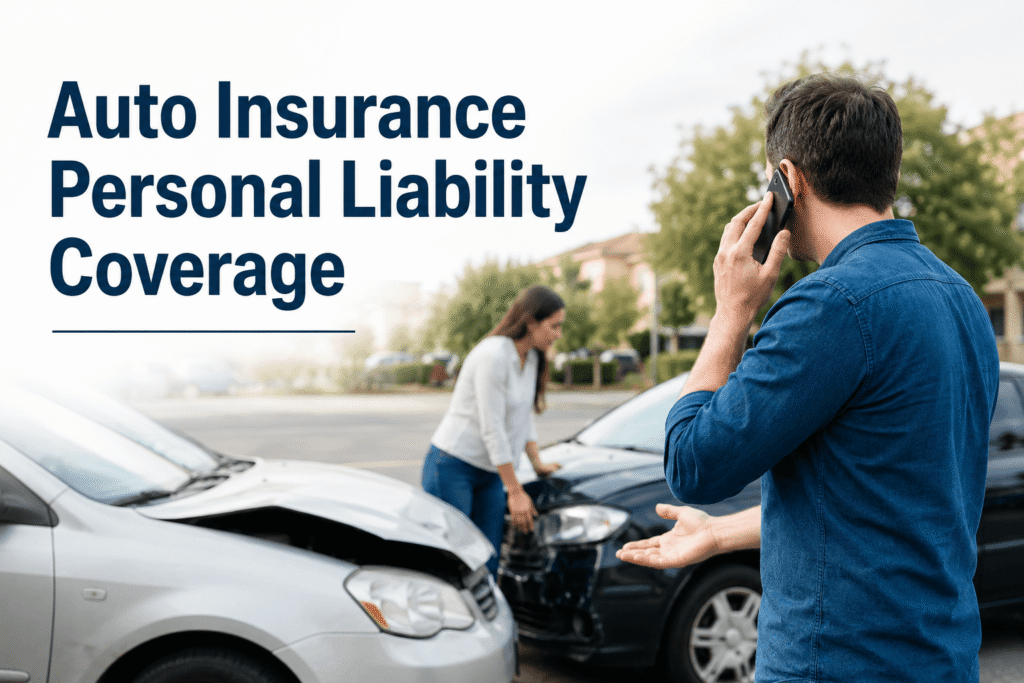
Picture this: you’re driving home from work, tired, half-thinking about dinner, and in a split second you rear-end the car in front of you at a red light. Nobody expects it. That’s exactly the point.
The other driver is hurt. Not seriously, but seriously enough for an ambulance, an emergency room visit, a few weeks of physical therapy, and a chiropractor afterward. Their car, a leased SUV, is totaled. A few weeks later, a letter arrives from an attorney. The number on it has six figures.
This is exactly the situation auto insurance personal liability coverage exists to handle. It’s not a luxury add-on or fine print you can skip past. It’s the part of your policy that stands between you and a financial catastrophe that follows you for years, possibly decades, if you don’t have enough of it.
Here’s the problem: nearly every state requires you to carry liability insurance, but almost none of them require you to carry enough of it. State minimums were set decades ago in many cases, and they haven’t kept pace with the cost of modern medical care, vehicle repairs loaded with sensors and cameras, or the size of jury verdicts. A driver who buys exactly what their state demands and nothing more can end up legally compliant and financially exposed at the same time.
Millions of Americans misunderstand what this coverage actually does. Some think it covers their own car. It doesn’t. Some think their insurance company will always protect them from a lawsuit. It will, but only up to your policy limit — after that, you’re on your own. Some assume “full coverage” means they’re fully protected against everything, when in reality liability is just one slice of that pie, and often the most important one.
In this guide, we’ll explain everything in plain English so you can choose the right coverage with confidence. We’ll walk through exactly what liability insurance pays for, what it leaves you exposed to, how state requirements differ, what coverage actually costs in 2026, and how to figure out the right limits for your specific situation — whether you’re a new driver, a parent of a teenager, a small business owner, or someone with enough assets that an umbrella policy starts to make sense.
What is auto insurance personal liability coverage?
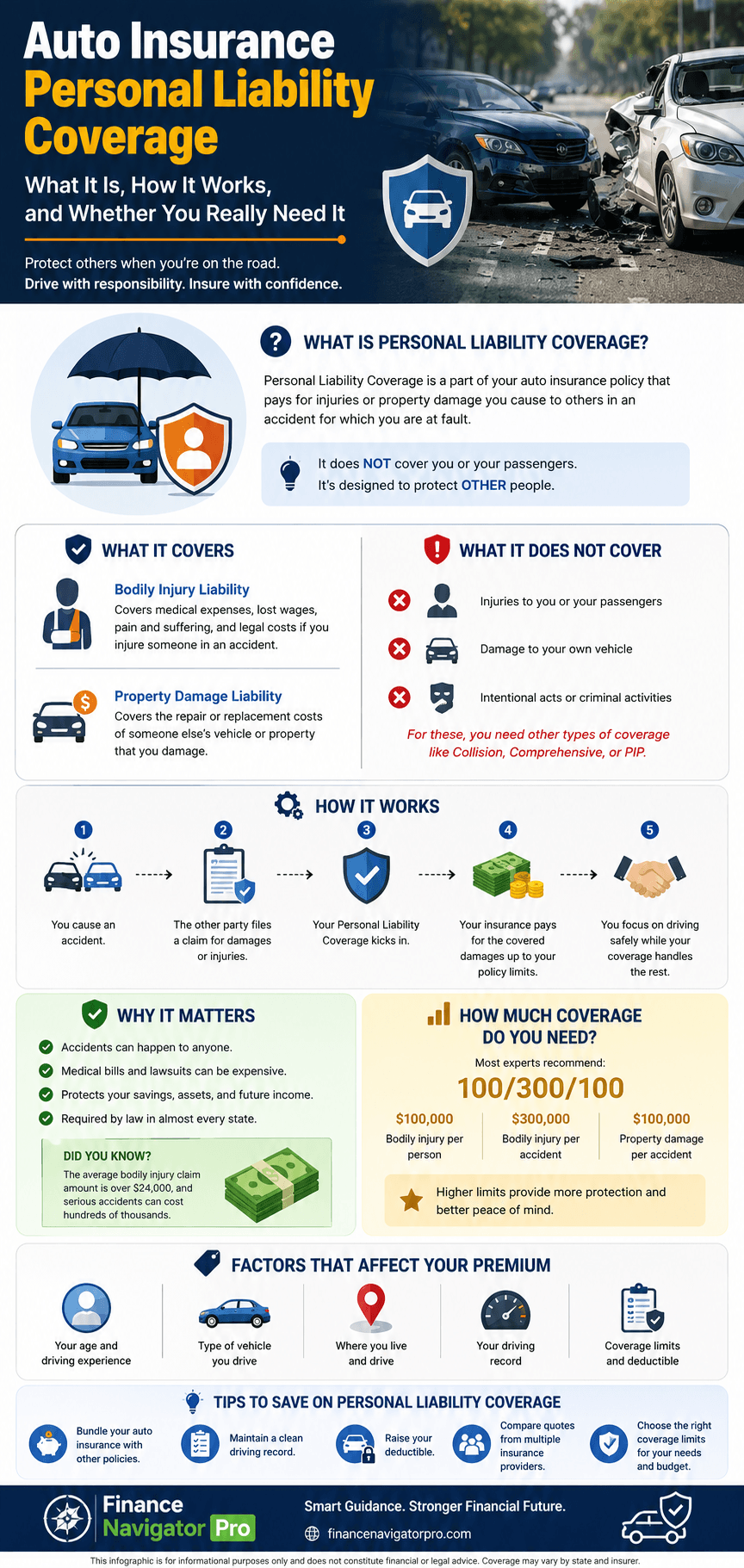
Auto insurance personal liability coverage is the part of your car insurance policy that pays for injuries and property damage you cause to other people when you’re at fault in an accident. It has two halves: bodily injury liability, which covers the other person’s medical bills, lost wages, and legal costs, and property damage liability, which covers repairs to their vehicle or other property.
It’s required in nearly every state because it protects other drivers, pedestrians, and property owners from bearing the financial cost of accidents that aren’t their fault. Without it, an at-fault driver with no assets and no insurance could simply walk away from a serious accident, leaving the injured party to cover their own bills.
| ✓ | Covers injuries you cause to others |
| ✓ | Covers property damage you cause |
| ✓ | Pays legal defense costs if you’re sued |
| ✓ | Required in almost every state |
| ✗ | Does NOT cover your own vehicle |
| ✗ | Does NOT pay your own medical bills |
Section 1: What Is Auto Insurance Personal Liability Coverage?
Auto insurance personal liability coverage is the legal and financial backbone of nearly every car insurance policy in the United States. At its core, it’s a promise from your insurance company: if you cause an accident, they will pay the other party’s covered losses, up to the limits you chose, instead of you having to pay them out of your own pocket.
That’s the practical definition. The legal purpose runs a little deeper. Every state, aside from a small handful of exceptions covered in Section 5, has what’s known as a financial responsibility law. These laws exist because driving a car is considered an inherently risky activity — a two-ton machine moving at speed is capable of causing real harm — and the state has an interest in making sure that when harm happens, the person responsible can actually pay for it. Liability insurance is how most drivers satisfy that legal obligation.
It’s worth being precise about who liability coverage protects, because this is where a lot of confusion starts. Liability coverage protects other people from you. It does not protect you from yourself.
Who Liability Coverage Protects
| • | The other driver involved in an accident you caused |
| • | Passengers in the other vehicle |
| • | Pedestrians or cyclists you injure |
| • | Property owners whose fences, buildings, or vehicles you damage |
| • | You, indirectly — by paying for a lawsuit so you don’t have to pay it yourself |
Who Liability Coverage Does NOT Protect
| • | You, if you’re injured in an accident you caused |
| • | Your own vehicle, regardless of who caused the crash |
| • | Your passengers’ injuries (these typically fall under MedPay or PIP, not liability) |
| • | Damage from theft, weather, fire, or vandalism |
One mistake I see drivers make constantly is assuming that because they’re “covered,” everything related to an accident is handled. In reality, a single at-fault accident might involve four separate coverage types working at once: liability for the other party, collision for your own car, MedPay or PIP for you and your passengers, and sometimes uninsured motorist coverage if the other driver flees. Liability is just one piece, but it’s the piece that determines whether a bad day turns into a bad decade.
How the Money Actually Flows
When you cause an accident, the process generally follows the same sequence, regardless of which state you’re in or which company insures you:
| Step | What Happens |
| 1. You cause the accident | Your actions (or your vehicle) are the primary cause of injury or property damage to another party. |
| 2. The claim is filed | The other driver, or their insurer, files a claim against your liability coverage. |
| 3. Your insurer investigates | An adjuster reviews the police report, damage, and any injuries to determine fault and value. |
| 4. Your insurer pays | Up to your policy limits, your insurer pays the other party’s bodily injury and property damage costs. |
| 5. You pay the rest, if any | Anything beyond your limits becomes your personal financial responsibility. |
That last row is the one that catches people off guard. Your policy limit isn’t a suggestion — it’s a hard ceiling. Once a claim exceeds it, your insurance company stops paying and you start paying, either out of savings, future wages, or assets a court can order you to liquidate.
Section 2: What Does Liability Coverage Actually Pay For?
Liability coverage splits into two distinct halves, and understanding the difference matters because each one has its own limit, its own claims process, and its own blind spots.
Bodily Injury Liability
Bodily injury liability (BI) is the half of your policy that responds when someone is physically hurt in an accident you caused. It’s almost always the more expensive half to claim against, because medical costs, lost income, and pain-and-suffering settlements can escalate quickly, especially with serious injuries.
Bodily injury liability typically covers:
| • | Hospital bills and emergency care |
| • | Follow-up treatment, physical therapy, and rehabilitation |
| • | Lost wages while the injured person recovers |
| • | Pain and suffering compensation |
| • | Funeral expenses, in the event of a fatality |
| • | Legal settlements reached with the injured party |
| • | Attorney fees if the claim escalates into a lawsuit |
Many people are surprised to learn that bodily injury liability doesn’t just cover physical injuries in the narrow sense. A lawsuit can include compensation for emotional distress, diminished earning capacity if the injury is long-term, and even loss of companionship claims from family members in catastrophic cases. This is exactly why bodily injury limits matter so much — a single serious injury claim can run well past $100,000 once medical care, lost income, and a settlement are all added together.
Property Damage Liability
Property damage liability (PD) covers the cost of repairing or replacing property you damage in an accident. People usually think of this as covering the other driver’s car, and that’s the most common claim, but it extends much further than that.
Property damage liability typically covers:
| • | Repair or replacement of the other vehicle |
| • | Damage to a fence, mailbox, or front yard structure |
| • | Damage to a storefront or other commercial building |
| • | Damage to road signs, guardrails, or utility poles |
| • | Damage to government-owned property, like a traffic signal or median barrier |
| • | Reasonable rental car reimbursement for the other party while their vehicle is repaired |
| • | Cleanup costs tied directly to the accident |
A quick real-world example: a driver loses control on an icy road, clips a utility pole, and knocks out power to several homes for an afternoon. Property damage liability is what pays the utility company for the pole and the repair work, not some separate government program. Costs like this add up fast, and they’re a big part of why property damage limits in the $25,000 range, common as a state minimum, can run out quickly in anything beyond a minor fender-bender.
Section 3: What Liability Insurance Does NOT Cover
This section might be the most important one in this entire guide, because the gaps in liability coverage are exactly where drivers get blindsided. Liability insurance is a one-way shield: it protects other people from the damage you cause. It does almost nothing to protect you or your own property.
| Not Covered by Liability Insurance | What You’d Need Instead |
| Damage to your own car in an at-fault accident | Collision coverage |
| Your own injuries from an at-fault accident | MedPay or Personal Injury Protection (PIP) |
| Theft of your vehicle | Comprehensive coverage |
| Flood damage | Comprehensive coverage |
| Hail damage | Comprehensive coverage |
| Fire damage | Comprehensive coverage |
| Vandalism | Comprehensive coverage |
| Mechanical breakdown | A separate mechanical breakdown policy or extended warranty |
| Rental car while your car is repaired | Rental reimbursement coverage |
| The difference between your car’s value and your loan balance | Gap insurance |
Notice the pattern: every single item in that left column is something that happens to you or your property. That’s the defining boundary of liability coverage. If you’re the one who needs the payout, liability insurance isn’t the policy that helps you — you’d need one of the coverages in the right-hand column instead, and those are typically bundled together under what people casually call “full coverage.”
Key Takeaway
| • | Liability insurance protects other people from financial harm you cause — it does not protect you, your passengers, or your own vehicle. |
| • | If your car is older, paid off, and not worth much, liability-only coverage might be a reasonable financial choice. |
| • | If you have a loan, a lease, or a newer vehicle, skipping collision and comprehensive coverage is a real financial risk. |
Section 4: How Liability Coverage Limits Work
Liability limits are usually written as three numbers separated by slashes, something like 100/300/100. If you’ve never had it explained plainly, that string of numbers looks like a code. It isn’t — it’s actually pretty simple once you know what each number represents.
Reading the Numbers
The format is: bodily injury per person / bodily injury per accident / property damage per accident. All three numbers are expressed in thousands of dollars.
| Limit Format | BI Per Person | BI Per Accident | Property Damage | Typical Use Case |
| 25/50/25 | $25,000 | $50,000 | $25,000 | Common state minimum; thin protection for serious accidents |
| 50/100/50 | $50,000 | $100,000 | $50,000 | A common mid-tier choice; better, still light for severe injuries |
| 100/300/100 | $100,000 | $300,000 | $100,000 | Widely recommended by independent agents and financial advisors |
| 250/500/250 | $250,000 | $500,000 | $250,000 | Suited to higher-asset households or those wanting extra cushion |
| 500 CSL | Combined single limit — one pooled limit per accident instead of split limits | Common in commercial auto; some personal insurers offer it too | ||
That last row deserves a quick explanation. Most personal auto policies use “split limits,” meaning there’s a separate cap for bodily injury per person, a separate cap for bodily injury per accident, and a separate cap for property damage. A combined single limit (CSL) policy pools all of that into one shared limit. A $500,000 CSL policy could pay out the full $500,000 toward a single severely injured person, or split it across multiple injured people and property damage, however the claim breaks down. CSL policies show up more often in commercial auto insurance, but some personal insurers offer them as an option too.
Walking Through an Example
Say you carry 100/300/100 and you cause an accident that injures two people and totals their car. The first person’s medical bills and lost wages come to $80,000. The second person’s injuries are more serious, totaling $150,000 in costs. The car itself is a $35,000 write-off.
Here’s how your limits would apply:
| • | Person 1: $80,000 in costs, under your $100,000 per-person cap — fully covered |
| • | Person 2: $150,000 in costs, but capped at your $100,000 per-person limit — you’d be personally responsible for the remaining $50,000 |
| • | Combined bodily injury payout: $180,000, under your $300,000 per-accident cap — no additional shortfall here |
| • | Property damage: $35,000, well under your $100,000 property damage limit — fully covered |
In this scenario, your insurer pays $215,000 total, and you’re personally on the hook for the $50,000 gap from Person 2’s injuries exceeding the per-person cap. That’s the kind of math that makes 100/300/100 a popular recommendation over bare state minimums — a higher per-person limit, like 250/500/250, would have fully covered this accident with room to spare.
Key Takeaway
| • | The first two numbers cover bodily injury: one caps what’s paid per injured person, the other caps the total for everyone hurt in the accident. |
| • | The third number caps property damage, separate from medical costs entirely. |
| • | Going over any single cap means you personally owe the difference — even if your overall policy limit hasn’t been reached. |
Section 5: State Minimum Liability Requirements
Every state sets its own minimum liability limits, and the differences between them are bigger than most drivers realize. A driver in one state might satisfy the law with $10,000 of property damage coverage, while a driver one state over is required to carry five times that amount. Understanding why these gaps exist, and where your state falls, is essential before you decide how much coverage to actually buy.
Why Every State Differs
There’s no federal auto insurance law. Auto insurance is regulated entirely at the state level, which means each state legislature and insurance department sets its own financial responsibility requirements based on local accident costs, medical costs, political pressure, and how long it’s been since the last update. Some states haven’t touched their minimums in decades; others have moved more recently to keep pace with rising repair and medical costs.
Financial Responsibility Without Traditional Insurance
Almost every state requires liability insurance specifically, but a few allow alternatives. New Hampshire is the most well-known exception: it doesn’t mandate that drivers buy a traditional insurance policy, but it does require drivers to prove financial responsibility, meaning they can show the state they have the means to cover an at-fault accident through a bond, a cash deposit, or self-insurance. In practice, most New Hampshire drivers still buy insurance because the alternative requires tying up a large sum of money with the state.
Virginia, similarly, used to allow drivers to pay an uninsured motorist fee instead of buying coverage, but that option was eliminated, meaning insurance is now effectively mandatory there. A few states permit self-insurance for drivers who can demonstrate sufficient assets, generally a six-figure sum held in a state-approved account or bond, but this option is realistically limited to a small number of financially well-resourced individuals and almost never makes sense for an average driver.
No-Fault States
About a dozen states operate under no-fault rules, which require drivers to carry Personal Injury Protection (PIP) in addition to liability coverage. In a no-fault state, your own PIP coverage pays your medical bills and lost wages after an accident, regardless of who caused it, up to your PIP limit. Liability coverage still exists in no-fault states and still pays for the other driver’s costs when you’re at fault, but the day-to-day claims process for your own injuries runs through PIP instead. Florida and Massachusetts are commonly cited examples of no-fault states.
States With Notably Low or High Requirements
Florida has historically stood out for not requiring bodily injury liability at all — just property damage liability and PIP — though that arrangement is set to change. Florida is scheduled to shift to an at-fault system with mandatory bodily injury and property damage liability minimums starting January 1, 2027, so drivers there should watch for updated requirements as that date approaches.
On the higher end, states including Alaska, Maine, and North Carolina have required bodily injury limits at or above $50,000 per person, closer to what independent agents typically recommend as a starting point rather than a legal floor.
Recent Changes Worth Knowing About
State minimums aren’t frozen in time, and several states have moved them upward recently. California raised its minimums from 15/30/5 to 30/60/15 effective January 1, 2025, its first increase since 1967. New Jersey completed a phased increase to 35/70/25 effective January 1, 2026. Massachusetts raised its limits to 25/50/30 in 2026, its first change since 1988. Hawaii, North Carolina, Utah, and Virginia have also adjusted their minimums upward within the past two years.
The pattern is clear: rising vehicle repair costs (today’s cars are loaded with sensors, cameras, and other expensive-to-replace components) and rising medical costs are pushing more states to revisit numbers that, in some cases, hadn’t moved in half a century.
State Minimum Liability Requirements at a Glance
The table below summarizes representative requirements across a range of states. State requirements change periodically, so always confirm current limits with your state’s Department of Insurance or DMV before renewing or shopping for a policy.
| State | Typical Minimum (BI/BI/PD) | Notable Rules |
| California | 30/60/15 | Raised from 15/30/5 effective Jan. 1, 2025 |
| Texas | 30/60/25 | Standard at-fault state |
| New York | 25/50/10 | No-fault state; PIP required |
| Florida | PIP/PD only (no BI minimum, pending 2027 change) | Shifts to at-fault with BI/PD minimums Jan. 1, 2027 |
| New Jersey | 35/70/25 | Increased from 25/50/25 effective Jan. 1, 2026 |
| Massachusetts | 25/50/30 | No-fault state; first increase since 1988 |
| Alaska | 50/100/25 | Among the higher state minimums nationally |
| North Carolina | 50/100/50 | Highest property damage minimum among most states |
| New Hampshire | 25/50/25 (if insured) | Insurance not legally mandatory; financial responsibility required |
| Virginia | 30/60/20 | Uninsured motorist fee option eliminated; insurance now required |
If your state isn’t listed above, the safest move is a quick check with your state Department of Insurance or DMV website, since this is exactly the kind of detail that changes from one legislative session to the next.
Key Takeaway
| • | There’s no national minimum — every state sets its own liability requirements, and they range widely. |
| • | No-fault states require PIP alongside liability; at-fault states generally don’t. |
| • | Several states have raised their minimums in 2025 and 2026 — check your current policy against your state’s latest requirement, especially if you haven’t reviewed it recently. |
| • | A state minimum is a legal floor, not a recommendation. Meeting it keeps you legal; it doesn’t necessarily protect your finances. |
Section 6: How Much Liability Coverage Do You Actually Need?
This is the question that matters most, and it doesn’t have a single universal answer. The right amount of liability coverage depends heavily on what you have to lose, how much driving risk you carry, and what your household situation looks like. Below is a breakdown by life stage and circumstance.
Teen Drivers
Teen drivers are statistically the highest-risk group on the road, which is exactly why insuring them costs so much. Because teens are more likely to be involved in an at-fault accident, and because a single serious accident involving a new driver can attract outsized legal attention, parents should generally lean toward higher liability limits, at least 100/300/100, rather than state minimums, even though it raises the premium. The math is straightforward: the extra premium for higher limits is almost always smaller than the financial exposure of an underinsured teen causing a serious crash.
College Students
If a college student is still listed on a parent’s policy, household liability limits typically apply to them as well, which simplifies things. If they have their own separate policy, the same teen-driver logic applies: a young, relatively inexperienced driver benefits from higher-than-minimum limits, especially since lawsuits sometimes name parents as co-defendants if the vehicle or policy is in a parent’s name.
Families
Families with multiple cars and drivers should think about liability limits at the household level, not the per-car level. One household accident involving a teenager or a long commute spouse can expose the entire family’s assets. 100/300/100 is a reasonable baseline for most families; those with home equity, retirement savings, or other assets worth protecting should look at 250/500/250 or consider an umbrella policy, covered in Section 10.
Luxury Car Owners
Owning a luxury or high-performance vehicle doesn’t change your liability needs directly, since liability covers the other person’s costs, not your own car. However, luxury vehicle owners frequently fall into the higher-net-worth category that benefits from higher limits and umbrella coverage, simply because they tend to have more assets that a lawsuit could put at risk.
Business Owners
If you use a personal vehicle for any business purposes, even occasionally, your personal liability policy may not fully apply, or your insurer may dispute a claim related to business use. Business owners should talk to their agent about whether they need a commercial auto policy, a hired and non-owned auto endorsement, or simply higher personal limits paired with a business umbrella policy.
High-Income Households
The general rule of thumb among independent agents: your liability limits should be roughly equal to your net worth, with a floor of at least 100/300/100. A high earner with $400,000 in assets but only state-minimum coverage is, frankly, underinsured relative to what a court could come after in a serious lawsuit.
Retirees
Retirees often drive less, which can lower risk, but many retirees have built up significant savings and home equity over decades, which raises the stakes of an underinsured lawsuit. Lower mileage doesn’t mean lower exposure if an accident does happen, so retirees with meaningful assets shouldn’t assume that infrequent driving justifies bare-minimum coverage.
Uber, Lyft, and Delivery Drivers
This is a coverage gap that catches a lot of gig workers off guard. Standard personal auto policies frequently exclude or limit coverage while you’re logged into a rideshare or delivery app, even if you haven’t picked up a passenger or order yet. Rideshare companies provide some liability coverage during active trips, but the coverage during the gap between accepting the app login and accepting a ride can be thin or nonexistent without a rideshare endorsement added to your personal policy. Anyone driving for Uber, Lyft, DoorDash, Instacart, or similar platforms should specifically ask their insurer about rideshare or delivery endorsements rather than assuming their personal policy already handles it.
High Net Worth Individuals
For households with substantial assets, state minimum liability coverage is close to irrelevant as a financial safeguard; the real protection comes from layering high liability limits with a personal umbrella policy, often $1 million or more, which extends well beyond what any auto liability policy alone would provide.
Key Takeaway
| • | Match your liability limits to what you actually have to lose, not just what your state requires. |
| • | 100/300/100 is a reasonable floor for most households with any meaningful assets or income. |
| • | Gig and rideshare drivers should check specifically for coverage gaps between app login and active trips. |
| • | High-net-worth households should pair high auto liability limits with an umbrella policy rather than relying on auto insurance alone. |
Section 7: Average Cost of Liability Insurance
Liability insurance costs vary more than most people expect, and the differences come from a long list of factors that insurers weigh together rather than any single number. As of 2026, the national average cost for a liability-only policy lands somewhere in the $60 to $76 per month range, or roughly $624 to $912 a year, though your actual quote could land well outside that range depending on your specific situation.
What Drives the Price
Age
Teen and young adult drivers pay dramatically more than older, more experienced drivers. Inexperience behind the wheel correlates strongly with accident frequency, and insurers price that risk accordingly. Rates generally decline through your 30s, 40s, and 50s, then tick back up slightly for senior drivers due to age-related risk factors, though the increase for seniors is typically much smaller than the premium young drivers pay.
Gender
In states that still allow it (a shrinking number, as several states have banned gender-based pricing), young male drivers have historically paid more than young female drivers, reflecting differences in accident statistics for that age group. This gap narrows substantially with age and driving experience.
State
Where you live matters more than almost any other factor. States with higher minimum requirements, higher population density, higher rates of uninsured drivers, or higher litigation costs tend to have noticeably higher average premiums. States with lower population density and lower accident rates, often rural states, tend to sit at the cheaper end nationally.
Driving Record
A clean record is one of the most powerful discounts available. A single at-fault accident or a moving violation can raise your premium noticeably, and multiple incidents within a short window can push you into high-risk insurer territory, where rates climb sharply.
Credit Score
In most states (though not all — a handful, including Massachusetts, restrict or ban this practice), insurers use credit-based insurance scores as part of pricing. Statistically, lower credit scores have correlated with higher claims frequency, so insurers price accordingly. Improving your credit score over time can meaningfully reduce your premium where this practice is allowed.
Vehicle
The vehicle itself affects your liability premium less than it affects collision or comprehensive premiums, but it still matters. Vehicles with a history of being involved in costly accidents, or vehicles favored by high-risk demographics, can carry a small liability premium adjustment.
ZIP Code
Even within the same state, your specific ZIP code affects pricing based on local accident frequency, theft rates, and the density of traffic. Two neighbors in different towns within the same state can see meaningfully different quotes.
Mileage
Drivers who log significant annual mileage, especially long commutes, statistically have more opportunities to be involved in an accident, which insurers factor into pricing. Low-mileage drivers may qualify for usage-based or low-mileage discounts.
Coverage Limits
This one is intuitive: higher liability limits cost more than the state minimum, but usually by a smaller margin than people expect. The jump from 25/50/25 to 100/300/100 often costs far less proportionally than the jump in actual protection it buys, which is part of why so many independent agents recommend it.
Deductibles
Deductibles apply to collision and comprehensive coverage, not liability, so they don’t directly affect your liability premium. However, raising deductibles on the collision and comprehensive portions of a full coverage policy can free up budget that you could redirect toward higher liability limits instead.
What You Might Actually Pay
| Coverage Type | Typical Monthly Cost | Typical Annual Cost |
| State minimum liability-only | $60 – $76 | $720 – $912 |
| 50/100/50 liability-only | $53 – $68 | $636 – $816 |
| 100/300/100 liability-only | Modestly above 50/100/50 | Modestly above 50/100/50 |
| Full coverage (avg., 100/300/100 + collision/comp) | $177 – $208 | $2,124 – $2,496 |
These are national averages pulled together from multiple 2026 industry rate analyses, and your own quote could land meaningfully above or below them depending on the factors above. Insurers like GEICO, USAA (military families only), Erie, and Auto-Owners have consistently ranked among the cheaper options for liability-only coverage in recent rate comparisons, though the cheapest company for you specifically depends on your state, profile, and driving history. The only reliable way to know your real number is to get quotes.
Key Takeaway
| • | National average liability-only costs run roughly $60–$76 per month, but your actual rate depends on a long list of personal and local factors. |
| • | Raising liability limits from state minimum to 100/300/100 typically costs less, proportionally, than the jump in protection it provides. |
| • | Shopping around matters — rates for the same coverage can vary significantly between insurers for the exact same driver. |
Section 8: Liability vs. Full Coverage
“Full coverage” isn’t an official insurance term — you won’t find it defined in any policy document — but everyone in the industry uses it to mean a policy that combines liability, collision, and comprehensive coverage. Here’s how the two approaches stack up against each other.
| Factor | Liability-Only | Full Coverage |
| Average cost | $60–$76/month | $177–$208/month |
| Protects other people | Yes | Yes |
| Protects your own vehicle | No | Yes (collision + comprehensive) |
| Legally required minimum | Yes, in nearly every state | Not required by any state |
| Required by auto lenders/leases | Not sufficient on its own | Typically required |
| Covers theft | No | Yes (comprehensive) |
| Covers weather damage | No | Yes (comprehensive) |
| Best suited for | Older, paid-off, low-value vehicles | Financed, leased, or higher-value vehicles |
| Main advantage | Lower premium | Comprehensive financial protection |
| Main drawback | No protection for your own car | Higher premium |
The honest, balanced answer here is that neither option is universally “right.” If your car is fifteen years old, paid off, and worth $3,000, paying $130 extra a month for collision and comprehensive coverage on a car you could replace with a few months of those premium payments doesn’t make financial sense for a lot of drivers. But if you’re financing a $35,000 vehicle, your lender will require full coverage anyway, and dropping it the moment the loan requirement technically allows it is usually a mistake — you’d be exposed to the full replacement cost of a financed vehicle with no insurance backup.
Section 9: Liability vs. Collision vs. Comprehensive
These three coverage types get confused constantly, partly because insurance companies bundle them together so often that people stop thinking of them as separate things. They’re not. Each one responds to a different category of loss.
| Coverage | What It Pays For | Whose Property | Required by Law? |
| Liability | Injuries and damage you cause to others | Other people’s | Yes, in nearly all states |
| Collision | Damage to your car from a collision, regardless of fault | Your own | No, but often required by lenders |
| Comprehensive | Non-collision damage: theft, fire, weather, vandalism, animal strikes | Your own | No, but often required by lenders |
A simple way to remember the split: liability looks outward, toward the people and property you might hurt. Collision and comprehensive look inward, toward your own vehicle. Collision specifically means a crash, whether with another car, a guardrail, or a tree. Comprehensive covers basically everything else that can happen to a parked or moving car that isn’t a collision — a hailstorm, a stolen catalytic converter, a deer in the road, a tree branch falling on the hood during a storm.
Section 10: Liability Coverage vs. Umbrella Insurance
Auto liability insurance has a ceiling. Even a generous 250/500/250 policy can run out in a catastrophic accident involving multiple serious injuries, a wrongful death claim, or a long-term disability. This is exactly the gap umbrella insurance is built to close.
A personal umbrella policy sits on top of your existing auto (and usually homeowners or renters) liability coverage and kicks in once those underlying limits are exhausted. Typical umbrella policies start at $1 million in additional coverage and are surprisingly affordable relative to the protection they offer, often a few hundred dollars a year, because they only activate in the rare worst-case scenario.
When Umbrella Insurance Becomes Valuable
| • | You own a home, or have meaningful equity built up in one |
| • | You have retirement accounts, investments, or savings beyond a modest emergency fund |
| • | You have a teenage or young adult driver on your policy |
| • | You regularly drive in high-traffic, high-litigation areas |
| • | Your profession or public visibility makes you a more attractive target for a lawsuit |
| • | You simply want peace of mind that a single bad day on the road can’t unravel everything you’ve built financially |
Most insurers require you to carry a certain minimum auto liability limit, often 250/500/250 or similar, before they’ll sell you an umbrella policy on top of it. That requirement exists because the umbrella is designed to supplement substantial underlying coverage, not replace thin coverage. If you’re considering an umbrella policy, talk to your agent about both pieces together rather than shopping for them separately.
Key Takeaway
| • | Auto liability insurance, even at higher limits, has a hard ceiling that can be exhausted by a single catastrophic accident. |
| • | Umbrella insurance extends your protection well beyond your auto policy’s limits, often starting at $1 million in additional coverage. |
| • | Umbrella policies typically require a minimum underlying auto liability limit before an insurer will write one. |
| • | Anyone with home equity, savings, or a teen driver in the household should at least get a quote and see what it would cost. |
Section 11: Common Liability Claim Examples
Reading about coverage in the abstract only gets you so far. These six scenarios reflect the kinds of claims that come up constantly in the real world, and each one illustrates a slightly different lesson about how liability coverage actually behaves under pressure.
Example 1: Rear-End Accident
You’re following a bit too closely in traffic, the car ahead brakes suddenly, and you can’t stop in time. In the overwhelming majority of rear-end accidents, the trailing driver is presumed at fault, since the basic rule of the road is to leave enough following distance to stop safely. Your property damage liability covers the repair to their bumper and trunk; your bodily injury liability covers any whiplash or soft-tissue injury claims, which are common in rear-end collisions even at relatively low speeds.
Example 2: Teen Driver Crash
A newly licensed teenager, still building judgment behind the wheel, misjudges a turn at an intersection and collides with a crossing vehicle. Because the policy is typically held by a parent, the parent’s liability limits apply to the claim. This is exactly the scenario that makes the case for higher-than-minimum limits when a teen driver is added to a household policy — inexperience plus higher accident frequency is a combination worth insuring against generously.
Example 3: Parking Lot Accident
Parking lot fender-benders happen constantly and are often treated as shared-fault situations, since both drivers usually have some duty to watch for cross-traffic in a lot. Liability still applies based on whatever fault percentage is assigned, and many states use a comparative negligence system (more on that in the next section) to divide responsibility rather than assigning 100% fault to one driver.
Example 4: Hit a Mailbox
A driver swerves to avoid a pothole and takes out a neighbor’s mailbox and a section of fence. This is a textbook property damage liability claim — no injuries involved, straightforward repair costs, usually resolved quickly without much back-and-forth.
Example 5: Multi-Car Accident
A chain-reaction crash on the highway, often triggered by one driver braking hard and several vehicles behind unable to stop in time, can result in multiple liability claims stacking against a single at-fault driver’s policy. This is exactly the kind of scenario where the per-accident bodily injury cap, the middle number in your 100/300/100-style limit, can get tested, since injuries from multiple vehicles draw against the same shared pool.
Example 6: Lawsuit Over Injuries
An accident initially looks minor, but the injured party’s symptoms worsen over the following weeks, eventually requiring surgery and months of lost work. Their attorney sends a settlement demand that exceeds the at-fault driver’s bodily injury limits. This is the scenario where umbrella insurance, discussed in Section 10, becomes the difference between a fully resolved claim and a personal financial crisis for the at-fault driver.
Section 12: How Insurance Companies Determine Liability
Fault isn’t always obvious, and insurance companies don’t simply take either driver’s word for it. They build a picture from multiple sources of evidence before deciding how to allocate responsibility, and that process directly determines how a liability claim gets paid.
Police Report
When officers respond to an accident, they typically document the scene, take statements, and sometimes note a preliminary opinion on fault or cite a driver for a traffic violation. Insurers weigh this report heavily, though it isn’t always the final word.
Witnesses
Independent witness statements, especially from someone with no connection to either driver, can carry significant weight, particularly in disputed cases where the two drivers tell conflicting stories.
Dashcam Footage
Dashcam adoption has grown substantially, and footage from either vehicle (or a nearby vehicle) can resolve disputes almost instantly when it’s available and clear.
Photos
Photos of vehicle positioning, skid marks, debris fields, and damage patterns help adjusters reconstruct what likely happened, especially in cases without witnesses or footage.
Traffic Laws
Adjusters compare the accident circumstances against the relevant state and local traffic laws — right-of-way rules, following distance expectations, signal compliance — to determine who violated a duty of care.
Adjusters
The claims adjuster is the person who actually pulls all of this together: police reports, statements, photos, repair estimates, and medical records, into a fault determination and a settlement value.
Negligence
At its legal core, a liability claim hinges on negligence: did the at-fault driver fail to exercise the level of care a reasonable driver would have under the same circumstances? Speeding, distracted driving, following too closely, and failing to yield are all classic examples of negligent behavior that support a liability claim.
Comparative Negligence
Many states use a comparative negligence system rather than an all-or-nothing fault rule. Under comparative negligence, fault can be split between both drivers, say 70/30, and each driver’s payout (or liability) is adjusted by their share of fault. A few states use a stricter contributory negligence standard, where being even slightly at fault can bar you from recovering anything from the other driver, though this approach is increasingly rare. The rules in your specific state meaningfully affect how a disputed claim gets resolved.
Key Takeaway
| • | Fault is determined through a combination of police reports, witness statements, dashcam footage, photos, and traffic law analysis — not a single piece of evidence alone. |
| • | Many states split fault percentages rather than assigning 100% blame to one driver, which directly affects how much a liability claim pays out. |
| • | Dashcam footage has become one of the fastest ways to resolve a disputed fault determination. |
Section 13: How to File a Liability Claim
Whether you’re the at-fault driver or the person making a claim against someone else’s liability coverage, the process tends to follow a fairly predictable sequence. Here’s the typical timeline from accident to payment.
Step 1: The Accident Happens
Make sure everyone is safe first. Move vehicles out of traffic if it’s safe to do so, and check on anyone who might be injured.
Step 2: Call the Police
Most states require a police report for accidents involving injury or significant property damage. Even when it’s not strictly required, having an official report makes the claims process considerably smoother.
Step 3: Notify Your Insurance Company
Report the accident to your own insurer promptly, even if you weren’t at fault. Most policies require timely reporting, and delays can complicate your claim.
Step 4: An Adjuster Is Assigned
The insurer assigns a claims adjuster, who becomes your main point of contact for the duration of the claim.
Step 5: Investigation
The adjuster gathers the police report, photos, witness statements, and any available footage to determine fault and assess damages, as described in Section 12.
Step 6: Repair Estimate
For property damage claims, the adjuster or a designated appraiser evaluates the vehicle (or other property) to determine repair costs, or to declare a total loss if repairs would exceed the vehicle’s value.
Step 7: Medical Review
For bodily injury claims, the insurer reviews medical records, bills, and sometimes requests an independent medical evaluation to assess the extent and cost of injuries.
Step 8: Settlement
Once the investigation and damage assessment are complete, the insurer proposes a settlement amount. For straightforward property damage, this can happen within days. For significant injury claims, especially ones involving attorneys, this step can take months as both sides negotiate.
Step 9: Payment
Once a settlement is accepted, the insurer issues payment, either directly to the claimant, to a repair shop, or to a medical provider, depending on the type of claim and the arrangement in place.
One mistake I see drivers make after a claim is assumed to be “done” is treating that first settlement offer as the only option. For property damage, getting a second repair estimate is reasonable if the first one seems low. For bodily injury claims, especially anything involving ongoing treatment, it’s worth understanding that initial offers are often a starting point for negotiation, not a final number.
Section 14: Ways to Lower Liability Insurance Costs
Reducing your premium doesn’t have to mean reducing your coverage. Most of the strategies below let you keep solid liability limits while still bringing the cost down. See our full list of insurance discounts most people don’t know about for more ways to save.
Bundling
Combining your auto policy with homeowners, renters, or other policies under the same insurer typically unlocks a multi-policy discount, often one of the largest discounts available.
Safe Driving
A clean driving record, free of at-fault accidents and moving violations, is consistently one of the strongest rate factors in your control.
Telematics Programs
Usage-based insurance programs track your actual driving behavior, braking habits, speed, time of day, through a phone app or plug-in device, and reward safer driving patterns with discounts.
Higher Deductibles
Raising your collision and comprehensive deductibles lowers those portions of your premium, freeing up budget that you can redirect toward higher liability limits instead of pocketing the savings entirely.
Good Student Discounts
Many insurers offer meaningful discounts for student drivers who maintain a strong GPA, recognizing a loose correlation between academic discipline and driving responsibility.
Military Discounts
Active duty, veterans, and military families often qualify for discounted rates, and insurers like USAA specialize specifically in this population with competitively low liability rates.
Defensive Driving Courses
Completing an approved defensive driving course can unlock a discount in many states, sometimes regardless of your existing driving record.
Low Mileage Discounts
If you drive significantly less than average, ask your insurer about low-mileage discounts, which directly reduce your accident risk profile.
Improving Your Credit
In states where credit-based insurance scoring is allowed, working on your credit score over time can gradually lower your premium.
Annual Shopping
Loyalty doesn’t always pay in the insurance world. Comparing quotes from several companies once a year, especially around renewal time, often reveals meaningfully cheaper options for the same coverage.
Key Takeaway
| • | You can lower your premium without lowering your liability limits — bundling, safe driving, and telematics programs are good places to start. |
| • | Redirecting deductible savings toward higher liability limits is a smart trade many drivers overlook. |
| • | Shop your policy annually; the cheapest insurer for your profile today may not be the cheapest one next year. |
Section 15: Biggest Liability Insurance Mistakes
Most coverage gaps don’t come from dishonesty or carelessness — they come from drivers simply not knowing what they don’t know. These are the mistakes that show up again and again.
Buying Minimum Limits Without Thinking It Through
Buying exactly what your state requires, without ever pausing to compare it against what you actually have to lose, is the single most common liability mistake. State minimums are a legal floor, set by legislators balancing affordability against protection across an entire state population — they were never designed as a personalized recommendation for your specific financial situation.
Not Updating Coverage as Life Changes
A policy that made sense five years ago, before a home purchase, a new teen driver, or a meaningful raise, might be badly outdated today. Liability needs should be revisited whenever your financial picture or household driving risk changes meaningfully.
Ignoring Inflation
Medical costs and vehicle repair costs have both risen substantially in recent years. A limit that felt generous a decade ago may have quietly become inadequate as the cost of claims has climbed around it.
Not Comparing Quotes
Sticking with the same insurer year after year without comparing alternatives often means leaving money on the table, sometimes hundreds of dollars a year for identical coverage.
Not Reading Exclusions
Every policy has exclusions, and the rideshare gap described in Section 6 is a perfect example of a coverage hole drivers don’t discover until they actually need the coverage and find out it isn’t there.
Cancelling Early
Cancelling a policy before a new one is fully active, even for a short gap, can create a lapse that’s both legally risky and financially costly, since insurers often charge higher rates to drivers with a coverage gap on their record.
Letting a Policy Lapse
Missing a payment and letting coverage lapse, even unintentionally, can lead to a SR-22 filing requirement in some states if you’re caught driving uninsured, along with higher future premiums.
Key Takeaway
| • | Most liability coverage gaps come from inertia, not bad decisions — a policy that fit five years ago may not fit today. |
| • | Re-evaluate your liability limits whenever your assets, household drivers, or financial picture change. |
| • | A short coverage lapse can cost you more in future premiums than it ever saved you in the moment. |
Section 16: Frequently Asked Questions
These are the questions drivers ask most often when they’re trying to understand liability coverage in practical, real-world terms. Each answer is intentionally concise so you can find what you need quickly.
What happens if damages exceed my liability limits?
Once a claim exceeds your policy limit, your insurer stops paying and you become personally responsible for the remainder. The injured party can pursue your wages, savings, or other assets through a judgment if you can’t pay voluntarily. This is exactly why many financial advisors recommend limits well above your state’s minimum.
Is liability insurance required?
Yes, in nearly every state. New Hampshire is the main exception, allowing drivers to prove financial responsibility through other means instead of buying a traditional policy. A small number of other states permit self-insurance for drivers who can demonstrate sufficient financial resources, but this is uncommon in practice.
Can someone sue me after insurance pays?
Yes, if their costs exceed your policy limits. Insurance pays up to your limit, but it doesn’t prevent a lawsuit for the remaining balance. This is the core reason higher liability limits and umbrella policies exist — to reduce the chance that a lawsuit can reach your personal assets.
Does liability cover family members?
Typically, yes. Most personal auto policies extend liability coverage to household family members driving the insured vehicle with permission, and often to the listed drivers even when they’re driving a different car, subject to your policy’s specific terms. Always confirm the details with your insurer.
Does liability cover rental cars?
Often yes, your personal auto liability coverage typically extends to a rental car used for personal travel, though this isn’t universal. Check your specific policy or call your insurer before relying on it, especially for international rentals or extended-use scenarios, which can fall outside standard coverage.
Can I increase liability anytime?
Yes, you can generally request a coverage increase at any point during your policy term, not just at renewal. Your insurer will adjust your premium to reflect the new limits, usually effective immediately or within a few days of your request.
What is split limit coverage?
Split limit coverage divides your liability protection into three separate caps: bodily injury per person, bodily injury per accident, and property damage per accident. Each cap applies independently, meaning exceeding one doesn’t borrow room from the others, which is the standard structure for most personal auto policies.
What is combined single limit coverage?
A combined single limit (CSL) policy pools bodily injury and property damage into one shared cap per accident, rather than splitting them into separate categories. It offers more flexibility in how the payout is allocated but is less common in personal auto policies than in commercial coverage.
Does liability cover road rage incidents?
Generally no, if the act is intentional. Liability insurance is built around accidents and negligence, not deliberate harm. An insurer can deny a claim tied to an intentional act, such as deliberately ramming another vehicle, leaving the at-fault driver personally exposed to both criminal and civil consequences.
Will liability insurance cover hit-and-run accidents?
Your liability coverage applies if you’re the one who fled the scene and are later identified. If you’re the victim of a hit-and-run and the other driver isn’t found, your own uninsured motorist coverage, not liability, is what typically responds to your losses.
What’s the difference between liability and no-fault insurance?
Liability coverage pays for damage you cause to others based on fault. No-fault insurance, primarily Personal Injury Protection, pays your own medical costs regardless of who caused the accident. No-fault states require both: PIP for your own injuries and standard liability for damage you cause to others.
Do I need liability insurance if I don’t own a car?
If you regularly drive a car you don’t own, such as a friend’s or family member’s vehicle, a non-owner liability policy can provide protection in case you’re at fault while driving it, since the vehicle owner’s policy may not always be your primary source of coverage.
How is fault determined in a multi-car accident?
Adjusters reconstruct the sequence of events using police reports, witness statements, vehicle damage patterns, and sometimes dashcam footage to assign fault percentages to each driver involved. In states using comparative negligence, fault, and therefore liability, can be split across multiple drivers rather than assigned entirely to one.
Can my insurance company drop me after a liability claim?
Insurers can choose not to renew a policy after one or more at-fault claims, particularly serious or repeated ones, though they generally can’t cancel mid-term for a single claim without cause. Rules vary by state, and some states limit how quickly an insurer can non-renew a policy.
Does liability insurance cover passengers in my own car?
No, not typically. Your liability coverage is designed for the other party in an accident you cause. Your own passengers’ injuries are usually covered under Medical Payments coverage (MedPay) or Personal Injury Protection (PIP), not your liability coverage.
What is an SR-22 and when do I need one?
An SR-22 is a certificate your insurer files with the state confirming you carry the required liability coverage, typically required after a serious violation like a DUI, driving without insurance, or multiple major infractions. It’s not a separate insurance policy, just proof attached to an existing one.
Does liability coverage follow the car or the driver?
It generally follows the car first, then the driver. If you lend your car to a friend and they cause an accident, your liability policy typically responds first, since the vehicle is the insured item. The friend’s own policy, if they have one, may provide secondary coverage after yours is exhausted.
How much does adding a teen driver raise my liability premium?
It varies significantly by insurer and state, but adding a teen driver is one of the largest single rate increases a household policy can see, often increasing the overall premium substantially, reflecting the statistically higher accident risk associated with new, young drivers.
Is it cheaper to get separate policies for multiple cars?
Almost never. Insuring multiple vehicles under one multi-car policy with the same insurer typically unlocks a multi-vehicle discount and simplifies management, usually working out cheaper than maintaining separate standalone policies for each car.
What happens to my liability claim if I’m partially at fault?
In states using comparative negligence, your fault percentage reduces what you can recover from the other driver’s insurer, and increases what their insurer can potentially recover from yours, in proportion to your share of the blame for the accident.
Does liability insurance cover damage I cause while test driving a car?
This depends on the dealership’s coverage and your own policy’s terms. Many personal policies extend some liability protection to non-owned vehicles you drive with permission, including test drives, but dealership insurance is often the primary coverage in this specific situation.
Can liability insurance rates differ for the same coverage between companies?
Yes, significantly. Two insurers can quote very different premiums for the identical coverage limits on the identical driver, because each company weighs risk factors, claims history, and target customer profiles differently. This is exactly why comparison shopping matters.
Do electric vehicles cost more to insure for liability?
Liability premiums for EVs are generally comparable to similar gas-powered vehicles, since liability covers the other party’s costs rather than your own vehicle. Where EVs often cost more is in collision and comprehensive coverage, due to higher repair costs for battery and sensor systems.
What if the other driver doesn’t have insurance?
If you’re the one who caused the accident, your liability coverage still pays the other party regardless of whether they have insurance themselves. If they caused the accident and have no insurance, your own uninsured motorist coverage, not liability, is what protects you in that scenario.
How quickly do liability claims typically get paid?
Straightforward property damage claims with clear fault often resolve within one to three weeks. Bodily injury claims, especially ones involving ongoing medical treatment or legal representation, can take several months to over a year to fully settle, depending on the complexity and severity of the injury.
Section 17: Expert Recommendations
Pulling everything in this guide together, here’s a practical, persona-based set of starting points. These aren’t rigid rules — your specific finances, state, and risk tolerance should always factor in — but they reflect what independent agents and financial planners commonly suggest as sensible baselines.
| Driver Profile | Suggested Starting Point | Why |
| Young drivers | 100/300/100, or household limits if listed on a parent’s policy | High accident frequency in this age group makes thin coverage especially risky |
| Families | 100/300/100 minimum; 250/500/250 with meaningful assets | Protects household assets from a single at-fault accident involving any driver in the home |
| Luxury vehicle owners | 250/500/250 plus umbrella consideration | Often correlates with higher net worth and more to protect, not the vehicle itself |
| Older cars (low value, paid off) | State minimum to 50/100/50 may be reasonable on the collision/comp side; keep liability higher | Liability protects others, not your car, so don’t cut liability just because the car is old |
| Teen drivers | 100/300/100 or higher on the household policy | New drivers carry the highest statistical accident risk on the road |
| Retirees | 100/300/100 or higher if meaningful assets exist | Lower mileage doesn’t eliminate the financial exposure of a serious at-fault accident |
| Business owners | Personal limits plus a commercial or hired/non-owned auto policy | Personal auto policies may not respond to claims involving business use |
| Gig workers (rideshare/delivery) | Personal limits plus a rideshare or delivery endorsement | Standard personal policies often have coverage gaps during app-logged-in periods |
| High-net-worth households | 250/500/250 plus a $1M+ umbrella policy | Auto liability alone has a ceiling that a catastrophic claim can exceed |
Notice that almost every row points toward coverage above the bare state minimum. That’s not an accident of this table — it reflects a genuinely consistent theme across the entire insurance and financial planning industry: state minimums exist to satisfy the law, not to protect your finances.
Section 18: Final Verdict
If you’ve made it this far, here’s the short version of everything above, distilled into decisions you can actually act on.
Who Needs Higher Coverage
Anyone with meaningful assets — home equity, retirement savings, a steady income worth protecting — should carry liability limits well above their state’s minimum, generally starting at 100/300/100 and scaling up from there based on net worth. Households with teen drivers, gig workers logging into delivery or rideshare apps, and business owners using personal vehicles for work all have specific, well-documented reasons to look beyond the baseline policy.
Who Can Reasonably Choose Lower Limits
Drivers with genuinely limited assets, an older paid-off vehicle worth relatively little, and tight household budgets may reasonably stick closer to state minimums on the collision and comprehensive side of a policy, though even in this situation, liability coverage specifically deserves a closer look, since it protects against lawsuits that have nothing to do with your own car’s value.
How to Compare Quotes
Get at least three quotes from different insurers using identical coverage limits across each one, so you’re comparing apples to apples rather than letting different limit structures muddy the comparison. Ask each company directly about bundling, telematics programs, and any discounts specific to your profile, since these can shift the real-world cost more than the base rate alone.
When Umbrella Insurance Makes Sense
If you have a home, meaningful savings, or a teen driver in the household, it’s worth getting an umbrella insurance quote even if you ultimately decide against it. The cost is often lower than people assume, and the protection it adds, especially layered on top of solid auto liability limits, addresses exactly the catastrophic scenario that keeps financial planners recommending it.
Liability coverage isn’t the most exciting part of owning a car, and it’s easy to treat it as a box to check rather than a decision worth real thought. But it’s also the single coverage type most likely to determine whether a bad accident stays a bad day or turns into a financial setback that follows you for years. Take a few minutes to look at your current limits against what’s actually in this guide, compare a few quotes, and make sure your coverage matches your real life, not just your state’s legal floor.
About This Guide
This guide was prepared as an editorial resource to help U.S. drivers understand auto insurance personal liability coverage in plain language. It draws on publicly available information from state insurance departments, the National Association of Insurance Commissioners (NAIC), the Insurance Information Institute (Triple-I), and 2026 industry rate analyses from licensed insurance publications. Coverage rules, state minimums, and average costs referenced throughout change periodically; always confirm current details with your insurer, agent, or state Department of Insurance before making a coverage decision.
Further Reading
| • | Best Auto Insurance Companies |
| • | Cheap Car Insurance |
| • | Full Coverage Auto Insurance Explained |
| • | Collision Coverage Guide |
| • | Comprehensive Insurance Guide |
| • | Umbrella Insurance: Is It Worth It? |
| • | SR-22 Insurance Explained |
| • | No-Fault Insurance States Guide |
| • | Uninsured Motorist Coverage Explained |
| • | Gap Insurance: What It Covers |
| • | Understanding Car Insurance Deductibles |
| • | How Much Car Insurance Do I Need? |
Sources
National Association of Insurance Commissioners (naic.org) • Insurance Information Institute / Triple-I (iii.org) • State Departments of Insurance and DMV websites • National Highway Traffic Safety Administration (NHTSA) • Consumer Reports • Federal Emergency Management Agency (FEMA) • Internal Revenue Service (business mileage guidance) • 2026 industry rate analyses from licensed insurance comparison publications.
This article is for general educational purposes and does not constitute personalized financial, legal, or insurance advice. Coverage needs vary by individual circumstances, and readers should consult a licensed insurance agent for guidance specific to their situation.