
Quick Answer — In Under 60 Words
Pay per mile car insurance is an auto policy that charges you a low monthly base rate plus a small fee for every mile you actually drive. Instead of paying a flat annual premium based on estimates, you pay only for the miles you use. Drivers covering fewer than 10,000 miles per year often save 20–40% compared to traditional policies.
1. Introduction: Why Low-Mileage Drivers Are Overpaying
Here is a number worth sitting with: the average American drives roughly 14,000 miles per year, yet millions of drivers cover half that — or less — and still pay premiums calculated as if they were piling on highway miles every single day.
Remote work changed everything. Before 2020, working from home was a perk enjoyed by a small slice of the workforce. Today, tens of millions of Americans work remotely full-time or on hybrid schedules. They commute to an office two or three days a week, if that. Their cars sit in driveways and parking garages for far longer than traditional insurers ever anticipated when they built their pricing models.
Retirees face the same mismatch. A couple in their late 60s who once racked up 25,000 miles per year shuttling to the office and chauffeuring kids now drives to the grocery store, the doctor, and the occasional weekend getaway. Their total mileage might be 6,000 miles annually, but their insurer — if they have never shopped around — is still pricing their policy for someone who drives twice that.
Then there is inflation. Auto insurance premiums surged dramatically in 2023 and 2024 as insurers struggled to keep pace with rising repair costs, medical inflation, and supply chain disruptions that made replacement parts expensive. The average U.S. auto insurance premium climbed sharply, and many drivers found themselves paying hundreds more per year than they did just two or three years earlier — for no increase in coverage and no increase in how much they actually drive.
Pay per mile car insurance exists to fix this fundamental unfairness. Instead of charging everyone a flat rate based on population-level risk averages, it lets your actual driving behavior set your price. Drive less, pay less. It is that direct.
This guide covers everything: how the pricing works, which companies offer it, what it costs by state and driver profile, and — critically — how to know whether it will actually save you money before you switch.
2. What Is Pay Per Mile Car Insurance?
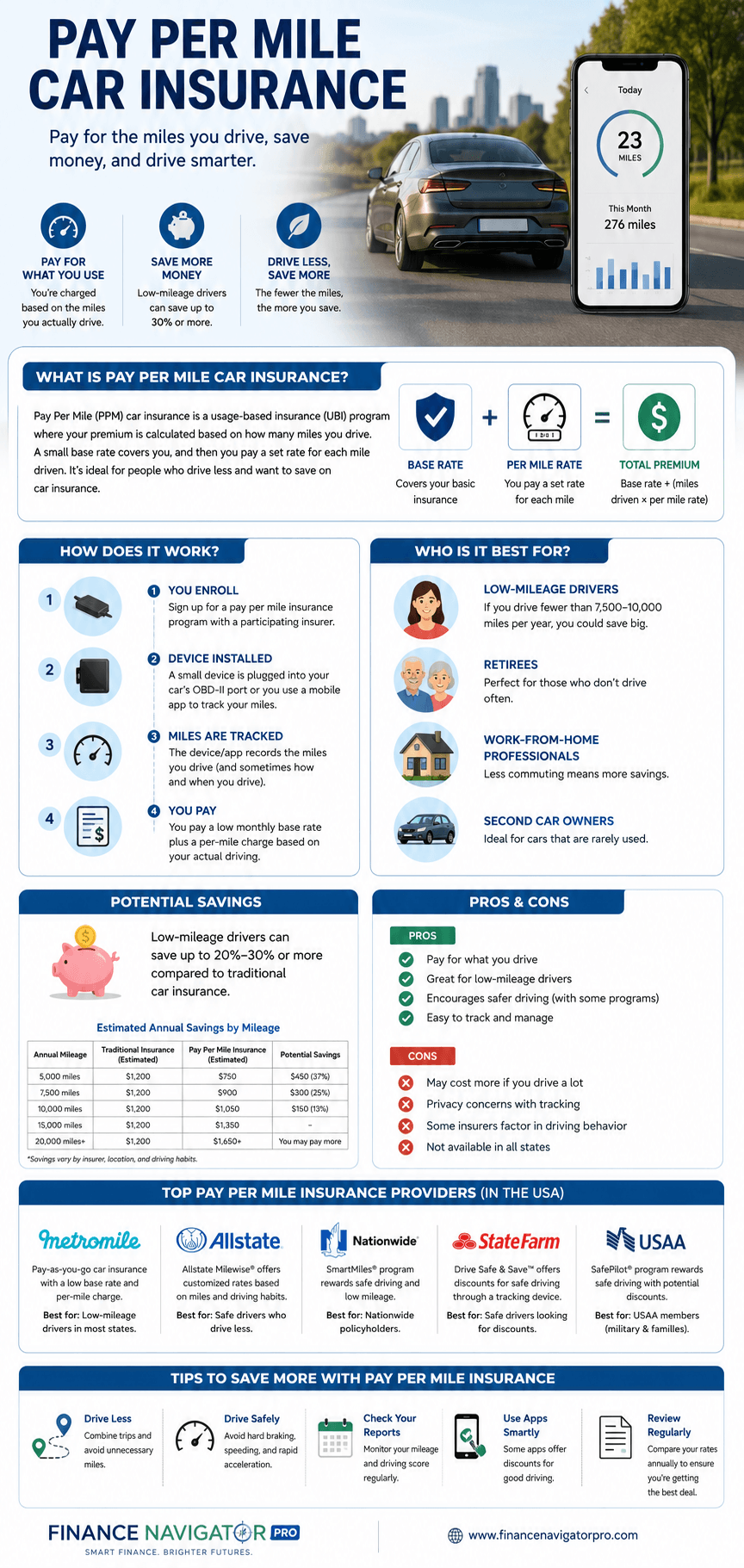
Pay per mile car insurance is an auto insurance model that splits your premium into two distinct components: a base rate and a per-mile rate.
The result is a premium that actually reflects your exposure to risk. Someone driving 400 miles per month pays dramatically less than someone driving 1,500 miles, even with identical vehicles and driving records.
How It Differs from Standard Car Insurance
Traditional auto insurance sets your annual premium based on a blend of statistical factors: your age, zip code, credit score, vehicle type, driving record, and an estimate of your annual mileage. That mileage estimate is usually self-reported and rarely verified. If you say you drive 12,000 miles per year and you actually drive 5,000, you are almost certainly overpaying — and your insurer is happy to let that continue.
Pay per mile insurance verifies your actual mileage every month through a tracking device or smartphone app. Your bill matches your driving. There is no gap between what you reported and what you did.
How It Differs from Usage-Based Insurance (UBI)
This distinction trips up a lot of drivers, and plenty of competing articles blur it deliberately or accidentally. Usage-based insurance — sometimes called telematics insurance or behavior-based insurance — tracks how you drive, not just how much. Insurers monitor hard braking, rapid acceleration, sharp cornering, late-night driving, phone usage while moving, and speeding. Your premium goes up or down based on a driving score.
Pay per mile insurance is simpler. It measures one thing: miles driven. Your braking habits, phone use, and driving hours do not factor into your rate. You are being charged for distance, not behavior.
Some insurers have begun combining both — charging per mile while also scoring your behavior — but the core programs are distinct. If a program offers you a discount based on how you drive rather than simply how far, it is UBI, not pure pay per mile.
How It Differs from Pay-As-You-Drive Insurance
Pay-as-you-drive (PAYD) is often used interchangeably with pay per mile, and in most practical contexts, they mean the same thing. Some industry analysts use PAYD as the broader category — any insurance that adjusts based on actual driving — with pay per mile as a subset focused specifically on distance. For the purposes of this guide, treat them as synonymous unless your insurer defines them differently in their policy documents.
3. How Pay Per Mile Insurance Works
The mechanics are straightforward, but a few important details determine whether the math works in your favor.
| 1 | Get quoted: The insurer evaluates your standard risk factors (driving record, vehicle, location, credit score where permitted) and sets your base monthly rate and per-mile charge. |
| 2 | Track your miles: Depending on the insurer, mileage is recorded via a plug-in OBD-II device, a smartphone app, odometer photo submission, or your vehicle’s connected car system. |
| 3 | Get billed monthly: At the end of each month, the insurer multiplies your miles driven by the per-mile rate and adds the result to your base rate. That sum is your monthly premium. |
| 4 | Coverage stays intact: Your liability, collision, and comprehensive coverage works exactly the same as any standard policy. Pay per mile is a pricing model, not a reduced-coverage product. |
4. Example Monthly Cost Calculations
Numbers make this concrete. Assume a base rate of $35/month and a per-mile charge of $0.06 (6 cents). Here is what different drivers would pay:
Key Insight
At 6 cents per mile, the breakeven point with a $1,800/year traditional policy is roughly 1,917 miles per month (23,000 miles per year). Drive less than that annually and pay per mile wins. Drive more, and it does not. Most low-mileage drivers sit well below 1,500 miles per month, making pay per mile a clear winner.
5. How Mileage Is Tracked
Tracking method matters more than most shoppers realize — both for accuracy and for privacy. Here are the four methods insurers use:
Odometer Photos or Readings
Some insurers, particularly for vehicles without OBD-II ports or smartphone-connected features, ask you to submit odometer photos at regular intervals — usually monthly or quarterly. You take a photo of your dashboard, upload it through the app, and the insurer calculates miles driven between readings.
Pros: No device installation, no continuous data stream, maximum privacy.
Cons: Requires manual effort, potential for submission delays, and some insurers may scrutinize unusually low readings.
OBD-II Plug-In Device
The On-Board Diagnostics II (OBD-II) port is a standardized diagnostic port found in virtually all vehicles sold in the United States after 1996. Insurers send you a small device — about the size of a USB drive — that plugs into this port, usually located beneath the dashboard on the driver side. The device reads your vehicle’s mileage data and transmits it wirelessly to the insurer.
Pros: Highly accurate, automatic, no manual submissions required.
Cons: Some drivers are uncomfortable with a device continuously connected to their vehicle’s data bus. Older vehicles may have limited OBD-II data. Device can occasionally interfere with some vehicle systems.
Smartphone GPS App
Several insurers use a smartphone app that tracks your location and mileage via your phone’s GPS. The app runs in the background, logging trips and uploading mileage data to the insurer.
Pros: Works without any physical device, compatible with all vehicles, often offers additional features like trip history.
Cons: Requires location access on your phone, drains battery somewhat, and raises the most significant privacy concerns since the insurer has your GPS location data.
Connected Car Technology
Newer vehicles — particularly those with built-in telematics systems, like many GM, Ford, Subaru, and Tesla models — can transmit odometer data directly to insurers through the manufacturer’s connected car platform. No device or app required; the data flows automatically from the vehicle’s own system.
Pros: Completely seamless, most accurate, no hardware or app required.
Cons: Only available on compatible vehicles, and you must authorize the data sharing with both the manufacturer and insurer.
Privacy Considerations
Every tracking method involves some degree of data sharing, and this legitimately concerns many drivers. Here is what you should know before signing up:
- Odometer photos share the least data — just a number.
- OBD-II devices may collect more than mileage — some capture vehicle diagnostics and speed data.
- GPS apps collect your physical location and can reconstruct your daily movements.
- State privacy laws vary significantly. California has stricter data protections than most states.
- Your policy documents will specify what data is collected and how long it is retained. Read them.
- Ask whether your data is sold to third parties. Reputable insurers generally prohibit this for underwriting data, but marketing uses vary.
6. Best Pay Per Mile Car Insurance Companies
Company Comparison Table
Note
Rates shown are estimates based on publicly available data and industry surveys as of 2026. Your actual rate depends on your state, vehicle, driving record, and credit score where permitted. Always get a personalized quote.
Metromile (Now Part of Lemonade)
Metromile pioneered pay per mile insurance in the U.S. and was acquired by Lemonade in 2022, bringing its specialized mileage-tracking technology under Lemonade’s AI-powered insurance platform. The combination gives Metromile-style pricing the backing of a larger, better-capitalized organization with a stronger claims infrastructure.
Best for: Urban drivers, city residents who walk or use transit for most trips, remote workers in high-cost states.
Tracking method: OBD-II device (Metromile Pulse) that plugs into your vehicle’s diagnostic port.
Standout feature: The Metromile app provides a detailed trip log, fuel cost tracking, and street sweeping alerts for supported cities.
Availability: Available in most states but verify your state before applying.
Nationwide SmartMiles
Nationwide’s SmartMiles program is one of the more established pay per mile offerings from a major traditional insurer. It uses an OBD-II device and caps the per-mile charge at 250 miles per day — meaning you will never be penalized for an occasional long road trip, since miles beyond 250 in a single day are not charged.
Best for: Hybrid remote workers who might occasionally drive long distances but primarily drive short trips.
Standout feature: The 250-mile daily cap is one of the most driver-friendly features in this category and provides a meaningful safety net.
Claims experience: Nationwide ranks above average in J.D. Power auto insurance satisfaction studies.
Allstate Milewise
Allstate’s Milewise uses a plug-in device and offers the full range of Allstate coverage options, including their Drivewise safe-driver program for those who want to layer behavioral discounts on top of mileage-based pricing. This makes Milewise a flexible choice for drivers who want both low-mileage savings and a traditional insurer’s breadth of coverage and agent network.
Best for: Drivers who value a large, established insurer with local agents, retirees, and second-vehicle owners.
Standout feature: Access to Allstate’s extensive agent network for in-person service, and the option to bundle with home or life insurance.
Progressive Snapshot (Pay Per Mile Option)
Progressive’s Snapshot program primarily functions as a UBI program — it scores your driving behavior — but Progressive also offers a mileage-based rate option in select states. If you are a safe, low-mileage driver, combining both elements can produce particularly competitive premiums. Progressive is available in all 50 states, making it the most accessible option nationwide.
Best for: Drivers who are both low-mileage and confident they are safe drivers — the combination maximizes discounts.
Mile Auto
Mile Auto is a specialist insurer focused exclusively on pay per mile pricing. Instead of an OBD-II device, Mile Auto uses odometer photos submitted through their app — a deliberate privacy-forward design choice. There is no device tracking your location or diagnostics. You simply photograph your odometer once a month.
Best for: Privacy-conscious drivers, classic car owners, and anyone who prefers not to have a device plugged into their vehicle.
Coverage note: Mile Auto specializes in personal vehicles and classic cars, and their rates for low-annual-mileage vehicles are often extremely competitive.
7. Pay Per Mile vs. Traditional Car Insurance
8. Pay Per Mile vs. Usage-Based Insurance
Confusion between these two is rampant, and it costs drivers money when they sign up for the wrong type.
Bottom Line
Pay per mile rewards you for driving less. UBI rewards you for driving well. If you are a low-mileage driver who is also a safe driver, some programs let you benefit from both — but make sure you understand which model your policy primarily uses before signing up.
9. Who Should Buy Pay Per Mile Insurance?
10. Who Should Avoid Pay Per Mile Insurance?
Pay per mile insurance is not a universal win. These driver profiles should stick with traditional policies:
- Rideshare and delivery drivers: Driving for Uber, Lyft, DoorDash, or Amazon Flex means high monthly mileage. Pay per mile costs will quickly exceed any base rate savings, and personal pay per mile policies generally do not cover commercial use anyway.
- Daily commuters driving 15,000+ miles per year: Beyond roughly 1,500 miles per month, pay per mile typically costs more than a comparable traditional policy.
- Sales professionals with large territories: A regional sales rep covering 30,000 miles per year will pay substantially more with mileage-based pricing.
- Travel nurses and healthcare workers: Frequent long-distance travel between facilities or assignments makes per-mile costs unpredictable and often high.
- Frequent long-distance travelers: If you regularly take 500+ mile road trips, the per-mile math quickly erodes your base rate savings.
- Drivers in states where pay per mile is unavailable: Not every state has a robust pay per mile market. If you live in a state with limited options, traditional policies may remain your only real choice.
11. Average Cost by Mileage, State, Age & Vehicle
By Annual Mileage
Cost Factors That Affect Your Rate
- State of residence: Insurance is regulated at the state level. California, Michigan, and New York traditionally have higher premiums across all policy types.
- Age: Younger drivers (under 25) face higher base rates and per-mile charges due to actuarial risk. Senior drivers over 75 may also see higher rates.
- Vehicle type: A luxury SUV costs more to insure per mile than a basic sedan. Sports cars carry additional rate factors.
- Driving record: At-fault accidents and serious violations increase your base rate, though the per-mile component remains distance-based.
- Credit score: Most states (California, Hawaii, Massachusetts, and Michigan are exceptions) allow insurers to use credit-based insurance scores in pricing.
- Coverage levels: Higher liability limits, lower deductibles, and add-on coverages increase your base rate.
12. State Availability
Pay per mile insurance is not uniformly available across all 50 states. Availability depends on which insurers are licensed in each state and whether that state’s insurance department has approved their telematics-based rate filings.
Broadly Available States (Most Major Programs)
- California — Multiple providers including Metromile, which has strong California roots.
- Texas — Good availability; SmartMiles and Milewise both operate here.
- Florida — Available through most major programs.
- Illinois, Washington, Oregon, Arizona — Generally well-served by pay per mile options.
- New York — Available but with additional state regulatory requirements.
States with Limited Availability
Alaska, Hawaii, and several smaller Midwest and Mountain West states may have limited pay per mile options due to smaller insurer presence or state regulatory environments that have been slower to approve telematics-based filings.
Action Step
Always verify current availability for your specific state directly with each insurer before shopping. Availability changes as insurers file new rate products with state regulators.
13. Coverage Options Explained
Pay per mile insurance is a pricing model, not a coverage reduction. You have access to the same coverage types as any standard auto policy:
14. Pros and Cons
15. How Much Can You Really Save?
Savings projections need to be realistic. Industry estimates often cite figures that represent the most favorable scenarios. Here is a more grounded breakdown:
Important Caveat
Your specific savings depend heavily on your base rate (determined by your location, driving record, vehicle, and credit score), your insurer’s per-mile rate, and your actual monthly mileage consistency. Always run a personalized quote comparison before switching.
16. How to Choose the Best Policy
Use this decision framework when evaluating pay per mile options:
- Calculate your realistic annual mileage: Pull your actual odometer readings from the past 12 months. Not an estimate — actual numbers from your records, registration renewal, or oil change receipts. People consistently underestimate their mileage when guessing.
- Determine your breakeven point: Get your current traditional premium and divide by 12 for your monthly cost. Then request pay per mile quotes and calculate your projected monthly cost at your realistic mileage. The one with the lower monthly cost wins.
- Evaluate the tracking method: Does the program use GPS, OBD-II, or odometer photos? Choose the level of data sharing you are comfortable with.
- Check for daily mileage caps: Nationwide SmartMiles caps at 250 miles per day. Programs without caps can get expensive during long road trips.
- Compare coverage options: Ensure the program offers the liability limits, deductibles, and add-on coverages you need.
- Assess financial strength: Use AM Best ratings. Look for A or better. This matters if you ever need to file a significant claim.
- Review customer satisfaction: J.D. Power auto insurance study scores and Consumer Reports ratings give you a picture of claims experience and customer service quality.
- Consider bundling: If you have home, renters, or life insurance, bundling with the same insurer often produces meaningful multi-policy discounts — see the discounts most people miss — that apply even to pay per mile programs.
17. Step-by-Step Buying Guide
- Gather your driving history: Your current premium, vehicle info (VIN, make, model, year), and 12 months of actual odometer readings.
- Get quotes from multiple insurers: Use each company’s online quote tool. Request quotes from multiple insurers plus your current insurer for comparison, from at least three pay per mile providers.
- Enter accurate mileage projections: Use your actual historical mileage, not a hopeful estimate. Underestimating leads to bill shock.
- Review the full policy document: Pay attention to the definition of a ‘mile’ (does the program track total odometer distance or only trip distance via app?), billing cycle details, and daily cap provisions.
- Understand the tracking device setup: Ask how the device is installed, what it requires, and what data it transmits. If using a smartphone app, review the location data permissions.
- Confirm your effective date and cancel your old policy: Avoid any gap in coverage. Do not cancel your existing policy until your new policy is confirmed and in force.
- Install the device or set up the app: Follow the insurer’s instructions carefully. Verify the device or app is reading your mileage correctly in the first billing cycle.
- Monitor your first few monthly bills: Compare actual charges against your projections. If your mileage is running higher than expected, revisit your decision.
18. Common Mistakes to Avoid
19. Real Customer Scenarios
The Remote Software Engineer
Marcus, 34, lives in Chicago and works fully remote. His car — a 2022 Honda Civic — sits in his apartment building’s garage most of the week. He drives maybe 400 miles per month: weekend grocery runs, occasional dinners out, a monthly trip to visit his parents 90 miles away. His traditional insurer was charging him $1,680 per year based on a 12,000-mile annual mileage estimate he entered during enrollment years ago. Switching to a pay per mile program with a $38 base rate and 6 cents per mile, he now pays about $62 per month — $744 per year.
Annual savings: $936
The Retired Teacher Couple
Barbara and James, both 68, share two vehicles. Their main car gets used regularly — doctor visits, grocery shopping, church, and occasional day trips. They drive it roughly 8,000 miles per year. The second car, a 2018 Ford Escape, gets driven maybe 2,500 miles per year for backup purposes and weekend errands when the other car is in for service. Switching the Escape to pay per mile insurance dropped its annual premium from $920 to roughly $440.
Over five years, that is $2,400 in savings on a vehicle they barely use
The College Student with a Campus Car
Sofia, 20, brought her 2019 Toyota Corolla to college. Most of her travel is on foot or bike — she drives mainly for monthly trips home (about 120 miles each way) and occasional weekend trips to see friends. Her estimated annual mileage is under 4,000 miles. As a young driver, her traditional policy was quoted at $2,100 per year. A pay per mile program with a $55 base rate and 8 cents per mile — reflecting her youth surcharge — runs her approximately $82 per month, or $984 per year.
Savings: over $1,100 annually
The Weekend Convertible Owner
David, 55, has a primary vehicle he uses daily for commuting. He also owns a 2021 Porsche Boxster that he drives exclusively on weekend drives — maybe 3,500 miles per year. His previous insurer charged $1,800 per year for the Boxster because of its high replacement value and sports car classification. Switching to a specialty pay per mile insurer dropped the annual premium to approximately $900, even accounting for the vehicle’s value, because the insurer recognized the dramatically limited mileage exposure.
Annual savings: roughly $900
The Urban Apartment Renter
Priya, 29, keeps a car in Boston primarily for weekend escapes to New Hampshire and the occasional late-night errand where public transit is unavailable. She drives roughly 300 miles per month. Her pay per mile policy costs $48 base rate plus $0.07 per mile — about $69 per month, or $828 per year. Her previous traditional policy was $1,560 per year.
Savings: $732
20. Frequently Asked Questions
QWhat is pay per mile car insurance?
Pay per mile car insurance is an auto policy that charges a fixed monthly base rate plus a small per-mile fee for every mile you drive. It is designed for low-mileage drivers who drive less than approximately 10,000–12,000 miles per year and want their premium to reflect their actual driving exposure.
QIs mileage tracked in real time?
It depends on the program. OBD-II devices and smartphone GPS apps typically track mileage continuously and transmit data to the insurer regularly. Odometer photo programs check in monthly or quarterly. No program continuously streams your live location to a human — data is aggregated and processed automatically.
QCan my premium increase mid-policy?
Your per-mile rate is typically locked for your policy term. However, if your driving patterns change significantly, your insurer may adjust rates at renewal. If you drive dramatically more miles than your projected estimate in one month, your monthly bill increases, but the rate per mile stays the same.
QIs GPS tracking required?
Not always. Mile Auto and some other programs use odometer photos and do not require GPS. OBD-II programs track mileage without necessarily streaming your location. Smartphone app programs do use GPS. Check the specific tracking method for any program you consider.
QDoes my credit score affect my pay per mile rate?
In most states, yes — credit-based insurance scores are used in the base rate calculation, just as they are for traditional policies. California, Hawaii, Massachusetts, and Michigan prohibit the use of credit scores in auto insurance pricing.
QCan I switch back to traditional insurance if I start driving more?
Yes. Pay per mile policies can be canceled at any time, subject to your state’s cancellation notice requirements. If your driving habits change permanently — a new job with a long commute, for example — switching back to traditional insurance is straightforward.
QWhat happens if I drive more miles than expected in a month?
You pay more that month. Your per-mile charge is applied to all miles driven (subject to any daily cap). There is no penalty beyond the additional mileage cost. Some programs let you set alerts when you approach a mileage threshold.
QWho offers pay per mile car insurance?
Major providers include Metromile (via Lemonade), Nationwide SmartMiles, Allstate Milewise, Liberty Mutual ByMile, and Mile Auto, among others. Progressive’s Snapshot program includes a mileage-based option in select states. Availability varies by state.
QHow much can I save with pay per mile insurance?
Low-mileage drivers (under 7,500 miles/year) commonly save 30–50% compared to traditional policies. Drivers at 10,000–12,000 miles typically save 10–25%. Savings depend on your specific base rate, per-mile charge, and how your actual mileage compares to what traditional insurers assumed you were driving.
QIs pay per mile insurance available in every state?
No. Availability varies by state and by insurer. Most major programs cover a substantial portion of the U.S., but some states — particularly smaller ones and those with specific regulatory constraints — may have limited options. Always verify availability for your specific state.
QDoes filing a claim affect my pay per mile rate?
An at-fault accident or significant claim can increase your base rate at renewal, exactly as it would with a traditional policy. The per-mile component is about distance driven, but the overall rate-setting considers your loss history.
QCan teenagers use pay per mile insurance?
Technically yes, but the high base rates applied to young drivers (under 25) combined with per-mile charges may make pay per mile more expensive for teenage drivers who also drive significant mileage. If a teen drives fewer than 5,000 miles per year, it is worth comparing quotes.
QIs pay per mile insurance good for electric vehicles?
Yes — EVs are often good candidates since EV owners in urban areas frequently drive less than ICE vehicle owners, and many EV drivers in cities use public charging, transit, or ride-share for some trips. Insurers are increasingly sophisticated about EV-specific risk factors.
QHow does billing work each month?
At the end of each billing cycle, the insurer calculates your total miles driven, multiplies by your per-mile rate, and adds your base rate to generate your bill. Payment is typically auto-charged to a credit card or bank account on file.
QWhat is a daily mileage cap and why does it matter?
A daily mileage cap is a limit on the number of miles that can be charged on any single day. Nationwide SmartMiles caps at 250 miles/day. This means if you drive 400 miles on a road trip day, you are only charged for 250. Programs without caps charge for every mile, which can make a single long-distance month expensive.
QCan I use pay per mile insurance for rideshare driving?
No. Standard pay per mile personal auto policies do not cover commercial vehicle use, including rideshare and delivery driving. You need a rideshare endorsement or a commercial auto policy for those activities.
QDoes pay per mile insurance cover rental cars?
It depends on your policy. Rental reimbursement (covering a rental while your car is repaired) is typically available as an add-on. Coverage for rental cars you rent yourself is a separate coverage (usually part of collision/comprehensive). Check your specific policy.
QWhat is an OBD-II device and is it safe to use?
An OBD-II (On-Board Diagnostics II) device is a small plug-in unit that connects to your vehicle’s standardized diagnostic port, present in virtually all U.S. vehicles built after 1996. Insurance devices typically only read mileage and some basic vehicle data. They are generally safe and widely used, though some high-performance vehicles may occasionally experience minor compatibility quirks.
QHow does pay per mile insurance handle multi-car households?
You can insure multiple vehicles on pay per mile policies. Each vehicle is tracked and billed separately based on its individual mileage. For households with one high-mileage vehicle and one low-mileage vehicle, a hybrid approach — pay per mile on the low-use vehicle, traditional on the high-use one — often produces the best overall savings.
QWhat if I forget to submit my odometer photo?
Programs that require odometer submissions typically have grace periods and may estimate your mileage based on prior months if you miss a submission. Repeated missed submissions can result in estimated billing or policy adjustment. Set a monthly calendar reminder if you choose an odometer photo program.
QDoes pay per mile insurance cover accidents that happen far from home?
Yes. Coverage applies anywhere in the United States (and sometimes Canada) where your standard policy would apply. The per-mile tracking is about billing, not about geographic coverage limits.
QHow do I verify my mileage readings are accurate?
Cross-reference the mileage reported by your insurer’s device or app with your vehicle’s actual odometer each month. If there is a discrepancy, contact your insurer’s customer service. Reputable insurers have dispute processes for mileage disagreements.
QIs pay per mile insurance cheaper for older vehicles?
Older vehicles with lower market values typically have lower comprehensive and collision premiums regardless of insurance type. Combined with the low-mileage discount of pay per mile pricing, insuring an older low-use vehicle this way can produce very low premiums — sometimes as little as $30–$50 per month total.
QCan I bundle pay per mile insurance with my home insurance?
Many insurers offering pay per mile coverage also offer home, renters, and life insurance. Bundling discounts — typically 5–15% off — often apply to pay per mile auto policies just as they do to traditional auto policies.
QWhat states have the most options for pay per mile insurance?
California, Texas, Florida, Illinois, Washington, and Oregon generally have the broadest range of pay per mile providers. California in particular has been a hotbed for mileage-based insurance innovation.
QIs pay per mile insurance regulated differently from traditional insurance?
Pay per mile insurance is regulated by the same state insurance departments as traditional auto insurance. Insurers must file their rate structures and have them approved. The key difference is that the rate filing includes per-mile pricing components, which most states now accommodate.
QWhat happens to my coverage if the tracking device fails?
Most insurers have processes for device failures. They may estimate your mileage based on prior months, send a replacement device, or switch you to an alternative tracking method temporarily. Your coverage remains intact regardless of device status.
QAre there discounts available with pay per mile insurance?
Yes. Many pay per mile programs offer multi-vehicle discounts, safe driver discounts, bundling discounts, paperless billing discounts, and auto-pay discounts. The mileage-based pricing itself is the primary discount mechanism, but these add-ons can further reduce your bill.
QHow does pay per mile insurance affect my credit score?
Paying your insurance premium (or not paying it) can affect credit in some states if an insurer reports to credit bureaus, but simply switching insurance companies or enrolling in a pay per mile program does not directly impact your credit score. A new quote may involve a soft credit inquiry that does not affect your score.
QWhat is the difference between telematics insurance and pay per mile?
Telematics insurance is the broad category covering any insurance that uses electronic data from your vehicle to inform pricing. Pay per mile is a specific telematics model focused solely on mileage. Usage-based insurance (UBI) is another telematics model focused on driving behavior. All three involve data collection, but the pricing mechanisms differ.
QWhat should I do before my first month ends on a new pay per mile policy?
Verify your device or app is functioning correctly by checking in the insurer’s mobile app. Confirm the mileage reading matches your vehicle’s odometer. If anything looks off, contact customer service before the billing cycle closes rather than disputing after the fact.
21. Expert Tips & Final Verdict
Money-Saving Expert Tips
Final Verdict
Pay per mile car insurance is one of the most genuinely fair pricing innovations in personal auto insurance in decades. It rewards a real and growing segment of American drivers — remote workers, retirees, urban residents, second-vehicle owners, and anyone who simply drives less than the national average — with premiums that actually match their risk exposure.
The caveat is straightforward: it works for low-mileage drivers and does not work for high-mileage ones. The breakeven point for most programs is somewhere between 12,000 and 15,000 miles per year. If you drive less than that, you are very likely a candidate. If you drive more, stick with traditional insurance.
Best Pay Per Mile Insurance Picks for 2026
Your Next Steps
- Calculate your actual annual mileage from odometer records.
- Get quotes from at least three pay per mile providers.
- Compare the total annual cost — not just per-mile rates.
- Review coverage options to ensure adequate protection.
- Check for bundling and loyalty discounts.
- Set a calendar reminder to compare rates again at renewal.
Sources: Insurance Information Institute (iii.org), National Association of Insurance Commissioners (naic.org), J.D. Power Auto Insurance Satisfaction Studies, AM Best Financial Strength Ratings, U.S. Federal Highway Administration vehicle travel data, state insurance department rate filings.
This guide is for informational purposes only and does not constitute insurance, financial, or legal advice. Always consult current insurer rate filings and your state’s insurance department for the most accurate and up-to-date information for your specific situation.
Disclosure: FinanceNavigatorPro may earn a commission from insurers or partners linked in this article, at no additional cost to you. This does not affect our editorial independence or recommendations.