

|
$100K/$300K
Recommended Minimum
|
$50–$100
Avg. Cost / Year
|
1 in 8
Drivers Uninsured
|
14+
States Require It
|
Key Takeaways
| ✓ | UIM coverage kicks in when the at-fault driver’s liability limits are too low to fully compensate you. |
| ✓ | It’s different from uninsured motorist (UM) coverage, which applies when the other driver has no insurance at all. |
| ✓ | In 2024, roughly 1 in 8 U.S. drivers was uninsured — and millions more carried only the state-minimum liability limits. |
| ✓ | UIM typically covers medical expenses, lost income, pain and suffering, and in some states, vehicle repair costs. |
| ✓ | The average cost is just $50–$100 per year added to your auto policy — often one of the best bargains in insurance. |
| ✓ | Many states allow you to “stack” UIM coverage across multiple vehicles, which can significantly increase your protection. |
| ✓ | You must file a UIM claim with your own insurer, not the at-fault driver’s company. |
| ✓ | Missing your state’s claim deadline can forfeit your right to any UIM payout. |
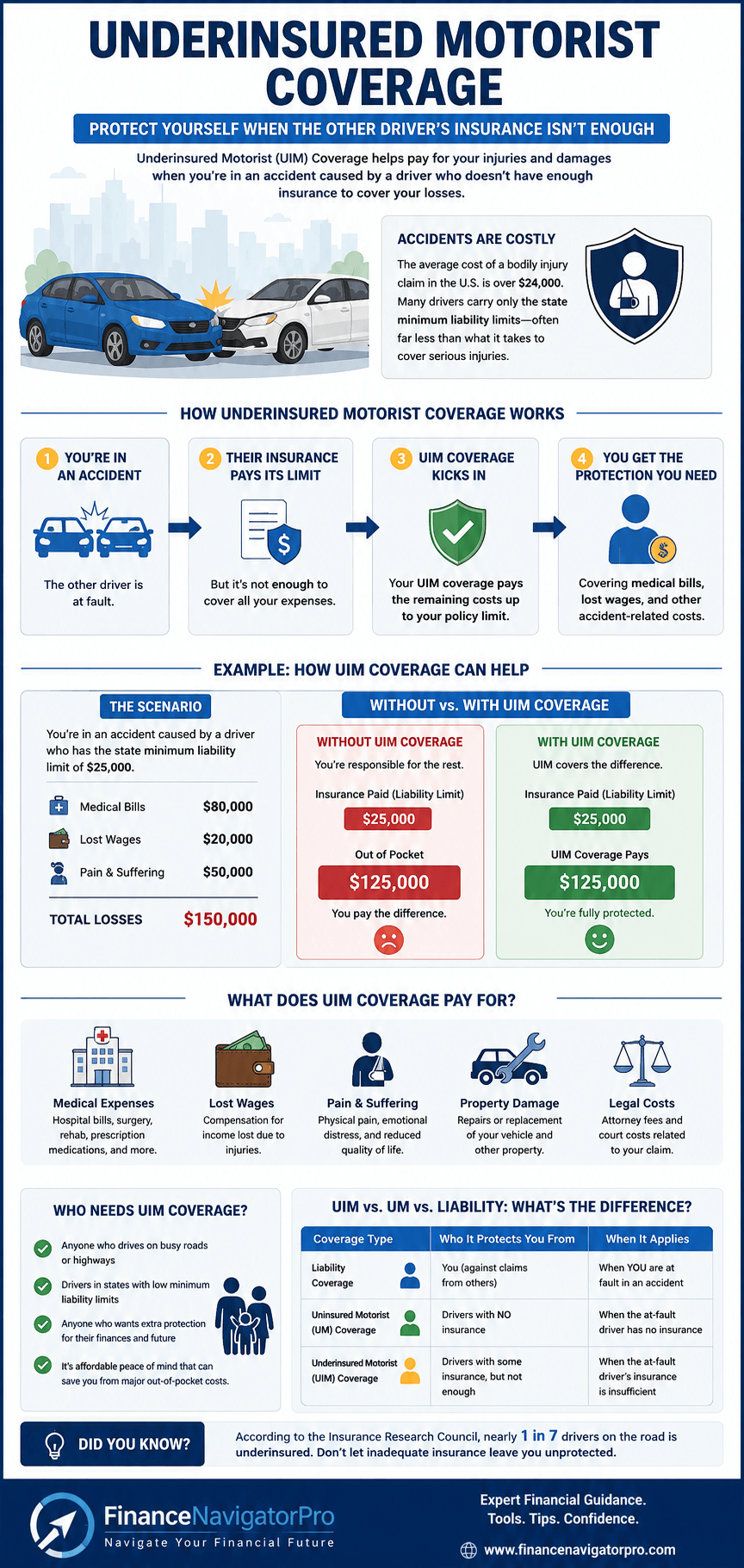
A $150,000 Problem You May Not Know You Have
Picture this: you’re driving home on a Tuesday evening. You’ve got a green light. You’re obeying every traffic law on the books.
Then a distracted driver blows through the red light and slams into your SUV at full speed.
You wake up in the hospital. The injuries are serious — a fractured pelvis, a broken arm, a concussion that’ll take months to heal. You’ll need surgery, physical therapy, and several weeks of missed work.
Total medical bills and lost wages: $180,000.
The at-fault driver’s auto insurance liability limit? $30,000.
That’s all you’re legally entitled to collect from their policy. Which leaves $150,000 unaccounted for.
If you don’t have underinsured motorist coverage, that $150,000 gap becomes your problem.
If you do have it, your own insurance company steps in and covers what the other driver’s policy couldn’t.
That’s what this guide is about. By the time you finish reading it, you’ll know exactly how underinsured motorist coverage works, whether you need it, how much to buy, and what to do if you ever have to file a claim.
Section 1: What Is Underinsured Motorist Coverage?
New to insurance basics? Start with our primer on what insurance is and how it works before diving in.
Underinsured motorist coverage — often abbreviated as UIM — is a type of auto insurance that protects you when you’re injured in an accident caused by another driver who doesn’t have enough liability insurance to pay for all your damages.
It’s purchased as part of your own auto insurance policy, and it pays you directly when the at-fault driver’s policy runs dry.
The Insurance Math That Makes UIM Necessary
Every state requires drivers to carry a minimum amount of bodily injury liability (BIL) insurance. These minimums protect other people if you cause an accident. In some states, those minimums are dangerously low.
For example, Florida requires only $10,000 in bodily injury liability per person. California requires $15,000 per person. Those amounts can be wiped out by a single emergency room visit.
Meanwhile, the average cost of hospitalization following a car accident regularly exceeds $60,000. Serious injuries — spinal cord damage, traumatic brain injuries, multiple fractures — can generate $200,000 to $500,000 or more in medical expenses.
When an at-fault driver’s policy doesn’t cover your full damages, you have a few options: sue them personally (which works only if they have significant assets), rely on your health insurance (which has its own limits), or turn to your own UIM coverage.
UIM is specifically designed to fill that gap.
Who Pays When UIM Activates?
Your own insurance company pays your UIM claim. You’ve been paying them premiums, and this is why.
That can feel counterintuitive at first. You didn’t cause the accident. Why is your insurer paying? Because you paid for this protection. UIM is optional coverage in most states that you add to your own policy specifically for situations like this.
After your insurer pays you, they may pursue the at-fault driver or that driver’s insurer to recover some of what they paid. That process is called subrogation, and it happens behind the scenes without any effort from you.
UIM vs. Your Liability Coverage: A Clear Distinction
Your liability coverage protects other people when you cause an accident. It does nothing for you.
UIM coverage protects you when someone else causes an accident and doesn’t have enough insurance to cover your losses. These are two completely separate coverages with completely different purposes.
Carrying high liability limits is important, but it doesn’t replace UIM. You need both.
| • | UIM coverage pays the gap between what an at-fault driver’s liability insurance covers and what you’re actually owed. |
| • | It’s part of your own auto policy. Your insurer pays, then may pursue the at-fault driver for reimbursement. |
| • | Liability insurance only protects others — it doesn’t protect you. You need UIM for that. |
Section 2: How Underinsured Motorist Coverage Works
Understanding how UIM coverage actually works — step by step — helps eliminate the confusion people often feel when they’re in the middle of a claim. Here’s exactly what happens from accident to payout.
Step-by-Step: From Crash to Compensation
|
1
|
The accident happens. You’re hit by another driver. Police are called, a report is filed, and you seek medical treatment.
|
|
2
|
The at-fault driver’s liability claim is filed. Their insurance company investigates the crash and makes a settlement offer — up to their policy’s limits.
|
|
3
|
Their limits run out. Their insurer pays their maximum — say, $30,000 — but your losses total $130,000. There’s a $100,000 gap.
|
|
4
|
You notify your own insurer. You file a UIM claim with your insurance company, documenting that the at-fault driver’s coverage was insufficient.
|
|
5
|
Your insurer investigates. They review the police report, medical records, and the at-fault driver’s policy declaration page to verify the gap.
|
|
6
|
UIM activates. Your insurer pays benefits up to your UIM policy limits, minus the amount you already received from the at-fault driver’s insurer.
|
|
7
|
Settlement reached. You receive compensation for your remaining medical bills, lost wages, and pain and suffering — up to the limit you purchased.
|
The Offset Rule: How Your UIM Benefit Is Calculated
Most states apply an offset to your UIM payout. Your insurer pays the difference between what the at-fault driver’s policy paid and your total damages — but only up to your UIM limit.
Example: You have $100,000 in UIM coverage per person. Your total damages are $130,000. The at-fault driver’s policy paid $30,000. Your UIM payout would be $100,000 (your UIM limit), not $130,000 minus $30,000. In this case, the math works out — but if your damages were $200,000, you’d still only collect $100,000 from UIM.
This is exactly why coverage limits matter, and why experts recommend buying as much UIM as you can comfortably afford.
Typical Timeline
| Phase | Estimated Duration |
|---|---|
| Accident and initial medical treatment | Ongoing (weeks to months) |
| Liability claim with at-fault driver’s insurer | 4–12 weeks |
| Settlement offer from at-fault insurer | 6–16 weeks |
| UIM claim filed with your insurer | Within days of confirming shortfall |
| UIM investigation by your insurer | 4–8 weeks |
| Final UIM settlement | 3–18 months total (complex cases longer) |
One critical note: in most states, you must resolve the liability claim with the at-fault driver’s insurer before your UIM coverage kicks in. Your insurer may also require you to get their permission before settling with the at-fault driver — failing to do so could jeopardize your UIM claim.
| • | UIM pays the gap between the at-fault driver’s liability limit and your total damages, up to your own UIM limit. |
| • | Always notify your insurer before settling with the other driver’s company — or you may lose your UIM rights. |
| • | The full process from accident to final settlement can take 6 to 18 months for serious injury claims. |
Section 3: A Real-Life UIM Claim Example
Meet Lisa, a 38-year-old nurse and mother of two in Atlanta, Georgia.
The Accident
On a Thursday morning, a 24-year-old driver ran a stop sign and T-boned Lisa’s car at 45 mph. Lisa suffered three fractured ribs, a torn rotator cuff, and a moderate traumatic brain injury requiring neurology follow-up.
The Bills
| Expense | Amount |
|---|---|
| Emergency room and hospitalization | $61,000 |
| Surgery (rotator cuff) | $38,000 |
| Neurologist and specialist visits | $14,500 |
| Physical therapy (6 months) | $12,000 |
| Lost wages (8 weeks off work) | $19,200 |
| Pain and suffering | $55,300 |
| Total Damages | $200,000 |
The Gap
The at-fault driver carried Georgia’s state minimum liability coverage: $25,000 per person. His insurer paid $25,000 — the maximum they owed.
Lisa was left with $175,000 in uncompensated damages.
UIM to the Rescue
Lisa had purchased $250,000 per person in underinsured motorist bodily injury (UIMBI) coverage. After collecting the $25,000 from the at-fault driver’s insurer, she filed a UIM claim with her own carrier.
Her insurer paid the remaining $175,000, bringing her total compensation to the full $200,000 in damages.
Without UIM coverage, Lisa would have faced $175,000 in out-of-pocket expenses — or years of litigation hoping the at-fault driver somehow had hidden assets worth pursuing.
What If Lisa Had Only $50,000 in UIM?
Had Lisa purchased only $50,000 per person in UIM coverage, she would have collected $25,000 from the at-fault driver and $50,000 from her UIM policy — for a total of $75,000. That still leaves $125,000 uncompensated.
Coverage limits are everything. This is not a place to cut corners.
| • | Real accidents generate damages that dwarf state-minimum liability limits. |
| • | UIM coverage can mean the difference between full compensation and financial ruin. |
| • | How much coverage you buy determines how much protection you actually have. |
Section 4: What Does Underinsured Motorist Coverage Pay For?
UIM coverage is broad, but it’s not unlimited. Here’s a clear breakdown of what it typically covers.
Medical Expenses
| ✓ | Emergency room visits and ambulance fees |
| ✓ | Hospitalization and surgery |
| ✓ | Specialist consultations (orthopedics, neurology, cardiology) |
| ✓ | Diagnostic imaging (MRI, CT scans, X-rays) |
| ✓ | Physical therapy and rehabilitation |
| ✓ | Prescription medications related to the injury |
| ✓ | Future medical treatment that’s reasonably certain to be needed |
Lost Income
If your injuries prevent you from working, UIM covers lost wages from the accident date through your recovery. It can also compensate for loss of earning capacity if your injuries permanently reduce your ability to earn income in your field.
Pain and Suffering
Non-economic damages — physical pain, emotional distress, loss of enjoyment of life, and loss of consortium (impact on your marriage or family relationships) — are covered. These damages are often larger than the medical bills themselves in serious injury cases.
Passengers in Your Vehicle
UIM coverage extends to passengers in your car at the time of the accident. Each passenger can make a claim under your UIM policy, subject to the per-person and per-accident limits.
Funeral and Wrongful Death Expenses
If the accident results in a fatality, UIM coverage can pay funeral costs and provide compensation to surviving family members through a wrongful death claim.
Underinsured Motorist Property Damage (UMPD)
Some states offer or require underinsured motorist property damage (UMPD), which covers repairs to your vehicle when the at-fault driver’s property damage liability is insufficient. This is separate from collision coverage, and not all states offer it. If you’re curious how add-ons like this stack up against related protection, see our guide to rental reimbursement coverage.
| • | UIM covers medical bills, lost wages, pain and suffering, passenger injuries, and in some states, vehicle damage. |
| • | Future medical treatment and lost earning capacity are compensable if clearly documented. |
| • | UMPD (property damage) is a separate optional add-on available in some states. |
Section 5: What Underinsured Motorist Coverage Does NOT Cover
Knowing what’s excluded is just as important as knowing what’s included.
| What’s Excluded | Why / Notes |
|---|---|
| Your own negligence or fault | UIM only applies when another driver is at fault. |
| Intentional damage to your own vehicle | Insurance fraud is excluded from all coverages. |
| Commercial use accidents (in most policies) | Rideshare drivers and delivery workers typically need separate commercial coverage. |
| Accidents involving excluded drivers | If a household member is specifically excluded from your policy, UIM won’t cover their accidents. |
| Vehicle damage (in most states) | Standard UIM covers bodily injury only; property damage requires collision or separate UMPD coverage. |
| Punitive damages (in some states) | Some state laws prohibit insuring against punitive damages. |
| Accidents outside your state’s policy territory | Coverage geography is defined in your policy — usually the U.S. and Canada. |
| Workers’ compensation situations | If you’re injured while driving for work, workers’ comp may be primary and limit UIM access. |
A Note on Health Insurance vs. UIM
Some drivers assume their health insurance makes UIM redundant. That’s a costly misconception.
Health insurance covers medical bills — but it doesn’t pay for lost wages, pain and suffering, or non-medical damages. It also comes with deductibles, copays, and network restrictions. And your health insurer may have subrogation rights — meaning if you recover money from the at-fault driver, your health insurer could demand reimbursement.
UIM is designed to pay the full scope of your damages, not just your doctor bills.
Section 6: Underinsured vs. Uninsured Motorist Coverage
People often confuse these two coverages, or assume they’re the same thing packaged together. They’re not.
| Factor | Underinsured (UIM) | Uninsured (UM) |
|---|---|---|
| Coverage trigger | At-fault driver has some insurance, but not enough | At-fault driver has no insurance at all |
| Who pays you | Your own insurer | Your own insurer |
| When used | Other driver’s limits are exhausted | Other driver is uninsured or flees (hit-and-run) |
| Typical cost | $50–$100/year added to policy | $50–$100/year added to policy |
| Required by law | Optional in most states | Required in about half of states |
| Hit-and-run coverage | Usually no (no confirmed insurer) | Usually yes |
| Stackable | In many states, yes | In many states, yes |
| Common claim examples | Low-limit driver, minimum-coverage drivers | Hit-and-run, no insurance card drivers |
Are They Usually Sold Together?
Yes. Most insurers package UIM and UM coverage together under a combined “uninsured/underinsured motorist” endorsement. The limits typically match — if you buy $100,000/$300,000 in UM, you get the same in UIM.
Some states require you to reject these coverages in writing if you don’t want them.
Do You Need Both?
Absolutely yes. They cover different scenarios, and you never know which situation you’ll face. The added cost for both coverages combined is typically less than $10 per month.
| • | UIM pays when the at-fault driver has some insurance but not enough. UM pays when they have none. |
| • | Both are usually sold together, often at identical limits. The combined cost is minimal. |
| • | About 1 in 8 U.S. drivers is uninsured — and millions more have minimum coverage. Both risks are real. |
Section 7: Do You Really Need Underinsured Motorist Coverage?
Let’s cut through the noise: yes, most drivers benefit significantly from carrying UIM coverage. But the need is especially acute for certain groups. For a broader look at how much protection you need across your entire policy, see our guide on what insurance coverage you actually need.
Who Absolutely Should Have UIM Coverage
| Driver Type | Why UIM Matters Most |
|---|---|
| Families with children | Multiple passengers = multiple injury claims. UIM per-accident limits need to cover everyone. |
| Teen drivers on your policy | Young drivers have higher accident rates and often encounter other young, minimum-coverage drivers. |
| Commuters in high-traffic areas | More miles driven = more accident exposure. Urban density means more underinsured drivers nearby. |
| Drivers without strong health insurance | Without good health coverage, a serious injury with no UIM could be financially devastating. |
| Drivers with high income or assets | If you can sue the at-fault driver and they have nothing, you’re stuck. UIM pays regardless. |
| Gig workers (delivery, rideshare) | Personal auto policies may not cover commercial use — check your rideshare gap coverage separately. |
| Retirees on fixed income | Any large uncompensated medical bill can permanently disrupt retirement savings. |
| Parents of college-age drivers | Young drivers away at school are still often on the family policy and need the same protection. |
The “I’ll Just Sue” Fallacy
A lot of people skip UIM thinking: “If they cause an accident and their insurance doesn’t pay enough, I’ll just sue them.”
Here’s the reality: most drivers who carry minimum liability insurance don’t have significant personal assets either. Suing someone who has nothing gives you a judgment worth nothing. Collecting on that judgment can take years and still produce nothing if the person has no assets to seize.
UIM pays you now, regardless of the at-fault driver’s financial situation.
The State-by-State Risk Factor
Your risk of encountering an underinsured driver depends heavily on where you live. According to the Insurance Research Council, states with the highest rates of uninsured drivers include Mississippi, Michigan, Tennessee, New Mexico, and Washington.
In high-risk states, UIM becomes even more critical. But since you can’t control where other drivers come from — or where your own driving takes you — UIM is a smart choice regardless of your home state.
| • | UIM is worth it for virtually every driver — the premium cost is low and the risk is real. |
| • | Suing an underinsured driver rarely produces a meaningful recovery. UIM guarantees payment. |
| • | Families, commuters, drivers without health insurance, and those with assets to protect need it most. |
Section 8: How Much Underinsured Motorist Coverage Should You Buy?
Coverage limits for UIM — like most liability coverages — are expressed as split limits or combined single limits. Here’s how to read them:
Split Limits Format: $X/$Y
The first number is the maximum per person per accident. The second is the maximum per accident regardless of how many people are injured.
Example: $100,000/$300,000 means your insurer will pay up to $100,000 for any single injured person, and no more than $300,000 for all injuries in a single accident.
Coverage Level Comparison
| Coverage Level | Per Person | Per Accident | Best For |
|---|---|---|---|
| State minimum / low | $25,000–$50,000 | $50,000–$100,000 | Budget-constrained drivers, young singles with low assets |
| Mid-tier | $100,000 | $300,000 | Families, homeowners, average-income drivers (recommended baseline) |
| Higher protection | $250,000 | $500,000 | Higher-income households, drivers with significant assets |
| Maximum tier | $500,000 | $500,000 | High-net-worth individuals, multiple-vehicle households |
| Umbrella policy | $1M–$5M+ | Combined | Wealthy households wanting comprehensive liability protection |
The Golden Rule of UIM Coverage
Your UIM limits should match your liability limits. If you carry $250,000/$500,000 in bodily injury liability, you should carry the same in UIM.
The logic: you’ve decided that $250,000 is an adequate amount of coverage to protect others in case you cause an accident. You should demand the same level of protection for yourself.
Should You Get an Umbrella Policy?
An umbrella policy provides additional liability and often UM/UIM coverage above your standard auto policy limits, typically in increments of $1 million.
If you have significant assets — a home, retirement accounts, savings — an umbrella policy is worth serious consideration. It costs roughly $150–$300 per year for the first $1 million in coverage.
Talk to your agent about how your umbrella and UIM limits interact. In most cases, umbrella policies require underlying UIM limits of at least $250,000/$500,000 before extending umbrella coverage to UIM claims.
| • | Buy at least $100,000/$300,000 in UIM coverage as a baseline. More if you have assets or dependents. |
| • | Match your UIM limits to your liability limits — the same logic applies to both. |
| • | Consider an umbrella policy if your assets exceed what auto policy limits can protect. |
Section 9: How Much Does Underinsured Motorist Coverage Cost?
Here’s the good news: UIM coverage is remarkably affordable relative to the protection it provides.
Average Annual Cost
According to data from the Insurance Information Institute and state insurance department filings, UM/UIM coverage combined typically costs $50–$100 per year for $100,000/$300,000 in limits — often less than $10 per month added to your existing auto premium. See how that compares to average insurance costs across the U.S.
At higher limits ($250,000/$500,000), you might pay $120–$200 per year. Still a bargain when you consider that a single serious accident could generate six-figure losses.
Factors That Affect Your UIM Premium
| Factor | How It Affects Cost |
|---|---|
| State | State laws, litigation rates, and underinsured driver rates directly affect premiums. |
| Coverage limits | Higher limits = higher premiums, but not proportionally — doubling limits rarely doubles cost. |
| Age | Young drivers (under 25) and seniors may pay more due to statistical risk profiles. |
| Driving history | Accidents and violations on your record increase premiums across all coverages. |
| Vehicle type | Expensive vehicles or those with high injury profiles (larger vehicles, sports cars) may affect rates. |
| Deductible (UMPD) | If your state has UMPD coverage, adding a deductible lowers the premium. |
| Insurance company | Rates vary significantly between carriers. Shopping is essential. |
| Multi-policy discount | Bundling home and auto with the same carrier often reduces auto premiums by 10–15%. |
If you drive a classic or collector vehicle, factors like “vehicle type” work differently — see our guides to antique car insurance and collector car insurance for coverage considerations specific to those vehicles.
Curious how deductibles work across the rest of your policy? Check out our full breakdown of insurance deductibles explained.
Is UIM Worth the Extra Cost?
Let’s do the math. You pay $80 per year for $100,000/$300,000 in UIM coverage. Over 10 years, that’s $800.
A single serious accident with an underinsured driver could leave you facing $100,000+ in uncompensated losses. The break-even on this coverage is one incident in a lifetime.
Given that approximately 14% of U.S. drivers are currently estimated to be uninsured — and that millions more carry only minimum liability limits — the odds of encountering this scenario in a driving lifetime are not trivial.
| • | UIM coverage typically costs $50–$200/year depending on limits — usually under $10 per month. |
| • | The cost-to-benefit ratio is exceptional: one serious accident can generate losses exceeding 10 years of premiums. |
| • | Shopping carriers is essential — rates for identical coverage can vary by 40% or more between companies. |
Section 10: States That Require Underinsured Motorist Coverage
State laws vary significantly. In some states, UIM coverage is mandatory. In others, it’s optional but must be offered. And in a handful of states, the rules are structured differently due to no-fault insurance systems.
States Where UIM or Combined UM/UIM Is Required
| State | UIM Required? | Notes |
|---|---|---|
| Connecticut | Yes | UM/UIM must equal liability limits unless waived in writing. |
| Maine | Yes | Required at same limits as liability unless waived. |
| Maryland | Yes | UM/UIM mandatory with specific minimums. |
| Massachusetts | UM required | UIM optional but commonly carried. |
| Minnesota | Yes | UM/UIM required as part of no-fault auto coverage. |
| Missouri | Yes | UM required; UIM offered but rejection allowed in writing. |
| New Hampshire | Yes | UM/UIM required with financial responsibility. |
| New York | Yes | SUM (supplementary uninsured/underinsured motorist) coverage required. |
| North Carolina | Yes | UM/UIM mandatory at minimum $30,000/$60,000. |
| Oregon | Yes | UM/UIM required; limits set by state. |
| South Carolina | Yes | Required at same limits as liability unless rejected. |
| Virginia | Yes | UM/UIM required or written rejection accepted. |
| West Virginia | Yes | Required unless rejected in writing. |
| Wisconsin | Yes | UM required; UIM required at same limits. |
States Where UIM Is Optional
In states not listed above, UIM coverage is typically optional — but must be offered by your insurer. That means you can waive it, but your insurer has to give you the opportunity to purchase it.
States like California, Florida, Texas, Arizona, and Illinois fall into this category. Just because it’s optional doesn’t mean you should skip it. These states have significant underinsured driver populations.
No-Fault States and UIM
In no-fault states (Florida, Michigan, New Jersey, New York, Hawaii, Kansas, Kentucky, Massachusetts, Minnesota, North Dakota, Pennsylvania, Utah), your own insurer pays your initial medical expenses through personal injury protection (PIP) regardless of fault. UIM may still be available for serious injuries that exceed your PIP limits.
| • | More than a dozen states require UIM coverage. Most others require insurers to offer it. |
| • | Even in states where UIM is optional, the risk of encountering underinsured drivers is significant. |
| • | No-fault states use PIP as the primary medical coverage — UIM supplements it for serious injuries. |
Section 11: How to File an Underinsured Motorist Claim
Filing a UIM claim requires precision and timeliness. Missteps can cost you the compensation you’re legally entitled to. Here’s exactly what to do.
The UIM Claim Checklist
|
1
|
Call 911 and get a police report.
You’ll need the report number and officer’s name. This is non-negotiable evidence for any insurance claim.
|
|
2
|
Seek immediate medical treatment.
Go to the ER or urgent care even if you feel okay — adrenaline can mask injuries, and delayed treatment can hurt your claim.
|
|
3
|
Document everything.
Photograph the accident scene, all vehicles, your injuries, road conditions, and any visible damage. Get witness names and contact info.
|
|
4
|
Obtain the at-fault driver’s information.
Insurance company, policy number, driver’s license, license plate, and contact details.
|
|
5
|
Notify your own insurer immediately.
Even before you know whether UIM will be needed, tell your insurer about the accident. Most policies require prompt notice.
|
|
6
|
File the liability claim with the at-fault driver’s insurer.
Their insurer investigates and makes a settlement offer.
|
|
7
|
Get the at-fault driver’s policy declaration page.
You’ll need proof of their coverage limits before your UIM insurer will proceed.
|
|
8
|
Get consent from your own insurer before settling with the at-fault driver.
Settling without consent may waive your UIM rights in many states.
|
|
9
|
File your formal UIM claim.
Submit your documentation: medical records and bills, wage loss verification, police report, at-fault driver’s policy information, and settlement documentation.
|
|
10
|
Follow your insurer’s investigation process.
Cooperate fully. Provide recorded statements if required. Attend any required medical exams.
|
|
11
|
Negotiate your UIM settlement.
Your insurer may dispute the value of your claim. Having a personal injury attorney review large claims is worth considering.
|
|
12
|
Watch your state’s statute of limitations.
Most states give you 2–3 years from the accident date to file a UIM claim, but some are shorter. Missing this deadline forfeits your rights.
|
Should You Hire an Attorney for a UIM Claim?
For minor injuries and small gaps in coverage, handling the claim yourself is usually fine.
For serious injuries, large coverage gaps, or disputed liability, an experienced personal injury attorney can dramatically increase your settlement outcome. Most personal injury attorneys work on contingency — meaning they take a percentage of your settlement rather than charging upfront fees.
Study after study from insurance defense attorneys has confirmed that claimants represented by attorneys receive significantly higher settlements than unrepresented claimants — often more than enough to offset the attorney’s fee.
| • | Notify your own insurer immediately after any accident, even before you know UIM is needed. |
| • | Never settle with the at-fault driver’s insurer without getting consent from your own insurer first. |
| • | State deadlines are firm — missing the statute of limitations means losing your UIM rights permanently. |
Section 12: Common Mistakes Drivers Make With UIM Coverage
These mistakes cost drivers real money every year. Don’t be one of them.
| • | Buy more than the minimum. Ignore stacking at your financial peril. |
| • | Don’t rush to settle — and never settle with the at-fault driver without your insurer’s consent. |
| • | Health insurance doesn’t replace UIM. They serve completely different purposes. |
Section 13: Pros and Cons of Underinsured Motorist Coverage
|
✅ Advantages
|
❌ Disadvantages
|
Section 14: Frequently Asked Questions About UIM Coverage
Section 15: Expert Tips for Getting the Most From UIM Coverage
Money-Saving Tips
| ✓ | Shop multiple insurers annually. UIM rates can vary by 40%+ for identical limits. A 20-minute comparison exercise can save $100+ per year. |
| ✓ | Bundle home and auto policies. Multi-policy discounts typically reduce your auto premium by 10–15%, making higher UIM limits more affordable. |
| ✓ | Ask about pay-per-mile policies if you drive fewer than 10,000 miles per year. Lower-mileage policies can dramatically reduce your base premium. |
| ✓ | Raise your collision deductible to offset the added premium cost of higher UIM limits. Collision pays for your car — UIM protects your body and income. |
Coverage Recommendations
| ✓ | Buy at least $100,000/$300,000. This should be considered a floor, not a ceiling. |
| ✓ | Match your UIM limits to your liability limits. Whatever you’ve decided is enough to protect others, protect yourself equally. |
| ✓ | Add an umbrella policy if your auto coverage maxes out below your net worth. Umbrella policies are remarkably affordable per dollar of coverage. |
| ✓ | In states that allow stacking, opt in. The cost increase is modest; the benefit can be enormous. |
| ✓ | Review your limits annually. As your income and assets grow, your coverage needs grow too. |
Claim Advice
| ✓ | Keep a dedicated accident folder with photos, names, dates, and documents from the moment an accident occurs. |
| ✓ | Never give a recorded statement to any insurance company — including your own — without consulting an attorney first in a serious injury claim. |
| ✓ | Track all out-of-pocket expenses meticulously: medical bills, transportation to appointments, household help you need while recovering. |
| ✓ | Document pain and suffering with a daily journal starting from the accident date. Descriptions of daily limitations and emotional impact are powerful evidence. |
| ✓ | Consult a personal injury attorney before settling any UIM claim involving injuries that required hospitalization or resulted in missed work. |
Shopping Tips
| ✓ | Ask specifically about stacking options when shopping in stacking-allowed states. Not all agents volunteer this information. |
| ✓ | Review each insurer’s claims handling reputation, not just their premium rates. J.D. Power and AM Best ratings provide useful signals. |
| ✓ | Read the exclusions section of any policy before purchasing. Understand exactly when coverage won’t apply. |
| ✓ | Compare UIM coverage as a separate line item — don’t just look at total premium. Some carriers offer great base premiums but inflate UIM rates. See how insurance quotes are calculated for more on this. |
Section 16: The Bottom Line on Underinsured Motorist Coverage
At $50–$150 per year for solid coverage, UIM is one of the highest-value insurance products available. The risk is real, the premium is small, and the protection can be life-changing.
Let’s recap what we covered:
| ✓ | UIM coverage pays the gap between the at-fault driver’s policy and your actual damages — it’s your financial safety net when other drivers fall short. |
| ✓ | It costs as little as $4–$8 per month and can cover hundreds of thousands of dollars in losses. |
| ✓ | It covers medical bills, lost wages, pain and suffering, and passenger injuries. |
| ✓ | It’s required in over a dozen states — and worth having in every state. |
| ✓ | Filing a claim requires precise steps: notify your insurer early, don’t settle without consent, document everything. |
| ✓ | Common mistakes — minimum limits, ignoring stacking, settling too fast — are entirely avoidable. |
Your Action Plan
|
1
|
Pull out your insurance declaration page today and check your current UM/UIM limits.
|
|
2
|
If you’re below $100,000/$300,000, call your agent and ask about the cost to increase.
|
|
3
|
Ask about stacking if you have multiple vehicles on your policy.
|
|
4
|
Compare at least three insurers to make sure you’re getting competitive rates.
|
|
5
|
If you have significant assets, ask your agent about adding an umbrella policy.
|
You can’t control how much insurance other drivers carry. You can control how well you protect yourself from the consequences when their coverage runs out.
That’s exactly what underinsured motorist coverage is for.
Related Coverage Guides
Explore these related articles on FinanceNavigatorPro.com:
Sources & References
Content in this guide references publicly available research and data from:
| • | Insurance Information Institute (iii.org) |
| • | National Association of Insurance Commissioners (naic.org) |
| • | Insurance Research Council |
| • | National Highway Traffic Safety Administration (nhtsa.gov) |
| • | State Insurance Department publications and rate filings |
Disclaimer: This article is for informational purposes only and does not constitute legal or financial advice. Insurance requirements and coverages vary by state. Consult a licensed insurance professional or attorney regarding your specific situation.
Last updated: 2026 | FinanceNavigatorPro.com