
Maybe you just closed on your first house. Maybe you brought home a new baby, or finally launched the business you’ve been planning for years. Whatever the moment was, it probably came with the same quiet realization: you need life insurance, and you need it sooner rather than later.
For a long time, that realization led to the same next step — a phone call to an agent, a visit to an office, maybe a few weeks of back-and-forth before you even saw a quote. That process still exists, and for some buyers it’s still the right one. But it’s no longer the only one.
Direct term life insurance has changed how a large share of Americans shop for coverage. Instead of starting with a phone call, you start with a website. You compare costs, answer some health questions, and in many cases get a coverage decision in minutes, not weeks — all without ever sitting across from a salesperson.
That doesn’t mean direct buying is automatically better, or that it fits everyone’s situation. It’s a different distribution model with its own strengths and its own blind spots, and the right choice depends on your health, your finances, and how complicated your protection needs are.
This guide walks through exactly how direct term life insurance works, who tends to benefit most from it, where it falls short, and how it stacks up against buying through an agent or relying on coverage through your employer. By the end, you should have a clear, balanced picture of whether it’s the right fit for your situation — not a sales pitch in either direction.
⚡ Quick Answer
Direct term life insurance is a policy you buy straight from an insurance carrier — typically through a website or app — rather than through a commissioned agent. It’s built for people with straightforward health and coverage needs who want speed and price transparency. Applicants compare quotes online, complete a digital application and health questionnaire, and in many cases receive a coverage decision through accelerated underwriting rather than a traditional in-person medical exam. Once approved, the policy is issued electronically and pays a tax-free death benefit to named beneficiaries if the insured person dies during the policy term.
Key Takeaways
Table of Contents
What Is Direct Term Life Insurance?
Direct term life insurance is term life coverage sold directly by an insurance company to a consumer, usually through a website, app, or call center — without an independent or captive agent earning a commission on the sale.
“Term” simply means the policy covers you for a set period, such as 10, 20, or 30 years, rather than your entire life. If you die during that term, your beneficiaries receive a death benefit. If the term ends and you’re still alive, the coverage typically ends too, unless you renew or convert it. If you’re still getting familiar with how insurance works at a basic level, it can help to start there before comparing policy types.
What makes a policy “direct” isn’t the type of coverage — it’s how you buy it. The same basic term life product can be sold through three different channels: a captive agent who works for one company, an independent agent who represents several companies, or a direct platform where you apply yourself, online or over the phone, straight to the carrier.
How It Differs From Traditional Purchasing
In a traditional sale, an agent walks you through the application, recommends a coverage amount and term length, and submits your information to the insurer on your behalf. They’re typically compensated through a commission built into the policy’s cost structure.
In a direct sale, you do that legwork yourself using tools the insurer provides — quote calculators, coverage estimators, and guided application flows. Some direct insurers route applicants to licensed representatives for support during the process, but that person isn’t working on commission to sell you a specific product the way a traditional agent might be.
Who Sells It
Direct term life insurance is sold by a mix of traditional carriers that have built out digital-first divisions, and newer insurtech companies that partner with an underlying licensed insurer to issue the actual policy. In both cases, the policy itself is a real, state-regulated insurance contract — the “direct” label describes the sales channel, not a different category of product.
The Online Buying Process
Most direct insurers follow a similar pattern: you enter some basic information to get an instant quote, choose a coverage amount and term length, complete a more detailed application with health and lifestyle questions, and submit it for underwriting review. Depending on your answers and the insurer’s underwriting model, you may get a decision immediately or within a few business days.
How Insurers Evaluate Applicants
Behind the scenes, direct insurers still need to assess risk the same way traditional insurers do. They typically check prescription history databases, motor vehicle records, and sometimes lab work or wearable health data, depending on the product. The difference is that this verification often happens electronically and in the background, rather than through an in-person paramedical exam scheduled weeks after you apply.
Key takeaway: Direct term life insurance is the same basic product as traditional term life — the real difference is the sales channel and how quickly the underwriting happens.
How Does Direct Term Life Insurance Work?
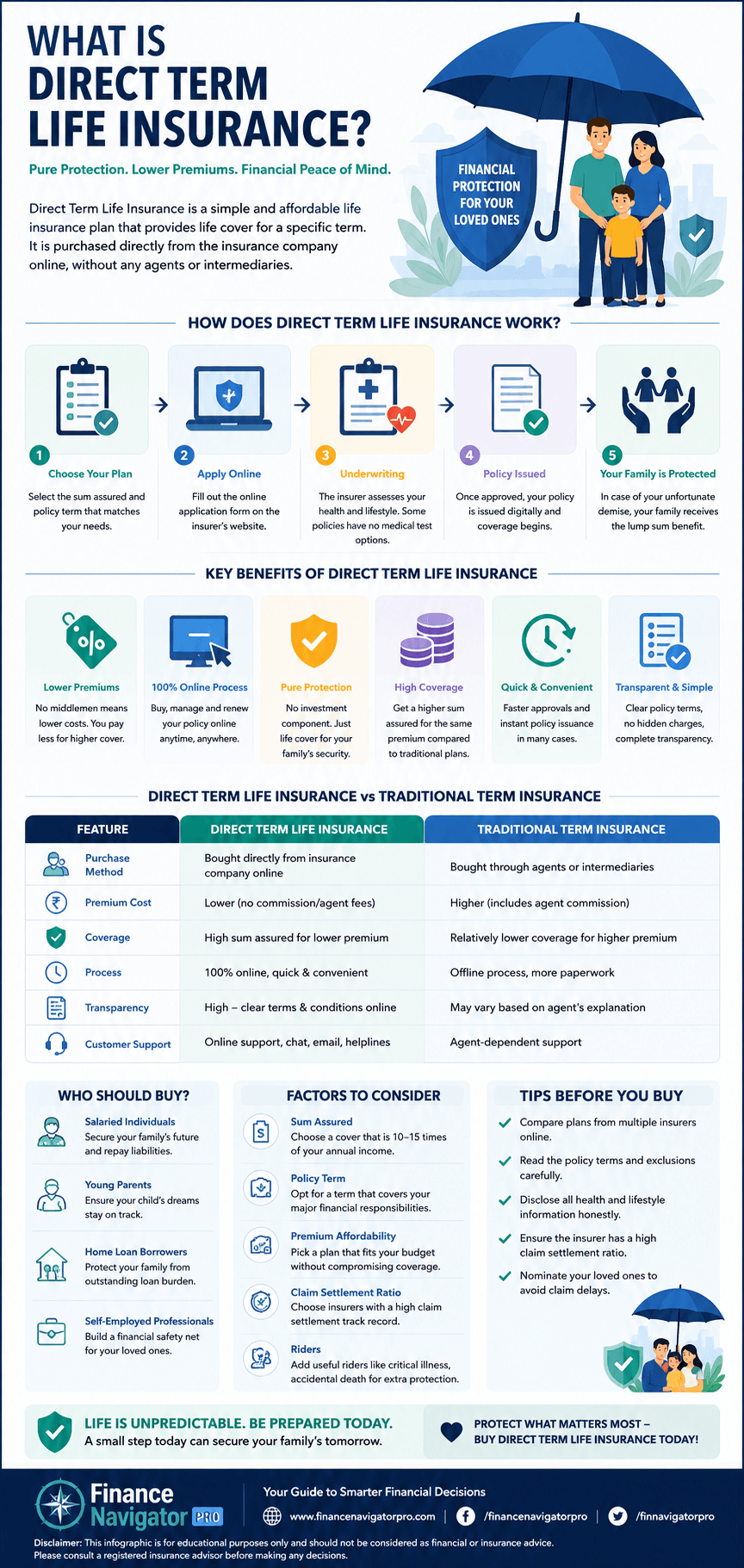
The process is designed to be self-service from start to finish, though most insurers offer phone or chat support if you get stuck. Here’s the typical sequence, step by step.
For applicants who qualify for accelerated underwriting, steps five and six can happen in minutes. For others — particularly those with certain health conditions or who want larger coverage amounts — the insurer may still require a more traditional underwriting process before issuing the policy.
Key takeaway: The seven-step process is the same skeleton used by most direct insurers; what varies is how much of it happens instantly versus how much still requires manual underwriting.
How Is Direct Term Life Insurance Different From Buying Through an Agent?
The clearest way to see the differences is side by side. Independent agents represent multiple insurance companies and can shop your application across several carriers. Captive agents represent a single insurer and can only offer that company’s products. Direct platforms let you apply straight to one insurer’s online system yourself.
| Factor | Buying Direct | Independent Agent | Captive Agent |
|---|---|---|---|
| Price | Often competitive; no agent commission built in | Varies by carrier; commission included | Varies; commission included |
| Convenience | High — apply anytime, fully online | Moderate — scheduling needed | Moderate — scheduling needed |
| Personalized advice | Limited; mostly self-directed | High — compares your situation across carriers | Moderate — limited to one carrier’s products |
| Company choices | One insurer per application | Multiple insurers | One insurer only |
| Application speed | Fast; often same-day decision | Days to weeks | Days to weeks |
| Ongoing support | Phone/chat support, no dedicated agent | Dedicated agent relationship | Dedicated agent relationship |
| Policy customization | Limited to standard riders offered online | Can tailor across multiple products | Limited to one carrier’s riders |
| Best for | Simple, well-defined coverage needs | Complex needs, comparison shopping | Buyers loyal to one carrier or bundling policies |
Key takeaway: Direct buying tends to win on speed and convenience; agents tend to win on comparison shopping and tailored advice — the right choice depends on how complex your needs are.
Advantages of Buying Direct Term Life Insurance
For applicants with straightforward health histories and clear coverage needs, direct term life insurance offers some genuine, practical advantages.
Convenience
You can start and finish an application from your couch, on your lunch break, or after the kids are asleep. There’s no need to coordinate schedules with an agent or take time off work for a meeting.
Faster Approval
Because many direct insurers use accelerated underwriting models that pull data electronically rather than waiting on a scheduled exam, qualifying applicants can sometimes go from application to approval in the same day.
Online Applications
The entire process — quote, application, health questionnaire, e-signature — happens through a single digital flow, which many buyers find less intimidating than a sales conversation.
Transparent Pricing
Quote tools typically show you a price before you commit to anything, so you can compare options across insurers without first sitting through a pitch.
No Sales Pressure
Because there’s no commissioned agent guiding the conversation in real time, the process tends to feel more neutral — you move at your own pace and make your own comparisons.
Available Anytime
Direct platforms don’t keep office hours. You can request a quote at midnight or fill out an application on a Sunday afternoon.
Digital Document Management
Policy documents, beneficiary forms, and premium payment records are usually stored in an online account you can access anytime, rather than a paper file in someone else’s office.
Key takeaway: The advantages of direct buying cluster around speed, convenience, and control — which matter most to buyers whose situations are relatively simple.
Potential Drawbacks You Should Know
Direct term life insurance isn’t free of trade-offs. Understanding the limits of the model helps you decide whether it fits your situation.
Limited Personalized Advice
Online tools can estimate how much coverage you might need, but they can’t fully account for nuances in your financial picture the way a conversation with a knowledgeable professional sometimes can.
May Not Compare Every Insurer
When you apply directly with one company, you’re seeing that company’s pricing and underwriting decision — not a side-by-side comparison across the market the way an independent agent could provide.
Complex Situations May Need an Advisor
If your finances involve multiple income sources, business ownership, or significant assets, a generic online application may not capture everything relevant to your coverage decision.
Medical Conditions
Applicants with certain pre-existing conditions may find that accelerated underwriting isn’t available to them, pushing the process back toward a more traditional — and slower — underwriting path anyway.
Business Owners
Coverage tied to business loans, buy-sell agreements, or key-person insurance often involves structuring decisions that go beyond what a standard direct application is built to handle.
Estate Planning
Life insurance used as part of a broader estate strategy — for example, to address estate tax exposure or fund a trust — usually benefits from coordination with an attorney or financial planner, not just an insurance purchase.
Policy Customization
Direct platforms typically offer a defined menu of riders and term lengths. If you need a more customized structure, that flexibility may be harder to find online.
Key takeaway: The drawbacks of direct buying tend to show up when situations get complicated — multiple policies, business needs, or estate considerations — rather than in everyday term coverage.
Who Should Consider Direct Term Life Insurance?
Direct term life insurance tends to work best for people whose needs are relatively straightforward: a clear coverage amount, a defined term length, and few complicating health or financial factors.
Young Professionals
Early-career applicants with good health and a clear sense of how much income they want to protect often qualify for the fastest, most affordable direct underwriting tiers.
Parents
New and existing parents frequently turn to term coverage to make sure childcare, education, and daily living costs would be covered if a primary caregiver’s income disappeared.
Homeowners
A 30-year mortgage and a 30-year term policy can line up neatly, giving homeowners a way to ensure a mortgage wouldn’t become unaffordable for survivors.
Married Couples
Couples who depend on both incomes — or who want to protect a stay-at-home spouse’s economic contribution — often use term coverage on one or both partners.
Business Owners (With Simple Needs)
Sole proprietors or small business owners with uncomplicated structures sometimes use direct term policies for basic income protection, separate from more specialized business coverage.
People Replacing Employer Coverage
Workers who only have group life insurance through their employer — which usually doesn’t follow them if they change jobs — often use direct term policies to build portable, independent coverage.
Healthy Applicants
Applicants in good health with no major prescription history or risk-factor lifestyle activities are the most likely candidates for instant or near-instant approval.
People Wanting Affordable Coverage
Because there’s no agent commission built into the price, and because digital operations can be less costly to run, direct insurers are often able to offer competitively priced term coverage for qualifying applicants.
Freelancers and Gig Workers
Independent workers without access to employer-sponsored benefits frequently turn to direct platforms specifically because they can shop and apply on their own schedule.
Key takeaway: If your situation is health-straightforward and your coverage goal is clear — protect income, a mortgage, or a family’s daily expenses — direct buying is usually well suited to it.
Who Might Benefit More From Working With an Insurance Agent?
Some situations carry enough complexity that personalized guidance — and the ability to compare offerings across several insurers — becomes genuinely valuable.
High-Net-Worth Families
Larger coverage amounts, multiple policies, and coordination with other financial assets often call for more hands-on planning than a standard online application provides.
Complex Estate Planning
When life insurance is meant to help cover potential estate tax exposure or fund a trust structure, coordinating with an attorney or financial planner alongside an insurance professional is usually worthwhile.
Special Medical History
Applicants with significant health conditions sometimes get better outcomes working with an agent who knows which carriers tend to underwrite specific conditions more favorably.
Business Succession
Buy-sell agreements, key-person coverage, and succession funding involve legal and financial structuring well beyond a basic term application.
Multiple Insurance Needs
Buyers juggling life, disability, and long-term care coverage simultaneously often benefit from someone who can look at the full picture at once.
Trust Planning
Setting up an irrevocable life insurance trust or other trust-owned policy structure typically requires legal guidance that goes beyond what a direct insurer’s online tools are designed to offer.
Key takeaway: Complexity — not income level alone — is usually the signal that professional guidance will add real value over a self-directed online purchase.
Does Direct Term Life Insurance Require a Medical Exam?
It depends on the insurer, the product, and your answers to the health questionnaire. Some direct policies skip the medical exam entirely; others still require one, just scheduled and managed digitally.
Traditional Underwriting
Traditional underwriting includes a paramedical exam — blood pressure, height and weight, blood and urine samples — along with a review of medical records. It tends to produce the most precisely priced rate but takes longer, sometimes several weeks.
Accelerated Underwriting
Accelerated underwriting uses algorithms and electronic data sources instead of a physical exam for applicants who meet certain age, health, and coverage-amount criteria. It’s the engine behind most instant-decision direct policies.
“No-Exam” Policies
Some direct insurers market “no medical exam” term policies. These still involve health questions and electronic record checks — they simply replace the in-person exam with other forms of verification, and often come with somewhat higher pricing or lower maximum coverage amounts to offset the added underwriting risk.
Instant Approval
Instant approval is typically reserved for healthy applicants within specific age ranges requesting coverage amounts under a set threshold, often guided by real-time data checks rather than waiting on lab results.
Lab Work
When required, lab work usually screens for things like cholesterol, glucose levels, and nicotine, and can sometimes be completed at home through a mobile examiner.
Prescription History
Most underwriting — direct or traditional — includes a check of prescription history databases, since medication patterns often reveal health information faster than self-reported answers alone.
Motor Vehicle Reports
Driving records are commonly reviewed because they correlate with risk-taking behavior relevant to mortality risk assessment.
Electronic Health Records
Some insurers can pull relevant portions of electronic health records directly, which speeds up verification without requiring you to track down paper files yourself.
Key takeaway: “No medical exam” doesn’t mean “no underwriting” — insurers are still verifying risk; they’re just doing it through data instead of a physical exam.
How Much Does Direct Term Life Insurance Cost?
There’s no single answer to what direct term life insurance costs, because pricing is built from a combination of personal factors that vary from one applicant to the next. Rather than quoting fixed premium figures — which can be misleading outside the context of a real quote — it’s more useful to understand what actually moves the price up or down.
Because these factors interact with each other, the only reliable way to know what you’d actually pay is to get a personalized quote from one or more insurers. Anyone promising a guaranteed price before knowing your age, health, and coverage needs isn’t giving you a complete picture. For a broader sense of typical pricing across policy types, see our breakdown of average insurance costs in the U.S.
Key takeaway: Premiums are personal by design — the same coverage amount can cost very different amounts for two applicants depending on age, health, and lifestyle factors.
How to Buy Direct Term Life Insurance Online
Buying coverage online is straightforward once you know the sequence. Use this checklist to move through the process methodically rather than rushing into the first quote you see.
Key takeaway: Treat the online application the way you would any major financial purchase — compare first, then commit, rather than applying impulsively to the first quote you see.
Best Features to Look For
Not all term policies are built the same way. These features are worth checking for specifically when comparing direct insurers.
Level Premiums
A level premium structure means your payment stays the same for the entire term, which makes long-term budgeting much easier than a policy with rates that increase over time.
Convertible Option
A convertible term policy can be converted to permanent coverage later without a new medical exam, which can matter if your health changes or your needs shift toward lifelong coverage.
Accelerated Death Benefit
This feature allows access to a portion of the death benefit while you’re still living if you’re diagnosed with a qualifying terminal illness, which can help cover medical or end-of-life costs.
Living Benefits
Some policies extend access to benefits for chronic or critical illness as well as terminal illness — worth checking carefully, since terms and triggers vary by insurer.
Waiver of Premium
This rider waives your premium payments if you become totally disabled, helping keep coverage in force during a period when income may also be disrupted.
Child Rider
A child rider adds a small amount of coverage for your children under your own policy, often convertible to a standalone policy for them later.
Guaranteed Renewability
Guaranteed renewability ensures you can renew coverage at the end of the term (usually at a higher rate) without new medical underwriting, which matters if your health has declined.
Financial Strength
An insurer’s financial strength rating reflects its ability to pay claims over the long term — important for a contract that may not pay out for decades.
Digital Account Management
A well-built online account lets you update beneficiaries, review documents, and make payments without needing to call in for routine changes.
Key takeaway: Price matters, but the features above often determine how well a policy actually serves you years down the road — they’re worth comparing as carefully as the premium itself.
Common Mistakes Buyers Make
Even a fast, convenient buying process can lead to a policy that doesn’t actually fit your needs if you skip a few key steps.
Buying Too Little Coverage
It’s tempting to choose the cheapest premium, but a coverage amount that doesn’t actually replace enough income or cover real debts can leave a family underprotected when it matters most. If you’re unsure where to start, our guide on how much insurance coverage you need walks through the math.
Only Comparing Price
The lowest quote isn’t useful if the insurer has a weak financial strength rating or the policy lacks features you’ll likely need later, like convertibility — see our list of common mistakes that make insurance more expensive in the long run.
Ignoring Riders
Riders are easy to skip during a quick online application, but a waiver of premium or child rider can matter significantly if circumstances change.
Choosing the Wrong Term
A 10-year term might be cheaper today, but if it expires while you still have a mortgage or dependents, you could face much higher premiums — or a harder time qualifying — when you go to renew.
Not Reviewing Beneficiaries
Outdated beneficiary designations are one of the most common life insurance problems, especially after marriage, divorce, or the birth of a child.
Waiting Too Long
Premiums generally increase with age, and health changes can affect eligibility, so delaying a purchase rarely makes coverage cheaper.
Buying Unnecessary Coverage
On the flip side, over-insuring — or duplicating coverage you already have through an employer — can mean paying for protection you don’t actually need.
Key takeaway: Most buying mistakes come from rushing past the planning step, not from choosing the wrong sales channel — take the time to size coverage correctly before comparing premiums.
Direct Term Life Insurance vs Other Types of Life Insurance
Term life insurance is only one branch of the broader life insurance family. Here’s how direct term coverage compares with other common types you might encounter while researching.
| Factor | Direct Term | Whole Life | Universal Life | Guaranteed Issue | Final Expense | Employer Coverage |
|---|---|---|---|---|---|---|
| Purpose | Temporary income/debt protection | Lifelong coverage + savings | Lifelong, flexible coverage | Coverage for hard-to-insure applicants | Cover funeral/end-of-life costs | Basic protection tied to a job |
| Cost | Generally lower for the coverage amount | Higher; includes cash value | Higher; flexible premiums | Higher relative to coverage amount | Moderate for small coverage amounts | Often free or low-cost; limited amount |
| Flexibility | Low — fixed term and amount | Moderate | High — adjustable premiums/benefits | Low | Low | Low — tied to employment |
| Cash value | None | Yes | Yes | Sometimes, limited | Sometimes, limited | No |
| Medical exam | Sometimes; often accelerated | Often required | Often required | Not required | Often not required | Not required |
| Coverage duration | 10–30 years | Lifetime | Lifetime | Lifetime | Lifetime | While employed |
| Ideal buyer | Income replacement during working years | Estate/legacy planning | Buyers wanting flexible permanent coverage | Applicants with significant health issues | Older adults covering final expenses | Supplemental coverage, not primary protection |
Curious how the permanent options stack up? See our dedicated guides to universal life insurance, indexed universal life (IUL), and final expense insurance.
Key takeaway: Direct term insurance is built for temporary, defined-need protection — permanent products like whole or universal life serve a fundamentally different, lifelong purpose.
Frequently Asked Questions
Is direct term life insurance legitimate?
Yes. Direct term life insurance policies are issued by licensed, state-regulated insurance carriers — the same regulatory framework that governs policies sold through agents. The “direct” label refers to the sales channel, not a different or less-regulated category of product.
Is direct term life insurance cheaper?
It’s often competitively priced because there’s no agent commission built into the cost, but it isn’t automatically cheaper for every applicant. Your final premium still depends primarily on age, health, coverage amount, and term length, so comparing actual quotes is the only reliable way to know.
Can I buy life insurance without speaking to an agent?
In most cases, yes. Direct insurers are built around self-service applications, though many still offer optional phone or chat support if you have questions along the way.
Can I switch insurance companies later?
Yes, you can apply for a new policy with a different insurer at any time. Keep in mind that switching usually requires new underwriting, and your rates will be based on your age and health at that later point.
Can I cancel a direct term life insurance policy?
Yes. Term life policies typically don’t have cancellation penalties the way some other financial products do — you can usually stop paying premiums and let the policy lapse, though it’s worth checking your specific policy terms first.
Can I convert my term policy to permanent insurance?
Many term policies include a convertible option that allows you to convert some or all of the coverage to a permanent policy without new medical underwriting, usually within a specified window during the term. Not all policies include this feature, so it’s worth confirming before you buy.
How long does approval take for direct term life insurance?
For applicants who qualify for accelerated underwriting, approval can happen within minutes to a few hours. Applicants who need traditional underwriting — due to health history, age, or coverage amount — may wait anywhere from several days to a few weeks.
Do I need a medical exam to buy direct term life insurance?
Not always. Many direct insurers offer accelerated or no-exam underwriting for qualifying applicants, relying on electronic data checks instead. Others still require a traditional exam depending on your age, health, and the coverage amount requested.
Can seniors buy direct term life insurance?
Some direct insurers offer term coverage to older applicants, though maximum issue ages and available coverage amounts vary significantly by company. Seniors with health complexities may find more options by comparing several insurers or working with an agent.
Can I buy life insurance entirely online, from quote to policy?
For many straightforward applications, yes — quote, application, underwriting decision, and policy issuance can all happen digitally. More complex applications may still involve a phone call or additional document requests before the policy is finalized.
Is direct life insurance safe?
Direct insurers are licensed and regulated the same way traditional insurers are, and most states maintain guaranty associations that provide a layer of protection if an insurer becomes insolvent. As with any insurer, it’s reasonable to check financial strength ratings before buying.
How are beneficiaries paid after a claim?
Once a claim is filed and approved, the death benefit is typically paid to named beneficiaries as a lump sum, though some insurers also offer installment or annuity-style payout options.
Can I increase my coverage amount later?
Some policies allow you to add coverage through a rider, but in many cases increasing coverage significantly requires applying for an additional policy, which involves new underwriting based on your age and health at that time.
Can I have multiple life insurance policies at once?
Yes, it’s common to hold multiple policies — for example, a smaller employer-provided policy alongside a larger individual term policy. Insurers do consider your total coverage in force across companies during underwriting.
Does employer life insurance replace the need for a direct term policy?
Usually not entirely. Employer-provided group life insurance is often valuable but limited — commonly capped at one to two times your salary — and typically doesn’t transfer with you if you leave the job. Many people use it as a supplement to, rather than a replacement for, an individual term policy.
Expert Tips Before Buying Direct Term Life Insurance
A little preparation before you start an application tends to pay off in a policy that actually fits your life, rather than one chosen quickly under time pressure.
Final Thoughts
Direct term life insurance has made it genuinely easier for a lot of people to get covered — no waiting on a callback, no scheduling around someone else’s calendar, no sitting through a pitch you didn’t ask for. For healthy applicants with clear, well-defined needs, that speed and transparency is a real advantage, not just a marketing point.
At the same time, convenience isn’t the only thing that matters. The best policy is the one that actually fits your situation — the right coverage amount, the right term length, and features like convertibility or a waiver of premium if they’re relevant to you. That holds true whether you buy directly, through an agent, or some combination of both over the course of your life.
Take the time to understand your own needs first. Compare more than one quote. Read what you’re actually agreeing to. And remember that choosing adequate coverage — not simply the cheapest premium on the page — is what protects the people who’d be relying on this policy after you’re gone.
Related Reading
Sources
This article draws on general consumer guidance published by the following authoritative organizations. Readers researching their own coverage decisions can consult these sources directly for the most current information:
Editorial note: This article is for general educational purposes and isn’t individualized financial, legal, or insurance advice. Underwriting standards, premiums, product features, and availability vary by insurer and by state. Speak with a licensed insurance professional or financial advisor about your specific situation before making a purchase decision.