

Imagine paying life insurance premiums for decades while also building an investment portfolio inside your policy. Sounds appealing — but what happens if the stock market crashes and your cash value drops 40%? That’s exactly the kind of scenario you need to understand before signing a variable life insurance contract.
Variable life insurance is one of the most powerful — and most misunderstood — financial products available in the U.S. market. Done right, it offers permanent life insurance protection combined with meaningful tax-deferred investment growth. Done wrong, it can mean high fees, a lapsed policy, and a disappointing financial outcome.
This guide covers everything you need to know before making a decision: how variable life insurance works, who it genuinely benefits, the risks that get glossed over in sales presentations, the real tax advantages, what it actually costs, and whether Variable Universal Life (VUL) might be a better fit for your situation.
Quick Answer
What is Variable Life Insurance?
Variable life insurance is a type of permanent life insurance that combines a guaranteed death benefit with a cash value account you invest in market-based sub-accounts — similar to mutual funds. Your cash value can grow significantly in strong markets, but it can also decline. Death benefit protection remains in place, but investment returns are never guaranteed. The policy is regulated by both state insurance regulators and, because it involves securities, the SEC and FINRA.
Key Takeaways
- Permanent life insurance coverage with no expiration date — lasts your entire lifetime
- Cash value is invested in market-based sub-accounts (stocks, bonds, balanced funds, index funds)
- Higher growth potential compared to whole life or universal life — but with real investment risk
- Your cash value is NOT guaranteed — it can decrease during market downturns
- Fixed premiums in most variable life policies; Variable Universal Life adds premium flexibility
- Tax-deferred cash value growth; death benefit is generally income-tax-free under IRC §101(a)
- Regulated by the SEC and FINRA in addition to state insurance departments
- Best suited for disciplined investors with long time horizons, permanent insurance needs, and higher risk tolerance
What Is Variable Life Insurance?
Variable life insurance is a form of permanent life insurance that does two things simultaneously: it protects your family with a lifelong death benefit, and it lets you invest the policy’s cash value in market-based investment accounts.
Here’s what sets it apart from simpler policies. With term life, you pay premiums for a set period and receive pure coverage — nothing else. With whole life, you get permanent coverage plus a cash value that grows at a low, fixed rate guaranteed by the insurer. Variable life takes it a step further. Instead of the insurer controlling how your cash value grows, you do.
Think of it this way: variable life insurance is like combining a permanent life insurance policy with a personal brokerage account. You pick from a menu of investment sub-accounts — often similar to mutual funds — and your cash value grows or falls based on how those investments perform.
The trade-off is straightforward. More upside potential, but also real downside risk. Unlike whole life, the insurer does not guarantee your cash value. Unlike term life, the coverage never expires as long as the policy remains in force.
Variable life insurance is classified as a security by the SEC because of its investment component. That means the agent who sells it must hold a securities license — typically a FINRA Series 6 or Series 7 registration — in addition to a state insurance license. This dual regulatory oversight is one reason variable life is generally sold through full-service financial advisors rather than direct-to-consumer insurance platforms.
Takeaway: Variable life insurance gives you investment control inside a permanent life insurance wrapper — but that control comes with investment risk that the insurer does not absorb on your behalf.
How Does Variable Life Insurance Work?
Understanding the mechanics helps you evaluate whether this type of policy is right for your situation. Here’s how it works, step by step.
Apply and Get Approved. You apply through a licensed insurance agent who also holds a securities license. The application includes a health questionnaire and often a medical exam. Your premium is determined by your age, health classification, coverage amount, and the specific policy design. Because variable life is a security, your agent must be FINRA-registered and state-licensed before they can legally sell it to you.
Pay Your Premiums. Variable life insurance typically has fixed premium payments. You pay the same amount on schedule, whether markets are up or down. This fixed structure enforces financial discipline but also means you must make every payment regardless of market conditions. Variable Universal Life (VUL), discussed next, relaxes this requirement.
Insurance Charges Are Deducted. Before your premium goes into your investment accounts, the insurer deducts its costs. These include the cost of insurance (COI) — which pays for the death benefit itself — plus mortality and expense (M&E) charges, administrative fees, and any rider costs. The amount remaining after deductions flows into your cash value.
You Invest the Cash Value. You allocate your cash value among the sub-accounts offered by the insurer. These may include stock funds, bond funds, balanced funds, money market accounts, international funds, and sometimes a fixed-interest account with a guaranteed minimum return. You choose based on your risk tolerance, time horizon, and financial goals.
Investment Performance Affects Your Policy. Your cash value rises or falls based on how your chosen sub-accounts perform. In strong markets, your cash value could grow significantly over time. In a market downturn, it can drop — and if it falls below the level needed to cover ongoing insurance charges, the policy is at risk of lapsing.
Death Benefit Is Paid. When you pass away, your beneficiaries receive the death benefit income-tax-free. Depending on how the policy is structured, this may be a fixed amount (a face amount that stays the same), or it may increase if your investments performed well — often referred to as a ‘variable’ death benefit option.
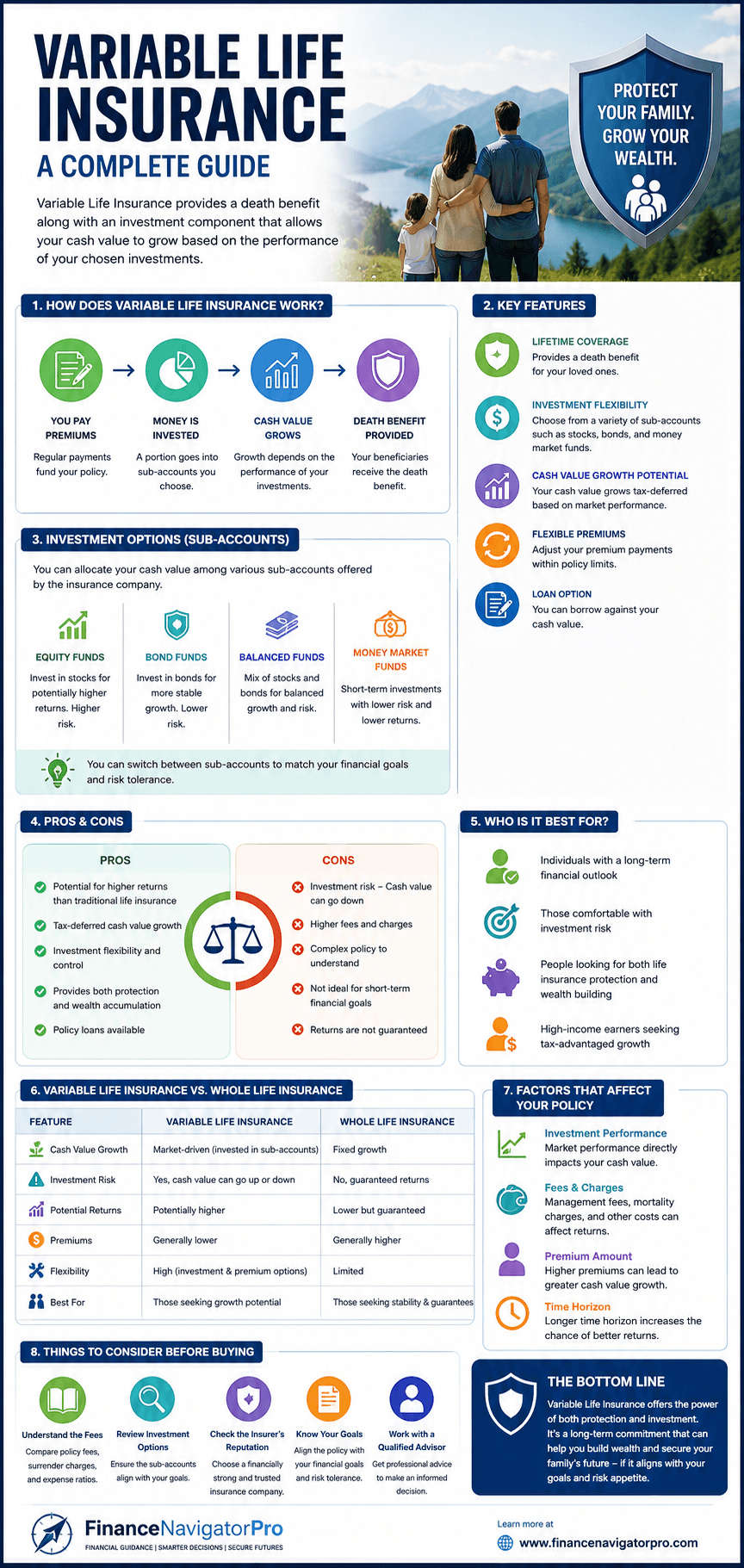
Takeaway: Variable life insurance has multiple moving parts — insurance charges, investment allocation, market performance, and ongoing management. Understanding each layer is essential before you commit.
What Is Variable Universal Life (VUL)?
Variable Universal Life, or VUL, is a close cousin to standard variable life insurance — but with one major distinction: flexibility.
With a traditional variable life policy, your premiums are fixed. Miss a payment, and the policy may be at risk. Variable Universal Life relaxes that rule. You can increase your premiums in high-income years to build cash value faster, or reduce them when times are lean — as long as the cash value is sufficient to cover ongoing insurance costs.
VUL also gives you more control over the death benefit. You can increase coverage if your family grows or your estate planning needs change, or reduce it to lower insurance costs as the kids leave home. This flexibility is genuinely useful for business owners, commission-based professionals, and anyone whose income varies significantly year to year.
Here’s the caution: the same flexibility that makes VUL attractive can also be dangerous. Consistently underfunding a VUL policy — especially during a market downturn when cash value is already declining — is one of the most common reasons these policies lapse. The policyholder reduces premiums just when the policy needs more funding, compounding the problem.
Both Variable Life and VUL offer the same investment sub-accounts, the same tax advantages, and the same SEC/FINRA regulatory framework. The primary difference is whether you want fixed discipline or adjustable flexibility in how you fund the policy.
Variable Life Insurance vs. Variable Universal Life
This comparison table breaks down the key differences between Variable Life and VUL across the dimensions that matter most to buyers:
| Feature | Variable Life Insurance | Variable Universal Life (VUL) |
|---|---|---|
| Premium structure | Fixed — required on schedule | Flexible — adjustable within limits |
| Death benefit | Generally fixed | Adjustable (increase or decrease) |
| Cash value | Market-based sub-accounts | Market-based sub-accounts |
| Investment control | Full — you choose sub-accounts | Full — you choose sub-accounts |
| Premium flexibility | None | Yes — can overfund or reduce |
| Death benefit flexibility | Limited | High |
| Lapse risk | Lower (fixed premiums enforce discipline) | Higher (underfunding is a common problem) |
| Complexity | High | Very High |
| Best suited for | Steady-income earners needing perm. coverage | Variable-income earners, high-income professionals |
| Surrender charges | Yes — typically 7–15 years | Yes — typically 7–15 years |
| Tax advantages | Tax-deferred growth; tax-free death benefit | Tax-deferred growth; tax-free death benefit |
| SEC/FINRA regulated | Yes | Yes |
| Ideal use case | Long-term coverage + disciplined investment growth | Aggressive accumulation; premium variability needed |
Bottom line: If you have a predictable income and value the discipline that fixed premiums provide, standard Variable Life may be the right fit. If your income varies and you want the ability to aggressively fund the policy in good years and scale back in lean ones, VUL offers that flexibility — but it demands more active management to avoid a lapse.
Takeaway: The choice between Variable Life and VUL often comes down to income predictability and how much management responsibility you’re willing to take on. VUL’s flexibility is a feature when used wisely — and a risk when ignored.
How the Cash Value Investment Works
The cash value in a variable life policy is held in what are called separate accounts — investment accounts legally distinct from the insurer’s general assets. This is actually a meaningful consumer protection: if the insurance company faces financial trouble, creditors generally cannot reach the funds in your separate account.
Within those separate accounts, you allocate your money among sub-accounts — individual investment options that function similarly to mutual funds, each with its own portfolio manager, risk profile, expense ratio, and potential return.
Here’s what typically happens each month:
- Your premium payment is received by the insurer.
- The cost of insurance (COI) and other charges are deducted from the premium or the cash value.
- The remainder is directed into your chosen sub-accounts according to your allocation instructions.
- The sub-accounts fluctuate in value daily based on the underlying investment performance.
- Your policy cash value equals the current market value of your sub-account holdings.
Unlike whole life insurance, there is no guaranteed floor on your cash value in the variable component (unless you allocate to a fixed-interest account option, which some policies include as a conservative sub-account choice).
The insurer provides a prospectus — a detailed legal document — describing all available sub-accounts, their investment objectives, management teams, historical performance, and expense ratios. You should review the prospectus carefully before selecting your allocation, and revisit your choices periodically as your financial situation evolves.
Takeaway: Your cash value in a variable life policy behaves like a managed investment portfolio — which means both the growth potential and the downside risk are yours to own.
Investment Options Available in Variable Life Policies
Most variable life policies offer a menu of 20 to 50 sub-accounts. Here are the most common categories and the types of investors each tends to suit:
Aggressive Growth Funds
High equity exposure, often concentrated in small-cap stocks, sector-specific equities, or emerging markets. These carry the highest potential returns — and the highest volatility. Best for younger policyholders with a 20+ year time horizon and genuine comfort with significant swings in value.
Growth Funds
Primarily large-cap domestic equities — think funds tracking companies in the S&P 500 or Nasdaq. Less volatile than aggressive growth but still carries meaningful market risk. Suitable for investors who want long-term capital appreciation without maximum volatility.
Balanced Funds
A mix of equities and bonds — often in a 60/40 or similar ratio. Offers moderate growth potential with lower volatility than a pure equity allocation. Popular among mid-career professionals who want growth but are starting to think about capital preservation.
Income Funds
Focus on dividend-paying stocks and investment-grade corporate or government bonds. Lower growth potential than equity funds, but provides a smoother ride. Suitable for policyholders nearing retirement who prioritize income and stability.
International Funds
Exposure to non-U.S. markets, including developed markets (Europe, Japan) and emerging markets (India, Brazil). Adds geographic diversification to your portfolio but introduces currency risk and geopolitical risk alongside potential for stronger returns.
Index Funds
Track a benchmark index such as the S&P 500, Russell 2000, or MSCI World. Passive management means lower expense ratios compared to actively managed sub-accounts. Increasingly popular within variable life policies because of their cost efficiency.
Fixed Account Option
Not truly a variable sub-account — this is an option guaranteed by the insurer at a minimum interest rate. It provides a safe harbor when markets are turbulent and can be a useful tool for a conservative portion of your allocation as you approach retirement age.
Takeaway: The right sub-account mix depends on your age, risk tolerance, financial goals, and time horizon. Review your allocations at least annually — the same portfolio that made sense at 40 may not be right at 55.
Can You Lose Money in Variable Life Insurance?
Yes — and understanding this is non-negotiable before you buy. Unlike whole life or traditional universal life, variable life insurance does not guarantee your cash value. If your chosen sub-accounts decline in value, your cash value declines with them.
Market Downturns
If your sub-accounts are heavily invested in equities and the stock market drops sharply, your cash value can fall substantially. During the 2008 financial crisis and the market volatility of 2020, many variable life policyholders experienced cash value declines of 30–50% in equity-heavy allocations. The death benefit often remained intact, but the investment component suffered significant losses.
Insurance Costs Compounding the Decline
Even when markets are falling, the insurer continues to deduct mortality charges, COI, and administrative fees from your cash value. These fixed costs represent a growing percentage of a shrinking cash value — accelerating the decline and making recovery harder.
The Risk of Policy Lapse
If your cash value falls below the level needed to cover ongoing insurance charges, the policy can lapse. A lapsed variable life policy means losing your coverage. Worse, if you had accumulated gains inside the policy, a lapse can trigger a taxable event — potentially creating an income tax liability at the worst possible time.
Example Scenario
Illustration: Market Downturn Impact
Alex is 45 years old and purchased a $500,000 variable life policy 10 years ago, paying $5,000 in annual premiums. After a decade of strong markets, the cash value has grown to $68,000. A major market correction hits. His equity sub-accounts drop 35%. Cash value falls to $44,200. Insurance charges of $150/month continue to come out. If Alex doesn’t increase his premium or shift to more conservative sub-accounts, the cash value erosion could accelerate — eventually jeopardizing the policy.
Investment returns are not guaranteed. A policy illustration projecting 8% annual growth is a projection — not a promise. Always ask your agent to show illustrations at 0%, 4%, and 8% return assumptions so you understand the range of possible outcomes.
Takeaway: Variable life insurance carries real investment risk. Understanding that your cash value can decrease — significantly — is the most important thing to internalize before purchasing this type of policy.
Pros and Cons of Variable Life Insurance
Before deciding whether variable life insurance belongs in your financial plan, consider both sides of the ledger:
| Advantages | Disadvantages |
|---|---|
| Permanent lifelong coverage — no expiration | Cash value is NOT guaranteed — can decrease |
| Higher growth potential than whole or UL | Multiple fee layers erode returns |
| Full investment control over sub-accounts | Surrender charges if you exit in early years |
| Tax-deferred cash value growth | Policy can lapse if cash value falls too low |
| Income-tax-free death benefit (IRC §101(a)) | Not suitable for risk-averse individuals |
| Policy loans available — generally tax-free | Requires active monitoring and management |
| Powerful estate planning and wealth transfer tool | More complex than most life insurance products |
| Sub-accounts legally separated from insurer assets | Agent must hold a securities license (FINRA) |
| Diversification across stocks, bonds, and funds | Can be oversold as a pure investment vehicle |
| Some policies offer a guaranteed minimum DB | Investment fees add to total cost of ownership |
The right conclusion isn’t that variable life insurance is good or bad — it’s that it’s well-suited to a specific type of buyer in a specific financial situation. The analysis that matters is whether your situation matches that profile.
Takeaway: Variable life insurance’s strengths — growth potential and tax advantages — are real. But so are the risks and fee layers. The product only makes sense for buyers who understand both sides of the equation.
Variable Life Insurance Costs Explained
Variable life insurance is not a low-cost product. Here’s a full breakdown of every layer of fees you’re likely to encounter:
| Cost Component | Typical Range / Description |
|---|---|
| Premium payments | Varies widely by age, health, coverage amount, and insurer. A healthy 35-year-old seeking $500,000 in coverage might pay $3,000–$7,000 per year. |
| Mortality & Expense (M&E) | 0.5%–1.5% of sub-account value annually. Covers the insurer’s cost of providing the death benefit and operating expenses. |
| Cost of Insurance (COI) | Increases with age. Pays for the pure death benefit protection. Deducted monthly from your cash value. |
| Administrative fee | $10–$30 per month flat charge for policy maintenance and record-keeping. |
| Fund expense ratios | 0.5%–2.5% annually per sub-account. Similar to mutual fund management fees. Varies by fund type. |
| Surrender charges | Substantial in early years (often 7%–10% of cash value) and decline gradually, typically disappearing after 7–15 years. |
| Policy rider fees | Varies by rider. Long-term care riders and guaranteed insurability riders add meaningful annual cost. |
| Total annual fee estimate | For a 40-year-old with a $750,000 policy and $6,000 annual premiums, total fees could run $1,500–$2,500/year — before investment gains are considered. |
Here’s why this matters: assume your variable life sub-accounts earn 7% annually on average. After deducting M&E charges (1%), COI, and fund expenses (1%), your effective net return to the cash value might be closer to 4–5%. That gap is significant over a 20–30 year policy, and it’s one of the main reasons financial planners sometimes recommend ‘buy term and invest the difference’ for investment-focused clients rather than variable life.
That said, for policyholders who genuinely need permanent life insurance and want tax-deferred investment growth, the fee structure can be justified — particularly in high tax brackets where the tax advantages offset the costs.
Takeaway: Always request a full policy illustration with a complete fee disclosure before purchasing. If an agent cannot or will not provide a detailed breakdown of all charges, that is a serious red flag.
Tax Benefits of Variable Life Insurance
Tax advantages are among the strongest arguments for variable life insurance — when the policy is properly structured and managed. Here’s a plain-English breakdown of the key tax benefits:
Tax-Deferred Growth
Your cash value grows tax-deferred. Unlike a taxable brokerage account where you pay capital gains taxes on dividends and realized gains each year, a variable life policy allows your investment gains to compound without annual tax drag. You don’t pay income taxes on investment growth until you withdraw funds — and in many cases, you can access them without triggering taxes at all (through policy loans).
Income-Tax-Free Death Benefit
In most cases, the death benefit paid to your beneficiaries is completely free of federal income tax under Internal Revenue Code Section 101(a). For high-net-worth estates, this is a significant advantage — particularly when the policy is held inside an Irrevocable Life Insurance Trust (ILIT), which can remove the death benefit from your taxable estate entirely.
Policy Loans — Generally Tax-Free Access
You can borrow against your cash value without triggering a taxable event. Policy loans are not classified as income by the IRS — you can access potentially significant sums without a tax bill. However, unpaid policy loans reduce the death benefit dollar for dollar, and if a loan causes the policy to lapse, you may owe income taxes on any gains accumulated inside the policy. Loan management is an area where many policyholders get into trouble.
Withdrawals Up to Basis
Withdrawals from a variable life policy up to your cost basis (the total premiums you’ve paid) are generally income-tax-free. Withdrawals of gains above your basis are taxable as ordinary income. This is less favorable than the capital gains tax rates available in a taxable account, which is a legitimate counterpoint to the tax-deferred growth argument.
MEC Warning — Modified Endowment Contract
If you fund a variable life policy too aggressively — exceeding the limits set by Internal Revenue Code Section 7702 — the policy can be reclassified as a Modified Endowment Contract (MEC). A MEC loses its favorable loan and withdrawal tax treatment. Loans from a MEC are taxed as income first, and early withdrawals before age 59½ may be subject to a 10% penalty. Work with a qualified tax professional when designing the funding schedule for a variable life policy to avoid MEC classification.
Takeaway: The tax advantages of variable life insurance are real and meaningful — but they require careful policy design, proper funding levels, and disciplined loan management to protect. Consult a licensed tax professional before purchasing.
Who Should Buy Variable Life Insurance?
Variable life insurance genuinely serves a specific type of buyer. Here’s who tends to benefit most:
High-Income Earners. People who have already maxed out 401(k) contributions, Roth IRAs, and other tax-advantaged accounts may find variable life a useful additional vehicle for tax-deferred investment growth. The tax benefit is most valuable when you’re in a high marginal income tax bracket.
Business Owners. Company-owned life insurance (COLI) using variable life or VUL can serve legitimate business purposes: key person coverage, buy-sell agreement funding, or executive compensation plans (such as deferred comp arrangements). Variable life’s investment component can serve long-term corporate planning needs.
Professionals with Long Time Horizons. Doctors, lawyers, and executives in their 30s or early 40s who plan to hold the policy for 20+ years can potentially benefit from market-driven cash value growth. The longer the time horizon, the more the tax-deferred compounding and investment returns can offset the fee structure.
Estate Planning Families. High-net-worth families frequently use variable life insurance inside Irrevocable Life Insurance Trusts (ILITs) for estate tax planning and multigenerational wealth transfer. The income-tax-free death benefit and estate-planning flexibility make it a legitimate tool in this context.
Sophisticated Investors. People who are genuinely comfortable evaluating investment sub-accounts, rebalancing allocations, monitoring policy performance, and making proactive adjustments are the best candidates. This is not a set-it-and-forget-it product.
Takeaway: Variable life insurance works best as part of a comprehensive financial plan — not as a standalone solution. It’s most appropriate for income-stable, investment-savvy individuals with a genuine permanent insurance need.
Who Should Avoid Variable Life Insurance?
Despite its strengths, variable life insurance is the wrong product for many people. Be cautious if any of the following applies to you:
You have limited or unpredictable income. Fixed premium requirements make standard variable life difficult to sustain if your cash flow fluctuates. A missed premium can threaten the policy, particularly if the cash value has declined due to market performance.
You are risk-averse. If the thought of your cash value declining 30% or more in a bad market year causes genuine distress, this isn’t the right product. Whole life offers guaranteed cash value growth. Indexed Universal Life (IUL) provides market-linked upside with downside protection via a floor. Either may be a better emotional and financial fit.
Pure coverage is your primary need. Term life insurance delivers far more death benefit per premium dollar than variable life. If protecting your family in the event of your death is the primary goal — especially for a defined period like until your children finish college — term life is the more efficient, lower-cost choice.
You have a short investment horizon. Surrender charges in the first 7–15 years can be substantial. If there’s any possibility you’ll need to exit the policy early, the charges can eliminate any gains you’ve accumulated. Variable life is a long-term commitment, not a short-term investment vehicle.
You don’t want to actively manage investments. Ignoring your sub-account allocations for years at a time can result in a risk profile that’s completely inappropriate for your current age and financial situation — and can lead to poor policy performance.
Takeaway: If you need affordable coverage, prefer guaranteed returns, or aren’t comfortable actively managing investments, variable life is probably not the right product for your situation.
Variable Life Insurance vs. Other Policies
How does variable life compare to the other major life insurance products on the market? Here’s a side-by-side look at the five most common alternatives:
| Feature | Variable Life | Variable UL (VUL) | Whole Life | Universal Life | Term Life |
|---|---|---|---|---|---|
| Coverage duration | Permanent | Permanent | Permanent | Permanent | 10–30 years only |
| Cash value | Yes — market | Yes — market | Yes — guaranteed | Yes — interest | No |
| Investment control | Full | Full | None | None | None |
| Premium flexibility | Fixed | Flexible | Fixed | Flexible | Fixed |
| Market risk | High | High | None | Low | None |
| Growth potential | Highest | Highest | Low, guaranteed | Moderate | None |
| Fee complexity | High | Very High | Moderate | Moderate | Low |
| Best for | Investors + perm. need | High earners, variable income | Conservative, guaranteed growth | Flexible, moderate growth | Affordable pure coverage |
| SEC regulated | Yes | Yes | No | No | No |
Quick Recommendation Matrix:
- Need affordable coverage for a defined period only? Term Life is the most efficient choice.
- Want permanent coverage with guaranteed, conservative growth? Whole Life.
- Want flexible premiums without investment risk? Universal Life or Indexed Universal Life.
- Want market-linked upside with a downside floor? Indexed Universal Life (IUL).
- Want full investment control with premium flexibility? Variable Universal Life (VUL).
- Want full investment control with fixed premium discipline? Variable Life Insurance.
Takeaway: No single policy type is universally best. The right choice depends on your specific goals, risk tolerance, time horizon, and tax situation. A fiduciary financial advisor can help you evaluate the options objectively.
Real-Life Example: How Variable Life Insurance Plays Out
Let’s look at how variable life insurance might realistically play out for two different market scenarios with the same policyholder.
The Policyholder: Jordan is 35 years old, healthy, and works as a corporate attorney earning $220,000 per year. Jordan has already maxed out a 401(k) and Roth IRA and is looking for additional tax-advantaged growth. Jordan purchases a $1,000,000 variable life insurance policy with annual premiums of $9,000, allocating 65% to a growth equity fund and 35% to a balanced fund.
Scenario A — Bull Market (Average 8% Annual Return)
After 20 years, Jordan’s total premium payments total $180,000. With consistent average annual growth of 8% on the invested portion — after M&E charges, COI, and fund expenses of approximately 2% annually — the net effective return on the cash value is closer to 5.5–6%. Jordan’s estimated cash value after 20 years: approximately $225,000–$265,000. The death benefit has remained at $1,000,000. Jordan can now access policy loans for supplemental retirement income without triggering federal income tax, and the death benefit passes to beneficiaries income-tax-free.
Scenario B — Volatile Market (Average 3% Annual Return)
If markets underperform — averaging just 3% with several significant down years — the picture is materially different. After fees, the net return on the cash value might be 0.5–1.5%. Jordan’s cash value after 20 years could be $75,000–$110,000. Worse, if market downturns occurred in years 15–20, Jordan might need to increase annual premiums to prevent the policy from lapsing during retirement — exactly when extra premium payments are least convenient.
Key lesson: Policy illustrations showing 7–8% projected returns are projections based on hypothetical market performance — they are not guarantees. Always review illustrations at 0%, 4%, and maximum illustrated rate to understand the full range of possible outcomes before signing.
Takeaway: A variable life policy can be a powerful wealth-building tool in favorable markets — but plan conservatively. The downside scenario is a real possibility, not a theoretical one.
Best Riders for Variable Life Insurance
Riders are optional add-ons that allow you to customize your variable life policy. Here are the most valuable riders available from most major carriers:
| Rider | What It Does |
|---|---|
| Accelerated Death Benefit | Allows access to a portion of the death benefit if diagnosed with a terminal illness. Often available at no additional cost. |
| Waiver of Premium | Waives required premium payments if you become totally disabled and unable to work. Critical for fixed-premium policies. |
| Long-Term Care (LTC) Rider | Lets you draw on the death benefit to cover qualified long-term care expenses — an alternative to a standalone LTC policy. |
| Child Rider | Provides small term life coverage on your children at low cost. Often convertible to a permanent policy later without a medical exam. |
| Guaranteed Insurability | Allows you to purchase additional coverage at specific future dates without undergoing a new medical examination. |
| Return of Premium (ROP) | Some insurers offer riders that return a portion of premiums paid if you surrender the policy. Adds significant cost. |
Not every rider is worth the added cost. The Accelerated Death Benefit rider is almost always worth having (and often costs nothing). The Waiver of Premium rider is highly valuable for professionals who depend on their income. Evaluate each rider based on your specific circumstances and what it would actually cost annually.
Takeaway: Riders add real value — but each one adds cost. Focus on the riders that address genuine risks in your personal situation rather than purchasing all available options by default.
How to Choose the Right Variable Life Insurance Policy
Buying a variable life policy is a long-term financial commitment. Here’s a practical checklist to guide your evaluation:
- Define your financial goals clearly. Are you buying primarily for the permanent death benefit, for tax-deferred investment growth, for estate planning, or some combination? Your primary goal should drive every subsequent decision.
- Assess your genuine risk tolerance. Not the risk tolerance you think you should have — the one you’ll actually live with when your cash value drops 25% in a bad quarter. If that scenario would cause you to panic-sell or reduce premiums, variable life may not be right for you.
- Request a complete fee disclosure. Ask for a breakdown of M&E charges, COI by year, fund expense ratios, administrative fees, and the full surrender charge schedule. If an agent resists providing this, walk away.
- Review the investment sub-account menu carefully. Does the policy offer a diverse range of quality sub-accounts with reasonable expense ratios? Are index fund options available? What is the historical performance track record of the available funds?
- Evaluate carrier financial strength. Look for insurers with A+ or A++ ratings from AM Best. Leading carriers in the variable life space include Northwestern Mutual, MassMutual, New York Life, Prudential, Lincoln Financial, Pacific Life, and Nationwide.
- Verify your advisor’s credentials. Your agent must hold a FINRA securities registration (Series 6 or Series 7) and a state insurance license. Verify their credentials at FINRA BrokerCheck before proceeding.
- Request policy illustrations at multiple return rates. Specifically: 0% (flat), 4%, and the maximum illustrated rate. This gives you a realistic sense of outcomes across the range of plausible market environments.
- Understand the full surrender charge schedule. Know exactly what it would cost to exit the policy in years 1, 5, 10, and 15. Make sure you’re genuinely prepared to hold the policy through the surrender period.
Takeaway: The quality of the insurer, the transparency of your advisor, and the diversity of the investment menu are just as important as the policy’s projected returns when evaluating a variable life policy.
Questions to Ask Before Buying Variable Life Insurance
A trustworthy, well-informed agent will welcome these questions. If your agent seems evasive or discourages scrutiny, that’s a significant red flag:
- What is the total annual cost of this policy, including all fees and charges, in year 1, year 5, and year 15?
- What sub-accounts are available and what are their individual expense ratios?
- What is the full surrender charge schedule, and what does it cost to exit in year 1, 5, and 10?
- How is the death benefit structured — level amount, increasing, or variable based on performance?
- What happens to my policy if the market drops 30% in a single year — how much premium would I need to add?
- What is the minimum cash value required to keep the policy in force without additional premiums?
- Can I reallocate between sub-accounts without a fee, and how often?
- Is there a guaranteed minimum death benefit regardless of investment performance?
- How do I make sure this policy doesn’t become a Modified Endowment Contract (MEC)?
- What is the company’s financial strength rating from AM Best, S&P, and Moody’s?
- What are the policy loan interest rates, and are they fixed or variable?
- What riders are available and what does each one cost annually?
- Can the insurer increase M&E charges or other fees in the future?
- What is the 10- and 15-year historical performance of the available sub-accounts, net of fees?
- Who regulates this policy — which state insurance department, SEC registration number, and FINRA registration?
Takeaway: These aren’t trick questions — they’re the due diligence every serious buyer should conduct. The answers will tell you as much about the advisor as they do about the policy.
Common Mistakes to Avoid with Variable Life Insurance
1. Buying Variable Life Primarily as an Investment
Variable life insurance is, first and foremost, a life insurance product. The investment component carries significantly higher fees than investing directly in a taxable brokerage account through index funds. If your primary goal is investment growth and you don’t have a genuine permanent insurance need, a Roth IRA or brokerage account is almost certainly more cost-efficient.
2. Ignoring the Full Fee Picture
Many buyers focus on projected returns without accounting for the combined drag of M&E charges, COI, administrative fees, and fund expense ratios. These charges can reduce your effective return by 1.5–3 percentage points annually — a significant impact over a 20-year period.
3. Underfunding the Policy
Paying only the minimum required premium during market downturns — when cash value is already declining — is a common and dangerous pattern. The result can be an accelerating spiral: lower cash value means insurance charges consume a larger percentage, further depleting the cash value. Maintain adequate funding levels, especially during market stress.
4. Setting Allocations and Forgetting Them
Unlike a set-it-and-forget-it investment account, variable life requires periodic review. The equity-heavy allocation appropriate for a 35-year-old is typically not the right mix for the same person at 55. Failing to rebalance as you age and as market conditions change can expose you to inappropriate risk at the wrong time.
5. Borrowing Too Aggressively from Cash Value
Policy loans feel like ‘free money’ because they don’t trigger a taxable event. But outstanding loans reduce the death benefit and can cause the policy to lapse if the loan balance erodes the remaining cash value — especially during a market downturn. Treat policy loans with the same discipline you’d apply to any other debt.
6. Not Understanding the Surrender Charge Timeline
Many buyers purchase variable life with an expectation of flexibility to exit early if needed. In reality, surrender charges in the first 7–15 years can be substantial — often 7–10% of the cash value in year one, declining gradually. Fully understand the surrender schedule before purchasing, and only buy if you are genuinely committed to holding the policy long-term.
Takeaway: The most costly mistakes with variable life insurance are preventable — they stem from insufficient research, misaligned expectations, poor ongoing management, and treating a complex insurance product as a simple investment vehicle.
Frequently Asked Questions
Q: Is variable life insurance worth it?
Variable life insurance is worth it for a specific type of buyer: a high-income earner with a genuine permanent insurance need, a long time horizon, a high risk tolerance, and the discipline to actively manage the policy. For someone seeking affordable pure coverage or guaranteed growth, other products are likely more appropriate. Consult a licensed financial advisor to evaluate whether it fits your complete financial picture.
Q: Can you lose money in variable life insurance?
Yes, absolutely. Your cash value is invested in market-based sub-accounts and can decline in value during market downturns. Unlike whole life, there is no guaranteed minimum on the variable component. In severe market scenarios, a sustained decline can deplete the cash value to a level that threatens the policy’s continuation. This is not a theoretical risk — it has happened to many policyholders during major market corrections.
Q: Is Variable Universal Life (VUL) better than variable life insurance?
Neither is objectively better — they serve different needs. VUL’s premium flexibility is valuable for variable-income earners who want to overfund in good years and scale back in lean ones. Standard variable life’s fixed premiums enforce discipline and reduce the risk of accidental underfunding. VUL also tends to be more complex to manage correctly. The right choice depends on your income stability and your willingness to actively manage the policy.
Q: Is VUL (Variable Universal Life) taxable?
VUL follows the same tax treatment as standard variable life insurance: cash value grows tax-deferred, policy loans are generally not treated as taxable income, and the death benefit is typically income-tax-free to beneficiaries. Withdrawals of gains above your cost basis are taxed as ordinary income. If the policy is classified as a Modified Endowment Contract (MEC), different — less favorable — tax rules apply.
Q: Can I borrow from my variable life insurance cash value?
Yes. You can take policy loans against the accumulated cash value of a variable life policy. These loans are generally not classified as income by the IRS and do not trigger a taxable event. However, outstanding loan balances accrue interest, reduce the death benefit, and can cause the policy to lapse if the loan balance erodes the remaining cash value. Unpaid loans at the time of death reduce the benefit your beneficiaries receive.
Q: What happens if the stock market crashes and I have a variable life policy?
If the market drops sharply, the cash value in your variable sub-accounts will decline. Insurance charges (COI, M&E, admin fees) continue regardless of market performance. If the cash value drops too low to cover these charges, you may need to pay additional premium to keep the policy in force. In the most severe scenarios, if you don’t add funds, the policy can lapse. A diversified sub-account allocation and adequate premium levels reduce — but do not eliminate — this risk.
Q: Can I cancel my variable life insurance policy?
Yes, you can surrender a variable life policy at any time. However, if you cancel within the surrender charge period (typically 7–15 years), you will receive only the cash surrender value — the cash value minus applicable surrender charges. Additionally, if you have accumulated gains inside the policy, surrendering it may trigger a taxable event. Review the surrender charge schedule carefully before canceling.
Q: How much does variable life insurance cost per month?
The cost varies widely based on your age, health classification, the amount of coverage, the insurer, and the policy design. A healthy 35-year-old seeking $500,000 in coverage might pay $250–$600 per month in premiums. A 45-year-old seeking $1,000,000 in coverage could pay $600–$1,200 or more per month. Total costs also include M&E charges, COI (which increases with age), and fund expense ratios — so the premium alone understates the full cost.
Q: Who regulates variable life insurance?
Variable life insurance has dual regulation. As a life insurance product, it is regulated by the insurance department in each state where it is sold. As a security (because of the investment component), it is also regulated by the Securities and Exchange Commission (SEC) and sold only by agents registered with FINRA. This dual oversight is why you must buy from an advisor with both insurance and securities credentials.
Q: What happens to my variable life policy when I retire?
Many policyholders use accumulated cash value in retirement for tax-advantaged supplemental income through policy loans. In retirement, you might reduce or stop paying premiums if the cash value is sufficient to cover ongoing insurance costs — though this requires careful management. Some policyholders shift sub-account allocations toward more conservative, income-focused funds as retirement approaches to reduce volatility risk.
Q: What is the difference between variable life and whole life insurance?
The core difference is in how the cash value grows. Whole life offers guaranteed cash value growth at a low rate determined by the insurer — your money is safe, but growth is modest. Variable life lets you invest the cash value in market-based sub-accounts with higher growth potential — but no guarantee. Whole life is typically simpler, lower-maintenance, and better suited to conservative investors. Variable life suits those comfortable with market risk.
Q: What is a sub-account in variable life insurance?
A sub-account is an individual investment option within a variable life policy’s separate account. Sub-accounts function similarly to mutual funds — each has a specific investment objective (growth, income, balanced, international, etc.), a portfolio manager, a fee structure (expense ratio), and a daily net asset value (NAV). You select how to allocate your cash value among the available sub-accounts.
Q: What is a Modified Endowment Contract (MEC)?
A Modified Endowment Contract is a life insurance policy that fails the IRS’s ‘seven-pay test’ under Internal Revenue Code Section 7702A — meaning you funded it too aggressively relative to the death benefit. A MEC loses its favorable tax treatment: loans are taxed as income first (LIFO basis), and pre-59½ withdrawals may be subject to a 10% penalty. Work with a tax professional when designing your policy to avoid MEC classification.
Q: What is the difference between variable life and Indexed Universal Life (IUL)?
The key difference is how the cash value grows. IUL is linked to a stock market index (like the S&P 500) with a floor (often 0%) that protects against market losses — you won’t lose cash value due to index declines. Variable life allows direct investment in sub-accounts with no floor — you can gain more in strong markets, but you can also lose. IUL offers downside protection at the cost of some upside through participation rate caps.
Q: Can I use variable life insurance for estate planning?
Yes. Variable life insurance is a legitimate and widely used estate planning tool. Holding a variable life policy inside an Irrevocable Life Insurance Trust (ILIT) can remove the death benefit from your taxable estate, potentially reducing estate taxes significantly for high-net-worth families. The death benefit passes to beneficiaries income-tax-free, making it an efficient mechanism for multigenerational wealth transfer. Consult an estate planning attorney for specific guidance.
Q: How long do surrender charges typically last?
Surrender charge periods for variable life insurance typically last 7–15 years, depending on the insurer and the specific policy design. The charge is usually highest in year one (often 7–10% of cash value) and declines by approximately 1 percentage point per year until it reaches zero. Some policies have steeper initial charges that decline more rapidly; others have more gradual schedules. Always verify the specific surrender charge schedule before purchasing.
Q: What financial strength ratings should I look for in an insurer?
Look for insurers rated A or better by AM Best, which is the leading rating agency for insurance companies. A++ and A+ represent the highest strength ratings. For additional perspective, check S&P (AA- or better) and Moody’s (Aa3 or better). Carriers like Northwestern Mutual, MassMutual, New York Life, and Prudential typically maintain top-tier financial strength ratings. Avoid purchasing a long-term policy from a carrier with ratings below A-.
Q: Is variable life insurance a good retirement strategy?
It can be a component of a retirement strategy — specifically as a tax-deferred supplement for high-income earners who have maximized other retirement accounts. However, it’s generally not suitable as the primary retirement savings vehicle due to high fees, investment risk, and the requirement for a permanent insurance need. For most people, maxing out a 401(k) and IRA first makes more sense before considering variable life as a retirement supplement.
Final Verdict: Is Variable Life Insurance Right for You?
Variable life insurance occupies a specific and legitimate place in the financial planning landscape — but it’s not a product that belongs in every portfolio.
If you’re a high-income earner with a genuine permanent life insurance need, a long investment horizon of 20 or more years, and the risk tolerance and discipline to actively manage an investment-linked policy, variable life insurance — or its more flexible counterpart, Variable Universal Life — can provide meaningful tax-deferred growth alongside lifelong coverage. The tax advantages are real, the estate planning applications are powerful, and the investment flexibility is genuine.
However, if your primary goal is affordable coverage, guaranteed growth, low complexity, or short-term flexibility, there are better options. Term life covers the death benefit need efficiently and at far lower cost. Whole life offers guaranteed cash value growth without investment risk. Indexed Universal Life provides market-linked upside with meaningful downside protection. Each of these alternatives addresses a specific need more efficiently for the buyers who fit that profile.
The decision comes down to four questions: Do you have a genuine need for permanent life insurance? Can you comfortably sustain the premium payments for 20+ years? Are you comfortable with real investment risk in your policy’s cash value? And are you willing to actively monitor and manage the policy over time? If the answer to all four is yes, variable life deserves a serious look. If any answer is no, the alternatives deserve equal or greater consideration.
Ready to Compare Your Options?
Compare permanent life insurance options from multiple highly rated insurers, review policy illustrations at conservative return assumptions, and work with a licensed financial professional who holds both insurance and securities credentials. Carriers worth evaluating include Northwestern Mutual, MassMutual, Prudential, Lincoln Financial, Pacific Life, and Nationwide. Always consult a licensed insurance professional and a qualified tax advisor before purchasing a variable life insurance policy to ensure it aligns with your personal financial goals, risk tolerance, and tax situation.
Investment returns are not guaranteed. Variable life insurance involves investment risk, including the possible loss of cash value. Past performance of sub-accounts does not predict future results. This article is for educational purposes only and does not constitute financial, legal, or tax advice.