

Imagine a married couple who has spent decades building a successful business, growing investments, and creating a legacy for their children. Their biggest concern isn’t replacing income — it’s ensuring their heirs won’t have to sell assets just to pay estate taxes or settle the estate. That’s exactly where survivorship life insurance comes in. Unlike a traditional policy that pays out when one person dies, a survivorship policy covers two lives and delivers the death benefit only after both insureds have passed away. It’s a specialized tool designed primarily for estate planning, wealth transfer, and protecting the financial legacy you’ve worked so hard to build.
What Is Survivorship Life Insurance?
Survivorship life insurance is a type of permanent life insurance policy that covers two individuals — most often a husband and wife — under one contract. Unlike traditional life insurance that pays out when the first insured dies, a survivorship policy holds the benefit in reserve until both insureds have passed away. Only then does the policy pay the death benefit to the named beneficiaries.
This structure makes survivorship insurance uniquely suited to estate planning. Because married couples generally have an unlimited marital deduction under federal tax law (meaning assets pass between spouses estate-tax-free at the first death), the need for liquidity often arises only when the surviving spouse also passes away. That’s when the estate tax bill comes due — and that’s exactly when a second-to-die policy delivers.
Think of it this way: two people are walking a path together. Traditional life insurance is a safety net that activates when one person stumbles and falls. Survivorship life insurance is a bridge that’s built for the moment both have completed their journey — the benefit passes to the next generation right when they need it most.
The Second-to-Die Concept
The term ‘second-to-die’ refers to the triggering event for the death benefit: the death of the second insured. When the first insured dies, the policy remains active. Premiums continue to be paid. Coverage does not pay out. Only when the surviving insured also dies does the insurance company issue the death benefit to the beneficiaries (typically the couple’s children, a trust, or a charity).
This structure allows the policy to be priced on the joint life expectancy of both insureds — meaning the insurance company assumes it won’t pay out until both have died. Because the expected payout date is further in the future compared to a single-life policy, premiums are often significantly lower per dollar of death benefit.
How It Differs from Traditional Life Insurance
A standard life insurance policy covers one person. A survivorship policy covers two. With a single-life policy, the death benefit helps replace lost income or cover immediate expenses when one spouse or partner dies. With survivorship life insurance, the goal is different: it’s about transferring wealth, paying estate taxes, or fulfilling charitable commitments after both insured individuals are gone.
This makes survivorship life insurance a complement to — not a replacement for — individual policies. Many estate planning attorneys and financial advisors recommend a combination: individual policies for income protection while both spouses are alive and working, and a survivorship policy to cover estate-level liabilities that arise at the second death.
How Survivorship Life Insurance Works
Understanding how a survivorship policy functions from start to finish can help you determine whether it fits your financial plan. Here’s a straightforward step-by-step breakdown:
The entire timeline from policy purchase to benefit payout may span decades, which is why this product is best viewed as a long-term estate planning tool rather than a short-term financial product.
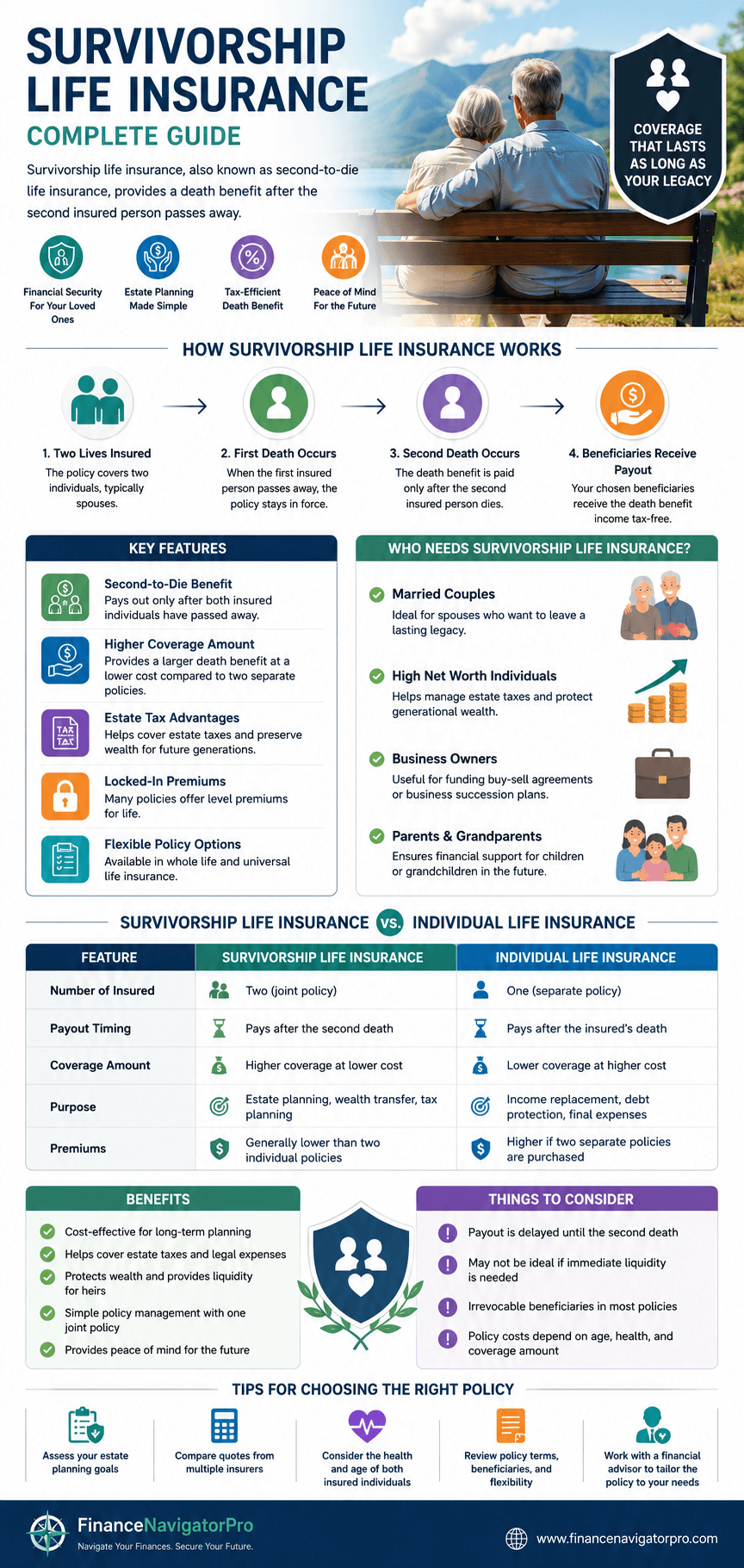
Why It’s Called Second-to-Die Insurance
The nickname ‘second-to-die’ is straightforward: the policy pays at the second insured’s death. Insurance professionals coined this term to distinguish it from joint first-to-die policies (which pay at the first death) and from traditional single-life policies.
The product gained popularity in the 1980s and 1990s as the federal estate tax became a significant concern for affluent families. Wealthy couples needed a tax-efficient way to fund the estate tax liability that would hit their heirs after both spouses had passed. Second-to-die policies filled that gap perfectly — they provided a large death benefit precisely when the estate tax clock started ticking.
A common misconception is that the surviving spouse is left financially vulnerable after the first death. In a well-designed estate plan, individual life insurance policies handle the surviving spouse’s income replacement needs, while the survivorship policy handles the estate-level tax and transfer costs after both are gone. These are distinct financial objectives that typically require separate tools.
Who Should Consider Survivorship Life Insurance?
Survivorship life insurance isn’t for everyone. It’s a specialized product designed for specific financial situations. Here are the primary groups who benefit most:
High-Net-Worth Families with Estate Tax Concerns
For 2026, the federal estate tax exemption is approximately $13.99 million per individual (indexed for inflation). Couples can effectively shelter up to roughly $27.98 million from federal estate taxes through proper planning — but estates above those thresholds can face a 40% federal estate tax at the surviving spouse’s death. A survivorship policy provides the liquidity needed to pay that tax bill without forcing heirs to sell real estate, business interests, or investment portfolios at potentially unfavorable prices or under time pressure.
Business Owners and Partners
Family business owners face a particular challenge: the business may represent the majority of their net worth, but it isn’t liquid. Heirs who inherit a business interest may be forced to sell shares or liquidate operations simply to fund an estate tax bill. A survivorship policy can provide the necessary liquidity to keep the business intact and operational for the next generation.
Business partners can also use survivorship policies as part of a buy-sell agreement, though the structure requires careful legal and tax planning.
Family Farms and Agricultural Properties
Agricultural estates face the same illiquidity problem as family businesses, often compounded by the difficulty of dividing farmland. The IRS does allow certain special-use valuations under Section 2032A for qualified farm property, but even with those benefits, estate taxes can still pose a serious threat to the family farm’s continuity. Survivorship insurance provides a dedicated fund to address this without disrupting operations.
Real Estate Investors
Real estate portfolios are notoriously difficult to liquidate quickly. A survivorship policy can fund estate taxes and settlement costs so heirs don’t have to fire-sell investment properties in a compressed timeframe.
Parents of Children with Special Needs
Parents caring for a child with physical or developmental disabilities carry a lifetime financial responsibility that doesn’t end when the parents are gone. A survivorship policy paired with a Special Needs Trust (SNT) can fund ongoing care for a dependent child without disqualifying them from government benefits like Medicaid or SSI. The trust receives the death benefit after both parents have passed and uses it to supplement (not replace) government support.
Couples Leaving Charitable Gifts
Philanthropically motivated couples may use a survivorship policy to fund a charitable bequest at the second death. The strategy allows them to make a significant gift to their favorite cause — a foundation, university, hospital, or religious institution — while preserving their other assets for family heirs during their lifetimes.
Wealth Preservation Across Generations
For families building a multi-generational legacy, survivorship insurance can be a cornerstone of dynasty trust planning. By pairing the policy with an Irrevocable Life Insurance Trust, families can move wealth out of their taxable estates and ensure it transfers to children, grandchildren, and beyond with minimal tax friction.
Types of Survivorship Life Insurance
Survivorship life insurance is available in several policy structures. Each has a different approach to premiums, cash value growth, flexibility, and risk. Understanding these differences helps you choose the right fit for your situation.
Survivorship Whole Life Insurance
Survivorship whole life is the most traditional option. Premiums are fixed and guaranteed never to increase. The policy builds cash value at a guaranteed rate, and many policies also pay dividends (though dividends are not guaranteed). The death benefit is guaranteed for life, provided premiums are paid.
Best for: Couples who prioritize guarantees and simplicity over flexibility or growth potential.
Survivorship Universal Life Insurance
Survivorship universal life (SUL) offers flexible premiums and adjustable death benefit amounts — within limits. Cash value grows at a rate tied to current interest rates declared by the insurance company, typically with a minimum guaranteed rate. Policyholders have the ability to pay more when cash flow allows or reduce premiums in leaner years (subject to maintaining sufficient cash value to keep the policy in force).
Best for: Couples who want permanent coverage with some premium flexibility and don’t need the highest potential returns.
Survivorship Indexed Universal Life Insurance
Survivorship indexed universal life (SIUL) ties cash value growth to the performance of a market index — commonly the S&P 500 — subject to a cap (maximum growth rate) and a floor (minimum, often 0%). This means the policy can participate in market upswings without the risk of losing cash value due to market downturns.
Best for: Couples seeking higher growth potential for cash value accumulation while maintaining a guaranteed floor of protection.
Survivorship Guaranteed Universal Life Insurance
Survivorship guaranteed universal life (SGUL) is the leanest option. It provides a guaranteed death benefit up to a specific age (often 90, 95, 100, 105, or 121) with minimal cash value accumulation. Premiums are lower than whole life, and the product acts similarly to permanent term insurance — maximum death benefit for minimum cost.
Best for: Couples focused entirely on maximizing the death benefit per premium dollar, with no need for cash value access.
| Feature | Whole Life | Universal Life | Indexed UL | Guaranteed UL |
|---|---|---|---|---|
| Premium | Fixed, highest | Flexible | Flexible | Fixed, lower |
| Cash Value | Guaranteed growth | Interest-based | Index-linked w/ floor | Minimal |
| Flexibility | Low | Moderate | Moderate | Low |
| Risk | Lowest | Low-moderate | Moderate | Low |
| Best Use | Guaranteed wealth transfer | Flexible estate planning | Growth + protection | Max death benefit, low cost |
Survivorship Life Insurance vs. Joint Life Insurance
Joint life insurance covers two people, but the term ‘joint life’ actually encompasses two very different products. Understanding the distinction matters.
A joint first-to-die policy pays the death benefit when the FIRST insured dies. This is designed for income replacement — ensuring a surviving spouse or business partner has financial resources after losing their co-insured. A survivorship (second-to-die) policy, by contrast, holds the benefit until the SECOND insured dies, making it a pure estate planning and wealth transfer tool.
| Feature | Joint First-to-Die | Survivorship (Second-to-Die) |
|---|---|---|
| Death Benefit Timing | At first death | After both insured have died |
| Primary Purpose | Income replacement for survivor | Estate taxes, wealth transfer, trusts |
| Premium | Higher (earlier expected payout) | Lower (payout further in future) |
| Estate Planning | Limited direct benefit | Core estate planning tool |
| Cash Value | Depends on policy type | Depends on policy type |
| Ideal Buyer | Dual-income couples, business partners needing income protection | High-net-worth estates, business succession, special needs planning |
Survivorship Life Insurance vs. Two Individual Policies
Another common comparison is between a survivorship policy and purchasing two separate permanent life insurance policies. Both approaches have merit — the right choice depends on your specific estate planning goals.
Advantages of Survivorship Over Two Individual Policies
Advantages of Two Individual Policies
When Separate Policies Are the Better Choice
If either spouse has significant income that the other depends on, individual life insurance is essential. Survivorship life insurance does not help a surviving spouse pay the mortgage, fund retirement, or replace lost earnings. For income protection, separate policies are non-negotiable. The best estate plans often include both. If you’re still weighing how much protection your household actually needs, our guide on what insurance coverage you need is a useful starting point.
Advantages of Survivorship Life Insurance
Survivorship life insurance offers a unique combination of benefits that few other financial products can match:
Disadvantages of Survivorship Life Insurance
No financial product is perfect. Before committing to a survivorship policy, it’s important to understand the potential drawbacks:
Estate Planning Benefits of Survivorship Life Insurance
For families with significant wealth, survivorship life insurance is one of the most efficient estate planning tools available. Here’s why it matters at every layer of an estate plan:
Federal Estate Tax Coverage
The federal estate tax — sometimes called the ‘death tax’ — is assessed on estates that exceed the applicable exemption at the surviving spouse’s death. For 2026, this exemption is scheduled to revert to approximately $7 million per person (adjusted for inflation) when the Tax Cuts and Jobs Act provisions sunset, unless Congress acts. That change would dramatically increase the number of estates subject to estate tax. A survivorship policy can be sized to cover the anticipated tax bill, ensuring heirs receive the intended inheritance.
Estate Liquidity
Even when no estate tax applies, settling an estate requires cash: attorney fees, executor fees, appraisals, final medical bills, and funeral costs. For estates heavy in illiquid assets like real estate, business interests, or collectibles, these costs can force rushed sales. A survivorship policy ensures liquid funds are available exactly when needed.
Business Succession Planning
For business owners, survivorship life insurance can fund a buy-sell agreement activated at the second death, ensuring remaining partners or heirs can purchase the business interest at a predetermined price. This protects family members from being forced into an unwanted business partnership while also giving surviving partners the funds to buy out the estate.
Trust Planning and Legacy Wealth
By holding the survivorship policy inside an ILIT, a couple can remove the death benefit from both spouses’ taxable estates. The trust receives the death benefit and distributes it according to the trust terms — potentially across multiple generations through a dynasty trust structure. This multi-generational planning approach allows wealth to compound outside the estate tax system for decades.
Asset Preservation Strategy
Rather than liquidating a portfolio of stocks, real estate, or business interests to pay estate taxes, heirs can use the life insurance death benefit to cover the tax bill and preserve the underlying assets. This is particularly valuable for assets with embedded capital gains — heirs benefit from a step-up in cost basis, making it even more tax-efficient to hold rather than sell. (See our overview of capital gains tax rates for how the step-up in basis works.)
Survivorship Life Insurance and Irrevocable Life Insurance Trusts (ILITs)
An Irrevocable Life Insurance Trust (ILIT) is one of the most powerful estate planning tools available — and survivorship life insurance is the product most commonly held inside one.
How an ILIT Works
Tax Advantages of an ILIT
Without an ILIT, a life insurance policy owned by the insured is included in their taxable estate under IRC Section 2042. For a $5 million policy, that could mean up to $2 million in estate taxes on the death benefit itself — reducing its value significantly. An ILIT, properly structured, removes the policy from the taxable estate entirely, preserving the full death benefit for heirs.
Annual gifts to the ILIT may also qualify for the annual gift tax exclusion (currently $18,000 per beneficiary in 2026), further reducing the taxable estate over time.
Common ILIT Mistakes to Avoid
Survivorship Life Insurance Costs
One of the most compelling reasons to consider survivorship life insurance is cost efficiency. Because the policy pays at the second death — often far in the future relative to a single-life policy — insurers can offer lower premiums per dollar of death benefit. The exact figure always comes down to how your quote is calculated, but the factors below give you a strong starting point.
Factors That Affect Pricing
Illustrative Premium Ranges
As a general illustration — not a guarantee — a healthy couple both aged 55 might expect to pay roughly $5,000 to $12,000 per year for a $2 million survivorship guaranteed universal life policy, depending on the insurer and specific underwriting results. Whole life policies for the same benefit amount and ages could run $15,000 to $25,000 or more annually. Actual premiums can only be determined through a formal underwriting and quote process with a licensed insurance professional.
How to Qualify for Survivorship Life Insurance
Qualifying for a survivorship policy involves medical and financial underwriting. Understanding the process can help you prepare.
Medical Underwriting
Most survivorship policies require both insured individuals to complete a health evaluation. This typically includes a paramedical exam (blood draw, urine sample, blood pressure check, height and weight), review of medical records (Attending Physician Statements for significant conditions), and prescription history checks.
Because the policy covers two lives jointly, underwriters look at the combined mortality risk. A significantly impaired insured may be assigned a higher table rating, which increases the premium — but in many cases the healthy co-insured’s mortality helps balance the overall risk, making coverage more accessible than on a single-life policy.
No-Exam Options
Some insurers offer simplified underwriting for smaller face amounts or certain age ranges. These accelerated underwriting processes use electronic health records, prescription databases, and predictive models to assess risk without requiring a physical exam. Coverage limits and eligibility vary by carrier.
Financial Underwriting
For large policies — particularly those in the millions — insurers also assess financial justification. They want to ensure the death benefit bears a reasonable relationship to the estate planning need. Applicants may be asked to provide estate planning documents, financial statements, or a letter of justification from their advisor or attorney.
Age Requirements
Most insurers offer survivorship life insurance to couples where both insured individuals are between age 20 and 80 (some carriers extend to 85 or even 90 for certain products). Older applicants may have fewer policy options but can still often obtain coverage.
Riders Available on Survivorship Life Insurance
Policy riders allow you to customize a survivorship policy to meet your specific needs. Common riders include:
Accelerated Death Benefit Rider
Allows one or both insured individuals to access a portion of the death benefit while alive if diagnosed with a terminal illness (typically with a life expectancy of 12–24 months or less). Some versions also cover chronic or critical illness. Usually included at no additional cost.
Long-Term Care Rider
Provides access to the death benefit to pay for qualified long-term care expenses if one or both insured individuals need assistance with activities of daily living. This can significantly reduce the out-of-pocket cost of nursing home or home care while preserving other assets.
Waiver of Premium Rider
Waives future premium payments if one insured becomes totally disabled. Some survivorship policies offer a waiver that activates at the first insured’s death so the surviving spouse doesn’t have to continue paying premiums alone.
Overloan Protection Rider
Prevents a policy from lapsing due to excessive loans against the cash value. This is especially important for policies that have been aggressively loaned against over many years.
Child Rider
Provides a small death benefit for covered children named in the rider. This is more common on individual policies but is available on some survivorship products.
Guaranteed Insurability Rider
Allows the insured individuals to purchase additional coverage at specified intervals without new medical underwriting. Useful if estate planning needs grow over time.
Best Survivorship Life Insurance Companies
The life insurance market includes dozens of carriers offering survivorship products. The best choice depends on your age, health, financial goals, and the specific product features you need. The following companies have historically been recognized for strong financial strength, competitive survivorship products, and quality service:
| Company | Financial Strength | Policy Types | Customization | Best For | Customer Service |
|---|---|---|---|---|---|
| Pacific Life | A+ (AM Best) | SUL, SIUL, SGUL | High | Estate planning, high-net-worth | Excellent |
| Lincoln Financial | A+ (AM Best) | SUL, SIUL, SGUL | High | Flexible premium structures | Excellent |
| John Hancock | A+ (AM Best) | SWL, SUL, SIUL | Moderate-High | Wellness benefits, ILIT planning | Very Good |
| Protective Life | A+ (AM Best) | SGUL, SUL | Moderate | Guaranteed death benefit | Good |
| North American | A+ (AM Best) | SIUL, SGUL | Moderate | Competitive premiums | Good |
| Nationwide | A+ (AM Best) | SWL, SUL, SIUL | High | Business succession | Excellent |
Note: Insurer availability, product offerings, financial ratings, and underwriting guidelines are subject to change and vary by state. The companies listed above are included for educational reference only. Always verify current ratings and product availability directly with the insurer or a licensed professional. (SWL = Survivorship Whole Life; SUL = Survivorship Universal Life; SIUL = Survivorship Indexed UL; SGUL = Survivorship Guaranteed UL)
How to Choose the Right Survivorship Life Insurance Policy
Selecting a survivorship policy is a significant financial decision. Use this framework to guide your process:
Step-by-Step Decision Checklist
Questions to Ask Before Buying
Common Mistakes to Avoid with Survivorship Life Insurance
Even well-intentioned estate plans can go wrong. Here are the most common pitfalls to avoid:
Real-Life Examples
Robert and Margaret are both 62 years old. Their estate — a mix of investment accounts, real estate, and a family business — is valued at $22 million. After the anticipated estate tax exemption sunset, their estate could face a significant federal estate tax bill when the surviving spouse eventually passes.
Their attorney recommends a $4 million survivorship guaranteed universal life policy held inside an ILIT. Annual premiums of approximately $52,000 are gifted to the ILIT each year, qualifying for annual gift tax exclusions. When the second of them passes, the ILIT receives $4 million in income-tax-free proceeds, which is used to pay the estate tax bill. The family’s real estate and business interests are preserved intact for their children — without any forced liquidation.
Susan and David co-own a manufacturing company valued at $8 million. Each owns 50%. They purchase a $4 million survivorship life insurance policy structured to fund their buy-sell agreement. When the second of them passes, the death benefit funds the estate’s buyout of the surviving family members, ensuring ownership transfers cleanly and the company can continue operating without a disruptive ownership dispute.
Jim and Carla have three children, including a 28-year-old daughter with a severe developmental disability who requires lifelong supervised care. Jim and Carla know that when they’re both gone, their daughter will need ongoing financial support — but without careful planning, an inheritance could disqualify her from Medicaid.
They establish a Special Needs Trust naming their daughter as beneficiary and fund it with a $1.5 million survivorship whole life policy owned by the trust. After both Jim and Carla have passed, the trust receives the death benefit and uses it to supplement their daughter’s care — covering expenses not paid by Medicaid — without jeopardizing her government benefits eligibility.
Frequently Asked Questions
Final Thoughts
Survivorship life insurance is one of the most targeted, efficient tools in the estate planning toolkit. When you understand what it does — and, equally important, what it doesn’t do — it becomes much easier to evaluate whether it belongs in your financial plan.
If you’re planning to leave a meaningful legacy to your heirs, protect a family business, fund ongoing care for a child with special needs, or ensure your estate doesn’t force painful asset liquidations, a second-to-die policy deserves serious consideration. The lower cost structure, favorable joint underwriting, and seamless integration with trust planning make it a product unlike almost anything else in personal finance.
That said, this is not a one-size-fits-all product. Estate planning is deeply personal. Tax laws change. Family circumstances evolve. A policy that’s perfectly designed today should be reviewed regularly to ensure it remains aligned with your goals.
The best next step is a conversation with an experienced, licensed insurance professional and an estate planning attorney who can model your specific situation and help you determine whether survivorship life insurance is right for your family.