
Guide to Coverage, Costs, Requirements & Best Companies
⚡ Quick Answer
What Is Collector Car Insurance?
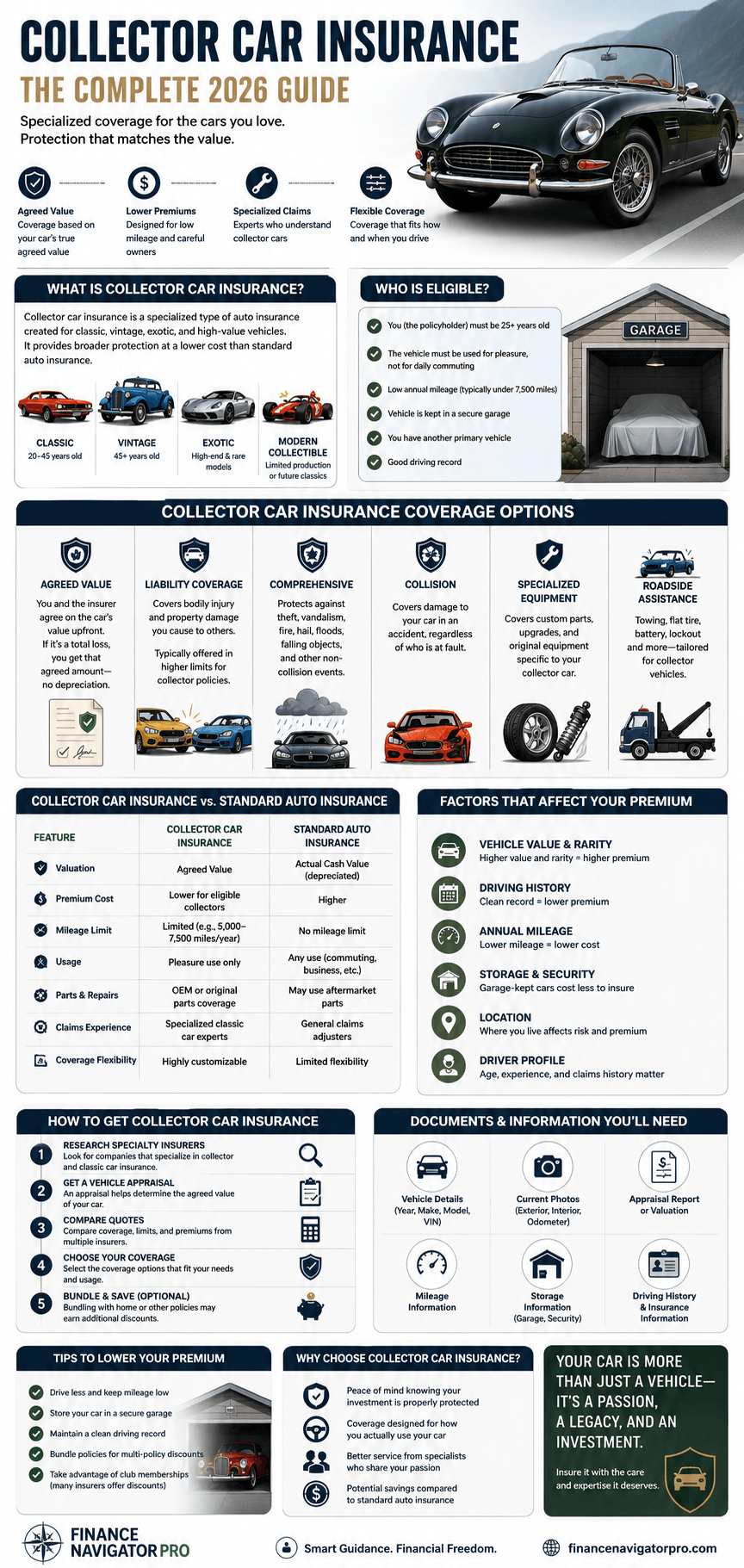
Collector car insurance is specialized auto insurance designed for vehicles that are driven rarely and stored carefully — classic cars, antiques, muscle cars, exotics, and historically significant automobiles.
Best providers: Hagerty, American Collectors Insurance, Grundy, Safeco, Progressive Classic
What Is Collector Car Insurance?
Collector car insurance is a specialized form of auto insurance built around one core reality: your collector vehicle is not a daily driver. It’s a prized possession, a hobby vehicle, a piece of automotive history — and standard auto insurance policies weren’t designed with that in mind.
When you insure a 1967 Ford Mustang GT500 or a pristine 1969 Chevrolet Camaro Z28 with a standard carrier, that insurer treats it like any other depreciating asset. If you total your car, they’ll cut you a check based on what your vehicle is worth today in the open market — minus depreciation, minus the deductible, minus whatever adjusters decide it’s worth on that particular day.
Collector car insurance companies do things differently. They work with you upfront to agree on your vehicle’s value before anything happens. That agreed value — also called guaranteed value or stated value — is what you receive if the car is totaled. No negotiation. No depreciation. No surprises.
Beyond agreed value, collector car policies include coverage options you simply won’t find on a standard policy: spare parts coverage, auto memorabilia and automobilia coverage, trip interruption benefits, and mileage-based pricing that rewards you for keeping the car parked 90% of the year.
How It Differs From Standard Auto Insurance
| Feature | Collector Car vs. Standard Auto Insurance |
|---|---|
| Valuation Method | Agreed Value (full payout, no depreciation) vs. Actual Cash Value (depreciation deducted) |
| Annual Premium | $200–$600/year vs. $1,200–$2,000+/year for comparable vehicles |
| Mileage Limits | Typically 1,000–6,000 miles/year vs. unlimited miles |
| Usage Restrictions | Pleasure/hobby use only vs. commuting, errands, daily driving |
| Storage Requirement | Enclosed garage often required vs. no storage requirement |
| Spare Parts Coverage | Available up to $500–$2,000 vs. typically not available |
| Roadside Assistance | Flatbed towing specialized for collector vehicles vs. standard tow |
| Claims Process | Dedicated classic car adjusters vs. general auto adjusters |
💡 Expert Tip
Always get a professional appraisal before purchasing collector car insurance. An appraisal document protects you at claim time and helps you set the right agreed value — avoiding both underinsurance (leaving money on the table) and overinsurance (paying too much in premium).
How Collector Car Insurance Works
Understanding the mechanics of a collector car policy helps you buy the right coverage and avoid costly mistakes. Here’s how the process works from start to finish:
Step-by-Step: From Application to Claim
Who Needs Collector Car Insurance?
If your vehicle fits into any of the categories below, you almost certainly need — and will financially benefit from — a dedicated collector car policy rather than standard auto insurance.
🚗 Classic Cars (25+ years old)
The backbone of the collector car market. Pre-1980 vehicles with historical or nostalgic significance qualify with virtually every major collector insurer.
💪 Muscle Cars
High-performance American vehicles from the 1960s–1970s — Camaros, Mustangs, Chevelles, GTOs, and Cudas — often carry values far exceeding their original sticker price.
🏛️ Antique Cars (45+ years old)
Vehicles 45 years or older qualify for antique registration in most states, often paired with antique auto insurance at significantly reduced rates.
📜 Vintage Cars (Pre-WWII)
Pre-1945 vehicles carry extreme historical significance. Agreed value is essential — standard ACV calculations are meaningless for a 1929 Model A Ford.
🏎️ Luxury & Exotic Collector Cars
Ferrari, Lamborghini, Porsche GT variants, Aston Martin, Rolls-Royce, and Bentley models require specialized coverage that accounts for both extreme value and parts availability.
🔧 Hot Rods & Custom Cars
Modified classics require explicit coverage for custom parts, aftermarket engines, and specialty paint. Hagerty and American Collectors Insurance are known specialists.
🛠️ Restored Cars
Vehicles undergoing restoration or recently restored carry unique risk. Several specialized policies cover parts, tools, and in-transit risk during restoration.
🔮 Future Collectibles
Limited-production modern vehicles — Dodge Challenger Hellcat, Ford Shelby GT500, Porsche GT3 RS — may qualify for collector coverage even when brand-new.
What Qualifies as a Collector Car?
There’s no single universal definition, but most collector car insurers use a combination of the following criteria to determine eligibility:
| Criteria | Typical Requirement | Notes | Impact on Premium |
|---|---|---|---|
| Age | Usually 15–25+ years | Some insurers accept 10-year-old vehicles with documented collectability | Older = lower premium |
| Condition | Good to excellent / show quality | Daily driver condition may be declined or require ACV policy | Better condition = lower premium |
| Mileage Limits | 1,000 – 6,000 miles/year | Higher limits available with some carriers | Lower mileage = lower premium |
| Storage | Enclosed private garage | Some allow carports or insured storage facilities | Proper storage = lower premium |
| Other Vehicle | Owner must have a daily-use vehicle | Required by most insurers to confirm no commuting on the collector car | Required by most carriers |
| Driving Record | Clean or near-clean record | DUI or major violations in past 3–5 years may result in denial | Clean record = lower premium |
| Ownership Docs | Title, registration, lien info | Lien holders may affect agreed value availability | Documentation completeness matters |
| Usage | Pleasure / hobby / car shows only | Must not be used for commuting, business, or ridesharing | Core eligibility requirement |
Collector vs. Classic vs. Antique vs. Regular Auto Insurance
These terms are often used interchangeably — even by insurance agents — but they have real differences that affect your coverage, eligibility, and premium. Here’s the definitive breakdown:
| Feature | Collector Car | Classic Car | Antique Car | Regular Auto |
|---|---|---|---|---|
| Vehicle Age | 15–25+ yrs | 25+ yrs | 45+ yrs | Any age |
| Valuation Type | Agreed Value | Agreed or Stated | Agreed Value | Actual Cash Value |
| Annual Premium | $200–$600 | $250–$700 | $150–$500 | $1,200–$2,000+ |
| Mileage Limits | 1,000–6,000/yr | 1,500–7,500/yr | Often 1,000–2,500 | Unlimited |
| Daily Driving | Not permitted | Not permitted | Not permitted | Permitted |
| Specialty Adjusters | Yes | Yes | Yes | No |
| Best For | Any collector-grade vehicle | Traditional classic collectors | True antique/historic cars | Daily transportation |
Agreed Value vs. Stated Value vs. Actual Cash Value
This is the most important concept in collector car insurance — and the one most buyers get wrong. Understanding how your vehicle gets valued at claim time could be worth tens of thousands of dollars.
Agreed Value Example
You insure a 1967 Ford Mustang Fastback for an agreed value of $85,000. The car is totaled in a garage fire. You receive exactly $85,000 — period.
Stated Value Example
You state a value of $85,000 for the same Mustang. But the insurer’s adjuster determines actual cash value is $70,000. You receive $70,000 — not $85,000. Stated value does NOT guarantee full payout.
| Aspect | Agreed Value | Stated Value | Actual Cash Value | Recommendation |
|---|---|---|---|---|
| Payout at Total Loss | Exactly the agreed amount | Lesser of stated or ACV | Fair market value minus depreciation | Always choose Agreed Value |
| Negotiation at Claim | None — locked in | Possible | Extensive — adjuster-driven | Eliminates disputes |
| Depreciation | No depreciation applied | May apply | Always applied | Only Agreed is dep-free |
| Risk Level | Low — protected | Medium | High — underinsurance risk | Agreed Value is safest |
🔑 Key Takeaway
If your insurer offers “stated value” and calls it equivalent to agreed value — it is not. Ask explicitly: “Will I receive the full stated/agreed value at claim time with no depreciation deduction?” If the answer isn’t a clear yes, it’s not true agreed value coverage. For any collector vehicle worth more than $15,000, agreed value coverage is non-negotiable.
What Does Collector Car Insurance Cover?
A comprehensive collector car policy can include all of the following coverage types. Not every insurer offers every option — review your policy carefully and ask specifically about coverages that matter to you.
What Isn’t Covered?
Understanding exclusions is just as important as understanding what’s covered. Collector car insurance policies specifically exclude the following:
- ✘ Daily commuting or regular transportation use
- ✘ Business use of any kind (delivery, sales calls, client transport)
- ✘ Ridesharing services (Uber, Lyft, or similar)
- ✘ Commercial photography or filming without a separate endorsement
- ✘ Racing or track events (separate track day coverage is required)
- ✘ Intentional damage or fraud
- ✘ Normal wear and tear, rust, corrosion, or gradual deterioration
- ✘ Mechanical breakdown (this is a maintenance issue, not an insured peril)
- ✘ Engine failure due to lack of maintenance
- ✘ Modifications not disclosed to and approved by the insurer
- ✘ Vehicles stored in locations not meeting policy requirements (e.g., street parking)
- ✘ Mileage beyond the policy’s annual limit
⚠️ Common Mistake to Avoid
Many collectors drive their car to a car show, add a few extra miles on the way home exploring backroads, and exceed their annual mileage limit without realizing it. Keep a physical or digital mileage log and check it quarterly. Exceeding your policy limit doesn’t automatically void coverage with every insurer, but it can complicate a claim significantly.
Collector Car Insurance Requirements
Before you can qualify for a collector car policy, most insurers require you to meet specific eligibility criteria. These vary by carrier, but here are the standard requirements you should expect:
| Requirement | Details & What to Expect |
|---|---|
| Minimum Driver Age | Most insurers require the primary driver to be at least 25 years old. Some carriers like Hagerty offer coverage for younger collectors with restrictions. |
| Clean Driving Record | No DUI convictions in the past 5 years. Major violations (reckless driving, hit-and-run) in the past 3 years may result in denial. |
| Enclosed Garage Storage | The vehicle must be stored in a private, enclosed garage — not a carport, parking lot, or street. Some insurers accept climate-controlled storage facilities. |
| Annual Mileage Limit | Typically 1,000 to 6,000 miles per year for pleasure driving. Higher limits available (up to 7,500+ miles) with select carriers at increased premium. |
| Daily-Use Vehicle | You must own or regularly use another vehicle for daily transportation. This confirms the collector car isn’t your primary transportation. |
| Valid Driver’s License | All drivers listed on the policy must hold valid, current driver’s licenses. |
| Vehicle Appraisal | Required by most carriers for agreed value policies on vehicles worth $30,000+. Some carriers require appraisals for any vehicle over 25 years old. |
| Vehicle Photos | Most insurers require 4–8 photos of the vehicle (front, rear, sides, interior, engine bay) at policy inception. High-resolution photos protect you at claim time. |
| Title & Registration | You must hold a clear title. Vehicles with salvage or rebuilt titles face eligibility restrictions at most collector car insurers. |
How Much Does Collector Car Insurance Cost?
Collector car insurance is remarkably affordable — typically 75–85% less expensive than insuring the same vehicle under a standard auto policy. Here’s what you can realistically expect to pay:
National Average Premiums (2026)
| Vehicle Value | Annual Premium | Monthly Equivalent | vs. Standard Policy |
|---|---|---|---|
| $10,000 – $25,000 | $150 – $300/yr | $12.50 – $25/mo | Save ~$800–$1,200/yr |
| $25,001 – $50,000 | $250 – $500/yr | $21 – $42/mo | Save ~$1,000–$1,500/yr |
| $50,001 – $100,000 | $400 – $800/yr | $33 – $67/mo | Save ~$1,200–$2,000/yr |
| $100,001 – $250,000 | $700 – $1,500/yr | $58 – $125/mo | Save ~$2,000–$4,000/yr |
| $250,001 – $500,000 | $1,200 – $2,800/yr | $100 – $233/mo | Save ~$3,000–$6,000/yr |
| $500,001 – $1,000,000 | $2,000 – $5,000/yr | $167 – $417/mo | Specialist carriers only |
| $1,000,000+ | $3,500 – $10,000+/yr | $292 – $833/mo | Chubb, Grundy, Hagerty specialty |
Factors That Affect Your Premium
Collector Car Insurance Cost by Vehicle Type
| Vehicle | Typical Market Value | Est. Annual Premium | Notes |
|---|---|---|---|
| 1967 Ford Mustang GT500 | $150,000 – $300,000+ | $900 – $2,200/yr | High demand; market values volatile |
| 1969 Camaro Z28 | $80,000 – $160,000 | $600 – $1,400/yr | Numbers-matching commands premium |
| 1963 Corvette Split Window | $100,000 – $200,000+ | $700 – $1,600/yr | One-year-only body; very collectible |
| 1970 Chevelle SS 454 | $60,000 – $120,000 | $450 – $1,000/yr | Popular muscle car; parts available |
| 2005 Ford GT | $250,000 – $450,000+ | $1,500 – $3,000/yr | Modern exotic collector car |
| Ferrari 308 GTS (1977-85) | $50,000 – $100,000 | $400 – $900/yr | Italian exotic; parts can be expensive |
| Porsche 911 (1970s–1980s) | $80,000 – $200,000+ | $600 – $1,600/yr | Air-cooled appreciation market |
| 1957 Chevrolet Bel Air | $40,000 – $80,000 | $300 – $700/yr | American classic; strong demand |
| Ford Model A (1927–31) | $15,000 – $35,000 | $200 – $400/yr | Antique; historically significant |
| Lamborghini Countach (1974-90) | $350,000 – $750,000+ | $2,000 – $5,000+/yr | High-value Italian exotic; specialist required |
| 1994 Toyota Supra Turbo | $60,000 – $180,000+ | $450 – $1,400/yr | JDM market; rapidly appreciating |
Collector Car Insurance Cost by State
Premiums vary by state based on local theft rates, weather risks, road conditions, and state insurance regulations. Below are estimated annual premiums for a collector car insured at $50,000 agreed value with a 3,000-mile annual limit:
| State | Est. Annual Premium | State | Est. Annual Premium | Key Regional Factor |
|---|---|---|---|---|
| California | $420 – $680 | Texas | $380 – $620 | High theft (CA), storm risk (TX) |
| Florida | $400 – $680 | New York | $450 – $740 | Hurricane risk (FL), density (NY) |
| Michigan | $350 – $560 | Illinois | $360 – $580 | Rust belt climate; strong car culture |
| Ohio | $310 – $500 | Pennsylvania | $330 – $530 | Favorable rates; large car show culture |
| Arizona | $300 – $480 | Nevada | $290 – $460 | Desert climate favorable; low rust risk |
| Tennessee | $300 – $480 | Indiana | $295 – $470 | Low cost-of-living states; favorable rates |
| New Jersey | $430 – $700 | Massachusetts | $410 – $670 | Dense population; higher theft exposure |
Best Collector Car Insurance Companies (2026)
Not all collector car insurers are created equal. Here is a detailed breakdown of the best companies in the market, including their strengths, weaknesses, and which type of collector they serve best. You can also check insurance discounts most people don’t know about to stack additional savings.
Up to 25,000 miles/year — highest in the market. Best for active drivers who bundle classic car coverage with regular auto or home policy.
Agreed value coverage through its Classic Car division with competitive rates, particularly in western states. Strong financial backing via Liberty Mutual.
GEICO partners with American Modern Insurance for collector coverage. Convenient for existing GEICO customers. American Modern’s standalone product may offer better features.
Collector car coverage in most states through its extensive agent network. Better suited to collectors who value face-to-face agent relationships.
Chubb’s collector vehicle program is designed for high-net-worth individuals with investment-grade collections. Bespoke coverage, concierge claims service, and no stated mileage limits for qualified clients.
⚡ Quick Comparison Summary
Collector Car Insurance Discounts
Most collector car insurers offer significant discounts that can reduce your premium by 10–30%. Here are the most common and impactful. For a complete guide on how to lower your insurance premium, see our dedicated guide.
| Discount Type | Typical Savings | How to Qualify |
|---|---|---|
| Multi-Vehicle Discount | 10–25% | Insuring 2+ collector vehicles with the same carrier |
| Car Club Membership | 5–15% | Membership in an approved car club (AACA, SVRA, etc.) |
| Garage & Security System | 5–15% | Alarmed garage with monitored security system |
| Low Mileage | 5–20% | Choosing the lowest available mileage tier (1,000 miles/year) |
| Bundling (Home + Auto) | 5–15% | Bundling collector car policy with homeowner’s or other policies |
| Defensive Driving Course | 5–10% | Completing an approved defensive driving course |
| Clean Driving Record | 10–20% | No accidents or violations in past 3–5 years |
| Vehicle Safety Features | 5–10% | Locking gas cap, kill switch, GPS tracker, or LoJack |
How to File a Collector Car Insurance Claim
Filing a claim on your collector car is different from a standard auto claim. Here’s what to expect — and how to protect yourself through the process:
Modified & Custom Collector Cars
Modifications can dramatically affect your collector car’s value, insurability, and coverage. Here’s what you need to know:
Most collector car insurers cover vehicles that have been moderately modified from original specifications — engine upgrades, suspension improvements, custom paint — as long as modifications are disclosed upfront and approved by the insurer. Undisclosed modifications can void your coverage at claim time.
Collector Car Insurance During Restoration
A vehicle under active restoration presents unique insurance challenges. Standard collector car policies typically require a roadworthy vehicle. However, several specialist programs exist for vehicles in the restoration process:
| Restoration Stage | Insurance Considerations |
|---|---|
| Disassembly & Frame-Off | Vehicle is not roadworthy; most collector policies require the car to be operable. Check if your insurer offers a “restoration policy.” |
| Parts & Components Stored | Spare parts coverage extends to parts stored separately. Ensure your parts inventory is documented and covered. |
| Vehicle in Shop Storage | Verify the shop carries adequate insurance. Your policy may not cover a vehicle while in a third-party shop — ask specifically. |
| In Transit (Trailer) | Most collector policies cover vehicles in transit on a closed trailer. Confirm this is included — especially important during restoration when the car cannot be driven. |
| Partially Restored | Some insurers offer agreed value on partially restored vehicles based on a current appraisal of the vehicle’s condition. |
| Post-Restoration | Update your agreed value immediately after restoration completion. A full concours restoration can double or triple a vehicle’s value. |
Frequently Asked Questions
Q: What is the minimum age requirement for collector car insurance?
Most insurers require the primary driver to be at least 25 years old. Some carriers like Hagerty offer programs for younger enthusiasts with documented experience and added restrictions. The vehicle itself typically must be at least 10–25 years old, depending on the carrier and vehicle type.
Q: Do I need a separate car for daily driving to qualify?
Most collector car insurers — including Hagerty and Grundy — require you to own or have regular access to a separate daily-use vehicle. This confirms that the collector car won’t be used for commuting. American Collectors Insurance and Progressive are more flexible on this requirement in some states.
Q: What happens if I exceed my annual mileage limit?
Exceeding your mileage limit can complicate a claim. Some insurers will prorate your coverage, while others may deny a claim entirely if the mileage limit is significantly exceeded. Keep a mileage log and contact your insurer if you anticipate going over your limit — you can often purchase additional miles.
Q: Is collector car insurance cheaper than regular auto insurance?
Yes — significantly. Collector car insurance typically costs 75–85% less than standard auto insurance for an equivalent vehicle value. The savings come from limited mileage, proper storage, and the lower risk profile of hobby vehicles. Average collector car policies run $200–$600 per year. You can also learn more about the average insurance cost in the US for comparison.
Q: Does collector car insurance cover me at the track?
Standard collector car policies explicitly exclude racing and most track events. However, several insurers — including Hagerty — offer Track Day Coverage endorsements that provide protection for authorized track events at an additional premium.
Q: What is agreed value insurance and why is it important?
Agreed value means you and your insurer agree on the vehicle’s value before the policy starts. If the car is totaled, you receive that exact amount — no depreciation, no negotiation. This is the gold standard for collector cars and is far superior to actual cash value (ACV) policies used by standard auto insurers.
Q: How often should I update my agreed value?
Review your agreed value every 1–2 years. The collector car market has seen significant appreciation in recent years. If your car appreciates significantly and you have an outdated agreed value, you could be seriously underinsured at claim time. A new professional appraisal every 2–3 years is recommended for valuable vehicles.
Q: Can I insure multiple collector cars on one policy?
Yes — most specialist insurers offer multi-vehicle policies with meaningful discounts (typically 10–25% off). This is one of the most effective ways to reduce your per-vehicle premium. Hagerty, American Collectors Insurance, and Grundy all offer fleet policies for serious collectors.
Q: What is spare parts coverage?
Spare parts coverage insures original and reproduction parts stored separately from the vehicle — typically up to $500 to $2,000. If you maintain a parts inventory for your collector car, this coverage is essential. It’s available through Hagerty, American Collectors Insurance, and most specialist carriers.
Q: Does my homeowner’s insurance cover my collector car in the garage?
No — homeowner’s insurance covers the contents of your home but does not cover vehicles. A dedicated auto insurance policy is required for any vehicle, including collector cars stored in an attached garage. Some homeowner’s policies may cover auto memorabilia stored in the garage — check with your homeowner’s insurer.
Q: Can I use my collector car for a charity event or parade?
Yes — most collector car policies allow use for parades, charity events, and community appearances as part of the pleasure/hobby use definition. However, if you charge a fee or use the vehicle commercially (e.g., wedding car rental), that would likely be excluded. Confirm with your insurer for specific event types.
Q: What’s the difference between Hagerty and American Collectors Insurance?
Hagerty is the largest collector car insurer with an extensive ecosystem (valuation tools, magazine, driving club) and is particularly strong for high-value and rare vehicles. American Collectors Insurance offers very competitive rates — often lower than Hagerty — for vehicles in the $10,000–$150,000 range. Both offer agreed value and comparable specialty coverages. The best choice depends on your vehicle’s value and which features matter most to you.
Q: Is a vehicle appraisal required for collector car insurance?
Most carriers require a professional appraisal for vehicles over $30,000 or for vehicles 25+ years old when using agreed value coverage. Even when not required, a professional appraisal is strongly recommended — it documents your vehicle’s condition and value and protects you at claim time. Appraisals typically cost $150–$400.
Q: Can I insure a car that’s not fully restored?
Yes, but coverage options are more limited. You can typically insure a driver-quality vehicle under an agreed value policy. Frame-off restorations in progress may require a specialty restoration policy. Contact Hagerty or American Collectors Insurance for options on in-progress restorations.
Common Collector Car Insurance Mistakes to Avoid
Expert Tips From 20+ Years of Collector Car Insurance
Get your vehicle appraised before applying for insurance — not after. The appraisal establishes value; the insurance protects it.
Always ask: “Is this agreed value or stated value?” These are not the same thing, and the difference can cost you tens of thousands of dollars.
Compare at least three quotes from specialist insurers — Hagerty, American Collectors Insurance, and Grundy — before deciding.
Take dated, high-resolution photographs of your vehicle at least annually. Store copies in cloud storage and with your insurer.
Keep every receipt for parts, restoration work, and maintenance. Documentation is your best friend at claim time.
Review your agreed value every year, especially in active appreciation markets. The 2020s have seen dramatic value increases in muscle cars, JDM imports, and air-cooled Porsches.
Join a recognized car club — not just for community, but for the insurance discount (typically 5–15%).
If you plan to transport your vehicle to shows or auctions, confirm your policy covers in-transit risk on a closed trailer.
Ask about inflation guard endorsements — some policies automatically increase your agreed value annually to track market appreciation.
For vehicles worth $200,000+, work with a specialist insurer (Hagerty, Grundy, or Chubb) rather than a general carrier’s classic car program.
Never use your collector car as a daily driver, even occasionally. A single commute claim under a collector car policy can be problematic if the usage pattern is questioned.
When buying at auction, purchase a short-term transport policy to cover the vehicle from the auction house to your garage.
Real-World Coverage Examples
Example 1 — 1967 Ford Mustang Fastback
Situation: Tom is a Michigan collector who owns a numbers-matching 1967 Mustang Fastback restored to concours condition. Professional appraisal puts the vehicle at $92,000. He drives it approximately 800 miles per year.
Insurance Solution: Tom insures through Hagerty with an agreed value of $92,000, a 1,500-mile annual limit, and full comprehensive and collision coverage. He adds spare parts coverage ($1,500) and auto memorabilia coverage ($500). His annual premium is approximately $580.
Claim Outcome: A garage fire damages the vehicle. Tom receives $92,000 — the full agreed value — within 30 days of filing. No negotiation required.
Example 2 — 1994 Toyota Supra Turbo
Situation: Marcus in California owns a 1994 Toyota Supra Turbo with a 2JZ-GTE engine, single turbo conversion, and full bolt-ons. Market value has climbed to $85,000–$120,000. He modified the car significantly.
Insurance Solution: Marcus disclosed all modifications upfront. His agreed value of $95,000 reflects current JDM market conditions. Hagerty covered the modified vehicle with a modification endorsement. Annual premium: approximately $690.
Claim Outcome: The vehicle is stolen. Marcus receives the full $95,000 agreed value. A standard auto insurer would have likely offered only $40,000–$60,000 based on general used car databases.
Example 3 — 2024 Porsche GT3 RS
Situation: David in Texas purchased a 2024 Porsche GT3 RS at MSRP ($244,500) and maintains it as a collector vehicle and occasional track car. He drives it fewer than 3,000 miles per year on public roads.
Insurance Solution: David insures through Grundy with an agreed value of $310,000 (reflecting current market premiums above MSRP). He purchases a track day endorsement for covered circuit events. Annual premium for the street policy: approximately $2,100.
Key Lesson: Modern collector cars with strong market premiums above MSRP need an agreed value that reflects actual market value — not purchase price. Insuring at MSRP would leave a $65,500 shortfall at total loss.
Collector Car Insurance Checklist Before You Buy
Use this checklist before purchasing or renewing your collector car policy:
Collector Car Insurance Glossary
Understanding collector car insurance terminology helps you buy smarter and avoid surprises at claim time. Here are the most important terms:
Final Verdict — Which Collector Car Insurance Is Right for You?
| Your Situation | Best Choice | Second Choice | Why |
|---|---|---|---|
| First-time collector, vehicle under $30k | American Collectors | Progressive | Competitive rates, easy eligibility, no daily driver req. |
| Serious collector, vehicle $30k–$100k | Hagerty | American Collectors | Superior expertise, valuation tools, flexible mileage |
| High-value rare vehicle ($100k–$300k) | Hagerty or Grundy | Chubb | Agreed value precision and collector market expertise |
| Ultra-high-value vehicle ($300k+) | Grundy or Chubb | Hagerty | Bespoke coverage, highest financial strength ratings |
| Modified or restomod vehicle | Hagerty | American Collectors | Broadest modification acceptance; specialist adjusters |
| Active driver (3,000–10,000 mi/year) | Progressive | Hagerty (extended) | Highest mileage limits in the market |
| Multi-vehicle collection (3+ cars) | Hagerty | American Collectors | Fleet discounts, consolidated management |
| Vehicle under restoration | Hagerty or American Collectors | Grundy | Restoration endorsements; parts and in-transit coverage |
Bottom Line
If you own a vehicle that qualifies as a collector car — and you’re currently insuring it with a standard auto policy — you’re almost certainly overpaying for coverage that would dramatically undervalue your car at claim time.
Switching to a dedicated collector car policy from Hagerty, American Collectors Insurance, or Grundy will typically cut your annual premium by 70–85% while giving you agreed value protection that actually reflects your vehicle’s true worth.
Action Step: Get quotes from at least 3 collector car specialists today — it takes 10 minutes and could save you thousands.
📚 Related Guides You May Find Helpful
Disclaimer: This article is for informational purposes only and does not constitute insurance advice. Coverage, eligibility, and premiums vary by insurer, state, and individual vehicle. Always consult a licensed insurance professional and review your policy documents carefully before purchasing coverage. Premium estimates are approximate and based on market research current as of 2026.