
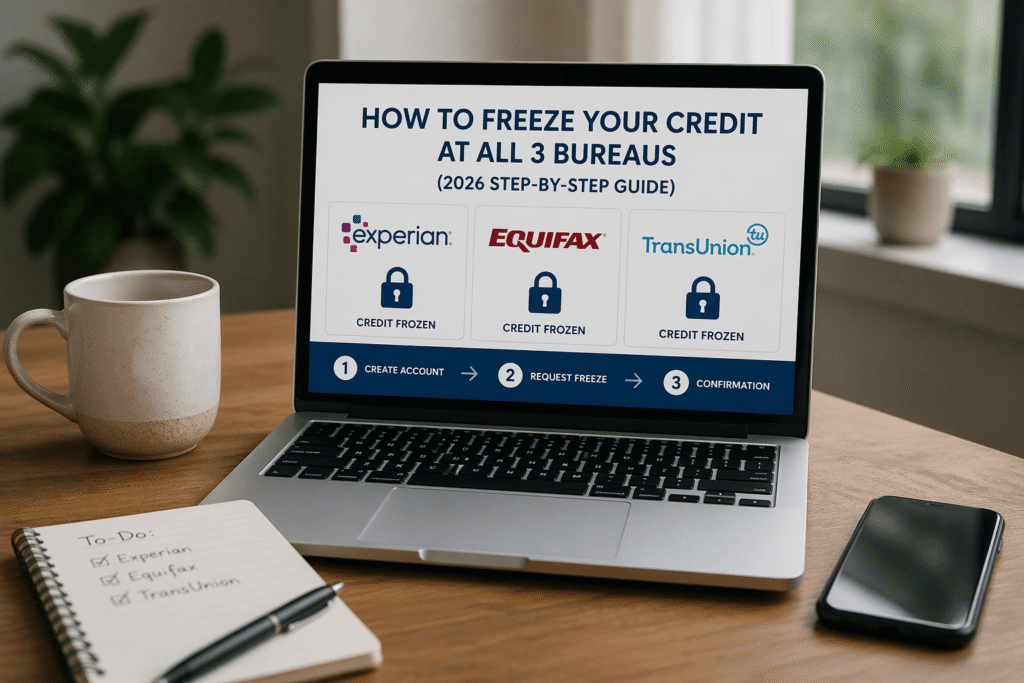
A credit freeze is the single most effective thing an ordinary person can do to protect themselves from identity theft. It’s free, it takes about 10 minutes per bureau, and once it’s done, no one — not even you — can open new credit in your name without lifting it first.
Most people put it off. Then something happens — a data breach notification shows up in their inbox, or a friend calls saying someone opened three credit cards in his name — and suddenly it feels urgent. Don’t wait for that moment.
Here’s everything you need to know about how to freeze your credit at all 3 bureaus: Equifax, Experian, and TransUnion.
What Is a Credit Freeze, Exactly?
Think of your credit report like a file that lenders pull to decide whether to approve you for a loan, credit card, or apartment. When you freeze your credit, you’re essentially locking that file. Lenders can’t see it. So even if someone has your Social Security number, date of birth, and address, they can’t open new accounts in your name because the application will get rejected before it even gets reviewed.
A credit freeze blocks lenders from accessing your credit report, preventing new accounts from being opened. That’s the cleanest definition, and it’s worth remembering.
Here’s what it doesn’t do: it doesn’t stop people from using your existing accounts. If someone gets your credit card number and charges a bunch of stuff, a freeze won’t help with that. It only protects against new account fraud — which is actually the most common and damaging type.
What a Freeze Does NOT Affect
Why a Credit Freeze Actually Matters in 2026
Let’s be honest — data breaches aren’t slowing down. Between the National Public Data breach of 2024 (which exposed Social Security numbers for potentially billions of Americans) and the steady drip of smaller leaks from retailers, healthcare providers, and financial companies, there’s a very real chance your personal info is already floating around somewhere on the dark web.
So what happens if someone has your SSN? Without a credit freeze, they can walk up to a lender’s website, fill out an application with your information, and potentially get approved. You won’t know until it shows up on your credit report — sometimes months later.
Identity theft reports have remained consistently high, with millions of Americans affected every single year. The FTC receives hundreds of thousands of identity theft reports annually, and credit card fraud and new account fraud top the list.
A freeze is free. A fraud investigation is not — in terms of time, stress, and sometimes money. Setting up a freeze now takes 30 minutes. Cleaning up after identity theft can take years.
How to Freeze Your Credit at All 3 Bureaus: Step-by-Step
You need to do this separately at each bureau. There’s no single place to do all three at once. Here’s exactly how to do it.
If the online verification fails (newer addresses or limited credit history), you can call the bureau directly or mail a written request with copies of your ID and proof of address. Don’t skip a bureau just because the online process got tricky.
Credit Freeze vs. Credit Lock: What’s the Difference?
This is where people get confused. And honestly, the bureaus don’t always make it clear because they’d love for you to pay for a credit lock service.
A legal right. Protected by federal law. It’s free. No company can charge you for it.
A product. Offered by bureaus as a paid subscription. Governed by terms of service, not federal law.
| Feature | Credit Freeze | Credit Lock | Credit Monitoring | Alert Only |
|---|---|---|---|---|
| Cost | Free (by law) | Free–$25/mo | Free–$30/mo | Free |
| Blocks new accounts | Yes | Yes | No | No |
| Legal protection | Yes (federal) | No (contractual) | No | No |
| Ease of use | Moderate | Very easy | Easy | Easy |
| Best for | Maximum security | Frequent applicants | Staying informed | Light awareness |
| Works at all 3 bureaus | Yes (manual) | Varies | Varies | Varies |
Bottom line: if you’re going to pick one, go with the freeze. It’s free, legally protected, and does the job.
When and How to Unfreeze Your Credit
A freeze isn’t forever, and it’s not a one-way door. You can unfreeze your credit anytime — either permanently or temporarily.
Common Reasons to Temporarily Lift a Freeze
How to Do a Temporary Lift
When you know you’re applying for credit, you can unfreeze just for a specific window of time. Here’s the process:
Pro tip: Some people unfreeze all three just to be safe, since not all lenders are upfront about which bureau they pull.
Common Mistakes People Make (And How to Avoid Them)
This is the big one. A lot of people freeze at Equifax or Experian and think they’re done. But if a lender pulls from TransUnion, your freeze doesn’t help. You need all three. No exceptions.
Older freeze processes issued a PIN to unfreeze your credit. If you lost that PIN, you’d have to jump through extra hoops. Now most bureaus let you manage freezes through your online account, but if you still have a PIN, store it in a password manager or safe.
A freeze only prevents new accounts from being opened. If your debit card number gets stolen or someone uses your existing credit card, a freeze doesn’t help. You still need to monitor your existing accounts.
If you do a permanent unfreeze (not a temporary lift), don’t forget to put the freeze back. Set a calendar reminder if you need to.
Most people don’t realize there’s a fourth bureau: Innovis. It’s smaller and less commonly used, but some lenders check it. You can freeze at Innovis for free at innovis.com. Takes five minutes.
Children have clean credit files that are incredibly attractive to fraudsters. Child identity theft can go undetected for years. All three bureaus allow parents to freeze a minor’s credit by mail, along with proof of guardianship and the child’s SSN.
Extra Steps Worth Taking Alongside a Freeze
A credit freeze is the best baseline protection. But there are a few additional steps that pair well with it.
Set Up Fraud Alerts
A fraud alert is different from a freeze — it tells lenders to take extra steps to verify your identity before opening an account in your name. Unlike a freeze, you only need to place it at one bureau and they’re required to notify the other two. Fraud alerts last one year (or seven years if you’re a confirmed identity theft victim). You can use both a freeze and a fraud alert — they’re not mutually exclusive.
Monitor Your Credit Reports
AnnualCreditReport.com is the only federally authorized site to get your free credit reports from all three bureaus. As of 2023, you can pull them weekly for free. Check them regularly.
If you want ongoing monitoring — alerts when new inquiries show up or when your info is found in a data breach — tools like Credit Karma, Experian’s free service, or paid platforms like Aura or IdentityForce are worth looking at. Some offer dark web monitoring too.
Use Strong, Unique Passwords for Bureau Accounts
Your freeze is only as strong as the account protecting it. If someone can log into your Experian account, they can lift your freeze. Use a unique password for each bureau account and enable two-factor authentication if it’s available.
Partial Lifts vs. Full Lifts: What’s the Difference?
This is insider info that most guides skip.
Removes the freeze entirely. Use this only if you’re confident you won’t need the freeze for a while and will remember to reinstate it.
You specify a date range — say, “lift the freeze from May 1 to May 5” — and your report is accessible during that window. After that, the freeze automatically comes back.
You allow access for a specific lender or purpose only. Not all bureaus offer this in the same way, but TransUnion and Experian both support variations of it.