
You’ve been paying every credit card bill on time. You haven’t missed a single payment in months. So why did your credit score drop — or barely budge?
For a lot of people, the answer has nothing to do with missed payments. It has everything to do with something called credit utilization. It’s one of the most misunderstood parts of the credit scoring system, and it’s silently holding millions of Americans back from the scores they deserve.
Here’s the good news: once you understand how credit utilization works, it becomes one of the easiest things you can fix. Unlike building payment history (which takes years), your credit utilization can improve your score within a single billing cycle. For a broader action plan, see our guide on how to improve your credit score fast.
In This Guide
- Exactly what credit utilization is — in plain English
- Why it matters so much to your credit score
- How to calculate yours (for both individual cards and overall)
- What percentage is considered ‘good’ vs. ‘dangerous’
- Practical, proven tips to lower it quickly
- Common mistakes that unknowingly hurt your credit
- Whether credit utilization has a long-term memory (spoiler: it doesn’t)
What Is Credit Utilization?
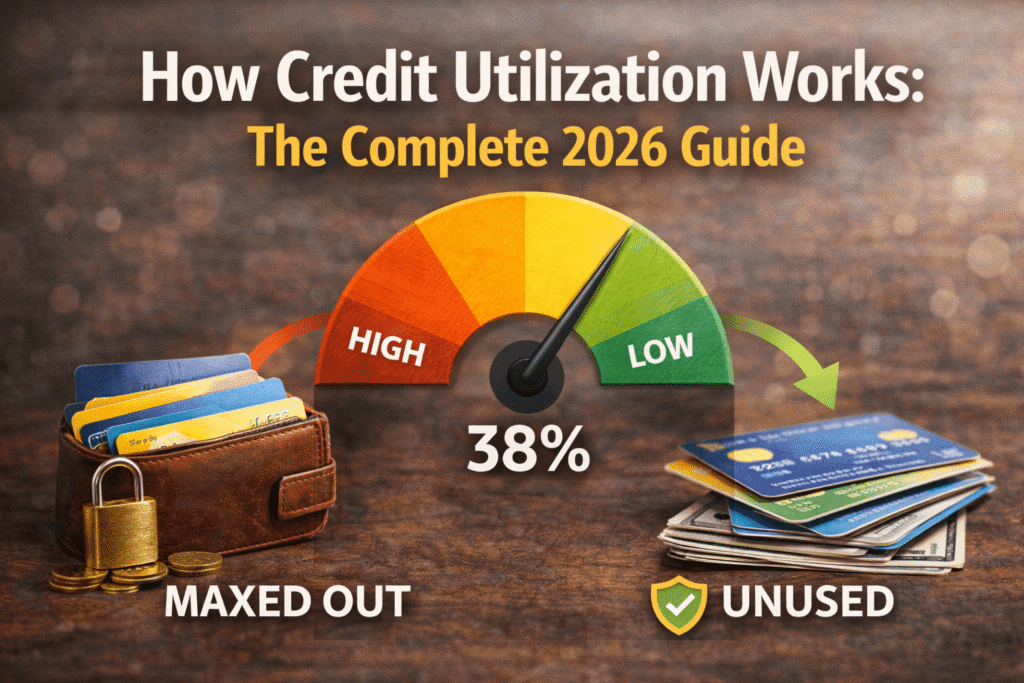
Credit utilization — sometimes called your credit utilization ratio or credit utilization rate — is simply the percentage of your available revolving credit that you’re currently using.
Think of it like a gas tank. If your tank holds 10 gallons and you’ve used 3, your tank is 30% full. Credit utilization works the same way: if you have a $10,000 credit limit and you’re carrying a $3,000 balance, your credit utilization is 30%.
The formula is straightforward:
Credit Utilization = (Total Balances ÷ Total Credit Limits) × 100
Example: $3,000 balance ÷ $10,000 limit = 0.30 × 100 = 30% utilization
This ratio applies to revolving credit — primarily credit cards and lines of credit. It does not apply to installment loans like mortgages, car loans, or student loans.
Lenders and credit scoring models pay close attention to this number because it gives them a snapshot of how much of your available credit you’re leaning on at any given time. The higher the percentage, the more financially stretched you appear — even if you pay your bill every month.
Why Credit Utilization Matters So Much for Your Credit Score
Your credit score is built from five main factors. Here’s roughly how much each one counts:
| Factor | Weight in FICO Score |
|---|---|
| Payment History | 35% — Most important |
| Credit Utilization | 30% — Second most important |
| Length of Credit History | 15% |
| Credit Mix | 10% |
| New Credit Inquiries | 10% |
That 30% weight makes credit utilization the second biggest factor in your FICO score — and one of the most actionable ones. VantageScore weighs it similarly, calling it a “highly influential” factor.
Here’s why lenders care so much: when someone is using a high percentage of their available credit, it can signal that they’re financially overextended. They may be relying on credit to cover everyday expenses, which increases the risk that they’ll fall behind on payments.
On the flip side, someone using a small portion of their available credit looks financially responsible — like they’re not dependent on borrowed money to get by. Lenders love that.
It’s worth noting: this isn’t just about FICO scores. Whether you’re applying for a mortgage, a car loan, a new credit card, or even a rental apartment, lenders often pull your full credit report and look directly at your balances and limits. Understanding how credit cards affect your credit score as a whole will help you manage all these factors together.
How to Calculate Your Credit Utilization Ratio
There are two types of utilization you need to track: per-card utilization and overall (aggregate) utilization. Both matter.
Per-Card Utilization
This is your utilization on each individual credit card. Scoring models look at each card separately, so even if your overall utilization is fine, a single maxed-out card can drag your score down.
Per-Card Example
Card A: $1,500 balance ÷ $5,000 limit = 30% utilization
Card B: $800 balance ÷ $4,000 limit = 20% utilization
Card C: $200 balance ÷ $3,000 limit = 6.7% utilization
Overall (Aggregate) Utilization
This combines all your balances and all your limits into a single ratio. It’s what most people mean when they talk about “credit utilization.”
Overall Example (using the cards above)
Total balances: $1,500 + $800 + $200 = $2,500
Total limits: $5,000 + $4,000 + $3,000 = $12,000
Overall utilization: $2,500 ÷ $12,000 = 20.8%
A quick way to track this: log into your credit card accounts and note your current balance and credit limit. If you’ve never pulled your credit report before, our guide on how to check your credit score for free walks you through the best no-cost options step by step.
What Is a Good Credit Utilization Ratio?
You’ll often hear “keep it under 30%” — and that’s decent advice. But the reality is more nuanced. For a full breakdown of what makes a credit score “good” vs. “excellent,” see our companion guide on what is a good credit score.
Here’s where many people get confused: the 30% threshold isn’t a magic number. Your score doesn’t suddenly become perfect the moment you dip below 30%. It’s a sliding scale — the lower your utilization, generally the better your score.
Research from FICO shows that people with the highest credit scores (800+) typically have credit utilization in the single digits. Many credit experts recommend aiming for under 10% if you’re actively trying to maximize your score.
Credit Utilization vs. Credit Card Balance: Know the Difference
Here’s a common misconception worth clearing up: you don’t have to carry a balance to have credit utilization.
Many people assume that if they pay their bill in full every month, their utilization is 0%. That’s not always true. Credit card companies report your balance to the credit bureaus on your statement closing date — not your payment due date.
So even if you pay your entire balance before the due date, your credit report might still show whatever balance existed when your statement closed. Let’s walk through an example:
⚠️ How Statement Dates Affect Reported Utilization
Statement closes April 15: Your balance is $2,800 on a $5,000 limit
→ Your report shows 56% utilization for that billing cycle
You pay the full $2,800 by April 29 (the due date):
→ Great! No interest charged.
But your credit report STILL shows that $2,800 balance until the next statement closes. → Your score is being calculated on a 56% utilization rate.
The solution? If you have a high balance relative to your limit, try paying it down before your statement closing date. That way, a lower balance gets reported to the credit bureaus. For a deeper look at how card behavior shapes your overall score, see our guide on how credit cards affect your credit score.
How Credit Utilization Affects Your Credit Score: Real Scenarios
Scenario 1: Sudden Spike in Utilization
Imagine you normally keep your balance around $500 on a $10,000 limit (5% utilization). Then you book a big vacation and charge $6,000 in one month. Suddenly your utilization jumps to 60%. Even though nothing else changed, your credit score can drop significantly — sometimes 20 to 50+ points — purely from this one shift.
Scenario 2: Creeping Close to Your Limit
Using $4,500 of a $5,000 credit limit puts you at 90% utilization. That’s extremely damaging. Scoring models view anything above 75% as a serious warning sign. Even one card in this zone can noticeably drag down your overall score.
Scenario 3: Sustained High Utilization Over Months
Your credit report is recalculated each time the bureaus receive new data. If your balances stay high for several consecutive months, the negative impact compounds. You won’t see your score bounce back until those balances come down — but the good news is, as soon as they do, your score can recover quickly.
9 Proven Tips to Lower Your Credit Utilization
Credit utilization is one of the most controllable factors in your credit score. Here’s what actually works. For a complete 30-day plan that covers utilization and beyond, see our guide on how to improve your credit score fast.
Pay Your Balance Before the Statement Closing Date
This is the most powerful trick most people don’t know. Find out when your statement closes (check your card’s website or app) and pay down your balance beforehand. A lower balance at statement close = lower utilization reported.
Make Multiple Payments Per Month
You don’t have to wait until your due date. Paying twice a month keeps your balance lower throughout the cycle. If your statement closes mid-month, an early payment ensures a lower number gets reported.
Request a Credit Limit Increase
If your income has grown or your credit has improved, ask your card issuer for a higher limit. More available credit with the same balance = lower utilization ratio. Just make sure you don’t treat the new limit as an invitation to spend more.
Spread Spending Across Multiple Cards
Instead of putting everything on one card and maxing it out, spread purchases across two or three cards. This keeps per-card utilization lower on each individual card, which helps both your per-card and overall ratios.
Avoid Closing Old Credit Cards
Closing a card eliminates its credit limit from your total available credit. Even if you never use it, keeping an old card open gives you more available credit — which keeps your utilization lower.
Open a New Card Strategically
Opening a new credit card increases your total available credit. If done responsibly (not to spend more), this can reduce your overall utilization. Just be aware that new accounts can temporarily ding your score due to the hard inquiry and reduced average account age.
Set Up Balance Alerts
Most card issuers let you set alerts when your balance hits a certain threshold — say, 20% of your limit. This keeps you aware before you accidentally creep into risky territory.
Use a Personal Loan to Pay Down Cards
If you’re carrying high balances across multiple cards, a personal loan to consolidate them can dramatically lower your credit card utilization. Personal loans are installment debt (not revolving credit), so they don’t factor into your utilization ratio. This can give your score a quick boost — just don’t charge the cards back up afterward.
Ask About Automatic Limit Increases
Some issuers like Capital One and Discover automatically review accounts for limit increases every 6–12 months. Make sure your issuer has your updated income on file, as this can lead to increases without you having to ask.
Common Credit Utilization Mistakes (And How to Avoid Them)
❌ Mistake #1: Maxing Out One Card While Others Are Empty
Your per-card utilization matters just as much as your overall ratio. Putting all your spending on one card — even if your other cards are unused — is a red flag in scoring models. Spreading the load is almost always better.
❌ Mistake #2: Closing Paid-Off Cards
Closing a card removes that limit from your available credit pool, instantly raising your utilization ratio. Unless the card charges high annual fees, keeping it open is almost always better for your score.
❌ Mistake #3: Only Making Minimum Payments
Minimum payments barely dent your balance. High balances persist month after month, keeping your utilization dangerously high. For strategies on paying down balances more efficiently, see our guide on how to improve your credit score fast.
❌ Mistake #4: Applying for Multiple New Cards at Once
Each new credit application triggers a hard inquiry. Multiple hard inquiries in a short period can temporarily lower your score, and new accounts also lower your average account age — which can offset some of the utilization benefit.
❌ Mistake #5: Not Checking Your Credit Report for Errors
If a creditor incorrectly reports your limit as lower than it actually is, your utilization looks higher than it really is. Check your report at AnnualCreditReport.com regularly. Not sure how to read it? Our guide on how to check your credit score for free walks through the whole process.
❌ Mistake #6: Ignoring Authorized User Accounts
If you’re an authorized user on someone else’s account, that card’s utilization can affect your score too. If the primary cardholder has high utilization, it could pull your score down even though it’s not your card.
Does Credit Utilization Have Memory?
Here’s one of the most empowering things you can learn: most scoring models only look at your most recently reported balance. There’s no long-term memory baked into this metric.
Unlike a late payment, which stays on your credit report for seven years, a high utilization ratio disappears from your score calculation as soon as a new, lower balance is reported. This means:
- ✓ If you’ve had 80% utilization for the past year…
- ✓ …and you pay it down to 10% this month…
- ✓ …your score can bounce back significantly within 30–60 days
That makes credit utilization one of the fastest ways to improve a credit score in the short term. If you’re preparing for a mortgage application, paying down your credit card balances now is one of the highest-impact moves you can make. Pair this with the full plan in our credit score improvement guide for the best results.
Real-Life Comparison: How Utilization Shapes Two Credit Scores
Let’s make this concrete. Sarah and Marcus have identical credit profiles — same accounts, same payment history, same age of credit — with one difference: how much of their limit they’re using.
Marcus’s credit score likely sits 80 to 120 points higher than Sarah’s, purely because of how he manages his balances. That gap could mean the difference between getting approved for a mortgage at a competitive rate and being turned down entirely. Wondering where your own score falls? See our guide on what is a good credit score to find out.
Credit Utilization and Different Types of Credit
Credit Cards
Credit cards are the primary source of utilization that scoring models measure. Both your individual card ratios and your combined ratio are factored in. This is where you have the most control. To understand the full impact of card behavior on your score, see our guide on how credit cards affect your credit score.
Lines of Credit
A personal line of credit or a home equity line of credit (HELOC) is also revolving credit. If you have a $20,000 HELOC and you’ve drawn $15,000, that balance counts toward your revolving utilization.
Installment Loans
Car loans, mortgages, student loans, and personal loans are installment debt — not revolving credit. They don’t factor into your utilization ratio. However, using a personal loan to pay off credit card debt will improve your utilization, since you’re eliminating revolving balances. Learn more about how personal loans work in our guide on what is a personal loan.
Charge Cards
Charge cards (like some American Express cards) technically have no preset spending limit, so they may not be factored into your utilization calculation the same way — or at all, depending on the scoring model. This varies by card and bureau.
Frequently Asked Questions About Credit Utilization
The Bottom Line on Credit Utilization
If there’s one thing to take away from this guide, it’s this: credit utilization is both important and fixable. It’s the second biggest factor in your credit score, but it’s also one of the fastest to change.
Here’s a quick summary of everything we covered:
Key Takeaways
- Credit utilization is the percentage of your available revolving credit you’re currently using
- It accounts for roughly 30% of your FICO score — second only to payment history
- Aim for under 10% for excellent scores; stay under 30% at minimum
- Both per-card and overall utilization matter to scoring models
- Your balance is reported on your statement closing date — not your due date
- High utilization has no long-term memory — once you pay it down, your score recovers quickly
- Avoid closing old cards, maxing out single cards, and making only minimum payments
Managing your credit utilization isn’t complicated — but it can make a huge difference in your financial future. Whether you’re trying to qualify for a better mortgage rate, get approved for a car loan, or just build a stronger financial foundation, keeping your utilization low is one of the highest-return habits you can build.
Start today: check your current balances, find out when your statements close, and make a plan to pay down before that date. Then explore the full roadmap in our guide on how to improve your credit score fast to keep the momentum going.
📚 Related Articles on FinanceNavigatorPro
What Is a Good Credit Score? (2026) →
How to Check Your Credit Score for Free →
What Is a Personal Loan? (2026) →
What Is a FICO Score? →
How Credit Cards Affect Your Credit Score →
How Late Payments Affect Credit →
How to Remove Negative Items from Credit Report →
Average Credit Score in the U.S. (2026) →
Disclosure: This article is for informational purposes only and does not constitute financial advice. Credit scoring models vary by bureau and lender. Always review your full credit report and consult a financial advisor for personalized guidance.