
Credit Score Guide · 2026
If you’ve ever wondered whether your credit score is actually good — or just okay — you’re not alone. Here’s everything you need to know, from score ranges to real-world impact to exactly what you can do to move the needle.
FinanceNavigatorPro Editorial Team · March 3, 2026 · Credit Score
| Credit Score Ranges | Average U.S. Score |
| Why It Matters | Lender Minimums |
| FICO Factors | How to Improve |
| Is 700 Good? | Excellent Score |
| FAQs |
Credit Score Ranges Explained
Your credit score is a three-digit number, typically falling somewhere between 300 and 850. Two scoring models dominate the landscape: FICO and VantageScore. They use slightly different criteria and ranges, but both paint a similar picture of your creditworthiness.
FICO Score Ranges
FICO is the gold standard — used by roughly 90% of top lenders when making credit decisions.
| Score Range | Rating | What Lenders Typically Think |
|---|---|---|
| 800 – 850 | Exceptional | Best rates, top cards, easy approvals |
| 740 – 799 | Very Good | Well above average; great loan terms |
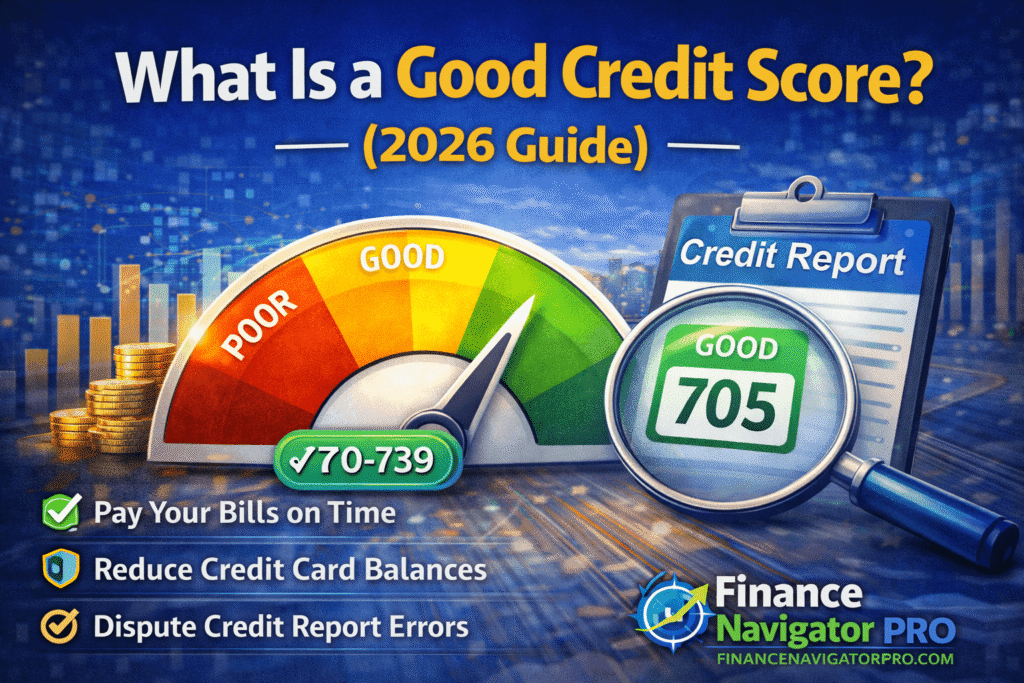
| 670 – 739 | Good ✓ | Approved for most products; solid rates |
| 580 – 669 | Fair | Limited options; higher rates likely |
| 300 – 579 | Poor | Very limited credit access; secured cards |
If your score is sitting around 680, you’re actually in pretty decent shape. The real leap in benefits tends to happen once you cross the 740 threshold.
VantageScore Ranges
VantageScore was developed jointly by the three major credit bureaus — Equifax, Experian, and TransUnion.
| Score Range | Rating | Comparison to FICO |
|---|---|---|
| 781 – 850 | Excellent | Equivalent to FICO “Exceptional” |
| 661 – 780 | Good | Covers FICO “Good” + “Very Good” |
| 601 – 660 | Fair | Similar to FICO “Fair” |
| 500 – 600 | Poor | Overlaps with low FICO “Fair”/”Poor” |
| 300 – 499 | Very Poor | FICO “Poor” zone |
Your FICO score and VantageScore can differ by 20–50 points even from the same data — completely normal. When applying for a mortgage, check your actual FICO score. That’s what most lenders will use.
What Is the Average Credit Score in the U.S.?
According to FICO data, the average American credit score sits in the low-to-mid 700s — typically around 714 to 718. That puts most Americans squarely in the “good” range.
- If you’re at 700 or above, you’re right around average — and that’s not a bad place to be
- You don’t need to be in the 800s to qualify for most credit products
- Lenders are very used to scores in the 670–750 range — it’s common territory
- Younger Americans and those with limited credit history typically score lower — completely expected
Why a Good Credit Score Actually Matters
Your credit score has real, tangible effects on your financial life — and the gap between a “fair” score and a “good” one can be worth thousands of dollars.
Lower Interest Rates
The biggest benefit of a strong credit score is access to lower interest rates. Here’s a real-world look at what that means:
$350,000 Home · 30-Year Fixed Mortgage
|
680
~7.2% APR $2,380/mo Fair credit rate |
760
~6.6% APR $2,240/mo Very good credit rate |
Rates are illustrative examples and will vary by lender, down payment, and market conditions.
Better Credit Card Offers
With a good-to-excellent score, you’ll start getting approved for cards that actually reward you:
- Travel rewards cards with generous sign-up bonuses
- Cash back cards earning 2–5% on everyday spending
- 0% APR intro offers for 12–21 months
See our guide to the best credit cards for fair credit if you’re working your way up.
What Score Do Lenders Actually Require?
| Loan Type | Minimum | Best Rates At | Notes |
|---|---|---|---|
| Conventional Mortgage | 620+ | 740+ | Lower scores = higher PMI & rate |
| FHA Mortgage | 580+ | 660+ | 500–579 requires 10% down |
| Auto Loan | 580+ | 700+ | Subprime rates can exceed 15–20% |
| Personal Loan | 600+ | 670+ | Online lenders often more flexible |
| Premium Credit Card | 700+ | 750+ | Top-tier rewards cards want 750+ |
These are general benchmarks. Individual lenders also consider income, debt-to-income ratio, and employment history. The CFPB has helpful resources on understanding lender decisions.
What Makes Up Your Credit Score? The 5 FICO Factors
FICO breaks your score into five weighted categories. The top two factors alone make up 65% of your score.
How to Improve Your Credit Score — Step by Step
Improving your credit score isn’t complicated. It just takes consistency. Here’s what actually moves the needle:
See our full guide: How to Improve Your Credit Score Fast — with specific timelines and tactics for every starting point.
Is 700 a Good Credit Score?
Short answer: yes. A 700 falls solidly in the “good” category. You’ll qualify for most credit cards, personal loans, and auto loans. Mortgage approval is well within reach too. You may not get the absolute best rates that a 740+ score would unlock, but it’s a perfectly solid place to be.
A 700 is a perfectly solid place to be. Keep doing what you’re doing and let it grow naturally.
What Is an Excellent Credit Score?
Under FICO, 800 and above is considered exceptional. VantageScore calls anything 781+ excellent. At that level you’ll get approved for anything at the best rates. That said, the benefits plateau around 760–780. Don’t obsess over 850 — get yourself into the 740–780 range and let the rest take care of itself.
Frequently Asked Questions
Related Guides on FinanceNavigatorPro