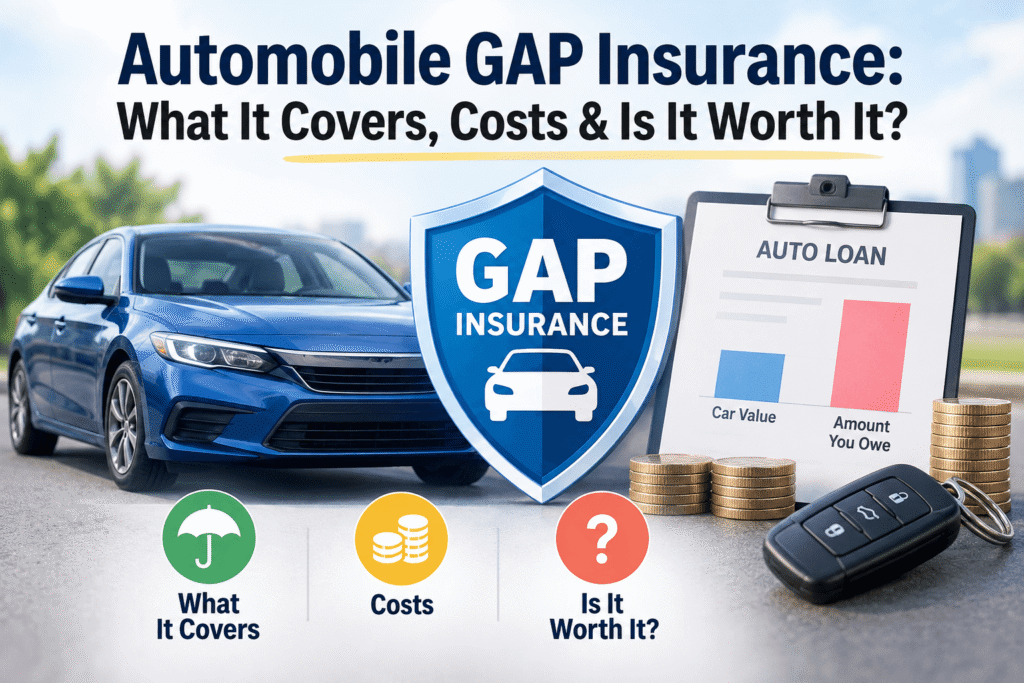
📌 Quick Answer: What Is Automobile GAP Insurance?
Automobile GAP insurance — short for Guaranteed Asset Protection — pays the difference between what your auto insurer pays after a total loss or theft and what you still owe on your car loan or lease. Without it, you could be stuck paying thousands out of pocket for a vehicle you no longer have.
Key Takeaways
- ✅ GAP insurance pays the gap between your remaining loan balance and your vehicle’s actual cash value (ACV) after a total loss or theft.
- ✅ Standard collision and comprehensive coverage only pay the car’s current market value — not what you owe the lender.
- ✅ New vehicles can lose 15–25% of their value in the first year, creating an immediate coverage gap.
- ✅ Most auto insurance policies add GAP coverage for just $20–$60 per year — far cheaper than the thousands you could owe.
- ✅ Dealer-sold GAP products typically cost $400–$900 upfront and are often rolled into your loan (costing even more in interest).
- ✅ You should strongly consider GAP insurance if your down payment is under 20%, your loan term is 60+ months, or you drive a high-depreciation vehicle.
- ✅ GAP insurance is not the same as full coverage — full coverage does not pay off your remaining loan balance.
- ✅ You can usually cancel dealer GAP coverage and receive a prorated refund.
- ✅ GAP coverage typically expires once your loan balance drops below the vehicle’s ACV — often around the 2–3 year mark.
- ✅ Some lenders require GAP insurance; no U.S. state legally mandates it for all drivers.
1. What Is Automobile GAP Insurance?
Automobile GAP insurance — formally called Guaranteed Asset Protection insurance — is a type of add-on auto coverage that pays off the remaining balance on your car loan or lease if your vehicle is declared a total loss or stolen and not recovered.
Here’s the problem it solves: when your insurer totals your car, they pay you the actual cash value (ACV) — what the vehicle is worth on the open market at that moment, factoring in depreciation. That number is almost always lower than what you still owe your lender. GAP insurance covers that shortfall.
Think of it as a financial safety net sitting between your auto loan and your auto insurance policy. Without it, a single accident could leave you making monthly payments on a car that’s already been hauled to a salvage yard.
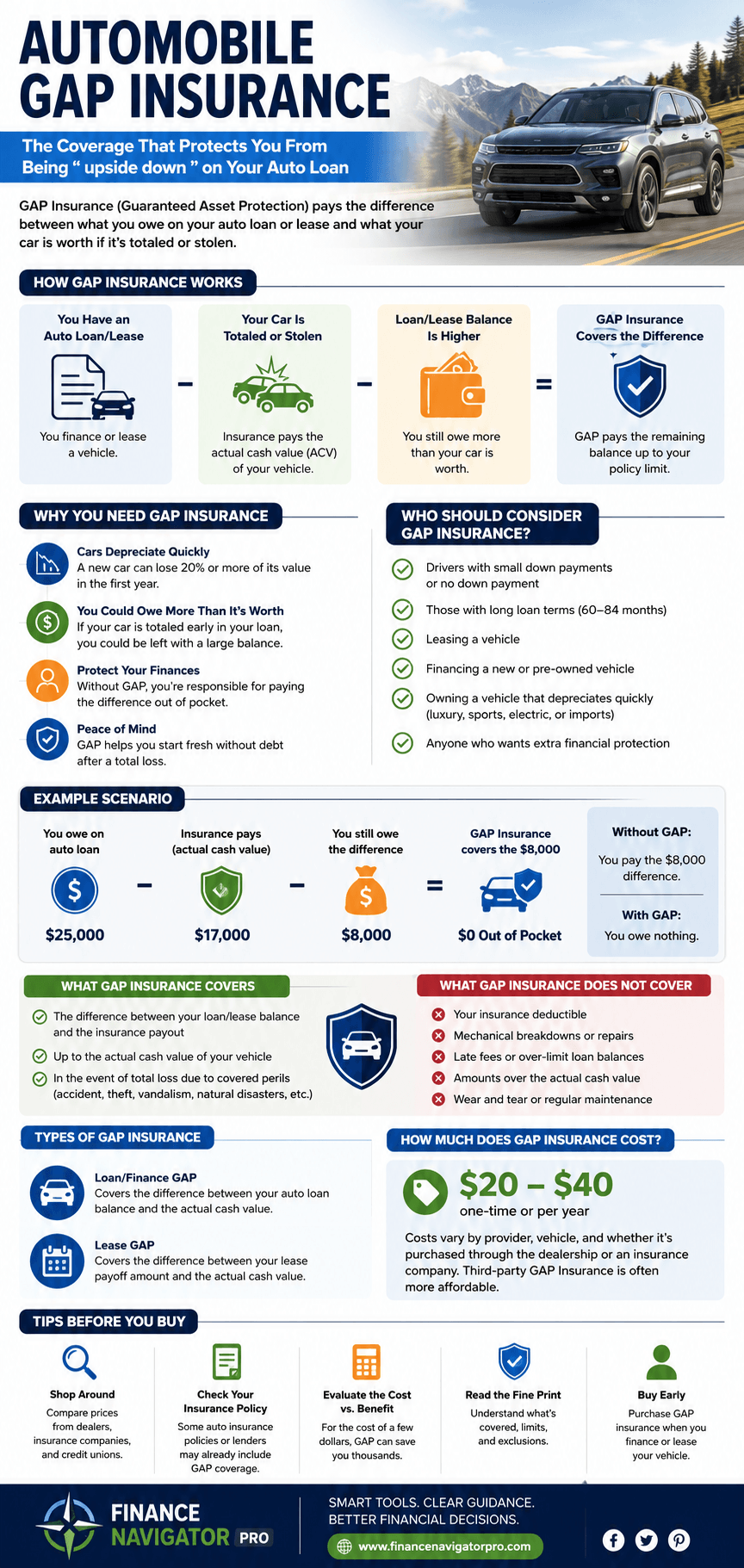
GAP insurance at a glance: what it covers, how a claim works, and typical costs
The Guaranteed Asset Protection Explained
The term ‘Guaranteed Asset Protection’ comes from the original intent of the product: protecting the asset — your vehicle — on behalf of the lender who financed it. In the early days, lenders required it on loans where the vehicle’s value was likely to fall below the loan balance. Today, it’s a voluntary (in most cases) add-on for borrowers.
The ‘guarantee’ refers not to a guaranteed payout for every scenario, but to the guarantee that the asset’s financing will be protected against depreciation-driven shortfalls in the event of a covered total loss.
A Real-World Example
You finance a new SUV for $40,000 with a small down payment. A year later, a drunk driver totals it. Your insurer pays the ACV of $30,000. But you still owe $36,000 on your loan. Without GAP insurance, you owe $6,000 out of pocket — for a vehicle sitting in a junkyard.
With GAP insurance, that $6,000 difference is covered. You walk away with your loan settled and your savings intact.
2. How Does GAP Insurance Work?
GAP insurance kicks in only after your primary auto insurance has already settled its portion of a claim. Here’s the step-by-step process:
- Your vehicle is involved in a covered incident — typically a total loss accident or a theft where the vehicle is not recovered.
- Your auto insurance company investigates and determines the vehicle is a total loss.
- The insurer calculates the Actual Cash Value (ACV) of your vehicle at the time of the loss and issues a settlement check.
- The ACV payment is applied to your outstanding loan or lease balance.
- If a balance remains (because the ACV was less than what you owe), your GAP insurance provider covers that remaining eligible amount.
- Your loan or lease account is paid in full. You owe nothing further on the vehicle.
Important
GAP insurance does not pay you directly. It pays your lender or lease company. Its sole purpose is to eliminate the loan or lease balance — not to help you buy a new vehicle.
The Role of Depreciation
New cars depreciate rapidly. According to industry estimates, the average new vehicle loses approximately 15–25% of its value within the first year. Over a 5-year loan, the car may lose 40–60% of its original purchase price.
Meanwhile, loan balances shrink slowly at first because most auto loan payments are weighted heavily toward interest in the early months. This mismatch — fast depreciation vs. slow loan payoff — is exactly what creates the GAP that this insurance is named after.
3. What Does GAP Insurance Cover?
Coverage specifics vary by policy and provider, but here’s a comprehensive breakdown of what GAP insurance typically does and does not cover.
✅ What Is Usually Covered
- Total loss from a collision
- Total loss from a comprehensive claim (fire, flood, hurricane, tornado, hail, vandalism)
- Vehicle theft — when the car is not recovered
- Negative equity (the underwater portion of your loan, up to policy limits)
- Lease payoff difference (the gap between ACV and remaining lease obligation)
- State fees and taxes in some policies
❌ What Is Usually NOT Covered
- Your insurance deductible (unless your policy specifically includes a deductible waiver)
- Missed or overdue loan payments at the time of the claim
- Late fees, prepayment penalties, or other finance charges on your loan
- Extended warranties or service contracts rolled into your loan balance
- Credit insurance or life insurance bundled into the loan
- Negative equity from a previous vehicle rolled into your current loan
- Mechanical repairs or maintenance
- Engine failure or breakdown
- Down payment on a replacement vehicle
- Security deposits on leases
- Carryover balances exceeding policy limits (typically 125–150% of vehicle value)
🔑 Key Insight
Read your policy carefully. Many drivers are surprised to learn that rolled-over debt from a prior vehicle is not covered. That negative equity was there before you bought this car — GAP insurance only covers the depreciation gap on the current vehicle.
4. What Is Actual Cash Value (ACV)?
Actual Cash Value (ACV) is the fair market value of your vehicle immediately before a total loss or theft. It is the amount your auto insurance company uses to settle a total loss claim — not the amount you paid for the car or the amount you still owe.
ACV is calculated using your vehicle’s replacement cost minus depreciation. Insurers consider factors including:
- Make, model, and trim level
- Year and mileage
- Vehicle condition (pre-loss)
- Local market pricing for comparable vehicles
- Options, packages, and installed equipment
- Accident history (prior damage may reduce ACV)
ACV vs. Replacement Cost
| Term | Definition |
|---|---|
| Actual Cash Value (ACV) | What your vehicle is worth right now on the open market, after depreciation. |
| Replacement Cost | What it would cost to buy an equivalent new or similar vehicle today. |
| Invoice/Purchase Price | What you originally paid for the vehicle. |
| Loan Payoff Amount | What you currently owe to the lender. |
ACV Example
You bought a vehicle for $42,000 two years ago. It has 28,000 miles and is in good condition. The insurer checks comparable vehicles in your market and determines your car’s ACV is $29,500. That $29,500 — not $42,000 — is what they pay on a total loss claim.
If you owe $34,000 on your loan, the remaining $4,500 is your GAP — and that’s exactly what GAP insurance is designed to cover.
5. GAP Insurance Example: Seeing It in Action
Nothing illustrates GAP insurance better than a side-by-side example. Here’s a scenario involving a typical new car purchase:
| Item | Amount |
|---|---|
| Original Vehicle Purchase Price | $38,000 |
| Down Payment | $1,900 (5%) |
| Original Loan Amount | $36,100 |
| Loan Term | 72 months |
| Months into Loan at Time of Accident | 14 months |
| Remaining Loan Balance | $31,500 |
| Vehicle ACV at Time of Loss | $25,800 |
| Insurance Deductible | $500 |
| Amount Insurance Pays (ACV minus deductible) | $25,300 |
| Remaining Loan Balance After Insurance Pays | $6,200 |
| Amount GAP Insurance Covers | $6,200 |
| Out-of-Pocket Cost to Driver (with GAP) | $500 deductible only* |
| Out-of-Pocket Cost to Driver (without GAP) | $6,200 |
*Some GAP policies include a deductible waiver, bringing your cost to $0.
What Happens Without GAP Insurance
In the scenario above, without GAP coverage, the driver would owe $6,200 — due immediately — on a vehicle they can no longer drive. Many lenders require this balance to be paid within 30 days of the insurance settlement. That’s a financial emergency for most households.
The annual cost of GAP insurance through a typical insurer? Roughly $20–$60. The math is compelling.
6. Who Needs Automobile GAP Insurance?
GAP insurance isn’t for every driver — but for many people, it’s an essential protection. Here are the situations where GAP coverage makes the most financial sense:
You Definitely Should Consider GAP Insurance If:
- Small down payment: You put less than 20% down on your vehicle. A small down payment means your loan balance starts very close to — or even above — the vehicle’s value from day one.
- Long loan term: You have a 72-month or 84-month loan. Longer terms mean slower early payoff and a larger window of negative equity.
- Leased vehicle: Most lease agreements effectively require GAP coverage (some include it; always verify). Your lease payoff can easily exceed the vehicle’s ACV if it’s totaled.
- High-depreciation vehicle: You’re buying a brand-new vehicle (especially a luxury car, electric vehicle, or model with historically fast depreciation).
- Negative equity rollover: You traded in an underwater vehicle and rolled the negative equity into your new loan, starting the loan already above the car’s value. Note: the rolled-over portion itself typically isn’t covered by GAP.
- Young or first-time buyer: Your loan carries a higher interest rate (meaning slower early principal payoff), increasing your time in negative equity.
- Bad credit auto loan: Higher interest rates mean more of each payment goes to interest early on, delaying the point when your loan balance drops below the vehicle’s value.
- Electric vehicle: EVs can depreciate significantly in the first few years due to rapid technology changes and shifting market dynamics.
GAP Insurance Is Especially Valuable For:
| Driver Type | Driver Type | Driver Type |
|---|---|---|
| New Car Buyers | New Lease Drivers | Long-Loan Borrowers |
| First-Time Buyers | Bad Credit Borrowers | EV Buyers |
| Luxury Vehicle Owners | Low-Down-Payment Buyers | High-Mileage Drivers |
7. Who Probably Doesn’t Need GAP Insurance?
GAP insurance isn’t the right fit for every situation. You can likely skip it if:
- Your vehicle is paid off. No loan balance, no gap. Simple.
- You made a large down payment (20%+). A substantial down payment often means your loan balance is already at or below the vehicle’s value from the start.
- You have a short loan term (36–48 months). Faster payoff means you’ll likely exit the negative equity zone quickly — often within the first year or two.
- Your vehicle is already worth more than your loan. Run a quick check: look up your car’s value (Kelley Blue Book, Edmunds) and compare it to your loan payoff. If the value is higher, you don’t have a gap.
- You’re financing an older used vehicle. Many providers won’t cover vehicles over a certain age or mileage. And older vehicles depreciate more slowly in percentage terms.
- Classic or collectible vehicles. These often appreciate over time, so the gap problem doesn’t apply — and specialized classic car insurance is a better product for these vehicles.
8. Is GAP Insurance Worth It?
For most people financing a new vehicle with less than 20% down, yes — GAP insurance is absolutely worth the cost, especially when purchased through your auto insurance company rather than a dealership.
- ✓Protects you from owing thousands on a vehicle you no longer have
- ✓Eliminates the risk of financial hardship after a total loss or theft
- ✓Inexpensive when added to an existing auto policy ($20–$60/year)
- ✓Peace of mind, particularly in the first 2–3 years of ownership
- ✓Often required or strongly recommended by lenders on high-LTV loans
- ✓May be available with a deductible waiver, further reducing your out-of-pocket exposure
- ✗Adds to the total cost of vehicle ownership
- ✗Unnecessary if your loan-to-value ratio is already favorable
- ✗Coverage limitations can create unexpected denials (rolled-over debt, fees, overdue payments)
- ✗Dealer-sold GAP is significantly more expensive and harder to cancel
- ✗Coverage becomes redundant once your loan balance drops below the vehicle’s ACV
The Decision Framework
Ask yourself: If my car were totaled today, how much would I owe my lender after the insurance check? If that number is more than $0 — and you’d struggle to cover it out of pocket — GAP insurance is probably worth buying.
| Situation | Recommendation |
|---|---|
| Down payment under 20%? | Strong case FOR GAP insurance |
| Loan term 60+ months? | Strong case FOR GAP insurance |
| New vehicle purchase? | Moderate case FOR GAP insurance |
| EV or luxury vehicle? | Moderate case FOR GAP insurance |
| Down payment 20%+? | May not need GAP insurance |
| Short loan term (36–48 mo)? | May not need GAP insurance |
| Vehicle value exceeds loan? | Do NOT need GAP insurance |
| Vehicle paid off? | Definitely do NOT need GAP insurance |
9. How Much Does GAP Insurance Cost?
The cost of GAP insurance varies significantly depending on where you buy it. This is one of the most important decisions you can make — because the same protection can cost $40 per year or $700+ as a one-time fee.
Average GAP Insurance Costs by Source
| Source | Typical Cost | Notes |
|---|---|---|
| Auto Insurance Company | $20–$60/year | Most affordable; added as an endorsement or rider |
| Credit Union / Bank | $200–$400 one-time | Moderate; often added to loan balance |
| Car Dealership (F&I) | $400–$900 one-time | Most expensive; often rolled into loan (gaining interest) |
| Online Standalone Provider | $200–$500 one-time | Varies; check terms carefully before buying |
When you buy dealer GAP at $700 and roll it into a 72-month loan at 7% interest, you end up paying well over $800 for that coverage — and you can’t easily cancel or switch if you refinance.
💡 Pro Tip
Always check with your current auto insurance company first. Adding GAP coverage to an existing policy is almost always cheaper than dealer or standalone options.
Factors That Affect GAP Insurance Cost
- Vehicle make, model, and depreciation rate
- Original loan or lease amount
- Loan-to-value ratio (LTV) at time of purchase
- Loan term length
- Your state of residence
- The insurance company or provider
- Whether it’s a new or used vehicle
- Your primary policy deductible (some GAP policies cover it)
10. Where Can You Buy GAP Insurance?
You have more options than most car buyers realize. Here’s a breakdown of each channel:
1. Your Auto Insurance Company
This is the recommended route for most drivers. Major insurers like State Farm, GEICO, Progressive, Allstate, and USAA offer GAP coverage as an endorsement on existing policies. You typically pay a small additional premium (often under $5/month) and can cancel anytime with no penalty. If you’re comparing carriers, our roundup of cheapest car insurance companies is a good place to check who offers GAP as a low-cost endorsement.
2. Car Dealership Finance Office
Dealers offer GAP through the F&I (Finance & Insurance) office at the time of vehicle purchase. The coverage often sounds convenient — it’s packaged into the deal — but the cost is typically $400–$900, and it’s usually rolled into your loan, where it accumulates interest. Dealer GAP can be canceled, but the process varies by state and contract.
3. Banks and Credit Unions
Many banks and credit unions offer GAP protection when you take out an auto loan. Credit union GAP products in particular tend to be competitively priced, often between $200–$400 as a one-time fee. Ask specifically about terms, coverage limits, and refund policies.
4. Online Standalone GAP Providers
A small number of companies specialize in GAP insurance outside of dealerships and traditional insurers. These can sometimes be competitive but vary widely in terms of coverage quality and claim processes. Always read the policy terms before buying.
5. Lease Companies
If you lease your vehicle, the leasing company may include GAP protection in your lease agreement at no additional cost, or require you to purchase it separately. Review your lease documents carefully — don’t assume it’s included.
11. Dealer GAP Insurance vs. Insurance Company GAP Insurance
This comparison is critical for any car buyer. The differences go far beyond price.
| Feature | Dealer GAP | Insurer GAP | Bank/CU GAP | Standalone GAP |
|---|---|---|---|---|
| Typical Cost | $400–$900 one-time | $20–$60/year | Varies | Varies |
| Payment Structure | Rolled into loan | Added to premium | Varies | Varies |
| Cancellation | Varies by state | Anytime, no penalty | Often strict | Varies |
| Refund on Cancel | Prorated (state-dependent) | Full remaining premium | Partial | Varies |
| Coverage Limits | Typically 125–150% of ACV | Similar | Varies | Varies |
| Deductible Waiver | Often included | Sometimes included | Rare | Varies |
| Works After Refinancing | Often loses coverage | Usually continues | May lapse | Varies |
| Ease of Claim | Through dealer/separate provider | Through your insurer | Through bank | Separate |
🔑 Bottom Line
Unless your insurer doesn’t offer GAP coverage, buying it through your auto insurance company is almost always the better deal — lower cost, easier cancellation, and simpler claims.
12. GAP Insurance for Financed Cars
GAP insurance was designed primarily for vehicle financing — situations where you take out an auto loan to buy a car. The loan-to-value (LTV) ratio at the time of purchase is the key metric to understand.
Understanding Loan-to-Value (LTV)
LTV is simply the ratio of your loan amount to the vehicle’s value. If you borrow $35,000 to buy a $36,000 vehicle, your LTV is about 97%. That means you’re almost entirely underwater the moment you drive off the lot — because the car immediately begins depreciating while your loan doesn’t.
| LTV Range | GAP Insurance Need |
|---|---|
| Under 80% | Low — you likely have equity from day one |
| 80%–90% | Moderate — consider GAP for first 1–2 years |
| 90%–100% | High — GAP strongly recommended |
| Over 100% (rolled-in negative equity) | Critical — you start underwater immediately |
How Lenders View GAP Insurance
Many lenders — particularly for 72-month and 84-month loans with low down payments — either require GAP insurance or strongly recommend it. From the lender’s perspective, it protects the collateral backing the loan. From your perspective, it protects your credit score and savings from having to cover a deficiency balance. If you’re weighing loan length against monthly payment size, it’s worth reading how loan terms affect your monthly payments before you sign.
13. GAP Insurance for Leased Vehicles
If you lease a vehicle, GAP coverage is arguably even more important than for a purchase — and many lessees don’t realize they need it (or already have it).
How Leasing Creates a GAP
A lease is essentially a long-term rental. You’re paying for the vehicle’s depreciation over the lease term, plus interest. If the car is totaled in month 18 of a 36-month lease, you still owe the remaining lease payments and any residual obligations — and the ACV payout from your insurer rarely covers all of that.
Is GAP Insurance Included in Most Leases?
Many lease agreements from major manufacturers and financial institutions include GAP coverage automatically in the lease contract. However, this is not universal — always check your specific lease agreement.
If your lease includes GAP, you do not need to purchase it separately. If it does not, you should.
Lease GAP Coverage vs. Loan GAP Coverage
| Lease GAP | Loan GAP | |
|---|---|---|
| What it covers | Difference between ACV and remaining lease payoff | Difference between ACV and remaining loan balance |
| Included by default? | Yes, many manufacturers include it | No, typically purchased separately |
| Who provides it? | Leasing company or manufacturer | You purchase from insurer, dealer, or bank |
| When to verify? | Before signing the lease | At loan origination |
14. GAP Insurance for Used Cars
GAP insurance is less common — and often less necessary — for used vehicles, but it can still make sense depending on your situation.
Eligibility Restrictions for Used Vehicles
- Most providers cap coverage at vehicles under a certain age (commonly 3–5 model years old, though some allow up to 7–10 years)
- Mileage restrictions often apply (many providers cap eligibility at 100,000–125,000 miles)
- Coverage limits may be lower (often capped at 125% of ACV at time of claim)
- Some providers only offer GAP on used vehicles if purchased from a dealership, not a private seller
When Used Car GAP Insurance Makes Sense
If you’re financing a certified pre-owned vehicle with a relatively high loan balance, low down payment, and extended loan term — GAP insurance on a used vehicle can still protect you from owing money on a totaled car. Run the numbers and compare your loan payoff to your vehicle’s estimated value before deciding. If your credit is a factor in the loan you qualify for, see our guide to auto loans for good, fair, and bad credit for how that affects your terms.
15. GAP Insurance for New Cars
New cars are the sweet spot for GAP insurance — this is where the product was designed to be used and where it provides the most value.
A new vehicle loses an estimated 10–15% of its value the moment you drive off the lot. Within the first year, depreciation can reach 20–25%. If you financed with minimal money down, your loan balance can easily exceed the car’s value for the first 2–3 years of ownership.
Best Timing for New Car GAP Insurance
- Purchase it at the time of financing — don’t wait. You can be upside-down on your loan from day one.
- If buying from your insurer, you can typically add it within the first 30–90 days of purchase.
- Don’t buy dealer GAP before checking your insurer’s rate — the price difference is often dramatic.
If you’re still deciding how much car to finance in the first place, the 20/3/8 car buying rule is a useful framework for keeping your down payment, loan term, and monthly payment in a healthy range — which directly shrinks how much GAP risk you’re carrying.
16. Does Full Coverage Include GAP Insurance?
Direct Answer
No. Full coverage auto insurance does NOT include GAP insurance. Full coverage refers to combining liability, collision, and comprehensive coverage — none of which pay your remaining loan balance after a total loss.
This is one of the most common and costly misconceptions in auto insurance. Many drivers assume that because they have ‘full coverage,’ they’re fully protected from every financial consequence of a total loss. They’re not.
Full coverage pays the vehicle’s actual cash value — period. If you owe more than the ACV, you’re responsible for the difference regardless of whether you carry full coverage. Worth pairing this with a broader look at what insurance coverage you actually need so you know exactly what your policy does and doesn’t protect.
17. GAP Insurance vs. Full Coverage
| Full Coverage | GAP Insurance | |
|---|---|---|
| What it pays after a total loss | Vehicle’s Actual Cash Value (ACV) | The difference between ACV and loan/lease balance |
| Covers remaining loan balance? | No | Yes (up to policy limits) |
| Required? | Often required by lender | Optional in most states |
| Cost | $1,000–$3,000/year average (for full policy) | $20–$60/year (as an add-on) |
| What it protects | The vehicle itself | Your loan/lease obligation |
| Works alone? | Yes, as standalone coverage | No — requires collision/comprehensive first |
18. GAP Insurance vs. New Car Replacement Insurance
New Car Replacement Insurance (also called New Vehicle Replacement Coverage) is an upgrade from GAP — but it’s only available for new vehicles and typically only in the first 1–3 years.
| GAP Insurance | New Car Replacement Insurance | |
|---|---|---|
| What it pays | Difference between ACV and loan | Cost to replace with a brand-new equivalent vehicle |
| Do you get a new car? | No — pays off the loan only | Yes — covers full replacement cost of a new vehicle |
| Typically available for | New and used vehicles | New vehicles only, usually within first 1–3 years |
| Cost | Lower | Higher — premium add-on |
| Best for | Protecting against loan shortfall | Ensuring you can get an equivalent new vehicle |
19. GAP Insurance vs. Loan/Lease Payoff Coverage
Some insurers offer ‘Loan/Lease Payoff Coverage’ rather than traditional GAP insurance. These products are similar in purpose but may differ in coverage caps.
| Traditional GAP Insurance | Loan/Lease Payoff Coverage | |
|---|---|---|
| Coverage amount | Up to 125–150% of ACV typically | Often capped at 25% above ACV |
| Available from | Insurers, dealers, banks, credit unions | Primarily auto insurers as an endorsement |
| Deductible waiver | Sometimes included | Rarely included |
| Flexibility | May be standalone product | Typically tied to your primary insurer |
20. How Long Should You Keep GAP Insurance?
You should keep GAP insurance for as long as your loan balance exceeds your vehicle’s market value. Once the two cross — once you have positive equity — GAP coverage is no longer necessary.
When to Remove GAP Insurance
- Your vehicle’s estimated value (from Kelley Blue Book or Edmunds) is higher than your loan payoff amount
- You’ve paid down the loan significantly (often after year 2–3 on a new vehicle)
- You refinanced to a shorter term or lower balance
- You made a large additional principal payment
How to Check if You Still Need It
- Look up your vehicle’s current trade-in or private party value at KBB.com or Edmunds.com
- Call your lender or log into your loan account to get your current payoff balance
- If payoff > vehicle value: Keep GAP insurance
- If vehicle value > payoff: You can cancel GAP coverage
Check your GAP need every 6 months. On a typical 5-year loan, most borrowers reach the breakeven point between months 18 and 36, depending on down payment, depreciation rate, and loan terms.
21. Can You Cancel GAP Insurance?
Yes — you can cancel GAP insurance, but the process and refund you receive depend significantly on where you purchased it.
Canceling Insurer GAP Coverage
If you added GAP as an endorsement to your auto insurance policy, canceling is simple: call your insurer or log into your account, remove the endorsement, and your premium drops. You’ll receive a prorated refund for the unused portion of your policy period.
Canceling Dealer GAP Coverage
Dealer GAP is more complicated. The process varies by state, dealership, and the actual GAP provider (which may be a third-party company the dealer uses). In general:
- Contact the dealer’s F&I department or the third-party GAP provider directly
- Request a cancellation form (may need to be in writing)
- Submit proof of payoff, refinancing, or sale of the vehicle if applicable
- You are typically entitled to a prorated refund based on the remaining loan term
- Refunds may take 4–8 weeks to process
When You Should Always Cancel GAP Insurance
- You sell or trade in your vehicle
- You pay off your loan early
- You refinance the loan (GAP from a prior loan typically does not transfer)
- Your loan balance drops below the vehicle’s estimated value
⚠️ Note
If you rolled dealer GAP into your loan, the refund goes to your lender — not directly to you. It reduces your loan balance, not your monthly payment.
22. How to File a GAP Insurance Claim
Filing a GAP claim involves coordinating between your primary auto insurer and your GAP provider. Here’s the step-by-step process:
Step-by-Step GAP Claim Process
- File a claim with your primary auto insurance company immediately after the loss or theft.
- Allow your primary insurer to complete their investigation and issue an ACV settlement.
- Once you receive the primary settlement, contact your GAP insurance provider to initiate the GAP claim.
- Gather all required documentation (see below).
- Submit the GAP claim package to your provider.
- The GAP provider reviews the claim, verifies the shortfall, and issues payment directly to your lender.
- Confirm with your lender that the loan is paid in full.
Documents Typically Required for a GAP Claim
- Primary insurance settlement letter showing the ACV paid
- Loan or lease payoff statement from your lender (current as of loss date)
- Your original loan or lease agreement
- Vehicle title (or copy)
- Proof of insurance (showing collision/comprehensive was in force at time of loss)
- Police report (required for theft claims)
- A copy of your GAP policy or contract
- Government-issued ID
GAP Claim Timeline
| Stage | Typical Timeline |
|---|---|
| Total loss/theft occurs | Day 0 — Report to primary insurer immediately |
| Primary insurer investigation | Days 3–10 typically |
| ACV settlement issued | Days 10–30 after claim opened |
| GAP claim submitted | As soon as ACV settlement received |
| GAP claim reviewed | 5–15 business days typically |
| GAP payment to lender | Within 30–60 days of claim submission |
| Loan confirmed paid in full | Within 30–60 days of GAP payment |
Common GAP Claim Mistakes to Avoid
- Waiting too long to file — contact your GAP provider as soon as your primary insurer settles
- Submitting incomplete documents — missing a single item can delay payment by weeks
- Not getting the payoff amount as of the loss date — lenders need a specific date-stamped payoff figure
- Assuming GAP pays your deductible — confirm this with your specific policy before claiming
- Not following up — GAP claims can get lost; check in every 7–10 business days
23. Common Reasons GAP Claims Get Denied
Understanding why GAP claims get denied is almost as important as knowing how to file one. Here are the most frequent reasons:
- Overdue loan payments: Missed payments increase your loan balance artificially. GAP typically won’t cover amounts that exceed the scheduled balance at the time of loss.
- Coverage limits exceeded: Most GAP policies cap coverage at 125–150% of the vehicle’s ACV. If your loan is severely underwater beyond that threshold, the excess isn’t covered.
- Rolled-in fees not eligible: Extended warranties, credit insurance, gap insurance itself, or other products rolled into your loan balance are usually excluded from GAP coverage.
- Policy was canceled: If you lapsed on your GAP premiums or the policy was canceled before the loss, no coverage applies.
- Vehicle was not covered by comprehensive or collision: GAP requires a valid primary settlement to activate. Without collision or comprehensive coverage on your primary policy, there is no primary payout to trigger the GAP claim.
- Fraud or misrepresentation: Any material misrepresentation on the original application can void the policy.
- Vehicle not declared a total loss: GAP only applies to total losses. If your insurer pays for repairs rather than totaling the vehicle, GAP doesn’t apply.
24. State Laws and GAP Insurance
No U.S. state currently requires every driver to carry GAP insurance. It is not a state-mandated coverage like liability insurance. However, state laws do govern how GAP products are sold, priced, and administered.
What State Law May Govern
- Required disclosures when GAP is sold at a dealership
- Refund and cancellation rights — many states require prorated refunds
- Maximum pricing caps for dealer-sold GAP products
- How GAP is classified (insurance product vs. debt cancellation agreement)
- Regulatory oversight — some states regulate GAP as insurance; others as a finance product
Debt Cancellation Agreement vs. GAP Insurance
When GAP is sold at a dealership, it may actually be structured as a ‘Debt Cancellation Agreement’ (DCA) rather than an insurance product. The practical effect is similar — the lender agrees to cancel your loan balance in the event of a total loss — but the regulatory framework and consumer protections may differ. Always read the contract and understand what type of product you’re purchasing.
When Lenders Require GAP Coverage
While no state mandates it, individual lenders may require GAP insurance as a condition of loan approval — particularly for loans with high LTV ratios. This is more common for:
- Auto loans with 0–5% down payment
- 84-month or longer loan terms
- Borrowers with lower credit scores
- Vehicles with historically high depreciation rates
25. Advantages of GAP Insurance
- Complete financial protection: Eliminates the risk of owing thousands on a vehicle you no longer have, preventing sudden financial hardship.
- Loan payoff guarantee: Your lender is paid in full, protecting your credit score from a deficiency balance.
- Peace of mind: Knowing you’re covered against negative equity reduces the financial anxiety of new car ownership.
- Cost-effective when purchased correctly: At $20–$60/year through an insurer, the annual cost is minimal relative to the potential benefit.
- Protects savings: Without GAP, a total loss could drain your emergency fund or require you to take out an additional personal loan.
- May include deductible coverage: Some policies eliminate your out-of-pocket deductible, further reducing your cost after a total loss.
26. Disadvantages of GAP Insurance
- Added ongoing cost: Even at $20–$60/year, it adds to the total cost of ownership — a cost you may not ever need to use.
- Limited eligibility: Not all vehicles or loans qualify; older vehicles or low-balance loans may not be eligible.
- Can become redundant quickly: Once you have positive equity, you’re paying for coverage you no longer need. You must actively monitor and cancel.
- Coverage exclusions create surprises: Drivers often discover during a claim that their rolled-in debts, fees, or overdue payments aren’t covered.
- Dealer GAP is often overpriced: The convenience of buying at the dealership comes at a steep premium that can cost you $500+ more than buying through your insurer.
27. Expert Tips: Getting the Most from GAP Insurance
- Always price GAP with your auto insurer before accepting it from the dealership — the savings are often substantial.
- If you must buy dealer GAP, negotiate the price before entering the F&I office. Dealer GAP prices are not fixed.
- Never roll dealer GAP into your loan if you can pay cash for it — the interest cost adds up significantly.
- Set a calendar reminder every 6 months to check your loan balance vs. your vehicle’s current value.
- If you refinance your vehicle, check whether your GAP coverage transfers or needs to be repurchased.
- When you cancel dealer GAP after a refinance, make sure the refund goes to your new lender (or ask for it directly — depending on your state and contract).
- If your leased vehicle includes GAP, verify this in writing from the leasing company before the lease start date.
- Consider new car replacement coverage as a slightly more expensive alternative that gives you a new vehicle, not just a loan payoff.
- Check the coverage cap in your GAP policy. If your loan is more than 125–150% of the vehicle’s value, you may have an uncovered shortfall above that cap.
- Keep your GAP policy documents with your vehicle paperwork so you can access them quickly in the event of a claim.
- If your insurer denies a GAP claim, you have the right to appeal. Review the policy terms carefully and dispute any items you believe are covered.
- Pay your loan on time every month. Overdue payments are one of the most common reasons GAP claims are reduced or denied.
28. Common Mistakes Drivers Make with GAP Insurance
- Buying too late: Waiting until months after purchase to buy GAP means you missed the window with the highest gap risk. Buy at or near the time of financing.
- Keeping it too long: Continuing to pay for GAP coverage long after your loan balance drops below your vehicle’s value wastes money.
- Buying expensive dealer GAP without shopping: Accepting the dealer’s GAP price without checking your insurer’s rate is one of the most expensive car-buying mistakes you can make.
- Confusing full coverage with GAP: A very common and costly misconception — full coverage does not pay your loan balance.
- Ignoring exclusions: Not reading the fine print on what’s excluded (extended warranties, late fees, rolled-in debt) leads to shock at claim time.
- Not canceling after refinancing: Most dealer GAP policies don’t automatically follow you to a new loan. Failing to cancel the old one means paying for coverage that may no longer apply.
- Assuming GAP covers your deductible: Some policies include deductible waivers; many don’t. Confirm before a claim — not during one.
29. Frequently Asked Questions About GAP Insurance
Q: What is automobile GAP insurance?
A: GAP insurance (Guaranteed Asset Protection) covers the difference between what your auto insurer pays after a total loss — the vehicle’s actual cash value — and what you still owe on your loan or lease. It prevents you from owing money on a vehicle you can no longer drive.
Q: Is GAP insurance required by law?
A: No U.S. state requires GAP insurance for all drivers. However, some lenders require it as a condition of loan approval, particularly for high-LTV loans or long loan terms.
Q: Does GAP insurance cover my deductible?
A: Standard GAP policies do not cover your deductible. However, some policies include a deductible waiver as an added benefit — check your specific policy terms.
Q: Can I buy GAP insurance after purchasing a car?
A: Yes, in most cases. Your auto insurance company typically allows you to add GAP coverage at any time, though it’s best purchased early when the gap risk is greatest. Some standalone providers also sell it after the fact.
Q: Can GAP insurance be transferred to a new vehicle?
A: No. GAP coverage is tied to a specific vehicle and loan. When you sell, trade in, or pay off the vehicle, the coverage ends. You’ll need to purchase new coverage for a new vehicle.
Q: Can I cancel GAP insurance and get a refund?
A: Yes. If purchased through your insurer, you receive a prorated premium refund. Dealer GAP typically provides a prorated refund of the original one-time fee, though processing times and procedures vary.
Q: Does GAP insurance cover engine failure or mechanical breakdown?
A: No. GAP insurance only applies to total loss situations — when your vehicle is totaled in an accident or declared a total loss due to theft, fire, flood, or similar covered incident. It does not cover mechanical repairs.
Q: Does GAP insurance cover theft?
A: Yes, if your vehicle is stolen and not recovered, GAP insurance covers the difference between your insurer’s ACV settlement and your remaining loan or lease balance. You must have comprehensive coverage on your primary policy for the theft claim to be paid.
Q: How much does GAP insurance cost per month?
A: Through an auto insurer, GAP coverage typically costs $2–$5 per month added to your existing premium. Dealer GAP is usually sold as a one-time fee of $400–$900, often rolled into the loan.
Q: Does GAP insurance cover negative equity from my trade-in?
A: No. GAP insurance covers the gap created by depreciation on the current vehicle only. Negative equity rolled over from a previous vehicle into your new loan is not covered by a standard GAP policy.
Q: Who offers the best GAP insurance?
A: Major auto insurers including State Farm, GEICO, Progressive, USAA, and Allstate offer GAP coverage. Shopping your current insurer first is recommended — rates are typically far below dealer or standalone alternatives.
Q: Is dealer GAP insurance worth it?
A: Dealer GAP can be worth it if your insurer doesn’t offer it, but in most cases it’s significantly overpriced compared to insurer-provided GAP. If you’ve already bought dealer GAP, check whether canceling and switching to your insurer makes financial sense.
Q: Can used cars get GAP insurance?
A: Yes, though restrictions apply. Most providers require the vehicle to be under a certain age (3–7 years typically) and mileage (under 100,000–125,000 miles). Coverage limits may also be lower for used vehicles.
Q: Does GAP insurance expire?
A: GAP coverage doesn’t technically expire on a set date, but it becomes unnecessary (and is typically terminated) when the loan is paid off or the vehicle is sold/traded in. Some policies automatically expire at the loan term end.
Q: What happens to GAP insurance if I refinance?
A: When you refinance your auto loan, any existing GAP coverage tied to the original loan typically does not carry over. If your new loan is still upside-down, you’ll need to purchase new GAP coverage for the refinanced loan.
Q: Does GAP insurance pay me directly?
A: No. GAP insurance pays your lender or lease company directly to settle the remaining balance. It is not a check issued to you personally.
Q: What is the maximum GAP insurance will pay?
A: Most GAP policies cap payouts at 125–150% of the vehicle’s ACV at the time of loss. If your loan balance exceeds that threshold, the amount above the cap is not covered.
Q: Does GAP insurance require collision and comprehensive coverage?
A: Yes. GAP insurance activates only after your primary auto insurer has paid a total loss settlement. Without collision (for accidents) or comprehensive (for theft, fire, flood) coverage, there is no primary payment to trigger GAP coverage.
Q: How long does a GAP insurance claim take?
A: After your primary insurer settles the total loss (which can take 10–30 days), the GAP claim itself typically takes an additional 30–60 days, assuming all documentation is submitted promptly.
Q: Is GAP insurance taxable?
A: The GAP insurance premium itself is not tax-deductible for personal vehicles. A GAP claim payout goes to your lender, not to you, so it does not represent income. Consult a tax professional for guidance specific to your situation.
Q: What is a debt cancellation agreement?
A: A debt cancellation agreement (DCA) is a contract between you and your lender — not a traditional insurance product — in which the lender agrees to cancel your loan balance if your vehicle is declared a total loss. It provides similar protection to GAP insurance but may have different regulatory oversight.
Q: Can I negotiate the price of dealer GAP insurance?
A: Yes. Dealer GAP pricing is not fixed. The F&I manager has flexibility on pricing. You can negotiate, or simply decline and purchase from your insurer instead.
Q: Does GAP insurance cover a leased vehicle?
A: Yes. GAP insurance is often especially important for leases, as the lease payoff obligation can significantly exceed the ACV of a totaled vehicle. Many lease agreements include GAP coverage automatically — verify your lease contract.
Q: What if my GAP insurance claim is denied?
A: Review the denial letter carefully, compare the denial reason against your policy terms, and file a formal appeal with the GAP provider. If the denial is related to an action by your primary insurer, you may need to appeal that decision first. State insurance departments can assist with disputes.
Q: Does GAP insurance cover a car that’s been in a flood?
A: Yes, if the vehicle is declared a total loss as a result of flood damage and your primary auto policy includes comprehensive coverage, GAP insurance would cover the shortfall between the ACV settlement and your remaining loan or lease balance.
Q: Can I buy GAP insurance if I have bad credit?
A: Yes. GAP insurance eligibility is based on the vehicle and loan, not your credit score. Borrowers with bad credit who carry higher-rate loans and longer terms are often the people who most benefit from GAP coverage.
Q: What is the difference between GAP insurance and roadside assistance?
A: They are completely different products. Roadside assistance provides emergency help (towing, flat tire, lockouts) for any breakdown or incident. GAP insurance only addresses the financial gap between your ACV settlement and your loan balance in a total loss scenario.
Q: Is GAP insurance worth it for a 72-month or 84-month car loan?
A: Almost certainly yes. Long-term loans mean slower principal payoff. Combined with vehicle depreciation, borrowers on 72–84 month loans often carry significant negative equity for 3 or more years. GAP insurance is a smart, low-cost protection in this scenario.
Q: Do I need GAP insurance if I leased a Tesla or other EV?
A: EV depreciation rates have been volatile, with some models losing significant value rapidly while others hold value better. For leased EVs, check whether your lease includes GAP coverage. For financed EVs, GAP insurance is often a wise purchase given the uncertainty in long-term depreciation trends.
30. Final Verdict: Is GAP Insurance Right for You?
Automobile GAP insurance is one of those financial products that seems unnecessary — until you desperately need it. At $20–$60 per year through an auto insurer, the cost-to-benefit ratio is compelling for anyone financing a new vehicle with less than 20% down.
The biggest mistake most buyers make isn’t failing to buy GAP insurance — it’s buying it from the wrong place. Dealer GAP can cost 10–20 times more than insurer GAP for the same protection. Always check with your auto insurance company first.
Use this checklist to guide your decision:
GAP Insurance Decision Checklist
- ☐Is your down payment less than 20%? → Buy GAP
- ☐Is your loan term 60 months or longer? → Buy GAP
- ☐Are you leasing and GAP isn’t included in your lease? → Buy GAP
- ☐Are you financing an EV or luxury vehicle? → Strongly consider GAP
- ☐Did you roll negative equity from a prior vehicle into your new loan? → Buy GAP
- ☐Did you make a large down payment (20%+) on a short loan? → You may not need GAP
- ☐Is your current loan balance already less than the vehicle’s value? → Cancel or skip GAP
- ☐Is your vehicle paid off? → You definitely don’t need GAP
✅ Take Action
The best time to buy GAP insurance is at vehicle purchase. The best place to buy it is through your auto insurance company. If you’re unsure whether you’re currently covered or need it, call your insurer today and ask — it takes five minutes and could save you thousands.
This guide was written by an experienced U.S. personal finance and insurance specialist with over two decades of experience helping American consumers navigate auto financing, insurance decisions, and vehicle ownership costs. It has been reviewed for accuracy by a licensed insurance professional.
Sources and References
- Insurance Information Institute (III) — iii.org
- National Association of Insurance Commissioners (NAIC) — naic.org
- Consumer Financial Protection Bureau (CFPB) — consumerfinance.gov
- Federal Trade Commission (FTC) — ftc.gov — Car Financing and Credit
- State insurance department resources (varies by state)
Related Auto Insurance & Finance Guides
What Insurance Coverage Do You Need? →Roadside Assistance Insurance: Complete Guide →Cheapest Car Insurance Companies in the US →Auto Loans for Good, Fair, and Bad Credit →The 20/3/8 Car Buying Rule →Insurance Deductibles Explained →How to Lower Your Insurance Premium →Minimum Credit Score to Buy a Car →
DISCLOSURE: Coverage, pricing, and availability vary by insurer and state. This guide is for educational purposes only and does not constitute insurance or financial advice. Always consult a licensed insurance professional for guidance specific to your situation.