
Complete Guide to Coverage, Costs, and the Best Policies
Picture this: You’ve spent three years and $45,000 restoring a 1967 Ford Mustang Fastback to showroom condition. You’ve sourced the original Pony interior, rebuilt the 390 engine, and had the Candyapple Red paint matched to factory specs. It’s not just a car — it’s a rolling piece of American history that you’ve poured your heart and savings into.
Then one afternoon, a distracted driver runs a red light and T-bones your Mustang at an intersection. You file a claim with your regular auto insurance company, expecting to walk away with enough to restore or replace your prize possession. Instead, the check arrives for $8,500 — what their adjuster determined is the “actual cash value” of a 57-year-old used car.
That gap between what your car is actually worth and what a standard insurer will pay for it? That’s exactly why classic car insurance exists — and why getting it right is one of the most important decisions you’ll make as a collector.
Classic car insurance — also called collector car insurance, antique car insurance, or vintage auto insurance — is a specialized coverage designed for vehicles that don’t fit neatly into the regular auto insurance world. Whether you own a meticulously restored muscle car, a numbers-matching mid-century luxury sedan, a vintage European sports car, or a rare American pickup from the 1950s, standard insurance policies almost always undervalue your vehicle at claim time.
The collectible vehicle market has grown substantially over the past decade. Auction houses like Barrett-Jackson, RM Sotheby’s, and Mecum regularly report record-breaking results. Restoration costs have also climbed sharply — quality body work, mechanical rebuilds, and sourcing NOS (new old stock) parts all cost far more today than they did just a few years ago. If your vehicle is underinsured, you absorb that entire gap when something goes wrong.
Here’s what surprises most first-time buyers: classic car insurance is actually cheaper than regular auto insurance — often significantly so. Because collectible vehicles are driven far less than daily drivers and are typically stored more carefully, specialty insurers offer premiums that can be 30–70% lower than what you’d pay for a standard auto policy. Annual premiums of $300–$700 are common for mid-range collectibles.
In this guide, I’ll walk you through everything you need to know:
- What qualifies as a classic car for insurance purposes
- How agreed value, stated value, and ACV coverage work — and why this distinction can mean tens of thousands of dollars at claim time
- What a classic car policy covers and what it specifically excludes
- How much classic car insurance actually costs and what drives premiums up or down
- An in-depth breakdown of the best classic car insurance companies, including Hagerty, Grundy, American Collectors, and more
- 15+ expert tips for keeping your premiums as low as possible
- 35+ frequently asked questions answered in plain English
By the time you finish this guide, you’ll know exactly what coverage you need, which insurer fits your situation, and how to avoid the costly mistakes that catch too many collectors off guard.
⚡ Quick Answer
What Is Classic Car Insurance?
Classic car insurance is a specialized auto insurance policy designed for collectible, antique, and vintage vehicles. Unlike standard car insurance, most classic car policies use “agreed value” coverage — meaning you and the insurer agree on the car’s full insured value upfront, with no depreciation deducted at claim time. Premiums are typically 30–70% lower than standard auto insurance because collectible cars are driven far less.
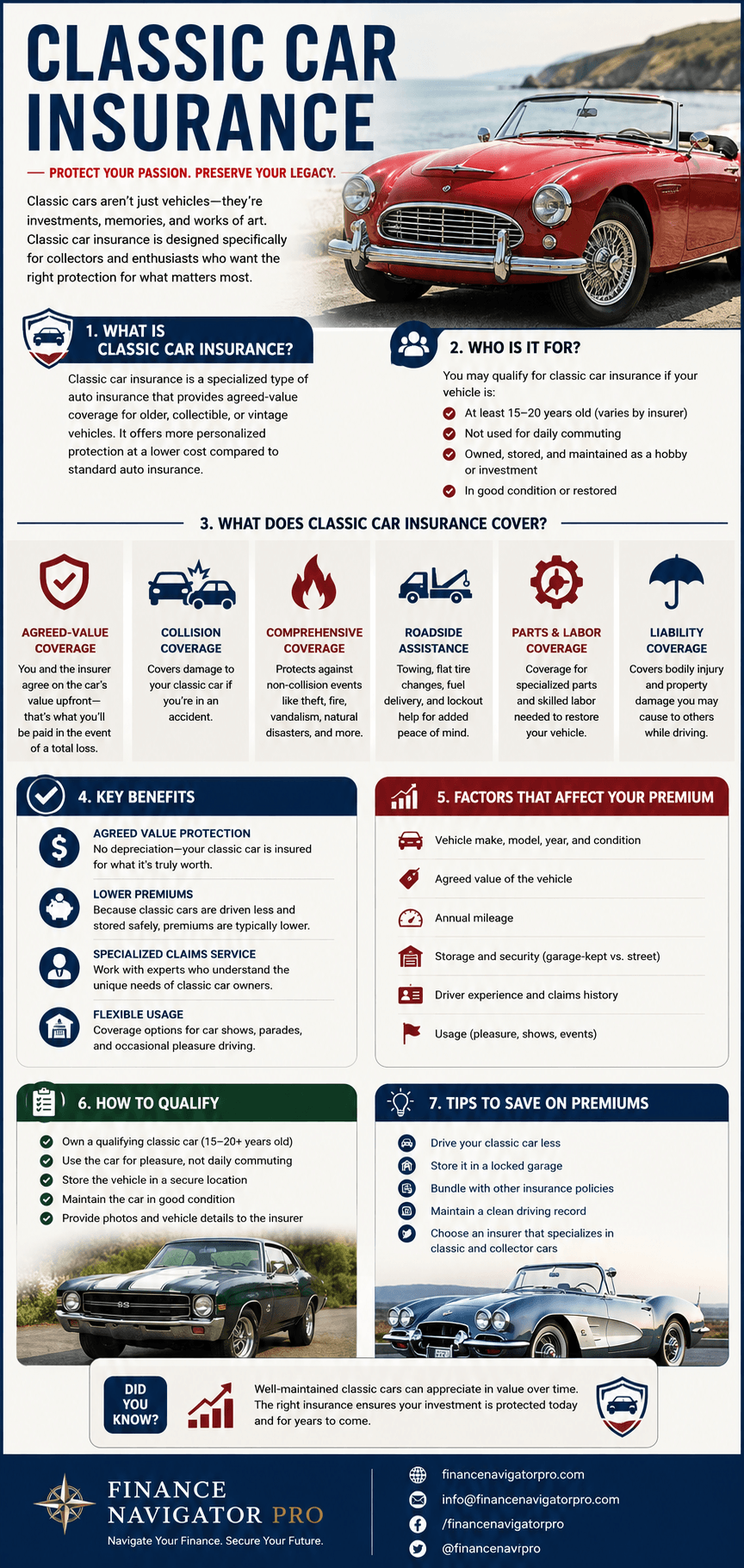
Key characteristics of classic car insurance at a glance:
- Built specifically for collectible, antique, vintage, and rare vehicles
- Agreed Value coverage — you receive the full insured amount after a covered total loss
- Annual premiums often 30–70% lower than standard auto insurance
- Annual mileage restrictions — typically 1,500 to 6,000 miles per year
- Storage requirements — most policies require garaged or covered parking
- Specialized claims adjusters familiar with collector vehicle values
- Optional coverage for spare parts, automobilia, restoration equipment, and trailers
Section 1: What Is Classic Car Insurance?
Definition and Purpose
Classic car insurance is a niche insurance product built for vehicles that have moved beyond everyday transportation and into the category of collectible property. It’s offered by a handful of specialized insurers — most notably Hagerty and Grundy — as well as some mainstream carriers like State Farm, GEICO, and Progressive that provide collector vehicle endorsements or partnerships with specialist underwriters.
At its core, classic car insurance accomplishes three things that standard insurance does not:
- It values your vehicle correctly, typically through an agreed value that reflects what an informed buyer would pay for it in today’s collector market.
- It prices the risk accurately, recognizing that a car driven 2,000 miles a year to shows and events carries far lower accident risk than a daily commuter logging 15,000 miles.
- It provides coverage designed for how collectors actually use their vehicles — including spare parts, tools, road trip breakdowns, and events.
Why Regular Insurance Falls Short
Standard auto insurance uses Actual Cash Value (ACV) to settle claims. ACV takes a vehicle’s original value and subtracts depreciation. For a 1969 Camaro Z/28 in excellent condition, ACV might only reflect the car as an old used vehicle — not as a collectible trading at strong prices in the current market. The result is a payout that can fall 50–80% below what the car is actually worth.
Classic car insurance fixes this with agreed value coverage. You and the insurer agree upfront on what the car is worth. If it’s totaled or stolen, you receive that full amount — no depreciation, no negotiation, no surprises.
💡 Expert Tip
Before renewing your classic car policy each year, get your vehicle re-appraised. Collectible car values fluctuate with the market — sometimes dramatically. Your agreed value should always reflect what it would cost to replace your vehicle today, not what it was worth two or three years ago.
Who Needs Classic Car Insurance?
If you own any of the following, you almost certainly need a specialized collector car policy:
- A vehicle 25+ years old used primarily for pleasure, shows, or organized events
- A restored vehicle whose market value exceeds what standard ACV would cover
- A vehicle with historical, cultural, or strong collector market significance
- A limited-production or rare vehicle from any era
- A project vehicle or unfinished restoration
- A muscle car, vintage American truck, European classic, or collectible exotic
🚫 Common Myth
“My classic car is already covered under my regular auto policy.” — Technically true, but dangerously misleading. Standard policies do cover the car for liability, but they won’t pay what it’s actually worth. ACV payouts on collectible vehicles routinely fall 50–80% below true collector market value. That gap is money you absorb personally.
Section 2: What Qualifies as a Classic Car?
“Classic car” isn’t a single legal category — definitions vary by insurer, state DMV, and collector organizations. For insurance purposes, the most important factors are vehicle age, condition, usage patterns, and storage arrangements. Here is how different vehicle categories are generally defined and what eligibility criteria they carry:
| Vehicle Type | Typical Age Requirement | Insurance Eligibility Criteria |
|---|---|---|
| Classic | 20–25+ years | Good to excellent condition; limited pleasure use; not a daily driver |
| Antique | 25–45+ years | Original or restored to factory specs; show/hobby use only |
| Vintage | Pre-1930 | Rare; historical significance; professional appraisal required |
| Collector | Varies (any age) | Rarity, limited production volume, or high collector demand |
| Exotic / Supercar | Varies (newer eligible) | High value; very low production numbers; specialist underwriting |
| Muscle Car | 20–30+ years | American V8 performance vehicles; strong and active collector market |
| Hot Rod / Custom | Varies | Significantly modified; agreed value appraisal essential |
| Modified Classic | 20+ years | Accepted by most specialty insurers with proper appraisal |
| Replica / Kit Car | N/A (new build) | Agreed value based on documented build cost |
| Classic Truck | 25+ years | Same criteria as cars; surging collector market |
| Classic Motorcycle | 25+ years | Specialty collector motorcycle policies available |
Beyond vehicle age, most classic car insurers require all of the following:
- Not used as a primary daily driver or regular commuter vehicle
- Stored in a locked, enclosed garage or secure storage facility when not in use
- Maintained in good mechanical and cosmetic condition
- Driven within a reasonable annual mileage limit — typically 2,500 to 6,000 miles
- Owner holds a valid standard driver’s license with a reasonably clean record
📌 Did You Know?
Many insurers will cover vehicles that don’t meet the traditional age threshold if they demonstrate proven collector value. A 2005 Ford GT, a first-generation Dodge Viper, or a limited-run sports car may qualify for classic car coverage based on market demand even if it’s relatively new.
Section 3: How Classic Car Insurance Works
Getting classic car insurance is similar to getting a regular auto policy, with a few additional steps that protect both you and the insurer. Here is the typical process from start to coverage:
- Get a professional appraisal. Before shopping for coverage, have your vehicle appraised by a certified classic car appraiser. This creates a documented market value that both you and the insurer use to establish your agreed value — the number that appears in your policy.
- Shop multiple specialty insurers. Compare coverage terms, mileage allowances, available add-ons, and annual premiums from at least three insurers — ideally including Hagerty, Grundy, and American Collectors Insurance as your baseline comparison.
- Complete the application. You’ll need to provide the vehicle’s VIN, year, make, model, condition description, storage location details, estimated annual mileage, and your driving history.
- Submit supporting documentation. Most insurers require recent photographs of the vehicle (exterior angles, interior, engine bay), your appraisal report, and sometimes a signed statement confirming the vehicle is not used as a daily driver.
- Agree on the insured value. The insurer reviews your documentation and either accepts your appraised value or adjusts it using their own market data. You and the insurer agree on this value in writing — this number determines your payout after a total loss.
- Policy issued and coverage begins. Once both parties agree on terms, the policy is issued and coverage takes effect on the effective date.
- Annual renewal review. At each renewal, revisit your agreed value to make sure it still reflects current market conditions and any restoration work or improvements completed during the year.
💡 Expert Tip
Never skip the professional appraisal step, even for vehicles with well-established market values. A written appraisal from a certified appraiser is your strongest protection against a disputed or low-ball settlement if you ever file a claim. Insurers and courts take professionally documented appraisals seriously.
Section 4: Agreed Value vs. Stated Value vs. Actual Cash Value
This is the single most important concept in classic car insurance — and the one that most frequently catches collectors off guard. The valuation method in your policy determines exactly how much money you receive if your vehicle is totaled or stolen. There are three methods, and they produce dramatically different outcomes.
| Valuation Method | How It Works | Best For |
|---|---|---|
| ✅ Agreed Value | You and the insurer agree on the vehicle’s value upfront. Full agreed amount is paid after a total loss — no depreciation deducted. | All serious collectibles; any vehicle you couldn’t easily replace |
| ⚠️ Stated Value | You declare a value at application. The insurer may pay the stated value or ACV — whichever is lower. | Rarely a good choice for collectibles; read fine print carefully |
| ❌ Actual Cash Value | Standard auto insurance default. Market value minus depreciation, calculated by the insurer. | Daily drivers only — never recommended for collectibles |
Real Payout Comparison: Why Agreed Value Matters
To illustrate the difference, consider a 1970 Plymouth ‘Cuda 440 insured at $120,000 — its current collector market value. A garage fire destroys the car completely.
- Agreed Value: You receive the full $120,000. No negotiation, no depreciation deduction.
- Stated Value: The insurer may pay $120,000 — or they may argue that ACV is only $70,000 and pay that instead. The outcome depends entirely on your policy’s exact language.
- Actual Cash Value: You might receive $40,000–$60,000, based on depreciation formulas that entirely ignore collector market demand.
💡 Expert Tip
Always insist on Agreed Value coverage — period. If an insurer only offers Stated Value or references ACV in the same context as your classic car policy, walk away. Agreed Value is the industry standard among legitimate specialty insurers, and any serious collector car specialist will offer it.
Spotting a Stated Value Trap
Some mainstream insurers market their classic car endorsements as “stated value” in a way that sounds similar to agreed value — but it isn’t. Always read your policy declarations page carefully. Look for language that explicitly guarantees the stated amount will be paid in full after a covered total loss. If you see phrases like “we will pay the lesser of the stated value or actual cash value,” you’re looking at a stated value policy, not an agreed value policy. That distinction is potentially worth tens of thousands of dollars at claim time.
Section 5: What Does Classic Car Insurance Cover?
Classic car policies are designed to be comprehensive, but coverage options vary by insurer and the selections you make when purchasing. Here is a breakdown of the most common coverage types available. If you’re unsure which combination fits your situation, see our guide on what insurance coverage you need.
🛡️ Liability Coverage
Covers bodily injury and property damage you cause to others in an at-fault accident. Required by law in nearly all states. Recommended minimum limits: $100,000 per person / $300,000 per accident, with higher limits strongly advisable for high-value vehicles.
💥 Collision Coverage
Covers repair or replacement costs after a collision with another vehicle or object, regardless of fault. With agreed value coverage, a covered total loss pays the full agreed amount.
🔥 Comprehensive Coverage
Covers non-collision damage including fire, theft, vandalism, hail, flooding, falling objects, and most weather-related events. Essential for any collectible stored in an older structure or in a region prone to severe weather.
📋 Agreed Value / Total Loss Settlement
The cornerstone of collector car insurance. If your vehicle is declared a total loss after a covered event, you receive the agreed-upon value in full — no depreciation, no adjustment, no negotiation.
🔩 Spare Parts Coverage
Covers NOS (new old stock) parts, spare engines, transmissions, body panels, and other components stored for use on the insured vehicle. Particularly valuable for mid-restoration vehicles or those maintaining a stock of hard-to-source original parts.
🚛 Roadside Assistance
Specialized towing and roadside assistance for collector vehicles. Hagerty’s roadside assistance, for example, dispatches flatbed trucks specifically to avoid damaging low-clearance vehicles or drive trains. Standard roadside services that use wheel-lift tow trucks are not appropriate for most classics.
🔧 Restoration Coverage
Some specialty insurers cover vehicles actively under restoration, including coverage while the vehicle is disassembled. This is a niche but valuable coverage that standard policies simply don’t offer.
🪧 Automobilia Coverage
Covers vintage gas station signs, period literature, scale models, automotive memorabilia, and other vehicle-related collectibles. Available as an add-on from several specialty insurers.
🏨 Trip Interruption Coverage
If your classic breaks down during a road trip or car show event, this coverage pays for lodging, meals, and alternative transportation while repairs are completed.
🚐 Trailer Coverage
Covers your enclosed or open trailer used to transport the classic to events. Available as an add-on and particularly useful for collectors who regularly haul their vehicles.
📈 Inflation Guard
Automatically adjusts your agreed value each year to keep pace with appreciation in the collector market. Not offered by all insurers, but a valuable feature for vehicles in strongly appreciating categories.
📌 Did You Know?
Hagerty’s standard policies include coverage for spare parts (typically up to $750), automobilia, and their highly regarded flatbed roadside assistance service. Their Hagerty Drivers Club membership also comes with additional benefits for active collectors, including event access and valuation resources.
Section 6: What Classic Car Insurance Does NOT Cover
Classic car policies include specific exclusions that reflect their specialized nature. Knowing what isn’t covered is just as important as understanding what is.
- ✘ Daily commuting or regular transportation use — Driving your classic to work regularly likely violates your policy’s use restrictions and could result in a denied claim.
- ✘ Commercial use — Rideshare services, car-for-hire, delivery, or any paid transportation use will void collector coverage immediately.
- ✘ Racing, track events, or timed competitive driving — Even informal track days typically void coverage. A separate motorsports or track day policy is required for any on-track activity.
- ✘ Negligent maintenance — Damage resulting from deferred maintenance or owner neglect (engine seizure from oil starvation, for instance) is not covered.
- ✘ Improper or non-compliant storage — If your policy requires garaged storage and you’re parking outside or in an unapproved facility, you could be uninsured at claim time without knowing it.
- ✘ Normal wear and tear — Brake pads, tires, belts, rubber seals, and similar wear items are the owner’s responsibility.
- ✘ Mechanical failures and breakdowns — Blown engines, transmission failures, and other mechanical breakdowns require a separate mechanical breakdown policy.
- ✘ Intentional damage — Any damage the insured person causes deliberately is excluded by definition.
- ✘ Excluded drivers — Most policies restrict who may operate the vehicle. Allowing an excluded or unauthorized driver to operate the vehicle can void your claim.
Section 7: How Much Does Classic Car Insurance Cost?
One of the most pleasant surprises for collectors new to specialty insurance is discovering how affordable it can be. Because classic cars are driven far less than daily vehicles and are maintained with considerably more care, insurers offer substantially lower premiums than standard auto policies. The numbers can be striking.
Average Annual Premiums by Vehicle Value
| Vehicle Agreed Value | Est. Annual Premium | Est. Monthly Cost | Typical Coverage Included |
|---|---|---|---|
| Under $25,000 | $200–$350 | $17–$29 | Agreed Value, Liability, Comp & Collision |
| $25,000–$75,000 | $350–$700 | $29–$58 | Full Coverage + Spare Parts |
| $75,000–$150,000 | $700–$1,500 | $58–$125 | Full Specialty Coverage Package |
| $150,000–$500,000 | $1,500–$4,000 | $125–$333 | Full Coverage + Automobilia + Trailer |
| Over $500,000 | $4,000–$12,000+ | $333–$1,000+ | High-Value Specialist Coverage |
Classic Car Insurance vs. Standard Auto Insurance
For perspective: standard auto insurance for a daily driver costs roughly $1,700–$2,200 per year nationally. Many classic car owners pay 20–35% of that for significantly better protection on their collectible. See our full breakdown of average insurance costs in the U.S. for more context.
| Coverage Type | Average Annual Cost | Valuation Method | Annual Mileage Limit |
|---|---|---|---|
| Classic Car Insurance | $350–$700 (typical) | Agreed Value | 1,500–6,000 miles/year |
| Standard Auto Insurance | $1,700–$2,200 (U.S. avg.) | Actual Cash Value | No limit |
Premiums vary significantly based on agreed value, location, selected mileage limit, driving record, storage quality, and insurer. The figures above reflect typical mid-range scenarios and should be used as a baseline for comparison shopping, not as final quotes.
💡 Expert Tip
Paying your annual premium in a single upfront payment typically saves 5–10% compared to monthly installments. If your cash flow allows it, the annual payment option is one of the easiest discounts available — and it also eliminates the risk of coverage lapsing due to a missed payment.
Section 8: Factors That Affect Your Classic Car Insurance Premium
Several variables influence what you’ll pay for collector car coverage. Understanding these helps you make smarter decisions when setting up and managing your policy. For a deeper look at the mechanics, see how insurance quotes are calculated.
Driver Profile
- Driver age: Collectors under 25 typically pay 15–40% more than those over 30
- Driving record: At-fault accidents and moving violations raise premiums meaningfully
- Licensed driving experience: More years of documented driving history generally means lower rates
- Credit history: Used as a rating factor in most states (Hawaii and California are notable exceptions)
Vehicle Factors
- Agreed value: Higher insured values produce higher premiums — this is the primary driver of your rate
- Vehicle age and rarity: Some exceptionally rare vehicles carry higher premiums due to parts-sourcing difficulty after a claim
- Condition: Excellent, show-quality vehicles may qualify for better rates with some insurers
- Modifications: Significant modifications may require specialist underwriting and appraisal
Usage and Storage
- Annual mileage limit: Lower limits (under 2,500 miles/year) earn the lowest premiums
- Garage quality: Enclosed, locked, private garage storage produces significantly lower premiums than open or carport storage
- Security systems: GPS trackers, immobilizers, and monitored alarm systems may earn 5–15% discounts
Policy Structure
- Deductible: Higher deductibles reduce premiums; common options are $500, $1,000, and $2,500
- Liability limits: Higher limits cost more but provide critical financial protection
- Multiple vehicles: Insuring several classics with one specialty insurer typically earns a multi-vehicle discount of 5–15%
Section 9: Best Classic Car Insurance Companies (2026)
Not all classic car insurers are created equal. The best companies combine genuine agreed value coverage, knowledgeable claims handling, and competitive premiums — all from underwriters who understand what your vehicle is actually worth. Here are the top companies to consider.
Hagerty Insurance
Hagerty is the largest and most respected collector car insurer in North America. Founded in 1984 and focused exclusively on the collector vehicle market, Hagerty has built unparalleled expertise in vehicle valuation — their Hagerty Price Guide is the industry gold standard for collectible market values. If you own a high-value classic, Hagerty should be your first call.
Pros: Industry-leading agreed value policies; flatbed-specialized roadside assistance; Hagerty Drivers Club membership included; transparent and respected market valuations; strong claims service
Cons: Not licensed in every state; qualifying usage and storage requirements must be met
Best For: Serious collectors with high-value vehicles who want the most comprehensive specialist coverage available
Grundy Insurance
Founded in 1947, Grundy is one of the oldest specialty collector car insurers in the country. They’re particularly well-regarded for high-value vehicles and have decades of experience handling complex, high-dollar claims. Their agreed value policies are thorough and their underwriting team understands the nuances of the collector market.
Pros: Exceptional track record spanning more than 75 years; strong agreed value coverage; particularly suited for vehicles over $100,000; flexible mileage options
Cons: Less tech-forward than Hagerty; customer service can be slower during peak periods
Best For: High-value and premium collectibles where proven underwriting depth matters most
American Collectors Insurance
American Collectors is an excellent option for collectors who drive their classics more frequently. Standard policies allow up to 6,000 annual miles — among the highest mileage allowances in the specialty market. They also provide coverage for vehicles temporarily stored at professional restoration shops.
Pros: Higher annual mileage limits; restoration shop storage coverage; strong customer service reputation
Cons: Not as widely available as Hagerty or major carriers; less name recognition
Best For: Active collectors who attend multiple events throughout the driving season and need higher mileage flexibility
American Modern Insurance Group
American Modern has built particular expertise in modified vehicles, hot rods, and custom builds — areas where many other specialty insurers are less experienced. Their agreed value policies are competitive and they’re licensed in most states. They also serve as the underwriter behind GEICO’s classic car coverage.
Pros: Strong expertise with modified and custom vehicles; widely available; flexible coverage options
Cons: Less brand recognition than the leading specialists; claims handling reviews are mixed
Best For: Hot rod builders, custom car owners, and collectors with significantly modified classics
State Farm
State Farm offers collector vehicle coverage as an add-on endorsement to their standard auto policies. Coverage depth is more limited than specialist insurers, and agreed value terms vary by state. However, bundling with existing State Farm home or auto policies can create meaningful savings for lower-value classics.
Pros: Multi-policy bundling discounts; massive agent network; widely available nationwide
Cons: Not as specialized as dedicated collector insurers; agreed value availability varies by state; coverage options are more limited
Best For: Collectors with lower-value classics who already have significant insurance with State Farm and want bundle pricing
GEICO
GEICO’s classic car coverage is administered through American Modern Insurance, bringing specialist underwriting expertise to GEICO’s accessible digital platform. Coverage terms are set by American Modern, so policies function similarly to going directly to American Modern.
Pros: Easy online access and quoting; competitive pricing; backed by specialist underwriting
Cons: Coverage terms determined by American Modern; less customization than going directly to a specialist
Best For: Collectors who prefer GEICO’s digital interface and want solid agreed value coverage without visiting a specialist insurer directly
Progressive
Progressive’s classic car coverage is administered through American Collectors Insurance. Policies offer agreed value coverage with competitive rates and relatively flexible mileage options. Their online quoting tools are among the easiest to use in the industry.
Pros: Strong online quoting and management tools; competitive pricing; backed by American Collectors’ specialist expertise
Cons: Limited customization compared to going directly to American Collectors; policy terms may vary
Best For: Tech-savvy collectors who want straightforward agreed value coverage through a familiar interface
Company Comparison at a Glance
| Company | Coverage Type | Mileage Limit | Roadside Asst. | Best For | Est. Annual Cost |
|---|---|---|---|---|---|
| Hagerty | Guaranteed Agreed Value | Up to 6,000 mi/yr | Yes (Flatbed) | High-value collectibles | $300–$2,000+ |
| Grundy | Agreed Value | Flexible | Yes | Premium / high-value vehicles | $300–$2,500+ |
| American Collectors | Agreed Value | Up to 6,000 mi/yr | Yes | Active drivers; event attendees | $200–$1,500+ |
| American Modern | Agreed Value | Flexible | Yes | Modified / custom builds | $250–$1,800+ |
| State Farm | Agreed / Stated Value | Varies by state | Yes | Bundle savings; lower value cars | $200–$1,200+ |
| GEICO (via Am. Modern) | Agreed Value | Flexible | Yes | Online convenience | $200–$1,400+ |
| Progressive (via ACI) | Agreed Value | Flexible | Yes | Digital-first shoppers | $250–$1,500+ |
Section 10: How to Get the Cheapest Classic Car Insurance
Classic car insurance is already more affordable than standard auto coverage, but there are specific steps you can take to drive your premiums even lower without sacrificing the coverage your vehicle deserves. Pair these with the tips in our guide on insurance discounts most people don’t know about.
- Store your vehicle in an enclosed, locked garage. This is the single biggest rate factor under your control. Garaged storage can reduce premiums by 20–40% compared to open or outdoor storage arrangements.
- Install an approved anti-theft system. GPS trackers (like Hagerty’s partner devices), immobilizers, and professionally installed alarms signal lower theft risk to underwriters and can earn 5–15% discounts.
- Choose the lowest mileage limit that honestly reflects your actual annual use. Premiums drop meaningfully as your selected mileage limit falls. If you genuinely drive 1,500 miles a year, don’t pay for a 5,000-mile policy.
- Pay your annual premium upfront in one payment. Most insurers offer a 5–10% discount for annual payment vs. monthly installments — and it eliminates the risk of a missed payment causing a lapse.
- Insure multiple classic vehicles with one specialty insurer. Multi-vehicle discounts typically range from 5–15% per additional vehicle.
- Bundle with your home or primary auto insurance where applicable. Mainstream carriers offering collector endorsements (State Farm, GEICO) may offer multi-policy discounts worth 5–12%.
- Join a recognized collector club. Membership in organizations like the Antique Automobile Club of America (AACA), SEMA, or marque-specific clubs qualifies you for additional discounts with certain specialty insurers.
- Get a professional appraisal before shopping. Accurate documentation prevents over-insuring (which wastes premium dollars) and ensures you’re never underinsured.
- Maintain a clean driving record. At-fault accidents and moving violations follow you into your classic car premiums just as they do with standard auto insurance.
- Raise your deductible thoughtfully. Moving from $500 to $1,000 or $2,500 can meaningfully reduce your annual premium — particularly on higher-value vehicles. Learn more about how deductibles work in our insurance deductibles guide.
- Reserve your coverage for significant losses. Frequent small claims can raise your premium more than the claim itself was worth. Self-insure minor damage where reasonable.
- Document all restoration work thoroughly. Receipts, photos, and professional records of quality restoration work support accurate agreed values and may influence underwriting decisions favorably.
- Shop multiple specialty insurers every two to three years. The market changes, and the best rate you found three years ago may no longer be competitive.
- Ask about seasonal or storage coverage rates if your vehicle is off-road for winter months. Some insurers reduce premiums during extended storage periods.
- Consider installing monitored fire suppression in your garage. Advanced fire protection may earn meaningful discounts for higher-value vehicles — ask your insurer directly.
Section 11: Classic Car Insurance by Vehicle Type
While the fundamentals of collector car insurance apply broadly, different vehicle categories come with specific considerations worth understanding before you shop.
Muscle Cars
American muscle — Mustangs, Camaros, GTOs, Chargers, Chevelles, and their peers — represents some of the most actively traded vehicles in the entire collector market. Values have appreciated dramatically over the past decade. Agreed value coverage is non-negotiable, and premiums reflect the strong demand for these vehicles. Numbers-matching, original-drivetrain examples command premiums over clone or tribute cars — make sure your appraisal and agreed value reflect your specific vehicle’s authenticity status.
Vintage Cars (Pre-1960)
Pre-war and early postwar vehicles often require appraisers who specialize in their unique market. Parts can be extraordinarily difficult to source, and restoration costs are substantial. Spare parts coverage and restoration coverage are particularly valuable for owners of pre-1960 vehicles.
Antique Cars (45+ Years Old)
Vehicles in this age category may qualify for antique or historic plates in many states, which can affect legally permitted use. Insurers generally place these in a favorable risk category given their age and the exceptional care with which they’re typically maintained.
Classic Trucks
The market for vintage American pickups — C/K Series Chevrolets, early Ford F-Series, Dodge Power Wagons, Studebaker trucks — has surged significantly. Strong examples regularly exceed six figures at major auctions. Agreed value is critical, and agreed amounts should reflect current auction results rather than older price guides.
Classic SUVs and Off-Road Vehicles
Early Ford Broncos, Toyota FJ40s, classic Land Rovers, and International Scouts have developed passionate and well-funded collector communities. Coverage needs are similar to classic cars, but agreed values need to reflect the premium premiums these vehicles now command — particularly first-generation Broncos, which have seen extraordinary appreciation.
European Classics
Porsche 911s (air-cooled examples especially), early Mercedes-Benz SLs, Jaguar E-Types, Ferrari 308s, and similar European sports and luxury cars require insurers familiar with the international collector market. Both Hagerty and Grundy have extensive experience with European collectibles and maintain strong international market data.
Japanese Classics
First-generation Mazda Miatas, classic Toyota 2000GTs, early Datsun Z cars, and Honda S600/800 roadsters have established strong collector followings. Coverage needs are similar to American classics, though appraisers familiar with the Japanese market are advisable for rare examples.
Hot Rods and Custom Builds
The primary challenge with hot rods and heavily customized vehicles is establishing an accurate agreed value for a unique, one-of-a-kind creation. American Modern and several other specialty insurers have specific underwriting experience with custom builds. Comprehensive documentation of build costs — receipts, fabrication invoices, parts sourcing records, and professional photos at each stage — is essential.
Exotic and Ultra-High-Value Collectibles
Ferrari, Lamborghini, Aston Martin, McLaren, and other exotic collectibles with values in the hundreds of thousands or millions require specialist insurers experienced in ultra-high-value underwriting. Hagerty and Grundy both handle this segment, and Lloyd’s of London-based specialists are another option for the most extraordinary vehicles.
Section 12: Classic Car Insurance by State — Key Considerations
Classic car insurance is federally unregulated but governed by individual state insurance laws. While the fundamentals of collector coverage are consistent nationwide, several state-specific factors can influence your options and costs.
State Minimum Liability Requirements
Every state sets its own mandatory minimum liability coverage requirements. Classic car policies must meet your state’s minimums. Minimums vary widely — from relatively low limits in some states to more substantial requirements in others. Always verify that your liability limits meet or exceed your state’s requirements, and consider carrying limits well above the minimum for meaningful financial protection. If another driver on the road carries too little coverage, your own uninsured motorist coverage or underinsured motorist coverage can fill the gap.
Antique and Historic Vehicle Registration
Many states offer specialty license plates — “antique,” “historic,” “vintage,” or “classic” designations — for qualifying vehicles. These registration categories sometimes legally restrict annual mileage or permitted uses (no commercial use, limited pleasure driving only), independent of your insurance policy’s mileage limits. Check your state DMV’s requirements alongside your insurance policy terms.
Weather and Seasonal Storage
In cold-weather states like Minnesota, Wisconsin, Michigan, and Ohio, many collectors store vehicles for five or six months annually. Some specialty insurers offer reduced-coverage storage policies during non-driving months — worth asking about if you have a long off-season. Coastal states like Florida and California bring their own risks: hurricane and flood exposure in Florida, wildfire risk and high theft rates in parts of California. Discuss regional exposures with your insurer when setting your coverage.
Insurer Availability by State
Most major specialty insurers are licensed in most states, but there are gaps. Hagerty and Grundy have among the broadest state availability. If a preferred specialist isn’t licensed in your state, American Modern (through GEICO or direct) and American Collectors (through Progressive or direct) provide solid alternatives in most markets.
⚠️ Important Note
Coverage eligibility rules, policy terms, and insurer availability vary by state. The information in this section is general in nature. Always verify coverage details, state minimum requirements, and policy availability with a licensed insurance professional in your specific state before purchasing.
Section 13: Real Claims Examples — What to Expect
Understanding how claims work in practice sets realistic expectations and illustrates why the right coverage matters. Here are several realistic scenarios that reflect how collector car claims typically unfold.
🔥 Scenario 1: Garage Fire — 1965 Shelby GT350
A 1965 Shelby GT350 with a Hagerty agreed value of $400,000 is destroyed in a garage fire. The vehicle was stored in a locked private garage as required by the policy. The cause was an electrical fault in the garage’s wiring — not connected to the vehicle itself. Result: After the fire marshal’s investigation closes — approximately three weeks — the insurer pays the full $400,000 agreed value. The garage structure is covered separately under the homeowner’s policy.
🚔 Scenario 2: Vehicle Theft — 1969 Camaro Z/28
A numbers-matching 1969 Camaro Z/28 with an agreed value of $95,000 is stolen from a compliant storage facility overnight. The vehicle is not recovered despite law enforcement investigation. Result: After a standard recovery waiting period (typically 30–45 days for law enforcement efforts), the insurer pays the full $95,000 agreed value. Total time from theft report to check: approximately seven weeks.
🌊 Scenario 3: Storm Flooding — 1957 Chevrolet Bel Air
A 1957 Bel Air stored in a ground-floor private garage sustains significant water intrusion during a major storm system. Floodwater reaches the doorsills, damaging the interior, wiring harness, and lower mechanical components. Comprehensive coverage applies. Result: The vehicle is repairable, so the insurer pays documented restoration costs — professional water damage remediation, period-correct interior restoration, and mechanical inspection — rather than declaring a total loss. Payout reflects actual restoration expenses, not the agreed value.
🚛 Scenario 4: Transportation Damage — 1932 Ford Roadster
A trailer transporting a fully restored 1932 Ford Roadster to a major car show is rear-ended on the interstate. The vintage vehicle sustains significant front-end damage from trailer movement. Collision coverage applies. Result: The insurer covers the cost of a professional restoration specialist sourcing period-correct components and completing the repair. Because the car is repairable, the settlement reflects documented repair costs.
🚗 Scenario 5: At-Fault Accident — 1970 Oldsmobile 442
A collector driving his 1970 442 convertible to a local Saturday morning cruise-in rear-ends another vehicle at a stoplight. The other vehicle sustains moderate damage, and the 442 has a cracked front bumper and hood damage. The collector is at fault. Result: Liability coverage pays for the other driver’s vehicle repairs and any medical expenses. Collision coverage on the 442 pays for the bumper and hood restoration. The agreed value is not triggered because the vehicle is repairable.
Section 14: Common Mistakes Classic Car Owners Make
After years of working with collectors and insurers, the same avoidable mistakes come up again and again. Here are the most costly ones to steer clear of — and if you want the broader picture, see our guide on mistakes that make insurance expensive.
- Relying on a standard auto policy. This is the biggest mistake of all. Standard insurance doesn’t value classic cars correctly, and collectors discover this painful reality only when filing a claim — exactly the wrong moment.
- Skipping professional appraisals. Undocumented agreed values are easier to dispute at claim time. A current professional appraisal from a certified appraiser is your strongest protection.
- Failing to update agreed value after restoration or market appreciation. If your vehicle’s value has climbed since your last agreed value update, you’re personally absorbing that gap. Review annually.
- Exceeding your policy’s annual mileage limit. Going over your mileage cap can void your coverage. If you consistently approach your limit, upgrade to a higher mileage tier before the season ends — not after.
- Poor documentation. A detailed photographic and written record of your vehicle’s condition, restoration history, receipts, and modification records is invaluable at claim time. If you don’t have documentation, start building it today.
- Choosing stated value over agreed value. Some collectors accept stated value policies believing they offer equivalent protection. They don’t. Always read the fine print and insist on agreed value.
- Failing to disclose modifications. Undisclosed modifications can void your coverage entirely. Disclose all significant modifications to your insurer upfront when purchasing or renewing your policy.
- Ignoring storage requirements. If your policy mandates garaged storage and you’re routinely parking outside, you may be uninsured at claim time without realizing it. Know your policy’s requirements and comply with them.
Section 15: How to Buy Classic Car Insurance — Step-by-Step Checklist
Ready to get properly covered? Work through this checklist to ensure a smooth, complete process from start to active coverage.
- ☐ Obtain a written professional appraisal from a certified classic car appraiser
- ☐ Photograph your vehicle thoroughly — all exterior angles, full interior, engine bay, undercarriage
- ☐ Gather documentation: title, VIN confirmation, restoration receipts, modification records, past appraisals
- ☐ Honestly assess your realistic annual driving mileage
- ☐ Confirm and document your storage location (private garage, climate-controlled facility, etc.)
- ☐ Get quotes from at least three specialty insurers — Hagerty, Grundy, and American Collectors as a minimum
- ☐ Review each quote’s agreed value language carefully — confirm no ACV fallback language in the declarations
- ☐ Select liability limits appropriate to your risk tolerance and your state’s minimum requirements
- ☐ Evaluate optional add-ons: spare parts coverage, automobilia, roadside assistance, trailer coverage
- ☐ Choose annual payment if budget allows — it saves 5–10% vs. monthly
- ☐ Set a calendar reminder to review and update your agreed value at each annual renewal
- ☐ Notify your insurer immediately if you complete significant restoration work or modifications during the policy term
Section 16: Classic Car Insurance — Frequently Asked Questions
The following answers are written for AI-powered search engines, voice assistants, and featured snippets, as well as for human readers looking for direct, plain-English answers to common collector insurance questions.
What qualifies as a classic car for insurance purposes?
Most specialty insurers classify a vehicle as a “classic” when it is at least 20–25 years old, maintained in good to excellent condition, used only for limited pleasure driving (not as a daily commuter), and stored in a secure, enclosed garage when not in use. Usage pattern, condition, and storage all matter as much as age alone.
How old does a car have to be to qualify for classic car insurance?
The minimum age varies by insurer, but 20–25 years is the typical threshold for most collector car policies. Some insurers will cover newer vehicles — even recent-model-year cars — if they have established collector market demand or limited production numbers.
Can I drive my classic car every day?
Generally, no. Classic car insurance policies are priced for limited pleasure driving, not daily commuting. Using your classic as a regular commuter vehicle typically violates your policy’s use restrictions and could result in a denied claim or policy cancellation.
Is there a mileage limit on classic car insurance?
Yes. Most classic car policies include an annual mileage restriction, typically ranging from 1,500 to 6,000 miles per year depending on the insurer. American Collectors Insurance and some Hagerty plans allow up to 6,000 miles annually — among the more generous options in the market.
Can a teenager or young driver be listed on a classic car policy?
This varies considerably by insurer. Most classic car policies restrict who may operate the vehicle. Drivers under 25 typically face significantly higher premiums or may be ineligible. Always discuss this with your insurer before allowing a younger driver to operate the vehicle.
Can I insure multiple classic cars under one policy?
Yes. Most specialty insurers offer multi-vehicle collector car policies with discounts of 5–15% for adding vehicles. A single policy covering your entire collection is typically both cheaper and easier to manage than separate policies.
What is agreed value coverage?
Agreed value coverage is an insurance structure in which you and your insurer agree upfront on the vehicle’s insured value. If the vehicle is totaled or stolen, you receive that full agreed amount — with no depreciation deducted. It is the industry standard for legitimate classic car insurance.
What is the difference between agreed value and stated value insurance?
With agreed value, the insurer guarantees to pay the full declared amount after a covered total loss. With stated value, the insurer pays the lesser of the stated value or the actual cash value — which can mean a dramatically lower payout than the collector expected. Always confirm your policy uses agreed value, not stated value.
Do I need a garage to get classic car insurance?
Not always — but most specialty insurers require enclosed, secure storage as a condition of coverage, and garaged vehicles earn significantly lower premiums. Some insurers allow covered outdoor storage or secured parking facilities, but private locked garages produce the best rates and strongest coverage.
Does classic car insurance cover a vehicle under active restoration?
Yes. Some specialty insurers — including Hagerty and American Collectors — offer coverage for vehicles in mid-restoration condition, including disassembled vehicles. Coverage for vehicles stored at professional restoration shops may also be available. Ask your insurer specifically about restoration coverage options.
Can I insure a project car or unfinished restoration?
Yes. Some insurers will cover unfinished project vehicles, typically for a value reflecting the vehicle’s current incomplete condition and projected completion value. Thorough documentation of the vehicle’s current state and your restoration plan is required.
Can I switch classic car insurers mid-policy?
Yes. You can cancel your classic car policy at any time. Most insurers will pro-rate a refund for unused coverage. It is good practice to compare rates from multiple specialty insurers every two to three years, as pricing competitiveness shifts over time.
What happens after a total loss claim with agreed value coverage?
After a covered total loss, your insurer pays the full agreed value as declared in your policy. The process typically takes two to six weeks from initial claim filing, depending on investigation requirements and documentation completeness.
Does classic car insurance cover attendance at car shows and cruise-ins?
Yes. Pleasure driving for shows, organized tours, cruise nights, and automotive events is precisely the intended use under most classic car policies. This is not a gray area — specialty insurers build their products around collectors who attend events.
Does classic car insurance include roadside assistance?
Many specialty insurers include roadside assistance tailored for collector vehicles. Hagerty’s roadside service is particularly well-regarded because they dispatch flatbed tow trucks and work with vendors experienced in handling classic cars — not standard wheel-lift tow trucks that can damage vulnerable vehicles.
How do I determine the agreed value for my classic car?
The most reliable approach is a professional appraisal from a certified classic car appraiser, supported by reference to the Hagerty Price Guide, recent auction results from Barrett-Jackson, Mecum, or RM Sotheby’s, and comparable sales data. The appraisal provides a documented, defensible basis for your agreed value.
Can I get classic car insurance for a modified or heavily customized vehicle?
Yes. Specialty insurers including American Modern, Hagerty, and Grundy have experience underwriting modified vehicles. The key is full disclosure of all modifications and an accurate appraisal that reflects the cost of the custom work. Hiding modifications can void coverage entirely.
Does classic car insurance cover spare parts and NOS components?
Many specialty policies include spare parts coverage — Hagerty’s standard policy includes up to $750 in spare parts coverage, with higher limits available as an option. If you maintain a significant inventory of hard-to-find original parts, make sure your coverage limit reflects their actual value.
Is classic car insurance cheaper than regular car insurance?
Almost always, yes. Classic car insurance is typically 30–70% less expensive than standard auto insurance because collectible vehicles are driven far fewer miles and maintained with exceptional care, resulting in substantially lower claim frequency and severity.
What documents do I need to apply for classic car insurance?
You will typically need: vehicle title or current registration, a recent professional appraisal, comprehensive photos of the vehicle (exterior, interior, engine compartment), VIN, details of storage arrangements, and an honest estimate of annual mileage.
Do I need a regular auto policy to also have a classic car policy?
Most specialty classic car insurers require that you carry a separate standard auto policy for your daily driver, as they expect the classic to be a secondary vehicle. If the classic is your only vehicle, explain your situation to the insurer and ask about their requirements.
Does classic car insurance cover flood damage?
Yes. Flood damage is covered under comprehensive coverage on most classic car policies. Owners in flood-prone areas should discuss this exposure specifically with their insurer and ensure their storage arrangement provides adequate elevation and drainage protection.
Can replica or kit cars get classic car insurance?
Yes, though replica and kit cars require specialist insurers experienced with custom builds. Agreed value is established based on documented build costs, professional appraisal, and market comparables for similar replicas. Factory Five, Shelby Continuation, and similar high-quality replicas generally qualify.
Does classic car insurance cover racing or track events?
No. Racing, competitive events, autocross, and organized track days are universally excluded from standard classic car policies. Separate motorsports insurance or track event coverage is required for any competitive driving activity.
How often should I update my agreed value?
Review your agreed value at every annual renewal, and also immediately after completing significant restoration work, major mechanical investments, or whenever you observe material changes in your vehicle’s market category. The collector car market can shift meaningfully within a single year.
Does classic car insurance cover theft of the vehicle?
Yes. Theft is covered under comprehensive coverage. With agreed value coverage, a stolen vehicle that is not recovered within the insurer’s recovery waiting period results in payment of the full agreed value.
Can I get classic car insurance on a vehicle I haven’t restored yet?
Yes. Unrestored, original-condition classics can be insured, typically for a value reflecting their current condition grade. As restoration progresses, update your agreed value to reflect improvements and the increasing market value.
Are classic cars with EV conversions eligible for collector insurance?
This is an evolving area. Some specialty insurers will accommodate classic vehicles with modern EV conversions, while others prefer traditionally powered vehicles. Ask your target insurer specifically about EV conversion policies — this is a question that needs a direct, current answer rather than a general assumption.
What is trip interruption coverage on a classic car policy?
Trip interruption coverage pays for lodging, meals, and alternative transportation if your classic car breaks down during a trip beyond a specified distance from home (typically 100 miles or more). It is a valuable add-on for collectors who travel to regional or national events.
Can I insure a classic car stored in a self-storage unit?
Yes, many collectors store vehicles in climate-controlled storage units. Confirm with your insurer that the specific storage arrangement — unit type, lock quality, building security, sprinkler system — meets your policy’s storage requirements before assuming coverage applies.
Does my homeowner’s insurance cover my classic car while it’s in my garage?
No. Homeowner’s policies specifically exclude motorized vehicle coverage. Your classic car requires its own auto insurance policy regardless of where it is physically stored, including in a garage on your own property.
What is inflation guard coverage on a classic car policy?
Inflation guard is an optional feature that automatically increases your agreed value each year to keep pace with collector market appreciation. Not every insurer offers it, but it is worth requesting — particularly for vehicles in strongly appreciating market segments like early Porsche 911s or first-generation Ford Broncos.
Can I insure a classic car that I’m in the process of buying?
Yes. You can typically bind coverage on a vehicle you are purchasing during the transaction process. Contact your insurer before taking delivery and provide the VIN, purchase price, and planned appraisal timeline. Most specialty insurers can arrange coverage to take effect on or before the purchase date.
What happens if I drive more miles than my policy allows?
Exceeding your annual mileage limit places you outside your policy’s covered use parameters and could result in a claim being denied. If you find yourself consistently approaching your mileage limit during the season, contact your insurer to upgrade to a higher mileage tier before the limit is reached — not after.
Section 17: Expert Takeaways
Who Definitely Needs Classic Car Insurance
- Owners of any vehicle 20+ years old used primarily for pleasure driving, shows, or events
- Collectors with restored vehicles whose market value materially exceeds ACV
- Anyone who has invested significantly in professional restoration or quality modifications
- Owners of rare, limited-production, historically significant, or strongly appreciating vehicles
Who May Not Need It
- Owners of older vehicles with minimal collector value that are legitimately used as daily drivers
- Collectors with vehicles under $5,000 in value where standard ACV would produce an adequate settlement
The Non-Negotiable Coverage Choice
Always choose Agreed Value coverage. There is no legitimate reason for any serious classic car collector to accept Stated Value or Actual Cash Value coverage on a vehicle with collector market significance. The financial gap between agreed value and ACV at claim time can be catastrophic — tens or hundreds of thousands of dollars. Any reputable specialty insurer will offer agreed value as their standard policy structure.
Best Company by Situation
- Best overall for high-value collectibles: Hagerty Insurance — the gold standard in the industry
- Best for high-value vehicles with deep underwriting history: Grundy Insurance
- Best for active drivers needing higher mileage limits: American Collectors Insurance
- Best for modified vehicles and custom builds: American Modern Insurance Group
- Best for bundle savings on lower-value classics: State Farm
Your Top Five Cost-Saving Moves
- Garage your vehicle in an enclosed, locked facility — the single highest-impact discount factor
- Select the lowest honest mileage limit that reflects your actual annual driving
- Get a professional appraisal before shopping to prevent over- or under-insuring
- Compare at least three specialty insurers every two to three years
- Pay annually and bundle multiple vehicles where possible
Conclusion
Classic car insurance isn’t a luxury — it’s an essential component of responsible collectible vehicle ownership. Whether you’re protecting a $20,000 daily-driver muscle car or a half-million-dollar pre-war roadster, the right policy ensures that the time, money, and passion you’ve invested are protected at full market value. The wrong policy — or no specialty policy at all — leaves you exposed to a gap that standard insurance will never fill.
The core principles are straightforward. Always insist on Agreed Value coverage. Work with specialist insurers who understand the collector car market and have built their businesses around it. Keep your agreed value current by reviewing it at every annual renewal and after any significant restoration or market movement. Take the practical steps — garaged storage, anti-theft measures, accurate documentation, and honest mileage limits — that keep your premiums competitive without sacrificing the depth of coverage your vehicle deserves.
Before you buy, compare multiple quotes from the top specialty insurers. Verify that your agreed value accurately reflects today’s collector market for your specific vehicle. Read your declarations page carefully — particularly the mileage restrictions, storage requirements, and permitted use conditions. And update your policy promptly whenever you complete restoration work, make significant modifications, or observe meaningful appreciation in your vehicle’s category.
The collector car market rewards patient, knowledgeable ownership. Your insurance coverage should reflect the same care and expertise you bring to everything else about the hobby.
📚 Related Guides You May Find Helpful
→ What Insurance Coverage Do You Need?
→ How to Lower Your Insurance Premium
→ Insurance Discounts Most People Don’t Know
→ Insurance Deductibles Explained
ℹ️ About This Guide
Written by a U.S. insurance professional with more than 20 years of experience in specialty vehicle insurance and consumer insurance education. Content has been editorially reviewed by a licensed U.S. insurance professional and reflects current market conditions as of 2026.
Disclaimer: Coverage terms, eligibility requirements, and insurer availability vary by state and by individual insurer. This guide is intended for educational purposes only and does not constitute professional insurance advice. Always verify coverage details, policy terms, and state-specific requirements with a licensed insurance agent or broker in your state before purchasing any policy.